Home Blog Page 4284

Appellate tax court grants 3M Philippines’ refund

CTA.JUDICIARY.GOV.PH

THE Court of Tax Appeals (CTA) has granted the appeal of 3M Philippines, Inc. to cancel P37.29 million of its deficiency taxes for the year 2014 and to refund P13.4 million from the same assessment it had paid in 2018.

In a 26-page decision dated Sept. 19, the CTA Special First Division said the firm was not liable to pay the taxes since the revenue officers who conducted the audit were not authorized through a letter of authority (LoA).

The officers were only assigned to assess 3M Philippines’ books of accounting through memorandums of assignment, which the tribunal said could not replace an LoA.

“Ergo, the absence thereof (of an LoA) taints the whole examination process and resultant tax assessments issued against petitioner (3M Philippines) covering said year (2014) with invalidity,” CTA Associate Justice Marian Ivy F. Reyes-Fajardo said in the ruling.

The commissioner of internal revenue (CIR) argued that the tax assessment had a legal basis and was discussed in depth in the assessment notices and letters of demand issued to the firm.

Under the Tax Code, only the CIR or his duly authorized representative may authorize an examination of a taxpayer’s tax liabilities. Revenue officers can only perform audits and assessments through a letter of authority issued by the CIR.

The tax court ordered the CIR to refund the P13.4 million, which was paid by the firm on April 20, 2018, since the taxes were illegally collected and were not appropriately audited.

The Bureau of Internal Revenue (BIR) and its agents were also barred from collecting 3M Philippines’ taxes for 2014.

The law defines illegally collected taxes as those collected without “statutory authority, or upon property not subject to taxation or by some officer [who] have no authority to levy the tax.”

The 2014 assessment covered the firm’s deficiency income tax, expanded withholding tax, withholding tax, final value-added tax, and accompanying penalties.

3M Philippines is the Philippine branch of an American multinational conglomerate engaged in the manufacturing and distribution of industrial products.

“Therefore, we declare the deficiency tax assessments covering the taxable year 2014 as void, for being a product of illegal audit and examination by respondent’s tax agents,” the tribunal said. — John Victor D. Ordoñez

Rice inventory declines in early June; corn stocks edge up

PHILSTAR FILE PHOTO

THE rice inventory declined 18.1% year on year, while that of corn rose 1.5% at the start of June, the Philippine Statistics Authority (PSA) said.

In a report, the PSA said that the rice inventory during the period was 1.82 million metric tons (MT), with holdings of households, commercial warehouses and the National Food Authority (NFA) all declining.

“As of June 1, about 48.7% of the total rice stocks were from the households, 46.6% were from the commercial sector, and 4.7% were from NFA depositories,” it said.

Household rice, dropped 15.7% to 885 thousand MT, while commercial warehouses held 848.11 thousand MT, 14.8% lower from a year earlier.

Rice held by the NFA amounted to 85.1 thousand MT, down 51.5% year on year.

On a month-on-month basis, the rice inventory fell 3.4% from May.

“Rice in the NFA depositories and household sector registered a monthly decrease of 15% and 11.0%, respectively… While (an) increment of 7.6% was noted in the rice stocks held by the commercial sector,” the PSA said.

Meanwhile, the PSA also said the corn inventory rose 1.5% year on year to 886.46 thousand MT during the period.

“Corn inventory in the household sector increased by 30.5%, while corn stocks from the commercial sector recorded an annual decline of 1.1%,” it said.

Corn held by commercial establishments was 791.96 thousand MT, accounting for 89.3% of the total.

Household corn, on the other hand, rose to 94.5 thousand MT, or 10.7% of the total.

Compared to a month earlier, the national corn inventory rose 32.6%.

“Corn stocks from the commercial and household sectors as of June 1 exhibited monthly growth of 35.4% and 12.9%, respectively,” the PSA said. — Adrian H. Halili

Developing the fashion industry by improving business skills

Young designers also get to show their style at PHx Station pop ups

YOU CAN make a dress, but can you sell it? A series of talks in November aims to equip fashion designers with business skills — just enough to get themselves launched worldwide.

The PHx Fashion Conference will be held on Nov. 17 to 19 at the Ayala Museum in Makati. The talks will include sessions and workshops about fashion business strategies. The conference will feature designer conversations, sessions on the best practices in the international fashion trade, a talk on brand identity and intellectual property, plus other topics intended to help fashion brands kick-start their journeys to adopting elevated standards.

Furthermore, PHx is also holding PHx Station, a three-month popup which introduces the clothes made by young designers Alexie Nethercott, Aire, Apara, Bagasáo, HaMu, Idyllic Summers, Jerome Lorico, Jill Lao, Jude Macasinag, Kelvin Morales, Le Ngok, Liliana Manahan, Neil Felipp, Nicolo, Novel, Randolf, and Renz Reyes, among others. PHx Station is also collaborating with fashion schools College of St. Benilde, iAcademy, and SoFA, wherein a fashion student selected from each school will have the opportunity to present their collections at each batch of PHx Station. PHX Station will run from October to January 2024 at Greenbelt 5.

Back to the conference: Paris-based Filipino-British designer Norman René de Vera will open it. Mr. De Vera, who started his global fashion journey at the London College of Fashion, previously worked with Celine, Louis Vuitton, Lanvin, Versace, and Calvin Klein. He is currently the design and image director for French legacy brand AZ Factory. Meanwhile, TFC Press founder Philippe Terrien and his wife, former fashion editor Giselle Go, will hold talks on business development and other related topics, considering collaborations TFC Press has done with brands like Dries Van Noten, Aesop, Carven, Emilio Pucci, and Courrèges (not to mention developing their own skincare line). Select participants will also have their portfolios assessed and reviewed by TFC Press.

Trickie Lopa, PHx co-founder, told BusinessWorld during the event’s press launch on Sept. 12 in Makati, “We realized that the whole point of the PHx group is really to propel these fledgling fashion labels to operate at a global standard,” she said.

On that note, creatives (like fashion designers) aren’t exactly known to be very good in business. Designer Seph Bagasao, also a co-founder of PHx, said, “It’s not very common for creatives to handle their business, but it will help to know the basics, and that’s something you impart to your team.”

PHx co-founder Esme Palaganas explained to BusinessWorld why they started the conferences (the first series was held in 2019, focusing on making it in Japan): “We felt like this kind of information we’re exchanging; it needs to be out there. We had our own struggles before.”

By developing more fashion designers, Ms. Palaganas hopes to create a more vibrant clothing ecosystem. “The Philippine fashion industry isn’t just defined by one name, or three names. To be an industry, you have to have a lot of names. That’s healthier for us.”

Follow www.facebook.com/phxfashionconference for more details on registration and other announcements. — Joseph L. Garcia

Fighting for our coral reefs

PHILIPPINE COAST GUARD/PHILSTAR GLOBAL

There were gushing descriptions and awesome pictures of bountiful marine life in the National Geographic magazine of May 12, 2022, that featured the coral reefs in the Philippines. Tubbataha Reefs, a national park and UNESCO World Heritage site in the center of the Sulu Sea, has been slowly revived after it was all but destroyed by blast fishing in the 1960s. But how can coral reefs be preserved at a time not just of increasing exploitation but also of human-driven changes in the very ocean itself, the magazine asks? Warming seas, acidifying seas, rising seas — these are the darker shadows that fall across the world’s coral reefs. The most diverse ecosystem in the ocean — a planetary feature for 240 million years — will start to disappear. “It is projected that by 2050 more than 90% of the global Coral Triangle’s reefs will be critically threatened by climate impacts,” the magazine warns.

All the gushing turns to dread for the severely exploited and damaged coral reefs. The West Philippine Sea has an estimated 4,640 km2 or 464,000 hectares of coral reef (based on the CARE-CaDRES Report 2019). The Philippines is believed to have the third largest reef area and the most diverse coral reefs in the world.

Why are coral reefs important? The US National Oceanic and Atmospheric Administration (NOAA) tells us that coral reefs are some of the most diverse ecosystems in the world. Because of the diversity of life found in the habitats created by corals, reefs are often called the “rainforests of the sea.” About 25% of the ocean’s fish depend on healthy coral reefs. Reef ecosystems can support more than 7,000 species of fish, invertebrates, plants, sea turtles, birds, and marine mammals.

“The Philippines is one of the world’s 18 mega-biodiverse countries — the archipelago contains two-thirds of the earth’s biodiversity and between 70% and 80% of the world’s plant and animal species. It is home to 505 coral species and 915 reef fish species. The country is the world’s third most coral-rich area after Indonesia and Australia” according to the Convention on Biological Diversity (bworldonline.com, June 29, 2018).

A square meter of a healthy coral reef produces one to five kilograms of white sand per year, making reefs an even more vital component of coastal tourism. And since coral reefs are natural wave breakers, they protect coastal communities from tidal waves, strong currents, and storm surges (philchm.ph). They protect coastlines from storms and erosion, provide jobs for local communities, and offer opportunities for recreation. They are also a source of food and new medicines. Over half a billion people depend on reefs for food, income, and protection. Fishing, diving, and snorkeling on and near reefs add hundreds of millions of dollars to local businesses. The net economic value of the world’s coral reefs is estimated to be nearly tens of billions of US dollars per year. These ecosystems are culturally important to indigenous people around the world (noaa.gov).

The Philippines is aware of the threats to its coral reef ecosystem, but more to protect its fisheries, the National Geographic article candidly says. If the corals die, fish will have no sanctuary wherein to spawn. Since the 1970s, community-managed marine protected areas (MPAs) have been set up as reserves (no-fishing areas) so as not to disturb and damage the coral ecosystem. Municipalities have jurisdiction over their coastal waters out to 15 kilometers and local fishermen freely enjoy the spill-over fish from the MPAs. Most of the Philippines’ more than 1,600 MPAs are small and locally managed, but enforcement is uneven according to the magazine’s evaluation. More than a million fishermen depend on the country’s coral reefs, but today 54% of the reefs are badly damaged (oceana.org, May 22, 2017).

PHILIPPINES-CHINA TENSIONS
The Philippines-China tensions in April 1992 were sparked by illegal fishing and damaging the reef-sanctuaries in the Philippines’ exclusive economic zone (EEZ). A Philippine Navy surveillance plane spotted eight Chinese fishing vessels anchored in the waters of the Scarborough Shoal. The Filipino inspection team that boarded the fishing ships claimed that they discovered illegally collected corals, giant clams, and live sharks. They attempted to arrest the Chinese fishermen but were blocked by Chinese maritime surveillance ships — it was a stand-off (Philippine Daily Inquirer, April 11, 2012).

Diplomatic protests were ignored by China and failed initial attempts at reciprocal fishing bans escalated with the stepped-up presence of Chinese fishing and patrol vessels in Scarborough Shoal. Chinese water cannons were focused on small Filipino fishing boats that slipped through the Chinese barriers, to fish for food more than for sale. And the Chinese continued to fish and poach coral in Scarborough Shoal.

On March 30, 2014, the Philippines submitted a case against China to the Permanent Court of Arbitration in The Hague over competing South China Sea claims, invoking the compulsory settlement of dispute clause under the Law of the Sea Convention.

China refused to participate in the arbitration, calling instead on bilateral negotiations to be used to resolve border disputes. Its refusal did not prevent the arbitral tribunal from proceeding with the case. On July 12, 2016, the Arbitral Tribunal in the South China Sea Arbitration (The Republic of the Philippines v. The People’s Republic of China) issued a unanimous award largely favorable to the Philippines.

The Tribunal ruled: “China has, through the operation of its official vessels at Scarborough Shoal from May 2012 onwards, unlawfully prevented Filipino fishermen from engaging in traditional fishing at Scarborough Shoal.” (PCA Award, Section VII(C)(5)(c)(814), p. 318.)

“The award of the arbitration is illegal, null and void. It is nothing more than a piece of wastepaper,” Foreign Ministry spokesperson Zhao Lijian said in a press conference in Beijing on July 12 (onenews.ph, July 13, 2021). He was basically repeating what President Rodrigo Duterte said about the Arbitral Award to the Philippines: “That paper, in reality between nations, that paper is nothing. Whoever is tough, the United States, the United Kingdom, they can do whatever they want. We won. When I came into office the ships were already in the West Philippine Sea, Chinese boats, we have nothing” (Philstar.com, May 6, 2021).

Earlier in 2019, President Duterte made confusing statements about allowing China to fish in our waters “because we (China and the Philippines) are friends.” Supreme Court Senior Associate Justice Antonio Carpio, one of the Philippines’ leading experts on the West Philippine Sea who helped craft and submit Philippines vs. China to the Arbitral Tribunal, pointed out that Duterte was wrong: “The Philippine government cannot allow Chinese fishermen to fish in Philippine exclusive economic zone (EEZ) in the West Philippine Sea because it will violate the Constitution.” Justice Carpio quoted the Constitution, “The State shall protect the nation’s marine wealth in its… exclusive economic zone, and reserve its use and enjoyment exclusively to Filipino citizens” (Rappler, June 25, 2019).

The Philippines has lost 3.6 million kilos of fish due to the presence of Chinese fishing vessels in the West Philippine Sea, according to estimates from food security advocacy group Tugon Kabuhayan (bworldoline.com, May 3, 2021). China has the largest fishing fleet in the world, with about 220,000 huge steel-hulled trawlers as opposed to Filipino fishermen’s wooden boats. In 2019, UP oceanographer Deo Onda estimated that the Philippines was losing around P33.1 billion annually from the damaged reef ecosystems in Panatag Shoal and the Spratlys Islands due to China’s reclamation activities (Philstar.com, Sept. 20, 2023).

Early this month, the Philippine military revealed a resurgence of Chinese swarming activity in the West Philippine Sea. The Coast Guard and Armed Forces reported “severe damage inflicted upon the marine environment and coral” at the Iroquois Reef, where it said 33 Chinese vessels had been moored in August and September. China, which has refused to recognize the 2016 ruling and has chafed at repeated mention of the case by Western powers, denied the latest claims of destruction of coral reefs (Reuters, Sept. 22, 2023).

Solicitor General Menardo Guevarra is studying the possibility of filing a second legal case before the Permanent Court of Arbitration (PCA) in the Hague. This is driven “not only by the alleged destruction of reefs but also by other incidents and the overall situation in the West Philippine Sea,” Guevarra told Reuters, adding that a report and recommendation would be sent to President Ferdinand Marcos, Jr. and the foreign ministry.

Justice Carpio recommends instead that the Philippines submit the conflicting claims in the Spratly Islands to voluntary arbitration in the International Court of Justice (ICJ), the principal judicial organ of the United Nations (UN) on international law. “All the other countries involved in the dispute — China, Vietnam, Malaysia, and Brunei — must agree to bring the issue to the ICJ. Brunei usually follows the lead of China,” Justice Carpio said. (Verafiles.org, Sept 23, 2023).

God willing, there would be peace at last in the West Philippine Sea.


Amelia H. C. Ylagan is a doctor of Business Administration from the University of the Philippines.

ahcylagan@yahoo.com

Reductive, seductive

PHOTO BY KAP MACEDA AGUILA

The refreshed Range Rover Velar shows that less is more

WHEN THE RANGE Rover Velar was first unveiled to the world in 2017, it became known as the “avant-garde model” in the Range Rover line. That’s according to IC Land Automotive, Inc. Vice-President Chris Ward, in a speech delivered during the recent local launch of the premium crossover’s refreshed version.

You could say the Velar builds upon its reputation by presenting a study in luxe that puts forth a “reductionist design approach.” A simple, smooth-curving exterior — set off by the proud Range Rover lettering above a new, sophisticated-looking grille — makes the model stand out through simplicity and elegance. These and more, says Land Rover, also drive home the modern luxury design theme.

And perhaps because it is an upgrade and not a full-model change just yet, the 2024 Velar sees an “evolution rather than revolution,” continued Mr. Ward. This incremental change applies a minimalist ethos to one of the key models in the Philippines which, added the executive, has been a “consistent seller in the market.” The mix of buyers, if you’re wondering, is a more even split between males and females — unlike smaller Range Rover Evoque, which is skewed by design for the ladies.

The Velar also represents a progression into the portfolio; a maturation into the Range Rover series. “Velar buyers are a little older. They’re a little more into style; that minimalist look. They would live in an apartment that has very few things on the sideboards; less is more. That makes a very focused statement. That’s the Velar buyer,” declared Mr. Ward with a smile.

The Velar gets the familiar floating roof (made by blacking out the pillars) and an unbroken waistline. The clean, smooth finish is underscored by flush, deployable door handles. New to this (still) current-gen Velar are the lower rear bumper design and dark accents. Meanwhile, pixel LED headlamps not only enhance visibility but imbue a “jewel-like” appearance to the vehicle. At the rear are “super-red LED taillights for better visibility and reduced dazzle.”

In a release, Jaguar Land Rover (JLR) Chief Creative Officer Prof. Gerry McGovern, OBE said that the Velar “is a flawless example of our modernist design philosophy — clean, reductive, and compellingly desirable. Defined by perfectly optimized proportions, Range Rover Velar embodies effortless sophistication with a bold elegance and dramatic presence that is truly unique.”

Inside, the simplification is underscored by collecting physical buttons and such into a single floating 11.4-inch curved glass touchscreen that is cleanly integrated into the center console. “Less is more,” posited Mr. Ward. “There’s one big screen, and everything has moved into that screen. We’ve done away with clutter in the center console.”

It’s really about removing distractions, he stated. “Literally, the only thing now is the gear selector. It’s clean and lovely inside.” It’s also about removing cruelty; the Velar is leather-free — employing, instead, Kvadrat wool blends and polyurethane textile. The vehicle also does away with CO2 and other harmful substances from the interiors through the Cabin Air Purification Plus feature, which employs advanced with PM2.5 filtration systems.

Interestingly, the country ranks second in Asia in terms of Land Rover sales, which should also mean further good news as vehicle production continues to ramp up, post-pandemic. The wait time, with a few model exceptions, has been significantly lessened from 15 to 18 months down to as little as six, reported the executive.

For now at least, this model comes in one flavor in the Philippines. Under the hood of the Range Rover Velar P250 is Land Rover’s familiar gas-sipping 2.0-liter P250 engine — submitting 250ps and 365Nm from 1,300rpm to 4,500rpm and mated with an eight-speed automatic. Priced at P6.69 million, the new Velar is available to order now. Production is expected to ensue, said Mr. Ward, in October and November, with deliveries to commence by December. For more information, visit https://www.landrover.ph/range-rover/range-rover- velar/overview.

Stock market listing still a challenge, say analysts

BW FILE PHOTO

INITIAL public offerings (IPOs) remain challenging at this time given the volatilities of the local market, analysts said, as they highlighted expansion prospects and strong revenues as among the main drivers of investor appetite.

Their comments are in response to news that Metro Pacific Investments Corp. (MPIC) is planning to list its tollways unit on the stock market.

“It would be challenging to do an IPO in the local equities market until we see risk sentiments improve. Perhaps the best time to list would be from mid-2024 or in 2025,” China Bank Capital Corp. Managing Director Juan Paolo E. Colet said in a Viber message over the weekend.

MPIC is expected to be no longer part of the Philippine Stock Exchange index (PSEi) starting Sept. 26 as its public float is set to fall below the required level. Its voluntary delisting is expected next month.

After its voluntary delisting, MPIC is expected to work on listing Metro Pacific Tollways Corp. (MPTC) on the stock exchange.

“MPTC would be a very attractive IPO candidate. They have a strong cash-generating business and a visible path for long-term growth,” Mr. Colet said.

He said investors would see the company as a healthy dividend stock and demographic play.

“They could do a straight IPO of MPTC or, alternatively, list their tollway portfolio as a real estate investment trust (REIT), which would be the first of its kind in the Philippines,” Mr. Colet said.

In a good market, MPTC could achieve an IPO valuation of up to P150 billion, he added.

The tollways unit of MPIC also has a significant potential for growth, Mr. Colet said, adding that its investments in Indonesia and Vietnam are catalysts for further expansion overseas.

“We think this is in line with the wider plan to list MPIC’s major business units and unlock their value,” China Bank Securities Corp. Research Director Rastine Mackie D. Mercado said in an e-mail.

MPIC’s plan to list its tollways unit would be an opportunity for investors to gain exposure to other businesses of the company, Mr. Mercado said.

“Particularly for its tollways business, investors are likely to find the recurring income of the business as its key value proposition. This also makes it a prime candidate as a REIT listing,” he said. Mr. Mercado said that with its potential as a REIT candidate, the other factors that could drive investors’ appetite are how its yield would compare to other income instruments and the company’s expansion plans. 

“We think that the conclusion to the Fed (Federal Reserve) and the BSP’s (Bangko Sentral ng Pilipinas) rate hike cycles and possible rate cuts late next year are key catalysts for improving market conditions and trading liquidity — paving the way for re-energized appetite for IPOs,” Mr. Mercado said. MPIC is one of three Philippine units of Hong Kong-based First Pacific Co. Ltd., the others being Philex Mining Corp. and PLDT Inc.

Hastings Holdings, Inc., a unit of PLDT Beneficial Trust Fund subsidiary MediaQuest Holdings, Inc., has an interest in BusinessWorld through the Philippine Star Group, which it controls. — Ashley Erika O. Jose

Money supply growth in July hit slowest in 6 months

GROWTH in domestic liquidity eased to its slowest in six months in July, amid the restrictive monetary policy stance of the Bangko Sentral ng Pilipinas (BSP).

Data from the BSP released late Friday showed that domestic liquidity, as measured by M3, expanded by 5.7% to P16.24 trillion in July, slower than the 5.9% growth in June.

On a month-on-month seasonally adjusted basis, M3 increased by about 0.2%.

The July domestic liquidity growth was the slowest in six months or since the 5.6% print in January. 

M3 growth further slowed in July amid the restrictive policy measures of the Philippine central bank, said Rizal Commercial Banking Corp. Chief Economist Michael L. Ricafort in a note.

This came as the BSP sought to mop up excess liquidity from the financial markets to bring down elevated inflation and curb inflationary pressures, Mr. Ricafort said. 

Last week, the BSP maintained key interest rates for a fourth straight meeting but signaled it might resume tightening at its next meeting in November if inflation pressures persist.

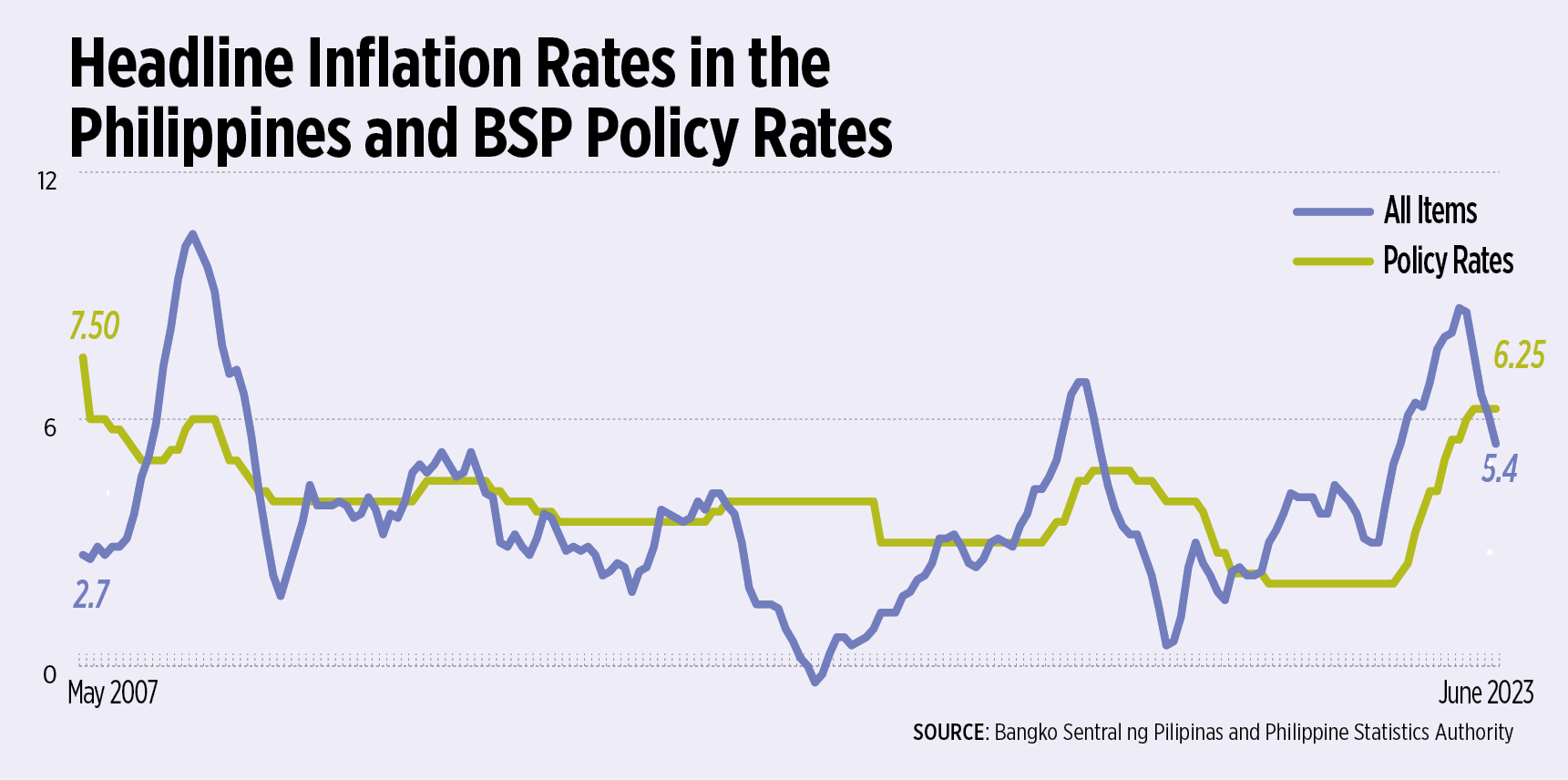
The Monetary Board kept its target reverse repurchase (RRP) rate at 6.25%, the highest in nearly 16 years. Interest rates on the overnight deposit and lending facilities were also left unchanged at 5.75% and 6.75%, respectively.

It raised borrowing costs by 425 basis points (bps) from May 2022 to March 2023.

“The BSP’s main liquidity [management] tools in siphoning off excess liquidity from the financial system scaled up in recent months, thereby partly slowing M3/domestic liquidity growth, such as the weekly BSP Term Deposit Facility auctions, the BSP securities auction, as well as the daily BSP overnight RRP auctions,” Mr. Ricafort said.

He also attributed the slower growth of money supply in the financial system to the lower amount of maturing government securities from May to July.

Based on BSP data, domestic claims grew by an annual 8.9% in July, slower than 10.1% in June.

Meanwhile, claims on the private sector rose by 8.2% in July from the 7.9% growth a month ago. The growth was driven by continued expansion in bank lending to nonfinancial private corporations and households.

However, net claims on the central government eased to 12.5% in July from 17.2% in June, mainly driven by the continued borrowings of the National Government.

Earlier BSP data also showed outstanding loans of big banks expanded by 7.7% to P11 trillion in July from P10.21 trillion a year ago. This was slower than 7.8% seen in June.

On the other hand, net foreign assets (NFA) in peso terms contracted by 2.6% in July, following a 2.8% decline in the prior month.

“The BSP’s NFA position decreased by 0.5% in July after contracting by 0.6% in the previous month. Similarly, the NFA of banks declined due to a contraction in interbank loans receivable and deposits maintained with nonresident banks,” the central bank said.

The BSP added that it would continue to ensure domestic liquidity conditions are consistent with price and financial stability.

“M3/Domestic liquidity growth could still slow, going forward, amid other restrictive monetary policy measures, on top of policy rate hikes…in an effort to bring down inflation towards the BSP’s inflation target of 2-4%,” Mr. Ricafort said.

Last week, the BSP raised its average inflation forecast for 2023 to 5.8% (from 5.6%) and to 3.5% (from 3.3%) for 2024. It kept its 2025 forecast unchanged at 3.4%.

Despite the higher forecasts, BSP Governor Eli M. Remolona, Jr. earlier said inflation is still projected to return to the 2-4% target by November in the absence of further supply-side shocks.

Headline inflation unexpectedly rose for the first time in seven months to 5.3% in August from 4.7% in July. Inflation averaged 6.6% in the eight-month period. — Keisha B. Ta-asan 

Mexico researchers show progress on drive to replace US corn imports

REUTERS

TEXCOCO, Mexico -— Researchers at a top Mexican agricultural university this week showed the progress they had made in producing more non-genetically modified (GM) yellow corn seeds to help replace imported grain from the United States that is at the center of a major bilateral trade dispute.

Experts at the Autonomous University of Chapingo, on the northeastern flank of Mexico City, unveiled advances in developing seeds for planting to offset corn imports as Mexico battles with the United States, its top trading partner, over its plan to limit use of GM corn.

Three-meter-high corn stalks rose from the soil across an extensive field at Chapingo, early signs of a potential future alternative for food producers like Kellogg and Mexican brand Maseca, researchers said.

The fields, planted in May, were generating new strands of hybrid seed varieties to be tested in 2024 with release for planting in 2025, they said.

“What we’re going to do is make available to the producer the seed that they need… and the technological package to achieve the desired yields,” said Claudio Carballo, operational manager of Chapingo’s corn seed production project.

The project aims in two years to develop enough non-GM seed varieties cultivable in Mexico to replace about 6 million of the 18 million metric tons of corn that the country imports from the US annually, most of which is GM yellow corn.

Mexico’s government wants to ban GM corn for human consumption, including its national staple, tortilla, on concerns about its health impact.

It still permits, for now, GM corn as livestock feed and in industrial use in some processed foods and cosmetics.

After months of tension over the policy, the US requested in August a dispute settlement panel under the US-Mexico-Canada Agreement (USMCA) trade pact, arguing that Mexico’s plan is not based in science.

President Andres Manuel Lopez Obrador has been vocal about the need to reduce Mexico’s dependence on US corn imports. However, his government has yet to significantly do so.

Still, Mexican Deputy Agriculture Minister Victor Suarez has said replacing 10% to 15% of corn imports is realistic.

“It’s like people’s income — if it’s not enough, then they’re dependent on someone. It’s that simple,” said Romel Olivares, a coordinator for the Chapingo project. “A country is the same.”

Mexico has ruled out new modifications to its decree ahead of the USMCA panel.

Lopez Obrador has said Mexico is not violating the trade pact but would respect the panel’s ruling.

Mexican officials say the US has been unwilling to collaborate on new scientific research to study the health impact of GM corn.

“Why take risks?” Mr. Olivares said as he stood in front of a long corridor of neatly planted corn. “The investigation must continue.” — Reuters

Style (09/25/23)


Pandora holds Disney Pop-Up at Power Plant Mall

PANDORA will open a Disney x Pandora Pop-Up Store at the Lifestyle Hallway, Power Plant Mall in Makati from Sept. 25 to Oct. 8. On offer will be Pandora’s limited-edition charms released for the Disney100 collection this year. These include character charms featuring Mickey Mouse, Minnie Mouse, Simba, Dumbo and others. The character charms are crafted from sterling silver with solid 14k gold accents and lab-created diamonds. The collection includes a sterling silver Disney100-themed chain bracelet in sterling silver, with a Mickey Mouse-shaped clasp and 14k gold “Disney100” engraving. The Disney x Pandora Pop-Up Store also includes jewelry inspired by favorite Disney Princess heroines like Jasmine and Ariel; icons and motifs from Beauty and the Beast, Cinderella, and Peter Pan; Disney Pixar items based on Toy Story, Up, Monster’s Inc., and Finding Nemo; and Avengers-themed charms from Pandora’s Marvel-inspired line. To learn more about the Disney-inspired jewelry pieces from Pandora, visit shop.lucerneluxe.com and follow @pandoraphilippines on Facebook.


New installment of Montblanc StarWalker collection out

THE LATEST installment of a collection celebrating the wonder of space exploration draws inspiration from the beauty of the galaxy. Montblanc explores new materials and techniques with every edition of the Montblanc StarWalker writing instrument collection. The StarWalker SpaceBlue is inspired by materials originating from space, namely the Widmanstätten pattern, considered among nature’s most hypnotic creations. The central design focus of the new edition is a rendition of the Widmanstätten pattern, first discovered in 1808 by Viennese scientist Count Alois von Beckh Widmanstätten. While flame heating iron meteorites, he noticed color and luster zone differentiation as the various iron alloys oxidized at different rates, showcasing fine interleaving kamacite and taenite bands or ribbons called lamellae. A pattern that forms only deep inside planetary bodies that take years to cool down, it has been recreated by Montblanc artisans on resin by using a newly developed injection molding tool, and on metal by etching. The innovative and tactile custom pattern is paired with a midnight blue hue evoking the night sky. A signature StarWalker design feature, each piece is crowned with a floating Montblanc emblem above a translucent smoky blue in a transparent cap top. The StarWalker SpaceBlue collection includes three different writing instrument versions — a Resin edition made of matte patterned blue resin with dark ruthenium-coated fittings, a Doué edition that pairs a patterned resin barrel with a metal cap, and a Metal edition entirely in patterned metal. Each edition is available as a Ballpoint, Fineliner and Fountain Pen featuring a ruthenium-coated Au 585 nib and fitted with a piston converter engineered specifically for the StarWalker collection and compatible with previous models. Montblanc is introducing a blue leather lined notebook featuring the distinctive pattern on its cover, as well as a matching dark blue ink. A pair of cufflinks in steel and lacquer with the signature StarWalker translucent dome design complete the collection. The Montblanc StarWalker SpaceBlue collection is now available at Montblanc boutiques worldwide and online. For more information, visit www.montblanc.com.


Uniqlo Manila Global Flagship Store marks 5th anniversary

GLOBAL apparel retailer Uniqlo marks the 5th anniversary of its Global Flagship store in the Philippines from Oct. 13 to 26 with new endorsers, new “experiences” and an updated UTme! lineup. The biggest Global Flagship store in Southeast Asia, The Glorietta 5 branch is the home to the complete line-up of LifeWear items in the country, as well as unique experiences such as the custom printing service, UTme!, and special displays and collaborations with various local talents. Uniqlo Manila’s 5th anniversary has the theme “Elevated Store. Elevated Essentials. Embrace the Future,” and bringing the concept to life is the brand’s partnership with five individuals who have achieved global recognition in their respective fields, with each partner representing one of the brand’s biggest item lines. They are: food and lifestyle content creator Erwan Heussaff for AIRism; director Martika Escobar, the first Philippine director to win an award at the Sundance Film Festival, represents HEATTECH; entrepreneur Gio Visitacion, owner of the Good Cup Coffee Company and 2020 Philippine Brewers Cup champion, for the AirSense line-up; Southeast Asian Games Medalist and Guinness World Record holder Kaizen Dela Serna for UV Protection products; and singer and actress Sarah Geronimo for Bra Tops. Meanwhile, opening on the second floor of the Global Flagship Store is Uniqlo Coffee cafe, which first opened in 2021 at the renewed Uniqlo Global Flagship Store in Ginza. The coffee drinks will be made with locally sourced, high quality coffee beans from Mt. Apo, and will feature goods and pastries that mix Filipino and Japanese flavors. The brand is also set to bring to Manila its Re.UNIQLO Studio. Visitors to the Global Flagship Store will get to enjoy repair services on their pre-loved UNIQLO items. Lastly, Uniqlo refreshes their UTme! line-up, collaborating with local artists to bring customers unique designs they can customize on T-shirts and tote bags. The artists include Gianne Encarnacion and Ross Du of Metro Manila, Johanna Velasco and Myka Arnado of Cebu, and Kajo Baldisimo of Davao. Muralist Glendford Lumbao also joins in to contribute a piece to be displayed at the new experience areas on the second floor of the Flagship Store. From Oct. 13 to 31, customers can expect exciting freebies and promos exclusive to the Uniqlo Manila Flagship store. There will also be workshops led by select UTme! artists and endorsers throughout the month of October. Meanwhile, the new Uniqlo U 2023 Fall/Winter collection designed by Artistic Director Christophe Lemaire and his Uniqlo R&D team in Paris will be launched on Oct. 6. Lemaire summarizes the collection in this way, “to make clothes that are like good friends — nothing that constrains you, nothing that disguises you.” It includes added coats, lambswool knits, and cozy flannel with a color palette of rich browns and rusts, charcoal and gray, beige and off-white. The Women’s collection includes jersey tailored jackets with striped lining, and brushed jersey turtleneck T-shirt with narrow ribbed cuffs and hem. The Men’s collection includes a padded single-breasted coat and short-length padded volume jacket, both featuring a relaxed silhouette. Both items are also water repellent. For the season’s accessories, the classic drawstring bag returns in a smaller size, along with a simple yet practical backpack, and casual mini messenger bag.


Original Penguin’s Golf Collection keeps a retro touch

THE LATEST collection of the Original Penguin Golf by Munsingwear, a division of Perry Ellis Int’l, features prints, solids, and stripes with a defined yet subtle retro touch with designs taken from the brand’s 1970s and ’80s archives. These have been reworked with modern fabrications for a more comfortable fit that complements the needs of the modern sportsman. To keep players cool and comfortable during play, Original Penguin utilized innovative fabrics. The eco-friendly polos are crafted with 30% recycled polyester and elastane blends for better ventilation and use recycled yarn and high-gauge knits with a cooling touch for superior performance and aesthetics. This collection offers prints like florals, tie-dyes, beers and cocktails, animals, and even the brand’s Pete the Penguin logo. There is also a range of solid color collared polo shirts, plus a selection of sophisticated polo shirts that incorporate stripes and smart color-blocking. The Original Penguin Golf Collection is exclusively available in stores located in Alabang Town Center, Greenbelt 5, Power Plant Mall, Robinsons Magnolia, Robinsons Place Manila, Rustan’s Makati, Shangri-La Plaza Mall, SM Mall of Asia, SM Megamall, SM North Edsa, Trinoma Mall, Uptown Mall, MarQuee Mall, SM City Baguio, SM City Clark, SM City Bacoor, Solenad Mall, Ayala Center Cebu, SM City Bacolod, and SM City Davao.


Avon PHL holds Fun Run for Breast Cancer Awareness

IN ANTICIPATION of Breast Cancer Awareness Month, Avon, invites the public to join the Fun Run to Boob Love on Oct. 21 at the Cultural Center of the Philippines Complex, Roxas Blvd., Pasay City. “Avon has been at the forefront of the fight against breast cancer for over 30 years. With the prevalence of this disease in the Philippines, we believe that no one should be left in the dark when it comes to breast cancer,” said Razvan Diratian, Avon APAC Managing Director and General Manager, Philippines. “With the support of our community, we hope this event will break down barriers to breast health education even further. By creating a venue that helps normalize discussions around breast cancer, we can empower more women with the knowledge and skills to take action and save lives.” With a 3K to 5K run and a fair dedicated to breast health, the fundraising event’s proceeds will be donated to Avon’s long-time partner organization Philippine Cancer Society. Join Fun Run to Boob Love by registering at https://bit.ly/AvonBoobLove.

ICTSI slips on US Fed, Bangko Sentral monetary policy stance

SHARES in Razon-led International Container Terminal Services, Inc. (ICTSI) inched down last week after the results of the central bank’s hawkish pause for a fourth straight meeting and the US Federal Reserve’s decision to keep rates steady.

Data from the Philippine Stock Exchange (PSE) showed the port operator ranking 15th in value turnover with P407.42 million worth of 1.99 million shares exchanging hands from Sept. 18 to 22.

ICTSI shares closed at P203.80 apiece on Friday, inching down by 0.6% from its P205.00 close on Sept. 15. Year to date, the stock slightly rose by 1.9%.

Rastine Mackie D. Mercado, research director at China Bank Securities Corp., said that the general market conditions last week were largely driven by the US Fed and Bangko Sentral ng Pilipinas’ (BSP) policy meetings.

“Market reaction to both central banks’ reiteration of their hawkish policy stances is not only particular to [ICTSI] but to other industries as well,” he said in an e-mail.

For John Louise L. Resurreccion, equity analyst at Regina Capital Development Corp., the stock market last week saw the index dropping to 6,000 levels, causing most of the Index names to be highly volatile and bearish.

“This caused prices to suddenly fall in a downward trend but for [ICTSI], we can see that it was moving in a range from [P200.00 to P211.00] so it’s a little more resilient in terms of price movement as compared to other index name,” he said in an e-mail.

Last week, the US Federal Reserve held interest rates steady but stiffened a hawkish monetary policy stance that its officials believe can lower inflation without wrecking the economy or leading to large job losses, Reuters reported.

The report added that the US central bank’s benchmark overnight interest rate may still be lifted one more time this year to a peak 5.5%-5.75% range.

Mirroring the stance, the BSP kept its key interest rate at 6.25% but signaled it is possible to resume policy tightening at its next meeting if inflation continues to persist.

The overnight deposit facility rate was kept at 5.75% while the lending facility rate was maintained at 6.75%.

Last week, developments included ICTSI’s plan to utilize digital solutions and extend the availability of its “ICTSI App” to other terminals in the group.

Launched in 2022, the app allows customers to track their cargo in various ports. Customers can track their shipments, allowing them to streamline their operations and potentially reduce logistical expenses.

In another report, the listed port operator said it is planning to finish its port expansion in Melbourne, Australia this year after the arrival of two new quay cranes from China.

Victoria International Container Terminal (VICT), ICTSI’s subsidiary, said the cranes are part of its 235-million Australian dollar expansion investment that will boost its capacity by up to 1.25 million twenty-foot equivalent units (TEUs).

To date, ICTSI invested around one billion Australian dollars in its Melbourne operations.

VICT’s supersized ship, M/V CMA CGM Pelleas, has docked in its Melbourne port. The container vessel, which has a carrying capacity of about 10,000 TEUs, is 350 meters in length and 43 meters wide.

These developments may not be a big catalyst, said Mr. Resurreccion, but will affect ICTSI’s earnings as its services become more accessible to its clients.

“What most likely will happen is ICTSI will keep reacting to the PSEI’s movement where if it falls, ICTSI will probably move in a range or fall if prices do not hold,” Mr. Resurreccion said.

On the other hand, he said that if the index recovers, ICTSI will surely benefit, with its stock price picking up.

For Mr. Mercado, the news will be taken positively by the market as further development and wider adoption of the app could strengthen demand for their services.

As for the port expansion in Australia, this should bode well for volumes, he said.

“However, we think investors are likely to focus more on global macro developments to assess how trade activities would trend moving forward,” he added.

In the second quarter, ICTSI’s attributable net income grew by 4.6% to reach $159.19 million, while total revenues rose by 13.5% to $628.47 million.

In the first semester, earnings increased by 6.6% to $313.80 million as consolidated revenues grew by 11.1% to $1.22 billion.

For Mr. Mercado, ICTSI’s full-year 2023 attributable net income could amount to $634 million.

For Mr. Resurreccion, ICTSI will continue to perform positively as it continues to expand its operations by securing new concessions and improving existing ports.

“Improving macroeconomic factors will also be beneficial for the company as this makes global trade more active which will lead to more volume in TEUs handled,” he added.

He also said that the port operator is fundamentally good and its price movement is also resilient compared with other index names during times of market downturns.

Mr. Resurreccion placed his support and resistance levels for the port operator at P203 to P208 “given that it was the previous range where prices moved around in the last few weeks.”

Meanwhile, Mr. Mercado said attractive points for ICTSI  include its expansion prospects, such as the Durban terminal in South Africa, the outlook for stable yields given that some terminals are due for tariff adjustments this year, and the track record of dividend payments, which have been increasing over the past years.

He pegged support and resistance levels at P200 and P216, respectively. — Abigail Marie Pelea Yraola

Vog and health

TOURISTS and residents in Tagaytay wear face masks amid the emission of smog at Taal Volcano in Batangas on Sept. 22, 2023. — PHILIPPINE STAR/WALTER BOLLOZOS

More than 200 people fell ill from Taal’s volcanic smog or vog, prompting the Department of Health (DoH) to put the medical community under “white alert” in Calabarzon.

Over the weekend, Civil Defense Administrator and National Disaster Risk Reduction Management Council Executive Director Undersecretary Ariel Nepomuceno said that there had been at least 263 health consultations due to the vog.

Volcanic fumes, like vog, can be hazardous to health and can be life threatening. While it is colorless, vog comes with a visible haze and pungent odor similar to fireworks or a burning match.

Volcanic gas emissions can pose environmental and health risks to nearby communities, said the United States Geological Survey (USGS). It is easy to understand why. Like urban, industrial, and other pollution sources, vog contains toxic contaminants, mostly sulfur dioxide (SO2) and acid particles. It explained that vog is comprised of gas and an aerosol of tiny particles and acidic droplets created when SO2 and other gases emitted from a volcano chemically interact with sunlight and atmospheric oxygen, moisture, and dust.

Particularly problematic is the PM2.5 — particulate matter less than 2.5 micrometers in diameter which can settle deeply in the lungs when inhaled — which in vog is mainly composed of acid and neutral sulfate particles. These particles, that are also found in vehicle exhaust and smoke from fires, are smaller than the width of a human hair, noted the USGS. Meanwhile, SO2 can irritate the skin and the tissues and mucous membranes of the eyes, nose, and throat.

While sensitivity to vog varies, individuals with pre-existing medical conditions are expected to be at highest risk, depending on the amount of emissions, their distance away from the eruptive vent, and wind direction from day to day. Also with increased sensitivity are children, pregnant women, and the elderly.

As classes were suspended in Metro Manila due to haze, the Philippine Atmospheric, Geophysical and Astronomical Services Administration (PAGASA) said that meteorological conditions resulted in smog formation, and not vog, in the National Capital Region. Even so, smog also brings with it a number of health hazards. “This (smog) occurs when very small particles get trapped close to the surface due to the presence of a thermal inversion, high humidity, and calm wind conditions. These floating minute particles in the air could be from smoke, pollutants, or volcanic aerosols,” the Philippine Institute of Volcanology and Seismology, better known as Phivolcs, said as it explained that the haze the NCR suffered from was not vog.

DEALING WITH VOG
The International Volcanic Health Hazard Network (IVHHN), an umbrella organization for all research and dissemination of information on volcanic health hazards and impacts, provided guidance on how to prepare for and take protective actions to reduce the impact of vog on individuals.

In preparing for vog, the IVHHN said that it is important to understand the hazard. It is helpful to be familiar with air monitoring sources as well as SO2 and PM2.5 advisory codes/levels. Learning about wind conditions is also key to predicting if and when one might be affected by vog. Since vog can cause illness or exacerbate an existing one, it is important to keep medications handy such as those for asthma or other respiratory conditions. The group added that one can assume that asthma could get worse during periods of high vog, therefore, seek medical assistance as necessary if an individual is having asthma symptoms or other conditions when exposed to vog.

The IVHHN added that it is important not to smoke and to avoid second-hand smoke. Those exposed to vog must also stay hydrated to help loosen congestion. It added that warm or hot liquids may help some people. In managing congestion or irritation, over-the-counter nasal sprays or eye drops can help to reduce symptoms. If symptoms don’t improve, it is advisable to seek immediate medical care.

Other ways by which one could care for themselves and their family is by wearing N95-type particle-filtering respirators/masks as needed. But the IVHHN also said that children should not use N95 masks because they are sized for adults.

Also, outdoor exercise or exertion increases one’s chances of being affected by SO2 gas and/or PM2.5. So, staying indoors is the prudent action. The group said that, if possible, people should stay indoors and close all outside doors and windows when there is vog. (At the same time, there is a need to beware of becoming overheated.) Additionally, when staying indoors, eliminate other sources of pollutants such as smoking, candles, or incense. Even if the house is not well-sealed, the IVHHN said it may still offer some protection. If a room can be closed up, an appropriate air-cleaning device can help reduce the levels of vog.

However, one may consider moving to indoor areas that are better-sealed. An individual may consider temporarily relocating, if necessary. To minimize air infiltration while inside the vehicle, temporarily close the windows and vents, and turn the fan and air conditioner off.

Finally, staying updated on information coming from the government and official sources is crucial.

“We also remind the public to heed the advisories of the Department of Health (DoH) as well as the warnings being issued by the Philippine Institute of Volcanology and Seismology for the safety of everyone. Phivolcs and the DoH have been issuing warnings on the health hazards posed by the volcanic smog. We are amplifying these advisories and warnings for public awareness,” said Undersecretary Nepomuceno.

Teodoro B. Padilla is the executive director of Pharmaceutical and Healthcare Association of the Philippines (PHAP). PHAP represents the biopharmaceutical medicines and vaccines industry in the country. Its members are in the forefront of research and development efforts for COVID-19 and other diseases that affect Filipinos.


Teodoro B. Padilla is the executive director of Pharmaceutical and Healthcare Association of the Philippines (PHAP).  PHAP represents the biopharmaceutical medicines and vaccines industry in the country. Its members are in the forefront of research and development efforts for COVID-19 and other diseases that affect Filipinos.

ADVERTISEMENT
ADVERTISEMENT