Home Blog Page 428

Stuff to Do (01/16/26)
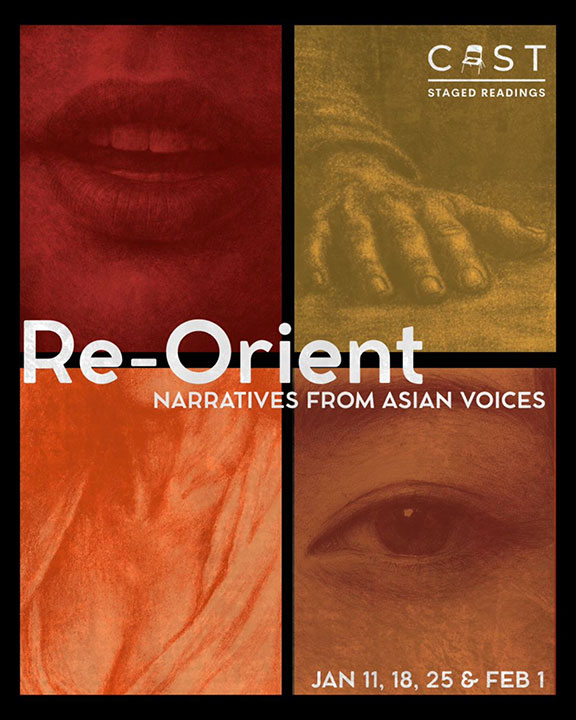

Watch CAST’s staged readings

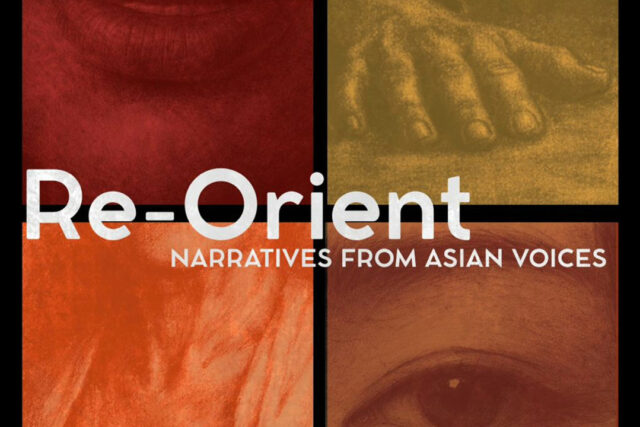
CAST PH’s (The Company of Actors in Streamlined Theatre) is once again presenting its annual staged readings. The theme of this year’s season (its 6th) is “RE-ORIENT — Narratives from Asian Voices.” As has been done every year during the CAST PH Staged Reading Series, the titles of the plays are not revealed beforehand. The plays take place over the course of four weeks (every Sunday), starting on Jan. 11 with Play #1, which was English by Sanaz Toosi, directed by Sarah Facuri, and starring Mikkie Bradshaw-Volante, Justine Peña, Jordan Andrews, Chaye Mogg, and Mayen Bustamante-Cadd. Play #2 will be presented on Jan. 18. It will be directed by Jaime del Mundo and feature Tarek El Tayech and Nelsito Gomez. On Jan. 25, Play #3 will be directed by Guelan Varela-Luarca. It will star Jenny Jamora, Zoë De Ocampo, Jam Binay, Frances Makil-Ignacio, Dolly de Leon, and Roselyn Perez, with stage directions to be read by Monty Uy. The season ends on Feb. 1 with Play #4 which will be directed by Caisa Borromeo. It will feature Jillian Ita-as, Kakki Teodoro, George Schulze, Yanah Laurel, Alfredo Reyes, and Miren Alvarez-Fabregas. There are only 100 seats per performance, priced at P500 each. For tickets, visit the company’s Google Form. All performances will be held at The Mirror Theatre Studios, 5th floor, SJG Center, Kalayaan Ave., Makati City. Performances are at 3 and 8 p.m.


Attend PPO’s 2026 opener: Preludi

THE Philippine Philharmonic Orchestra (PPO) opens the new year with PPO Concert V: Preludi on Jan. 16, 7:30 p.m., at the Samsung Performing Arts Theater in Circuit, Makati. Under the baton of PPO music conductor and principal conductor Grzegorz Nowak, the program will feature soprano Andion Fernandez and pianist Szymon Nehring. Tickets are available via https://premier.ticketworld.com.ph/shows/show.aspx?sh=PPOCON526.


Try out new fitness experiences at GH Mall

GH MALL at San Juan’s Greenhills Shopping Center, balances the overindulgence of the Christmas season by going healthy in January and offering a lineup of sports and wellness activities. There is the Table Tennis Academy, running until Jan. 31 at the 4F Tech Hub. Mallgoers can also play pickleball at the 5th floor until Jan. 31. The “Motion in Glow” Zumba sessions at the 6F roof deck run every Monday from 5 to 7 p.m. “Step & Groove” dance sessions occur in the same location and at the same time on Wednesdays, while yoga is available on Fridays.


Watch 28 Years Later: The Bone Temple

THE zombie thriller 28 Years Later: The Bone Temple — the fourth film in the 28 Years Later trilogy — is now showing in Philippine theaters. The series depicts the onslaught of the Rage virus where humanity is left to adapt to the dangerous environment. One of the survivors is Dr. Ian Kelson, played by three-time Oscar nominee Ralph Fiennes. The film title takes its name from the massive ossuary with which the character finds comfort in tending and honoring the dead. It is out now in cinemas nationwide.


Flashback

STOCK PHOTO | Image by DC Studio from Freepik

Nostalgia is in the air during and after the holiday season.

One needs to shift to low gear and shut out the present. Travel rejuvenates the body and nourishes the spirit. It warms the heart, especially when one goes back to a beloved place.

Crossing oceans and time zones can be exhausting, but it is delightfully refreshing in more ways.

Geographical distance makes one shed the crusty city attitude and tired skin. One’s perspective improves in a different environment. Problems seem diffused and recede into a blurry background. Worries melt away as the mind recharges in a stress-free mode. One blinks to rediscover another facet of nature — winter in a temperate zone.

Mentally retracing the old pathways, one feels a familiar spark. The heart-tugging ache blends with the novelty of a new vibe. It is seeing the past with a new pair of eyes in a dreamy light.

The beloved city with two mountains is more polished and alluring than ever. The iconic landmark, the Sagrada Familia Basilica with soaring organic towers, is almost complete after more than a century. Its architect passed a hundred years ago. Other architects continued the work in progress, supported by donations from the people who flock there to pray and marvel at the modern stained-glass windows that filter exquisite shifting rainbow rays of light. Designed by Catalan artist-architect Antonin Gaudi, the thought-provoking church has wonderful acoustics for classical concerts and thousands of details.

In Barrio Gótico, the medieval cathedral Santa Maria del Mar was built slowly — stone by stone, rock by rock, during the Black Plague.

The wide avenidas, paseos with trees and rotundas, glorious parks and sparkling fountains, glow after an icy downpour. Walking in the rain is chilly, but one can stop for hot chocolate and churros at a café. There are pintxos, jamon Iberico, figs, and seasonal delicacies in little stores.

Once upon a time, an elegant, isolated villa atop a hill with a magnificent panorama used to be a second home. It was surrounded by flowering trees such as cherry and almond blossoms in the spring. It was insulated from the distractions of the outside world and people. It was the place to study peacefully, absorb the classics, the ways of the old world, different cultures, art, music, languages, theology, literature, history, math and the sciences.

It was where one could grow up, sprout, and cultivate the budding wings of independence. Part of the education was to instill values and genteel manners, tradition, respect and courtesy, kindness and compassion. Slowly and carefully. Sometimes, under a magnifying glass.

It was a big challenge for a teenager to be transplanted and to adjust to a strange environment. After a few months, wonderful changes happened through new friendships that bridged cultures and countries with a shared Hispanic heritage.

This was a rich tapestry, with Asia’s only country with strong Catholic and Spanish roots. The travel tours were among the best educational aspects of the year. From the Pyrenees to Andalusia, Sevilla, Granada to Vienna, Salzburg, Munich, and the Austro-Hungarian empire.

Many years later, the old bonds of friendships formed in school and on those trips have been rekindled and nourished. This reverie is a flashback to those happy times.

The third home was a grand villa and brick buildings with towering cypress trees on one of the seven hills of the empire.

Rome offered exciting academic challenges, the chance to compete on an international level and attain the coveted precious medal of excellence.

There were new travel and artistic adventures that focused on the Vatican, the Sistine Chapel, Michelangelo’s frescoes, Castel Gandolfo, Leonardo’s Renaissance in Firenze, Veio, the ruins of the ancient Etruscans, Greece. Finally, a lost love.

The imagination has a distinct, mystical way of reviving memories.

One simply closes their eyes to be transported to the place where mist surrounds the mountains around the valley. It is a forest frozen in time. Miles and miles of evergreens, a romantic castle amidst the picturesque mountain range.

The aroma of fresh pine wafts through the thin air.

Oxygen is abundant. It pierces the nostrils and lungs. One inhales its sharp sweetness and is quickly intoxicated.

It is hard to resist the magnetic aura of the mountains and the snowy peak. What could be more exhilarating than ascending on a cable car? A dimension far removed from the tropics is captivating. An open palm holds pure snow and intricate snowflakes.

One recalls another distant mountain a continent away. On a gondola, one breathes in little gasps and exhales puffs of steam at such a high altitude. The rarefied air makes on feel giddy, light-headed without wine.

To bask in the golden sunshine amidst the breathtaking splendor of the mountains is a soulful and mind-expanding experience.

The mental cobwebs melt away as sunlight drenches the body with radiance. An eagle soars with the wind and circles above.

The sky becomes a canvas as it turns vermillion, russet, and lavender. The sun dips into the horizon. One hears the dramatic music of Beethoven’s violin concerto. An eclectic audience is enthralled by the music. During the final movements, light raindrops fall in a natural rhythm, accelerating into a stirring crescendo.

Symphonic music and a tranquil curtain call at sunset. Twilight comes in shades of indigo and cobalt.

At nightfall, the crickets rustle and echo in the woods. The stars slowly peek through the cirrus clouds. It is so quiet that one can almost hear the rocks grow near the gurgling brook.

Dawn brings a powder blue sky with delicate drifting wisps of puffy clouds.

Only poinsettias seem to thrive in this icy space.

At 3,700 meters above sea level, the panorama is inspiring, spellbinding. The splendid crystalline scene is a creative challenge to interpret on canvas.

How can a human attempt to paint such perfection? Only the Divine Artist can create it with celestial strokes and cosmic colors.

High above the world, one can understand why mystics and world-weary travelers seek refuge atop a mountain. Serenity provokes deep thought and meditation. One feels so close to heaven with the ethereal glimpse of the infinity.


Maria Victoria Rufino is an artist, writer and businesswoman. She is president and executive producer of Maverick Productions.

mavrufino@gmail.com

US reverses job cuts at work-safety research agency

REUTERS

THE administration of US President Donald Trump is reversing staffing cuts to the National Institute for Occupational Safety and Health (NIOSH), reinstating employees at the agency that provides research and services for coal miners, firefighters and others, according to an agency spokesperson.

The status of NIOSH workers had been in flux since mass job cuts last year, with some workers brought out of administrative leave earlier this month only to be notified days later that they were permanently terminated.

Department of Health and Human Services (HHS) spokesperson Andrew Nixon confirmed that the staffing cuts were reversed on Tuesday night.

“The Trump administration is committed to protecting essential services — whether it’s supporting coal miners and firefighters through NIOSH, safeguarding public health through lead prevention, or researching and tracking the most prevalent communicable diseases,” Mr. Nixon said in a statement.

The reversal was first reported by Bloomberg.

In April, around 875 of NIOSH’s roughly 1,000-strong workforce were terminated across the country, as part of sweeping job cuts by the HHS that affected several high-profile agencies including the Food and Drug Administration, Centers for Disease Control and Prevention and the National Institutes of Health.

Reuters had reported that those potential job cuts, as well as the cuts at the Mine Safety and Health Administration, were putting miners at risk even as Mr. Trump called for a revival of the coal industry.

The cuts also threatened worker safety training for those in the fishing industry, farmers and others in some of the country’s most dangerous jobs.

NIOSH is the US federal agency responsible for conducting research and making recommendations to prevent work-related injuries, illnesses and deaths. — Reuters

Victorias Milling income falls 56% on rising costs despite revenue gain

PHILSTAR FILE PHOTO

LISTED sugar milling company Victorias Milling Co., Inc. (VMC) reported a 56.23% decline in attributable net income to P162.28 million for the three months ended November, as rising operating costs offset revenue gains.

In a regulatory filing on Thursday, the company said its net income fell from P370.75 million a year earlier.

Total revenue for the period rose 28.82% to P3.24 billion from P2.51 billion in the same period last year.

Revenue from sales increased 61.34% to P3.1 billion from P1.92 billion, while revenue from services fell 76.43% to P139.69 million from P592.74 million a year earlier.

Other income, which includes storage and handling fees, interest income, and investments, dropped 28.21% to P96.7 million from P134.68 million.

Meanwhile, VMC’s cost of sales and services climbed 40.06% to P2.93 billion from P2.09 billion, driven by higher inventories used.

The figure also included a P222.14-million provision for inventory write-downs due to lower market prices of molasses and raw sugar.

Operating expenses rose 16.91% to P218.64 million from P187.02 million, reflecting increases in both general and administrative expenses and selling expenses.

On Thursday, VMC shares closed 3 centavos, or 1.4%, lower at P2.12 apiece. — Vonn Andrei E. Villamiel

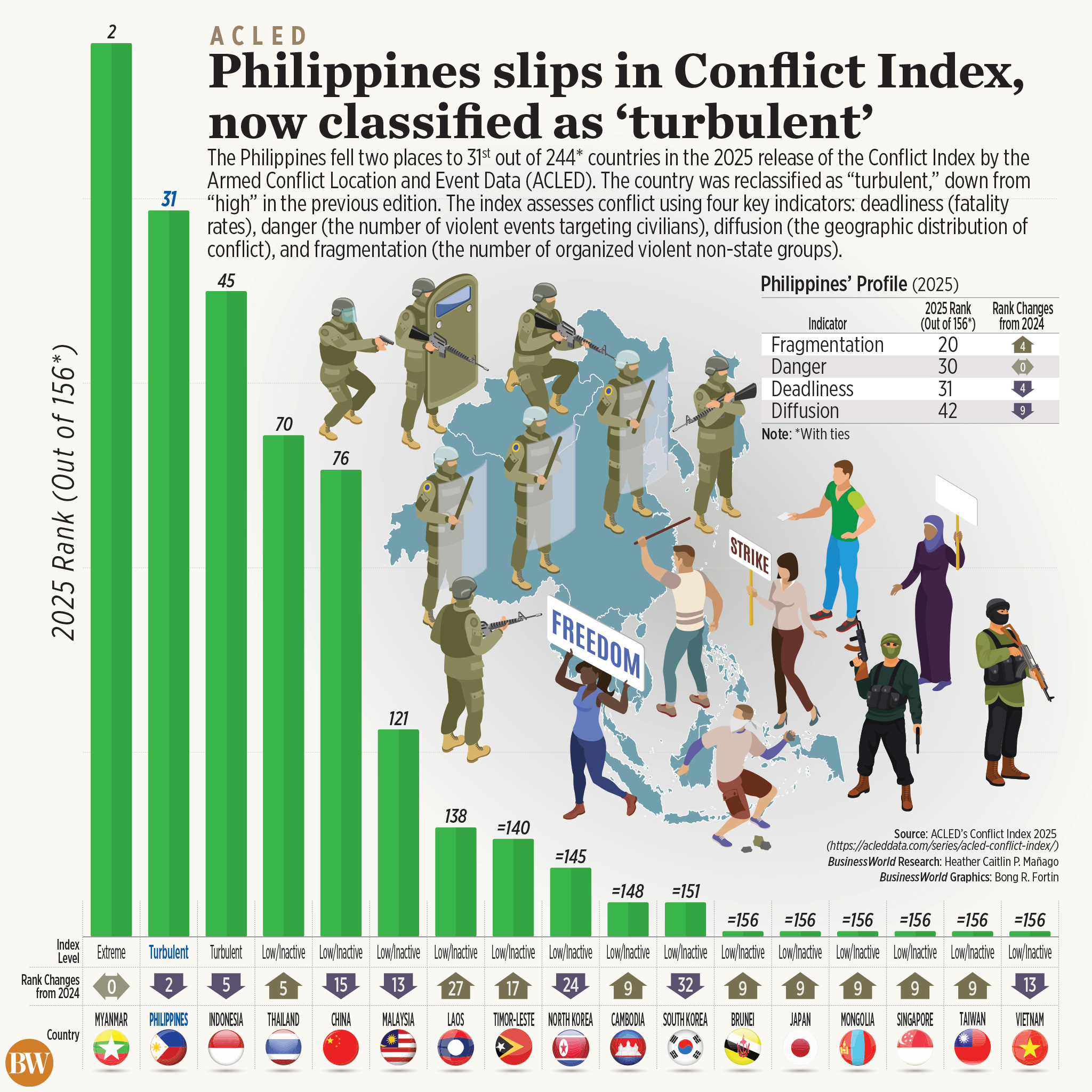
ACLED: Philippines slips in Conflict Index, now classified as ‘turbulent’

The Philippines fell two places to 31st out of 244* countries in the 2025 release of the Conflict Index by the Armed Conflict Location and Event Data (ACLED). The country was reclassified as “turbulent,” down from “high” in the previous edition. The index assesses conflict using four key indicators: deadliness (fatality rates), danger (the number of violent events targeting civilians), diffusion (the geographic distribution of conflict), and fragmentation (the number of organized violent non-state groups).

Allianz expects faster growth this year

MACROVECTOR/FREEPIK

ALLIANZ PNB Life Insurance, Inc. expects faster growth in its key financial metrics this year, driven by changes in its bancassurance partnerships, a revamped agency model and more aggressive customer expansion through its tie-up with HSBC.

“We remain very bullish and very, very positive about the Philippine market,” Allianz PNB Life President and Chief Executive Officer Joseph Gross said in a speech on Thursday, adding that the insurer is bullish on growth prospects this year.

Chief Financial Officer Lukas Immanuel M. Cacayan said the company posted double-digit growth across its financial metrics last year, with assets under management likely to hit the P135-billion target.

Growth was supported by double-digit gains in customer numbers from its bancassurance businesses, particularly partnerships with Philippine National Bank (PNB) and HSBC.

Mr. Gross said the agency channel lagged in customer growth last year after a restructuring aimed at improving quality rather than scale.

He said the agency arm might rebound this year following stricter standards and the appointment of Floro “Jun” Marasigan, Jr. as chief agency officer.

The insurer is also overhauling its sales model with PNB and expects improved branch performance. For its HSBC partnership, Allianz PNB Life is targeting double-digit customer growth among affluent and high-net-worth clients, amid rising demand for protection products.

Allianz PNB Life plans to simplify its product lineup and introduce additional investment options. — AMCS

Spanish prosecutors to hear testimony of Julio Iglesias accusers, rights group says

MADRID — Two women who say they were sexually assaulted by singer Julio Iglesias will provide testimony to Spanish prosecutors, the women’s rights group that filed a complaint on their behalf said on Wednesday.

This after a Spanish High Court prosecutor’s office said on Tuesday that it was investigating allegations in Spanish and US media outlets that singer Julio Iglesias sexually assaulted two former female employees.

Attempts by Reuters to contact representatives of Mr. Iglesias, 82, on Tuesday and Wednesday by e-mail and phone went unanswered. The star’s record label, Sony, declined to comment.

Women’s Link Worldwide said the complaint, which it filed at Spain’s High Court on Jan. 5, accused Mr. Iglesias of human trafficking for forced labor and servitude, alongside sexual abuse and violations of workers’ rights.

The group’s executive director, Jovana Rios, told an online press conference that the High Court prosecutor’s office would take statements from the two women as protected witnesses, adding that no date had yet been set and the court had yet to formally assert jurisdiction over the case.

The prosecutor’s office declined to comment, citing the secret nature of the preliminary inquiry.

“Being heard by prosecutors is a very important step in (the victims’) quest for justice, and we appreciate that authorities are being agile in their handling of the case,” Ms. Rios added.

The women, said to have worked in Mr. Iglesias’ Caribbean residences in the Dominican Republic and Bahamas over a 10-month period in 2021, were cited in a three-year investigation by US broadcaster Univision and Spanish outlet elDiario.es published on Tuesday.

Both women reported suffering sexual assault and workplace harassment while working for the singer, the outlets reported. The reports said Mr. Iglesias pressured them into sexual encounters and subjected them to additional physical and verbal abuse.

Mr. Iglesias is one of the world’s best-selling Latin artists, with more than 300 million records sold in 14 languages.

Ms. Rios described the two complainants as young Latin American women “in vulnerable situations who were heavily dependent on their wages due to their economic and social conditions.”

Criminal probes into alleged offences by Spanish citizens committed abroad are usually handled by the High Court, a recent example being the sexual assault trial of former Spanish soccer chief Luis Rubiales for kissing a player in Sydney, Australia.

Ms. Rios said Women’s Link had also been contacted by other women who said they had worked for Mr. Iglesias, but declined to provide further details, citing safety concerns.

She quoted one of the two complainants as saying she had decided to come forward for herself, for other women working for Mr. Iglesias and for her country, the Dominican Republic.

The allegations sparked a noisy reaction in Spain, where he is considered a national treasure.

Ana Redondo, the Socialist-led government’s Equality Minister, said in a statement she respected Mr. Iglesias’ presumption of innocence but that she believed the women’s testimony.

“He’s a great singer but people can have a dark side,” she said, praising the women for raising their complaints.

Leftist party Mas Madrid suggested the right-wing government of Madrid region should strip Mr. Iglesias of the keys to the city he was awarded as the capital’s most famous son. Mr. Iglesias has backed conservative political candidates in the past.

Regional president Isabel Diaz Ayuso issued a furious response on X, saying: “The Community of Madrid will never contribute to attacks on the prestige of artists, not least the most universal singer of all: Julio Iglesias.” — Reuters

Preparing Philippine business and workers for the age of AI

STOCK PHOTO | Image by DC Studio from Freepik

By Ferdinand A. Ferrer

ARTIFICIAL INTELLIGENCE (AI) is here and is already transforming how businesses in the country operate. Across industries like manufacturing, finance, marketing, and education, AI is enhancing efficiency, guiding smarter decisions, and unlocking insights from data like never before.

What we are seeing today is not a minor technology upgrade. The rapid spread of AI, and the productivity gains that come with it, is forcing both business and government to rethink how they manage operations, deliver services, and make decisions.

This was very clear in a recent discussion between the Philippine Chamber of Commerce and Industry (PCCI) and Artificial Intelligence for Public Health (AI4PH), a network of AI policy experts and industry leaders. The focus was not on whether AI will affect the Philippine economy, but on how it can be used to strengthen our competitiveness while making sure Filipino workers remain globally relevant.

One thing stood out: AI is no longer confined to manufacturing or back-office automation; it is now driving innovation across the entire economy — from customer service and creative industries to education, and research and development. Companies are using AI because it gives them deeper, faster, and more useful data, which leads to better decisions and better results.

Used well, AI allows people to do more, do it better, and do it more efficiently. But this transition will not manage itself. If AI is to lift the economy (rather than widen inequality), investment in people must be seriously pursued, similar to investment in technology. Filipino workers need more than just basic digital skills — they need to know how to work alongside AI tools to improve productivity, quality, and competitiveness.

This is where government, schools, and the private sector must work together. Government could consider recognizing and encouraging AI-related work as an apprentice-able occupation under the Enterprise-Based Education and Training (EBET) framework. This would allow companies to train young Filipinos in real workplace settings, at lower cost, while building the talent pipeline the industry badly needs.

Society’s mindset must also go beyond skills. If we envision our country to be more than just a user of AI, we need to compete in the infrastructure that makes AI possible — data centers, cloud services, and advanced computing. Without these, Filipinos will always be dependent on technology built elsewhere.

As PCCI continues to engage government on AI policy, our position is straightforward: AI should be a tool for growth, not fear. With smart regulation, serious investment in skills, and the right business environment, AI can help Philippine companies become more productive, more competitive, and better prepared for a rapidly changing global economy.


Ferdinand A. Ferrer is the newly elected president of the Philippine Chamber of Commerce and Industry (PCCI). He is the chairman and CEO of the EMS Group, which is engaged in electronics assembly, engineering services, contract manufacturing, and skills development with four locations in the Philippines and presence in five countries. He is a graduate from De La Salle University, Philippines, with a Bachelor of Science in Marketing Management.

Covert union avoidance strategies

Academically speaking, what common management best practices are there to deter workers from organizing a union? — Paper Crane.

Unfortunately, many of these “best practices” are legally questionable, if not outright illegal. Also, they have been silently considered ethically questionable by some human resources (HR) professionals.

I know because I was in a situation where at least three of my prospective employers asked me about my feelings about unions during job interviews. I was flatly rejected when I said I support the establishment of a union, if that’s what the employees want.

At one time, I was asked about how to bust an existing union. I politely ended the job interview. Even today, many of my HR friends still consult me on how to handle those unethical job interview questions as some employers try to explore such actions with their current and prospective HR people.

UNION AVOIDANCE TACTICS
Almost all of these management tactics may constitute unfair labor practices (ULPs) which must be proven in court. They are called gray areas by HR people (sometimes black), which makes it difficult to prove:

One, locating operations in some export processing zones (EPZs). This is preferred by factories that seek out locations with a weak union presence. Some EPZ authorities even silently promote their location as such, promising that they discreetly discourage union formation.

Two, fragmenting or dislocating the workforce. Organizations would prefer hiring only workers from cooperatives or manpower agencies, even if the work to be done is for regular workers. If not, they cycle through the hiring of project-based employees. 

Three, rotating workers under a training program. “Noisy” workers or rabble-rousers who have the potential to become union leaders are deployed to far-flung areas. It’s typically accompanied by a promise of a promotion after a yearlong assignment. 

Four, cultural and social engineering. This is done by establishing and maintaining an active community relations program by hiring workers from the same locality, organizing feeding programs for malnourished children, operating a day care, or sponsoring sports leagues, religious events, and barangay projects.

Five, hiring workers from a specific religion. These religious groups are perceived to have disciplined members that are less confrontational and believe in the supremacy of organizational hierarchy. Their workers are known to follow the orders of their religious leaders, who reciprocate by recommending them to employers.

Six, promoting a ‘family culture’ narrative. Unions are considered divisive as an external force “not aligned with their family values.” Some organizations even promote a bayanihan (communal spirit) culture.

Seven, signaling fear among the workers. Management would often talk about losing competitiveness, telling workers they can’t afford a labor union because their customers don’t like unionized suppliers whose members may sabotage their products.

Eight, selective enforcement of rules. This can take the form of suddenly enforcing dress code, ID, and absenteeism and tardiness rules. These minor offenses are often directed against perceived union sympathizers.

While the rules don’t change, enforcement becomes strict for no reason at all with the help of line supervisors.

Nine, manipulating the bargaining unit’s composition. In unionized establishments, this is typically done when a new collective bargaining agreement is negotiated. The playbook can call for reclassifying certain job categories as supervisory or confidential, rendering such workers unqualified to become union members.

Ten, giving wage increases, promotions, or bonuses. Usually, this could happen before a union certification election to influence the vote. To avoid any suspicion of manipulation, wage increases may given to all employees, including non-union members.

Eleven, paper compliance. Management can tell people that it “respects their right to unionize” while throwing procedural delays during negotiations, including claims of “lost” all documents and endless clarifications about the company’s future.

Twelve, hiring labor relations consultants. The job of these consultants is to coach line supervisors and managers in coded language about the impracticality of having a labor union. Many times, they are provided with scripts (nothing is written down) to minimize legal blowback.

DECEPTION COLLAPSES
From both my experience and from jurisprudence, many employees eventually see through the façade. They ask, “Why bother pretending?” That is why some workers — especially those who fear retaliation — turn to labor inspections, relying on authorities trained to detect patterns of abuse and hidden management intent.

When these cases reach the labor courts, labels no longer matter. What matters is effect. Courts look beyond job titles, policies, and corporate wordplay to determine whether labor rights were violated.

Yes, unethical managers may delay union formation through illegal tactics — but delay is not defeat. In the end, deception collapses under scrutiny, and no strategy is powerful enough to extinguish the workers’ collective will for dignity, voice, and justice.


Discover the answer to the old-age question — “Why People Hate HR?” Join Rey Elbo’s Feb. 20, 2026 public workshop on “Lean HR: Removing Waste from People Processes.” For details, check the link https://reyelbo.com/contact-us

PhilWeb, Hann Casino team up to expand online gaming

HANN CASINO — HANN HOLDINGS INC.

LISTED electronic gaming technology services provider PhilWeb Corp. and Hann Casino have entered into a partnership to expand Hann’s regulated online gaming operations.

“This partnership reflects both parties’ shared commitment to delivering a secure, compliant, and high-quality digital gaming experience aligned with regulatory requirements,” PhilWeb said in a disclosure on Thursday.

Under the agreement, PhilWeb will support the operation and management of Hann’s online gaming platform, leveraging its experience, technical expertise, and track record in the Philippine gaming industry.

“Hann Casino remains fully committed to responsible gaming, strong governance, and regulatory compliance, while PhilWeb’s operational and technical capabilities will enhance platform performance, player experience, and overall operational efficiency,” PhilWeb added.

Hann Casino Resort, Central Luzon’s first integrated resort, is owned by Hann Philippines, Inc.

The 11-hectare (ha) property features a casino with 274 table games and 1,721 gaming machines, over 800 hotel rooms at Swissôtel Clark and Clark Marriott, and the 8th Avenue Lifestyle Mall, which houses outlets such as Hard Rock Café, Tom N Toms, Lucky Dumpling, The Dine by Tony Jung, Las Flores, and Taboo bar.

The resort recently expanded its main casino floor by 1.22 ha and added The Canyon (a café by day and winery by night) and Three Woks (contemporary Asian dining) to its 20 restaurants, bars, and cafés offering local and international cuisines.

PhilWeb said the partnership represents a long-term collaboration aimed at sustainable growth, innovation, and the further development of regulated online gaming in the Philippines.

PhilWeb shares rose 8.92% to close at P7.08 apiece on Thursday. — Alexandria Grace C. Magno

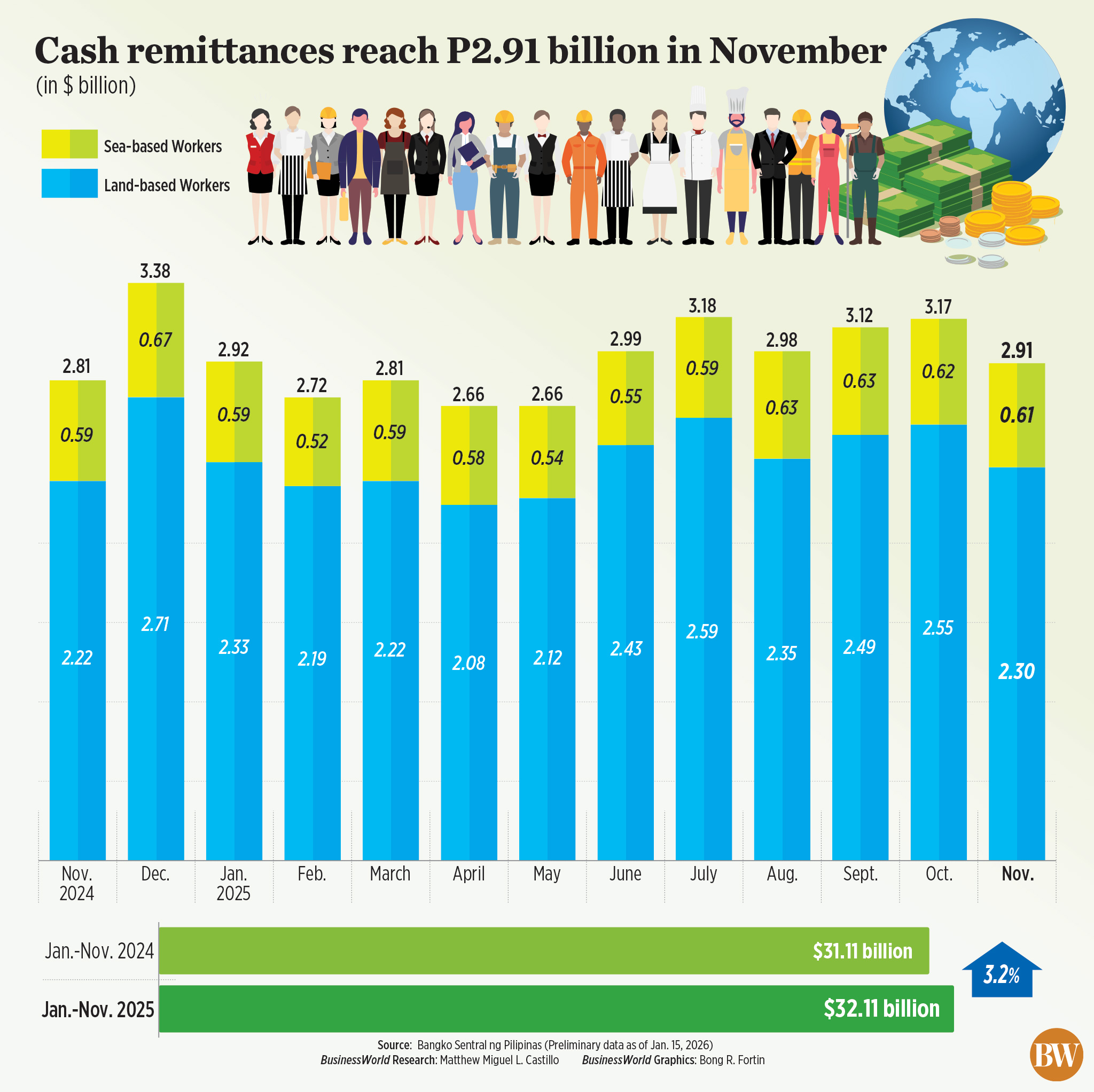
Cash remittances reach P2.91 billion in November

MONEY SENT HOME by overseas Filipino workers (OFW) fell to its lowest level in six months in November, the Bangko Sentral ng Pilipinas (BSP) reported. Read the full story.

Learning from Japan’s infrastructure edge

My recent visit to Tokyo once again reminded me why Japan remains among the world’s most admired nations when it comes to infrastructure and urban management. The country’s quiet efficiency does not compete for attention — it simply works. Whether in the form of ultra-modern railways, century-old network logic preserved through order and discipline, or underground engineering marvels hidden from public sight, Japan demonstrates what long-term planning, continuity and technical excellence can achieve.

Even in Shibuya — already one of the world’s most photographed intersections — major redevelopment continues. The district’s iconic Scramble Crossing remains the centerpiece, but a closer look reveals cranes, construction and newly risen towers forming what is arguably Tokyo’s  most ambitious urban renewal program in decades. Instead of slowing down after having “arrived,” Tokyo keeps rebuilding, reimagining and preparing for the next 50 years. Infrastructure is not treated as a political trophy; it is a national habit.

One of Japan’s most impressive feats is one that tourists rarely see: its vast underground flood control system, particularly the Metropolitan Area Outer Underground Discharge Channel — often called the G-Cans Project. This subterranean cathedral of engineering lies beneath Saitama and protects Tokyo from catastrophic flooding by diverting water from overflowing rivers into enormous silos before pumping them safely into the Edo River. Measuring more than 25 meters high and stretching about 6 kilometers, it is one of the world’s largest flood control facilities.

The Philippines, of course, is no stranger to flooding. Metro Manila’s perennial inundation during the typhoon season, exacerbated by clogged waterways and unplanned urban growth, makes one appreciate  the foresight behind Tokyo’s decision to invest in infrastructure that citizens never directly see. It is a reminder that the most important infrastructure is sometimes invisible — and that long-term risk mitigation requires an engineering mindset, not a short election-cycle horizon.

During this trip, our visit to TeamLab Planets —one of the city’s most innovative attractions — also revealed another piece of Tokyo’s brilliance: the Yurikamome Line. This elevated, driverless monorail connects Shimbashi to the  Toyosu area, gliding over Tokyo Bay with sweeping views of the skyline and waterfront. Unlike JR East or the Tokyo Metro, the Yurikamome is managed independently by a third-sector company, showing how multiple operators can co-exist productively through integration and coordination.

The Yurikamome Line is a lesson in urban transport innovation: automation, punctuality and seamless connectivity with other systems. And because it is elevated, commuters and tourists alike get a glimpse of the continuous developments around Tokyo Bay —a testament to how reclaimed land, when thoughtfully planned, can become a thriving economic and cultural hub.

In the Philippines,  infrastructure remains the Achilles’ heel of national competitiveness. Metro Manila’s road networks are choked, railways are limited, mass transit systems are either under construction or overloaded and flooding still paralyzes entire districts after a few hours of rain. The country’s infrastructure “nightmare” is rooted in three chronic issues: fragmented planning, inconsistent political commitmentand the lack of a long-term blueprint insulated from administrative turnover.

To this, one must add a fourth — and perhaps most painful — ailment: corruption. What should be budgeted must be spent properly, transparently, and free from the leakages that have long plagued Philippine public works. When the previous administration launched its ambitious “Build, Build, Build” program, there was initial hope that the infrastructure gap could finally be narrowed. Instead, many projects became mired in delays, questionable contracts, and accusations that padded deals served to enrich well-connected operators. Infrastructure is expensive — but corruption makes it unaffordable.

A glaring example is MRT-7. Launched with much fanfare and originally targeted for completion years ago, MRT-7 was positioned as a transformative project that would finally connect Quezon City to San Jose del Monte, Bulacan. Today, it stands as a symbol of chronic delay. The project keeps getting pushed back —affected by right-of-way issues, contractor disputes, shifting timelines and poor coordination among implementing agencies. For commuters who spend hours navigating Commonwealth Avenue daily, the endless construction has become a painful reminder that timelines in the Philippines are often aspirational rather than binding commitments.

MRT-7’s predicament reflects a deeper malaise: we plan grandly but execute weakly. Japan builds rail lines in phases but adheres to clear engineering schedules and transparent progress reporting. In the Philippines, by contrast, project slippage is normalized, and public frustration is met with shifting deadlines rather than accountability. If the Philippines is serious about solving its infrastructure deficit, it must fix the pipeline from feasibility study to right-of-way acquisition to implementation.

What, then, can we learn from Japan?

First, infrastructure must be apolitical and anchored on continuity. Japan’s projects span administrations, sometimes lasting decades, yet they are completed with the original objective intact.

Second, mass transit should be the backbone, not an afterthought. Tokyo’s railways —JR, Metro, Toei and private lines — form an integrated ecosystem. Manila must evolve toward a true multimodal, rail-centric model.

Third, invisible infrastructure matters. Investments in drainage, earthquake protection, underground utilities, and risk management are indispensable.

Fourth, continuous urban redevelopment is essential. Shibuya’s transformation shows that cities must evolve with time, not stagnate.

Finally, infrastructure integrity requires a culture of transparency and accountability. Clean governance is not optional; it is the foundation of credible public investment.

Tokyo shows what is possible. The question is whether we have the resolve — and honesty — to follow through.

The views expressed here are his own and do not necessarily reflect the opinion of his office or FINEX.


Benel Dela Paz Lagua was previously EVP and chief development officer at the Development Bank of the Philippines.  He is an active FINEX member and an advocate of risk-based lending for SMEs. Today, he is independent director in progressive banks and in some NGOs.

ADVERTISEMENT
ADVERTISEMENT