Home Blog Page 4274

Telecom permit streamlining rules to cover pending applications

BW FILE PHOTO

THE Anti-Red Tape Authority (ARTA) said that the newly launched implementing rules and regulations (IRR) of Executive Order No. 32 (EO 32), which streamlines the permit process for telecommunications infrastructure, will apply to all pending applications for permits.

“Just as the blueprint is essential for constructing a building, the IRR serves as our guide translating the principles of EO 32 into actionable steps and practical procedures,” ARTA Director General Ernesto V. Perez said at the launch and signing of the IRR on Monday.

He said that the IRR will apply to all current applications for permits, licenses, certifications and authorizations, including those submitted by public telecommunication entities, cable TV operators, VAS providers, ICT technology providers, independent tower companies and distribution utilities.

According to Mr. Perez, the IRR will also apply to all National Government agencies’ instrumentalities which include government-owned and -controlled corporations and local government units involved in the issuance of permits required for the construction or repair of passive telecommunications tower infrastructure.

Rule 3 of the IRR provides for a single application form for construction-related permits. The documents required include property documents, technical documents, a clearance for the structure’s proposed height, validated affidavits of undertaking, and Homeowners Association clearance.

“Building permit applications with complete documentary requirements must be processed by the various offices within the one-stop shop construction permit unit within a non-extendible period of seven working days,” Mr. Perez said.

The IRR also requires local government units to implement a one-time assessment of building-related fees and charges. It also sets the processing times for permits applied for.

Mr. Perez said that if a proposed structure is to be built outside critical areas as defined by the Civil Aviation Authority of the Philippines (CAAP), the applicant is not required to submit a height clearance permit and instead submit a CAAP-validated affidavit of undertaking which the agency is required to issue within two working days.

For clearances required from homeowners associations, the officers of the duly registered association are given 10 working days to act on the application.

Mr. Perez said that if this period lapses, upon complaint and due verification, the Department of Human Settlements and Urban Development can order the homeowners association to issue the clearance, which is deemed automatically approved. — Justine Irish D. Tabile

Transfer pricing rules for manufacturers

Foreign investors consider the Philippines a preferred destination in Southeast Asia for offshore manufacturing due to low labor costs, the large and young labor pool, high English proficiency, and fiscal incentives, to name a few.

Most manufacturers, if not all, are part of a multinational company (MNC). Hence, related party transactions are common within the group.

THE MANUFACTURING VALUE CHAIN AND PROPER ALLOCATION OF PROFITS
Porter’s value chain model recognizes two types of activity: primary and secondary. Primary activities are core functions for the enterprise, creating and delivering products and services for customers. This includes inbound logistics, operations, outbound logistics, marketing and sales, and service.

Secondary activities, on the other hand, support the primary activities; these activities often play a more significant role in the success of the primary activities. This includes procurement, human resources, technology, and infrastructure.

For an MNC engaged in manufacturing and selling products, having a well-planned value chain can help in achieving its goals by identifying business activities that can create value and a competitive advantage for the business. Creating separate entities to perform each function in the value chain can help optimize activities to maximize output and minimize organizational expenses. This strategy was adopted decades ago and has proven to be a success.

For instance, ABC Group, which sells electronic devices globally, may set up a research and development subsidiary, a manufacturing subsidiary, a logistics subsidiary, and a sales and marketing subsidiary. In practice, these subsidiaries are established in different jurisdictions for various commercial reasons.

In this set-up, transfer pricing (TP) issues usually arise, particularly on the question of whether each entity in the group is commensurately compensated depending on the functions performed, assets employed, and risks borne in the value chain. Because these entities are usually established in separate jurisdictions with different income tax rules, MNCs typically minimize their tax payments by setting up transfer prices in such a manner as to earn more profits from low-tax jurisdictions instead of high-tax jurisdictions, while maintaining the desired groupwide profits.

This is where the arm’s length principle (ALP) comes in. As a rule, the level of profit derived by an entity should be directly correlated to the functions performed, the assets used, and the risks assumed.

ARM’S LENGTH PRINCIPLE IN MANUFACTURING
TP rules provide that transactions between related parties must adhere to the ALP, which means that transactions with a related party should be made under comparable conditions and circumstances as transactions with an independent party, or the conditions of the commercial and financial relations between the independent parties are ordinarily determined by external market forces.

To determine the ideal transfer price or the appropriate level of profit for manufacturing companies, proper characterization of the entity is fundamental. For TP purposes, a manufacturing company is characterized as either a toll manufacturer, contract manufacturer, licensed manufacturer, or entrepreneur/full-fledged manufacturer.

A toll manufacturer processes the raw materials supplied by the principal into finished or semi-finished products based on the principal’s specifications, formula, and quantity. This entity performs very limited functions, does not own manufacturing intangibles, and bears limited risks.

A contract manufacturer produces goods for a principal generally based on pre-agreed quantities and schedules. The principal guarantees the purchase of goods for the quantity agreed. This entity generally performs moderate functions, with limited manufacturing intangibles, and shoulders limited risks.

A licensed manufacturer is akin to an entrepreneur/full-fledged manufacturer, except that it does not own the manufacturing intangibles used to produce the products nor perform any research and development (R&D) functions.

Lastly, an entrepreneur/full-fledged manufacturer has a high functional profile. It undertakes manufacturing functions for its own sales, and performs significant functions in the value chain (e.g., R&D, sales, production, after-sales, logistics, and marketing). In addition, it bears significant risks such as product liability, warranty, capacity utilization, market, price, etc., and receives all residual profits or losses from the value chain.

Functional analysis is performed to accurately identify the characteristics of the entity. By knowing the characteristics, the level of the risks borne and profit proportional to the risks can be predicted. Let’s consider a contract or toll manufacturer that only carries out production as ordered by a related party, without performing functions such as operational strategy setting, product R&D, and sales. Such a company is expected to maintain a consistent level of profitability. Should the manufacturer suffer from losses, it must prove that these losses are not a result of its transactions with a related party.

APPLICATION OF ALP IN MANUFACTURING
Below are the TP methodologies that manufacturing companies can use to measure the transfer price or level of profits.

Comparative Uncontrolled Price (CUP) method

This method compares the price that a manufacturer charges its related party (controlled transaction) with the price charged to an unrelated party (uncontrolled). This method requires the highest degree of similarity (i.e., type of product, volume of transactions, geographical market, period of transactions, terms of agreement, FAR analysis, specific features, etc.).

If the manufacturer sells to both related and unrelated parties where the product and other terms are comparable, internal CUP may be used. To illustrate, Mfg. Corp., a manufacturer of semiconductors, sells its products primarily to third-party customers at P10,000 per unit. If Mfg. Corp. sells comparable products to related parties with comparable terms and conditions, ideally, the price should also be P10,000.

On the other hand, external CUP may also be used by comparing the selling price charged to the related party with that of the selling price between two independent parties. Say, Mfg. Corp., a company that manufactures plastic molds, sells its products solely to related parties. If one of its competitors also manufactures and sells comparable plastic molds to third-party customers and charges P11,000 per piece, then Mfg. Corp. should ideally charge P11,000 per piece to its related parties, provided that the terms and conditions are also comparable.

Again, the CUP method requires the highest degree of comparability of the manufactured product as well as the terms and conditions of the transactions. With that said, a comparability analysis must be performed first between the related and independent transactions. If material differences exist such as quality of the products, credit terms, transport terms, etc., which affect the price, reliable adjustments should be made to eliminate the differences.

Cost Plus Method (CPM)

CPM compares the gross profit mark-up on the costs incurred by the manufacturer with the gross profit realized by the same manufacturer (internal CPM) or comparable independent manufacturers (external CPM) in uncontrolled transactions.

For instance, Mfg. Corp. manufactures packaging materials. The total cost of goods manufactured is P100 per unit. Mfg. Corp. bills third-party customers at a 40% mark-up on the cost of goods manufactured, or P140 per unit. If Mfg. Corp. sells comparable products to related parties, ideally, the price should also be P140 per unit.

On the other hand, if there are independent and comparable manufacturing companies whose gross profit mark-up is 50%, then Mfg. Corp. should ideally charge its related parties a 50% mark-up on costs of goods manufactured.

In using CPM, companies should bear in mind there may be substantial variance in the classification and accounting treatment of items of expenses as either cost of goods manufactured or operating expenditure among different manufacturing companies. Hence, these differences should be taken into consideration.

The Transactional Net Margin Method (TNMM)

TNMM compares the profit level indicator (PLI), net profit relative to an appropriate base (e.g., cost, sales, assets), realized by the manufacturing company from controlled transactions with the same PLI realized by independent and comparable manufacturing companies.

The TNMM is based on the economic concept that similar firms operating in the same industry would tend to yield similar returns over time.

As compared to other TP methods, TNMM allows for some degree of tolerance in minor differences between the functions and products of the comparable manufacturing companies and the taxpayer. Hence, the total profits of the companies can be tested even if there are some minor differences in the products and functions.

Takeaway

A Bible verse says, “Whoever sows sparingly will also reap sparingly, and whoever sows generously will also reap generously.” The same is true in applying the ALP in manufacturing companies — the more functions performed, assets employed, and risk borne, the higher benefits, and rewards that it should reap.

Let’s Talk TP is an offshoot of Let’s Talk Tax, a weekly newspaper column of P&A Grant Thornton that aims to keep the public informed of various developments in taxation. This article is not intended to be a substitute for competent professional advice.


Christian Derick D. Villafranca is a manager from the Tax Advisory & Compliance Practice Area of P&A Grant Thornton. P&A Grant Thornton is one of the leading audit, tax, advisory, and outsourcing firms in the Philippines, with 29 Partners and more than 1000 staff members.

Tweet us:  GrantThorntonPH, Facebook: P&A Grant Thornton

pagrantthornton@ph.gt.com

www.grantthornton.com.ph

More businesses turn to AI to strengthen cybersecurity defenses — Google

PIXABAY

Many businesses are turning to artificial intelligence (AI) as a solution to bolster their defenses against cyber threats, according to Google.

“Generative AI is now being used to identify threats faster, handle the increased volume load of events, and better support security analysts,” said Mark Johnston, director at the Google Cloud office of the chief information security officer (CISO), during the company’s cybersecurity checkup session on Friday last week.

The Asia-Pacific region accounted for 31% of global cyberattacks last year, taking approximately 33 days to detect attacks within the system, according to reports from International Business Machines and the cybersecurity firm Mandiant.

Data from Mandiant also indicated that more than 200,000 hours a year are spent responding to cyberattacks, tracking the movements of over 3,500 threat actors.

“AI can help respond to these unprecedented challenges,” noted Mr. Johnston, emphasizing that machine learning classifiers and detection eliminated two and a half times more device attacks in Google’s online browser.

Mr. Johnston also said that security expertise can be democratized through AI and large language models, which can also improve the output of defenders in drilling down on their cybersecurity events.

“The best modern digital security comes with openness,” he said regarding the company’s expansion to reward AI research and applications for safety. “Effective risk management strategies will need to evolve with AI.”

Google’s Duet AI platform can sift through large-scale logs and normalize information for security analysts through summaries and query or script recommendations, he noted.

“We used to require very skilled software engineers to understand particular threats,” he said. “AI tools can improve detection and provide mitigation of bad pieces of code that would have previously gone undetected.”

“This will have the most significant impact on organizations that lack the experts or resources,” he added, highlighting AI’s capacity to support small businesses with limited resources.

Mr. Johnston also noted that generative AI is in its early phases of cybersecurity adoption, with APAC CISOs currently experimenting with how to improve operations without increasing risks, considering the privacy concerns associated with the new technology.

At the same time, he stressed the importance of investing in upskilling cybersecurity knowledge to address today’s problems. “AI can have a major positive impact on the security ecosystem, but only if we are bold and responsible.”

Google has offered career certificate sponsorships in India and Singapore to upskill its employees with cybersecurity knowledge.

“No single model rules them all,” he said regarding the various applications of AI in companies’ cybersecurity. “We still need to develop a system that enhances talents and capabilities.”

“Organizations require industry-wide support to embrace AI confidently and securely.” — Miguel Hanz L. Antivola

E-wallet transaction limits needed to fight vote buying before and on election day — Namfrel

STOCK PHOTO | Image by Pongsawat Pasom from Unsplash

By Miguel Hanz L. Antivola, Reporter

Vote buying on digital platforms is a major concern that often goes unnoticed, especially with more and more people using e-wallets and a lack of direct reports, an election watchdog said.

It is next to impossible for the Commission on Elections (Comelec) to implement a one-shot solution, Eric Jude O. Alvia, secretary general of the National Citizens’ Movement for Free Elections (Namfrel), said in an interview with BusinessWorld. 

“[E-wallets] should put a cap of ten transactions or lower sent during a number of days before and on the election day to make it cumbersome for someone to do vote buying,” Mr. Alvia said on a more feasible response to the problem.

“The indicated mobile numbers can be used as support, but these are not fool-proof ways to curtail the issue,” he added. 

“It could only supplement other means of evidence that was gathered during the actual observation [of vote buying],” he said.

The Comelec received 1,226 vote buying reports in last year’s national and local elections, Comelec Chairman George Erwin M. Garcia told a recent briefing. 

International poll watchdog Asian Network for Free Elections has noted that rampant vote buying is “the biggest flaw in Philippine elections… which may plague the country more than any other in Asia.”

“Incumbents were more often seen to benefit from such malpractices,” it said in its report published in 2022. “But the impunity afforded to those who violate campaign finance laws ensures that all sorts of candidates and parties engage in vote buying.”

“The enforcement of existing laws is essential in order to establish a playing field that is somewhat level from now, as it certainly was not the case for the 2022 elections.” 

The Comelec launched the Committee on KontraBigay on Sept. 8 — an upgrade from the former task force — to ensure the efficient implementation and enforcement of all policies and guidelines to curb vote buying and vote selling, according to Comelec Resolution No. 10946. 

This included the opening of the online KontraBigay Complaint Center to receive vote buying complaints and reports, following the upcoming barangay and Sangguniang Kabataan elections on Oct. 30. 

House Bill 1709, or an “Act Defining and Declaring Vote-Buying as a Heinous Crime,” was filed in August last year, which the Comelec said must be complemented by a review and revision of the Omnibus Election Code to adopt to the digital age, BusinessWorld reported in August last year. 

Mr. Alvia said the Comelec has invited e-wallet companies to monitor and report transactions which reflect small amounts in huge volumes. 

“Putting a limit is a double-edged sword because you inhibit business activity,” Mr. Alvia said, noting that possession of any amount above P500,000, alongside campaign paraphernalia, two days before and on election day is already presumed vote buying. 

Additionally, causing the splitting of at least P20,000 to smaller denominations five days before and on election day also counts as presumed vote buying, according to the resolution. 

Albeit evergreen, e-wallet platform GCash has set limits on account balance and transaction amounts, in accordance with the Anti-Money Laundering Act mandated by the central bank. 

Ingrid Rose Ann G. Beroсa, chief risk officer at GCash, told BusinessWorld that classified parameters are in place to detect suspicious transactions that exhibit vote buying behavior.

“If any of these parameters are hit, these accounts are suspended and investigated,” she said. 

“Once internal investigation is completed, these flagged accounts will form part of the suspicious transaction monitoring report submitted to the Anti-Money Laundering Council.”

Asiad boxing: Marcial marches on, Aira Villegas and Irish Magno fall

EUMIR MARCIAL

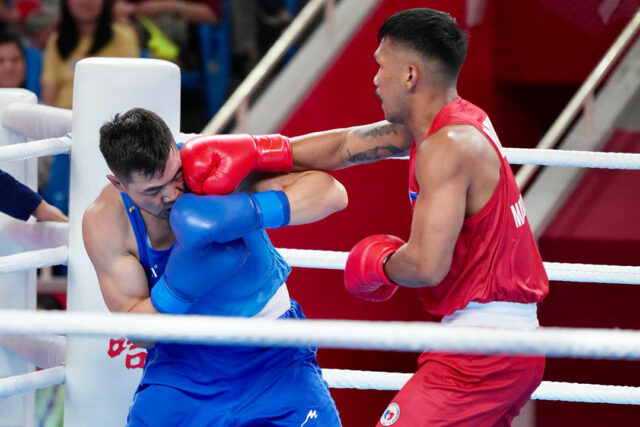
HANGZHOU — Eumir Marcial came through with a dominant showing in his light-heavyweight debut, but Irish Magno bowed out of contention as the two Olympians suffered contrasting fates at the start of the boxing competitions in the 19th Asian Games.

Mr. Marcial, 27, scored an overwhelming 5-0 victory over Dalai Gadzorig of Mongolia at the Hangzhou gymnasium to advance in the Round-of-16 of the men’s 80 kg class.

The Filipino pro boxer went up in weight from being a middleweight, where he won a bronze medal in last year’s Tokyo Olympics.

While he felt good in his first bout, Mr. Marcial has yet to fully determine if he’s really fit to fight as a light-heavyweight.

Earlier, the 32-year-old Ms. Magno was outclassed by her younger foe in Nigina Uktamova of Uzbekistan, 5-0, in the women’s 54 kg class.

The loss of Ms. Magno and Aira Villegas left Olympic silver medalist Nesthy Petecio to carry the fight for the women’s boxing team. The former world champion is set to see action on Sept. 29 against top seed Lin Yu Ting of Chinese-Taipei in the 57 kg class. — PSC

Filipinas U17 qualifies for Asia Cup in beating Vietnam

ISABELLA PRESTON — PILIPINASWNFT

IT’S the turn of the Filipinas’ under-17 team to shine as it punched historic a ticket to the 2024 AFC U17 Women’s Asian Cup.

And the young Filipinas, taking the cue from their FIFA World Cup history-making senior counterparts, did it in spectacular fashion, nipping host Vietnam, 1-0, in Sunday night’s make-or-break Qualifiers matchup at the National Youth Football Training Center in Hanoi.

Isabella Preston delivered a stunning free kick at the 56th minute to power the Philippine U17s to the massive victory that sealed their milestone debut in the ultimate battle for the Continental crown and sustained the momentum started by the Filipinas.

The Pinay teens finished runner-up in Group B with six points on two wins and a loss and joined unbeaten group winner Australia and Group A Top 2 Korea and Thailand in the march to the main draw in April.

The four qualifiers will face off with titlist Japan, North Korea and China — the top 3 teams in the 2019 AFC U16 Women’s Championship — as well as host Indonesia in the grand finale.

“I knew that I can score from a long-distanced range and I trusted myself to do it, and when it went in I was in complete awe,” said Preston, who placed a thunderous FK shot towards the top left corner beyond the reach of Vietnam keeper Le Thi Thu to give the visitors the upperhand.

“It was an amazing effort from the girls and we made history and we’re going to the Asian Cup.” — Olmin Leyba

Kiyomi Watanabe, Philippine judokas bomb out

HANGZHOU, China — Kiyomi Watanabe and four other Filipino judokas suffered crushing losses in the judo competition of the 19th Asian Games on Monday at the Xiaoshan Linpu Gymnasium here.

Ms. Watanabe, who emerged with a silver medal in the previous edition of the Asian Games in Jakarta in 2018, fell prey to a Japanese powerhouse in the quarterfinals to bomb out of medal contention of the women’s -63-kilogram class.

Two-time world silver medalist Miku Takaichi flaunted her strength as she threw the 27-year-old Ms. Watanabe for an ippon in the first 12 seconds of their match and booked a slot in the semifinals.

Ms. Watanabe was relegated to repechage but lost to Esmigul Kuyolova of Kazakhstan also via ippon in the first 13 seconds of their encounter.

“Our athletes are in good condition,” Philippine Judo Federation Secretary General Dave Carter said.

“But we got unlucky in the draw. Our athletes got paired against the top seeds in Asia. We will work hard and be more prepared next time.”

Also bombing out early were Keisei Nakano, Rena Furukawa, John Ferrer, and Ryoko Salinas.

The 26-year-old Mr. Nakano lost to Asian Games silver medalist Behruzi Khojazoda of Tajikistan via ippon in the Round of 16 of the men’s -73-kg while Ms. Furukawa fell prey to Momo Tanaoki of Japan also via ippon in the Round of 16 of the women’s -57-kg event.

Mr. Ferrer, for his part, sizzled early as he beat Janga Bahadur Saru of Nepal in the Round of 32 of the men’s 81-kg class before bowing to Bolor-Ochir Gereltuya of Mongolia in the Round of 16.

Ms. Salinas also had a good chance when she beat Garima Choundhary of India in the Round of 16 of the women’s 70-kg class.

She, however, surrendered to Shiho Tanaka of Japan, who posted an ippon in the first 45 seconds of their battle to secure a spot in the semifinals, before losing to Liao Wun Jung of Chinese Taipei in the repechage to close his Asiad stint on a sour note.

Still, the national judo squad has a chance to salvage some measure of pride as Carl Dave Aseneta and Dylwynn Gimena compete in the resumption of the tourney on Tuesday. — PSC

Joanie Delgaco misses single sculls rowing podium finish

ROWER JOANIE DELGACO — PSC-POC MEDIA POOL.

HANGZHOU, China — Rower Joanie Delgaco fell short of winning a medal as she settled for fifth in the women’s single sculls event of the 19th Asian Games on Monday at the Fuyang Water Sports Centre here.

Ms. Delgaco, the only Southeast Asian in the final round, clocked eight minutes and 5.93 seconds to finish fifth behind Anna Prakaten of Uzbekistan, Liu Ruiqi of China, Shiho Yonekawa of Japan, and Huang Yi Ting of Chinese Taipei.

Ms. Prakaten, who won the silver medal for Russia in the Tokyo Olympics, reigned supreme in the 2,000-meter race as she clocked 7:39.05 while Ms. Liu clinched the silver in 7:49.98 and Ms. Yonekawa settled for the bronze in 7:51.88.

Still, Philippine Rowing Association President Patrick Gregorio remains proud of the achievement of the 25-year old pride of Bicol.

“We should all be proud of Joanie’s feat,” Mr. Gregorio said in a statement.

“Asian rowing final is a world-class field. To achieve a fifth-place finish is truly commendable.”

Mr. Gregorio added that their goal is to make it to the Paris Olympics in 2024.

“We will continue to focus. The Paris 2024 single sculls will have five Asian qualifiers,” he said, adding that Cris Nievarez also has a good chance of returning to the Olympics following his eighth place finish in the men’s single sculls event.

Mr. Nievarez clocked 7:19.45 to emerge second behind Mahamed Riyadh Jasim Al-Khafaji of Iraq (7:16.72) in the Final B.

“According to our coach, Shukrat Ganiev, both Joanie and Cris will have a good chance of qualifying for the Paris Olympics 2024 if we prepare and train well.”

“The Asian Championship qualifying will be in Korea this April 2024.” — PSC

Gilas Pilipinas boys settle for fourth-place finish in FIBA U16 Asian Championship, Alas in All-Star Five

WORLD Cup-bound Gilas Pilipinas boys settled for a fourth-place finish after an 87-59 loss to China in the FIBA U16 Asian Championship bronze-medal match yesterday at the Al-Gharafa Sports Club Multi-Purpose Hall in Doha, Qatar.

Like in the semifinal duel against eventual champion Australia, Gilas misfired and bled for only eight points in the third quarter that doomed its hopes of finishing at the podium.

The Filipino teens were outscored by their Chinese counterparts, 26-8, in the third period and never recovered from there on their way to a 28-point defeat.

Joaquin Garbriel Ludovice top-scored with 15 points as ace player Kieffer Louie Alas tallied 13 points, five rebounds, two assists and four steals for the wards of coach Josh Reyes, who still broke their seventh-place finish last year plus a World Cup ticket.

Mr. Alas, behind averages of 15.4 points, 8.6 rebounds and 2.6 assists, made it to the FIBA U16 All-Star Five led by MVP Oscar Goodman of New Zealand.

Also in the fray were Lachlan Crate of New Zealand, Henry Sewell of Australia and and Boyuan Zhang of China to complete the best teenage hoopers in Asia-Oceania zone heading into the 2024 FIBA U17 World Cup in Turkey.

Mr. Zhang erupted for 34 points to lead China’s commanding win over Gilas for the bronze medal.

Meanwhile, Dash Daniels had 17 points while Nash Walker added 14 points including the insurance basket in the last 17 seconds as Australia earned a 79-76 win over New Zealand (NZ) to complete a three-peat.

Hayden Jones fired 31 points to spearhead NZ’s runner-up finish, an improvement from its third-place campaign last edition also held in Qatar.

Japan, Iran, host Qatar and Jordan finished in order to complete the Top 8 teams in the Asian youth tourney. — John Bryan Ulanday

NCAA: New coaches of Arellano, San Sebastian debut today

Games Tuesday
(Filoil EcoOil Arena)
2 p.m. — San Beda vs Arellano University
4 p.m. — San Sebastian vs Mapua

Newbie coaches Chico Manabat of Arellano University and John Kallos of San Sebastian College-Recoletos will try to prove their worth as they debut today against powerhouse teams San Beda University and Mapua University, respectively, in NCAA Season 99 at the Filoil EcoOil Arena.

Mr. Manabat, who succeeded Cholo Martin, will handle a team that will have nine rookies when they clash with the Lions at 2 p.m. while Mr. Kallos, who took over from Egay Macaraya, tackle the fancied Cardinals at 4 p.m.

“We’re a young team,” said Mr. Manabat, who has finally gotten a big break after being an assistant to Jeff Napa for a long time.

Mr. Manabat will break in Kyle Anama, Yuan Camay, John Lorenz Capulong, Dominic Dayrit, Joshua Dela Cruz, Ernest Geronimo, Bryan Rosalin, Felix Villarente, and Ralph Yanes after losing Axel Doromal, Shane Menina, Cade Flores and Travis Mantua from a season back.

Staying were Danielle Mallari, Joshua Abastillas, Lars Sunga, Jade Talampas, Mc Jeadan Ongotan, and Troy Valencia.

For Mr. Kallos, he reaped the seeds that Mr. Macaraya planted as he will have at his disposal battle-tested veterans in Rafael Are, Romel Calahat, Alex Desoyo, Jessie Sumoda, James Una and Cris Jacob Shanoda.

The two will be put to acid tests though as they battle a Mapua and a San Beda team out to redeem themselves for underperforming a year ago.

The Cardinals, runners up two seasons back, ran into trouble early and never got their bearings back and finished seventh while the Lions had their worst effort in the past three decades after ending up at No. 4.

“We’re eager to bounce back this year,” said Mapua mentor Randy Alcantara. — Joey Villar

Shagne, Ariana find Chinese, track too tough to crack in MTB cross-country

CHUN’AN — Shagne Paula Yaoyao finished eighth and Arian Evangelista fell two laps behind in the women’s cross-country Olympic race of cycling’s mountain bike (MTB) in the 19th Asian Games on Monday.

“They’re like robots,” was Ms. Yaoyao’s reaction to China’s Li Hongfeng and Ma Caixia, who won gold and silver, respectively, finishing the technical race still looking fresh and ready for more as the rest were, simply, spent.

Ms. Li won in one hour, 30 minutes and 59 seconds to improve on the silver she clinched in Indonesia five years ago, while Ms. Ma crossed six minutes for the silver but with a six-minute gap ahead of bronze medalist Faranak Partoazar of Iran.

Ms. Yaoyao wound up seventh in the 15-rider field with a 26-minute gap to Li.

“But I’m happy with my result, I really did my best here and I didn’t expect to land in the top 10,” said Ms. Yaoyao, a bronze medalist in MTB’s mixed relay in the Cambodia SES Games last May.

She competed in the UCI world championships along with Evangelista last month in Scotland but raced in her first Asian Games.

“I cant hardly believe how tough and strong the Chinese were,” said PhilCycling secretary-general Atty. Billy Sumagui. “While the others were visibly exhausted and drained, the Chinese looked like they could go several more laps.”

For Arian Evangelista, it was tough luck — her front tire had reduced pressure and her rear was super flat. She had to run her bike 2 kms to the feed zone to have both replaced thus losing two laps in the event raced over a 4.8-km loop.

She had to be pulled out of the race along with three others, while another three entries were more unfortunate as they ended up DNF or did not finish. “It was very dry today and there were too many rocks,” said Ms. Evangelista of the course.

With MTB done, the country’s campaign — supported by the Philippine Olympic Committee President Rep. Abraham “Bambol” Tolentino, who also heads PhilCycling, and the Philippine Olympic Committee — in cycling reverts to BMX racing with 2014 Incheon Asiad gold medalist Daniel Caluag teaming up with Patrick Coo. Their event is set for October 1.

After BMX, Ronald Oranza, Jonel Carcueva and Joshua Pascual vie in Road on Oct, 6. — PSC

PHL 3×3 women’s team out of Asiad

HANGZHOU — Its appeal for inclusion of two replacement players denied, the Philippine women’s 3×3 team decided to withdraw from the 19th Asian Games with a heavy heart.

Coach Pat Aquino said the team was left with no recourse as it only has Camille Nolasco and Louna Ozar in its roster after the Hangzhou Asian Games Organizing Committee (HAGOC) thumbed down last-minute replacements Cielo Pagdulagan and Marga Villanueva.

Mmess. Pagdulagan and Villanueva were supposed to take the place of 3×3 veterans Camille Clarin and Angel Surada.

The decision was handed out Monday morning at the start of basketball competitions in the quadrennial showpiece.

Mr. Aquino apologized in behalf of the team, and at the same time, felt sorry for the players as the stint was the first time the 3×3 women’s squad is seeing action in the Asiad.

The Philippines was scheduled to play Jordan for its first game. — PSC

ADVERTISEMENT
ADVERTISEMENT