Home Blog Page 4243

Yields on gov’t debt rise
YIELDS on government securities (GS) increased last week after US and Philippine central banks doubled down on their hawkish stance.

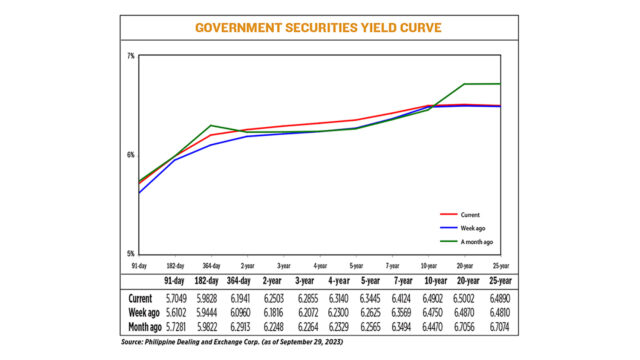
GS yields at the secondary market went up by an average of 5.78 basis points (bps) week on week, according to PHP Bloomberg Valuation Service Reference Rates as of Sept. 29 published on the Philippine Dealing System’s website.

Yields climbed across the board week on week. Rates of the 91-, 182-, and 364-day Treasury bills (T-bills) rose by 9.47 bps (to 5.7049%), 3.84 bps (5.9828%), and 9.81 bps (6.1941%), respectively.

At the belly, rates of the two-, three-, four-, five-, and seven-year Treasury bonds increased by 6.87 bps (to 6.2503%), 7.83 bps (6.2855%), 8.40 bps (6.3140%), 8.20 bps (6.3445%), and 5.55 bps (6.4124%), respectively.

Yields at the long end went up as the 10-, 20-, and 25-year debt papers increased by 1.52 bps (to 6.4902%), 1.32 bps (6.5002%), and 0.80 bp (to 6.489%), respectively.

Total GS volume traded on Friday fell to P10.96 billion from P20.27 billion on Sept. 22.

“Yields were relatively higher [last week] on the short to belly maturities given the higher US yields that saw 10 years break 6.5% support and the possible off-cycle hike statements and pushback of cuts further into 2024 from the BSP (Bangko Sentral ng Pilipinas) governor,” Security Bank Corp. Chief Investment Officer for Trust and Asset Management Group Noel S. Reyes said in an e-mail.

Yield movements last week came after the majority of US central bank officials hinted at prolonged periods of high interest rates, echoing the guidance from the latest US Federal Reserve meeting, a bond trader said in a separate e-mail interview.

The Fed last month kept its key rate between 5.25% and 5.5% and penciled in one more hike before the year ends.

Federal Reserve Bank of New York President John Williams on Friday said the central bank may be finished with rate hikes as inflation pressures are moving toward the 2% target, Reuters reported.

However, Mr. Williams noted that uncertainty about the future remains high and their decisions will always be guided by the data.

Meanwhile, the BSP last month kept its policy rate at a near 16-year high of 6.25%.BSP Governor Eli M. Remolona, Jr. signaled he is open to an off-cycle hike before its next Monetary Board (MB) meeting on Nov. 16 and also ruled out rate cuts in the near term.

“The announcement of a possible rate hike by November at the latest has sustained the overall weaker sentiment and defensive posture of players,” Mr. Reyes said.

For this week, investors may remain defensive as they anticipate the release of September Philippine inflation data on Oct. 5, Thursday, he said.

“Any number lower than last month’s shall trigger buying and anything higher will lead to further selling from the larger probability of an off-cycle hike from the MB.  Some support will come out for the longer maturities leading to increased flatness of the curve,” he added.

A BusinessWorld poll of 17 analysts yielded a median estimate of 5.4% for September headline inflation, near the lower end of the BSP’s 5.3% to 6.1% forecast for the month.

If realized, this would be faster than the 5.3% print in August but lower than the 6.9% seen last year. — ACA with Reuters


GCash awaits better showing for rest of 2023

ELECTRONIC WALLET platform GCash is bullish on its improved performance in the remaining months of the year amid increased new customer registrations and stronger consumer spending, according to its operator G-Xchange, Inc.

“I think we are [bullish]. We’re very thankful to our customers and our partners,” G-Xchange Chief Executive Officer Oscar A. Reyes, Jr. said on the sidelines of a signing event in Makati City last week.

He said GCash is seeing more usage from its existing customers “and we see more customers joining us as well.” He did not provide specific figures.

“Also from our partners, we continue to expand services with them. We’re offering more products through them and that actually helps us serve our customers better as well together,” he added.

Mr. Reyes said a factor behind the positive outlook for GCash is the return of retail spending.

“Overall, the market is in a good upswing now. Everybody’s face to face. Everybody is back. Retail spending is there,” he said.

“If people have money, people are getting to earn, then they will use GCash,” he added.

Mr. Reyes said this as GCash sets its sights on further expanding to more areas outside the Philippines such as the Middle East, Europe, and other Southeast Asian countries, including Singapore.

“Right now, we are in six markets overseas. We want to expand that further. There are 10 more countries where we want to expand to as soon as we can,” he said.

GCash has a presence in France, Germany, Japan, Australia, Italy, the United States, the United Kingdom, and Canada, with users being able to access the e-wallet using an international subscriber identity module or SIM card.

Meanwhile, Mr. Reyes said GCash’s plan for an initial public offering (IPO) is progressing, adding that the company is already “financially sustainable.”

“The standing order is for us to be IPO-ready. We’re doing everything to make that happen. [The] good thing is we’re financially sustainable as a company, but there are other things that we need to work on to make that happen,” Mr. Reyes said, adding that the timing also depends on the “readiness of the market.”

“We want it to be a good IPO. We’re hoping that it becomes a big one,” he added. — Revin Mikhael D. Ochave

Don’t worry about global population collapse

JOSEPH CHAN-UNSPLASH

THE WORLD’s massive human population is leveling off. Most projections show we’ll hit peak humanity in the 21st century, as people choose to have smaller families and women gain power over their own reproduction. This is great news for the future of our species.

And yet alarms are sounding. While environmentalists have long warned of a planet with too many people, now some economists are warning of a future with too few. For example, economist Dean Spears from the University of Texas has written that an “unprecedented decline” in population will lead to a bleak future of slower economic growth and less innovation.

But demographers I spoke with say this concern is based more on speculation than science. A dramatic collapse in population is unlikely to happen within the next 100 years barring some new plague or nuclear war or other apocalypse. And if we need more creative minds in the world, we could stop doing such a terrible job of nourishing and educating the people we’re already producing.

Predictions about future population levels that don’t come with wide margins of error should always be taken with a grain of salt. Joel Cohen, a mathematician, biologist, and demographer at Rockefeller University wants to see population projections treated like a real science with a proper accounting for uncertainty. We don’t even know the exact number of people alive now, he points out. When the UN declared we’d surpassed 8 billion on Nov. 15, 2022, it was a “publicity stunt,” he says.

The uncertainty in counting world populations is at least 2% — which adds up to about 160 million people or more. Since the world population grows at most by 80 million a year, we could have hit 8 billion two years earlier, or it might not happen until 2024.

Benjamin Franklin first recognized populations can grow exponentially, and forecast that the American colonies would double every 25 years. In 1798, English economist Thomas Malthus applied this principle globally and wrongly predicted this growth rate would continue until we ran out of food and civilization collapsed.

This line of pessimistic thinking may sound familiar to those who remember the 1968 book by Stanford University scientists Paul and Anne Ehrlich, The Population Bomb. The Ehrlichs famously — and incorrectly — envisioned a 20th century starvation catastrophe. They failed to recognize that technological advances might meet increased need, and that women worldwide would change from having six to slightly under two children each, on average, in the coming half-century.

Today’s forecasts account for multiple variables and recognize that population increases are leveling off, not spiking and then plummeting. Some of the most reliable projections, Cohen said, come from demographers with the UN. Their latest estimate shows the global population will plateau at around 11 billion people by 2100.

A different model, created by the Institute for Health Metrics and Evaluation (IHME) and published in The Lancet in 2020, showed an earlier, lower peak around 2064 at 9.7 billion, followed by a steady decline, bringing us down to around 6 billion by 2100. Cohen doesn’t find that alarming — that’s about the number of people alive in 2000.

That inevitable rise in the near term worries Daniel Blumstein, an ecologist at UCLA who is co-author of a 2021 paper on avoiding a “ghastly future” (co-authored with, among other researchers, the Ehrlichs). Population and consumption patterns are intertwined, he says, and together are causing multiple environmental problems, some of them irreversible.

Blumstein points out that the innovations in agriculture that Malthus and the Ehrlichs failed to account for have allowed our population to swell far beyond our ecological niche — with unintended consequences. Pesticides, for example, are killing the bees necessary for pollinating crops. The big picture: Buildup of waste, especially carbon dioxide, along with the destruction of habitat for wild plants and animals, are now threatening humans more than a shortfall in the global supply of food. These changes are contributing to valid concerns about the creation of climate refugees.

There are also real reasons to be concerned about how society will adapt to an aging population. In many countries, the elderly make up a large and growing share of people. Nicholas Eberstadt, a demographer and economist from the American Enterprise Institute, said most countries in the world are already reproducing below replacement level, except for the Middle East and Sub-Saharan Africa. Even China’s massive population has begun to shrink, and India’s fertility has fallen below replacement level.

People aren’t selfish for choosing smaller families. We are powerfully programmed by Darwinian evolution to want to have offspring, or at least to have sex, but women are also endowed with the instinct to limit reproduction to the number who can be raised with a high probability of success in life. When women have large numbers of children, it’s often a result of high child mortality or lack of power over their own lives.

Those warning that a population drop could decrease collective brain power and hurt the economy overlook a better solution than producing more babies: Taking better care of the ones we have.

About 22% of children under five today are too short for their age because they don’t get enough of the right kinds of nutrients to grow, and because worms and infections compete for the inadequate food they do get, Cohen said. That can affect not only the body, but the brain. And Eberstadt worries about future mismatches between skilled jobs and an undereducated population.

Taking good care of the next generation is the logic parents around the world apply to their own families — and while it won’t solve all our environmental and economic problems, it’s a start.

BLOOMBERG OPINION

BMW M2: Power to the people

The BMW M2 in MotoGP safety car livery at the Chang International Circuit in Buriram, Thailand — PHOTO BY KAP MACEDA AGUILA

By Kap Maceda Aguila

POP OPEN the hood of the BMW M2, and you’ll see a pretty cramped engine bay. The engine cover proudly proclaims what motivates this coupe: “BMW M Power.” To be specific, an M TwinPower Turbo, inline-six hums with 460hp and 550Nm of torque.

This is important because this rear-wheel-drive M2 actually shares a mill (albeit detuned with a smidge less hp) with its larger M3 and M4 siblings. But because it obviously needs to move a lighter vehicle, the six-banger effectively turns the M2 into a pocket rocket. At the very least, in this regard, this entry-level M model gives you (most literally) bang for your buck.

This we learned firsthand, ensconced in the driver’s seat of the vehicle that BMW Philippines just officially launched recently.

Prior to the launch, at the Chang International Circuit in the heart of Buriram, Thailand, select motoring media practitioners were given stints behind the wheel of some BMW models, including the M340i, 330e M Sport, iX xDrive40 Sport, and, of course, the M2.

Despite its compact size, the M2 undoubtedly looks athletic — set off by the frameless kidney grille that gives it a right blend of aggression and poise. It’s a bit low-key, but you know it means business — especially with its sculpted, muscular fascias front and back. Particularly eye-catching are the vertically arranged reflectors and the two pairs of exhaust tailpipes.

But the proof in the pudding is when you step on the throttle. The engine returns a modest grumble — a promise of what’s to come. And you’ll definitely come back for more. That we learned as we floored the pedal and breached 100kph in no time on the circuit’s straight — routinely breaching 200kph before we confidently stepped on the brakes at the last moment before making a sweeping right turn.

The engine can rev confidently to a maximum of 7,200rpm, with the M-specific exhaust (bearing electrically controlled flaps) blatting its way up the eight-speed M Steptronic transmission with Drivelogic, which offers three shift settings. Despite repeated track abuse, BMW says the oil supply system “is designed to handle extremely dynamic driving situations when out on the track, as is the cooling system.” We do not doubt it.

The official standstill-to-100kph time, per BMW, is 4.3 ticks for the eight-speed M Steptronic, and it can reach 250kph for the M2 Pure (priced at P5.99 million). The M2 Carbon (retailing for P8.89 million) can attain 290kph.

Inside, the BMW M2 is equipped with M-specific readouts, controls, and setup options, plus the large BMW Widescreen Display. “Driving-related information including Shift Lights appears in a new graphical layout on the 12.3-inch information display. M-specific widgets for vehicle setup and tire condition are just two of the items that can be called up in the 14.9-inch control display,” reports the company in a release.

The M2 is a luxury and tech showcase as well, with the “BMW Curved Display and the BMW Intelligent Personal Assistant being part of the latest-generation BMW iDrive.” Designers have ensured “intuitive interaction between driver and vehicle using touch control and natural language.” Happily, Apple CarPlay and Android Auto come standard as well. The BMW Live Cockpit Plus comes with the BMW Maps navigation system, ambient lighting, and a high-fidelity speaker system for the BMW M2 Pure. The BMW M2 Carbon, on the other hand, receives a Harman Kardon Surround sound system — not to mention an M Carbon roof that reduces weight by around six kilograms.

Sports seats are wrapped in Sensatec/Alcantara surfaces for the BMW M2 Pure, while the M Carbon bucket seats on the BMW M2 use carbon fiber reinforced plastic (CFRP) in the “structural elements” of the seat cushion and backrest. Side bolsters and the space below the head restraints get cutouts to save on weight. A three-zone automatic climate control comes with the list of amenities.

The BMW M2 Pure and Carbon are available in Alpine White, Zandvoort Blue, M Brookyln Grey, Black Sapphire, and M Toronto Red metallic shades. BMW Philippines packages each purchase with a five-year comprehensive BMW Warranty.

Maharlika could be active in market by Q1, Diokno says

Finance Secretary Benjamin E. Diokno holds a press briefing in Malacañang on May 30, 2023. — PHILIPPINE STAR/KRIZ JOHN ROSALES

THE Maharlika Investment Corp. (MIC) will likely start becoming active in the market by the first quarter, once it works out an investment strategy and as the industry becomes familiar with the people running it, Finance Secretary Benjamin E. Diokno said.

Mr. Diokno told reporters that while the Maharlika Investment Fund is expected to be operational by the end of the year, market activity will take somewhat longer.

“What investors are looking for now are the faces behind the MIC, as well as the strategy of where the funds will be allocated,” he said.

The sovereign wealth fund will be managed by the MIC, which will have authorized capital stock of P500 billion. Its initial funding of P125 billion will come from the National Government, the Land Bank of the Philippines (LANDBANK), and the Development Bank of the Philippines (DBP).

The MIC’s board is composed of the president and chief executive officer (CEO), the president and CEO of LANDBANK and DBP, two regular directors and three independent directors. The Finance Secretary will also serve as chairman in ex-officio capacity.

The application period to fill MIC’s president and CEO and independent and regular director positions closed on Sept. 27.

“The Advisory Body will then transmit the final list of nominees to the Office of the President on or before Thursday, Oct. 12, after which the President of the Philippines will appoint the best candidates for the respective positions,” Mr. Diokno said.

The Advisory Body is composed of the secretaries of the Budget and the National Economic and Development Authority, as well as the national treasurer.

In July, President Ferdinand R. Marcos, Jr. signed into law Republic Act No. 11954, which created the sovereign wealth fund.

The implementing rules and regulations for the fund were released in August. They took effect on Sept. 12. — Luisa Maria Jacinta C. Jocson

Nike Air Jordan cachet tumbles on resale market. Is sneaker culture moving on?

STOCKX.COM

NEW YORK — When Nike reports its results for the key back-to-school shopping season, investors will be eyeing the performance of its Jordan brand, a major profit-driver for the company.

Data from analytics firm Altan Insights shows the value of some Jordan shoes has been slipping on the resale market as other sneaker brands, including On Running, experience meteoric growth. On the resale platform StockX, the average premium paid on new releases of Nike’s Air Jordan 1 Retro High, long considered a quintessential collector’s shoe, has slipped from a high of 61% in 2020 to 4% in 2023.

In other words, sneaker styles that once sold on StockX for $100 or more above Nike’s list price are now selling for a premium of less than $10 — or at a discount, in the case of the “True Blue,” “Skyline,” and “White Cement” colors of Air Jordan high-tops released this year. Some investors are concerned the Jordan brand, a major source of sales for Nike, may be “losing steam,” Bernstein analysts said on Sunday.

Nike did not immediately respond to a request for comment.

Chief executive officer John Donahoe told investors in June that Jordan was “well on its way to becoming the second largest footwear brand in North America,” with growth of more than 30% in fiscal 2023.

The company does not report what percent of its total revenues come from the Jordan brand. But within wholesale, Jordan accounts for roughly 16% of Nike’s revenues, according to its fiscal 2023 annual report — up 29% compared to the previous year.

The company will report results for the first quarter of its 2024 fiscal year, which Nike in late June projected would be below Wall Street expectations as North American consumers continue to cut back on discretionary purchases like footwear and apparel.

Sales on StockX do not directly impact Nike’s revenues, but analysts say resale values can measure consumer sentiment toward a brand and the broader demand for discretionary goods. Nike still ranks among the top five best-selling sneaker brands on StockX, but the platform is recording faster year-over-year sales growth from other companies, including running brand Asics and the French-owned sports retailer Salomon.

Major retailers such as Foot Locker have flagged strong demand in recent quarters for “performance running” shoes from brands like Deckers-owned Hoka, while sales of everyday “lifestyle” sneakers, such as canvas skate shoes, have softened.

Sales of performance shoes from Nike’s Jordan brand have also outpaced retro styles, which include Air Jordan 1 high-tops, Mr. Donahoe said in June.

Altan’s head of research, Dylan Dittrich, said that was a sharp departure from 2020 and 2021, when strong demand for Nike’s lifestyle sneakers — coupled with limited availability due to pandemic-related supply chain snarls — guaranteed strong sell-through. At the time, Nike could count on both shoppers and resellers snapping up available inventory, which was reflected in high premiums for Nike styles on resale platforms such as StockX.

As resale premiums have fallen, Nike has also reported slower growth. Sales in the key North American region rose 5% in the fourth quarter ending May 31, its slowest increase in four quarters.

Apptopia data from Barclays showed that during the fiscal first quarter, Nike app downloads were down 18% compared to last year — the biggest drop since mid-2019 — while daily average users also slid 2% year on year.

As shoppers shift toward running shoes, some investors are concerned that Nike’s innovation has not kept pace with newer brands gaining share in the US market, according to Jessica Ramirez, a senior research analyst at Jane Hali & Associates.

“They are still chasing that,” she said. “The space within the sport has gotten extremely competitive and shoppers now have a lot of good brands to choose from.”

Mr. Donahoe told investors in June that the company had “reset” its running business, highlighting updates to existing styles including its Infinity road running shoes and Pegasus trail running shoes. — Reuters

China places major orders of feed corn in boost for Ukraine

REUTERS

HAMBURG/KYIV/SINGAPORE — Chinese importers are believed to have made large purchases of animal feed corn from Ukraine in the past two weeks, traders in Asia and Europe said, providing a boost for the war-ravaged country from an unlikely source.

The traders were unable to say the exact volumes, but several said they amounted to several hundred thousand metric tons.

Some estimates from European traders ranged from 500,000 to 1 million tons for shipment between October and December.

A Ukrainian government source also confirmed corn sales to China, a key ally of Russia, particularly since Moscow’s full-scale invasion of Ukraine in February 2022.

“Importers in China have bought around 10 to 12 Panamax cargoes of Ukrainian corn for November/December shipment,” said a Singapore-based trader at an international grain trading company, referring to a size of ship with a capacity that typically exceeds 60,000 tons of grain.

“Ukraine is the cheapest origin for corn as of now,” the trader said.

A Ukrainian government source said: “I cannot tell you the volume, but I know that many (traders) did it and it is a good trend (for Ukrainian corn).”

Russia has tried to impose a de facto blockade on seaborne Ukrainian grain exports through the Black Sea. Its exit from a UN-backed safe shipping corridor in July has made the Danube River Ukraine’s main grain export route and Moscow has been bombing port infrastructure along the river for months. 

Ukrainian farmers say that domestic grain prices have fallen by 40% due to the inability to export freely and this is forcing them to reconsider sowing plans for next year.

And even a new maritime corridor established by Kyiv, together with the Danube River ports, cannot compensate for the previously operating export routes from the Odesa port hub and Mykolaiv port.

China is traditionally one of the biggest buyers of Ukraine’s corn to meet its animal feed needs. Chinese corn shipments were among the largest freight types transported in the UN-backed safe shipping channel.

European traders said the latest deals with China could allow sellers to choose the shipping route.

This could involve either direct ocean shipment via ports in the Odesa region if Kyiv’s new shipping channel succeeds, traders said.

Otherwise, Romanian ports could be used, they said.

Ukraine is seen as having large volumes of corn for export. It was able to harvest 25.6 million tons of corn this year and 19 million tons could be potentially exported, the APK-Inform agriculture consultancy estimates.

Farm ministry data show Ukraine has exported 2.6 million tons of corn so far this season, including 545,000 tons in September.

A large Chinese domestic corn crop and surging imports from Brazil are set to flood the Chinese market in coming weeks, reducing demand for other grains, Reuters reported. — Reuters

Primeworld Land highly recognized by esteemed award-giving bodies this year

Housing developer Primeworld Holdings Land Inc. continues its corporate milestones as it bags several awards this year for its excellence in real estate development.

These recognitions come from DOT Property Philippine Awards 2023, Lamudi Philippine Real Estate Awards, and PropertyGuru Philippines Property Awards 2023, major real estate award-giving bodies that honor the best property developments in the country.

Primeworld received its first awards of the season from DOT Property Philippine Awards 2023 last Sept 14, at The Penninsula Manila. The developer’s Primeworld Enclave was awarded this year’s title of Best Investment Property in North Luzon. Primeworld Enclave is a modern-designed, spacious, and affordable house-and-lot property located in a gated subdivision at San Rafael, Bulacan. The first batch of two-storey townhouses is currently being turned over at Primeworld Enclave.

Primeworld also received the Best Mid Range Condo Development for Primeworld District, a development located in Lapu-Lapu, Mactan Island, Cebu that consists of resort-style private villas and mid-rise condominiums where homeowners can enjoy a modern and luxurious lifestyle, making them feel like every day is a lifelong vacation. At present, Primeworld District has already completed the construction and turned over the first building last July 2023.

DOT Property Awards was attended by Primeworld Land CEO Sherwin Uy and representatives from Greater Manila and Cebu. The award for Primeworld Enclave was accepted by Celine Co, head of Business Development of Primeworld Enclave, while the award for Primeworld District was accepted by Jami Lee Laniba, sales and marketing head of Primeworld in Visayas and Mindanao.

The Outlook by Lamudi Philippine Real Estate Awards, another prestigious awarding ceremony in the industry, was celebrated last Sept. 21 at Shangri-La The Fort, Manila. This year, Lamudi Philippines has returned this gathering to honor the prominent and highly-recognized figures of real estate in the Philippines. With the commitment to building a better environment for Filipinos to live in, the awards hailed the top real estate projects and developers in the Philippines.

Lamudi Philippine Real Estate Awards honored Primeworld as this year’s Best Boutique Developer of the Year in Visayas and Mindanao, making Primeworld the best boutique developer for two consecutive years. That same night, Primeworld also won the Best Affordable Condo of the Year for Visayas and Mindanao.

More recently, Primeworld has also shined at this year’s PropertyGuru Philippines Property Awards 2023. The awarding ceremony was held at Shangri-La, The Fort, Manila, on Sept. 22, and was attended by Mr. Uy.

Primeworld Enclave was recognized by PropertyGuru as highly commended for Housing Development for Luzon, while Primeworld: The Township received the Best Housing Development for Mindanao.

Primeworld: The Township is a 14.5-hectare residential land located in Butuan, Agusan del Norte. It consists of two unit types of homes, such as a two-storey single detached (Georgine) and a two-storey townhouse (Fiona) in a gated subdivision, where homeowners can access modern amenities, 24/7 security, and establishments near the vicinity. Currently, The Township is still undergoing construction, and yet it has already become Primeworld’s bestselling development to date.

“Primeworld: The Township is a mid-end subdivision located in Butuan City, which has been a great market for us, being in the trade center of Northern Mindanao. We are actually turning over the first set of houses by the end of the year. So this award is really inspiring for us. Again, thank you to PropertyGuru, and congratulations of course to our Primeworld Team for this milestone, especially our Visayas and Mindanao group,” Mr. Uy said in his acceptance speech at Property Guru Philippine Awards 2023.

Established in 2010, Primeworld develops real estate and housing projects that not only help address the country’s housing gap but also create quality and affordable homes that intend to provide comfort and security to different Filipino households. Throughout the years, as Primeworld evolved, it became one of the most renowned figures in the real estate sector.

Primeworld Land’s development projects can be found across Luzon, Visayas, and Mindanao. For more information about Primeworld Land, you may visit www.primeworldland.com.


Spotlight is BusinessWorld’s sponsored section that allows advertisers to amplify their brand and connect with BusinessWorld’s audience by enabling them to publish their stories directly on the BusinessWorld website. For more information, send an email to online@bworldonline.com.

Join us on Viber at https://bit.ly/3hv6bLA to get more updates and subscribe to BusinessWorld’s titles and get exclusive content through www.bworld-x.com.

PHL net external liability position widens at end-June 

THE PHILIPPINES’ net external liability position went up at end-June from a quarter ago amid the decline in external financial assets, the Bangko Sentral ng Pilipinas (BSP) said late on Friday.   

Preliminary data released by the BSP showed the country’s international investment position (IIP) stood at a net external liability of $48.5 billion as of June, a 2.5% increase from the $47.4 billion seen at end-March.   

Year on year, the country’s IIP was also 73.3% wider than the $28 billion seen as of June 2022.

“This development was driven mainly by the contraction in the country’s external financial assets (by 1%), which outpaced the decline in external financial liabilities (by 0.4%),” the central bank said in a statement.   

The IIP is a financial statement of the value and composition of a country’s financial assets and liabilities. It is an indicator of an economy’s external exposure in financial assets and liabilities compared with the rest of the world.   

BSP data showed the country’s external financial assets contracted by 1% to $231.6 billion as of June from $234 billion at end-March. Annually, it went up by 1% from $229 billion.

“The quarter-on-quarter contraction in the country’s total stock of external financial assets emanated mainly from the decline in reserve assets to $99.4 billion (from $101.5 billion) and other investments to $26.8 billion (from $27.4 billion),” the BSP said.   

It added that the annual expansion in external financial assets reflected the direct investments abroad, particularly in debt instruments and equity capital.   

The BSP held 44.8% or $103.8 billion of the country’s total external financial claims as of end-June. Other sectors held $94.1 billion (40.6%) during the same period, while banks kept $33.7 billion (14.6%).   

Among these financial assets, 42.9% or $99.4 billion were in the form of reserves. The claims also include debt instruments of $40.6 billion (17.5%), debt securities of $31.4 billion (13.5%), and equity capital of $28.5 billion (12.3%).

Meanwhile, the country’s external financial liabilities slipped by 0.4% to $280.2 billion as of June from $281.4 billion at end-March. However, it rose by 8.8% from the $257.4 billion logged at end-June 2022.

Other sectors accounted for the largest share of 60.5% or $169.4 billion of the country’s total external financial liabilities.

The rest were held by the National Government and banks, with financial liabilities worth $71.4 billion (25.5%) and $35.5 billion (12.7%), respectively.

The BSP said the decrease in external financial liabilities in the second quarter was due to the contraction in foreign portfolio investments (FPI), which was offset by the growth in foreign direct investments (FDI).

Short-term portfolio investments dipped by 2.6% to $85.2 billion in the second quarter of 2023, the central bank said. Meanwhile, net FDI inflows inched up by 0.8% to $117.5 billion in the same period.   

“The annual growth in the total external financial liabilities emanated mainly from the combined increases in the outstanding value of all components of the liability account,” the BSP said. — Keisha B. Ta-asan

AboitizPower stocks pick up on bargain hunting, joint venture

ABOITIZ POWER Corp.’s (AboitizPower) stock price picked up last week as investors bought shares at a bargain after the previous week’s low trading.

A total of P3.98 billion worth of 121.76 million AboitizPower shares were traded from Sept. 25 to 29, data from the Philippine Stock Exchange (PSE) showed, making it the most actively traded stock last week.

The stock’s share price went up by 8.9% week on week to P33.50 apiece last Friday. Year to date, however, the stock went down by 1.6%.

In a Viber message, Globalinks Securities and Stocks, Inc. Senior Trader Mark V. Santarina said that while news about AboitizPower’s joint venture was positive for the stock, its removal from the PSE index (PSEi) affected its performance, as seen in “substantial” foreign selling.

AboitizPower was removed from the PSEi on Sept. 26 after it breached the 20% minimum free float requirement.

“In light of [AboitizPower’s] removal from the index, fund managers are required to rebalance their portfolios, involving the sale of [the company’s] shares. This contributed to the stock hitting a 52-week low [two weeks ago] at P29.40,” he said.

He added that with AboitizPower’s price trading on the low side, investors might pick up its stock as an attractive bargain.

“With this adjustment now behind us, investors may consider picking up [AboitizPower] shares as a potential opportunity,” Mr. Santarina added. 

The company’s announcement of its joint venture with Vivant Energy Corp. and Singapore-based Vena Energy added positivity to the stock’s price last week. The three companies agreed on Sept. 26 to create a wind power plant to be called Lihangin Wind Energy Corp.

The project is projected to start construction by November this year and is expected to open for commercial operations by the first quarter of 2025.

With AboitizPower’s strong income earnings in the second quarter and first half of the year, Mr. Santarina said he is certain that the company could maintain its growth targets by the rest of the year.

In the second quarter, AboitizPower’s net income grew by 46.6% year on year to P11.29 billion. Its attributable net income rose by 45% to P10.29 billion.

In the first semester, the company’s net income surged by 84.6% to P19.7 billion from P10.67 billion In the same period a year ago.

Mr. Santarina projected AboitizPower’s net income at P6.1 billion for the third quarter and P30.3 billion for the full year.

For the week, Mr. Santarina placed the company’s support and resistance levels at P32 and P35.70, respectively, adding that AboitizPower’s stock might continue to trade sideways in the coming weeks.

“Another significant factor to consider is the global oil price, currently hovering around $90 per barrel, which has the potential to impact [AboitizPower]’s earnings, despite its strong performance in previous quarters,” he said. — Bernadette Therese M. Gadon

Protecting the heart

OLIVIER COLLET-UNSPLASH

Heart disease was the leading cause of death in the country in 2022, data from the Philippine Statistics Authority (PSA) show. It is common knowledge now that an unhealthy diet, physical inactivity, smoking, and excessive alcohol intake can damage the heart and lead to heart disease. A less well-known fact is certain bacteria, viruses, and (less commonly) fungi can cause infections that can damage or inflame the heart.

The parts of the heart most often damaged by infection include the heart muscle (myocardium), valves, inner lining (endocardium), and outer membrane or sac (pericardium). There are three main types of infection that can affect the heart: bacterial endocarditis (an infection of the lining of the heart valves), myocarditis (an inflammation of the heart muscle), and pericarditis (an inflammation of the pericardium).

While rare for most people, heart infections are more common for those who are older than 65 and have had heart surgery, among others. Individuals with a history of the following are also at higher risk for a heart infection: long-term catheter use; heart attack; an implanted heart device, heart valve disease or heart valve surgery; dental health problems; radiation therapy; a suppressed immune system; and injectable drug use.

Common symptoms of heart infection include chest pain; fatigue; fever; fluid buildup (edema) in the legs, ankles, feet or abdomen; joint pain or body aches; night sweats; rapid heartbeat or pounding heartbeat (heart palpitations); and shortness of breath. Individuals who experience any of these symptoms should immediately consult a doctor.

Among the ways one can lower an individual’s risk for heart infection are avoiding contact with people with viral infections; getting recommended vaccines, including for COVID-19 (initial doses and boosters) and the flu (annual shots are recommended); not engaging in substance abuse; reducing exposure to tick-infested areas and bird droppings; scheduling regular dental care; taking prescribed antibiotics before medical and dental procedures, especially if one has had heart valve repair and unrepaired congenital heart disease; and washing hands regularly.

It is important to reiterate that individuals with heart conditions are at increased risk of developing severe COVID-19. Moreover, people with heart disease and those who have had a stroke are at risk of developing serious complications from flu. Studies have shown that for people with heart disease, influenza is associated with an increase in heart attacks and stroke. As such, the US Centers for Disease Control and Prevention (CDC) strongly recommends that people with heart conditions be fully vaccinated against COVID-19 and the flu. Another jab that the CDC recommends people with heart disease get is the pneumococcal vaccine, which protects against pneumococcal diseases such as pneumonia, meningitis, and bloodstream infections. Pneumococcal pneumonia is a serious complication that can cause death.

Immunization across the life course is a cost-effective way to improve health, support health system sustainability, and promote economic advancement. The life-course approach to immunization recognizes the role of immunization as a strategy to prevent disease and maximize health over one’s entire life, regardless of an individual’s age. A life-course approach requires that immunization schedules and access to vaccination respond to an individual’s stage in life, their lifestyle, and specific vulnerabilities/risks to infectious diseases that they may face.

In 2010, the global health community declared a “Decade of Vaccines” and experts developed the World Health Organization (WHO) Global Vaccine Action Plan 2011–2020 (GVAP), that includes a focus on establishing a life-course approach to immunization. The WHO is continuing to develop and invest in the importance of a life-course approach to health by establishing a “Universal Health Coverage and the Life Course” division and highlighting the benefits of a life-course approach in its 13th General Program of Work for 2019-2023.

While vaccines are highly effective in disease prevention, the average global immunization uptake is still far from WHO target rates, especially amongst the Association of Southeast Asian Nation (ASEAN) member countries, reported the paper published by EU-ASEAN Business Council, Western Pacific Pharmaceutical Forum, Sanofi, and KPMG. In highlighting the value of immunization and urging more countries to ramp up their nationwide immunization efforts, the WHO endorsed an immunization agenda for 2030 (IA2030) with the view of a “world where everyone, everywhere, at every age, fully benefits from vaccines to improve health and well-being.” It is an agenda fully aligned with the country’s direction to promote heathy settings through preventive, primary care.


Teodoro B. Padilla is the executive director of Pharmaceutical and Healthcare Association of the Philippines (PHAP).  PHAP represents the biopharmaceutical medicines and vaccines industry in the country. Its members are in the forefront of research and development efforts for COVID-19 and other diseases that affect Filipinos.

Jetour Auto Philippines is official mobility partner of MPT South experiential tour

PHOTO FROM JETOUR AUTO PHILIPPINES

JETOUR AUTO PHILIPPINES partnered with Metro Pacific Tollways South Management Corp., the Department of Tourism, the Department of Interior and Local Government, and the Cavite provincial government for a unique two-day journey in the southern outskirts of Metro Manila.

Jetour was the mobility partner of the Biyaheng South Experiential Tour, held from Sept. 21 to 22. The activity took 18 influencers and content creators on a leisurely drive to various destinations just south of the Metro. Featured vehicles were the Jetour X70 Sport three-row family crossover, Jetour X70 Plus seven-seater SUV, and the Jetour Dashing compact crossover.

“(We are) honored to be a part of MPT South’s Biyaheng South Experiential Tour. There’s no better way to showcase our Travel Plus philosophy than by actually taking our stylish, efficient, and reliable crossovers on memorable drives,” said Jetour Auto Philippines Managing Director Lito Jose. “We believe that through the special talents and engaging storytelling of our ka-biyaheros, more Filipinos will get to see and appreciate Jetour vehicles and their ability to create lasting memories in every journey.”

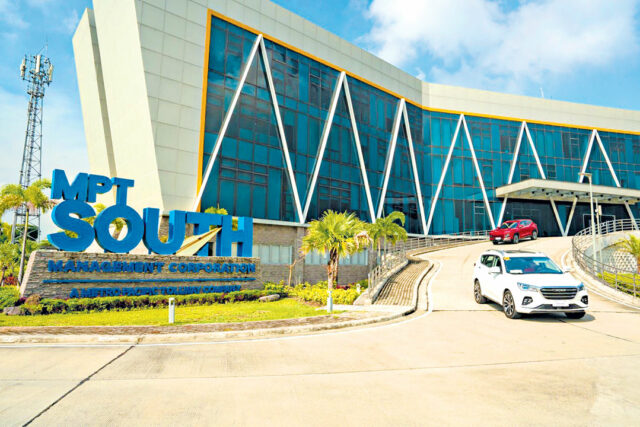
The two-day event commenced at the MPT South Hub in Imus, Cavite. From there, participants drove and rode their Jetour crossovers and traveled through the Cavite-Laguna Expressway or CALAX to Tagaytay and Silang, Cavite.

Next came a food crawl of famous eating and recreational stops, such as Ricardo’s Coffee + Classic Cuisine and Bag of Beans, along with Coffee Art Painting sessions and a tour of Silang Garden and Perlas ng Silang. After an overnight stay at The Park Silang, the delegation headed back to Metro Manila. The trip ended with lunch and a foccacia-making activity at Cafe Agapita.

The Biyaheng South Experiential Tour involved participants from Spot.ph, Manila Bulletin, Lifestyle Inquirer, DarSheyGoesTo, The Social Momdia, Kametayo, Travel with Karla, Go Cavite, Go Philippines, Go Tagaytay, All About Cavite, Dabyahero, Aliventures, and Lakwatsero Caviteño.

ADVERTISEMENT
ADVERTISEMENT