Home Blog Page 4242

Global trade deceleration and economic growth due to large population
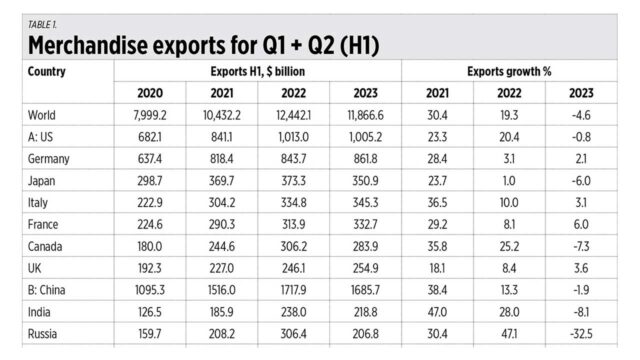
The deteriorating global and regional economic environment this year is better seen in the deceleration in value and growth of merchandise trade. The World Trade Organization (WTO) has reported the second quarter (Q2) 2023 data for merchandise exports.

In Table 1, I compare exports performance in Q1 + Q2 or the first half (H1) of 2020 to 2023. Global exports contracted by 4.6% in H1 2023 compared to H1 2022. I grouped the countries into three: Group A is made up of G7 industrial countries, Group B is the BRICS nations, and Group C contains major and medium East Asian exporters. European exports have expanded among each other, but all East Asian exporting countries plus India suffered contractions this year.
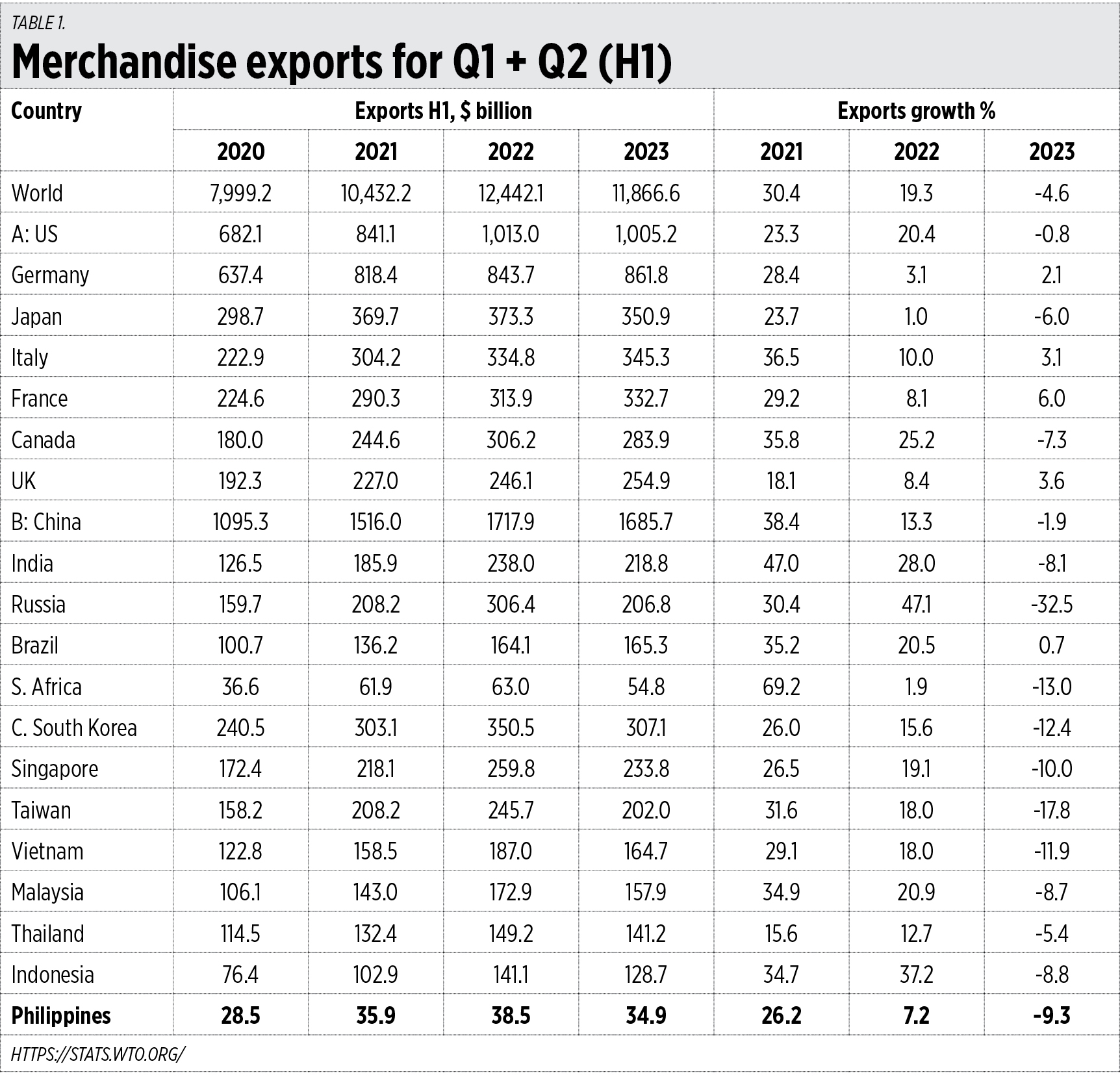
Despite this trend, the fastest growing major economies in the world are Asian, led by India, China, the Philippines, and Indonesia with gross domestic product (GDP) growth of 5% to 7% in H1 2023, whereas Europeans were crawling at -0.2% to 1.2% over the same period.

I think the main explanation for this is the dynamic domestic economies of these four Asian countries thanks to their big populations: 1.4 billion each for China and India, and 275 million and 113 million for Indonesia and the Philippines, respectively. The beauty of having a big population is it also means there is a big supply of entrepreneurs and workers, producers and consumers. So, when the global business and economic environment deteriorates, there is a big and strong domestic market to continue the business momentum.

Nonetheless, Philippines merchandise exports were the smallest among the ASEAN-6. There is a need to clear up bottlenecks in exports production and trade facilitation. See the BusinessWorld reports related to this, written by Justine Irish D. Tabile and John Victor D. Ordoñez: “Five ecozones could be proclaimed by October” (Sept. 17), “Trade boost expected from partnerships forged by ASEAN business organizations” (Sept. 19), “PCCI to help encourage greater use of FTAs” (Sept. 25), and, “PPP bill approved on 3rd reading” (Sept. 25).

Back to population and economic growth. In the middle of this month, the Philippine Statistics Authority (PSA) released 2022’s full monthly data for vital statistics. I summarize the annual and average monthly data (see Table 2).
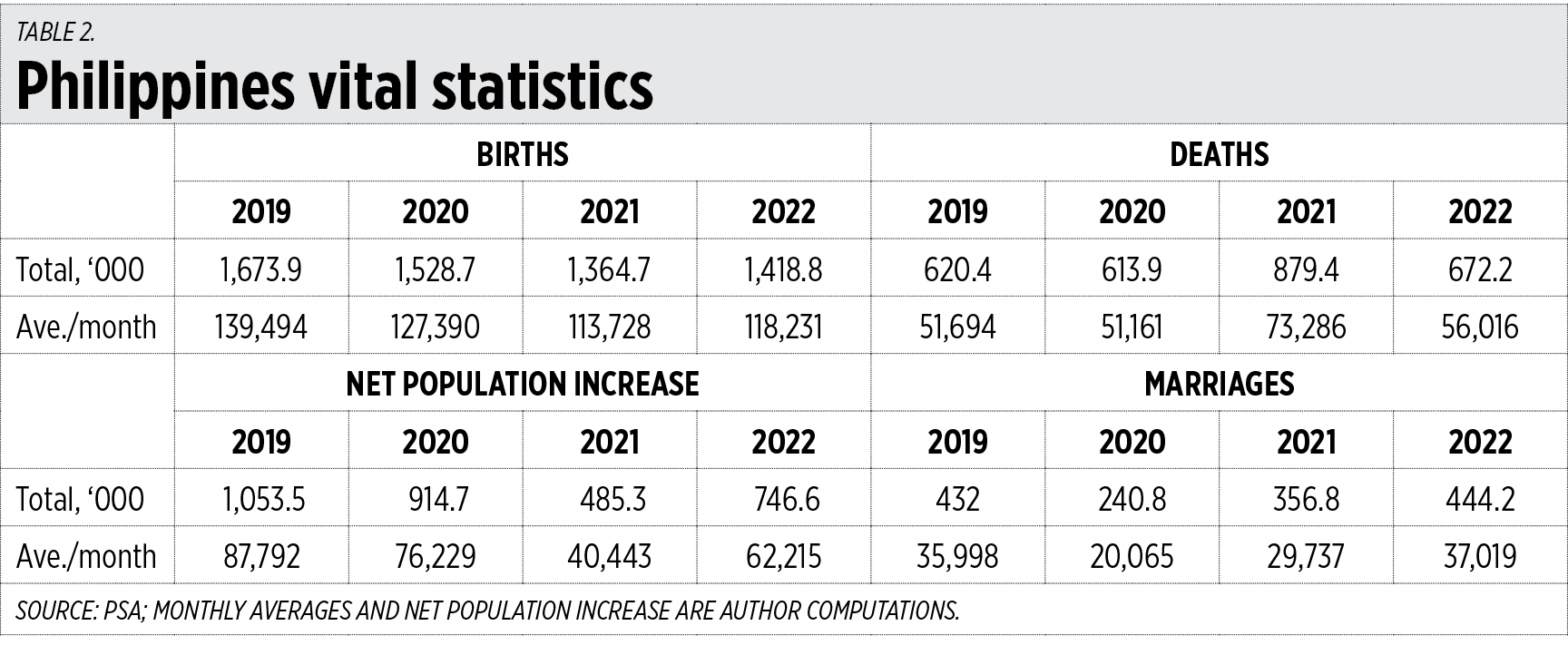
Births: There was consistent decline in the number of births, from 139,500/month in 2019 to only 113,700/month in 2021 which is bad. The good thing was that there was a slight recovery to 118,200/month in 2022, but it is still low compared to 2019’s average.

Deaths: There was no excess mortality in 2020 compared to 2019 despite all the scare mongering over COVID-19 and its related severe lockdowns and business closures. High excess mortality occurred in 2021 — nearly 22,000/month over 2019 levels — especially in the second half when mass vaccination went full blast.

The computed net increase in population (births less deaths) has declined from 87,800/month in 2019 to only 40,400/month in 2021, and slightly up to 62,200/month in 2022.

Marriages have declined significantly, from 36,000/month in 2019 to only 20,000/month in 2020. This has recovered to 37,000/month in 2022 (see Table 2).

There is a need to relax the implementation of the Reproductive Health (RH) law of 2012 (RA 10354). State funding of population control-leaning programs is wrong.

There is also a need to review and assess the impact of mass vaccination against COVID on human fertility, both short and long-term.


Bienvenido S. Oplas, Jr. is the president of Bienvenido S. Oplas, Jr. Research Consultancy Services, and Minimal Government Thinkers


minimalgovernment@gmail.com

HONOR launches new budget phones, tablet

SMART devices brand HONOR on Tuesday launched its latest range of budget smartphones and a new tablet in the Philippines, including the 90 Lite 5G, Pad X9, and additions to its X series.

The new lineup of products is targeted towards students and professionals looking for all-rounded devices at affordable prices, HONOR Philippines said.

“Innovation is about enriching lives,” Paulo Oga, public relations manager at HONOR Philippines, said at the launch event on Tuesday.

“The devices we have launched in 2023 are a testament to our dedication in providing leading edge technology that empowers and inspires,” he added. “We will go even further and beyond in 2024.”

The 90 Lite 5G features a 6.7-inch display with 90Hz refresh rate. It has a 4,500mAh battery, 8GB+5GB of RAM, and a 100-megapixel main camera.

Joepy Libo-on, brand marketing manager at HONOR Philippines, said the phone is “paired with a large 256GB storage that is very rare for [its] price range.”

The 90 Lite 5G retails at P12,990.

Meanwhile, the Pad X9 has a 11.5-inch display with 120Hz refresh rate. It is powered by a Qualcomm Snapdragon 685 processor and a 7,250mAh battery, alongside a six-speaker audio system and 128GB of storage capacity.

Stephen Cheng, HONOR Philippines vice-president, said the tablet “combines best-in-class display, incredible audio system, and massive storage for a guaranteed superb entertainment and educational experience.”

It is priced at P11,990.

The additions to the HONOR X series, the X6a and the X5 Plus, both feature a 90Hz 6.56-inch display, 5,200mAh battery, 50-megapixel camera, and expandable storage.

The X6a features a 50-megapixel triple camera system, while the X5 Plus has 50-megapixel dual cameras.

“By making our quality products more affordable, we make technology more accessible to every Filipino out there,” Mr. Cheng said.

The X6a costs P6,990, while the X5 Plus is priced at P5,990.

The new HONOR devices are available for pre-order at the brand’s partner stores and online with selected freebies and discounts. — MHLA

Cityland’s 101 Xavierville set for turnover

LISTED property developer Cityland Development Corp. announced that its 101 Xavierville condominium project in Quezon City is now ready for turnover, it said in a regulatory filing on Wednesday.

Cityland’s 101 Xavierville is a 40-storey commercial and residential condominium that has studio, one-bedroom, and commercial units.

Launched in 2018, the condo development is located along Xavierville Avenue, Barangay Loyola Heights.

According to Cityland, 101 Xavierville caters to students, young professionals, and couples starting a family. 

“Close to the project are well-known colleges and universities (Ateneo, Miriam, University of the Philippines), churches, wellness centers, malls, and other places of interest,” Cityland said.

“As more Filipinos are geared toward convenient living, 101 Xavierville offers a quiet, friendly, secure, and comfortable living spaces. It is a transit-oriented development that provides accessibility to public transportation, buses, and Light Rail Transit (Katipunan station) within the metropolis,” it added.

The company said the amenities of 101 Xavierville include a gym, swimming pool, study area with free Wi-Fi, multipurpose function hall, open lounge area, and 24-hour association security.   

“Cityland has steadfastly solidified its reputation for developing quality, affordable projects in prime locations that provide good investment for every hardworking Filipino,” the company said.

Cityland’s projects consist of medium to high-rise office, commercial, residential condominiums, residential subdivisions, and farm lots.

On Wednesday, shares of Cityland at the local bourse ended unchanged at 74 centavos each. — Revin Mikhael D. Ochave

Italy seeks Monte Paschi deal in push to create banking hub

ITALY is seeking to turn Banca Monte Paschi di Siena SpA into the country’s third-largest bank by merging it with one of its peers.

The government is evaluating how to make the world’s oldest lender a cornerstone of a new banking hub to challenge the duopoly of Intesa Sanpaolo SpA and UniCredit SpA, according to people familiar with the administration’s plans.

The administration’s favorite option would be a merger between Paschi and peers of a similar size like Banco BPM SpA or BPER Banca SpA, said the people who asked not to be named on a confidential issue. There are so far no formal talks with those lenders which have denied any interest in Paschi.

Ahead of such a deal, the government is planning the sale of a minority Paschi stake of as much as 15% on the market, according to the people. Financial advisers could be hired by the end of the year to manage the disposal, they added. Newspaper Il Messaggero reported Wednesday that Equita could be picked as an adviser.

The European Commission, the European Union’s executive arm, has told Italy to exit Paschi this year or next. The people argued that selling a minority stake would buy the government time and demonstrate that it is committed to complying with this demand.

The finance ministry declined to comment. A spokeswoman for Banco BPM reiterated that the lender is not interested in M&A deals as it pursues a standalone strategy. A representative for BPER Banca declined to comment.

The plan has been conceived as a landmark deal for Prime Minister Giorgia Meloni’s right-wing government in the corporate sector. But forging such a merger won’t be an easy task, given that Rome doesn’t own stakes in Banco BPM or BPER Banca and has no formal power to force them into a takeover.

Previous cases of government-backed takeover talks between domestic lenders show they can be difficult to pull off, with Commerzbank — whose largest shareholder is the German government — and Deutsche Bank failing to reach agreement in early 2019. By contrast, the government-engineered takeover of Credit Suisse by UBS in Switzerland earlier this year only worked because it came with very favorable terms for UBS.

Deputy Premier Matteo Salvini of the League party, a junior ally in Ms. Meloni’s coalition, has lobbied for months for the creation of a new hub which would retain the world’s oldest brand, they added.

Rome has long struggled to sell the controlling stake in Siena-based Paschi. Two years ago, the previous government tried but failed to combine Paschi with UniCredit as no agreement was reached on financial terms. But progress made under Chief Executive Officer Luigi Lovaglio, who implemented a turnaround after years of painful restructuring, has made the bank more appealing to investors.

BPER Banca’s top shareholder has recently requested authorization to increase its stake in Banca Popolare di Sondrio SpA, fueling speculation about a possible deal between those two banks.

Paschi, which traces its roots to the 15th century, is now the country’s fifth-largest bank, with more than 3.3 million clients and €120 billion ($127 billion) in total assets. It reported net income of €383 million in the second quarter, more than 10 times higher than a year earlier.

Major consolidation in European banking stalled after the financial crisis despite the widely held view that greater scale would make struggling lenders more competitive. With rising interest rates lifting profit from lending, prospects for deal-making in the industry have recently improved. — Bloomberg

Solo flight

ANNE NYGARD-UNSPLASH

FILIPINOS who have achieved global prominence have been mostly individuals, not teams. The first and only Philippine gold was won at the Tokyo Olympics (2021) for the women’s weightlifting event. Other Olympic silver medals have been won in men’s boxing. All these honors have gone to individuals.

Outstanding performances in the international arena too have often been solo flights. Singular successes in bowling, ballet, piano, billiards, singing, tennis, chess, taekwondo, and musical theater have been so notable that one can quickly name Filipino stars in these international fields. This includes those born and raised abroad whose ethnicity is Filipino.

As a country, we seem to thrive almost exclusively in solo flights. What is it about singular pursuits that allows the Filipino to be globally competitive? Are there cultural traits in our national DNA that make success possible only in individual contests?

A solo talent seems easier to discover through contests or auditions. Development and training require less investment in time and money to achieve a high level of competitiveness. Sponsorships too are more accessible. If funding is not available locally, a change of country representation or even citizenship is possible. Rewarding solo winners with cash prizes and celebrity endorsement of products is quite straightforward.

Coaching in a solo sport is usually just one-on-one, or maybe even three-on-one, even including a demanding parent or partner. There is only one individual to discipline and motivate. Unlike team sports where some players are benched, given fewer minutes, or designated as go-to leaders, the solo competitor knows he has no other person to depend on but himself.

Team competitions deal with more variables. Competing as a team is culturally more challenging.

Even with motivational sessions (There is no “I” in team) to force the group to think as one, there are distractions. In a basketball team, for example, there are bound to be inequalities with the players, not limited to playing time. What about the pay premium bestowed on “stars” who don’t always measure up to their hype and price? Of course, this inequality affects teamwork — Let’s see if you’re worth 20 times more than me.

Envy is seldom discussed as a factor in analyzing team chemistry. Motivation and incentives are focused on individuals while the game itself depends on teamwork and how each player contributes to the win.

The phenomenon of solo flights is not limited to competitive sports and the performing arts. It applies as well to business.

Corporate compensation is mostly focused on individual performance. Variable pay is bestowed on executives meeting or exceeding their Key Results Areas (KRA). The leader is supposed to then evaluate his team and give his own individual incentives from some assigned pie, also depending on performance of the unit.

Companies too are identified with individual CEOs or the designated scions of dynastic business families. In business, as in religious groups and civic clubs, the cult of personality elevates the leader to solo prominence. Companies are identified as extensions of the leader’s identity.

The identification of a company or even a conglomerate with a single person obscures the concept of teamwork. Even succession plans are reserved only for the leader, not the team. Thus, the burden of designating a successor falls on the one being succeeded. Is it any wonder that prioritizing this process is often deferred? (Let’s focus on inventory management.)

A team sport like basketball obliges a marquee player to depend on teammates to receive a pass and make the buzzer-beating winning shot that will be replayed over and over for the fans and coaches. While an assist pass is credited too, the clutch shot for the winning margin is accorded star status. What if the game winning shooter is not the designated star player? Are tantrums far behind?

Are team sports and our inability to work out roles and achieve cohesiveness, even accepting fewer minutes and being consigned to a small role a liability in achieving success? Is the solo flight our only chance as a culture to excel?

Maybe it is stretching it a bit to say that nationalism, or a love and willingness to sacrifice for the country’s good, requires a team culture. Solo flights (What’s in it for me?) and walkouts to avoid accountability (not my problem) may be pulling us down as a nation. It’s time to form a national team… and not just for basketball.


Tony Samson is chairman and CEO of TOUCH xda

ar.samson@yahoo.com

Far Eastern University, Inc. to conduct 2023 Annual Meeting of Stockholders on Oct. 21


Spotlight is BusinessWorld’s sponsored section that allows advertisers to amplify their brand and connect with BusinessWorld’s audience by enabling them to publish their stories directly on the BusinessWorld website. For more information, send an email to online@bworldonline.com.

Join us on Viber at https://bit.ly/3hv6bLA to get more updates and subscribe to BusinessWorld’s titles and get exclusive content through www.bworld-x.com.

Girls avoid internet due to abuse and bias, report warns

TRUSTPAIR.COM

Deeply entrenched gender norms, biases, and perceptions are affecting the ability of girls and young women to use the internet, influencing their online activity and hurting their access to information and work, a new report has found.

A survey of more than 10,000 users aged 14-21, and their parents, in over half-a-dozen countries including Ethiopia, Kenya, Nigeria, Tanzania, and India, found that girls are constantly being monitored and told they are vulnerable and not competent online, “creating a crisis of confidence.”

“This is resulting in girls setting up more protections and behaving more conservatively when connecting with others and sharing personal information online,” said the report by nonprofit Girl Effect, the Malala Fund, the United Nations’ children’s agency United Nations Children’s Fund (UNICEF), and the Vodafone Americas Foundation.

“These attitudes are not just impacting girls’ access and usage, they are influencing their self-confidence and shaping their own perceptions of their ability to use these tools to pursue their social, educational, and intellectual interests,” said the report.

The gender digital divide has persisted despite efforts by governments worldwide. A UNICEF study earlier this year showed that in 54 countries, the median gender parity ratio is 71, meaning that for every 100 adolescent boys and young men who use the internet, only 71 adolescent girls and young women do.

At the same time, women experience more online abuse, and harassment is driving girls to quit social media platforms such as Facebook and Instagram, recent studies have found.

Among digitally connected youth, 12% more girls than boys said that they feel self-conscious while using social media, and are 11% less likely to post photos or comments online compared to boys of the same age, the report by Girl Effect found.

VICIOUS CYCLE
As girls’ exposure to the internet is restricted by biases and fear of abuse, they do not see themselves as tech-savvy, and do not see the internet as something that is for them, the report from Girl Effect said.

“This creates a vicious cycle whereby girls avoid tech because they don’t think it’s for them, and then tech is seen as ‘not for them’ because they have been avoiding it,” it said.

As teenagers who scrutinize, regulate, and limit their behavior online, women “often carry these traits to their workplace, where they face difficulties in demonstrating their skills and building strategic connections,” said Mitali Nikore, a gender policy specialist at research group Nikore Associates.

“This negatively affects women’s behaviour at workplaces, constraining their labour market opportunities and professional advancement… and their access to potential sources of revenue-generating activities,” Nikore told the Thomson Reuters Foundation. 

Besides better smartphone access for girls and young women, digital literacy programs and an end to discrimination based on gender norms are needed, said Ms. Nikore.

Girls must also be involved in creating digital products for their needs, said a spokesperson for Girl Effect.

For example, Girl Effect developed artificial intelligence-enabled chatbots in South Africa and India — Big Sis and Bol Behen (“tell me, sister”) — with girls, as a source of accurate information on general health and sexual well-being for girls.

While new laws such as Britain’s Online Safety Act and the proposed Kids Online Safety Act in the United States can help protect children somewhat, “regulations can only go so far, and often lag behind technological advances,” the spokesperson for Girl Effect said.

“Adolescent girls and young women want to be involved in co-creating solutions; they have clear ideas for the functions, experiences, and strategies that could be applied to make the internet a safer, more accessible place.” — Thomson Reuters Foundation

Chelsea launches travel booking app

CHELSEA Logistics and Infrastructure Holdings Corp. launched on Wednesday an all-in-one travel booking app for its subsidiaries Starlite Ferries, SuperCat, and Trans-Asia Shipping Lines.

“The Chelsea Travel App, powered by Outsystem, is focused on innovations that aim to make booking more convenient, reliable, and satisfying not only for our passengers but also for our back-end users who are tasked to diligently review and validate an average of 300 transactions daily,” Chelsea Logistics Information Technology Head Efren M. Bernardino said in a media release on Wednesday.

The company said its app features a group booking option and self-service booking management.

Chryss Alfonsus V. Damuy, president and chief executive officer of Chelsea Logistics, said the group will continue enhancing its services “to make our valued passengers happy and satisfied with their travel experience.”

“We believe that sea travel is not only a mode of transportation, but also a way of discovering new places, cultures, and perspectives. That’s why we are constantly investing in our fleet, our crew, and our techno,” he added.

Chelsea Logistics is the listed shipping and logistics arm of Udenna Corp.

For the second quarter, it trimmed its attributable net loss to P106.83 million from the P587.63 million loss recorded a year ago, lifted by an increase in the company’s revenues for the period.

For the April-to-June period, its gross revenue increased to P1.87 billion, higher by 16.1% than the P1.61 billion a year ago

At the local bourse on Wednesday, shares in the company gained two centavos or 1.69% to end at P1.20 apiece. — Ashley Erika O. Jose

US judge throws out Texas ban on drag acts, calls it unconstitutional

A FEDERAL judge in Texas ruled on Tuesday that the state’s new law limiting public drag performances was an unconstitutional restriction on speech and he permanently forbids enforcement of it.

“Not all people will like or condone certain performances,” US District Judge David Hittner wrote. “This is no different than a person’s opinion on certain comedy or genres of music, but that alone does not strip First Amendment protection.”

More than a dozen states have sought to restrict drag shows over last year, with Texas one of at least four to pass restrictions into law, part of broader Republican efforts to regulate the behavior of LGBT people.

Mr. Hittner ruled that the Texas law was discriminatory and improperly vague. He said drag performances were not inherently obscene, and were the sort of expressive speech protected by the US Constitution’s First Amendment.

Drag performers and Pride march organizers joined the American Civil Liberties Union in a lawsuit in Houston’s federal court seeking to block the law. Modern drag has roots in musical and dance performances in LGBT venues.

The office of the Texas attorney general defended the law, which, among other restrictions, banned “the exhibition of sexual gesticulations using accessories or prosthetics that exaggerate male or female sexual characteristics” in public, or in venues where people under 18 may see it. Violations could be punished by fines and a jail sentence of up to one year.

Texas lawmakers said the law was needed to protect children from seeing “sexually explicit” content.

Opponents of the law said it was so broad that it appeared to criminalize acts by pop stars and cheerleaders, and that it was explicitly intended to target LGBT performers.

Other federal judges in Tennessee, Florida, and Montana have blocked similar new drag restrictions, finding similar free-speech violations. — Reuters

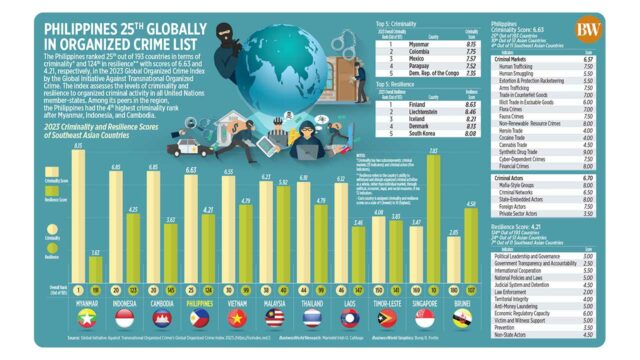
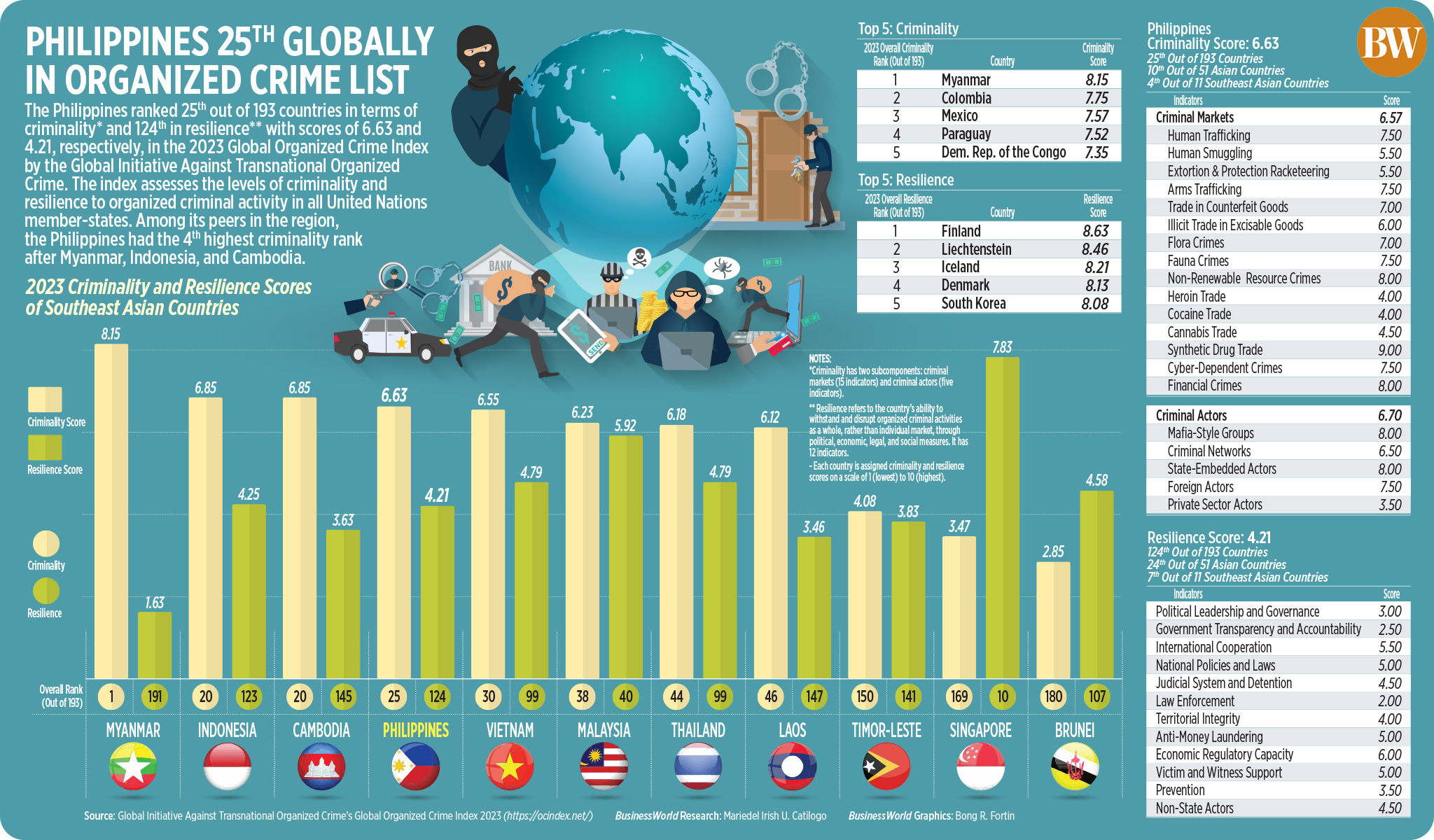
Philippines 25th globally in organized crime list

The Philippines ranked 25th out of 193 countries in terms of criminality* and 124th in resilience** with scores of 6.63 and 4.21, respectively, in the 2023 Global Organized Crime Index by the Global Initiative Against Transnational Organized Crime. The index assesses the levels of criminality and resilience to organized criminal activity in all United Nations member-states. Among its peers in the region, the Philippines had the 4th highest criminality rank after Myanmar, Indonesia, and Cambodia.

Philippines 25<sup>th</sup> globally in organized crime list

How PSEi member stocks performed — September 27, 2023

Here’s a quick glance at how PSEi stocks fared on Wednesday, September 27, 2023.


Marcos to hear data-based arguments on rice price cap

PHILIPPINE STAR/EDD GUMBAN

By Luisa Maria Jacinta C. Jocson, Reporter

PRESIDENT Ferdinand R. Marcos, Jr. will meet next week with the National Economic and Development Authority (NEDA) to discuss the possible lifting of the price ceiling on rice, NEDA Secretary Arsenio M. Balisacan said.

“We’ll more likely meet again next week because (Mr. Marcos) did say he wants us to meet again and see the numbers, see the indicators, see the outcomes versus the objectives of the price cap and then we’ll make a decision,” Mr. Balisacan said in chance remarks to reporters in Manila on Wednesday.

“But we all recognize there are so many moving parts, and this price cap could not be expected to last very long because that creates a lot of problems,” he added.

Price caps on rice have been in force since Sept. 5 to address rising prices. The ceiling has been set at P41 per kilo for regular-milled rice and P45 per kilo for well-milled rice.

“What we want to see now is the lifting soon of the price cap. The President will announce that once we have all the information that he is asking us to show (and) to study the indicators that would be useful to inform that decision, hopefully in the next, in a week or so, maybe we can come up with those indicators and the President can make a decision,” he added.

Separately, Mr. Balisacan said that the proposed tariff cut on rice imports is no longer needed amid improving market conditions.

“The risk of further price increases on the world market seems to be diminished compared to the situation we were looking at a month or two ago. So that is the context” behind the President’s decision not to consider a reduction in the tariff, he said.

“Again, what you would want to do is reduce the tariff when world rice prices are increasing; increase the tariff when the world prices are decreasing to stabilize local prices and… protect our local producers, rice farmers in this particular case, and also protect our consumers, particularly the poor, and also address inflation,” he added.

Mr. Marcos late Tuesday announced that he rejected proposals to temporarily reduce rice tariffs.

“We decided with the agriculture and economic managers that… it was not the right time to lower the tariff rates because the projection of world rice prices is that it will go down. So, this is not the right time to lower tariffs,” Mr. Marcos was quoted as saying in a statement.

NEDA and the Department of Finance (DoF) earlier proposed the temporary reduction of rice import tariffs to lower domestic prices. The DoF in particular proposed to slash the 35% rice import tariff to zero percent or maximum of 10%.