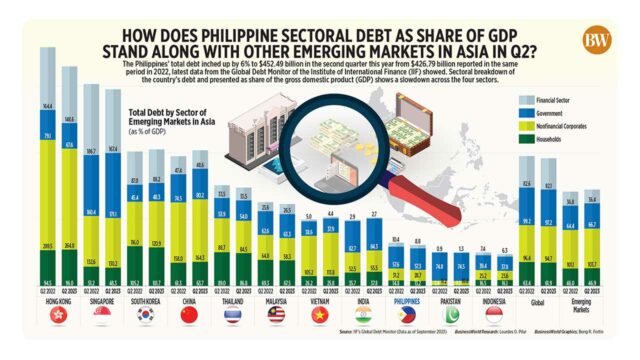
How does Philippine sectoral debt as share of GDP stand along with other emerging markets in Asia in Q2?
LIMA — Peruvian workers unearthed eight bundles of funeral belongings believed to be around 1,000 years old while installing a gas pipeline in capital Lima, archaeologists said on Friday, saying the site likely marked a children’s cemetery.
The finding in northern Lima’s Carabayllo district suggests the site may have been a cemetery for children who died from severe anemia resulting from a climate event that would have hit local agriculture, according to early analysis.
“Nutritional stress might have caused the children’s mortality rate, explaining why we found more burials of infants in these cemeteries,” said Jesus Bahamonde Schreiber, archaeologist for gas company Calidda.
Six of the bundles — found around 100 meters from a previous discovery of 28 graves — belonged to children and two to adults, he added.
Mr. Schreiber said they are believed to be between 1,100 and 800 years old, which would link them to the pre-Inca Ychma and Chancay cultures that developed in what is now northern Peru and along its central coastline.
Best known for the picturesque mountain-top royal Inca retreat of Machu Picchu, which draws millions of tourists every year, Peru was home to various pre-Hispanic cultures that thrived in the centuries before the Inca empire rose to power.
Some 400 huacas — ancient tombs or monuments — and other archeological ruins can be found in residential neighborhoods of metropolitan Lima. — Reuters
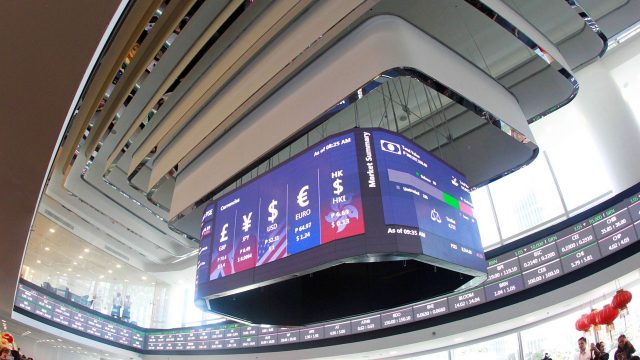
PHILIPPINE STOCKS climbed further on Tuesday following hawkish comments from the central bank chief and amid excess liquidity due to Metro Pacific Investments Corp.’s (MPIC) tender offer.
The Philippine Stock Exchange index (PSEi) went up by 91.10 points or 1.47% to end at 6,263.94 on Tuesday, while the broader all shares index rose by 36.23 points or 1.09% to 3,361.38.
“Shares on the Philippine Stock Exchange climbed as banks rally after central bank Governor Eli Remolona said he’s open to an unscheduled interest rate increase before the November meeting,” Globalinks Securities and Stocks, Inc. Head of Sales Trading Toby Allan C. Arce said in a Viber message.
“The local bourse bucked the trend across the region as most Asian stocks sank as the prospect of higher US rates and persistent concerns over a Chinese economic slowdown kept investors wary of regional markets,” Mr. Arce added.
Bangko Sentral ng Pilipinas (BSP) Governor Eli M. Remolona, Jr. told Bloomberg on Monday that he is open to an off-cycle rate hike before their Nov. 18 meeting and also ruled out cuts in the near term.
The central bank kept rates unchanged for a fourth straight meeting last week, but signaled it might resume tightening at its next meeting in November if inflation pressures persist.
The Monetary Board kept its target reverse repurchase rate at 6.25%. Interest rates on the overnight deposit and lending facilities were also left unchanged at 5.75% and 6.75%, respectively.
Investors also saw opportunities from MPIC’s tender offer, Unicapital Securities, Inc. Senior Equity Research Analyst Carlos Angelo O. Temporal said in a Viber message.
“The index ended higher by 1.48%, notably outperforming other markets in the region, and this is likely attributable to the allocation of the extra liquidity brought about by MPI’s tender offer across the market as today marks the cross date for the transaction,” Mr. Temporal said on Tuesday.
In July, MPIC said the tender offer price went up to P5.20 per share from P4.63 per share initially offered by the consortium, which is backed by First Pacific Co. Ltd., GT Capital Holdings, Inc., and Mitsui & Co. Ltd.
Last week, MPIC told the local bourse that the tender offer had closed, with cross date scheduled on Sept. 26 and settlement date on Sept. 28.
All sectoral indices went up on Tuesday. Property rose by 41.24 points or 1.6% to 2,607.22; financials climbed by 28.79 points or 1.6% to 1,823.31; holding firms increased by 90.27 points or 1.54% to 5,952.13; industrials went up by 98.86 points or 1.12% to 8,923.01; mining and oil added 61.04 points or 0.58% to end at 10,445.83; and services inched up by 6.12 points or 0.41% to 1,498.05.
Value turnover surged to P35.16 billion on Tuesday with 6.41 billion shares changing hands from the P8.48 billion with 1.79 billion shares seen on Monday.
Advancers outnumbered decliners, 115 versus 59, while 53 shares closed unchanged.
Net foreign selling rose to P15.20 billion on Tuesday from P316.23 million on Monday. — SJT
THE PESO weakened to a 10-month low against the dollar on Tuesday as the US currency generally strengthened against Asian currencies due to elevated US Treasury yields.
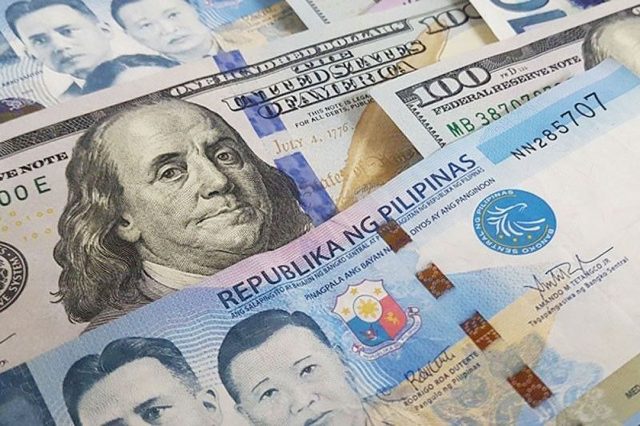
The local currency closed at P56.955 versus the dollar on Tuesday, weakening by 17 centavos from Monday’s P56.785 finish, data from the Bankers Association of the Philippines’ website showed.
This was the peso’s weakest finish in over 10 months or since its P57.375 per dollar finish on Nov. 22, 2022.
The local unit opened Tuesday’s session at P56.85 per dollar, which was also its intraday best. Its worst showing was at P56.98 against the greenback.
Dollars traded rose to $1.06 billion on Tuesday from the $904.9 million on Monday.
The peso sank against the dollar following the general decline in Asian currencies due to rising US Treasury yields, ING Bank N.V. Manila Senior Economist Nicholas Antonio T. Mapa said in a Viber message.
However, the peso was still one of the strongest currencies in the region, he noted.
The US dollar generally strengthened on Tuesday to 10-month highs due to elevated US Treasury yields, Rizal Commercial Banking Corp. Chief Economist Michael L. Ricafort likewise said in a Viber message.
Against the Japanese yen, the dollar strengthened to 11-month highs, Mr. Ricafort said.
The dollar rose to a new 10-month peak on Tuesday as US bond yields surged to their highest level since October 2007, while the Japanese yen resumed its slide, putting traders on alert for signs of government intervention, Reuters reported.
Federal Reserve policy maker Neel Kashkari said on Monday that, given the strength of the US economy, interest rates should probably rise again and be held “higher for longer” until inflation falls back down to 2%.
His comments helped push up the yield on the 10-year US Treasury — the benchmark US yield that sets the tone for borrowing costs around the world — to 4.566% on Tuesday. Bond yields move inversely to prices.
Higher US yields boosted the allure of the greenback, pushing the dollar index to 106.2, the highest since late November 2022. The index, which tracks the currency against six major peers, was last up 0.11% at 106.07.
A rally in the dollar did further damage to the Japanese yen, which fell past the 149 per dollar mark for the first time since October 2022, hitting 149.19. The dollar was last up 0.12% against the yen at 149.06.
For Wednesday, Mr. Ricafort sees the peso ranging from P56.79 to P56.99 per dollar. — AMCS with Reuters
PRESIDENT Ferdinand R. Marcos, Jr. on Tuesday called the rice supply adequate as he distributed seized grain to cash transfer beneficiaries, issuing a warning to smugglers and hoarders of his intent to give away confiscated rice.
“Instead of letting the rice go to waste, it’s better to distribute it to our citizens,” he said. “This will also serve as a warning to smugglers and hoarders that we will keep an eye on rice.”
Mr. Marcos continued to blame hoarders for the high rice prices.
“Sapat ang supply ng bigas dito sa Pilipinas. Ang kailangan lamang po ay maayos na pamamahala ng produksyon at bentahan nito (The rice supply is sufficient in the Philippines. What is needed is proper oversight over the market for rice),” he said at the rice distribution exercise in Manila.
He was distributing some of the 42,180 sacks of smuggled rice valued at P42 million seized by the Bureau of Customs during a warehouse raid in Zamboanga City on Sept. 15.
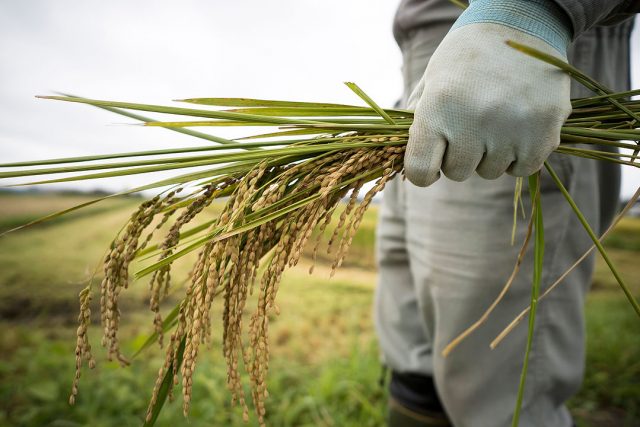
Palay output hit 4.25 million metric tons (MT) in the second quarter, slightly higher than the 4.2 million MT recorded a year earlier.
Mr. Marcos’ economic team has been proposing to cut the tariff on rice imports to as low as 0% from 35%, prompting questions from the farm industry.
“There is no rice shortage, therefore there is no basis for reducing tariffs,” Samahang Industriya ng Agrikultura Chairman Rosendo So said in a statement signed by 26 agricultural groups.
“It is very clear to us that Finance Secretary Benjamin E. Diokno and National Economic and Development Authority (NEDA) Secretary Arsenio A. Balisacan are publicly contradicting the President with their continued insistence on reducing tariffs and encouraging more imports,” he said. “They are not serving at the pleasure of the President, but of the importers.”
He said any tariff reduction will have a negative impact on farmgate prices “as imports will again flood the market.”
Mr. So urged legislators to compel the Finance and NEDA Secretaries to explain why executive orders on tariff reduction are being issued over the heads of Congress.
“Bakit hindi sila sa Congress makipag-usap? (Why is Congress not being consulted)” Mr. So said. “Ang tariff modification ay trabaho ng Congress (Modifying tariffs is a job for Congress).”
Action for Economic Reforms coordinator Filomeno S. Sta. Ana III has said that the government should lift the price caps on rice instead of imposing a zero-tariff policy.
“The proposed zero tariff of course will bring down the price of rice, but shortages, especially in the aftermath of Indian rice export ban, and increasing demand will still exert upward pressure on prices,” he told BusinessWorld earlier this month.
“But if the market price still exceeds the price ceiling, despite the zero tariff, don’t expect the exports to come in,” he added. “So, remove the price ceiling. The price ceiling is not working, based on the stories of rice sellers. It will only exacerbate the shortage. The sooner it is removed, the better.” — Kyle Aristophere T. Atienza
THE US Department of Agriculture (USDA) said it downgraded its forecast for Philippine rice production due to damage to the crop from multiple typhoons.
In a report prepared by the USDA’s Foreign Agricultural Service (FAS), the Grain and Feed Update, the FAS said that milled rice production is estimated to drop to 12.55 million metric tons (MT) for the market year 2023-2024. This was a 0.4% downgrade from its previous forecast of 12.6 million MT.
The typhoons that damaged rice-growing areas were Dodong (international name: Talim), Egay (Doksuri), and Falcon (Khanun).
“Industry contacts’ expectations for the 2023 El Niño are mixed but balanced across the country, so overall effects on production are likely minimal,” FAS said.
The government weather service, known as PAGASA (Philippine Atmospheric, Geophysical and Astronomical Services Administration), estimates the El Niño to peak in late 2023 or early 2024.
The FAS also projected a decline in rice imports due to high international prices and the uncertainty introduced by the price controls for rice at the retail level.
It expects rice imports to decrease to 3.5 million MT, downgrading the previous estimate of 3.8 million MT.
“Rice importers are adopting a wait-and-see attitude, with some importers canceling their purchases in the days after the price ceiling was announced, according to industry contacts,” it added.
The government imposed a temporary price ceiling on regular-milled rice of P41 per kilogram and on well-milled rice of P45 per kilo, via Executive Order 39.
The USDA made the 3.8 million MT projection in an earlier report, Grain: World Markets and Trade, covering the marketing year 2023-2024.
The Philippine Department of Agriculture (DA), however, said imports will be “much less” than the USDA is forecasting.
Meanwhile, the FAS also projected a decline in corn production to 8.2 million MT, likewise due the recent typhoons and “the continued presence of the fall armyworm.”
“The situation is particularly severe in Ilagan, Isabela, the corn capital of the Philippines, and surrounding areas,” it said.
Imports of corn are expected to increase to 1 million MT during the market year.
“FAS estimates corn imports to increase for MY 2023/24 because of the domestic production shortfall,” it said. — Adrian H. Halili
THE National Food Authority (NFA) has implemented a new system for setting its purchasing price for palay or unmilled rice, the Department of Agriculture (DA) said.
In a statement issued by the DA, the NFA released a new Equitable Net Weight Factor table, which measures the grain’s moisture levels, damage, and coloration to determine a buying price.
“(This) corresponds to the reference for the pricing scheme based on the moisture content (MC), purity, and damaged and discolored grains parameters in the classification of palay,” it said.
The NFA council last week set new purchase price ranges for dry and wet palay of P19-P23 and P16-P19 per kilogram, respectively.
The previous buying price for domestic rice was P16 per kilo for wet and P19 per kilo for dry palay.
NFA Administrator Roderico R. Bioco told reporters on Tuesday that the agency has sufficient funding to purchase domestically grown palay in fulfilment of its mission to maintain a buffer stock of rice.
“We have enough (funds) for this season; if need be, we also have a large credit line from (Land Bank of the Philippines and Development Bank of the Philippines,)” Mr. Bioco said.
“That credit line is more than enough for our requirements, because the President’s target is (to build a reserve of) at least 10 to 15 days’ demand and even more, up to 30 days. We have the resources to do that,” he added.
He said that the NFA is currently disbursing funding to its buying stations for them to start procuring palay.
The NFA maintains a network of 267 palay buying stations.
“At this time of the year, inventory is expected to drop… including (stocks held by) NFA. That is why we replenish it,” he said. — Adrian H. Halili
MULTILATERAL development banks (MDBs) must ramp up financing efforts to address risks to growth and enhance sustainable development, Finance Secretary Benjamin E. Diokno said.
“The COVID-19 pandemic and its aftermath and the subsequent Russia-Ukraine conflict reversed much of the world’s progress toward inclusive and sustainable growth,” Mr. Diokno said in his speech at the Asian Infrastructure Investment Bank (AIIB) Governor’s Business roundtable.
“In this context, MDBs are expected to scale up and reform their response to these global challenges,” he added.
Mr. Diokno also cited extreme weather events, debt crises, and persistent inflation as risks to global growth.
“The Philippines concurs with the (AIIB’s) assessment of the Members’ short- to medium-term needs to address the impacts of these economic challenges, while not losing sight of the objective towards sustainable economic growth, particularly in the race to net-zero and climate resilience,” he said.
For the part of the AIIB, Mr. Diokno said the lender should “implement its corporate strategy in an adaptive manner while remaining committed to its core function as an infrastructure-focused financing agency.”
“The Philippines welcomes the extension of the use of policy-based co-financing to further enhance the bank’s ability to respond to client demands amid current and emerging crises,” he said.
“In addition, we encourage the bank to make available more grant facilities to aid in the implementation of programs/projects and enhance the concessionality of its terms,” he added.
Mr. Diokno also prompted the AIIB to improve its presence and monitoring of development cooperation projects in member countries. “This will enable the AIIB to maintain an effective client-demand-driven approach.”
The Philippines has obtained $3.4 billion in loan commitments related to pandemic recovery from the AIIB to date. — Luisa Maria Jacinta C. Jocson
THE Civil Aeronautics Board (CAB) said the airline passenger and cargo fuel surcharge will be unchanged for October.
The surcharge covers domestic and international flights, the CAB said in an advisory on Tuesday.
The current surcharge is what the CAB calls Level 6. In this category, the domestic passenger surcharge is between P185 and P665. For international flights, the surcharge is between P610.37 and P4,538.40.
Airlines are allowed to collect fuel surcharges according to a matrix approved by the CAB.
The airline fuel surcharge is an optional fee charged by airlines to recover fuel costs. It is set based on the movements of jet fuel prices.
The CAB added that the applicable conversion rate for October is P56.61 per dollar.
“Airlines wishing to impose or collect fuel surcharge for the same period must file their applications with this office on or before the effectivity period, with fuel surcharge rates not exceeding the above-stated level,” the CAB said.
In September, the CAB raised the passenger and cargo fuel surcharge rate to Level 6 after keeping it at Level 4 in the three months to August.
Level 4 surcharges allow the collection from domestic passengers of between P117 and P342 for domestic flights and from international passengers of between P385.70 and P2,867.82. — Ashley Erika O. Jose
THE Board of Investments (BoI) said that a Guangdong-based electronics company, Shenzhen Grandsun, is set to open two more factories in the Philippines by the end of 2025.
In a statement on Tuesday, the BoI said the two new factories of unit Grandsun Advanced Electronics (Philippines) Co., Inc., will complement the company’s audio devices production facility at the LIMA industrial park in Batangas.
Asked about the size of the investment, the BoI said in a Viber message that Shenzhen Grandsun did not publicly disclose the investment expected by 2025.
By the end of 2028, the company has a target of generating 8,000 jobs, the BoI added.
The two new factories are expected to service the US and European markets for original equipment manufacturer (OEM) products as well as house-brand Shenzhen Grandsun speakers.
The construction of the two factories is part of the second phase of Shenzhen Grandsun’s expansion in the Philippines, following the expected completion of its four production facilities this year.
“With the expected completion of Shenzhen Grandsun’s four audio device production facilities in the Philippines this year, total investments by the Guangdong-based company will amount to more than P3 billion,” the BoI said.
By the end of the year, Grandsun’s four audio device production facilities are projected to employ 1,000.
“The complementarity of Shenzhen Grandsun in the Philippines is a good model for other possible Chinese locators to the Philippines, as it allows a top Chinese OEM and original brand manufacturer to work with Filipino talent as they address growing global requirements of their top customers especially from the Europe and the US,” Ceferino S. Rodolfo, BoI managing head and Trade undersecretary, said.
Shenzhen Grandsun supplies wired and Bluetooth headphones, Bluetooth speakers, drivers and other related intelligent devices. — Justine Irish D. Tabile

TWENTY-FOUR PROJECTS were signed between companies and local government units (LGUs) from China’s Fujian province and the Philippines with a total contract value of 42.62 billion yuan (P331.87 billion).
The deals were signed on Monday at the China (Fujian)-Philippines Joint Demonstration Zone for Economic Innovative Development & Economic and Trade Cooperation Promotion Conference at the Conrad Manila.
“I have not looked into the specific details because these are private to private projects. Once they are ready and start applying for incentives that is when we are going to get more details of the investments,” Trade Secretary Alfredo E. Pascual told reporters on Monday.
Of the projects, nine valued at 15.77 billion yuan involve Philippine investments in China, covering petrochemicals, aquaculture, small factories, hotels and commercial complexes.
These projects include the 3.53-billion-yuan industrial serialization project of Megasoft (Philippines) Hygienic Products, Inc. in Quanzhou, Fujian. Its partner is the Quanzhou Municipal Bureau of Commerce.
Another is a partnership between Philippine Universal Resorts and the Jinjiang, Fujian Municipal People’s Government for a 1.2 billion yuan five-star hotel in Jinjiang City’s Chidian Town.
Nine of the contracts involve investments in the Philippines worth a combined 22.65 billion yuan. These deals are production facilities and warehouses for steel, photovoltaic, sanitary, and aquatic products.
Among these projects is the construction of a steel production base in the Bataan Economic Zone between the Philippines’ Liwang Summit Properties, Inc. and China’s RSIN Group, which is valued at 12 billion yuan.
Another project involves the construction of a photovoltaic industrial park to be put up by Fujian Uptop Trading Co., Ltd. and Gain City Solution Philippines Corp. The contract is worth 5 billion yuan.
Another 4.2 billion yuan worth of contracts are trade cooperation projects in the building materials, clothing, and footwear industries, as well as fruits. Three economic and trade cooperation agreements were signed by business associations, while colleges and universities entered into talent exchange agreements.
In a speech at the event, Mr. Pascual welcomed the promotion of the Philippines-China (Fujian) Industrial Park, particularly the Yatai Industrial Park, as it will provide a platform for businesses from both countries to innovate.
“There is a major trade relationship between Fujian and the Philippines — (both in) export and import. What we are encouraging now are further investments,” said Mr. Pascual.
“They are building an industrial park there and we are also building an industrial park here. We have Filipino investors which will invest in their park, and investors from Fujian province and in other parts of China, will invest in ours,” he added.
Yatai Industrial Park will focus on attracting electricity and heat production and supply, ferrous metal smelting and rolling, and non-ferrous metal smelting and rolling metal locators.
Foreign investors and their immediate family members are entitled to be permanent residents, while foreign citizens can be hired under the preferential policies attached to Yatai Industrial Park.
Zhangzhou city and the Philippines are currently collaborating to set up two parks — the Asian Time Industrial Park and the Philippine-China Economic Cooperation Industrial Park.
“China’s prominence in the Philippine economic narrative is undeniable. Standing as our most significant trade ally among 231 nations, in 2022, China was our primary source of imports and our third-biggest export destination,” Mr. Pascual said. — Justine Irish D. Tabile

THE National Irrigation Administration (NIA) said it is set to direct a major portion of its expanded budget for next year to solar-powered irrigation projects.
“This additional budget will be concentrated in our solar pump irrigation project, NIA Administrator Eduardo G. Guillen said in an interview with PTV.
Mr. Guillen added solar irrigation systems promise rapid installation of between one and three months.
The agency has about 183 solar powered irrigation sites in the pipeline for 2024. It is budgeting about P1.72 billion to irrigate 2,168 hectares.
The NIA is also proposing an additional 791 potential sites across 39,694 hectares, requiring an outlay of P30 billion, for solar-powered irrigation projects.
“We all know that irrigation infrastructure is one of the keys to food security… higit sa lahat matutugunan natin ang El Niño,” (most of all we could address the impact of El Niño) he added.
The government weather service, known as PAGASA (Philippine Atmospheric, Geophysical and Astronomical Services Administration), has said that El Niño will peak in late 2023 or early 2024. — Adrian H. Halili