Home Blog Page 4222

Marking Philippine real estate’s newest milestones

The Outlook 2023: Philippine Real Estate Awards honors transformative builders

In its quest towards further rebound and sustained growth, the Philippine real estate is building and delivering spaces that meet the transformed needs of the market, mainly driven by digitalization and sustainability trends. In one of Philippine real estate’s most awaited and most esteemed annual recognitions, a leading online real estate marketplace has hailed the country’s leading developers for working on such efforts.

Lamudi’s The Outlook 2023: Philippine Real Estate Awards gathered notable and esteemed figures in the industry in honoring the country’s top real estate projects and developers at a time of further rebound and modernization in the industry.

The Outlook 2023: Philippine Real Estate Awards winners pose with their trophies together with Lamudi Philippines’ Country Head Anurag Verma, Head of BPI’s Retail Mortgage Division Bernadette Ocampo, and Lamudi’s Associate Director for Corporate Accounts Mark Bailey.

Held last Sept. 21 at the Shangri-La The Fort in Bonifacio Global City in Taguig, The Outlook 2023: Philippine Real Estate Awards presented 21 awards to the country’s top real estate developers across various segments. The awardees were selected based on a voting process that included the help of 10,000 active seekers.

Aside from citations for the best condo, house, and commercial developments, Lamudi also recognized the developers and projects that led the industry toward a more digital and wellness-focused sector.

In his speech, Lamudi Philippines Country Head Anurag Verma highlighted the value of the online space, which Lamudi largely occupies as a leading real estate marketplace, in establishing developers as trusted brands with trusted offerings.

“It has never been so important to focus on building a trusted name online and positioning your products in an authentic and transparent way. Now, real estate players must give seekers a personalized and delightful experience at every touchpoint,” Mr. Verma said.

The awarding ceremony, he continued, signifies the collaborative efforts of developers and other stakeholders in the property industry in building better homes and communities for Filipinos.

“We all can agree that improving the industry is not a one-man job,” Mr. Verma said. “Together, we must create a collective vision with a shared mindset of helping Filipinos find their dream home. This room is filled with educators, innovators, planners, designers, builders, legislators, and marketers who all want to introduce each family to the perfect home that will empower them to do more — to dream more.”

Lamudi Philippines’ Country Head Anurag Verma opens The Outlook 2023: Philippine Real Estate Awards.

The world has moved into the digital age and the real estate journey starts with an online search, Mr. Verma also stressed.

“We are very excited to witness the start of this inflection point of tech adoption in the Philippine real estate industry as more developers are welcoming digital solutions with open arms and are proud that Lamudi is helping them in this journey through our solutions,” Mr. Verma said.

“At Lamudi, we believe that your success is our success. For the last nine years, our vision has been to make the real estate journey trustworthy, convenient, and easy,” he added.

Modernizing real estate

The event started with a panel discussion on the theme “Laying the Groundwork: Real Estate Modernization Roadmap,” with AJ Rocero, managing and executive director of PropTech Consortium of the Philippines; and Randolph Ilawan, real estate portfolio manager from the Economic Research and Real Estate Portfolio Team of Bank of the Philippine Island’s (BPI) Corporate & Commercial Credit Group, as speakers.

Like other sectors, real estate is on the frontline of adopting technology and sustainability into their operations.

Digitalization, for instance, is transforming real estate marketing, property management, and investments in an effort to make searching for, buying, and investing in properties more accessible and more convenient.

According to Ms. Rocero, investing in property technology, or proptech, helps developers and investors automate and manage properties and buildings, and it also helps them in receiving inquiries, managing sales processes, and communicating with their clients much better.

Ms. Rocero added that sustainability initiatives in the country are already being adopted by various developers.

“I can confidently say that we’re going towards the right direction that the other developers are adapting because we have private and government agencies that are promoting incentives,” she said regarding sustainability.

Mr. Ilawan of BPI shared that technology and sustainability come hand in hand, especially since using proptech will help drive sustainability. In BPI’s case, the bank uses proptech to tailor-end users’ financial behavior and promote financial awareness.

AJ Rocero and Randolf Ilawan discuss sustainable initiatives in Philippine real estate during the panel discussion of The Outlook 2023: Philippine Real Estate Awards.

However, the real estate portfolio manager noted that regionally and globally the country is still lacking in adopting to these trends compared to neighboring countries. What the country needs, thus, is more education and awareness of digital technologies, especially in rural areas.

“The [people’s] first impression with adapting these initiatives is that it’s added cost. But they haven’t seen what’s in the long run, so it’s a matter of making them realize, breaking down the cause and effect, and the advantages if [these] green and property technology initiatives [are pushed],” Mr. Ilawan explained.

In addition, Bernadette Ocampo, head of BPI’s Mortgage Division, shared that industry players and partners had recognized the potential of online platforms as a tool to further expand their audience reach and streamline their operations.

“BPI and Lamudi see similarities in both of our missions and goals, which are to provide Filipinos with their dream homes and empower them to achieve it today,” Ms. Ocampo said in her welcome remarks.

Sharing these similar missions and goals, Lamudi and BPI are set to launch BPI Verified. With this upcoming service, Lamudi’s property listings will be converted into BPI-verified property listings. This offering is seen to provide Filipinos a variety of properties on the online platform that were already pre-assessed and title-verified, and then apply as well for a BPI Housing Loan.

“BPI Verified’s main objective is to give clients confidence in their property by having a bank pre-assess and check those listings already. [This is an] indicator that the property listing is good collateral and can be easily qualified for bank financing in BPI,” Ms. Ocampo said.

Winners

The Outlook 2023: Philippine Real Estate Awards awarded this year’s best affordable and premium condominiums; best affordable and premium houses; and best mized-use developments across Luzon, Visayas and Mindanao.

Aboitiz Land, Inc., Alveo Land Corp., Vista Residences, Inc.,and Wee Community Developers, Inc. were the awardees from Luzon. Camella, Primeworld Land Holdings, Inc., RLC Residences, Wee Community Developers, and Vista Land and Lifescapes, Inc. were the winners for Visayas and Mindanao.

Lamudi also gave recognitions for the Best Co-Working Space, Best Office Development, and Best Industrial Development, which were received by Inphin8 Space, Inc., KMC Solutions, and Damosa Land, Inc., respectively.


Among the notable winners of this year’s awards is RLC Residence, which earned the title of “Digital Innovator of the Year.” RLC Residence was recognized for its adoption of new technology to improve customer experiences and streamline real estate operations. RLC Residence continues to be a top developer and a catalyst for integrating cutting-edge technology in the real estate market.

Another win for the RLC Residences is the “Wellness-Focused Development of The Year” for The Residences at The Westin Manila by RLC Residences, a high-residential condominium that is designed to enhance well-being and support residents’ active lifestyles.

The Real Estate Innovation of the Year, meanwhile, was awarded to My Enso Lofts by PH1 World Developers. The modern and high-rise residential condominium was recognized for adopting innovative building solutions that address the housing crisis in the Philippines.

The grand awards were bagged by PHINMA Properties for Boutique Developer of the Year — Luzon; Primeworld for Boutique Developer of the Year — Visayas and Mindanao; and Camella for Developer of the Year both for Luzon, and Visayas and Mindanao categories.

The Outlook 2023: Philippine Real Estate Awards was sponsored by The Boring Group Industry and Home Solutions, Concepcion Midea, Yale, ContractWorld Furniture, Taylor Living Furniture, Awards Central, MetroMart, Pick.A.Roo., and was co-presented by BPI. BusinessWorld is among the media partners.

Visit lamudi.com.ph/outlook2023 to learn more about The Outlook 2023: Philippine Real Estate Awards. — Angela Kiara S. Brillantes

Inflation soars to 6.1% in Sept.

Rice inflation accelerated 18% year on year in September despite the government’s imposition of a ceiling on rice prices. — PHILIPPINE STAR/EDD GUMBAN

By Keisha B. Ta-asan, Reporter

INFLATION quickened for a second straight month in September due to a double-digit increase in rice prices, putting pressure on the Bangko Sentral ng Pilipinas (BSP) to resume monetary tightening.

“I think a hike in November is possible but we’re still analyzing the (inflation) data,” BSP Governor Eli M. Remolona, Jr. said in a Viber message.

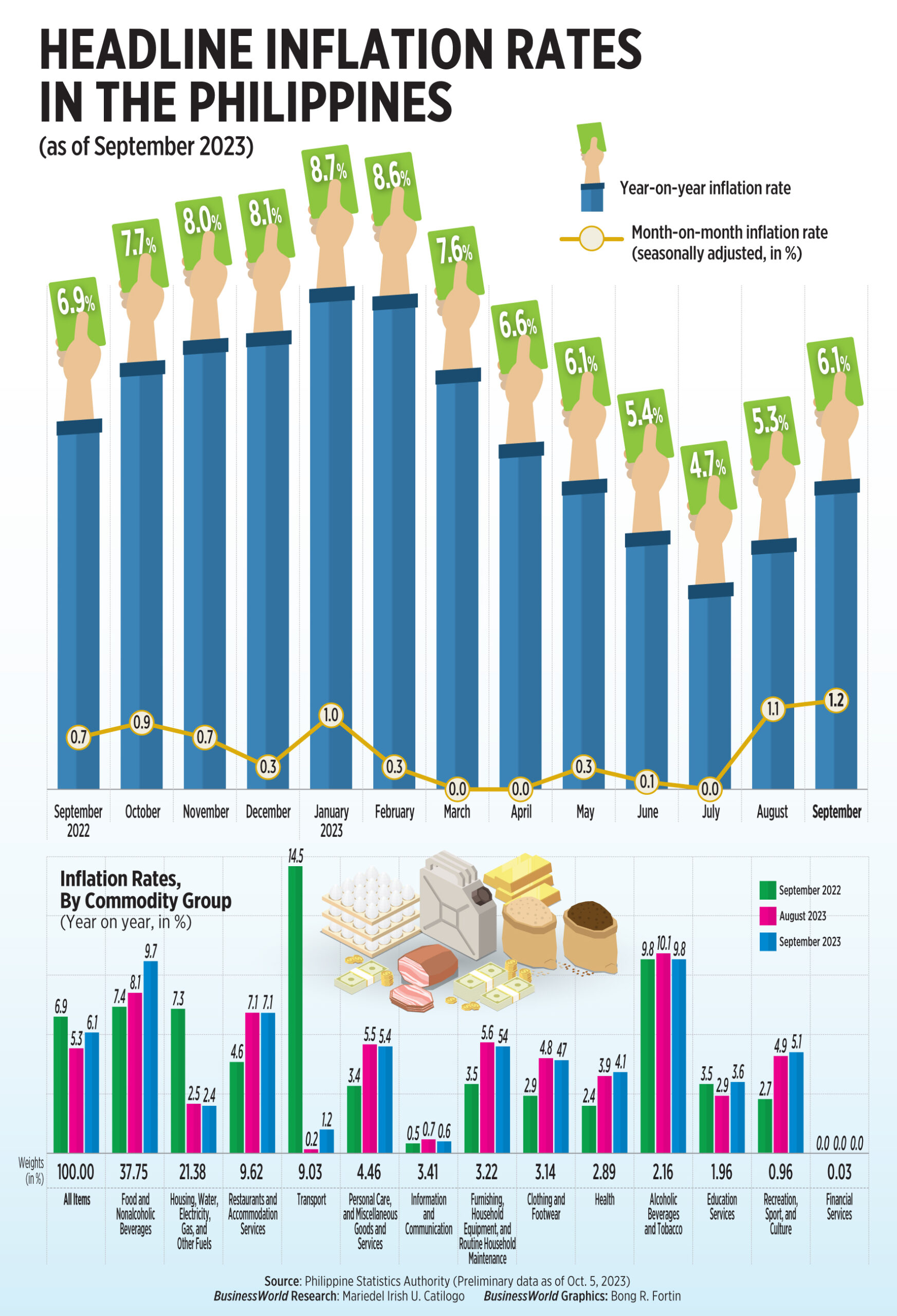
Preliminary data from the Philippine Statistics Authority (PSA) showed headline inflation accelerated to 6.1% in September from 5.3% in August but slowed from 6.9% in September 2022.

The September print was above the 5.4% median in a BusinessWorld poll conducted last week, and also at the upper end of the BSP’s 5.3-6.1% forecast.

The latest consumer price index (CPI) was also the fastest in five months or since the 6.6% in April 2023, and matched the 6.1% logged in May.

September marked the 18th straight month that inflation breached the BSP’s 2-4% target this year.

On a monthly basis, headline inflation inched up by 1.2% in September from 1.1% in August.

This brought nine-month average inflation to 6.6%, higher than 5.1% a year ago and still above the BSP’s recently revised 5.8% forecast for 2023.

The government’s imposition of a price cap on rice starting Sept. 5 appeared to have failed to tame overall inflation in September.

The heavily weighted food and non-alcoholic beverages index rose to a seven-month high of 9.7% in September from 8.1% in August. Food inflation alone soared to 10% from 8.2% a month ago.

Rice inflation surged to 17.9% in September from 8.7% in August. This is the highest print since March 2009, when rice inflation rose to 22.9%. Rice has the biggest weight in the overall CPI basket at 8.87%.

National Statistician Claire Dennis S. Mapa said at a briefing that rice prices may have increased as many retailers appeared unable to comply with the price ceiling of P41 for regular milled and P45 for well-milled rice.

“The PSA was able to collect (data on) 2,601 regular milled rice varieties in September and we saw that only 640 of these varieties were priced at P41 or below. For well-milled rice, the total number of varieties that we got was 3,498, and 687 or about 20% followed the P45 cap or less,” he said in mixed English and Filipino.

In September, he said the average price of regular milled rice rose to P47.50 per kilogram from P43.30 in August. The average price of well-milled rice also went up to P52.70 per kilogram from an average of P47.63 a month earlier.

ING Bank N.V. Manila Senior Economist Nicholas Antonio T. Mapa said in an e-mail that he expected rice inflation to be “modest” due to the price cap.

“However, it appears that price caps were largely ineffective in keeping a cap on the all-important rice price,” he said,

President Ferdinand R. Marcos, Jr. on Wednesday announced the lifting of the ceiling on domestic rice prices.

Bank of the Philippine Islands (BPI) Lead Economist Emilio S. Neri, Jr. said the contribution of rice to headline inflation doubled to 1.6% in September, accounting for the majority of the jump in inflation.

“The upcoming harvest season for rice may help in stabilizing the price of the commodity. However, local production can only cover around 85% of rice consumption and the country needs to import the rest from abroad,” he said.

Mr. Neri noted that global rice prices have not shown any signs of slowing down so far.

“With the rice export ban of India still in place, the global supply of rice might remain tight in the near term,” he said.

“There is also a spillover impact on other food items whenever the price of rice goes up significantly. It seems other food items tend to follow the price behavior of rice especially those that are considered as substitute for the said staple.”

Meanwhile, core inflation, which discounts volatile prices of food and fuel, eased to 5.9% year on year in September from 6.1% a month ago but still faster than the 5% a year earlier.

Year to date, core inflation averaged 7.2%.

PSA’s Mr. Mapa said headline inflation was also driven by faster increases in transport (1.2% in September from 0.2% in August), health (4.1% from 3.9%), recreation, sport and culture (5.1% from 4.9%), and education services (3.6% from 2.9%).

Inflation in the National Capital Region (NCR) jumped to 6.1% in September, from 5.9% in August, while inflation in the areas outside Metro Manila surged to 6% from 5.2% in the prior month.

Similarly, inflation as experienced by the bottom 30% income households climbed to 6.9% in September from 5.6% in August. It averaged 7.3% in the nine months to September.

The National Economic and Development Authority (NEDA) said the government will continue to support the most vulnerable sectors while implementing measures to mitigate rising prices.

“The government is committed to providing targeted assistance to affected vulnerable segments of the population while food prices remain elevated,” NEDA Secretary Arsenio M. Balisacan was quoted in the statement as saying.

Finance Secretary Benjamin E. Diokno in a statement said the government is “redoubling its efforts” to stabilize inflation.

“The Philippine government is all-hands on deck in ensuring that we have the right policy measures, programs, and monitoring mechanisms in place to arrest rising commodity prices,” he said.

STILL WITHIN TARGET BY END-2023

According to the BSP, inflation is expected to “remain elevated in the coming months” amid supply shocks on food and oil.


“Nonetheless, inflation is still projected to decelerate back to within the inflation target by end-2023 in the absence of further supply shocks,” the central bank said.

However, risks to inflation remain for 2023 to 2025.

“The potential impact of new petitions for transport fare adjustments, higher domestic prices of key food items facing persistent supply constraints, higher-than-expected minimum wage adjustment in areas outside NCR, impact of El Niño weather conditions on food prices and utility rates, and higher electricity rates are the major upside risks to the inflation outlook,” it said.

PSA’s Mr. Mapa said October inflation may be affected by the P1 provisional jeepney fare hike that will be implemented starting Sunday (Oct. 8).

He noted fare hikes directly impact transport inflation as jeepney fare has a weight of 3.5% to the overall CPI basket.

Pantheon Macroeconomics Chief Emerging Asia Economist Miguel Chanco said he raised his 2023 average inflation forecast to 6% from 5.6% previously, in light of September’s “hot print.”

“Our revised near-term outlook now implies that inflation is unlikely to return to the BSP’s 2-4% target range until December, at the earliest, so our call for the start of an easing in policy in the fourth quarter no longer applies,” he said.

“Crucially, the (Monetary) Board won’t be digesting target inflation until its first meeting in Q1 next year. To be clear, we doubt that fresh hikes will be on the table next month either, especially if we’re right about the Q3 gross domestic product (GDP) report revealing a technical recession.”

The PSA will release its third-quarter GDP data on Nov. 9.

The BSP said it is ready to resume monetary policy tightening as necessary “to prevent the renewed broadening of price pressures as well as the emergence of additional second order effects in view of the persistent upside risks to the inflation outlook.”

The BSP has kept its key interest rate at a near 16-year high of 6.25% since March this year. Mr. Remolona earlier said the BSP is considering hiking policy rates if inflationary pressures continue, even hinting at an off-cycle rate hike.

For ING’s Mr. Mapa, the BSP may likely be forced to hike borrowing costs anew.

“We expect the BSP to be monitoring the actions of the Fed closely with a potential off-cycle rate hike carried out but only if the Fed hikes in early November,” he said.

“If the Fed stands pat, the BSP could consider further tightening should their own inflation forecast point to inflation in 2024 threatening the upper end target of 4%,” he said.

The US Federal Reserve kept the target Fed funds rate unchanged at 5.25-5.5% at its meeting last month, but earlier said it would keep rates higher for longer.

The Fed’s next meeting is from Oct. 31 to Nov. 1, while the BSP is scheduled to discuss policy on Nov. 16.

ADB approves $300-M PHL loan to boost financial inclusion

REUTERS

THE Asian Development Bank (ADB) on Thursday said it approved a $300-million loan to fund the Philippine government’s initiatives to boost vulnerable sectors’ access to financial services.

In a statement, the multilateral lender said its Inclusive Finance Development Program (Subprogram 3) supports reforms to expand financial inclusion in the Philippines by improving financial infrastructure.

The program also aims to boost the capacity of financial service providers, including rural banks and nonbank financial institutions.

“Through this loan, ADB is expanding its partnership with the Philippines in ensuring all Filipinos will have access to financial products and services, including via digital platforms, to help improve their lives and livelihoods,” ADB Senior Financial Sector Specialist Kelly Hattel was quoted as saying in the statement.

Mr. Hattel said the reforms supported by the ADB loan will ensure the government can extend assistance to the most vulnerable segments during times of crises and emergencies, as well as raise climate resilience of farmers and mi-cro-, small-, and medium-scale businesses through expanded insurance.

Based on the 2021 Global Findex Database, the number of Filipino adults with accounts with financial institutions or mobile money providers stood at 51% of the population in 2021 from 34% in 2017.

The Philippine government wants to raise the number of Filipinos holding an account with financial institutions or mobile money providers to 70% by 2024.

As of Sept. 1, almost 88% of Filipinos are registered under the Philippine Identification System (PhilSys).

The newly approved ADB loan is a continuation of the first and second subprograms of the ADB’s Inclusive Finance Development Program launched in October 2018 and August 2020, respectively.

The ADB is earmarking up to $4 billion worth of loan financing for the Philippines, focused on eight projects and programs.

In 2022, the ADB was the country’s top provider of active official development assistance. This accounted for 33.47% of the total, equivalent to $10.85 billion. — L.M.J.C.Jocson

Marcos urged to extend lower tariff rate on rice

PHILIPPINE STAR/KRIZ JOHN ROSALES

By Luisa Maria Jacinta C. Jocson, Reporter

THE INTER-AGENCY Committee on Inflation and Market Outlook (IAC-IMO) has recommended extending the lowered tariff rate on rice until the end of 2024, National Economic and Development Authority (NEDA) Secretary Arsenio M. Balisacan said.

“To address the increasing price of rice and ensure enough supply through timely and adequate importation, the IAC-IMO recommends extending the lower Most Favored Nation (MFN) tariff rate on rice until December 2024, but subject to review in July 2024,” he said in a statement on Thursday.

The interagency committee, which is chaired by the NEDA Secretary, made the recommendation during a meeting on Oct. 3.

Mr. Balisacan made the statement after data showed September inflation quickened for a second straight month to 6.1% in September, mainly due to a surge in rice and transport costs.

Rice inflation alone accelerated 17.9%, the fastest rate since March 2009, despite the imposition of a price ceiling on domestic rice in September.

Mr. Balisacan said that the committee’s proposal to extend the reduced tariff must be supported by “efforts to improve the predictability and transparency of issuing the Sanitary and Phytosanitary Import Clearance for rice and all commodities.”

“As we implement short-term measures to ease the negative effects of inflation, it is imperative that we also address our long-term food supply issues by providing support for our local farmers to boost their productivity and resilience. These include investing in irrigation, modern high-yielding varieties, pest control, and logistics,” Mr. Balisacan added.

In December last year, President Ferdinand R. Marcos, Jr. signed Executive Order (EO) No. 10, which extended the lower tariff rates on rice, pork and corn until Dec. 31, 2023.

The order retained the lower tariff rate for rice at 35% for imports within the minimum access volume (MAV) quota and those exceeding the quota.

The NEDA statement on Thursday did not mention if the IAC-IMO’s recommendation included extending the lower tariff rates on pork and corn.

Mr. Balisacan noted that if there is a need to stabilize prices, the proposal to temporarily lower tariff on rice “may be revisited.”

The NEDA and Finance department earlier proposed to temporarily reduce tariff on rice imports to address spiraling prices. However, Mr. Marcos last week rejected this proposal, stating that it was “not the right time.”

China Banking Corp. Chief Economist Domini S. Velasquez said that the proposal to extend EO No. 10 could mitigate the increase in rice prices next year.

“EO No. 10 should be taken as a stop gap and temporary measure only in light of higher prices. In the medium term, there is a need to ramp up efforts to improve the production capacity of local farmers,” she said in a Viber message.

Raul Q. Montemayor, national manager for the Federation of Free Farmers, said that the savings on the tariff reduction was not “proportionally passed on by importers to consumers.”

“Retail prices of the commodities involved, particularly pork, corn and sugar have not significantly gone down,” he said.

Mr. Montemayor also noted economic managers appear to be applying a “shotgun’ approach, not knowing who will benefit and who will be harmed.”

“Without such deliberate strategies and a factual analysis of the impact of the tariff cuts, it does not make sense to extend EO NO. 10,” he added.

In a separate statement, the Department of Finance (DoF) is also working on implementing measures that address “non-competitive market behavior, support farmers, and protect the vulnerable.”

The DoF said that the government is cracking down on smugglers, hoarders, and other anti-competitive market players.

“The government will further improve the utilization and implementation of Rice Competitiveness Enhancement Fund programs such as farm mechanization, seed development, propagation and promotion, credit assistance, and extension services to improve the productivity of rice farmers, reduce production costs, and link domestic producers to the value chain,” the DoF said.

It also cited measures such as energy and water demand management, targeted cash transfer programs, and fuel subsidy and assistance programs.

Economists doubt reported benefits of rice price cap

A farmer harvests rice in Rajal, Nueva Ecija in this March 13 file photo. — PHILIPPINE STAR/KRIZ JOHN ROSALES

By Kyle Aristophere T. Atienza, Reporter

ECONOMISTS have called for a clear assessment of the real effects of the price ceiling on rice that was implemented for almost a month, noting that the commodity’s prices have remained elevated.

Consumer prices quickened to 6.1% in September, as rice inflation rose by double digits.

Geny F. Lapina, a professor at the University of the Philippines Los Baños’ Department of Agricultural and Applied Economics, said the prices of premium and special rice have “not really gone down and generally remained at their levels” in the whole month of September, when the price ceilings were enforced.

The price cap, which took effect on Sept. 5 and was lifted on Oct. 4, limited the price to P41 a kilo for regular milled rice and P45 for well-milled rice.

Mr. Lapina said the quality of rice sold in markets must be checked.

“One can argue that price ceilings made rice affordable, especially for the poor, but the quality of rice might be questionable,” he said.

The Philippine Institute for Development Studies earlier warned that the price cap would be bad for consumers because it could lead to “adulterated rice” and “reclassification of rice grades.”

Mr. Lapina said various stakeholders have expected that prices, especially at the farm level, would decline during the harvest season from October to November.

“In this case, there will be greater supply in the market and hence prices will tend to go down, he said, noting that the ceiling unlikely led to a decline in retail prices, “especially since it was limited to only regular milled and well-milled rice.”

Danilo V. Fausto, president of the Philippine Chamber of Agriculture and Food, Inc., noted that based on data, 60% of the country’s total palay harvest usually happens during the last two quarters of the year.

“The decrease in rice prices, in my opinion, was mainly caused by the ongoing harvesting of palay,” he said in a Viber message.

On Oct. 3, a day before Mr. Marcos lifted the price cap, Bureau of Plant Industry (BPI) Director Glenn F. Panganiban said at a Palace briefing that authorities had observed a significant decrease in rice prices, attributing it to the ceiling as well as im-proving domestic production.

Former Finance Undersecretary Cielo D. Magno, in a Facebook Messenger chat, noted that rice prices were high last month despite the cap as seen in the September inflation data.

Rice inflation rose to 17.9% in September from 8.7% in August. This was the fastest inflation rate for the staple grain since March 2009, when rice inflation was at 22.9%.

Leonardo A. Lanzona, who teaches economics at the Ateneo de Manila University, said there should be a “clear assessment of wastage and opportunity costs caused by spending resources for a program that had nowhere to go.”

“In addition, reports of rationing as well as continued hoarding need to be verified,” he said via Facebook Messenger chat.

He lamented that the government did not rely on data in arriving at the policy “because if it did, it would be clear that wet season harvest would be enough to keep the rice price low without the need to decrease it artificially through massive subsidies to retailers and the farmers.”

Mr. Marcos has blamed economic saboteurs — hoarders and smugglers alike — for the commodity’s soaring prices.

“Cartels, hoarders and smugglers are only influential if production is weak and distribution is in shambles,” Mr. Lanzona said, noting that the agricultural sector has “become more inefficient under this presidency.”

“The key issue is why hoarders and smugglers have become more powerful now in this administration compared to the previous administrations.”

Roy S. Kempis, a retired professor at the Pampanga State Agricultural University, said if indeed rice prices have decreased, as reported by the government, it “cannot solely be attributed” to the price cap.

Among the factors that need to be considered are “price speculations that prices will drop anyway because of the start of the harvest season in some areas” and “continuing importation or release of already imported rice found in Philippine warehouses,” he said in a Viber message.

He said the price cap likely prevented retailers from buying rice from wholesalers, traders and rice millers at levels equal or higher than the ceiling. “The incentive to “buy at low prices and sell at higher prices” is therefore eliminated.”

Raul Q. Montemayor, national director of the Federation of Free Farmers, said tight supply was the main culprit for the increase in rice prices, noting that as early as the dry season harvest from March to May, palay buying pric-es were already increasing.

“Traders were anticipating tight supplies and high prices during the July-September lean months,” he said via Viber message. “There could have been some hoarding and price manipulation going on, but these were only reactions, and not the proximate cause, of the price increases.”

“So, imposing the price cap was the wrong solution because it did not address the tight supply problem.”

As global prices are still expected to increase in the coming months, the Philippine government should study whether it needs to lower rice tariff, Philip Arnold “Randy” P. Tuaño, dean of the Ateneo School of School of Government, said via Messenger chat.

For now, it should ensure that the tariff revenues from rice imports support farmers’ productivity, he said. The government should also boost supply linkages between rice producers and local communities, he added.

MPIC health unit buys Antipolo Doctors Hospital

Top leaders of Metro Pacific Health (MPH) and board members of Antipolo Doctors Hospital (ADH) gather for a ceremonial signing event. (From left): Jose Noel dela Paz, MPH director for corporate development; Edith B. Tanquilut, MD, chairman of the board and founding member of ADH; Augusto P. Palisoc, Jr., MPH vice-chairman and president; Manuel A. Oliveros, Jr., MD, president and CEO, board member of ADH.

THE healthcare arm of conglomerate Metro Pacific Investments Corp. (MPIC) has acquired a majority stake in Antipolo Doctors Hospital (ADH), further expanding its hospital network.

In a statement on Thursday, MPIC’s subsidiary Metro Pacific Health (MPH) said it had secured a majority stake in Antipolo Doctors, Inc., which owns and operates ADH. The hospital is located along Manuel L. Quezon Extension in Antipolo, Rizal.

The acquisition of ADH marks the first hospital of MPH in Rizal province.

ADH, founded in 1992, is a Level 2-ready facility with 77 beds that covers areas in Rizal such as Antipolo, Taytay, Teresa, and Angono. The hospital has a pool of over 200 physicians.

According to MPH, there are plans for the renovation of ADH’s emergency room and operating rooms, as well as the introduction of a new outpatient care center to increase its capacity.

MPH said its investment in ADH marks the 22nd hospital under its private hospital network, joining its other hospitals such as Makati Medical Center, Asian Hospital and Medical Center, Cardinal Santos Medical Center, Riverside Medical Center, and Davao Doctors Hospital.

“By expanding its presence to Rizal, MPH not only brings top-tier medical services closer to the province’s residents but also continues its journey of nation-building through health. Addressing the healthcare gaps in such a vital region amplifies MPH’s dedication to fortify the nation’s health landscape,” the company said.

MPH’s private hospital network also features 26 outpatient care centers, two allied health colleges, and a centralized laboratory. The company claims to be the largest group of private hospitals in the country.

“Guided by a compass that points towards sustainability, accessibility, and affordability, MPH remains unyielding in its commitment to deliver excellent and compassionate healthcare services to the Filipino populace,” MPH Vice-Chairman and President Augusto P. Palisoc, Jr. said.

“We will continue to expand so we can reach out and address the healthcare needs of Filipinos all across the country, and this latest inclusion is further testament to that commitment,” he added.

Pangilinan-led MPIC logged a 7.6% increase in its first-half attributable income to P10.22 billion compared with P9.5 billion a year ago.

MPIC is one of three key Philippine units of First Pacific, the others being Philex Mining Corp. and PLDT Inc. Hastings Holdings, Inc., a unit of PLDT Beneficial Trust Fund subsidiary MediaQuest Holdings, Inc., has a majority stake in BusinessWorld through the Philippine Star Group, which it controls. — Revin Mikhael D. Ochave

SEC flags three more entities, including impostor of US firm

UNSPLASH

THE Securities and Exchange Commission (SEC) has cautioned the public against investing in three entities after soliciting investments without the necessary registration.

In three separate advisories, the SEC flagged Morgan Stanley Investment Firm, Hope Financial Marketing OPC, and Multi-Asset Solution as they are unauthorized to solicit investments.

The corporate regulator said that Morgan Stanley Investment Firm Elinyapp/Eliny-Ph.com/Eliny App is allegedly enticing the public to invest in the entity, which appears to impersonate American global financial services firm Morgan Stanley.

The entity offers investments from P500 to P1,500, promising a 50% daily profit, a 10% share from a direct referral, and a minimum salary ranging from P350 to P6,500, which resembles a Ponzi scheme where money from new investors is used in paying “fake profits” to prior investors, the regulator said.

The SEC said that foreigners could be responsible for the scheme due to the use of “Philippine financial department” and “Ministry of Finance” in the entity’s posts and marketing materials.

“As posted online, the entity claims that it is an app owned by Morgan Stanley, which provides real-time investment based on the port container shipping index. It is further claimed that it is the first policy to benefit the people launched by the Philippine Financial Department in order to quickly revive the national economy,” the SEC said.

“It is also the first policy to benefit the people launched by Morgan Stanley when it opened an additional office in the Philippines. They allege that it is legal, safe and permanent, and is an important tool for the Filipino people to increase their wealth,” the corporate regulator added.

The SEC said in a separate advisory that Rizalyn Lopez through HOPE Advertisement Marketing/HOPE Financial Marketing OPC allegedly encourages the public to invest online ranging from P1,000 to P50,000 depending on the chosen plans.

The entity offers four plans consisting of short-term, long-term, lock-in contract, and monthly profit sharing that promise guaranteed profits ranging from 20% in eight days to 160% in 40 days.

The monthly profit-sharing plan also offers 40% guaranteed profit monthly for five months plus 140% profit on the sixth month. The plans also include referral commissions and royalty rewards.

Meanwhile, the SEC said that Multi-Asset Solutions (MAS) and/or Multi-Asset Financial Consultancy Services and/or JBF and Gainz Philippines Founder and/or Julie May Velasco Vergara allegedly offers three investment plans consisting of starter (seven-day period), standard (15-day period), and superior (25-day period).

According to the corporate regulator, the entity is soliciting investments to be invested in activities such as heavy equipment rentals, cryptocurrency trading, casino VIP financing and land development.

The entity promises a guaranteed profit from 30% to 200% after an investment ranging from P500 to P500,000, as well as a referral bonus equivalent to 10% of the investments received from referrals. — Revin Mikhael D. Ochave

Philippine hiring declines 9% in August — foundit

FREEPIK

THE PHILIPPINES registered a 9% decline in hiring in August resulting from challenges faced in various sectors, according to talent platform foundit.

“The Philippines exhibits a recovering job market, underscoring the continuous need for learning and growth in alignment with changing hiring trends,” foundit Chief Executive Officer Sekhar Garisa said in a statement.

He added that the results of the foundit Insights Tracker report indicate the critical need for employee re-skilling and upskilling not only for the Philippines but also for Malaysia and Singapore.

In the six months to August, the Philippines was estimated to have recorded a 5% decrease in job demand.

“Despite this decline, the month-on-month uptick of 3% suggests a reviving job market, hinting at the potential for recovery in the near future,” the talent platform said.

The Philippines had the highest job demand growth in retail with 45%, which foundit said was driven by store expansions.

However, the Philippines registered a 35% decline in demand in the logistics industry after a 24% decline in demand for purchasing, logistics, and supply chain professionals.

It posted a 22% decline in hiring in the information technology (IT) and telecommunications/internet service provider industries due to the uncertain global economic conditions.

Growth was flat in the hospitality and business process outsourcing and information IT-services industries, despite a 6% increase in demand for customer service specialists.

Demand for marketing and communications professionals fell 23% year on year, reflecting adjustments in marketing strategy as market dynamics evolve.

The report focuses on the demand for specific skills, available positions, and the salary ranges in the Malaysia, Singapore and the Philippine markets, seeking to identify hiring patterns in the three Asian markets. — Justine Irish D. Tabile

PSE names 60 companies compliant with Shari’ah, includes three new issues

BW FILE PHOTO

SHARI’AH-COMPLIANT firms listed at the Philippine Stock Exchange, Inc. (PSE) have jumped to 60 from 58 following the market operator’s quarterly screening for the period ending Sept. 25.

The PSE issued a memorandum on Oct. 4, which showed that three issues were included while one issue was removed from the list of securities deemed compliant with Shari’ah standards.

Based on the latest report, the additions to the Shari’ah-compliant list were property developer Araneta Properties, Inc., education firm iPeople, Inc., and mining company United Paragon Mining Corp., while energy firm SPC Power Corp. was removed.

The market operator issued the previous list on July 5, which covered the period ending June 25.

Shari’ah refers to “the moral code and religious law of Islam covering the rules, regulations, teachings, and values that govern the lives of Muslims,” the PSE said.

“Shari’ah-compliant investment instruments create a mechanism for listed companies to gain access to potential funding from Islamic investors including those in countries in the Middle East and other countries with high Islam population such as Malaysia and Indonesia,” the PSE said on its website.

The listed companies were screened by IdealRatings, Inc. in accordance with the standards for Shari’ah compliance as provided by the Accounting and Auditing Organization for Islamic Financial Institutions.

IdealRatings is a provider of Islamic finance information engaged in screening securities for Shari’ah compliance.

The PSE releases the list of securities that are Shari’ah compliant on a quarterly basis. The initiative seeks to provide more investment opportunities for Muslims locally and across the world, as well as expand the investor base of the local stock market.

“The adoption of Shari’ah in the capital market will help foster an ethical investment climate that provides opportunities for local Islamic investors to comfortably participate in the Philippine business community,” the PSE said.

“Due to the ethical stance of putting premium on compliance to Islamic laws over profitability, Islamic investors can better gauge the risks involved in their investments,” it added. — Revin Mikhael D. Ochave

PHL salaries mostly flat in 2023 — JobStreet

PHILIPPINE STAR/WALTER BOLLOZOS

SALARIES across industries and specializations in the Philippines were largely flat this year, according to online job portal JobStreet.

In its 2023 Salary Guide report, JobStreet said 97.6% of industries reported steady salaries, while 1.2% posted increases and 1.2% decreases.

“With minimal year-on-year fluctuations, Filipino talent can predict their median salary more accurately,” it said.

“The stability of wages is also good news for employers, who can more easily estimate the salary range they must offer to attract and retain talent.

Healthcare reported the highest median salary increase in the past year at 3.8%, equivalent to P1,254, while the materials industry saw the highest increase in median salaries of 57.1%, or equal to a P40,000 increase.

Accounting and finance positions saw the biggest decline in median salary with a 26.7% drop, while the insurance industry collectively posted the biggest drop in median salary at 49.5%.

JobStreet noted that job seekers reported that the absence of financial incentives, work-life balance, and retirement and insurance benefits were dealbreakers in deciding whether to accept job offers.

Dannah Majarocon, managing director of JobStreet Philippines, said employers must diversify their benefits packages and other forms of compensation to attract more skilled professionals and workers.

“While salary is still a huge contributor (in motivating talent) to apply for or stay in a company, they are also enticed by other benefits that allow them to balance their job and life,” she said. — John Victor D. Ordoñez

SEC plans two formats for sustainability reports

FREEPIK

THE Securities and Exchange Commission (SEC) will instruct publicly listed companies (PLCs) to submit sustainability reports in two formats as part of the proposed revised guidelines on sustainability reporting.

In a statement on Thursday, the corporate regulator said it issued the draft memorandum circular (MC) containing the revised sustainability reporting guidelines on Oct. 4 for public comment. The draft seeks to update current rules provided by MC No. 4 issued in 2019.

Under the draft MC, PLCs would be required to submit sustainability reports in the sustainability reporting narrative and sustainability report (SuRe) form formats.

For the sustainability report narrative, PLCs should pass a narrative report using the format provided in MC 4, which would be submitted in conjunction with the companies’ annual report.

The companies would pass the SuRe form via the SEC electronic filing and submission tool. The form template has three sections consisting of the sustainability and climate-related opportunities and risks exposures (SCORe), cross-industry standard metrics (CISM), and industry-specific metrics (ISM).

“The SuRe Form aims to elevate the quality of sustainability reporting and ensure the consistency of non-financial information submitted by PLCs,” the SEC said.

According to the SEC, it would also release separate guidelines for ISM at a later time.

“In keeping with the commitment to be at the forefront of promoting good corporate governance, and aligned with international best practices, the SEC considers it imperative to keep sustainability reporting regulations responsive to latest global developments,” SEC Chairperson Emilio B. Aquino said.

“The further development of the sustainability reporting framework in the country contributes to the creation of a green and blue economy, as well as the establishment of sustainable communities,” he added.

In 2019, the SEC issued MC 4 which instructed PLCs to pass sustainability reports via a “comply or explain” approach that allowed them to disclose corporate sustainability data, when available, and provide explanations for items where there are none.

Meanwhile, the SEC said the draft MC considered the latest sustainability reporting frameworks such as International Financial Reporting Standards (IFRS) S1 on the general requirements for disclosure of sustainability-related financial information and IFRS S2 on climate-related disclosures.

The corporate regulator added that the guidelines recognize other frameworks such as the United Nations Sustainable Development Goals, Global Reporting Initiative, Sustainability Accounting Standards Board, International Integrated Reporting Council, and the United Nations Conference on Trade and Development-International Standards of Accounting and Reporting Guidance on Core Indicator.

“The adoption of sustainability reporting across covered entities has been very positive, with an average of 96% of PLCs submitting sustainability reports annually,” the SEC said.

Interested parties have until Oct. 16 to submit their comments regarding the draft MC on the revised sustainability reporting guidelines for PLCs. — Revin Mikhael D. Ochave

France denies train bedbug infestation but calls in sniffer dogs

Race is on to stamp out bedbug ‘scourge’ before Olympics

PARIS — Sniffer dogs will help inspect French trains and the Paris metro for bedbugs after dozens of reports of infestations, the transport minister said on Wednesday, adding that so far not a single bedbug had been found.

With the Paris Olympics less than a year away, French authorities want to make sure the bedbugs don’t bite during the games and have started a drive to exterminate the pests.

Social media users have been publishing footage of the insects crawling around in high-speed trains and the Paris metro, alongside a rash of online articles about bedbugs in cinemas and even Charles de Gaulle airport.

The reports have reached the highest levels of government.

“The state urgently needs to put an action plan in place against this scourge as France is preparing to welcome the Olympic and Paralympic games in 2024,” the capital’s deputy mayor, Emmanuel Gregoire, said in a letter to Prime Minister Elisabeth Borne last week.

Transport Minister Clement Beaune said there had been about 10 traveler reports about bedbugs at Paris public transport operator RATP and 37 at rail operator SNCF in recent weeks.

“When there is a problem, we deal with it, we won’t deny it. There is no outbreak of bedbugs in public transport,” Mr. Beaune said after meeting with transport operators and travel associations.

Mr. Beaune said all French public transport operators will boost health procedures in general and the fight against bedbugs in particular, notably with canine sniffer teams, which he said were the most effective means of detection.

He added that every three months, data will be published about all bedbug reports and any confirmed infestations.

“Total transparency will bring total confidence,” he said, adding that there was “no need for psychosis or fear.”

Mr. Beaune also plans to meet pest control companies and aims to organize a conference about solutions to any potential problem by the end of this month.

At the Paris Gare de Lyon train station, travelers last week said they doubted whether authorities would be able to get on top of the problem.

“I’m worried about it. I’ll keep my luggage closed to stop (bedbugs) getting into my home. Once I get home, I’ll have to wash all my clothes,” Laura Mmadi, a sales worker heading to the south of France said.

Coming into Paris from Nice, Sophie Ruscica said she had inspected her seat closely for any signs of the insects that feed on human blood and can live in a wide range of habitats as well as beds.

“It stressed me out. I had to take the train and I wondered whether I would find bedbugs. But then again, one can find them in cinemas and just about everywhere,” she said.

In a report published in July, health agency Anses said that between 2017 and 2022, bedbugs had infested more than one in 10 French households.

“Everyone is panicking,” pest control store manager Sacha Krief said. “People can really get depressed, even paranoid over it.”

Deputy mayor Mr. Gregoire called on insurers to include bedbug cover in house insurance policies, as low-income people rarely had the means to call in pest control firms. — Reuters

ADVERTISEMENT
ADVERTISEMENT