Home Blog Page 4193

BSP gets P98.8M in coins through deposit machines

Bangko Sentral ng Plipinas Governor Felipe M. Medalla (left) and Robinsons Retail Holdings, Inc. President and Chief Executive Officer Robina Gokongwei-Pe (right) inspect the coin deposit machine located in Robinsons Place Ermita in Manila. — KEISHA B. TA-ASAN

CONSUMERS have deposited P98.8 million worth of currency into the Bangko Sentral ng Pilipinas’ (BSP) coin deposit machines (CoDMs) as of end-September or just three months after their rollout in June.

This is equivalent to 37.2 million pieces of coins from over 37,000 transactions, the BSP said in a statement. The highest single transaction recorded on the machines so far was worth P100,260.

“With more CoDMs installed in various retail establishments, the BSP expects wider public use that will lead to more efficient coin recirculation in the country,” the central bank said.

The BSP has completed its goal of deploying 25 coin deposit machine units across Metro Manila and other nearby provinces. The central bank began deploying CoDM units in June in partnership with Filinvest Lifemalls Corp., Robinsons Supermarket Corp., and SM Retail, Inc.

BSP Deputy Governor Bernadette Romulo-Puyat told reporters on Wednesday that the central bank is looking to roll out more machines across the country, adding that the BSP has been asked to set up some in Cebu, Davao, Pampanga, and Baguio.   

“Right now, we are just assessing [the existing machines]. We’re talking to the provider how to make the machines better because the machines are usually jammed,” she said in mixed English and Filipino.

The machines can get stuck if the coins deposited are taped or bundled or if a consumer deposits foreign objects such as nails, tokens, and screws, she said.

“The ideal is when we deploy coin deposit machines, it would be stand-alone,” Ms. Romulo-Puyat said. “Now, the machines need technical assistance all the time.”

The demand for coin deposit machines has been higher than expected, with people lining up to deposit coins, she added.

“People have warmed up to it. The mere fact that people are asking when the BSP will deploy units in their area means people are looking for it,” she added.

The BSP has installed coin deposit machines in SM Megamall in Mandaluyong City, SM City Grand Central in Caloocan, SM City Marilao in Bulacan, SM City Taytay Rizal, SM Hypermarket FTI in Taguig City, SM Southmall in Las Piñas City, SM City Sucat in Parañaque, SM City Calamba, SM City Marikina, SM City San Mateo Rizal, SM City Valenzuela, Robinsons Place Metro East in Pasig City, Robinsons Place Antipolo City, Rizal, Robinsons Place Novaliches and Robinsons Place Magnolia, Quezon City.

The value of coins deposited in CoDMs may be credited to the depositor’s e-wallet account or converted into a shopping voucher for over-the-counter transactions. Customers depositing coins can credit the equivalent amount to their GCash or Maya e-wallets.

All denominations of the BSP Coin Series and New Generation Currency Coins Series are accepted by the CoDM. Unfit and demonetized coins, foreign currency, and foreign objects are rejected by the machine and returned to the depositor. — Keisha B. Ta-asan

Southeast Asia eyes hands-off AI rules, defying EU ambitions

TRUSTPAIR.COM

SINGAPORE/STOCKHOLM — Southeast Asian countries are taking a business-friendly approach to artificial intelligence (AI) regulation in a setback to the European Union’s (EU) push for globally harmonized rules that align with its own stringent framework.

Reuters reviewed a confidential draft of the 10-member Association of Southeast Asian Nations’ (ASEAN) “guide to AI ethics and governance,” whose content has not previously been reported.

Three sources told Reuters the draft is being circulated to technology companies for feedback and is expected to be finalized at the end of January 2024 during the ASEAN Digital Ministers Meeting. Companies that have received it include Meta, IBM, and Google.

EU officials earlier this year toured Asian countries in a bid to convince governments in the region to follow its lead in adopting new AI rules for tech firms that include disclosure of copyrighted and AI-generated content.

In contrast to the EU’s AI Act, the ASEAN “AI guide” asks companies to take countries’ cultural differences into consideration and doesn’t prescribe unacceptable risk categories, according to the current version reviewed. Like all ASEAN policies, it is voluntary and is meant to guide domestic regulations.

With almost 700 million people and over a thousand ethnic groups and cultures, Southeast Asian countries have widely divergent rules governing censorship, misinformation, public content, and hate speech that would likely affect AI regulation. Thailand, for example, has laws against criticizing its monarchy.

Technology executives say ASEAN’s relatively hands-off approach is more business friendly as it limits the compliance burden in a region where existing local laws are already complex and allows for more innovation.

“We are also pleased to see this guide aligns closely with other leading AI frameworks, such as the United States’ NIST AI Risk Management Framework,” IBM Asia’s vice-president of government affairs Stephen Braim said, referring to voluntary guidelines developed by the US Department of Commerce’s National Institute of Standards and Technology.

Meta and Google did not respond to request for comment.

BENEFITS VS HARM
The guide, which is meant to be periodically reviewed, urges governments to aid companies through research and development funding and sets up an ASEAN digital ministers working group on AI implementation.

Senior officials in three ASEAN countries said they are bullish on the potential of AI for Southeast Asia and believe the EU has been too quick to push for regulation before the harms and benefits of the technology are fully understood.

The ASEAN guide advises companies to put in place an AI risk assessment structure and AI governance training, but leaves specifics to companies and local regulators.

“We see it as putting ‘guardrails’ for safer AI,” one official told Reuters. “We still want innovation.”

The guide warns of the risks of AI being used for misinformation, “deepfakes,” and impersonation, but leaves it to individual countries to work out the best way to respond.

Other Asian nations such as Japan and South Korea have flagged similarly relaxed approaches to AI regulation, casting doubts over the EU’s ambition to establish a global standard for AI governance based on the rules that would apply to its 27 member states.

Driving the EU push are concerns in Brussels about the rapid pace of AI development and its effect on civil rights and security, which have put risk controls and enforcement at the center of the proposed legislation.

While ASEAN does not have any powers to make laws, its preference for member states to make their own policy determinations puts those countries on a distinctly different track to the EU.

The EU’s struggles to create global consensus on AI regulation contrast with its mostly successful campaign last decade to establish data protection laws that have become a template for other major economies around the world. 

“What we think is important is to have similar principles,” a European Commission spokesperson told Reuters. “We are not seeking full harmonization, as we are mindful of cultural differences, however, we regard the underlying principles as important.”

EU officials and lawmakers told Reuters that the bloc would continue to hold talks with Southeast Asian states to align over broader principles.

“If we want AI to be used for good, we need to come together on the basic principles of human rights,” Dutch minister for digitalization Alexandra van Huffelen told Reuters. “I don’t think we are very far off from that we couldn’t bridge the differences.” Reuters

Declining unemployment and the Tholos forum

There were a number of positive economic stories in the Philippines recently as reported in BusinessWorld: “AMRO sees PHL as fastest-growing economy in the region” (Oct. 5), “Marcos removes cap on rice prices” (Oct. 5), “Philippine manufacturing output peaks in August” (Oct. 6), “Jobless rate dips to 3-month low in August” (Oct. 6), “NAIA 9-month passenger traffic surpasses 2022 full-year tally” (Oct. 8), “‘Much better’ growth seen in 2nd half” (Oct. 9), “IMF still sees PHL as one of region’s strongest economies this year” (Oct. 11), “FDI net inflows jump to 3-month high in July” (Oct. 11).

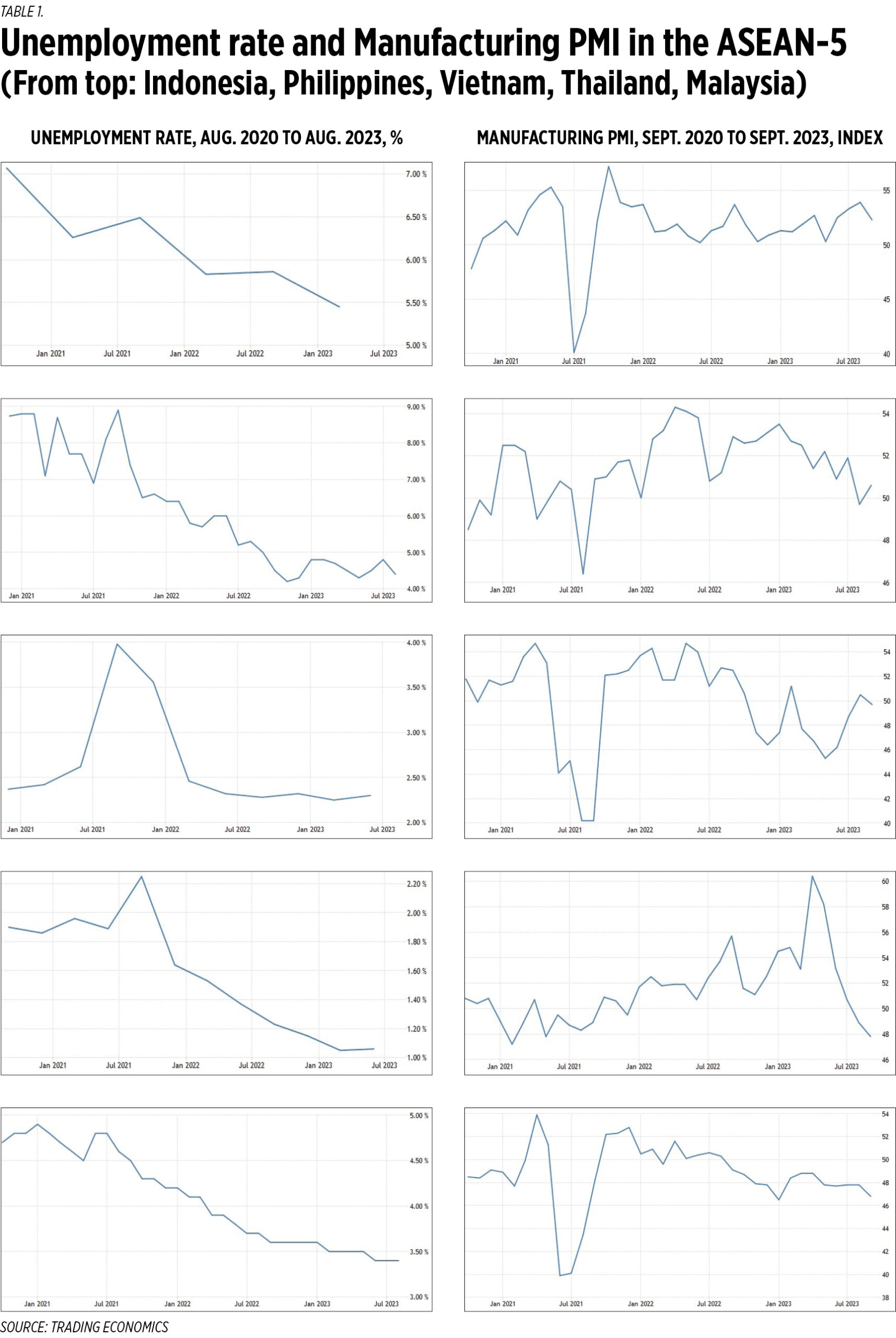
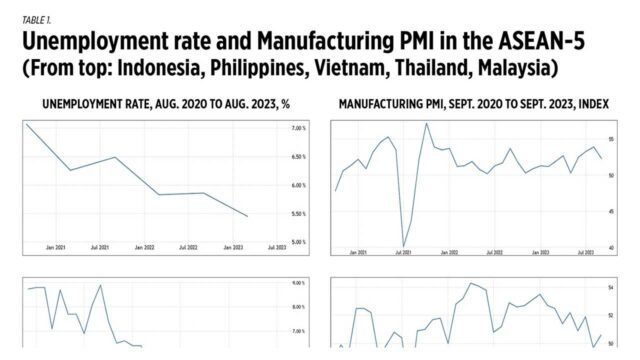
So, despite the Philippines’ slowing GDP growth and high inflation rates in the second and third quarters of 2023, the unemployment rate went down to 4.4% in August. Then the manufacturing purchasing managers’ index (PMI) stayed above 50. The PMI is an indicator of whether market conditions are expanding, staying the same, or contracting as viewed by purchasing managers.

I checked the data for the ASEAN-5 on unemployment rates and manufacturing PMI over the last three years. All five countries — Indonesia, Malaysia, the Philippines, Thailand, and Vietnam — showed declining unemployment, which is good. But when looking at the manufacturing PMI, only Indonesia and the Philippines had an index above 50 as of September. The other three countries have seen declining PMI, below 50, especially Thailand and Malaysia (see Table 1).

Congrats to the economic team, particularly Secretaries Benjamin Diokno of the Finance department, Amenah Pangandaman of the Budget and Management department, and Arsenio Balisacan of the National Economic and Development Authority, for leading the positive business outlook of the country.

THOLOS FORUM 2023
Meanwhile, the Tholos Foundation in the US will hold the Tholos Forum 2023 with the theme, “Coalitions, Freedom, Innovation” on Oct. 16 to 18 in Nice, France. Among the topics to be discussed in the conference are digital taxes, harm reduction, the international property rights index (IPRI), climate and energy, US and Germany politics, and country updates from international participants. This writer is one of Tholos International Fellows.

Results of IPRI 2023, which was launched by the Property Rights Alliance (PRA, Washington DC) in late September, will be presented again by Lorenzo Montanari, Executive Director of PRA.

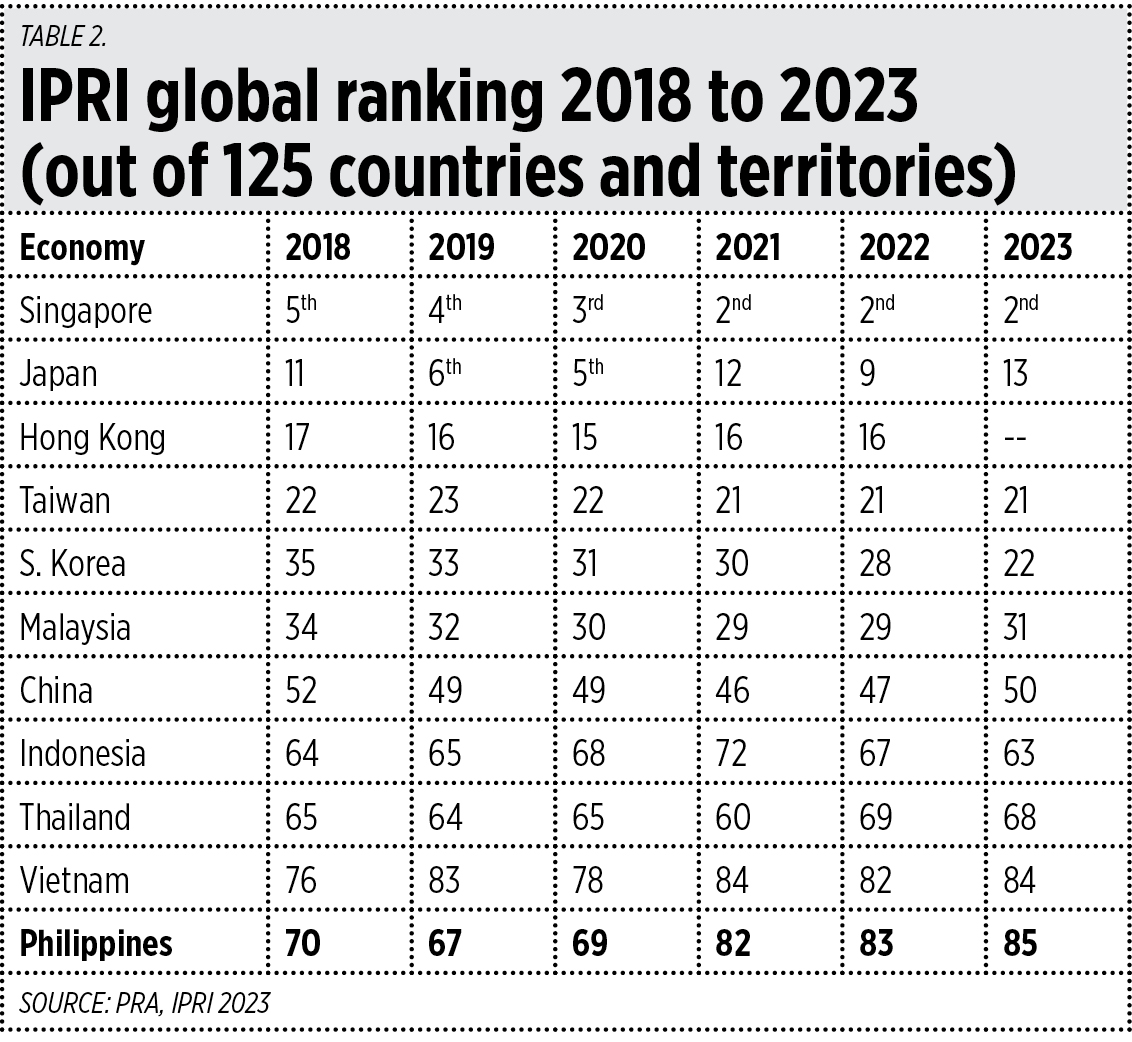
The IPRI is a composite of three sub-indices: legal and political (LP) environment, physical property, and intellectual property protection. Basic data for LP to derive the index come from the World Justice Project and the World Bank’s World Governance Indicators. The Philippines showed a deterioration in its global ranking, from 70th in 2018 to 85th in 2023, pulled down by a low score in LP due to a poor performance in the rule of law and political stability — and/or other countries simply improved (see Table 2).

My suspicion on why the Philippines and other ASEAN countries have low overall scores is that the World Bank’s data on world governance is itself tainted. Nonetheless, various economic and business indicators, like those in Table 1, point to the Philippines having an improving overall business environment.

I will write more about the Tholos Forum next week.


Bienvenido S. Oplas, Jr. is the president of Bienvenido S. Oplas, Jr. Research Consultancy Services, and Minimal Government Thinkers

minimalgovernment@gmail.com

SM Prime to open mall in San Pedro City with 90% space leased out

SY-led SM Prime Holdings, Inc. is set to open a new mall in San Pedro City, Laguna on Oct. 13, marking its 84th mall in the country.

In a regulatory filing on Wednesday, the listed property developer said that SM Center San Pedro is its fourth mall in Laguna province, joining SM City Sta. Rosa, SM City San Pablo, and SM City Calamba.

SM Prime President Jeffrey C. Lim said the new mall “is set to provide further opportunity for the company to expand its brand of service and convenience to more Filipinos in the south, specifically in Laguna and nearby towns of Cavite.”

He added that the mall, “with its ideal location, aims to converge business, leisure and entertainment that will enhance economic and civic activities in the area.” 

SM Center San Pedro is situated along U.B. Main Road, Brgy. United Bayanihan.

According to SM Prime, the mall will open with almost 90% of space lease-awarded, sharing three levels of shopping, dining, and entertainment hubs, including the company’s SM Hypermarket, SM Appliance, Ace Hardware, Miniso, Watsons, Simply Shoes, Pet Express, and BDO.

It will also feature an SM Foodcourt, Cyberzone, indoor plaza, and parking areas.

In the first half, SM Prime recorded a 38% increase in consolidated net income to P19.4 billion from P14.1 billion a year ago due to higher revenues.

Shares of SM Prime on Wednesday rose 10 centavos or 0.32% to P31.10 apiece. — Revin Mikhael D. Ochave

LVMH sales growth loses fizz as post-pandemic splurge wanes

ALEXANDER NAGLESTAD-UNSPLASH

The wines and spirits division posted a 14% revenue decline over the quarter

PARIS — Luxury goods bellwether LVMH reported a 9% rise in third quarter revenue on Tuesday, marking slower growth as a strong wave of post-pandemic spending eases due to rising inflation and economic turbulence.

“After three roaring years, and outstanding years, growth is converging toward numbers that are more in line with historical average,” LVMH chief financial officer Jean-Jacques Guiony told analysts.

LVMH, which owns labels including Louis Vuitton, Dior, Tiffany, and Bulgari, said revenue came to 19.96 billion euros ($21.16 billion), up 9% year on year, stripping out the effect of currency fluctuations and acquisitions. Total revenue rose 1% year on year.

The fashion and leather goods division, home to Louis Vuitton and Dior, recorded sales growth of 9%, compared to analysts’ expectations for 10% growth.

LVMH is facing slowing demand for high end goods in the United States and Europe, where rising prices have prompted shoppers — especially younger generations — to pull back from a post-pandemic spending euphoria, while the recovery in China has been uneven.

Mr. Guiony noted that while business slowed in Europe over the quarter, there was not a marked change in demand for fashion and leather goods from China compared to two years ago, except that more purchases are being made outside of the mainland as travel resumes.

In the United States, there was little change in trends, according to Mr. Guiony.

The wines and spirits division posted a 14% revenue decline over the quarter, with the company flagging less demand for Champagne over the period, while the weak economic environment in the US, and a slower-than-expected bounce back in China affected demand for Hennessy cognac.

LVMH is the first major global luxury firm to report earnings this quarter and gives investors an insight into what to expect from rivals Hermes and Kering report on Oct. 24.

“This seems good enough to support the share price, as buyside expectations were possibly more muted, as the significant market derating suggests,” said Luca Solca, analyst with Bernstein, noting the company faced a tougher comparison period following strong performances in China, the United States and Europe a year ago.

Investors have recently lowered their expectations for the luxury sector and around 96 billion euros has been knocked off the value of LVMH since April.

The French luxury group was last month unseated as Europe’s most valuable listed company after a 2-1/2 year long reign by Danish drugmaker Novo Nordisk, which was boosted by the growth of anti-obesity drug Wegovy.

A stronger euro against the US dollar than a year earlier also impacted the company as US sales were worth less when converted back into its home currency. The negative currency impact was worse than anticipated, said Mr. Guiony, noting he expected it to negatively affect margins in the second half, although some of that would be offset by hedging strategies.

The currency impact is expected to affect European companies with large US operations this earnings season.

Sony LinkBuds S x Olivia Rodrigo headphones to be available in PHL

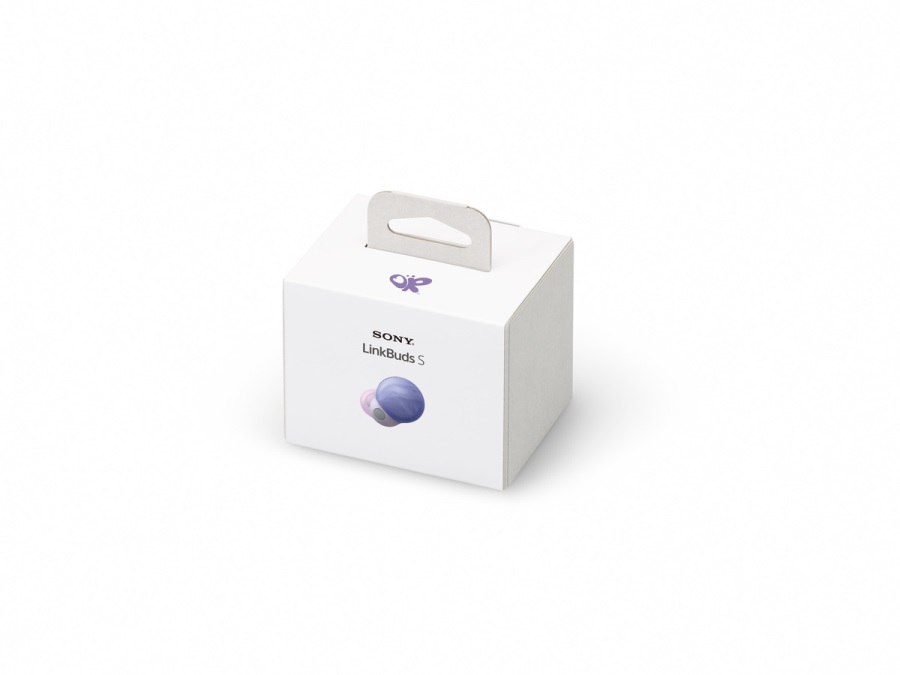
SONY Philippines last week announced that its limited-edition collaboration with singer Olivia Rodrigo will be available for pre-order in the country by the end of the month.

The LinkBuds S x Olivia Rodrigo limited edition headphones are priced at P10,999 and will be available for pre-order from Oct. 28 to Nov. 16 at select Sony dealers and the brands official Lazada and Shopee stores. Those who will purchase will get a free Olivia Rodrigo GUTS tote bag.

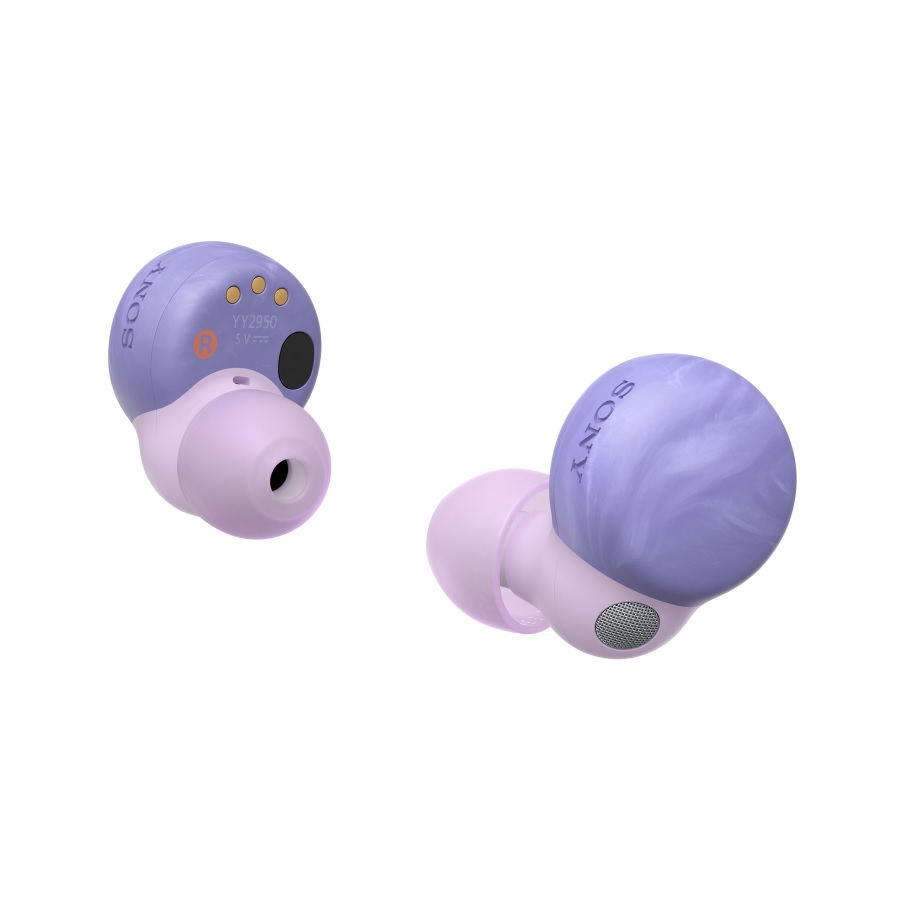
“Based off Sony’s LinkBuds S noise canceling truly wireless headphones, the new limited edition LinkBuds S x Olivia Rodrigo feature Custom EQs (special equalizers) tuned by Olivia and her producer Daniel Nigro for optimal listening of her albums GUTS and SOUR on any music streaming service and come in a unique violet marble pattern styled by Olivia and made with environmentally conscious materials,” Sony said in a statement.

“I’m so excited that I got to design a limited edition LinkBuds S in the color violet. The sound is incredible, and I can’t wait for my fans to experience GUTS in this way,” Ms. Rodrigo was quoted as saying.

The headphones have two special equalizers customized for Ms. Rodrigo’s music that can be accessed via the Sony | Headphones Connect app, the brand said.

“When designing the LinkBuds S x Olivia Rodrigo, Olivia chose an environmentally conscious design using factory recovered plastic, reclaimed water bottles, and recycled plastic materials from automobile parts to create parts of the case and body of the headphones. Due to the variation in material, the headphones host a violet marble pattern that causes no two pairs of LinkBuds S x Olivia Rodrigo to be the same,” Sony said.

The LinkBuds S x Olivia Rodrigo have noise canceling and high-resolution audio wireless features.

“Smart features such as Adaptive Sound Control and Auto Play learn from the user’s behavior and automatically adjust sound settings to provide the right sound for the moment,” Sony said.

Furnished copies

FREEPIK

THE MEMOS of old had a list of recipients at the end of the typed message just under the sender’s signature. They were categorized under “cc,” which stood for “carbon copies” — if one still remembers those thin sheets of onion-skin paper that record imprints from the typewriter in ever lighter shades as copies were added.

A list of those furnished copies of the now more common e-mail determines the importance of the message and the audience being addressed, aside from the direct recipient. This may even include others outside the organization.

So, after finding out what the e-mail is about (Pending reorganization?), the list of those copied shows how far the ripple effect will go. The longer the list with copies, the more significant the news is likely to be for the main addressee. (It could even be good news, like winning a loyalty award.) Sometimes, the copy involves a whole department (no names needed) in case the subject is about a new head of the department.

The designation of the digital audience revolves around the following possibilities: 1.) The inclusion is simply “For Your Information” (FYI) ensuring that the persons in the list have been looped in and cannot claim later on that they didn’t know what was coming, then hide behind feigned ignorance; 2.) Credit for some success is being shared by the sender; and, 3.) The copied persons are asked to give their opinions, formally being solicited. The list of furnished copies does not include leaks.

There is a difference between the memo addressee at the top and the copied list right under “subject.” The top name, sometimes more than one, is the purported target of the correspondence. Those copied are people who can add to the applause or come to the sender’s aid, if required. This is an important audience for any further exchange of e-mails that may result from the original one.

Most insidious is the box for “bcc” which is a blind list known only to the sender. The blind copies involve people who may have no business being in the loop, maybe even some who are not authorized to know the contents of the message. None of the formally copied know the invisible list added to the correspondence.

The blind copies may also include a person several rungs higher than the sender whose boss (and the blind copy’s subordinate) is the formal addressee or among the copy list. The blind copy seems to say — hey, you shouldn’t get this but it’s good for you to know who your friends are.

What does the copied person do with mail that does not affect how well he sleeps at night or how hefty his bank balances can become? Does he even read what to him may simply be e-junk? And should he react and press “reply to all” to get the whole audience panting for more? “Noted” may be a good enough response. It’s the same as saying — I need to take a nap.

Because of the ease and speed of e-mail, it is important for a sender to be careful with his words. A mis-sent message, or inclusion of someone already forced into early retirement in the copy box, can result in career changes of the worst kind. After pressing “send,” there is no way to retract this digital missile.

It’s safe to follow a simple rule. Just ignore e-mail where you are only copied. Fine, you can still read what the message is about (or simply skip it altogether) but there is no need to react, not right away.

Now Viber groups are formed around some project (Operation Shoelace) to keep each of the designated participants in the loop for the latest updates, sometimes hourly on a hot issue. Here, it is important to routinely check who are the designated participants. An opinion that is carelessly expressed (he is useless and a power tripper besides) may refer to a recently added personality. Can retribution be far behind?

Copied lists are worth studying. They denote the personalities whose opinions are being sought. (Should I go ahead with this?) It is up to the respondent to “reply to all” or just limit his recommendations to the main sender who has the option to share it with the original copy list. By this time anyway, the grapevine has taken over… or lost interest.


Tony Samson is chairman and CEO of TOUCH xda

ar.samson@yahoo.com

realme to launch Pad 2 tablet in PHL

TRUSTPAIR.COM

realme Philippines is set to launch on Friday its new budget smart tablet, the realme Pad 2.

“Designed to inspire, the realme Pad 2 promises to redefine entertainment, work, and leisure — more especially for those constantly on the move,” realme Philippines said in a statement on Wednesday.

The Pad 2 has an 11.5-inch 2K resolution display with a 120Hz refresh rate.

It is powered by the MediaTek Helio G99 processor, which the brand claims can support casual to average gaming. It has an 8,360mAh battery with 33W fast charging.

It also has a quad speaker setup enhanced by Dolby Atmos.

The realme Pad 2’s 6GB+128GB LTE variant will retail for P13,999, while the 8GB+256GB LTE variant will be priced at P17,999.

The Pad 2 will be launched on Friday at all realme stores and will come with a free portable blender until Oct. 19.

Online availability via Shopee will start on Oct. 17 at P2,000 off for both variants. — MHLA

GCash introduces Visa-powered payment card

INSTAGRAM.COM/GCASHOFFICIAL

GCASH has launched GCash Card, the financial super app’s payment card powered by Visa, Inc. which offers more cashless payment options.

The electronic wallet platform said on Wednesday that any fully verified GCash user can order their payment card through its application without any additional documents required for approval.

“The new card powered by Visa unlocks more payment options for GCash users as they can use at over 100 million merchants in the Philippines and across the world,” said Oscar Enrico A. Reyes, Jr., president and chief executive officer of G-Xchange, Inc., the mobile wallet operator of GCash.

GCash said that with the new card, “more Filipinos, especially those busy with the daily hustle, can have access to another cashless payment option which they can use for their everyday expenses.”

It said the payment card can also be used for overseas payments in more than 200 countries as it is powered by multinational payment card Visa.

“This gives traveling GCash Card users and overseas Filipinos another secure and convenient way of paying abroad,” GCash said.

“We are very happy to partner with GCash to provide the GCash Card to Filipinos, which paves the way to better financial inclusion,” said Jeff Navarro, Visa country manager for the Philippines and Guam. — A.E.O. Jose

BSP says open to granting more digital banking licenses ‘soon’

THE CENTRAL BANK is open to granting licenses to more digital banks “soon,” its top official said on Wednesday.

“There are a lot of good players who are applying [for digital banking licenses]. I’m hoping that we can begin issuing licenses again pretty soon,” Bangko Sentral ng Pilipinas (BSP) Governor Eli M. Remolona, Jr. told reporters in mixed English and Filipino.

Many groups are interested in setting up digital banks, Mr. Remolona said.

“But we’re looking at the existing ones — the six digital banks that have licenses. Essentially, we’re looking at their business models, and we’re learning. They’re learning,” Mr. Remolona said.

“Once we get more comfortable with their business models, we will allow more licenses for digital banks,” he added.

BSP Supervisory Policy and Research Department Director Maria Cynthia M. Sison said the central bank has not decided when to lift the moratorium on the grant of digital banking licenses. 

“We’re still doing the study on the existing digital banks. Once we have completed that study, the decision whether to lift the moratorium or not will follow,” Ms. Sison said.

The central bank closed the applications for digital bank licenses in 2021 after allowing six new lenders to operate.

Then-BSP Governor Benjamin E. Diokno said keeping the number of licensed digital banks at six would allow regulators to monitor the industry’s development and ensure healthy competition among the new lenders.

The first six digital banks allowed by the BSP to operate are Overseas Filipino Bank, Tonik Digital Bank, Inc. (Philippines), UNObank, Union Digital Bank, GoTyme Bank, and Maya Bank.

Digital banks are not required to set up branches or even branch-lite units and are only expected to maintain a head office to allow them to focus their investments on technology.

These lenders are subjected to prudential requirements imposed on traditional lenders.

Lenders with digital banking licenses are expected to help the BSP reach its goal to bring 70% of Filipinos into the formal financial system and have 50% of transactions done online by the end of this year. — K.B. Ta-asan

EU sees lower 2023 wine output on big falls in Italy and Spain

APOLO- PHOTOGRAPHER-UNSPLASH

PARIS — Wine production in the European Union (EU) is set to fall 6% this year after steep declines in major producers Italy and Spain following adverse weather, the European Commission said on Monday, as the grape harvest winds down.

In its first estimate for this year’s output, the EU executive forecast 2023 wine production of about 150 million hectoliters, with output in Italy and Spain falling 12% and 14% respectively from last year.

Extreme weather and fungal diseases hit vineyards in Italy so much this year that the country will lose its position as the world’s largest wine producer, with France set to reclaim the number one spot for the first time in nine years, Italian wine lobbies said last month.

France’s farm ministry estimated on Friday that wine output there this year would be similar to 2022 and 3% above the five-year average at 46 million hectoliters, though with big differences between regions. The Commission pegged French wine output at 45 million hectoliters.

A hectoliter is the equivalent of 100 liters, or 133 standard wine bottles. — Reuters

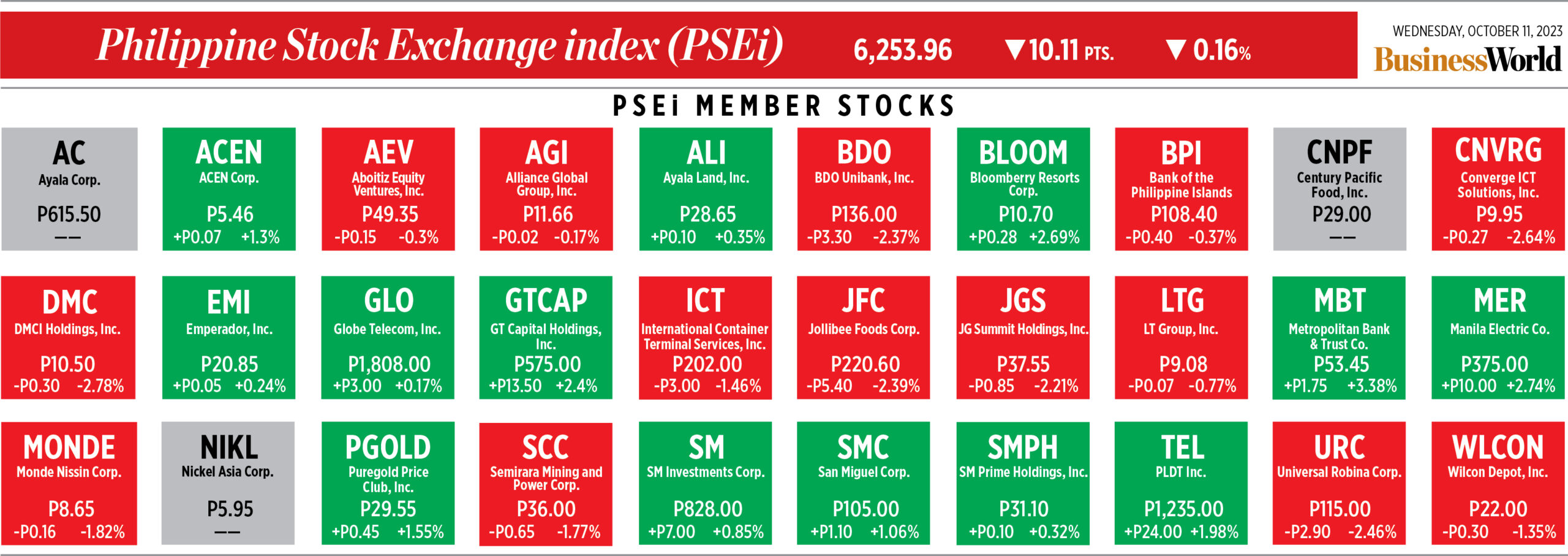
How PSEi member stocks performed — October 11, 2023

Here’s a quick glance at how PSEi stocks fared on Wednesday, October 11, 2023.