Home Blog Page 419

Fed poised to cut rates this week, with more easing likely on tap
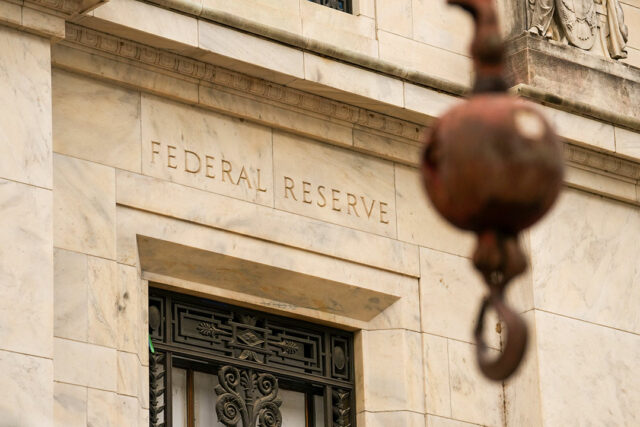
View of the facade as construction continues on the Federal Reserve Board Building in Washington, DC, Sept. 17, 2025. — REUTERS/KEN CEDENO

Federal Reserve policymakers are widely expected to reduce US short-term borrowing costs this week by a quarter of a percentage point for the second time this year as they look to prevent further slowing in the labor market.

Odds are it won’t be the last of the series.

Climbing unemployment insurance claims suggest that labor market demand continues to cool, even as the government shutdown delays publication of most official economic statistics, including the unemployment rate, last estimated at 4.3% in August.

Milder-than-expected inflation readings, including last week’s report that the consumer price index rose 3% in the 12 months through September, have put worries of tariff-driven price pressures on the back burner.

And perhaps more importantly, the Fed’s consensus-crafted post-policy-meeting statement following last month’s quarter-point rate cut incorporated a reference to “additional adjustments” in the policy rate.

Fed Vice Chair for Supervision Michelle Bowman called out that language specifically as foreshadowing future interest-rate cuts, and analysts do not expect the Fed to point to a possible pause by tweaking that language.

“While a good chunk of the committee would probably like to signal that a December ease shouldn’t be taken for granted, we think this alternative wording choice might be too hawkish for the leadership,” wrote JP Morgan Chief US Economist Michael Feroli.

To be sure, Fed Chair Jerome Powell won’t use his post-meeting news conference on Wednesday to suggest another rate cut in December is already in the bag.

There’s too much that could change before then, with global trade discussions in flux that could remake the outlook for prices as well as for economic growth more broadly.

And an end to the government shutdown that restarts the publication of data could also mean Fed policymakers get three months of employment data between now and their December meeting, potentially reshaping their views of the state of the labor market.

“Powell is likely to keep options open and not pre-commit to a particular action through year-end,” Deutsche Bank economists said.

A quarter-point rate cut on Wednesday at the close of the Fed’s two-day meeting would put the policy rate in the 3.75%-4.00% range. Financial markets are betting heavily on further rate cuts in both December and January.

The Trump administration has been vocal about its desire for lower interest rates, keeping Powell under intense political pressure to deliver rate cuts even as he manages a deep split within the Fed’s own policymaking ranks.

Since September’s decision, several Fed policymakers have called for caution on policy easing, citing worries about inflation that has been well above the Fed’s 2% target for the last several years.

More, however, have said they feel further rate cuts will be needed to manage the risk of more job-market deterioration.

New Fed Governor Stephen Miran, who plans to return to his job as White House economic advisor at the end of his Fed term in January, could cast a dissent this week, as he did last month in support of a half-point interest rate cut.

Beyond the interest-rate decision itself, the Fed could signal this week it will soon stop shrinking its balance sheet, ending its so-called quantitative tightening as soon as this month. Analysts say this week’s meeting will also likely include a vigorous debate about how the Fed communicates its rate-path guidance as it looks to revamp its communications. — Reuters
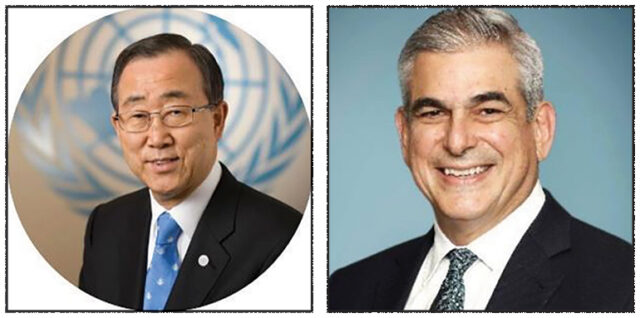

AIM hosts AFES 2025: Ban Ki-moon, Zobel de Ayala lead conversations on enterprise for a resilient future

United Nations former secretary-general Ban Ki-moon (left) and Ayala Corp. Chairman Jaime Augusto Zobel de Ayala, who both have shaped the global sustainability agenda, will set the tone for the Asian Forum on Enterprise for Society (AFES) 2025.

On Nov. 11-12, 2025, the Asian Institute of Management (AIM) will host the Asian Forum on Enterprise for Society (AFES) 2025 at the Makati Shangri-La. Organized by AIM’s Ramon V. del Rosario, Sr. Center on Enterprise for Society (RVR Center), AFES brings together global thought leaders, changemakers, and innovators to explore how enterprise can be a force for resilience and renewal in times of disruption.

At a moment defined by climate instability, shifting geopolitics, and the rapid evolution of artificial intelligence, AFES 2025 will examine how enterprises can lead with purpose, adaptability, and a commitment to long-term progress.

Two figures who have shaped the global sustainability agenda will set the tone. Ban Ki-moon, former Secretary-General of the United Nations, played a pivotal role in forging the Paris Agreement and the Sustainable Development Goals. Jaime Augusto Zobel de Ayala, Chairman of Ayala Corp., has led sustainability-driven transformation across Philippine and regional business sectors. Their perspectives will anchor the forum’s call for collective leadership in solving the challenges that define our time.

With the theme “Navigating Disruption: Enterprise Priorities for a Resilient Future,” AFES 2025 will explore practical pathways toward inclusive and sustainable growth. Discussions will focus on how enterprises can harness technology responsibly, design climate solutions rooted in nature, and strengthen systems that value education, diversity, and equity. The forum will also highlight micro-entrepreneurship and inclusive finance as key drivers of opportunity for communities most affected by global change.

Confirmed Speakers and Panelists include:

  • H.E. Ban Ki-Moon — 8th Secretary-General, United Nations
  • Jaime Augusto Zobel de Ayala — Chairman, Ayala Corp.
  • Ms. Cathy Yap-YangHead of Programs, Cignal TV, Inc.
  • Ms. Anna Mae Yu Lamentillo — Founder, NightOwl AI
  • Mr. Anshu Gupta — 2015 Ramon Magsaysay Awardee, Founder, Goonj and Gram Swabhimaan
  • Mr. Antonio Lambino — President, Ayala Foundation, Inc.
  • Ms. Carmina Bayombong — Founder & CEO, InvestEd
  • Ms. Ena Louise Quitain — COO, DMD Skin Sciences
  • Atty. Geraldine Acuña-Sunshine — Founder and President, Khan Academy
  • Mr. Gita Wirjawan — former Minister of Trade and Founder, Ancora Group
  • Dr. Gonzalo J. Varela — Lead Economist for Philippines, Malaysia, and Brunei, World Bank
  • Ms. Imelda Madarang — CEO, Fisherfarms, Inc.
  • Ms. Jean Pauline Landicho — CARD MRI — 2008 Ramon Magsaysay Awardee Organization
  • Mr. Jeremy Prepscius — Managing Director, Asia Pacific ESG-Sustainable Supply Chains, PwC
  • Mr. Jerico Matawaran — Enterprise Risk Management Director, ICTSI
  • Mr. Jesus Antonio S. Itchon — President, BDO Network Bank
  • Ms. Louise Mabulo2019 UN Young Champion of the Earth, and Founder, The Cacao Project
  • Mr. Mark Ruiz — Co-founder, Hapinoy
  • Dr. Muhammad Amjad Saqib — 2021 Ramon Magsaysay Awardee, Founder, Akhuwat
  • Dr. Nanthaporn “Prae” Seributra — CEO, Starfish Education
  • Ms. Neha DasHead, UN Global Compact Asia & Oceania
  • Dr. Panitan Wattanayagorn — former Chairman, Prime Minister of Thailand’s Security Advisory Committee
  • Dr. Raul FabellaNational Scientist, National Academy of Science and Technology
  • Archi. Romolo Nati Chairman and CEO, Italpinas Development Corp.
  • Ms. Shaahina Ali2025 Ramon Magsaysay Awardee, Executive Director, Parley Maldives
  • Dr. Jikyeong Kang — President and Dean, Asian Institute of Management
  • Dr. Albert Wee Kwan Tan Associate Professor and Academic Program Director, Online Master in Business Administration, Asian Institute of Management
  • Dr. Bradley Googins — Strategy Professor, E4Impact Foundation
  • Dr. Chad Michael Briggs — Professor and Academic Program Director, Executive Master in Disaster Risk and Crisis Management, Asian Institute of Management
  • Dr. Christopher Monterola — Professor and Head of Aboitiz School of Innovation, Technology, and Entrepreneurship (ASITE), Asian Institute of Management
  • Dr. Daniel Broby — Professor and Academic Program Director, Master of Science in Financial Technology, Asian Institute of Management
  • Dr. Dynah A. Basuil Professor and Executive Director, AIM-RVR Center on Enterprise for Society, Asian Institute of Management

For AIM, convening AFES 2025 affirms a belief that management education must evolve alongside the problems it seeks to solve. The institute’s mission is not only to train leaders but to equip them to build systems that are both economically sound and socially responsible.

Since its founding in 2002, AFES has grown into one of Asia’s leading platforms for cross-sector dialogue. Through the RVR Center, AIM continues to advance its vision of innovation, partnership, and enterprise as vital pathways toward a sustainable and equitable future.

For more information, visit afes.aim.edu.


Spotlight is BusinessWorld’s sponsored section that allows advertisers to amplify their brand and connect with BusinessWorld’s audience by publishing their stories on the BusinessWorld Web site. For more information, send an email to online@bworldonline.com.

Join us on Viber at https://bit.ly/3hv6bLA to get more updates and subscribe to BusinessWorld’s titles and get exclusive content through www.bworld-x.com.

Canada PM Carney says talks begin for new trade deal with Philippines

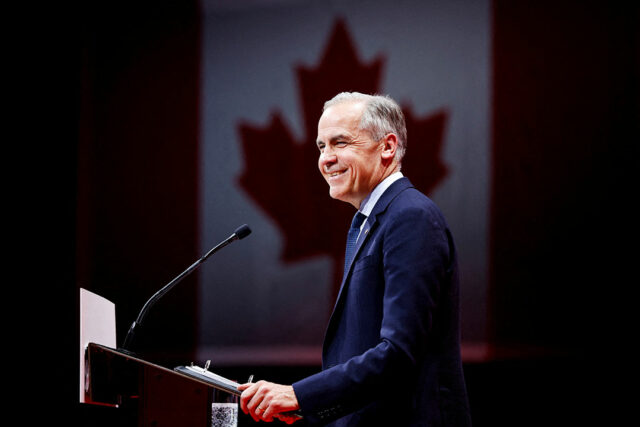
Canada’s Prime Minister Mark Carney — REUTERS

KUALA LUMPUR – Canada has begun talks on a new free trade deal with the Philippines, Canadian Prime Minister Mark Carney said on Monday in Kuala Lumpur, where he is attending the ASEAN summit.

Mr.Carney told reporters that he and ASEAN leaders also have agreed to accelerate progress on a Canada-ASEAN deal with the aim of finalising an agreement by next year.

Ottawa is also exploring opportunities with Malaysia’s Petronas to strengthen Canada’s role as a reliable energy supplier, Mr. Carney said. — Reuters

Putin and North Korea’s foreign minister discuss strengthening ties, KCNA says

SEOUL — North Korea’s Foreign Minister Choe Son Hui met Russian President Vladimir Putin at the Kremlin on Monday to discuss strengthening cooperation, North Korean state media KCNA said on Tuesday.

“Many future projects to constantly strengthen and develop” the bilateral relationship were discussed during the meeting, KCNA said. Choe also conveyed North Korean leader Kim Jong Un’s “brotherly regard” to Putin.

The visit comes amid growing international concern over cooperation between the two countries, in which Pyongyang is supplying Moscow with soldiers and artillery for its war in Ukraine in exchange for military technology assistance from Russia.

Choe also held talks with her Russian counterpart, Foreign Minister Sergei Lavrov, on Monday and reached agreement on all points during strategic discussions on global issues, KCNA said.

During Choe’s talks with Lavrov, the North Korean side expressed support for Russian measures to “remove the root of the Ukraine conflict”. The Russian side expressed support for North Korean efforts to protect its security interests and sovereign rights, KCNA said.— Reuters

Man accused of killing ex-Japan PM Abe to go on trial

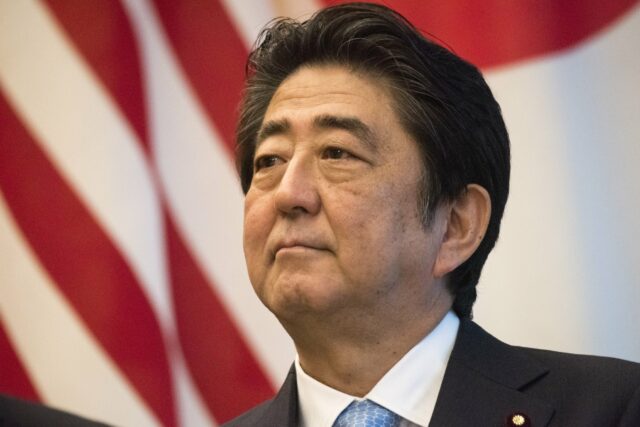
Former Prime Minister Shinzo Abe. Image via Chairman of the Joint Chiefs of Staff/Flickr/CC BY 2.0

TOKYO — A man accused of fatally shooting former Prime Minister Shinzo Abe is set to go on trial on Tuesday, three years after the assassination of Japan’s longest-serving premier stunned a nation where gun crime and political violence are rare.

The trial opens the same day as two of Abe’s former allies, incumbent Prime Minister Sanae Takaichi and visiting US President Donald Trump, hold a summit.

Tetsuya Yamagami, 45, was arrested at the scene of the shooting in July 2022 after allegedly firing at Abe with a homemade gun while the former premier was giving a speech during an election campaign in the western Japanese city of Nara.

Yamagami blamed Abe for promoting the Unification Church, a religious group he held a grudge against after his mother donated to it some 100 million yen ($663,218), local media reported.

The Unification Church was founded in South Korea in 1954. It is famous for its mass weddings and counts Japanese followers as a key source of income.

Having moved through pretrial conferences, Yamagami is set to admit to murder while disputing parts of the indictment related to violations of the Firearms and Swords Control Act and Ordnance Manufacturing Act, an official at the Nara District Court said.

The shooting was followed by revelations that more than a hundred lawmakers of Abe’s Liberal Democratic Party had ties to the Unification Church, driving down public support for the ruling party, which is now led by Takaichi.

After Tuesday’s first court session, starting at 2 p.m. (0500 GMT), 17 more hearings are scheduled by year-end before a verdict on January 21.— Reuters

Lawyers for Brazil’s Bolsonaro request review of coup plot sentencing

EN.WIKIPEDIA.ORG

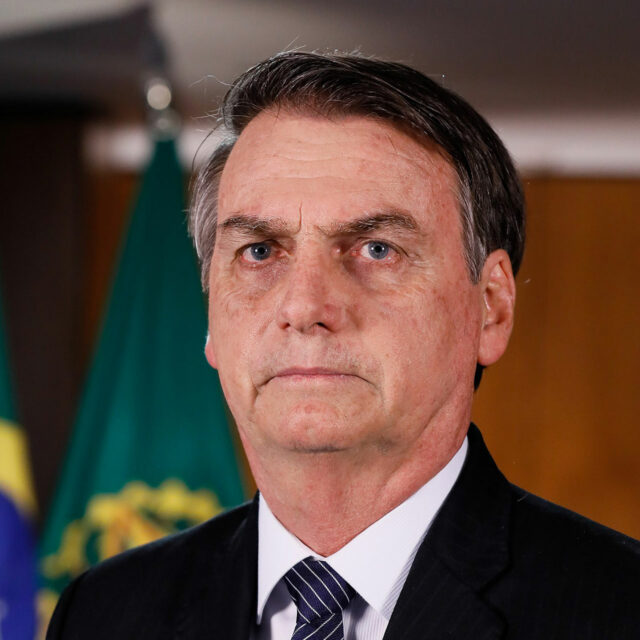
BRASILIA — Lawyers for former Brazilian President Jair Bolsonaro on Monday filed a motion asking for a review of last month’s Supreme Court ruling sentencing him to more than 27 years in prison for plotting a coup to remain in power after the 2022 presidential election.

In the 85-page motion filed with the court, Bolsonaro’s lawyers questioned parts of the conviction, including the length of the former president’s prison time.

In September, four of the five judges of a Supreme Court panel voted to convict Bolsonaro of five crimes, including taking part in an armed criminal organization, attempting to violently abolish democracy and organizing a coup.

Typically, defendants sentenced by Brazil’s Supreme Court need at least two justices to diverge on the ruling to request an appeal that could significantly change the decision.

With only one judge dissenting, Bolsonaro’s lawyers filed a lesser motion that requires clarification or reviews of specific parts of the conviction.

Bolsonaro, who has denied any wrongdoing, will only start serving time once appeals against his sentencing are exhausted.

However, he has been under house arrest since August for allegedly courting the interference of US President Donald Trump, who has raised tariffs on imports of Brazilian goods to 50% and sanctioned the judge overseeing the case.— Reuters

Political uncertainty may stall Philippine growth — Fitch

Visitors browse locally made products on display at the National Arts and Crafts Fair in a mall in Mandaluyong City, Oct. 26. — PHILIPPINE STAR/NOEL B. PABALATE

PHILIPPINE economic growth is expected to remain within target this year, although global trade woes and domestic political uncertainty may cloud the outlook, Fitch Ratings said.

“We expect the Philippines’ economy to expand by 5.6% in 2025, broadly in line with 2023-2024, fueled by the traditional growth drivers of large public infrastructure investments, services exports and remittance-funded private consumption,” Fitch Ratings said in a peer credit analysis released Monday.

The credit rater maintained its Philippine gross domestic product (GDP) projection at 5.6% for this year, within the government’s 5.5-6.5% target.

“Private demand should be supported by easing inflation and interest rates,” Fitch added.

Headline inflation picked up to 1.7% in September, faster than the 1.5% in August but slower than the 1.9% clip a year ago. This brought the year-to-date inflation to 1.7%, matching the Bangko Sentral ng Pilipinas’ (BSP) full-year forecast.

Earlier this month, the BSP trimmed its key policy rate by 25 basis points (bps) to a three-year low of 4.75%. It has so far reduced borrowing costs by a total of 175 bps since August last year. 

“However, domestic political uncertainty could affect investment, with allies of President Ferdinand Marcos doing worse than we expected in the recent midterm elections and a recent corruption scandal,” Fitch said.

Recently, several Public Works officials, private contractors and lawmakers have been linked to multibillion-peso corruption involving government flood control projects.

“Global trade tensions will likely drag on growth, in particular indirectly through weaker global demand,” Fitch added.

At the same time, Fitch Ratings said its “BBB” rating and “stable” outlook for the Philippines, which it last affirmed in April, reflects the country’s strong medium-term growth prospects.

“The ‘BBB’ rating and ‘stable’ outlook reflect the Philippines’ strong medium-term growth, which supports a gradual reduction in government debt/GDP, and the large size of the economy relative to ‘BBB’ peers,” it said. “The rating is constrained by low GDP per head, despite an upward trend.”

In the first half, the Philippine economy grew by an average 5.4%, slower than 6.2% seen in the same period last year.

For his part, Department of Budget and Management (DBM) Undersecretary and Principal Economist Joselito R. Basilio said third-quarter GDP will likely remain within target, driven by private consumption.

“(The GDP is) most likely on target,” he told reporters on the sidelines of the 2025 Fiscal Policy Conference on Monday. “The target range is low, right? So, it can be reached very easily,” he added referring to the 5.5-6.5% government target.

The third-quarter GDP data will be released on Nov. 7.

Mr. Basilio said that private consumption might have picked up in the third quarter amid easing inflation and interest rates.

“So, maaasahan natin ngayon ’yung private sector driven growth (So, we can now rely on private sector-driven growth),” he added.

Mr. Basilio said he expects GDP growth to remain on target until yearend as the government plans to boost its spending in the coming months.

The Development Budget Coordination Committee is scheduled to meet between late November to early December to review its macroeconomic targets, he added.

‘CORRUPTION KILLS GROWTH’
Meanwhile, GlobalSource Partners’ analysts said massive corruption in flood control projects have weighed on Philippine economy, preventing it from growing over 6%.

“These funds — siphoned through fraudulent contracts and padded budgets — could have built schools, improved hospitals, and created up to 266,000 jobs. The resulting drag on productivity meant economic growth of 5.5-5.7%, when the economy could have expanded closer to over 6%,” GlobalSource country analysts Diwa C. Guinigundo and Wilhelmina C. Mañalac said in an Oct. 23 commentary.

Finance Secretary Ralph G. Recto earlier said the economy may have lost up to P118.5 billion between 2023 and 2025 due to these anomalous projects.

“The moral indictment is clear: corruption kills growth, weakens resilience, and erodes trust. When infrastructure becomes a source of private enrichment rather than public service, the entire development agenda collapses,” they added.

For a developing country like the Philippines, they said good governance is an “economic necessity,” not a “moral luxury.”

“Every peso lost to corruption is a peso withheld from productive investment. When public works are marred by inefficiency and fraud, they not only waste resources but also weaken the very foundations of inclusive growth: connectivity, productivity, and resilience,” they said.

“Unmasking corruption in public works, therefore, is more than an anti-graft exercise — it is a strategy for resilience and growth. In the final analysis, the most enduring infrastructure a nation can build is good governance itself: a system sturdy enough to withstand both earthquakes and temptations.” — Katherine K. Chan

Local carriers shelve terminal enhancement fee proposal

Local airlines have shelved a plan to impose a terminal enhancement fee on passengers departing from the Ninoy Aquino International Airport (NAIA). — PHILIPPINE STAR/RYAN BALDEMOR

By Ashley Erika O. Jose, Reporter

LOCAL CARRIERS are no longer pursuing their proposal for a terminal enhancement fee, the Civil Aeronautics Board (CAB) said, adding that carriers may explore options that do not require government approval.

“They are not pursuing it anymore. Because maybe they are making a judgment, there are many options for them. One is just increasing the fares by tucking it in or maybe partly absorbing (the high cost),” CAB Executive Director Carmelo L. Arcilla told reporters on the sidelines of an event last week.

Local airlines including Philippine Airlines, Cebu Pacific, and AirAsia Philippines have earlier sought CAB approval to impose a terminal enhancement fee amid higher charges at Ninoy Aquino International Airport (NAIA).

They proposed to collect a terminal enhancement fee of P150 for domestic roundtrip flights and up to P300 each way for international flights.

The airlines are seeking government approval to collect the terminal enhancement fee separately, as these will not be included in the fare.

If approved, the fee would be charged separately from the base fare and itemized distinctly on passenger receipts, similar to fuel surcharges and value-added tax.

Mr. Arcilla said the carriers’ proposal is “archived” for now, noting that the airlines have the right to increase fares to offset the high cost of operating at NAIA.

Since taking over NAIA operations in September last year, private operator New NAIA Infra Corp. (NNIC) has raised landing, takeoff, and other fees.

CAB said previously that some foreign carriers are also seeking to collect terminal enhancement fees to offset rising costs at NAIA.

However, these foreign airlines are also no longer seeking to collect such fees, Mr. Arcilla said, noting that these carriers did not formally file an application to impose terminal enhancement fees.

AirAsia Philippines said it is working closely with the government and industry partners to explore options to address adjustments in airport operational costs, including terminal enhancement fees.

AirAsia Philippines Communications and Public Affairs Head Steve F. Dailisan said in a Viber message that the airline supports initiatives that “enhance the overall customer journey.”

“I fully agree (with this move). It is indeed more inconvenient for passengers to pay separate fees for so many things related to their travel — everything should be incorporated to the cost of the ticket and paid only once,” Nigel Paul C. Villarete, senior adviser on public-private partnership (PPP) at Libra Konsult, Inc., said via Viber on Monday.

Mr. Villarete said it is understandable why airlines would want to collect it as a separate fee, but deciding to tuck it in the base fare would be the best option.

“I understand that the airlines don’t like this and will oppose it, but this is the way to go and the best option. Airlines can print the breakdown in the tickets for the passengers to see,” he said.

“It is a very convenient move, to hide the additional cost in the base fare. Blame will then be attributed to airlines, not the terminal operator. To the public, it is the same impact,” said Rene S. Santiago, an international consultant on transport development and former president of the Transportation Science Society of the Philippines.

Starting September this year, NNIC has also started collecting higher passenger service charge or terminal fee to P950 from P550 for international departures. The terminal fee for domestic departures was raised to P390 from P200.

AIR TALKS
Meanwhile, Mr. Arcilla said CAB has also signed an agreement with Thailand which allowed local carriers like AirAsia Philippines to continue operating there through a third-country code-sharing agreement.

The recently signed deal amends the Philippines and Thailand’s existing air service agreement, Mr. Arcilla said.

A third-country code-sharing agreement involves carriers in two countries selling flights on a third country’s airline.

“Philippines AirAsia is 100% foreign owned but it is still a local carrier,” Mr. Arcilla said, adding that under the current air service agreement only locally controlled airlines are allowed to operate in Thailand.

In June, CAB said that the Philippines is also working on a code-sharing agreement with South Korean and Japanese carriers to expand connectivity between Manila and the US.

Tighter US immigration policies, weak job market could hurt PHL remittances 

PHILIPPINE STAR/MIGUEL DE GUZMAN

By Katherine K. Chan

STRICTER visa and immigration policies in the United States could slow demand for Filipino workers and potentially dampen remittance inflows, analysts said.

Pantheon Macroeconomics Chief Emerging Asia Economist Miguel Chanco said a weakening US labor market has started to affect remittances from US-based migrant Filipino workers.

“We’re arguably already starting to see the softening in the US job market impact remittances from Filipinos there,” Mr. Chanco told BusinessWorld in an e-mail.   

He noted that the growth in remittances from US-based Filipinos has slowed to 0.5% in August, “a far cry from its previous peak of 4.2% in the middle of last year.”

“This ongoing slowdown certainly poses a downside risk to the BSP’s (Bangko Sentral ng Pilipinas) 3% growth assumption for remittances,” he added.

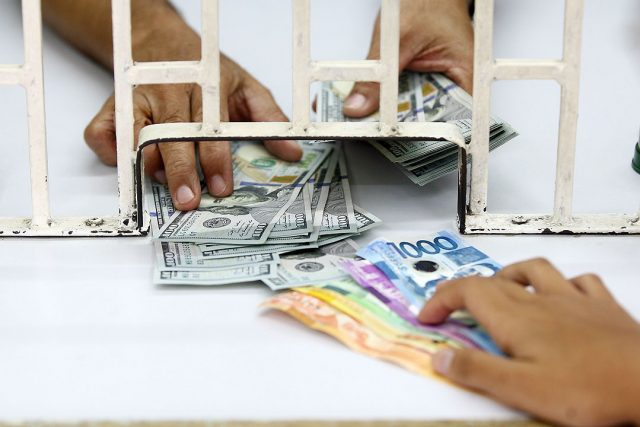
In August, cash remittances grew by 3.2% to $2.977 billion from $2.885 billion a year ago. 

This brought the cumulative cash remittances in the January-to-August period to $22.909 billion, 3.1% higher than the $22.217 billion seen in the same period last year. The bulk or 40.4% of the remittances came from US-based Filipino workers.

The BSP projects cash remittances to increase by 3% to $35.5 billion this year.

Since assuming office in late January, US President Donald J. Trump has tightened border enforcement, ordered a crackdown on illegal immigration and has moved to limit foreign workers.

“Such policies tend to make OFWs more cautious, possibly reducing remittance amounts or sending frequency,” John Paolo R. Rivera, a senior research fellow at the Philippine Institute for Development Studies, said in a Viber message. 

“Given that the US is a major source of Philippine remittances, these developments could make it harder to hit the BSP’s 3% growth target for remittances,” he added.

VISA ISSUE
Meanwhile, the International Monetary Fund (IMF) said the US government’s move to impose a $100,000 fee on new H-1B visas may pose a risk to remittances from the US.

“The fee on H-1B visas could impact remittances from the US, but we do not have specific estimates at this point,” an IMF spokesperson told BusinessWorld in an e-mail, adding that they will monitor further developments and evaluate its impact once additional information becomes available.

In September, Mr. Trump issued a proclamation that required employers who are sponsoring foreign-born workers through the H-1B work visa to pay a one-time fee of $100,000 fee to the US government.

H-1B visas allow foreign workers to temporarily work for US companies in industries such as science, information technology, engineering and finance. The fees are typically shouldered by employers. 

Angelo B. Taningco, research head and chief economist at Security Bank, said stricter US immigration and visa policies may have a moderate to minimal effect on overseas Filipino workers (OFWs) remittances.

“I think OF remittance flows from US to the Philippines would be moderately impacted by restrictive US immigration policy, but minimally affected by the hefty $100k H-1B visa fee because there are not many Filipino H-1B visa applicants,” he told BusinessWorld in an e-mail.

Workers from India account for the majority or about 70% of the total H-1B visa approvals.

On the other hand, Filipinos hold less than 1% of the total number of H-1B visas, according to IT & Business Process Association of the Philippines President and CEO Jonathan R. Madrid.

Nonetheless, Mr. Rivera said the new visa fee could reduce future remittance inflows by discouraging new applicants.

“The new $100,000 fee on new H-1B visa petitions raises the cost of working legally in the US, which could discourage new entrants or slow the growth of that skilled migrant stock, thus dampening future remittance volumes,” he said.

Reinielle Matt M. Erece, an economist at Oikonomia Advisory and Research, Inc., noted that lower remittances could hit the economy as it might limit household spending.

“Lower remittances may show lower disposable income of families with OFWs, thus lower disposable income may result in lower spending,” he said in a Viber message. “Lower spending results in slower jobs and income growth within the domestic economy.”

Mr. Rivera also said weaker inflows could also put a strain on foreign exchange reserves as well as put more pressure on the peso and external balance.

“The Filipino diaspora in the US is still the largest globally — by far — so I highly doubt that making it difficult for new entrants to come into the country in the future will instantly affect the US’ position as the largest origin market for remittance inflows,” Mr. Chanco said.

“For now, with total remittance growth holding fairly steady at 3%, these aforementioned developments in the US shouldn’t have a significant bearing on the Philippines growth prospects,” Mr. Chanco added.

ASEAN, South Korea launch FTA upgrade talks

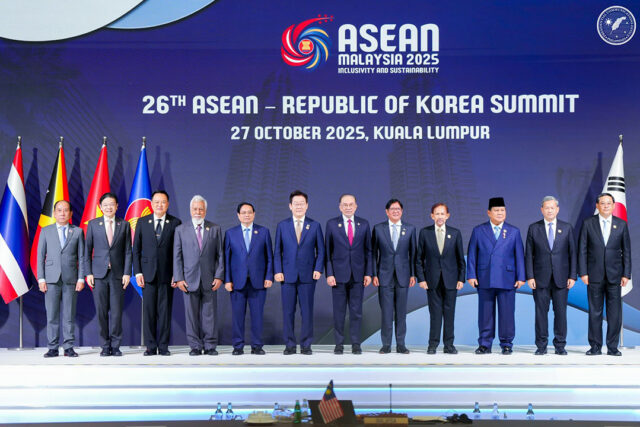
Philippine President Ferdinand R. Marcos, Jr. (eighth from left) poses for a photo with South Korea’s President Lee Jae Myung (sixth from left) and other leaders from the Association of Southeast Asian Nations (ASEAN) during the 26th ASEAN-Korea Summit in Kuala Lumpur, Malaysia, Oct. 27. — COURTESY OF PRESIDENTIAL COMMUNICATIONS OFFICE (PCO) FACEBOOK PAGE

By Chloe Mari A. Hufana, Reporter

KUALA LUMPUR — Philippine President Ferdinand R. Marcos, Jr. on Monday pushed for an expanded free trade deal between the Association of Southeast Asian Nations (ASEAN) and South Korea, saying this would keep markets open and counter growing protectionist trends in the global economy.

Mr. Marcos said a review of the ASEAN-Korea Free Trade Agreement (AKFTA) marks a “shared determination” to ensure the partnership remains relevant amid global economic uncertainty.

“The Philippines welcomes the launch of the negotiations to upgrade the ASEAN-Korea Free Trade Area, a timely step in strengthening ASEAN-Korea economic ties and ensuring that our partnership remains relevant in today’s rapidly changing global economy,” he said during the 26th ASEAN-Republic of Korea Summit in Kuala Lumpur.

The President added that enhancing the trade pact would reaffirm both sides’ commitment to transparency, fairness and cooperation in trade.

Trade between ASEAN and South Korea reached $187.1 billion in 2023, according to the South Korean Ministry of Foreign Affairs.

Seoul is the regional bloc’s second-largest trading partner, while ASEAN is South Korea’s second-largest investment destination, with foreign direct investment inflows reaching $10.8 billion in 2022 and $7.31 billion in 2023.

ASEAN Studies lecturer at De La Salle-College of St. Benilde Josue Raphael J. Cortez said the review of the AKFTA underscores the need for trade partnerships to adapt to current geoeconomic challenges.

As ASEAN’s second-largest trading partner, South Korea plays a key role in ensuring mutual economic resilience amid global shifts, he noted.

“This strengthening of partnership is undoubtedly a win-win situation, especially since trade diversification is not an alternative anymore today, but is an imperative that every nation-state must embrace,” he said via Facebook Messenger.

If realized, the upgraded FTA would boost trade in agriculture and machinery, enhance tourism-driven growth, and attract more South Korean investments to the region, he added.

For the Philippines, the deal could strengthen its electronics exports and provide alternative sources of oil, petroleum, and agricultural goods, supporting both energy stability and food security, Mr. Cortez noted.

RCEP
During the 5th Regional Comprehensive Economic Partnership (RCEP) Leaders’ Summit on Monday, Mr. Marcos urged the member states to accelerate the accession process to expand the bloc’s membership and ensure that businesses, especially micro, small, and medium enterprises (MSMEs), fully benefit from the world’s largest free trade agreement.

He noted that early expansion would deepen regional integration, reinforce supply-chain resilience, and reaffirm ASEAN’s central role in shaping Asia’s economic future.

“It is in our collective interest to advance the accession process without delay,” Mr. Marcos said.

The RCEP brings together the ASEAN member states along with China, Japan, South Korea, Australia and New Zealand, covering nearly a third of global gross domestic product (GDP) and trade.

“RCEP exemplifies ASEAN’s commitment to a rules-based trading system — our strongest anchor amid today’s global uncertainties,” the Philippine president said.

“It provides a stable and predictable framework for trade and investments, allowing our economies to grow and develop together in an environment of trust, fairness, and transparency.”

Mr. Marcos called on all RCEP parties to enhance cooperation on awareness-building and capacity development, enabling MSMEs to utilize the pact’s benefits better.

He added that Manila is ready to collaborate with other members on a regional campaign to promote the pact and facilitate dialogue, business matching and cross-border collaboration.

“To further demonstrate our commitment, the Philippines will be pleased to host this International Trade Forum in November next year,” he said.

The President also underscored the need for RCEP to evolve with global trends, highlighting the importance of cooperation in digital trade, the creative economy, green transition, and innovation.

According to Mr. Cortez, the President’s remarks highlighted the Philippines’ openness to collaborate with other nations and underscore the importance of multilateral approaches to today’s economic challenges.

He noted the regional trade pact offers a framework for both developed and developing members to protect their economic interests amid global market volatility and geopolitical uncertainty.

“One has to bear in mind that trade is not merely affected by skyrocketing tariffs, but also political and armed conflicts. With every part of the world today seemingly challenged by political uncertainty, trade disruptions are inevitable,” Mr. Cortez said.

“Hence, it is in the best interest of RCEP not only to devise collective frameworks, but also to widen its membership as these new signatories, in one way or another, will always be an alternative should the need arise.”

He urged the bloc to expand its focus beyond traditional industries to emerging sectors like the creative economy and innovation — while ensuring such progress does not disadvantage low-skilled workers, in line with RCEP’s founding principles.

TARIFF TALKS CONTINUE
Palace Press Officer Clarissa A. Castro quoted Special Assistant to the President for Investment and Economic Affairs Frederick D. Go as saying the tariff negotiations between Manila and Washington continue.

This as Malaysia and Cambodia signed trade pacts with the US over the weekend, while framework trade agreements with Vietnam and Thailand were also inked.

“There are also some issues that we can describe as comprehensive, particularly concerning trade rules and regulations, as well as nontariff measures like services and investments,” Ms. Castro said in Filipino during a briefing at the Kuala Lumpur Convention Center on Monday.

“These involve issues related to protecting our country’s interests, especially in sectors such as agricultural products — like coconuts, pineapples, sugar, cocoa — and electronic products,” Ms. Castro said, noting these are among the areas Manila cannot easily address at the moment.

Since Aug. 7, the US has imposed a 19% duty on many goods from the Philippines, Cambodia, Malaysia, Thailand and Indonesia.

“ASEAN values its partnership with the United States and seeks to build practical, strategic, and forward-looking collaboration that delivers concrete outcomes for our businesses and citizens alike,” Mr. Marcos said during the 13th ASEAN-US Summit on Sunday.

Jeju exit in sight as Bloomberry inks sale agreement for casino unit

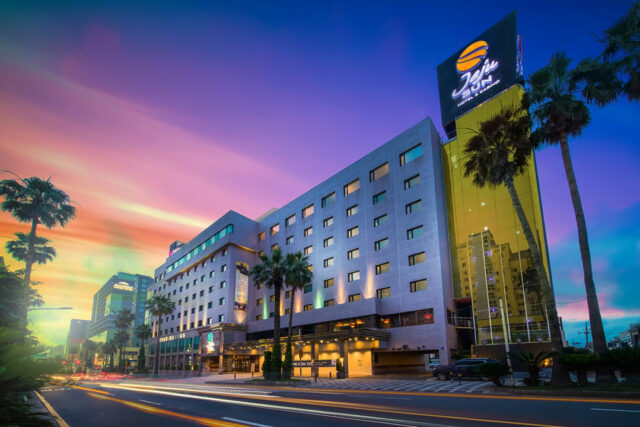
JEJU SUN Hotel & Casino, operated by Bloomberry Resorts Corp.’s subsidiary Golden & Luxury Co., Ltd., is located on Jeju Island, Republic of Korea. — BLOOMBERRY.PH

RAZON-LED Bloomberry Resorts Corp. has found a buyer for its casino business in South Korea, which analysts said could help strengthen its earnings outlook.

In a disclosure to the stock exchange on Monday, Bloomberry said its indirect subsidiary, Golden & Luxury Co., Ltd., has signed a share purchase agreement with Gangwon Blue Mountain Co., Ltd. to spin off and sell its casino business.

The buyer has made a down payment of 500 million Korean won (around P20.48 million), the company said. The completion of the transaction is subject to regulatory approvals.

Golden & Luxury operates Jeju Sun Hotel & Casino, located on Jeju Island, one of South Korea’s major tourist destinations.

“The divestment is intended to cut losses and rechannel corporate resources to the Philippine operations. This is a positive development for Bloomberry because it will be shedding a losing business,” China Bank Capital Corp. Managing Director Juan Paolo E. Colet said in a Viber message.

Jeju Sun’s gross gaming revenue (GGR) dropped 93% in the second quarter to P2.5 million from P35.7 million in the same period last year, Bloomberry data showed.

COL Financial gaming analyst Richard Laneda said the sale could generate gains for Bloomberry.

“In terms of the financial impact of the transaction, the casino license has already been fully impaired last year so there would be no one-off loss on that, but there is likelihood that BLOOM will book a gain from the other assets like the casino building and gaming equipment,” he said.

Bloomberry posted a P1.4-billion net loss in the second quarter, reversing the P1.3-billion net profit recorded a year earlier. Its total GGR also eased 1% to P14.3 billion, reflecting weaker demand in its VIP and premium mass segments.

The company operates Solaire Resort Entertainment City in Parañaque and Solaire Resort North in Quezon City.

At the local bourse on Monday, Bloomberry shares fell by 2.76% or nine centavos to close at P3.17 apiece. — Beatriz Marie D. Cruz

GT Capital, Ateneo sign deal to build Cavite campus

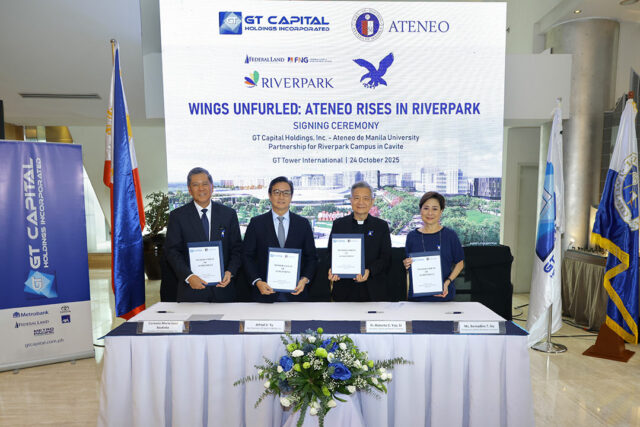
FROM left to right: GT Capital President Carmelo Maria Luza Bautista, GT Capital Vice-Chairman Alfred V. Ty, Ateneo de Manila University President Fr. Roberto Yap, S.J., and Ateneo de Manila University Board of Trustees Chairperson Bernadine T. Siy.

TY-LED conglomerate GT Capital Holdings, Inc. has signed a memorandum of agreement with Ateneo de Manila University to develop a 15-hectare Ateneo campus within Riverpark, its flagship township in General Trias City, Cavite.

Riverpark is a mixed-use development by GT Capital’s property arm Federal Land, Inc., through its joint venture with Japan’s Nomura Real Estate Development Co. Ltd. under Federal Land NRE Global, Inc. (FNG).

GT Capital Vice-Chairman Alfred V. Ty said the partnership aligns with the group’s long-term commitment to sustainable community development.

“Ateneo’s presence in Riverpark not only strengthens the educational landscape of Cavite but also uplifts the lives of the communities we serve,” he said in a statement on Monday.

“Our investment in this campus reflects our long-term commitment to creating sustainable value for generations of Filipinos, anchored on the values of excellence and service,” he added.

The Cavite campus, targeted to open by 2030, will cater to students from southern Metro Manila and nearby provinces.

Riverpark has been drawing major investors, with UNIQLO’s logistics facility and the soon-to-open SM City General Trias among ongoing developments.

Earlier this year, FNG reported that the first batch of commercial lots in Riverpark had sold out, which are set to be developed into offices, retail, and mixed-use facilities.

By 2026, residents will gain direct access to the Open Canal Interchange of the Cavite-Laguna Expressway (CALAX), which is expected to cut travel time to and from the township.

The signing ceremony was held on Oct. 24 at the GT Tower International Penthouse in Makati City, with GT Capital represented by Mr. Ty and President Carmelo Maria Luza Bautista, and Ateneo represented by its president, Fr. Roberto C. Yap, S.J.

Also present were Ateneo Board of Trustees Chairperson Bernadine T. Siy, Federal Land Vice-Chairman and FNG President William Thomas Mirasol, FNG Vice-Chairman Yusuke Hirano, and Federal Land President Jose Mari H. Banzon.

At the local bourse on Monday, GT Capital shares slipped by 0.72% or P4 to close at P555 apiece. — Alexandria Grace C. Magno