Home Blog Page 4184

PEZA investment approvals hit P132B
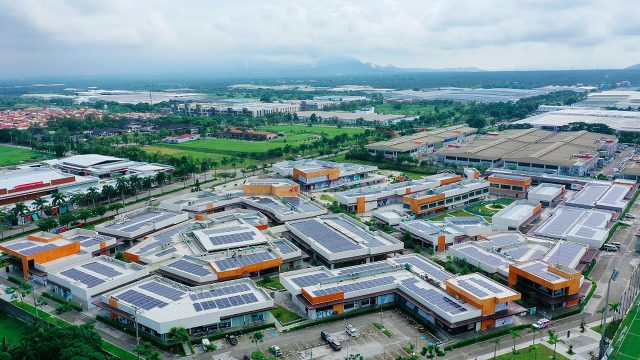
LIMA Estate’s 30-hectare commercial area in Batangas. — BW FILE PHOTO

THE PHILIPPINE Economic Zone Authority (PEZA) has approved P131.76 billion worth of investments as of the first week of October, putting the investment promotion agency (IPA) on track to meet its P154-billion full-year target.

At the same time, PEZA Director-General Tereso O. Panga said the agency will continue to push for amendments to the Corporate Recovery and Tax Incentives for Enterprises (CREATE) Act to attract more foreign and local investments, particularly in the information technology (IT) sector.

The PEZA Board of Directors on Oct. 6 greenlit 25 new projects worth a combined P20.55 billion. This brought the total number of PEZA Board-approved projects to 169, 14% higher than the 148 projects worth P39.63 billion approved a year ago.

“This is a tangible demonstration of our dedication to positioning our country as an attractive investment destination, thereby encouraging greater local and foreign investments in the Philippines,” Mr. Panga told reporters on Thursday.

Of the 25 newly approved projects, 13 are in the export sector, six are in the information technology sector and three are in logistics. Two projects involve the construction of facilities, while one is still in development.

These new projects are expected to have an export value of $643.32 million and generate 5,500 jobs.

Mr. Panga said the PEZA Board approved two big-ticket projects, one by Japan’s Murata Manufacturing Co., Ltd. and another by American company Analog Devices, Inc. Big-ticket projects are those with investments of P1 billion and above.

Asked whether the agency will be able to surpass its P154-billion approval target for this year, Mr. Panga said that PEZA has a “fearless target” of approving new investments worth as much as P300 billion.

“Once the investment from Texas Instruments, Inc. enters, although that has been previously announced, that is already worth a billion dollars, and then we are also expecting more big projects that I am not at liberty to disclose,” he said.

In 2022, the PEZA approved P140.7 billion worth of new investments.

Mr. Panga said the strong investment figures reflect investor confidence in the Philippine economy and its growing domestic market.

Economic managers are targeting 6-7% gross domestic product (GDP) growth this year.

The PEZA also expects four more economic zones, with a total investment of P773.96 million, to be proclaimed before the end of the year.

To date, the PEZA hosts 422 economic zones and 4,352 locator companies and projects.

CREATE AMENDMENTS
Meanwhile, Mr. Panga said the agency is working with several business groups on the proposed amendments to the CREATE law.

At the IT & Business Process Association of the Philippines (IBPAP) Infrastructure Series at LIMA Estate, he said that PEZA is still seeking to have work-from-home (WFH) eligibility for its locators.

“We need to do something about the WFH… We are asking for PEZA locators to be given the chance to do WFH,” said Mr. Panga. “But also, to support the IT developers putting up costly IT centers, our business model is 70% on-site and 30% WFH for our locators to be able to enjoy the incentives.”

Under Section 9 of the CREATE law, a qualified registered project or activity under an IPA administering an economic zone shall be exclusively operated within the geographical boundaries of the zone. Any project or activity conducted outside the geographical boundaries of the zone shall not be entitled to the incentives.   

Mr. Panga said that there is a need to update the CREATE law in order for PEZA to be given an “equal footing” as the Board of Investments (BoI) can provide incentives for IT and business process management firms with up to 100% WFH scheme.

From January to October, PEZA-approved locator investments under the IT sector reached P7.13 billion which comprised 36 projects and 1.05 million direct employment. It also approved 13 developer projects under the IT sector with total investments worth P36.07 billion.

Mr. Panga said PEZA is consulting the IBPAP, Semiconductor and Electronics Industries in the Philippines Foundation, Inc., and Philippine Ecozones Associations on the proposed CREATE amendments that will be given to Congress.

He said the proposed changes to the law would include a longer sunset period, separate Customs territory status, removal of the cap for tax- and duty-free importation and investment threshold of IPAs, and longer fiscal incentives period.

“The 10-year sunset period is so short for existing locators, even the 17 years for existing registered business enterprises,” Mr. Panga said.

“Imagine if that time comes, it will be graduated to the regular corporate income tax (CIT) rate and we are up against ASEAN (Association of Southeast Asian Nations) economies offering a much lower CIT rate. That would surely signal exodus of our existing locators,” he added.

On the investment threshold for IPAs, he said that PEZA has been approving projects with investments far bigger than the current cap.

“It is delaying the process, it takes longer to approve big-ticket projects, so these have to be addressed by the government,” he added. — Justine Irish D. Tabile

Contributions to Maharlika fund may threaten state lenders’ financial stability

By Luisa Maria Jacinta C. Jocson and Keisha B. Ta-asan, Reporters

THE CONTRIBUTIONS of state-run banks to the Maharlika Investment Fund (MIF) may threaten the lenders’ financial stability, analysts said.

“We warned that the Land Bank of the Philippines (LANDBANK) and Development Bank of the Philippines’ (DBP) capital contribution to the MIF will weaken their respective balance sheets and said that the Bangko Sentral ng Pilipinas (BSP) will erode its moral standing on disciplining banks if it gives regulatory forbearance to these two government financial institutions,” Calixto V. Chikiamco, Foundation for Economic Freedom (FEF) president, said in a Viber message.

The Philippines’ first sovereign wealth fund will be managed by the Maharlika Investment Corp. (MIC), which will have an authorized capital stock of P500 billion. Under the law, the LANDBANK and DBP will contribute P50 billion and P25 billion, respectively, for the MIC’s initial funding.

BSP Governor Eli M. Remolona, Jr. last week said both banks are still compliant with regulations even after remitting their contributions to the MIC. But the contributions put these lenders at risk of being noncompliant with their capital requirements.

“With capital charge of 100% on their investment in MIF, the two GFIs (government financial institutions) must be in need of more time to build up their capital to be able to sustain their usual volume of lending,” GlobalSource Partners Country Analyst Diwa C. Guinigundo said in a note.

DBP President and Chief Executive Officer Michael O. de Jesus earlier said the lender and LANDBANK are seeking regulatory relief from the BSP for their contributions to the sovereign wealth fund.

Under BSP regulations, all investments of banks, be it to allied or non-allied undertakings, will be fully charged against a bank’s capital. This means the investment of DBP and LANDBANK in the MIF will be deducted from the banks’ capital when they compute their capital adequacy ratio.

This ratio compares the available capital that a bank has on hand to its risk-weighted assets, which measures the risk profile of the lender’s lending and investing activities. The more risk a bank is taking, the more capital it will be required to have to protect depositors.

“The MIF implementation is also starting on the wrong foot, with contributing GFIs already asking for capital relief this early in the game. It reflects the lack of foresight of government,” Enrico P. Villanueva, senior lecturer of economics at the University of the Philippines Los Baños said in a text message.

Filomeno S. Sta. Ana III, coordinator of Action for Economic Reforms, said that the consequences of the fund are now becoming apparent.

“Sound, prudential banking practice is sacrificed. National Government spending is sacrificed.  But how society will benefit from funds transferred to Maharlika remains muddled,” he said via Facebook Messenger chat.

Sonny A. Africa, executive director of think tank Ibon Foundation, said that requiring the state banks to contribute to the fund is “fundamentally problematic” since it diverts them from fulfilling their primary mandate of providing financing to rural producers and smaller enterprises.

“The promise of financial returns from the Maharlika fund is a specious justification that, moreover, raises the risk profile of these government financial institutions. It is unlikely that, before the Maharlika fund, they would have invested in similarly risky instruments. Their ability to absorb financial losses is being compromised,” Mr. Africa said in an e-mail.

In a statement on Sunday, the LANDBANK said it remains “strong, adequately capitalized, and compliant with regulatory requirements of the BSP.”

As of June, the bank’s capital adequacy ratio (CAR) stood at 16.61%. LANDBANK noted this was a “very healthy level” and above the 10% minimum requirement of the BSP.

LANDBANK also said that it will meet its CAR requirements even with its P50-billion contribution to the MIC.

“Our Common Equity Tier 1 (CET 1) ratio stands at 15.73%, also compliant with the 10.25% CET 1 requirement,” it added.

Last week, President Ferdinand R. Marcos, Jr. signed an executive order slashing LANDBANK’s remittances to the National Government to 0% of its net earnings from 50% previously.

DBP’s Mr. De Jesus said that the bank is also requesting for a similar dividend relief.

“We need to reduce the mandated dividends to the National Government to 0% so we can use the funds to build up our capital position. This will allow us to book more loans and fulfill our mandate of developmental financing,” Mr. De Jesus said in a Viber message.

Finance Secretary Benjamin E. Diokno earlier said that the MIC is expected to be operational by the end of the year and will begin market activities by the first quarter of 2024.

Philippines urged to monitor external threats amid blue economy push

The Philippines has long considered itself a maritime nation, with 25.89 million tons of goods — equivalent to 99.9% of domestic trade — being transported via water in 2019. — PHILIPPINE STAR/WALTER BOLLOZOS

By Kyle Aristophere T. Atienza, Reporter

THE PHILIPPINE government should keep a close eye on potentially destabilizing external forces as it opens up the shipping industry to full foreign ownership and promotes investments in its ocean-based sectors, analysts said.

Jovito Jose P. Katigbak, a lecturer at De La Salle – College of Saint Benilde’s School of Diplomacy and Governance, said the government should update its list of strategic industries to include the maritime industry, which he noted is highly vulnerable to external threats.

He said the Philippines has yet to adopt a policy or pass a law that would underline and address “security threats and risks” in the blue economy.

However, Mr. Katigbak noted that China-based companies are facing greater scrutiny in other countries as some of them have been linked to the Chinese government, which has ramped up its data-gathering activities overseas in pursuit of its strategic ambitions.

“The negative performance of Chinese companies in other countries as well as their link to the Chinese Communist Party raises apprehensions from other governments, including the Philippines,” Mr. Katigbak said.

“The Philippine government should therefore practice due diligence in screening foreign investments and in regularly monitoring the activities of foreign players in several economic sectors, especially those considered strategic industries,” he added, noting that private maritime activities may be leveraged for strategic advances.

Blue economy tourism is among those highly vulnerable to security threats as foreign nationals may pose as tourists and gather sensitive information, Mr. Katigbak said.

The Philippines has long considered itself a maritime nation, with 25.89 million tons of goods — equivalent to 99.9% of domestic trade — being transported via water in 2019.

President Ferdinand R. Marcos, Jr. has vowed to put focus on the country’s maritime industry and the blue economy at large — a move that has been supported by many as the country confronts increasing security threats at sea, including China’s aggression. The administration has included a blue economy bill and a proposed maritime zones law in its legislative agenda.

In its development plan for 2023 to 2028, the Philippine government said it would unlock “more opportunities in the blue economy to leverage and optimize the country’s vast coastal and marine resources and maritime domain.”

Terry L. Ridon, a public investment analyst and convenor of InfraWatch PH, said key sectors in the maritime industry could be a launchpad for the geopolitical ambitions of foreign aggressors such as China.

“The opening up of new economic sectors to broader foreign investment is, to a certain extent, also its curse, as adversarial states may use the new liberalization law as a platform to influence, interfere or implement its geopolitical agenda in the country,” he said in an e-mail.

Last year Congress passed a law that amended the country’s 85-year-old Public Service Act, allowing full foreign ownership in domestic shipping, telecommunications, railways, subways, airlines, expressways, tollways, and airports. Under the law, public utilities such as seaports, public utility vehicles, electricity transmission and distribution, water and wastewater pipeline distribution systems including sewerage, petroleum and petroleum products, and pipeline transmission systems, are still subjected to the 40% foreign equity limit.

Mr. Ridon fears that “firms, particularly state-owned and controlled firms, from adversarial states” may install “infrastructure and equipment in their facilities, which may covertly contribute to an adversarial nation’s geopolitical objectives and ambitions.

“Even areas which are still deemed public utilities are not safe from being a platform of an adversarial nation’s influence or interference operations in the country,” he said.

Mr. Ridon said the President should consult the national security cluster whether it is advisable to require security clearances for foreigners seeking to serve as executives or investors in sectors deemed “critical, sensitive or vulnerable.”

“However, these concerns should not prevent the nation from developing its blue economy, and the government should invite both foreign and domestic investments to develop our shipbuilding and ship repair and maintenance industries.”

Joshua Bernard B. Espeña, a resident fellow at International Development & Security Cooperation, said the Philippine government should consider China’s gray zone tactics in its blue economy push as these pose threats to the operations of fishing and merchant fleets.

“For instance, water cannon attacks and dangerous maneuvers may result in damage to vessels and wastage of fuel and food needed to take the journey.”

He urged the government to give the Defense department, particularly the Philippine Navy, a bigger role in the protection of the West Philippine Sea, which refers to areas in the South China Sea that fall within the Philippines’ 200-nautical mile exclusive economic zone (EEZ).

“We must remember that the Chinese Coast Guard and Maritime Militia are controlled by the People’s Liberation Army-Navy and supervised by the Chinese Military Commission, which is headed by President Xi Jinping,” he said.

About 324,312 metric tons of aquatic products were procured from the West Philippine Sea in 2020, accounting for 7% of the country’s total fisheries production that year, according to the Bureau of Fisheries and Aquatic Resources.

The Recto Bank, which is within the Philippine EEZ in the South China Sea, reportedly holds up to 5.4 billion barrels of oil and 55.1 trillion cubic feet of natural gas. It “holds unexplored hydrocarbon stores,” according to the United States Energy Information Administration.

MB greenlights $2.7B in gov’t foreign borrowings

ALEXANDER SCHIMMECK-UNSPLASH

THE MONETARY BOARD (MB)  has approved $2.7 billion of public sector foreign borrowings in the third quarter this year, which would fund the government’s programs on economic recovery and climate resilience, among others. 

The amount is significantly higher compared with the $178.1 million worth of foreign borrowings by the public sector that the Bangko Sentral ng Pilipinas (BSP) greenlit in the third quarter last year.

Quarter on quarter, it was lower by 1.09% than the $2.73 billion approved in the second quarter of 2023.

Broken down, the BSP approved four project loans totaling $1.95 billion and one program loan worth $750 million.

“These borrowings will fund the National Government’s (NG) program on economic recovery, environmental protection and climate resilience, as well as projects for the transport and agricultural sectors,” the BSP said in a statement late on Friday.

The 1987 Constitution requires the Monetary Board to approve any foreign loan agreement that is entered into by the National Government.

“The BSP promotes the judicious use of the resources and ensures that external debt requirements are at manageable levels, to support external debt sustainability,” the central bank added.

Latest data from the central bank showed the country’s outstanding external debt increased by 9.5% to $117.918 billion at end-June from $107.692 billion a year ago.

However, it dipped by 0.8% from the record $118.812 billion seen at the end of March.

This is equivalent to 28.5% of the country’s gross domestic product, easing from the 29% ratio as of end-March.

The government plans to borrow P2.207 trillion this year, of which 75% will be sourced locally. Broken down, P1.654 trillion will be sourced domestically and P553.5 billion will come from overseas. — Keisha B. Ta-asan

SEC ‘actively monitoring’ any market links to insider trading

THE SECURITIES and Exchange Commission (SEC) has called on the public to report suspected instances of insider trading as it scrutinizes market activities to further strengthen investor protection, an official of the agency said.

“I can relay that the SEC’s Enforcement and Investor Protection Department (EIPD) is actively monitoring the markets. We have the appropriate machines, among other things,” SEC Commissioner Kelvin Lester K. Lee said during a roundtable in Makati City last week.

He made the statement when asked about the matter, to which he said the commission has people monitoring and studying any activities linked to insider trading.   

“We would welcome if the public has any complaint or formal report. Please do send us. That would help move across any investigation on our part,” he added.   

Mr. Lee added that the probe on telecommunications giant PLDT Inc. continues, under Capital Markets Integrity Corp. (CMIC), the independent audit, surveillance and compliance arm of the Philippine Stock Exchange.

“As I understand, it is still being studied at the CMIC level. But the SEC’s Markets and Securities Regulation Department (MSRD) is coordinating with them or at least it is being updated,” Mr. Lee said.    

In December last year, the SEC started its investigation on possible insider trading after PLDT disclosed an estimated P48-billion budget overrun over a four-year period, as well as the “selloff in shares” prior to the disclosure.   

PLDT attributed the overspending to site rollout, transport projects, and ports rollout.

SCAM ADVISORIES
Meanwhile, SEC Chairperson Emilio B. Aquino said SEC warning advisories have increased in recent years. He did not give specific numbers.

“In 2018 when I came in, we averaged 25 advisories per year. In 2019, it went up to 50. In 2020 to 2021, the average was about 150 advisories. This is not because there is a rise in actual scams. It is just because our enforcers are more vigilant,” Mr. Aquino said.

According to Mr. Aquino, the increase in the investment scam advisories was due to the SEC’s stronger monitoring as well as a wider coverage to protect overseas Filipino workers (OFWs).   

“The [number of] advisories have gone up because we are not just monitoring local [scammers] but also global scammers to protect our OFWs who are dollar earners. We do regular sweeps of the internet just to make sure. It doesn’t mean that if the SEC did not issue an advisory, there are no scammers,” Mr. Aquino said. — Revin Mikhael Ochave

Changan Philippines changes hands

Flashing the Changan sign are (from left): Changan International Corp. (CIC) Asia-Pacific Sales Manager Leslie Wu, CIC Asia Pacific Vice-Director Arieson Zhang Yang, CIC Asia-Pacific Senior Director Li Yuanxing, CIC Vice-General Manager Tom Yin, Inchcape Philippines Managing Director Alex Hammett, Inchcape Philippines Chief Operating Officer Francis Jonathan Ang, Changan Auto Philippines General Manager Maricar Parco, Changan Auto Philippines Assistant Vice-President for Marketing Vincent Gavino, Changan Auto Philippines Assistant Vice-President for Sales Jun Cajayon, and Changan Auto Philippines Head of Aftersales Joey Bias.— PHOTO BY KAP MACEDA AGUILA

Chinese auto brand distributorship in PHL now helmed by Inchcape

CHANGAN AUTO PHILIPPINES is flush with hope, excitement, and promise. That’s what a new beginning usually brings.

This fresh start is care of a partnership with London-based multinational automotive distribution and retail firm Inchcape (with the CATS Group of Companies here), which in turn widens its footprint in the country by tucking the Chinese car maker into its portfolio — a first in Asia-Pacific.

The new dispensation made its formal debut recently with a week-long display of its vehicles at the Bonifacio Global City in Taguig.

In a speech, Changan International Corp. Vice-General Manager Tom Yin outlined the main targets of the brand as electrification, increased connectivity, and a so-called “vast ocean” plan that espouses the sale of 1.2 million cars outside of China by 2030.

For his part, Inchcape Philippines Managing Director Alex Hammett said that the global partnership with Changan, inked this year, successfully began in South America, and now promises “much better services” to the growing number of Changan customers in the Philippines. Present in 42 markets, Inchcape is poised to leverage its “industry-leading digital and data analytics capabilities based here in the Philippines,” continued Mr. Hammett. “(It’s here) where we have our digital center with over 650 employees working on digital solutions, AI (artificial intelligence), machine learning, cybersecurity, and so on.”

Changan will keep the existing lineup of vehicles made up of the Alsvin passenger car, the CS35 Plus SUV, the CS55 Plus SUV, the Uni-T, and Uni-K SUVs, according to new Changan Auto Philippines General Manager Maricar Parco. In fact, the new management team has already added a seven-seater SUV, the Changan X7 Plus, which marks the brand’s entry into the three-row segment. Priced at P1.58 million, the large SUV is powered by a turbocharged 1.5-liter Bluecore engine mated with a seven-speed wet dual-clutch transmission with Tiptronic — delivering 185hp and 300Nm of torque.

“We are focusing on ICE (internal combustion engine) vehicles and we’re seeing that in the market. Only a little over 200 electric vehicles have been sold,” declared Ms. Parco. “I know it will be inevitable. How much time we’re not sure yet, but at the moment the focus is on ICE and that’s what we’re offering currently.”

She expressed confidence that the Changan X7 Plus will do well in “a very strong segment in the industry,” and she looks to it being “a significant contributor for the last quarter of the year and next year.”

Meantime, Inchcape Philippines COO Francis Jonathan Ang conveyed bullishness with Changan saying, “It definitely fits into our product portfolio. Together, our ambition is to grow the brand in the Philippines, deliver exceptional customer services, an exceptional experience, and make sure that the partnership grows and is sustained — (while offering) better mobility for every Filipino.”

To reiterate, the Philippines effectively becomes the gateway for Inchcape’s Changan footprint in the region, following its Latin American conquests in Chile, Peru, Bolivia, and Costa Rica. Mr. Yin said the new distributor promises both change where it is  needed, and continuity as well. “The philosophy is unchanged,” he maintained. “But there will be a better network, better price positions, and more products.”

Replying to a question from “Velocity,” the executive said that even as Changan is not looking at benchmarking itself against other Chinese auto marques already in the Philippines, the global aspiration is to become the number-one China-headquartered car maker and breach the top-10 list of global auto brands. Today, Changan is the top internal-combustion-engine-powered vehicle maker in China.

“We want to create values,” he continued. “We need to see what the customer needs — whether EVs or what. We are studying these and we have different solutions.” Significantly, the company also previewed the Changan S7 battery electric vehicle at the brand relaunch, although not yet officially available.

Added Ms. Parco, “We have a wide range of product models, and we will continue to broaden the lineup. With the Inchcape support and expertise, there will be a wealth of opportunities — from dealership expansion, to digital expansion. The Inchcape partnership brings a new sense of vigor.”

Changan plans to grow its Philippine network from 19 dealership locations to more than 30 “in the next couple of years,” concluded Ms. Parco.

For more information, visit www.changan.ph. Follow Changan Auto PH online on Facebook and @changanauto.ph on Instagram.

Aboitiz unit to start building Tarlac estate early next year

ABOITIZINFRACAPITAL.COM

ABOITIZ INFRACAPITAL, Inc. (AIC) is targeting to start construction works for its fourth economic estate in the first half of next year, a company official said.

Rafael Fernandez de Mesa, head of AIC Economic Estates, said the estate will rise on a 200-hectare property in Tarlac City.

“We are looking to start construction probably within the first half of next year,” Mr. de Mesa told reporters last week. “We see that the demand is there and we want to make sure that the Philippines is able to capitalize on the strong interests in the market.”

In a disclosure on Thursday, Central Azucarera de Tarlac, Inc. said that its board of directors had approved the proposed sale of a property under its wholly owned subsidiary Luisita Land Corp. to Lima Land, Inc.

Although both parties have not disclosed the total amount of the transaction, Central Azucarera de Tarlac said the sales proceeds will be used in part to liquidate Luisita Land’s long-term debt, which it placed at P1.65 billion.

It added the total consideration for the sale is more than 10% of the total assets of the sugar milling company.

“We have an agreement in place to purchase those 200 hectares, but there are certain conditions that need to be met before the sale is finalized,” Mr. de Mesa said.

“But we are excited for our product to come to Central Luzon, and we will be trying to replicate the success that we had here in Batangas,” he added, referring to AIC’s LIMA Estate.

Asked when the company expects to close the deal, he said: “We anticipate that it will be closed probably in the next few months.”

The fourth economic estate will target to attract more manufacturing companies, which Mr. de Mesa said represents the current market demand.

“We expect to attract more manufacturing companies that are looking to export their product in the electronics industry, automotives, as well as local companies that manufacture for domestic market but want to be within an industrial development that has reliable utilities, safe and secure, and has the complementary facilities to help them attract and retain talent,” he said.

AIC has existing relationship with about 220 companies, which are already in its economic estates, he added.

“So, naturally that is part of the potential market that we will be trying to sell to, but in addition to that, we have been very proactive in going out there to attract investments to the country so we have been having roadshows in Japan, Taiwan, and China,” he said.

AIC currently has three economic estates: the 826-hectare LIMA Estate in Batangas, the 63-hectare MEZ2 Estate in Mactan Cebu International Airport, and the 540-hectare West Cebu Estate in Balamban. — Justine Irish D. Tabile

The terno keeps its relevance through the centuries

BEN FARRALES TERNOS donated by the Farrales family.

CSB exhibits part of its collection of 200 ternos, will soon open a costume institute

A BEQUEST of 40 ternos forms the nucleus for an exhibit at the De La Salle University – College of St. Benilde (CSB), but also a future costume institute.

When fashion designer Ben Farrales (dubbed the Dean of Philippine Fashion) died in 2021, his family thought it best to donate 40 pieces from his collection of ternos to aid the fashion design program of CSB. However, after they were exhibited last year, “Suddenly, when word got around that we were accepting couture pieces of noted Filipino designers, a lot of donors messaged us and came forward,” said architect Gerry Torres, curator and Director for the Center for Campus Art for CSB in an interview during the opening of the exhibition titled “Fashion, Power, Modernity: The Ternos of the Benilde Collection” last week.

“When the family saw that, and also the friends of Mang Ben (as Mr. Farrales was called by his clients), they said, (they) might just as well give the rest of the collection to Benilde, because they’re going to take care of it.”

Mr. Torres points out that the clothes are stored in a climate-controlled room, laid flat in boxes lined with acid-free paper (or else, folded exactly once to reduce the risk of crumpling). They are sometimes taken out to be hung to preserve their form, during which they are photographed and documented, and a report is written up on the condition of the clothing.

The Farrales family increased their donation from 40 pieces to 200, forming the bulk of the collection. Adding to the mix are ternos made for former first lady Luz Banzon-Magsaysay, some made by master Ramon Valera, the first Filipino fashion designer recognized as a National Artist. These were donated by her daughter, Milagros Magsaysay-Valenzuela. Other terno bequests were made by the late designers Aureo Alonzo and Pitoy Moreno, and some donated by socialites Conchitina Sevilla-Bernardo, Bambi Harper, and Vicky Rodriguez.

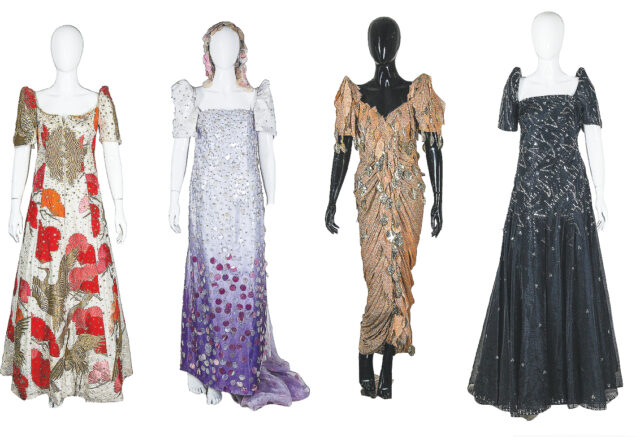
There is of course a marvelous gold lace terno made by Mr. Farrales, but also a number with a blue bodice and a frothy white skirt by Pitoy Moreno. Mrs. Magsaysay’s wonderfully draped and pleated white terno with crystals and mother-of-pearl by Ramon Valera stands in a corner. An elegantly somber black terno, also by Mr. Moreno, is in the exhibit, a gift from Ms. Sevilla-Bernardo. There are about 30 dresses on show.

From treasured memories of evenings past, these dresses now become a part of history. “I think they realized that what they have in their closets are valuable artifacts for fashion design education,” said Mr. Torres. “Instead of keeping them in their closet and no one will see them, no one will wear them again, I think these donors saw fit that if they would be used for the education of future generations of fashion designers, then why not?”

These bequests are paving the way for a future fashion and costume design institute by CSB. The former art deco Instituto Cervantes building at the corner of Leon Guinto and Estrada has already been earmarked for the project, and Mr. Torres says that they hope to open by next year.

THE TERNO, A HISTORY
The terno follows a relatively uninterrupted line of clothes dating back to pre-colonial times in the Philippines. The chemise and skirt combinations were worn by native Filipinos, in a number of combinations from the baro (a top), a tapis (cloth used as a skirt or apron), and the malong (a cylindrical garment that can be worn on the top or bottom) evolving into the kamisa (note the change in language, the word borrowed and changed from Europe) and the baro’t saya. The longer the Spaniards stayed here (the 1500s to the 1800s), the clothing continued to evolve, culminating in the traje de mestiza, which was the baro’t saya with a panuelo and huge sleeves, picking up influences from native dress, and fashions from Europe in the late 1700s to the 1800s.

The American occupation streamlined this dress, slowly melding all the elements together. By the 1930s, the look had been streamlined into what we now recognize as the terno — butterfly sleeves on a western-style gown, but still with vestiges of the panuelo (a triangular fichu). By the postwar period, thanks to the innovations of designers like Salvacion Lim Higgins, and fashionable Filipinas, the panuelo had been abandoned. Through war, privation and regime changes, Filipinas stubbornly held on to their big butterfly sleeves. While former first ladies Mrs. Magsaysay and Eva Macaraeg Macapagal contributed to the change in formal Filipiniana fashion, the terno in its most evolved form, and the pattern by which most designers base their designs today, were worn during the time of former first lady and dictator’s wife Imelda Marcos.

The exhibit represents some of the best gowns made not only in the Philippines, but arguably in the world. It’s one thing to be taught how to make a terno (in the exhibit, a guide illustrating how to make the sleeves greet a visitor), but to be exposed to the best, well: “In this gallery, you have an example of the highest levels of clothing construction,” said Mr. Torres. “For me, it is a good example of how something so basic” — here he points out that only the sleeves actually make the garment distinct — “Yet in the hands of these four great designers, they have been turned into works of art.”

“I am hoping that the next generation of Filipino fashion designers will be able to also create as innovatively and inventively the terno: re-create the terno as much as these four designers have done,” he said.

The terno is now more popular than ever. While associations with Mrs. Marcos may have put a damper on the terno for decades after the 1986 EDSA revolution, they slowly returning by the middle of the 1990s. Dress codes at weddings, formals, and state events made the terno indelible, and efforts like clothing brand Bench’s Ternocon keep the tradition alive for designers in the country. Still, this wouldn’t be possible without demand, so why do Filipinas still want to wear the terno?

“Filipinas realize that if you’re Pinoy, you will always look good in a terno,” said Mr. Torres. “The terno is designed in such a way — it’s open — to show your neck. The butterfly sleeves add height, presence, to the person wearing it. For the rest, you can do something. Anything.”

“Any Filipina can wear and feel comfortable and beautiful wearing it. It doesn’t have to be worn by somebody incredibly tall, or thin. I think in all shapes and sizes of a Filipina, the terno will still flatter her.”

“Fashion, Power, Modernity: The Ternos of the Benilde Collection” is now open to the public at the 12F Gallery of Benilde Design + Arts Campus until Friday, Dec. 15. — Joseph L. Garcia

Moving away from the ICE age

The Volvo XC40 Recharge has an introductory price of P4.19 million. — PHOTO BY KAP MACEDA AGUILA

Volvo PHL gets serious with electrification through two BEV models

By Kap Maceda Aguila

SWEDEN-HEADQUARTERED automaker Volvo is an atypical premium brand in that it chooses to fly under the radar. That’s a message we’ve consistently gotten from Volvo Philippines Marketing Director Chris Lee Yu in past conversations.

Still, it might come as a surprise to the average person that Volvo here actually quietly electrified its whole lineup sometime back — completely easing out models running solely on an internal combustion engine (ICE), and supplanting these with hybrid examples. “We introduced our T8 hybrid models in 2019,” shared Mr. Yu with this writer. “We are the first premium brand to launch plug-in electric vehicles in the Philippines, and we fully electrified our lineup last year.”

This ties in with the marque’s commitment to “all-out electrification” back in 2017, made at the United Nations assembly. All cars in Volvo’s portfolio now have an electrified version, and the company has vowed to become a fully electric car company by 2030.

Recently, Volvo Philippines took another crucial step toward its own sustainability aspirations by releasing two SUV battery electric vehicle (BEV) models — so-called “twins” in the Volvo C40 and Volvo XC40, given the “Recharge” appendage to denote full electrification.

“(They) are siblings that carry the trademark Volvo DNA of safety, quality, and sustainability. Yet even identical twins still have different personalities, as does our all-electric duo. One thing for sure is that both Volvos are designed to provide our customers with the freedom to move in a personal, sustainable, and safe way,” said Volvo Philippines President and CEO Atty. Alberto Arcilla in a release.

Both are built on the Compact Modular Architecture (CMA) vehicle platform, and boast an all-wheel-drive, twin-motor powertrain. “I hope you can test-drive them. Just take it easy because they are sporty,” said Volvo Cars Asia-Pacific Head of Operations Keith Schafer, in an exclusive interview with “Velocity.” With a healthy 408hp and 660Nm of torque on tap, the C40 can reportedly accelerate from a standstill to 100kph in 4.7 seconds; the XC40 does the same in 4.9 ticks.

Perhaps more significant for the average buyer are the range claims: 549 kilometers for the C40 and 537 kilometers for the XC40 — and with a quick DC fast-charge capability of a minimum of 27 minutes to get from 10% to 80% level.

The sleeker, smaller C40 is priced at P3.99 million and bears a fastback design to differentiate it from its sibling. The rear cargo hold is marginally smaller as well. Volvo said that the new front fascia is unique to electric Volvos and “includes headlights with state-of-the-art pixel technology.” The front bumper and a frameless grille further connect the C40 and XC40 (P4.19 million).

A planet-friendly thrust extends to cruelty-free accoutrements such as leather-free upholstery interiors in both models. Other features include a panoramic sunroof, advanced air purifier system (said to filter up to 80% of PM2.5 particles), and “smart cabin solutions,” among others. As Volvo has traditionally been known for safety, the two are equipped with the brand’s suite of advanced driver technology features.

When asked about the timing of the EV introductions, Mr. Schafer told “Velocity,” “We are launching these cars all over Southeast Asia, but we also need to have the infrastructure ready, right? We needed to have our dealers ready, we needed to have service ready. And this took some time for us.”

He continued, “When we do something at Volvo, sometimes it takes a little bit longer but we are very careful with the quality. It needs to feel good. Now we’re going to accelerate and we see huge opportunities in the Philippines for this. This is only the first two cars coming out. And as I said in the speech, we have more cars to come.”

As with other industry players, Volvo had been negatively impacted by semiconductor and parts supply issues as a result of the pandemic, but the executive asserted that “the situation looks much better.” C40 and XC40 units will be sourced from Volvo’s production lines in Malaysia, and Mr. Schafer promised “a stable supply.” He added, “The Philippines is a very important market for us.”

The two BEVs will come with a Volvo Ownership Package that includes an eight-year battery warranty, five years of free roadside assistance, a three-year comprehensive car warranty, a Wall Box charger, and unlimited digital update service.

Aseron’s puzzle

Memories of the past and family inspired the designer’s Red Charity Gala show

Trips past and future; and through time and space bind the elements of the first Red Charity Gala since the pandemic.

THE LOBBY of the Peninsula Manila became the stage for the gala held on Oct. 8, for the benefit of the Philippine Red Cross, the Assumption High School Batch 1981 Foundation, and the Hope for Lupus Foundation. After an auction, the grand party was closed by a fashion show by designer Ivarluski Aseron.

Among the items up for auction were a Patrick Coard Half Tower (which sold for P650,000), a necklace from Diagold with beauty treatments thrown in (with a top bid of P450,000), a stay at the Peninsula Istanbul (P550,000), an artwork by Jigger Cruz (P1.6 million), a strand of pearls from Jewelmer and a stay at the Peninsula Manila (P1.1 million), and a stay at the Peninsula London and round trip business class tickets from Emirates to any European country (P1.4 million).

As for the fashion show, Mr. Aseron opened the show with the sound of bells. A model descended The Pen’s marble staircase wearing a knife-pleated dress, her hair shaped like a crescent. After that introduction, layers and layers of fabric were used to form a page-leaf effect, forming dresses, skirts, and bodices, in orange, black, white, and gray, giving the clothes opulence, movement, and life.

Then came gray suits, vests, and jackets, with gold zipper pulls serving as embellishments. There was a black bodice with three-quarter sleeves scattered with strips of silver, while the same silver strips trimmed a skirt’s hem. A black suit draped with organza had golden razorblades as an ornament, and one could see exaggerated padding in the suits, playing with dimensions and proportions.

The final dress was a silver and black gown made just of shimmering thread and beads, worn by model Jo Ann Bitagcol. The overall effect was like a Balenciaga show in the 1950s, with matching hats and hauteur.

Throughout the show, one would notice the use of jigsaw puzzle pieces in gold or silver: there was a jumpsuit shaped like one, a dress covered with it, or a piece made with cutouts shaped like the puzzle piece. In an interview with BusinessWorld, the designer said, “It’s actually a childhood pastime of mine,” he said. The collection, numbering about 50 pieces, was called “A Memoir in Motion.” “I discovered that it (a puzzle piece) symbolizes autism. I have a nephew who has autism. It’s nice to go back to my childhood and relate that to my family,” he said about the significance of the jigsaw puzzle pieces scattered on this collection.

While the show was a review of his own 23 years in fashion, for him, there’s always room to learn more. For example, while he said the page-leaf effect achieved with the layers of fabrics was a signature, the gown made just of thread and beads was a (successful) experiment. “It’s not pretty obvious, but I didn’t use fabric there,” he said.

The whole collection took eight months to complete, beginning in February. The result was an absolute masterpiece, and a fitting greeting to the return of the Red Charity Gala. “I can rest,” he joked during the interview.

Because the collection absorbs lessons from his past, both professional and personal, Mr. Aseron said: “I think the past is important. My collections are revisiting my past works and linking it to the present; whatever I have explored, I have developed. I think it’s important to look in the past. The past is essential to the present and the future.” — Joseph L. Garcia

MDPPA marks 50 years of ‘safe and productive’ riding

From left are TVS Regional Business Head for ASEAN Vaibhav Srivastava, Yamaha Motor Philippines President Hiroshi Koike, Suzuki Philippines President Koichiro Hirao, Kawasaki Motors Philippines President Isao Sudo, Honda Philippines’ Jomel Jerezo, Motorcycle Development Program Participants Association (MDPPA) President Norminio ‘Boying’ Mojica, MDPPA Vice-President Alex Cumpas, MDPPA Auditor Alfredo Lejano, MDPPA Treasurer Erwin Estrada, and Motorcycle Dealer Association of the Philippines President Edwin Go. — PHOTO FROM MDPPA

By Dylan Afuang

THIS YEAR, the Motorcycle Development Program Participants Association (MDPPA) — comprised of the country’s key motorcycle manufacturers Honda, Kawasaki, Yamaha, and Suzuki — celebrates its 50th anniversary.

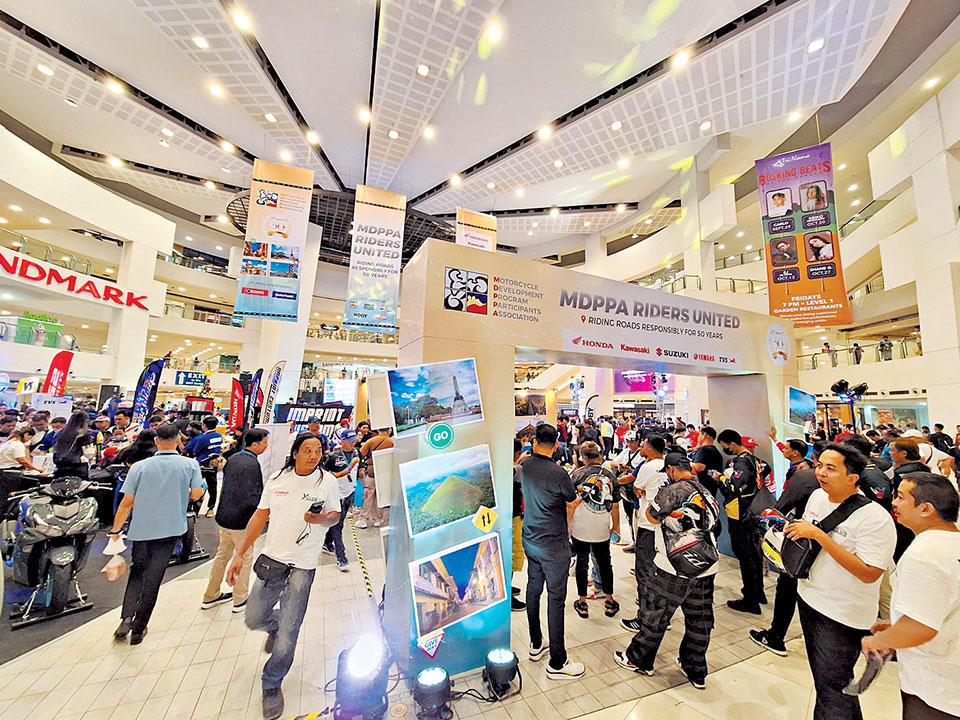
Bannering the theme “MDPPA Riders United: Riding Roads Responsibly for 50 Years,” the organization first began marking its anniversary at the TriNoma Activity Center in Quezon City two weeks ago, where it detailed contributions to the local motorcycle industry.

At the same time, participating motorcycle brands gathered the riding public as they showcased their products ranging from scooters to sport bikes, along with brands that manufacture various riding gear such as helmets and jackets. The occasion also introduced Indian motorcycle brand TVS as the newest member of the MDPPA.

Following this exhibition, MDPPA said in a release that it staged a “Road Safety Summit” in Taguig City that was attended by 300 riders participating in 50 rider groups and motorcycle clubs to foster “a deeper commitment to safety on the roads.”

In his speech, MDPPA President Norminio Mojica expressed, “Our journey of 50 years is a testament to our commitment to safety, innovation, and community. We remain steadfast in our purpose — to be the most relevant motorcycle association, proactively addressing the needs of industry stakeholders, and oriented towards global competitiveness and the sustainable development of the motorcycle industry.”

Recalling the association’s history, Mr. Mojica shared that the Philippine Motorcycle Manufacturing Program (PMMP) established in 1973 served as the company’s foundation. The institution was eyed to assist the Board of Investments’ agenda for the growth of Philippine motor vehicles.

The program’s name was changed to MDPPA in 1989, and since then, “it has been the leading association, leading the development and improvement of motorcycle production in the Philippines,” he declared.

The president continued, “MDPPA members comprise 70% of the motorcycle market in the Philippines, contributing 1.3% to the national GDP (gross domestic product) of the country. Last year, (the association’s) annual contribution to revenue generation was P122 billion.”

In the regional motorcycle industry, the motorcycle manufacturer’s association also provided its expert knowledge and assistance in developing regulations and policies through the organization’s various committees.

In the global scale, MDPPA, “as a member of the Federation of Asian Motorcycle Industries, has also been key in the harmonization of regulations and cooperation initiatives, especially in the Asian region,” Mr. Mojica added.

Also present at the festivities in Quezon City were Land Transportation Office Chief Vigor Mendoza II, Corrie Dichosa of the Philippine Board of Investments, Edwin Go of the Motorcycle Dealer Association of the Philippines, and presidents of the MDPPA-member manufacturers.

ADVERTISEMENT
ADVERTISEMENT