Home Blog Page 4154

BPI’s net income up 33.3% in Q3

BPI FACEBOOK PAGE

BANK of the Philippine Islands (BPI) saw its net income jump by 33.3% in the third quarter as it booked higher revenues, it said on Thursday.

BPI’s net profit climbed to P13.5 billion in the July-September period, which is “the highest quarterly net income achieved in the past decade,” it said in a statement.

The lender’s third-quarter performance brought its net income for the first nine months to P38.6 billion, up by 26.4% year on year, which it said was a “historical high for nine-month net income.”

This translated to a return on equity of 15.6% and a return on assets of 1.95%.

The bank’s financial statement was unavailable as of press time.

“Sustained loan and margin growth, as well as tempered provisions, were the main drivers of the strong financial performance,” BPI said.

Revenues rose by 18.3% year on year to P35.3 billion in the third quarter as the bank posted higher net interest and non-interest income.

For the first nine months, revenues climbed by 15.3% to P100.9 billion, “attributable to the 24.5% increase in net interest income to P76.8 billion, as average asset base expanded 8.1% and net interest margin widened 54 basis points to 4.07%.”

“This was partly offset by the 6.6% decline in non-interest income to P24.1 billion due to the property sale gain recognized in the prior year. Removing the impact of this one-off transaction, non-interest income would be higher by P3.3 billion or 15.7%, on higher fees from credit cards, bancassurance, various service charges, and trading gains,” BPI said.

Meanwhile, operating expenses increased by 21.3% to P48.6 billion in the first nine months as the bank ramped up spending for manpower, technology, and marketing.

BPI’s cost-to-income ratio was at 48.2%.

The bank’s loan portfolio grew by 8.8% to P1.7 trillion amid increases in corporate (5.3%), credit card (37.7%), and auto (22.3%) loans.

The bank’s nonperforming loan (NPL) ratio stood at 1.97%.

“Meanwhile, coverage remains adequate, with a 158.95% NPL coverage ratio,” BPI said.

Provisions for loan losses went down to 60% to P3 billion in the first nine months from P7.5 billion in the same period last year.

On the funding side, total deposits went up by 6.7% to P2.2 trillion at end-September.

The bank’s loan-to-deposit ratio stood at 80.2%.

Meanwhile, BPI’s assets stood at P2.7 trillion as of end-September, rising by 7.2% year on year.

Total equity was at P349.6 billion.

The bank’s common equity Tier 1 ratio stood at 16.1%, while its capital adequacy ratio was at 17%, well above the regulatory minimum.

BPI shares went down by 70 centavos or 0.65% to close at P106.80 each on Thursday. — A.M.C. Sy

Japanese labor set to demand more pay hikes for next year

REUTERS

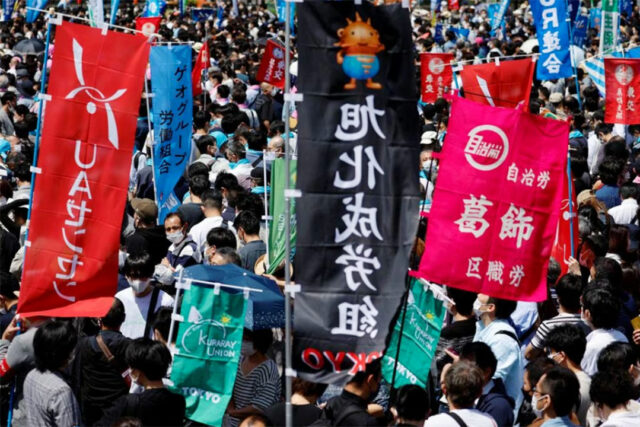
JAPAN’s largest labor union federation is set to demand higher pay increases for next year, potentially providing the key element needed for the central bank to move toward policy normalization.

Rengo, the country’s biggest trade union federation, plans to call for companies to raise wages by “at least 5%” in the annual wage negotiations starting next year, according to broadcaster NHK. The goal would be slightly more ambitious than the one set before this year’s talks, when the union sought an “about 5%” increase.

The federation is expected to announce its target figures later as part of its basic vision for upcoming wage negotiations that culminate in the spring.

The slightly more ambitious goal may be one factor that convinces the Bank of Japan (BoJ) that wage hike momentum is likely to be sustained following this year’s historic pay gains.

Governor Kazuo Ueda has repeatedly suggested that rising salaries are a key factor in achieving the goal of sustainable inflation, which is a precondition for scaling back ongoing stimulus.

“The BoJ may take Rengo’s request as a sign that momentum for wage increases is building,” said Yohei Nishino at Mizuho Research & Technologies’ research division. Still, Mr. Nishino said the minor change in language alone isn’t enough to convince the BoJ about the sustainability of wage growth or the need for a policy pivot.

“The BoJ should judge the trend once Rengo compiles requests from member companies in early March,” he said.

The goal for 2024 will include base salary increases of 3% or more, according to NHK. BoJ board member Asahi Noguchi recently said that base pay needs to increase at a pace close to 3% as a trend for the bank’s stable price target to be met.

During this year’s spring pay negotiations, workers ultimately won a 3.58% wage rise, the largest gains in around 30 years, with a 2.12% hike for base pay. But the strong gain appears to have been offset by inflation. Real wages for Japanese workers have continued to fall, while nominal pay has stagnated after rising sharply in May and June due to one-time factors.

Prime Minister Fumio Kishida is also paying close attention to wage negotiations, given his vision for fairer income distribution. The premier met with Tomoko Yoshino, the head of Rengo, on Wednesday and agreed that it is important to achieve sustained wage increases.

Following Rengo’s goal announcement, major Japanese companies may begin disclosing their individual pay plans toward the end of the year. Last year Nippon Life was among insurance companies unveiling plans for big raises, with the company eyeing gains of 7% for its sales force. Uniqlo operator Fast Retailing Co. said in early January that it would raise salaries by up to 40%, encouraging others to follow suit.

Considering factors including Rengo’s more ambitious demand, strong corporate earnings and labor shortages, next year’s wage increase could be higher than expected, according to Mizuho’s Mr. Nishino. — Bloomberg

Netflix shows Elite and Blood & Water cross into new territory

THE CHARACTERS of Blood & Water’s Khosi Ngema and Elite’s Andre Lamoglia will cross over to each other’s schools in season 7 of Elite this month and the 4th season of Blood & Water in 2024. — IMDB

LONDON — Fans of Spanish series Elite and South Africa’s Blood & Water will be treated to an international storyline in the next instalments that sees two characters from the popular Netflix shows cross, creators said.

Blood & Water It-girl Fikile, played by Khosi Ngema, will arrive at the exclusive Madrid school of Las Encinas in season 7 of Elite, while Ivan (Andre Lamoglia) from the Spanish teen series will appear at Cape Town’s prestigious Parkhurst College when Blood & Water returns for its fourth instalment in 2024.

The exchange gave a boost to cast, creators and characters, said Blood & Water creative producer Nosipho Dumisa-Ngoasheng.

“We’re always looking for what stories are going to have the most drama, the most dramatic impact, emotional impact and really challenge our characters in their emotional journeys. We like to put them through the wringer and so we thought, what better way to do that,” she said.

Both shows being set in the world of private schools made writing the crossover scenes easier, said Elite co-showrunner and writer Jaime Vaca.

Season 7 sees the return of former student Omar, who struggles to find peace from past events and discovers he is not alone in his suffering.

“It has the Elite DNA but with a theme that is current and necessary, that surrounds and frames the entire season, which is mental health,” said Vaca.

“As someone who has also experienced mental health issues, there is a lot of me in this season. This is one I am especially proud of and curious to see how it’s received.”

Elite Season 7 starts streaming on Oct. 20. — Reuters

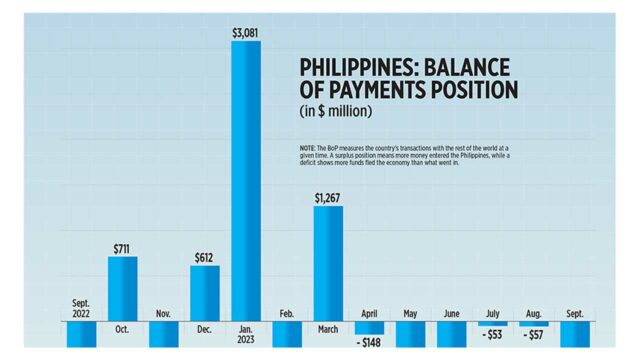
Philippines: Balance of Payments Position

THE PHILIPPINES’ overall balance of payments (BoP) position narrowed significantly to $414 million in September from the $2.34-billion gap in the same month a year ago, the central bank said. Read the full story.


Philippines: Balance of Payments Position

The cybersecurity landscape of Web3

GLENN CARSTENS PETERS-UNSPLASH

In the ever-evolving landscape of the internet, we’ve witnessed a remarkable journey, from its modest origins in the late 1960s to the dazzling Web3 we’re on the cusp of today.

Web3 represents a leap forward, underpinned by blockchain technology, into a world where decentralization and peer-to-peer interactions reign supreme. It’s a place where intermediaries become obsolete, and the data you hold becomes truly yours. This new web comes with promises and perils, and we are only beginning to fathom its profound implications. It is within this framework that we delve into the realm of Web3 and its impact on cybersecurity.

THE ESSENCE OF WEB3
Web3 is not just another iteration of the internet; it’s a revolution in the making. Unlike its predecessors, Web3 is decentralized, open-source, and poised to reshape the way we navigate the digital realm. This next evolution of the web finds its strength in blockchain technology, the very same technology that has driven the rise of cryptocurrencies.

Blockchain, a distributed ledger shared across a network of computers, offers secure and tamper-proof data storage. In the cryptocurrency arena, it enables transactions without the need for traditional intermediaries, such as banks or governments. This decentralization is a game-changer, enhancing security and transparency in a world where privacy and trust are paramount.

THE DUAL IMPACT ON CYBERSECURITY
Web3’s rise introduces a double-edged sword for cybersecurity. On one hand, the decentralized nature of Web3, with data stored across a distributed ledger, yields enhanced security and resilience against attacks. Traditional web applications pale in comparison to the robustness of Web3 applications in safeguarding data and thwarting threats.

However, the story does not end here. Enter smart contracts, and self-executing programs on a blockchain. While they hold immense potential, they also harbor vulnerabilities that can be exploited by cybercriminals. Furthermore, the pseudonymous nature of many Web3 applications makes tracking and prosecuting these digital wrongdoers a formidable challenge.

The transition to decentralized data holds promises and perils. In a centralized system, data resides under the guardianship of a single entity, like a government or a corporation. In the Web3 landscape, data is distributed across a network, fostering the democratization of control. But it also creates a vast, decentralized repository that could entice cybercriminals.

The growing number of devices connected to the internet expands the attack surface. Smartphones, laptops, and an ever-expanding universe of IoT devices have tipped the scales, with over 15 billion devices online. This proliferation provides a broader landscape for potential attacks, necessitating enhanced vigilance and fortified defenses.

While blockchain technology, known for its inherent security, brings optimism, it also attracts threats. Decentralized networks, with no central authority, pose a challenge in tracking and managing security vulnerabilities. These technologies often store sensitive data, making them prime targets for hackers.

THE BRIGHT SIDE OF WEB3
Amidst these cybersecurity challenges, Web3 offers a glimmer of hope:

Enhanced Security: Web3, with no central control, has the potential for unparalleled resistance to hacking and threats. It empowers individuals and entities to have greater control over their data and devices, fostering the development of robust technologies, including blockchain.

Cost Reduction: The elimination of intermediaries reduces costs for users and businesses. This transition from data monopolies to accessible information empowers people to access data and technology at lower costs.

Privacy Empowerment: Web3 platforms are designed with privacy in mind, employing encryption by default. They don’t share data with other users, reducing the chances of data leaks or unauthorized sharing.

User Control: In Web3, users interact directly with one another and the data they seek, minimizing dependence on intermediaries. This direct interaction offers individuals more control over their digital footprint.

THE OWNERSHIP REVOLUTION
The trend toward data ownership has gained momentum. In conventional platforms, the entities we engage with own and sometimes exploit our data. In a decentralized data landscape, control shifts to the users. Data is securely stored on devices that users control, and shared only with their consent, reducing the risk of data commercialization.

THE SHIFTING CONTROL PARADIGM
Web3 is dismantling the central control of data, a paradigm shift in progress. As blockchain and distributed ledger technology advance, users experience newfound freedom and autonomy over their data. This transition enhances digital resilience, reducing the specter of censorship and fostering a more open and free exchange of ideas.

Yet, Web3 presents a series of challenges that cannot be ignored. In this decentralized world, the lack of a central authority leaves questions about accountability and data access unanswered. Without a central entity, enforcing data protection measures and ensuring user privacy becomes a complex endeavor.

Decentralized data, while empowering individuals, can complicate decision-making for businesses. Centralized data acts as a single source of truth, facilitating informed decisions. Without it, the analysis becomes more intricate.

The decentralized nature of Web3 also introduces security concerns. Cybersecurity threats in this context demand innovative approaches, as the absence of a central authority makes managing vulnerabilities a formidable task. These technologies often store sensitive data, making them prime targets for hackers.

To navigate the Web3 landscape, we must fortify our cybersecurity strategies. Threat modeling, collaborative partnerships, and research and development are pivotal. With the absence of a playbook for this new frontier, proactive measures and collective vigilance are imperative.

PROTECTING YOUR WEB3 WORLD
As we embrace Web3, securing our digital presence becomes paramount:

Encryption: Encrypt your data to ensure only authorized users can access it. Explore additional layers of encryption to bolster your defenses, especially on unsecured networks.

Data Sharing: Limit the number of entities with whom you share data. Minimizing exposure reduces the risk of data leaks and unauthorized usage.

Authentication and Authorization: Employ robust authentication methods, like strong passwords and two-factor authentication, to safeguard your accounts. Secure accounts are a vital bulwark against unauthorized data access.

The recent Medusa ransomware attack on PhilHealth, affecting millions, serves as a stark reminder of the looming threats. Yet, Web3 has the potential to reshape how we interact with the digital world, providing the tools needed to combat the rising tide of cyber threats.

As we approach Web3, let us remember that this decentralized future carries the promise of cybersecurity solutions. With foresight and vigilance, we can harness the benefits of this decentralized future while mitigating the risks. This, ultimately, is the path forward in the age of Web3.


Dr. Donald Patrick Lim is the founding president of the Blockchain Council of the Philippines and the lead convenor of the Philippine Blockchain Week. He is also the Asian anchor of FintechTV.


LIMA Water sees lower energy costs via solar power source

LIMA Water Corp., a wholly owned subsidiary of Aboitiz InfraCapital, Inc. (AIC), has projected reduced energy costs after installing a solar panel in one of its sewage treatment plants.

The company said in a statement on Thursday that its 99.9-kilowatt solar power system, which was completed in April, could cut its energy costs through an estimated total power generation of 146 megawatt-hours annually.

Since its completion, the system has been generating 400 kilowatt-hours of “clean” and “green” energy daily, which is sufficient to power its second sewage treatment plant, or STP 2.

Aside from reducing the plant’s energy costs, the shift to renewable energy is expected to eliminate approximately 100 tons of carbon dioxide emissions each year, the company said.

“Harnessing the power of renewable energy is a fundamental part of LIMA Water’s commitment to protect the environment and promote sustainability through innovative technologies,” Hazele Manalo, general manager of LIMA Water, said in a media release on Thursday.

“Our solar project is a significant step towards addressing the pressing issue of carbon emissions to ensure a sustainable future for the next generations to come,” she added.

LIMA Water’s solar power initiative is said to have demonstrated AIC’s broader commitment to drive sustainability across its various sectors.

“At AIC, sustainability lies at the core of our operations. We ensure that we make use of our natural resources responsibly, and LIMA Water’s solar panel project is just one of the many sustainable practices and initiatives that we have,” said Eduardo Aboitiz, head of AIC’s water business and president of Apo Agua Infrastructura, Inc.

Mr. Aboitiz also mentioned the company’s pioneering innovation called “water-energy nexus” under AIC’s Apo Agua, which is a joint venture company between AIC and J.V. Angeles Construction Corp. based in Davao City.

The innovation allows the company to fully operate a water treatment plant solely on renewable energy generated from the natural flow of water from its primary surface water source.

LIMA Water said it is considering the possibility of transitioning one of its major facilities to renewable energy sources through the Green Energy Option Program of the Department of Energy. — Sheldeen Joy Talavera

Succession planning vs hiring ‘boomerang’ employees

We’re having trouble filling an important vacancy due to the resignation of a highly qualified and experienced person. Since he left us three years ago, we have tried nearly everything, including pirating from a competitor. The workers we poached can’t perform to our expectations. Now, we’re at a dead end. Is there a solution to this predicament? — Thunder Bolt.

There are short-term and long-term solutions. For the short term, I’m proposing that you explore the possibility of rehiring the person who resigned three years ago. It’s the fastest way to fill the gap. Who knows? You may be successful in attracting back a “boomerang employee” and solve your three-year old problem.

There’s nothing wrong with rehiring a boomerang person. It’s for the overall benefit of the organization. He will surely bring in additional experience. That’s assuming that the boomerang person had a consistent and above-average performance when he was with you.

The challenge with rehiring former employees is the possibility that both of you may not agree on pay and perks. But you can always try. If you don’t negotiate, then the answer will always be no. Which brings you back to square one. On the other hand, you may be in luck if your candidate is no longer happy in his current employment.

You’ll know this when he talks to you about possibly returning to the fold. But before offering a package, do the following:

One, ask the boomerang person to send you an updated curriculum vitae to include the milestones with his current employer. The past three years can give you additional, if not fresh insights on his accomplishments.

Two, hire an external background investigator to check for any criminal records. There’s no need to check with the human resource (HR) department, his boss or anyone from that same organization. You wouldn’t want to jeopardize his relationship with his current employer.

Three, require the boomerang person to undergo a medical examination, including a drug test. You’ll want to be sure that he’s clean.

If everything appears to be in good order, require him to sign a job offer and an employment contract. Be firm about him needing to start all over again in terms of seniority rights.

LONG-TERM SOLUTION
The long-term solution is a dynamic succession plan. It’s an effective solution for any eventuality like a valued worker leaving, becoming physically incapacitated due to illness or accident, or even dying. The only thing you can foresee with any certainty is workers coming up to their retirement age.

A succession plan must be reviewed periodically to be effective. Also, to avoid giving off false expectations, its contents must be kept confidential as the list of possible replacements can change at any time, being subject to fluctuations in the performance of your candidates.

Preparing a succession plan will require taking the following steps:

One, identifying key positions in every department. That includes those positions that are difficult to develop and fill in case of an emergency resignation. In most cases, this includes department heads and managers who possess special (or unique) leadership skills and competencies.

Two, defining ‘must-have’ competencies. What specific knowledge, attitudes, skills and habits must a candidate possess to become a possible successor for a key position? The HR department must conduct a competency mapping evaluation to identify and rank people according to their current skills.

Three, establishing the management gaps among candidates. The candidate’s immediate boss should know all from conducting performance appraisals. What are these common management gaps? What is the number one gap? Is it about problem-solving or decision-making? What else?

Four, offering a management development program. Usually, this program requires one or two years of immersion in management and leadership. It can be patterned after an MBA program, except that almost all lessons are focused on the company’s business. This requires that coaches or teachers be incumbent company officials.

Last, reviewing the succession plan as needed. This ensures the effectiveness of the plan to account for the personal milestones achieved by every candidate, the results of their annual performance appraisal, or any extracurricular activities of theirs that could be beneficial to the organization.

Having a dynamic succession plan is the key to ensuring the continuity of leadership in any organization. More than that, allowing workers to take over any vacant post is the ultimate solution of motivating workers and building their morale.

  At the core of a highly energized workforce is the quality of your HR policies and the one-on-one professional relationship between employees and their management. The key, of course, is their mutual trust and respect for one another.


Chat your feedback and workplace concerns with Rey Elbo via Facebook, LinkedIn, X (Twitter) or e-mail elbonomics@gmail.com or via https://reyelbo.com

How the Hollywood strike is scrambling film, TV schedules into next summer

PEDRO MARROQUIN-UNSPLASH

LOS ANGELES — Santa Claus will not be coming to Hollywood this year.

Dear Santa, a comedy by the Farrelly brothers about a young boy who accidentally sends a letter to Satan instead of Santa, will not reach theaters this holiday season, one of many victims of a prolonged actors’ strike that has set the US entertainment industry reeling from one of the longest work stoppages in its history.

The strike, which has entered its 14th week, is scrambling next year’s film slate and delaying the return of primetime television comedies and dramas.

While film and television writers have ended their 148-day work stoppage, talks between actors and studios broke down last week and both sides said they remain far apart on many issues with no negotiations scheduled.

Major releases such as Mission: Impossible — Dead Reckoning Part 2, Gladiator 2, and Ghostbusters: Afterlife 2 have been delayed because of the walkout, as was Bob Marley: One Love, a biopic about the reggae musician that was receiving early Oscar buzz. Other films, such as the romantic comedy, Anybody But You, cling tenuously to the December release calendar, but could be postponed if its stars remain on strike and unavailable to help with promotion, sources with direct knowledge told Reuters.

“The whole release calendar is going to be tossed around,” said one studio executive, who identified two major movies and an animated sequel with release plans that have been tossed into the wind. “The whole thing is a giant Rubik’s Cube.”

One film financier shifted investment strategies as Hollywood’s work stoppage stalled several big-budget studio projects, backing productions outside of North America instead, including director Guy Ritchie’s next film starring Jake Gyllenhaal and Henry Cavill, which is shooting in Spain.

Media analyst Doug Creutz noted that the strikes “came at a very difficult time” for major media companies already contending with declines of the traditional cable TV business, weak ad performance and streaming services that mostly lose money. Add to those concerns a struggling movie business, whose holiday quarter box-office proceeds could fall 30% or more below pre-pandemic levels, as the actors’ strike forces the delayed release of several movies.

Warner Bros. Discovery, which pushed Dune: Part Two to March from November, reduced its adjusted earnings estimates for this year by $300 million to $500 million. Other studios are expected to provide an accounting of the strike’s financial toll on upcoming quarterly investor calls over the next few weeks.

WINTER IS COMING
Among the hardest hit are independent production companies, whose lifeblood comes from delivering movies and television shows. After taking a series of cost-cutting measures, like curtailing travel and entertainment, they are contemplating layoffs, say several executives at the companies. Some have sold rights to film and television libraries to keep the lights on, one buyer told Reuters.

Television executives hope to return to production in December, or by February or March at the latest, to produce a shortened season of primetime shows, with half-hour comedies returning to air more quickly than hour-long dramas. Writers are already drafting scripts, these executives said.

At the same time, programmers are embracing unorthodox backup plans to fill screens, such as a CSI-inspired reality show focused on local police forensic investigators, which is in the works for CBS, according to two sources familiar with the project.

Some major studio films scheduled for next year could slip into 2025 if the work stoppage continues, according to the studio executive, raising concern that audiences will get out of the habit of going to theaters. One exhibitor expressed concern about how to fill movie screens in the second half of 2024, remarking, “There’s nothing in production.” — Reuters

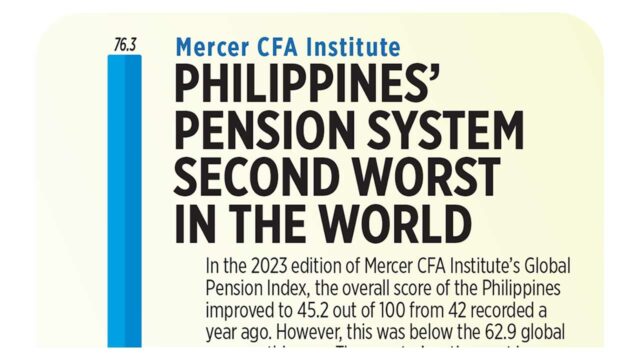
Mercer CFA Institute: Philippines’ pension system second worst in the world

In the 2023 edition of Mercer CFA Institute’s Global Pension Index, the overall score of the Philippines improved to 45.2 out of 100 from 42 recorded a year ago. However, this was below the 62.9 global average this year. The country’s retirement income system ranked the second worst among the 47 systems in the report. The index reviews the economies’ respective retirement income systems based on three weighted subindices*: adequacy, sustainability, and integrity.


Mercer CFA Institute: PHL's pension system second worst in the world

How PSEi member stocks performed — October 19, 2023

Here’s a quick glance at how PSEi stocks fared on Thursday, October 19, 2023.


Black Swans, Grey Rhinos and Ugly Ducklings 

Business leaders and experts led the discussions at the FINEX week sessions on Oct. 2-6 with the theme “Navigating Global Uncertainties Towards Sustainable Growth”. Former Bangko Sentral ng Pilipinas (BSP) Governor Say Tetangco, now SM Investments Corp. chair, was the keynote speaker. His topic was “Black Swans, Grey Rhinos and Ugly Ducklings.” Black swans are unexpected events with high impact such as the COVID-19 pandemic and the Ukraine war. Grey rhinos represent highly likely threats that are ignored, which can lead to business upsets and hurt economic growth, like climate change and technological disruptions. Lastly, ugly ducklings are hidden and overlooked opportunities that may seem unattractive but have the potential to transform and drive sustainable growth. 

What are some global risks and challenges that may affect the Philippines? Governor Say named a few:

1. Higher for longer interest rates – Higher interest rates mean tighter credit conditions and higher borrowing costs, which could add pressure to debt servicing burdens, dampen aggregate demand and lead to a slowdown, lower profits, and greater unemployment. A widening interest rate differential with the US exposes the Philippines to higher capital flow reversal and currency depreciation pressures, resulting in increased volatility in financial markets.

2. Technological disruptions – While digitalization and technological innovations are beneficial, they have the potential to disrupt markets.

3. Climate change – Climate change and the transition to sustainable energy present risks that can affect the broader economy. The Nanyang Technological University and University of Glasgow estimates that ASEAN could potentially lose up to 35% of gross domestic product by 2050 if no remedial measures are taken to address climate-related risks.

How can the Philippines successfully navigate these global risks and the grey rhinos? Governor Say said the best strategy is to build resilience to preserve the business while investing for the future, as well as harnessing data and experience for better strategic decisions. How then do we build resilience?

1. Diversification – Never put all your eggs in one basket. Diversify your portfolio in terms of products and geographical location. At the national level, Governor Say said it will be good to advance trade and economic integration by aligning with the Regional Comprehensive Economic Partnership.

2. Agility in embracing technology – Respond fast in essential in times of uncertainty. Embracing technology is important in achieving modern agility. Technology can help enhance risk assessment exercises in times of heightened uncertainty. Leverage on big data applications for more comprehensive analysis. Rely on machine learning algorithms to identify market trends and patterns and enhance ability to identify potential risk factors on time and enhance productivity.

3. Resilience in collaboration – Collaboration brings diverse perspectives and also paves the way for shared capacity and resources when tackling resource-intensive challenges. 

Another interesting topic during the conference was “Sustainable Cities: A Key Pillar for Nation Building.” Presenters were real estate developer Delfin Wenceslao, urban planner Paul Alcazaren, newly appointed first woman president of Ayala Land, Inc. Anna Margarita Dy and Makati Mayor Abigail Binay. Many of us now want to go to Iloilo to see the wonderful developments presented by Mr. Paul.

FINEX goes “beyond the bottom line.” So, there was a panel on “Protecting the Future, Preserving the Past: Built Heritage in the Philippines” with Ateneo Art curator Victoria Herrera, Old Manila Walks founder Ivan Dy and Galleria Duemila founder Silvana Diaz. We now appreciate old art works and their value.

There was also a discussion on “Generative Artificial Intelligence and Digitalization: Harnessing Emerging Technologies to Sustainably Increase Productivity” with SAP Philippines Management Director Rudy Abrahams, Mastercard Country Manager Simon Calasanz and Concentrix Vice-President Larah Sta. Maria.

The “Forging Alliances Towards Achieving Digital Inclusivity” panel was also informative. The panelists were Maya President Angelo Madrid, Ayala’s Managing Director for Data Science and AI Karl Chua and Google Cloud Philippines’ Ferdie Saputil. The conclusion is to welcome and utilize technology to make work easier and faster.

“Ethics in Technology” was presented by the FINEX ethics committee with Father Ben Teehankee of De la Salle, Dominic Ligot of Data Ethics PH and National Privacy Deputy Commissioner Leandro Aguirre. Ethics is ethics and it is always about “doing the right thing right all the time even when no one is looking”.

FINEX week successfully ended on Oct. 6 and FINEX executives unwound with a party. Little did we know that another black swan event was about to happen. Hamas attacked Israel the next day, with Israel immediately declaring a state of war.

The world is full of surprises and uncertainties. Let us be resilient and let us keep our faith up above. He is in control!


Flor G. Tarriela is former PNB chairman. She is lead independent director of Nickel Asia, director of LTG and FINEX, and a WomenBizPh member.  A gardener and an environmentalist, she founded Flor’s Garden in Antipolo which practices natural farming technology.

Peso weakens due to worries over Middle East war

BW FILE PHOTO

THE PESO weakened anew against the dollar on Thursday due to lingering worries over the war in the Middle East.

The local currency closed at P56.87 versus the dollar on Thursday, weakening by 17 centavos from Wednesday’s P56.70 finish, data from the Bankers Association of the Philippines’ website showed.

The local unit opened Thursday’s session weaker at P56.87 per dollar. Its intraday best was at P56.83, while its worst showing was at P56.90 against the greenback.

Dollars traded rose to $990.3 million on Thursday from the $877.5 million on Wednesday.

The peso dropped against the dollar on Thursday amid increased worries over the Israel-Hamas conflict and higher US Treasury yields, Rizal Commercial Banking Corp. Chief Economist Michael L. Ricafort said in a Viber message.

“The peso weakened amid downbeat investor sentiment from the lingering worries due to the Israel-Hamas conflict,” a trader likewise said in an e-mail.

The peso also tracked the weakness seen in the region but was in the “middle of the pack,” ING Bank N.V. Manila Senior Economist Nicholas Antonio T. Mapa noted in a Viber message.

The dollar generally strengthened on Thursday after US Treasury yields gained overnight, he added.

For Friday, the trader said the peso could weaken further due to potentially hawkish remarks from US Federal Reserve Chair Jerome H. Powell overnight.

The trader sees the peso moving between P56.80 and P57 per dollar on Thursday, while Mr. Ricafort expects it to range from P56.75 to P56.95. — AMCS

ADVERTISEMENT
ADVERTISEMENT