Home Blog Page 4145

Gross borrowings fall in August

BW FILE PHOTO

THE NATIONAL GOVERNMENT’S (NG) gross borrowings dropped by 6.96% to P124.056 billion in August, the Bureau of the Treasury (BTr) said.     

Data from the BTr showed that gross borrowings in August were lower than P133.338 billion in the same month in 2022.

Month on month, gross borrowings slipped by 5.97% from P131.937 billion in July.

In August, domestic borrowings accounted for almost all or 94.6% of total gross borrowings.

Gross domestic debt declined by 11.09% to P117.374 billion during the month from P132.021 billion a year ago.

Broken down, this was made up of P110.235 billion in fixed-rate Treasury bonds and P7.139 billion in Treasury bills.

Meanwhile, gross external debt grew fivefold to P6.682 billion in August from P1.317 billion in the previous year. External borrowings were entirely composed of new project loans.

In the January-to-August period, the NG’s gross debt jumped by 21.76% to P1.68 trillion from P1.38 trillion in the same period last year.

Domestic debt accounted for the bulk or 76.5% of total gross borrowings in the first eight months. Gross domestic borrowings increased by 23.37% to P1.28 trillion from P1.04 trillion.

This consisted of P904.76 billion in fixed-rate Treasury bonds, P283.763 billion in retail Treasury bonds, and P95.842 billion in Treasury bills.

As of end-August, external debt stood at P394.562 billion, up by 16.81% from P337.794 billion in the same period a year ago.

This was composed of P163.607 billion in global bonds, P145.059 billion in program loans, and P85.869 billion in new project loans.

ING Bank N.V. Manila Senior Economist Nicholas Antonio T. Mapa in a Viber message said that the lower gross borrowings in August was due to “less pressure” to borrow amid normalizing revenue streams.  

“As the economic reopening narrative fundamentally increased, the government tax revenue collections helped narrow the budget deficit and reduced the need for additional borrowings,” Rizal Commercial Banking Corp. Chief Economist Michael L. Ricafort said in a Viber message.

However, Mr. Ricafort noted risk factors such as elevated interest rates could drive up borrowing costs.

The Bangko Sentral ng Pilipinas (BSP) has raised its policy rate by 425 basis points (bps) from May 2022 to March 2023. This brought the key interest rate to a near 16-year high of 6.25%.

BSP Governor Eli M. Remolona, Jr. has given a signal of the possibility of another 25-bp rate hike at its November meeting, which would bring the benchmark rate to 6.5%.

This year, the National Government has set its borrowing program at P2.207 trillion, consisting of P1.654 trillion from domestic sources and P553.5 billion from foreign creditors. — Luisa Maria Jacinta C. Jocson

SEC warns of more entities with characteristics of Ponzi scheme

THE Securities and Exchange Commission (SEC) flagged three entities for soliciting investments from the public without the necessary registration.

In three separate advisories, the corporate regulator said that 888 Partners Corp. Budgetarian Online Shop, Integrated Digital Success, and Hailey & Hollyn Spa are unauthorized to solicit investments from the public.

According to the SEC, 888 Partners Corp. Budgetarian Online Shop claims to be the largest e-commerce intermediary in the Philippines and that its main partner sellers are from Amazon, Lazada, and Shopee.

888 Partners recruits online part-timers to purchase store products from the e-commerce platforms, supposedly helping merchants improve their so-called store ranking and translating to more opportunities and customers. 

The entity offers investments at a minimum of P500 and promises investors 5% earnings from direct referral and a P500 minimum daily salary. The corporate regulator flagged the entity, saying its investment plan “has the characteristics of a Ponzi scheme” where money from new investors is used in paying fake profits to prior investors.

“Its merchants pay a commission for each order, after that, the platform will charge a 10% service fee and the remaining commission will be returned to members. More members will get more benefits from the platform,” it added.

For Integrated Digital Success, the SEC said the entity allegedly entices the public to invest online in two programs called “starter” and “elite.”

The starter plan promises a 20% guaranteed profit after seven days with an investment ranging from P500 to P200,000 while the elite plan assures a 50% guaranteed profit after 15 days from a P1,000 to P500,000 investment.

The entity claims that the investment is managed by professional traders and asset managers. It was flagged after showing characteristics of a Ponzi scheme.

“Integrated Digital Success likewise offers an affiliate bonus and leadership bonus equivalent to a total of 10% of the investment received by the entity from the referrals made by its members,” the SEC said.

Meanwhile, the SEC said Hailey & Hollyn Spa is soliciting investments for a minimum of P50,000, which would be used for branch expansion.   

It added that the entity is promising a guaranteed profit of 5% to 10% monthly interest and a return on investment in 12 months.

The SEC said the entity is not registered with the commission as a corporation, one-person corporation, or a partnership “and has not been issued by the commission any license or permit to sell or offer securities to the public or to conduct any activities regulated by the commission.” — Revin Mikhael D. Ochave

SEC warns at least 298,000 firms at risk of being on delinquent list

STOCK PHOTO | Image by Charles Forerunner from Unsplash

THE Securities and Exchange Commission (SEC) has renewed its call for entities under its watch to avail of the agency’s amnesty program as it named more than 298,000 ordinary corporations that risk being classified as delinquent.

In a notice posted on its website, the SEC told 298,335 corporations to apply for amnesty after they failed to submit their general information sheet (GIS) as required under Republic Act No. 11232 or the Revised Corporation Code of the Philippines (RCC).

The SEC previously announced that the deadline for its amnesty program had been extended until Nov. 6 from Sept. 30.

“Based on the records of the Commission as of Oct. 12, the corporations appearing in the attached list have failed to submit their GIS for three times consecutively or intermittently within a five-year period. In this light, they are advised to avail of the SEC amnesty program before they are placed under delinquent status pursuant to Section 177 of the RCC,” the SEC said. 

“Section 177 of the RCC provides that every corporation, domestic or foreign, doing business in the Philippines shall submit to the SEC annual financial statements and a GIS, among other reportorial requirements, annually and within such period as may be prescribed by the Commission,” the corporate regulator added. 

The SEC said that the corporations included in the list could avail of the amnesty program by filing an online expression of interest to avail of amnesty on or before Nov. 6, and the latest due annual financial statement and GIS on or before Dec. 4.

Recently, the SEC issued a list covering 22,403 ordinary corporations that are in danger of having their certificates of incorporation revoked after failing to submit their GIS within five years from the date of their incorporation. 

Under Section 21 of the RCC, if a corporation does not formally organize and commence its business within five years from the date of its incorporation, its certificate of incorporation is deemed revoked as of the day after the fifth year.

“We reiterate our reminder to corporations to avail of the SEC amnesty program now, to avoid getting their certificates of incorporation revoked, or to avoid being placed under delinquent status,” SEC Chairperson Emilio B. Aquino said in a statement.

“Corporations’ timely submission of their annual financial statement, GIS, and other reportorial requirements is vital in maintaining a healthy and vibrant corporate sector, as this helps us identify active versus inactive corporations, enhance and organize the commission’s digital database, and protect the public from fraud,” he added.

Launched in March, the SEC’s amnesty program gives a reprieve for companies from the fines and penalties imposed due to the late or non-filing of their GIS and annual financial statements, and noncompliance with Memorandum Circular No. 28, Series of 2020.

Corporations that fail to avail of the amnesty program will also face higher fines, which will be implemented starting Nov. 7. — Revin Mikhael D. Ochave

Honda targets bigger market share by yearend

BW FILE PHOTO

HONDA Cars Philippines, Inc. (HCPI) is targeting to increase its market share to 5% from the current 4% by yearend, its sales official said.

“We are targeting about a 5% market share, I hope that by the end of the calendar year, we will be able to achieve that,” Louie C. Soriano, vice-president and sales division general manager at HCPI, told reporters on Friday.

Data from a joint report by the Chamber of Automotive Manufacturers of the Philippines, Inc. (CAMPI) and the Truck Manufacturers Association (TMA) showed that HPCI’s total vehicle sales in nine months to September reached 12,587, or a 4% share of the vehicle market.

As of the third quarter, the company registered a growth of 20.6% from the 10,440 units sold in the same period last year.

The company is currently in the seventh spot in terms of vehicle sales for the year, despite a 5.6% decline in its month-on-month sales.

Aside from growing its market share, the company is also targeting to grow its sales by at least 25% or as much as 30% before the year ends.

“With the models that we have, the promotions that we have, the availability of supplies that we have, I think we are going to achieve a growth that is more than the industry,” Mr. Soriano said.

He said that the company is no longer facing supply issues and had already served the back order for HR-V units, which previously faced a difficult supply situation.

“Now we have to make noise again. We need to inform the public that there is no more supply issue on the HR-V regardless of the variant,” he added.

CAMPI-TMA members sold a total of 314,843 units in the January-to-September period, booking a 26.9% increase from 248,154 last year.

CAMPI previously upwardly revised its sales forecast for the year to reach 423,000 from the previous target of 395,000. Last year, CAMPI-TMA members sold a total of 352,596 units. — Justine Irish D. Tabile

Weaving with Dina Bonnevie

By Joseph L. Garcia, Senior Reporter

IN HANGGANG SAAN, Hanggang Kailan, famous actress Dina Bonnevie played a villainous tobacco plantation heiress in Ilocos who throws out her half-sisters Esther and Jocelyn (played by Alice Dixson and Vina Morales) from the estate. In real life, Ms. Bonnevie (Geraldyn Bonnevie-Savellano since 2012) has been parlaying her efforts into helping build a lively weaving tradition in Ilocos Sur.

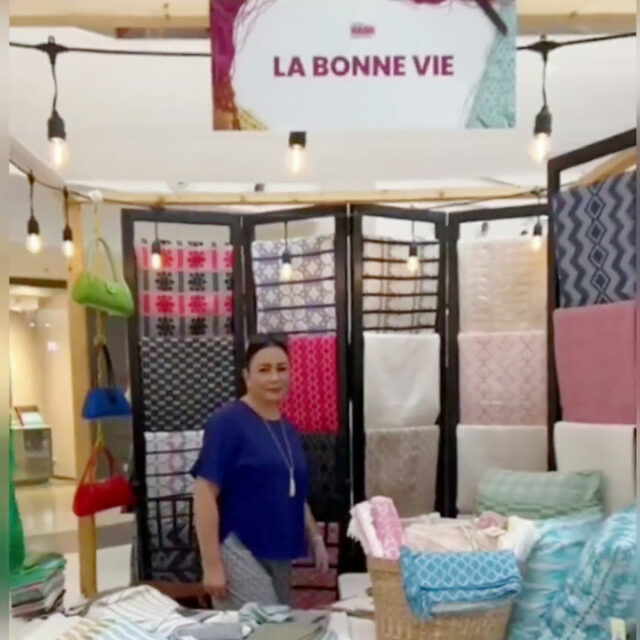
At this month’s Likhang Habi Fair in Glorietta, we caught up with Ms. Bonnevie manning the booth of her indigenous textiles brand, La Bonne Vie (“the good life” in French, just like the actress’ last name). The brand’s roots are a project of her third husband, former Ilocos Sur governor, vice-governor, and now Department of Agriculture undersecretary Deogracias Victor Savellano. “It’s not like I intentionally entered into indigenous textiles. This thing came to me as a surprise, actually,” she told BusinessWorld during an interview on Oct. 15.

The brand started in 2013. Before that, Mr. Savellano had a project to look for all of the artisans in Ilocos Sur, group them together and fund their weaving efforts. “He looked for the best weavers in the land, and he found them, made looms for them, and gave them thread so they could continue weaving,” she said. The province of Ilocos Sur is known for their weaving traditions, the result of which is known as abel iloko.

The management of the project was passed on to her after their marriage. She does have some experience: her father, Honesto Bonnevie, traded in abaca, and finished products had her name attached to it. “I made it popular,” she said of her father’s products. She recalled her husband saying, “Lend your name to inabel weaving para sumikat (so it would get famous/popular).”

NOT JUST A SHOPKEEPER
“I became a tindera in American Women’s Club [bazaar],” said Ms. Bonnevie of when she first started selling inabel. “Of course, I saw my classmates from Ateneo saying ‘Naging tindera ka na lang (you became just a shopkeeper)!’. I said, ‘Uy, akin naman ang binebenta ko (Hey, what I’m selling is mine). Hindi ako tindera, this is an advocacy, I’m a humanitarian, ano ka ba (what’s wrong with you)?,” she said in jest. “‘You married a politician tapos naging ano ka na lang, tindera? What happened?’ Nilait-lait pa ako [they teased me].”

It was during these bazaars that she met clients from SM’s Kultura, Rustan’s, and Tesoro’s, who now order from her in bulk. To ease transactions between these entities and the weavers, Ms. Bonnevie built La Bonne Vie as a formal brand, herself representing the weavers.

“They’re not our employees to begin with. You will never be able to employ any weaver,” she noted. “I offered a salary to them, and nobody would accept because they were landed people.” According to her, weavers pause their work during the harvest season to focus on their farms. What she does instead is to give them thread for free, then let them give her a price for their textiles. Asked how much this arrangement has changed the lives of the weavers, she said, “By a lot.”

She told about visiting farms and noting the dirt floors of many of the houses. After the weavers had begun working with her (not under her, as she makes clear), she noted improvements. Some families have been able to buy multiple tricycles, cars, and delivery trucks for their products. Some of them have branched out from La Bonne Vie, building their own brands, but still happy to help Ms. Bonnevie with her own orders.

Asked how she feels that some of them don’t seem to need her help anymore, she said, “I didn’t do that for them to be my slaves, or to be my employees. I’m empowering them. I want to make them entrepreneurs in the future. The common denominator for them and for me is for abel iloko to be known,” she said in English and Filipino. In one case, she visited the home of one of her blanket weavers, noting that the manang (an Ilocano term of endearment for an older sister) had earned enough to build a storeroom even bigger than her own. “Shelves and shelves of blankets,” Ms. Bonnevie said with some pride.

“I’d like to say I have a passion for empowering artisans. I believe in the craftsmanship of the Ilocano people. I believe in this art. The patterns [they weave] are not patterns that have a template or blueprint. The blueprint is in their brain,” she said.

PROUDLY LOCAL
Some of La Bonne Vie’s products have gone on to Australia and China (with the actress and entrepreneur noting that Chinese factories have since come out with pale imitations). She also notes that changing Filipino consuming attitudes are a huge help for businesses like hers. “Being proud of local is already one thing. There was a time when people were so Western-crazy,” she said. “Now the Filipino people have changed. They’re thinking now is to buy local, to support Filipinos. Together… you promote what’s Asian, you promote what you’re proud of.”

For her, she said that the more people wear inabel, the more successful her efforts would be. “True success is, hindi lang Titas of Manila ang makakabili ng textile mo [Not just the wealth matrons can buy your textiles]. Even average people can buy it, because that’s a treasure that people should be proud of.”

It’s not always roses for weaving, of course.

Ms. Bonnevie, for example, began the business in 2013 with just 10 to 12 weavers, all of them old women, signifying the danger of the craft dying along with her weavers. In time, she was able to entice younger people to begin weaving, but the pandemic hit their interests hard. Not only did some of the older weavers die of COVID-19, but the younger weavers moved on to jobs in caregiving and business process outsourcing. “They didn’t see weaving as a lucrative profession anymore,” she said. “It’s in a very fragile state, actually,” she said, while expressing a wish for the government to step in with nationwide projects to entice younger people to become weavers.

“It is an art, a language, our culture. Through the designs — these designs have stories! They speak!”

She pointed out the designs under her line: there’s kibin-kibin, a textile embossed with two figures holding hands, used to propose marriage. “Through thick and thin, we grow old hand-in-hand,” she said about the cloth’s promise. Another one was tokak, named after the frog rising out from it, and another with a fisherman.

In another instance, she talked about studying different ratios of thread to improve the product. She settled on a 70% polyester and 30% cotton blend, with the base in polyester and the raised designs in cotton. “This way, even if you wash it, or put it in the dryer, the shape will never change. The color will never change.” She did this in response to customers returning their items due to warping, or bleeding.

WHAT IS FAME FOR?
That leads us to ask: are the people there for her, or for the weaves and the weavers? “The young ones? Hindi nila ako kilala (they don’t know me).” She recounts one encounter where a younger shopper had to be reminded by her mother: “Hindi mo ba kilala? Si Dina Bonnevie ‘iyan! Noong bata ako, fan ako niyan! [Don’t you recognize her? That’s Dina Bonnevie! When I was young, I was her fan!]

Eh, iyong bata pinanganak, 2002. Or 1996. Anong malay niya [The kid was born in 2002. Or 1996. What would she know?],” she said.

There were many other younger customers that day. “They never knew who Dina Bonnevie was. Who the hell is Dina Bonnevie?,” she said, noting that she was only recognized after an older relative (usually female) would point her out to them. “Success iyong pumunta sila. Hindi naman nila alam kung sikat ka eh. Pero binibili nila iyong fabric ko eh. [I deem it a success that they come. They don’t know if you are famous. But they buy my fabrics.]”

She does know she still has some pull. “An advantage I have is, when I get into a business, before I even promote it, it’s already sikat,” she said. “Even before you make any marketing efforts, you’re already known.” She makes an example of people posting about seeing her on their social media accounts. “Punta iyong mga tao. [Other people go.]”

“The downside there is, one mistake, and the whole world knows. You have to be really be sure about the quality, and you have to walk your talk.”

DIFFERENT ROLES
What is it like to work in a business so far away from showbiz? (Though she still acts, with her most recent credits being the ongoing TV series Abot-kamay na Pangarap). Apparently, fellow actress Carmina Villaroel had asked her the same thing. “Well, if it’s God-given — I didn’t ask for it — it just fell into my lap. It came to me. When it’s God-given, it comes with a responsibility. You have a mission.”

For practical matters though, she brings her computer on the set to answer e-mails, take client calls, and even review their inventory, all in between takes. She discusses how previous experiences in acting help her now with a textile business. “Show business is all about giving life to a role you’re playing. Giving it character. It’s the same with the textiles. How do you give it character, life? Wear it.”

She’s juggling several roles now: there are her private roles as wife, mother, grandmother (from her children with host Vic Sotto), and stepmother (to her husband’s children); and then her public roles as actress, celebrity, entrepreneur, and political spouse. She credits the energy she has for all these things to passion.

“You have to have passion for everything. When you work, do it with passion. Sometimes I see T-shirts that say, ‘It’s going to be a dumb day,’ or ‘I hate Mondays.’ That’s so negative.”  She points out the brand’s own T-shirts. “Every single T-shirt that I sell here? The ones with a patch? I made that,” she said proudly.

“You have to have a passion for your work. You have to love what you do. If you love what you do, you put your heart and soul into it,” she said. “When you have a passion for everything, everything turns out well.”

Ms. Bonnevie isn’t just playing a role: she’s in inabel for the long haul.

T-bill, bond rates may climb to track secondary mart, US yields

BW FILE PHOTO

RATES of Treasury bills and bonds on offer this week could climb further due to an increase in US yields following hawkish signals from the US Federal Reserve.

The government will auction off P15 billion in Treasury bills (T-bills) on Monday, or P5 billion each in 91-, 182- and 364-day papers.

On Tuesday, it will offer P30 billion in reissued 10-year Treasury bonds (T-bonds) with a remaining life of nine years and 10 months.

T-bill and bond yields may track the increases seen at the secondary market on Friday amid elevated global crude oil prices due to worries that the Israel-Palestine war may escalate, Rizal Commercial Banking Corp. Chief Economist Michael L. Ricafort said in a Viber message.

At the secondary market on Friday, the 91-, 182-, and 364-day T-bills went up by 13.93 basis points (bps), 1.96 bps, and 15.33 bps week on week to end at 6.0104%, 6.1654%, and 6.4618%, respectively, based on PHP Bloomberg Valuation Service Reference Rates data published on the Philippine Dealing System’s website.

The 10-year bond rose by 6.42 bps week on week to yield 6.6170%.

Yields rose last week following the increase in benchmark US Treasury rates due to hawkish signals from US Federal Reserve Chair Jerome H. Powell, Mr. Ricafort added.

On Thursday, the 10-year US Treasury yield briefly crossed 5% following hawkish remarks by Mr. Powell, while the Middle East conflict kept investors jittery, Reuters reported.

Speaking at the Economic Club of New York on Thursday, Mr. Powell said the US economy’s strength and continued tight labor markets could require tougher borrowing conditions to control inflation.

The Fed kept its key rate unchanged at the 5.25% to 5.5% range at its meeting last month.

It has hiked rates by a cumulative 525 bps since it began its tightening cycle in March last year.

The Federal Open Market Committee will next meet on Oct. 31 to Nov. 1 to review policy.

T-bill and T-bond rates could rise due to expectations that inflation could remain above the central bank’s 2-4% target next year, a trader said in an e-mail. The trader sees the 10-year bond’s yield ranging from 6.875% to 7.0%.

Minutes of the Bangko Sentral ng Pilipinas’ Sept. 21 meeting released last week said the Philippines may miss its 2-4% annual inflation target for a third straight year in 2024.

Last week, the Bureau of the Treasury (BTr) raised just P11.947 billion via its offering of T-bills, short of the P15-billion program, even as total bids reached P19.371 billion.

Broken down, the Treasury borrowed only P3.637 billion via the 91-day T-bills, below the P5-billion offer, even as tenders for the tenor reached P5.137 billion. The average rate of the three-month paper rose by 18.4 bps to 5.99%. Accepted rates ranged from 5.85% to 6.10%

The government raised just P3.31 billion from the 182-day securities, short of the P5-billion program, despite bids for the tenor reaching P6.52 billion. The average rate for the six-month T-bill was at 6.207%, up by 9.2 bps, with accepted rates at 6.125% to 6.25%.

Meanwhile, the BTr made a full P5-billion award of the 364-day debt papers as demand for the tenor reached P7.714 billion. The average rate of the one-year T-bill rose by 8.3 bps to 6.388%. Accepted yields were from 6.325% to 6.438%.

On the other hand, the reissued 10-year bonds to be offered on Tuesday were last auctioned off on Sept. 19, where the government raised the planned P30 billion, with the papers fetching an average rate of 6.42%.

The BTr wants to raise P150 billion from the domestic market this month, or P60 billion via T-bills and P90 billion via T-bonds.

The government borrows from local and foreign sources to help fund its budget deficit, which is capped at 6.1% of gross domestic product this year. — Aaron Michael C. Sy with Reuters

More private sector investments seen needed in hotels to sustain Philippine tourism growth

THE private sector needs to invest more in hotel accommodations to support the growth of the country’s tourism industry, according to real estate brokerage company Leechiu Property Consultants, Inc. (LPC).

“To sustain the growth in the Philippine tourism industry, there’s a pressing need for greater private sector investment in additional hotel accommodations. Initiating these investments within the next year is critical to fortify international tourism beyond 2027,” the company said in a statement over the weekend.

According to LPC, about 15,000 new hotel rooms are expected to be delivered within the next five years, primarily located in Metro Manila.

It added that more hotel projects are likely to be announced in the coming months or years in line with the Department of Tourism’s (DoT) target of 12 million international arrivals by 2028.

DoT figures showed that the country logged 4.005 million international arrivals as of Sept. 29, nearing its full-year 2023 target of 4.8 million foreign visitors.

Of the total international arrivals, 91.58% or 3.67 million were foreign visitors while the remaining 8.42% or 337,426 were overseas Filipinos.

Meanwhile, LPC projected that Panglao Island in Bohol could surpass Boracay Island as the country’s premier tourism destination.

“In 2019, Panglao reached an impressive 1,581,904 visitors, coming close to Boracay’s 2,034,599 arrivals during the same period. Given these promising figures, it’s becoming increasingly likely that Panglao Island could surpass Boracay Island as the Philippines’ premier tourism destination,” LPC said.

Alfred Lay, Leechiu director for hotel, tourism, and leisure, said one advantage that Panglao has over Boracay is its larger size and capacity limits.

He added that ongoing developments in Panglao could increase land values in the area. Some of these are the proposed 50-hectare Panglao Shores project, the upcoming JW Marriott Hotel, the Cebu-Bohol bridge, and large-scale energy initiatives aimed at meeting Bohol’s surging energy requirements.

“These developments have had a significant impact on land values, with Alona Beachfront properties now priced at approximately P80,000 to P120,000 per square meter, approaching the land values in Boracay’s white beach area,” Mr. Lay said.

LPC projected that tourist arrivals, flight capacity, and hotel occupancy rates across the global tourism industry could return to pre-pandemic levels by next year.

“Industry stakeholders should look out for certain trends that can greatly impact the Philippines in the coming year, including the relaxation of visa restrictions, persistent high airfares driven by escalating aviation fuel costs, ongoing inflation, a high-interest rate environment that may leave consumers with diminished purchasing power, and the return of business travel and MICE (meetings, incentives, conferences, and exhibitions) events,” LPC said. — Revin Mikhael D. Ochave

Wearing piña on your feet

Making a version of the pineapple fabric for everyday clothing

WHEN one thinks of pineapple fibers used in textile, we tend to associate it with stiff and formal Filipino formalwear. Beautiful, translucent, and terribly fragile, this cloth, called piña, isn’t worn often. But what if one can wear piña everyday?

The proposition of Creative Definitions, the entity behind brands Lakat and Aire, is a little bit different.

According to Creative Definitions co-founder Michael Claparols during this month’s Likhang Habi Fair in Glorietta, they use fibers not from the Red Spanish variety used for the delicate fabric, but the usually discarded leaves from the sweet Hawaiian variety. The fibers from their pineapple leaves are also mixed with cotton. Not quite piña, but still Filipino, and moreover, sustainable. The yarns spun from this process are made into sneakers (for Lakat; meaning “walk” in the Hiligaynon spoken in Negros from which Mr. Claparols hails), shirts, and pants (for Aire).

“It’s really the Negros Island region I’m trying to help,” he said. The resulting fabric is opaque, has a texture akin to linen, and is very receptive to dyeing. Mr. Claparols adds that the fabric is very breathable.

Mr. Claparols and his wife Banj support local farmers by buying the leaves from their pineapple plants, while they support other local communities through the other processes associated with making textiles: spinning, weaving, sewing, and so forth. Lakat’s sneakers, for example, are assembled in Rizal province, with the rubber soles sourced from Mindanao. He says that the only foreign things in the sneakers are the aglets and eyelets for the shoelaces (from Taiwan), and only because the ones available in the market weren’t up to standard.

Creative Definitions wasn’t always in the business of fibers: when they were founded in 2008, the Calaparols couple were simply trading Negros-made crafts. In 2017, they went on a trip to Hong Kong and were exposed to sustainable materials. They then went on to partner with a Negros weaving community, then entered discussions with the Department of Science and Technology – Philippine Textile Research Institute (DoST-PTRI) to create their own sustainable textile (where they learned the process at every step, so the Claparols could make their own cloth and clothes if asked).

According to Mr. Claparols, the PTRI already had the technology to process pineapple fiber, but had no way to commercialize it. Today, after the leaves have been stripped into fiber (by a solar-powered machine), the fibers are sent to PTRI to be blended with cotton and spun into yarn. Mr. Claparols hopes that in the future, a similar facility could be built in the Negros region, to reduce their carbon footprint. “One of the greatest strengths of the Philippines is our source of fibers. The challenge is how to convert them into something wearable,” he said.

Cool and consciousness come together in this shoe brand — while Mr. Claparols is joyful that more people are adopting sustainable lifestyles, he admits that in everyday life, the concepts aren’t always clear-cut. By designing clothes and shoes made from sustainable sources, he hopes to help close the gap. “The consciousness on that side, you can also put it in everyday use. That’s what I’m trying to grow,” he said.

We do note that the shoes cost P3,900 (and the shirts could go for more). Mr. Claparols pins this on the economies of scale: since his production is still on a smaller scale, he has no choice but to charge a bit higher for the operations to chug along smoothly. He hopes for more developments in the scene so entrepreneurs like him could increase production, and bring down prices: “If it’s not affordable, and if people don’t buy, it doesn’t become sustainable.” — Joseph L. Garcia

LANDBANK net income rises by 24%

LAND BANK of the Philippines (LANDBANK) saw its net income rise by 24% in the first nine months of the year amid higher interest earnings from loans and investments, putting it on track to meet its profit target.

The state-run lender’s net profit stood at P31.85 billion as of end-September, higher than the P25.7 billion in the same period last year, the bank said in a statement on Sunday.

This is the highest net income recorded by the bank since it first breached the P30-billion mark at end-2022, it said.

This also exceeded the P26.3-billion goal for the first three quarters of the year and makes up 90.9% of the P35-billion full-year target.

LANDBANK’s performance in the first nine months translated to a return on average equity of 15.97%.

Other details about the bank’s financial performance for the period were not immediately available.

“The unprecedented income was driven by the aggressive expansion of our developmental loan portfolio, coupled with robust yields from loans and investments,” LANDBANK President and Chief Executive Officer Lynette V. Ortiz said. 

“We have likewise been prudent and disciplined with managing our expenses to maximize gains. We will ensure that our solid balance sheet continues to translate to substantial and meaningful support to the sectors we serve,” she added.

The bank’s interest income from loans and investments rose by 35.9% year on year to P91.15 billion.

Deposits grew by 12.8% to P2.7 trillion at end-September.

LANDBANK’s total assets went up by 11.5% to P3.1 trillion as of September from P2.8 trillion in the same period a year ago.

Total capital climbed by 21.9% to P249.2 billion from P204.4 billion in the same period in 2022, exceeding the lender’s full-year target of P243.8 billion.

“LANDBANK’s financial ratios remain at healthy levels, with capital adequacy ratio (CAR) at 16.15% and common equity Tier 1 at 15.30%, both well above the minimum requirements of the Bangko Sentral ng Pilipinas (BSP),” the lender said. Keisha B. Ta-asan

SLMC Bonifacio Global City MAB Corp. to hold 2023 Annual Stockholders’ Meeting on Nov. 10


Spotlight is BusinessWorld’s sponsored section that allows advertisers to amplify their brand and connect with BusinessWorld’s audience by enabling them to publish their stories directly on the BusinessWorld website. For more information, send an email to online@bworldonline.com.

Join us on Viber at https://bit.ly/3hv6bLA to get more updates and subscribe to BusinessWorld’s titles and get exclusive content through www.bworld-x.com.

Infrastructure development, consistent power supply seen to boost regional office demand 

REAL ESTATE brokerage and consultancy firm KMC Savills said that infrastructure development and stable power supply are the top factors that could boost office space demand in regional cities across the country.

“The key factor that will help boost the demand of the regional offices is, apart from labor, it is really the infrastructure development, like airports and roads,” KMC Savills Chief Operating Officer Cha Carbonell said in a virtual briefing last week.

“In terms of the power situation, I know some provinces and cities are still somewhat struggling with the availability of power or the consistency of the power that’s being provided. That is really one of the concerns when we do scorecards with our clients,” she added.

KMC Savills Executive Director John Corpus also said that there should also be improved connectivity in regional areas to improve office demand.

“We have to improve our connectivity, not just in the physical office, but also from our homes because it is now a requirement, especially those that are working from home or doing hybrid work,” Mr. Corpus said.

Meanwhile, Ms. Carbonell said that local governments in regional cities should sustain efforts to encourage more investors to develop their areas.

“It is also making sure that our local governments will continuously encourage investors to come in and develop the area,” Ms. Carbonell said.

“It is also building sustainable projects, not just offices, but also malls and parks, making sure that the developments are also future-proof,” Ms. Carbonell said.

KMC Savills recently said that it sees the sustained growth of property markets in regional cities such as Metro Cebu, Metro Clark, Davao, Iloilo, and Bacolod amid the continuous expansion of the information technology and business process management (IT-BPM) sector in the countryside.

Aside from the IT-BPM sector, the real estate brokerage firm said that it also sees more regional expansion from providers in the flexible office, e-commerce, and logistics sectors.

“One of the things that we are so excited about is that the provincial areas did better than Metro Manila. There’s been more activity happening outside Metro Manila. It’s all been to the provinces. Companies want to go where the best employees are,” KMC Savills Managing Director Michael McCullough said.

“A lot of people during the pandemic returned to the provinces. That’s where the companies want to move back to. There’s been available decent quality (office stock), IT-grade, and companies have taken advantage of the lower rates to set up offices where their employees are located. This reduces attrition and lowers costs. We expect this to continue,” he added. — Revin Mikhael D. Ochave

Iloilo City mayor backs waste-to-energy project

ILOILO CITY will seek the approval of its council for the P2.3-billion waste-to-energy (WTE) project proposed by a subsidiary of Metro Pacific Investments Corp. (MPIC) that is planned to power a desalination plant and help clear the city’s landfill, the local government’s chief said.

Speaking to reporters on Friday, Iloilo City Mayor Geronimo “Jerry” P. Treñas said the proposal had gone through the city’s public-private partnership selection committee and is set to be submitted to the council on Nov. 3 for approval.

“The waste-to-energy [project] will be used to power the desalination plant, which is needed by the city,” Mr. Treñas said.

The WTE process harnesses heat by burning waste at increased temperatures. The generated heat is then used to make steam, which drives a turbine that creates electricity.

In June, the city government and MetroPac Water Investments Corp. (MPW), a wholly owned water infrastructure investments subsidiary of MPIC, signed a negotiated deal for the proposed Iloilo City Integrated Solid Waste Management Facility.

The proposed facility can process up to 470 tons of nonrecyclable wastes as potential fuel per day and produce around 2.4 megawatts of electricity.

MPW has a joint venture with Metro Iloilo Water District — the water distribution utility that provides water for the city and nearby municipalities — called Metro Pacific Iloilo Water, which is created for the operation, rehabilitation, and maintenance of water distribution and wastewater management facilities of the water district.

“Once operational, then we don’t have to develop another module for sanitary landfill. The last time the city constructed a module for sanitary landfill, the city spent, I think, P300 million,” Mr. Treñas said.

The Iloilo City mayor said the proposal started in 2019 but had been delayed due to a “long gestation” period.

“They have to talk to the supplier, see how it is being done in other countries. It is quite difficult because we’re the first in the country. So, after this maybe if this continues, after getting all the approval from all the national agencies, it may be faster next time,” Mr. Treñas said.

Mr. Treñas said the proposal must go through the council first for approval from different national government agencies before the permits to build the facility.

“All of these expenses, we save. We do not go to another sanitary landfill and in the waste-to-energy [project], the city will still have a share,” he said, adding that even if the share is little, “at least we do away from these big expenses.”

MPIC is one of the three key Philippine units of Hong Kong-based First Pacific Co. Ltd., the others being Philex Mining Corp. and PLDT Inc.

Hastings Holdings, Inc., a unit of PLDT Beneficial Trust Fund subsidiary MediaQuest Holdings, Inc., has a majority share in BusinessWorld through the Philippine Star Group, which it controls. — Sheldeen Joy Talavera

ADVERTISEMENT
ADVERTISEMENT