Home Blog Page 4140

Telling stories about the reality of violence

Sheron Dayoc’s latest coming-of-age tale is making its debut at the Tokyo Int’l Film Fest

THE GOSPEL of the Beast is a coming-of-age drama about a 15 year-old boy, Mateo, who accidentally kills his classmate and runs away with an older man, bringing him into the criminal underworld. This story, though akin to many gritty Filipino indie films, is set apart by its focus on the perspective of a teenager who slowly loses his innocence, according to the film’s director, Sheron Dayoc.

The film, which is Mr. Dayoc’s first feature in seven years, his last being the Gawad Urian-winning Women of the Weeping River in 2016, is set to premiere in competition at the Tokyo International Film Festival this October.

“Some are not aware that this is happening, that kids gradually becoming drug dealers and being exploited as part of underground syndicates, is a rampant thing,” Mr. Dayoc told BusinessWorld in a Zoom interview.

He explained that it may be a fictional film, but it mirrors the Philippine reality of violence, where children falling to the wayside and taking the fall for greater evils is tolerated and normalized.

“Our culture has become passive about it,” he said.

COMEBACK FILM
The Gospel of the Beast was first conceptualized in 2017, shortly after Mr. Dayoc’s team’s previous feature swept most of the awards at the Gawad Urian and QCinema. Circumstances put it on hold indefinitely — until 2021.

That was when it received support from the International Co-Production Fund of the Film Development Council of the Philippines (FDCP) and was selected for the 2021 Full Circle Lab Philippines.

Southern Lantern Studios, the local production house behind Mr. Dayoc’s previous films, once again came on to produce, with help from E&W films from Singapore and Tinkerbulb Productions, also from the Philippines.

“In the past seven years, I focused more on making TV commercials, so I really wanted to go back to my creative roots,” said Mr. Dayoc.

“As a filmmaker, I thought about film not just as an opportunity to tell crucial stories, but also as a sustainable business practice to keep doing the important work. It’s something I, and many people in the industry, are still figuring out,” he explained.

For his part, the goal is to continue telling stories that mirror Philippine reality while making sure it isn’t too niche to be shown to a wider audience.

While The Gospel of the Beast awaits its reception by the global festival audience in Tokyo, the studio is working on deals to bring it to the Philippines, namely to Western Visayas where the story takes place.

In the meantime, Thailand-based sales agent Diversion has picked up international sales rights.

DISTINCTLY FILIPINO
Mr. Dayoc said that 100% of the film’s cast are from Western Visayas, a practice he insisted upon coming from a documentary filmmaking background and a similar approach to his previous film that had a full Mindanaoan cast.

This goes for the leads as well, with Antique native Jansen Magpusao (known for the film John Denver Trending) playing Mateo and the acclaimed Bacolod-born veteran actor Ronnie Lazaro taking on the role of his newfound father figure.

“What I set out to do is make meaningful stories that can have a meaningful impact in the community,” he said. “That’s why I hope to screen this in Iloilo.”

As for the visuals, Mr. Dayoc wanted to make it more filmic, with rich-colored textures rather than the dark atmosphere people associate with gritty dramas.

His film recommendations and inspirations for The Gospel of the Beast include the 2000 Spanish drama El Bola by Achero Mañas and the 1999 Scottish drama Ratcatcher by Lynne Ramsay — both centered on children navigating a bleak world.

“Compared to films I admire, and my own previous films, this one has the same approach, the same core,” he said.

“I’ve met with so many such people who’ve lived through violence and despair in my documentary days, so I want to tell stories about those without a voice.” — Brontë H. Lacsamana

Whose voice is it anyway? Actors take on AI copycats

MEXICO/LONDON/JOHANNESBURG — Voice actor Armando Plata does not recall promoting a shopping mall in Bogota, narrating a porn movie, or advertising a big bank. Yet his voice comes over loud and clear: schmoozing, sighing, and selling with neither permission nor payment.

It was the mild, robotic twang — rather than worry over any memory lapse — that alerted Mr. Plata to the fact his voice had been quietly cloned via artificial intelligence (AI), robbing the veteran actor of his key asset, artistic choice, and vocal rights.

“I believe that the most cloned and artificially used voice in Spanish is mine,” said Mr. Plata, owner of a deep and lilting voice, 50-year audio career, and president of the Colombian Association of Voice Actors.

Now Mr. Plata is organizing with voice actors across Latin America to legislate the “right to own one’s voice.”

And the group is not alone in what is emerging as a global push for human rights against the precipitous rise of AI.

From South Africa to Europe, Japan to the United States, artists are joining forces to protect their jobs, and their souls, from the ramifications of AI that sounds just like them.

The genesis of the voice grab seemed innocent enough.

It was two decades ago that Mr. Plata took part in a paid, text-to-speech project for a firm that later — unbeknownst to him — sold its recorded voices to an AI software company.

Mr. Plata’s voice proved popular, if of no commercial value — to him at least. As it common in the voiceover business, Mr. Plata signed no contract so could not then press any lawsuits.

“At one point we will be able to sue companies and push for class actions. But first, we need governments to recognize the ownership of our voices,” the voice actor told the Thomson Reuters Foundation.

HUMAN RIGHT TO A VOICE
This year, approximately 500,000 video and voice deepfakes will be shared on social media sites, according to synthetic media detection company DeepMedia.

Cloning a voice used to cost $10,000 in server and AI-training cost; now startups offer it for a few dollars, according to DeepMedia.

Among high-profile cases of vocal appropriation are Morgan Freeman, whose voice and likeness were used in a faked video to criticize President Joseph R. Biden in April 2023.

Given that an AI clone can come in at about half the cost of a voice artist, let alone a celeb, the technology is tempting.

One Colorado voice actor listed on Voices.com marketplace can be hired for a 60-second radio ad for $500; the AI equivalent costs $200 a minute, about $1 a word. Others cost half that.

Speech-generating AI — such as Microsoft’s VALL-E language model — works by sifting through reams of data, categorizing how people speak then using an algorithm — known as a neural network — to replicate human vocal patterns and speech characteristics.

After AI-powered audio production companies launched in Chile this year, the national voice actors’ association met with lawmakers to discuss voice ownership as a human right.

Voice actors in Colombia have similarly set up a legislative project to establish the human voice as personal patrimony.

Both legislations aim to serve as a basis for future regulations, such as mandating audio watermarks in all materials generated with synthetic voices.

While copyright laws protect works captured on a tangible medium, be it on canvas or stored digitally, voices fall outside the remit.

Some countries also prohibit deepfakes of celebrities, but there are no laws that govern vocal deepfakes specifically.

PERSONAL INFORMATION?
In Africa, voice artists are looking to protect themselves though there are few AI voice models able to prosper in such a rich mix of regional accents and languages, Andrew Sutherland, a South African sound engineer and voice artist, said.

One vehicle may be the South African Protection of Personal Information Act, under which personal data — voice included — cannot be collected, processed or stored without consent.

A voice could be classed as personal and sensitive data as it may show anything from class to age, said Mr. Sutherland, so “a legislator could recognize that and protect it on those grounds.”

The South African Guild of Actors is lobbying government to enact policies around performer rights, a tactic mirrored by Japan’s main industry body for freelance performers, Arts Workers Japan.

Copyright law in Tokyo sides more strongly with AI than does legislation in other countries, letting companies exploit any language, sound, or images for data analysis.

Tokyo, however, may have to bring in protections for actors at the start of their career, as AI can generate similar content instantly and preclude their future success, Michihiro Nishi, a partner at law firm Clifford Chance, told the Thomson Reuters Foundation over e-mail.

Japan has also pushed for new G7 legislation while relying on “superficial” old laws to fill the gaps, according to Megumi Morisaki, an actor who is president of Arts Workers Japan.

The result — scant artistic protection, said Ms. Morisaki.

WHO RULES IN AI WORLD WITHOUT BORDERS?
Artists across the world are looking to the European Union’s (EU) AI Act, which classifies AI tools by potential risk, aiming to lay a global baseline for the use of synthetic voices.

“I’ll work with a director in the UK, a producer in Canada, a voice actor in Africa, another producer in Sweden, and then I’m in Los Angeles — so who owns what?” said Tim Friedlander, president of the National Association of Voice Actors (NAVA).

“The internet doesn’t know borders or boundaries.”

While there was talk in the United States of AI legislation, Mr. Friedlander considers it is now at a political stalemate.

The EU must also do more; specifically, NAVA wants AI voices to sit alongside deepfake images in a high-risk group.

“It doesn’t just affect well-known voice actors, it affects anybody who has recorded audio anywhere,” Mr. Friedlander said, referring to the potential for scams or blackmail.

Industry expects the Act to pass this year but there is no deadline, so those at risk are taking their own precautions.

Spanish-speaking voice actors gathered this year to create the United Voices Organization, which aims to negotiate contracts with fair compensation for AI-related projects.

“We want to ensure that voices are used in an ethical manner, guaranteeing contracts of good faith,” said its president Daniel Soler de la Prada.

And while NAVA and the Screen Actors Guild-American Federation of Television and Radio Artists (SAG-AFTRA) have clauses in their contracts to guard against abuse by AI, fewer than one in five workers in the industry is unionized.

Similarly, voice artists are considered freelancers in South Africa and unable to “unionize and collectively bargain for rights and fair market fees and standards,” Mr. Sutherland said.

Having protections in informal markets is vital, especially in Global South countries, said Urvashi Aneja, founding director of Digital Futures Lab, a research collective.

“The nature of work is changing, we’re seeing more and more informal and precarious work,” Ms. Aneja said at the Thomson Reuters Foundation’s annual Trust Conference in London on Friday.

“But we have to design social protection systems that deal with the precariousness of that work.”

Until legislation is global, advocates for the rights of humans hope platforms will pay named voices instead of those startups that sell AI copies fed by data scraped off the web.

“The ethical piece of AI is so prominent now,” said Colin McIlveen, vice-president of Voices.com.

In an upbeat note, Mr. McIlveen said organizations are now looking to ethical sources for voice acting, something they may not have done two years ago when cheap was better than real.

Even Mr. Plata — the accidental porn and ad star — believes AI, if duly regulated, can become a new source of artistic income.

“Imagine that in 15 or 20 years from now, when I’m long gone, my family can still own my voice and have it be productive for one or two more generations,” he said.

“This can affect me, but also make me transcend.” —  Thomson Reuters Foundation

Robinsons Offices teams up with FarmTop to set up ‘sky farms’ in buildings

JG SUMMIT President and CEO Lance Y. Gokongwei (left) inspects the rooftop farm at the Robinsons Cyberscape Alpha in this photo taken Oct. 10. — COMPANY HANDOUT

ROBINSONS Offices and FarmTop have partnered to develop “sky farms” in the former’s office buildings around the Philippines.

FarmTop (Farm-to-Plate) promotes urban agriculture by developing “sky farms” on building rooftops, as way to address the growing demand for fresh produce delivered straight to your doorstep.

“Under the Farm-to-Plate concept, fresh vegetables are produced much closer to where they are consumed, typically within a five-kilometer radius. This minimizes the carbon footprint that traditional farm-to-market routes would typically entail,” the company said.

Danny Dy, president and chief executive officer of FarmTop, said each rooftop farm can produce as much as five tons of vegetables a month. This can serve customers in condominiums, offices, schools, hotels, and restaurants within its vicinity.

“By tying up with FarmTop, we are able to offer alternative means to healthy eating. We can provide the space, expand the market, and create jobs for urban farmers,”  Jericho P. Go, Robinsons Offices senior vice-president and general manager, said in a statement.

Mr. Dy said they want to raise awareness of rooftop farming or controlled environment agriculture as a technology-based method of producing food. “The goal is to control all our farm environment through my smartphone. We want to make farming more sexy,” he said.

Mr. Dy said FarmTop specializes in building farms on roof decks. “The travel of the greens to the consumer is shorter. It’s cost-efficient and it’s fresher,” he said.

By reducing the journey from farm to plate, he noted the rooftop farms play a crucial role in decreasing the reliance on fossil fuels. FarmTop is also exploring environmentally-friendly delivery options, like bicycles, side cars, or electric vehicles.

Robinsons Land has consistently supported the causes of Rise Against Hunger, an international hunger relief organization that distributes food and aid to the world’s most vulnerable.

FarmTop will formalize its commitment to Rise Against Hunger through the “Bawat Buto Buhay” program, which will be launched this year.

Financing growth: Maharlika Fund and SWFs from abroad

(Part 3 of a series)

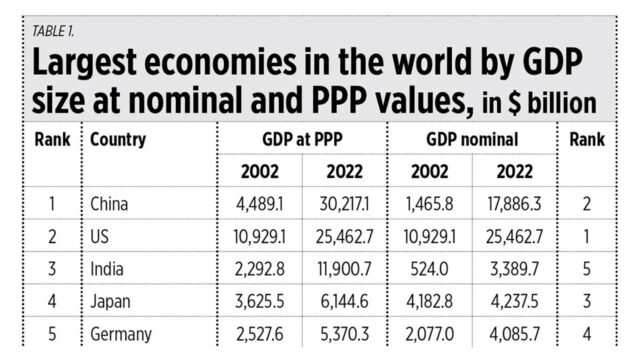
The International Monetary Fund (IMF) released the World Economic Outlook (WEO) October 2023 two weeks ago. In Table 1 I show the largest economies in the world, with a focus on Asians. Two valuations of GDP here: nominal (GDP at national currency divided by US$ average exchange rate for the year) and purchasing power parity (PPP, which converts the currency of one country with another to buy the same amount of goods and services in each country).

When it came to GDP at nominal values in 2022, the US was the largest in the world and three Asians were in the top 10. When it came to GDP at PPP values, China was the largest and three other Asians were in the top 10 — India, Japan, and Indonesia.

The Philippines was the 30th largest economy in the world at PPP values, but in nominal values, it was the 39th largest (Table 1). Since we have the 12th largest population in the world, this does not appear impressive, but if we look at the expansion over the past 20 years, from 2002 to 2022, the Philippines’ economy has expanded four to five times while the population has expanded only 1.4 times, from 80 million in 2002 to 112 million in 2022.

So there has been a significant increase in productivity and income in the Philippines and many other developing countries through the years and it is something to ponder, that all those crisis narratives and the alarmism in the world — the food/hunger crisis, the oil/energy crisis, the NCDs/virus crisis, the climate/garbage crisis, etc. — are not realistic enough to deter continued improvement in the people’s lives and standard of living.

MAHARLIKA FUND AND SWFs ABROAD
The Philippines economic team, composed of Finance Secretary Benjamin Diokno, Budget Secretary Amenah Pangandaman, Economics Secretary Arsenio Balisacan, and Bangko Sentral officials went to Doha, Qatar and Dubai, United Arab Emirates (UAE) on Sept. 10 to 12, for a business dialogue and Philippine Economic Briefing (PEB). The team met with the representatives of the sovereign wealth funds (SWFs) of both countries — the Qatar Investment Authority and the Investment Corp. of Dubai — plus other big investment entities. Several big investment pledges were made on those two economic diplomacy meetings in the Middle East.

Then President Ferdinand Marcos, Jr. went to Riyadh, Saudi Arabia for business dialogue last week, on Oct. 19. The head of the economic team, Mr. Diokno, joined him and again pitched the Maharlika Investment Fund. He said that “Maharlika seeks to work with other sovereign wealth funds, both as an investment partner and peer in the global sovereign wealth fund community. We look forward to exchanging views and learning from the best practices of top-of-class funds, such as those here in Saudi Arabia.”

Here are recent stories in BusinessWorld about the Maharlika Fund: “Philippines’ Marcos suspends implementation of sovereign wealth fund” (Oct. 18), “Philippines committed to start operating sovereign wealth fund this year — Marcos” (Oct. 19), “Safeguards sought for Maharlika fund” (Oct. 19), “Diokno tells Saudi investors Maharlika fund prioritizes safety, transparency” (Oct. 20), “Philippines says over $4.26-B investment deals agreed with Saudi business leaders” (Oct. 20), “MIF’s governance structure needs improvement — analysts” (Oct. 23).

For me, the establishment of the Maharlika Investment Fund is good and important mainly because there are many big infrastructure projects that must be done here, like the Cavite-Corregidor-Bataan bridge, and the Iloilo-Guimaras-Negros bridge, both 32 kms long each. And there are many super-rich and wealthy SWFs abroad that can be tapped to invest here and having our own SWF or sovereign investment fund will help attract them. In Table 2 are listed the largest and richest SWFs abroad.

I doubt the government-owned banks like LANDBANK and DBP, even the big conglomerates here like San Miguel Corp. and Metro Pacific, can attract those big SWFs abroad to bring in big money. They lack the political plus financial muscles in the vetting process by those huge SWFs. The Maharlika Fund capitalization of P500 billion is only $8.9 billion (at P56/$), of which only P125 billion is the initial capitalization. An investment of $2-3 billion in Maharlika is “small amount” for the SWFs of UAE, Qatar and Saudi Arabia. Not to mention the SWFs of Norway, China, Kuwait, Singapore and Hong Kong.

This administration’s economic team is doing the right thing when it comes to business and investment diplomacy. Go out there and meet those big SWFs, tell them of the reforms that have been done, the reforms that are under way, the big infrastructure projects that can be utilized by our big population and rising business communities. We need to sustain fast growth, 5% to 8% yearly, for many years to come.

See also my previous columns in this “Financing growth” series: Part 1, “Financing growth: a rice tariff cut, an MUP pension cut, and reforms in excise tax in mining, oil, and coal” (Sept. 26), and Part 2, “Financing growth: Reducing interest payments and spending control” (Oct. 5).


Bienvenido S. Oplas, Jr. is the president of Bienvenido S. Oplas, Jr. Research Consultancy Services, and Minimal Government Thinkers.

minimalgovernment@gmail.com

Keppel pays penalties after disclosure errors 

LISTED property developer Keppel Philippines Properties, Inc. said it had paid penalties to the Securities and Exchange Commission (SEC) on Oct. 6 due to errors in its disclosures.

In a regulatory filing on Monday, Keppel Philippines said it paid P117,600 due to noncompliance with the prescribed website template for publicly listed companies.

The company disclosed that it also paid P96,600 as a result of an incomplete disclosure on its 2017 integrated annual corporate governance report.

In the first half, Keppel Philippines logged an 87% decline in its net income to P56.9 million compared with P447.9 million last year, as its gross income declined due to the lower share in the results of associates and a joint venture.

Keppel Philippines holds investments in associates and joint venture involved in property development and holding of investment properties. The company derives its revenue from rendering management consultancy services to its associates.

Based on its website, Keppel Philippines is engaged in property development activities through its associates and joint venture. The company is ultimately owned by Singapore-based conglomerate and investment firm, Keppel Corp. Ltd. — Revin Mikhael D. Ochave

Shang Properties to expand in Quezon City, Cebu

SHANG PROPERTIES, Inc. is planning to launch new projects in Quezon City and Cebu, as the high-end property developer unveiled its new brand identity.

“The luxury real estate market continues to change and evolve and we strive to be at the forefront of change… We want to redefine luxury and set new standards,” Wolfgang Kreuger, executive director at Shang Properties, said during the company’s launch event.

Mr. Kreuger said the new logo and branding “marks the beginning of a new era of sophistication.”

Shang Properties’ new logo features a more streamlined look, which the company says reflects its design philosophy “uncompromising vision, elegance, and harmony in all details.”

It retained the crane in its logo “to show the company’s lasting commitment to creating inspired spaces that are thoughtful and meticulously designed with harmony in mind.”

“This signifies us formally ushering in a new era of our brand — one that takes our mastery of creating extraordinary moments to even greater heights,” Jayme T. Uy, marketing director at Shang Properties, said in an e-mail interview with BusinessWorld.

“Even after over three decades since entering the real estate property market, Shang Properties continues to pay the finest attention to all the details,” she added.

The property developer is planning to launch two new residential high-rise projects in Quezon City and Cebu. The Quezon City residential project is located along Scout Bayoran and Sgt. Esguerra.

“As of to date, we are still in the project planning phase for our Cebu project,” Rose O. Morales, senior director for group sales at Shang Properties, said.

Last month, Shang Properties launched its latest residential development project Laya in near Ortigas Center in Pasig City. Laya offers 1,283 residential units, ranging from studio to three-bedroom units.

Shang Properties is an affiliate of Shangri-La Hotels and Resorts worldwide, and Hong Kong property investment firm Kerry Properties Limited. Its projects in the Philippines include Shangri-La Plaza, The Shang Grand Tower, Shangri-La at the Fort, and The Rise Makati. — Miguel Hanz L. Antivola

Quo Vadis?

REUTERS

NOWADAYS, we frequently read and hear lamentations about why our country, the Philippines, has fallen to the bottom in terms of per capita GDP among the Bigger 6 ASEAN countries from our top position some 50 years ago.

We dropped down the ranks over the course of many years despite having tried to do several significant things to improve the economic condition of the country and the lives of the Filipino people.

The country was placed under martial law for a prolonged period of 14 years to make dealing with the conditions then prevailing manageable. The People Power Revolution ended it with the hopes of much improved political and economic conditions for the nation. In this connection, we changed our Constitution, the fundamental law of the land. We implemented a land reform program which has now been declared complete. We decentralized public governance to give more power to the local government leaders by devolving some government services and allocating much more national funds to the LGUs. We revised the education systems a few times to improve them and raise their effectiveness. We founded a nationwide vocational training program for unemployed youth. We established a universal healthcare program. We adopted a form of cash transfer for some selected poor citizens. And a few more.

More directly on the economic front, we tried to attract larger amounts of foreign investments by giving liberal tax and other incentives and creating more economic zones and undertaking international trade and investment promotion; for the same reason, we even amended a restrictive Commonwealth-era law to leave out certain business activities so that these are not considered as public utilities and, as such, foreign investors can take controlling interest in them; we tried to develop more infrastructure and, to increase such activities much more, we incentivized the private sector to participate in this development program; we made changes in the agricultural sector to make it more productive; we kept on revising our tax laws to attract investments and raise more taxes.

To support all these activities, we borrowed more — from foreign governments and financial institutions and from local sources. As a result, the national debt has increased to the point that it is now 61% of our GDP (based on 2023 Q2 data).

Sadly, all these efforts, and more, did not help us stop our descent in per capita GDP in comparison with our foreign country peers. In other words, the level of economic well-being of the average Filipino is currently the lowest among the average citizens of each of the other ASEAN Bigger 6 countries (Singapore, Malaysia, Thailand, Indonesia, Vietnam, and the Philippines).

But much more than this, and for which we do not need to add more statistical data, the internal evidence of the poor results of all our efforts for countless years is so visible, saddening, and frustrating. The physical evidence of widespread poverty is clear to anyone who cares to know. The underemployment rate, if not the unemployment rate, is exceedingly high. Millions of our people work abroad to support the family they left behind, but in doing so, the family must deal with the trying social problems that necessarily result from such family separation. The quality of education is so poor that interest groups keep mentioning and discussing it at every opportunity. The agricultural sector is in such bad shape that it has been a subject of constant debate. Food prices and the cost of electricity are higher than those of our neighboring countries, which makes interested parties keep on asking why. The picture of wide economic inequality is so clear that it cannot be denied.

Very obviously: either we are not doing enough of what we are already doing; we are doing the wrong things; we are doing the right things wrongly; we are not doing the right things we must do; or all the above.

But why is that?

It is obvious that the No. 1 cause is the lack of strong, dedicated, and effective leadership that knows what to do and knows how to do it. But sadly, we cannot just pull out such a desirable kind of leadership and bring it to center stage. We are caught in a trap. The majority of the Filipino electorate has been captured by about 100 or so families. This condition prevents highly qualified and eager-to-serve outsiders from competing for national and local leadership. Indeed, we have a very limited choice at election time. Now and since a long time ago.

The culprit? I would rather call it the enabling tool: vote-buying.

Vote-buying has become endemic and deeply entrenched in our society. Many of us may not be aware of this prevalent condition; or may know it but do not want to be concerned with it. Those who may disagree with this comment should ask around. Even the election of a municipal councilor does not escape this election practice.

Unfortunately, there is nothing that the ordinary citizens can do to abolish this injurious election practice for the foreseeable future. For as long as most of our electorates are poor or near poor and are not better educated, this sad condition will continue to persist. We are therefore in a seemingly unending vicious cycle. Unending, because it would be foolish to expect the present privileged and powerful few to give up their continuing strategic position and considerable advantage.

Without any substantial change to such a widely prevailing political practice, I believe we are in for a very long haul, without any workable solution in sight.

Or maybe we do not need to try despairingly to find one. It may become unnecessary.

If the prediction of some of the climate change experts would prove true, an expectation that the current efforts of the international community to contain the current global warming event will fail, in a couple of generations or so (one generation is currently defined as 25 years), the Philippines will increasingly experience intense death-causing heat, flooding caused by the rising sea and great storms, and devastating fire. If we cannot find ways to mitigate the adverse effects of these phenomena directly on people’s lives and agricultural production, much, if not almost the entirety, of the Philippine geography will be uninhabitable. If so, there would be a Filipino mass migration, managed or unmanaged, moving towards the far global north or towards the far global south. But in any event, the Filipino nation will be scattered, and each scattered part will be governed by somebody else. Except for those who could and would remain and therefore would have to reorganize themselves.

I might have painted some very bleak pictures. But these are extremely serious problems currently facing us as a nation.

What do we do? Where do we go?


Benjamin R. Punongbayan (ben.punongbayan@ph.gt.com) is an accountant and the founder of Punongbayan & Araullo.

Taylor Swift outdraws Scorsese, holding Hollywood royalty at bay

TAYLOR SWIFT: The Eras Tour

THE FILM version of Taylor Swift’s stadium tour held on to the box-office lead for a second-straight weekend, outdrawing a new Martin Scorsese drama from Apple, Inc.

Taylor Swift: The Eras Tour brought in $31 million in North American ticket sales, Comscore, Inc. said Sunday in a statement. Killers of the Flower Moon, the first-ever big-screen release from Apple Original Films, opened with sales of $23 million.

The Swift film has provided fresh content for theaters owners still looking to win back business lost to the COVID-19 pandemic, drawing women in especially large numbers. Though box-office sales are up this year, they remain below their pre-pandemic peak.

Apple, meanwhile, is bankrolling Scorsese to buoy demand for its streaming service. While the esteemed director’s work is often critically acclaimed, his pictures aren’t always a sure thing at the box office. His biggest opening was Shutter Island in 2010, with weekend sales of $41.1 million, according to Comscore, Inc.

Killers stars Leonardo DiCaprio, whose character is complicit in the murder of Osage Nation members in the 1920s after oil is found on their land.

Apple plans to spend $1 billion a year on films that will be released in theaters, Bloomberg News reported in March, joining rival streamer Amazon.com, Inc. in making a commitment to that struggling industry. Since the pandemic, cinema owners have complained about a shortage of big film releases.

The theater-centric strategy also plays well with directors and actors like Mr. Scorsese and Mr. DiCaprio, who like the public showcase their pictures get from a big-screen release. Because of the current actors strike, cast members were barred from promoting the film.

The ultimate calculus for Apple, however, isn’t ticket sales, but whether the movie generates awareness and subscriber numbers for its Apple TV+ online platform. It will become available for streaming in 45 days or more.

With its weekend take, The Eras Tour is edging closer to claiming the title for the highest-grossing concert movie ever. The picture captured the domestic record in its debut, and is now moving into position to take the global crown. The current record of $261.2 million is held by Michael Jackson’s This Is It from 2009, according to Box Office Mojo.

While a boon to theaters, the release of Ms. Swift’s film forced one studio to reschedule a picture. Comcast Corp.’s Universal Pictures released The Exorcist: Believer a week earlier to avoid head-to-head competition with The Eras Tour.

Another big concert film is in the works for December. Renaissance: A Film by Beyoncé is scheduled to open on Dec. 1. To avoid competition with that picture, Walt Disney Co. is planning to reschedule The Bikeriders, which was planned for the same weekend. — Bloomberg

SEC partners with police vs entity’s investment scheme

THE Securities and Exchange Commission (SEC) conducted a joint operation with the Philippine National Police-Criminal Investigation and Detection Group (PNP-CIDG) and Presidential Anti-Organized Crime Commission (PAOCC) to take down the “illegal investment solicitation activities” of Procap International, Inc.

In a statement, the SEC said it conducted an entrapment operation during an event organized by Procap in Makati City on Oct. 15, which led to the arrest of 20 individuals including the entity’s directors, incorporators, employees, and agents. Eight of the arrested individuals are foreigners.

“The PNP-CIDG carried out the entrapment operation, in coordination with the SEC and PAOCC, after receiving information that Procap engaged in illegal offering, solicitation, and selling of securities in the form of investment contracts without any secondary license from the SEC,” the corporate regulator said.

According to the SEC, Procap offers and sells securities in the form of investment contracts as gaming packages ranging from P73,000 to P4.3 million, which would entitle investors to play seven rounds of the entity’s prediction game.

The entity offers returns ranging from 6% to 42% per month with referral incentives for recruiting additional players.

“According to Procap, by following its formula, players will not incur any loss even if they get seven successive wrong predictions through its capital protection insurance where players can enjoy fresh seven rounds to play its game and so forth,” the SEC said.

Under Section 8 of Republic Act No. 8799 or the Securities Regulation Code (SRC), securities should not be sold or offered for sale or distribution within the Philippines without the registration statement duly filed and approved by the SEC.

Section 28 of the SRC also provides that no person should engage in the business of buying or selling securities in the country as a broker, dealer, salesman, or an associated person unless registered with the SEC.

Republic Act No. 11765 or the Financial Products and Services Consumer Protection Act (FCPA) also penalizes persons who commit investment fraud, which includes the offering or selling of investment schemes to the public without a license or permit from the SEC.

“Any person found violating any of the provisions of the SRC shall suffer a fine of as much as P5 million, or imprisonment of up to 21 years, or both,” the SEC said.

“In addition, a person found guilty of committing investment fraud under the FCPA shall suffer administrative sanctions, including a fine of up to P10 million for each instance of investment fraud plus P10,000 for each day of continuing violation,” it added. — Revin Mikhael D. Ochave

Yields on Treasury bills climb across the board

BW FILE PHOTO

THE GOVERNMENT made a partial award of the Treasury bills (T-bills) it auctioned off on Monday as rates climbed across the board amid growing tightening bets due to the war in the Middle East.

The Bureau of the Treasury (BTr) raised P14.26 billion via the T-bills it auctioned off on Monday, a tad short of the P15-billion program, even as total bids reached P23.359 billion.

Broken down, the Treasury made a full P5-billion award of the 91-day T-bills, with tenders for the tenor reaching P7.804 billion. The three-month paper was quoted at an average rate of 6.149%, 15.9 basis points (bps) above the 5.99% seen for a partial award last week. Accepted rates ranged from 6.04% to 6.249%.

The government likewise raised P5 billion as planned via the 364-day debt papers as bids reached P10.095 billion. The average rate of the one-year T-bill rose by 9.1 bps to 6.479% from the 6.388% quoted for last week’s offer. Accepted yields were from 6.4% to 6.525%.

On the other hand, the government borrowed only P4.26 billion through the 182-day securities, short of the P5-billion program, despite bids for the paper reaching P5.46 billion. The average rate for the six-month T-bill stood at 6.33%, up by 12.3 bps from the 6.207% seen last week, with accepted yields ranging from 6.245% to 6.399%.

“Treasury bill average auction yields were again mostly higher for the fifth straight week, similar to the weekly rise in the comparable short-term PHP BVAL (Bloomberg Valuation Service) yields,” Rizal Commercial Banking Corp. Chief Economist Michael L. Ricafort said in a Viber message.

At the secondary market on Friday, the 91-, 182-, and 364-day T-bills went up by 13.93 bps, 1.96 bps, and 15.33 bps week on week to end at 6.0104%, 6.1654%, and 6.4618%, respectively, based on PHP BVAL Reference Rates data published on the Philippine Dealing System’s website.

Before Monday’s auction, the 91-, 182- and 364-day T-bills were quoted at 6.01%, 6.165%, and 6.462% respectively, PHP BVAL Reference Rates data provided by the Treasury showed.

The ongoing conflict between Israel and Palestine and its impact on global oil prices pose upside risks to inflation, which could lead to further tightening by the Bangko Sentral ng Pilipinas (BSP) and the US Federal Reserve, Mr. Ricafort added.

“The higher T-bill rates reflected growing expectations of a potential BSP rate hike amid domestic price pressures. The massive bids continue to indicate strong investor demand for higher-yielding bills as the domestic yield curve remains flat,” a trader likewise said in an e-mail. 

Speaking at the Economic Club of New York on Thursday, Fed Chair Jerome H. Powell said the US economy’s strength and continued tight labor markets could require tougher borrowing conditions to control inflation, Reuters reported.

The Fed kept its key rate unchanged at the 5.25% to 5.5% range at its meeting last month.

It has hiked rates by a cumulative 525 bps since it began its tightening cycle in March last year.

The Federal Open Market Committee will next meet on Oct. 31 to Nov. 1 to review policy.

Meanwhile, the Philippine central bank is open to raising its policy rate by 25 bps during their meeting next month after inflation picked up for a second month in a row in September, BSP Governor Eli M. Remolona, Jr. said earlier this month.

Mr. Remolona said he “would not rule out” a 25-bp increase at the Monetary Board’s Nov. 16 meeting, adding there is still room for monetary tightening as the economy remains strong.

The Monetary Board has kept the policy rate at a near 16-year high of 6.25% at its last four meetings. It raised borrowing costs by 425 bps from May 2022 to March 2023 to help bring down inflation.

On Tuesday, the BTr will offer P30 billion in reissued 10-year Treasury bonds  (T-bonds) with a remaining life of nine years and 10 months.

The Treasury wants to raise P150 billion from the domestic market this month, or P60 billion via T-bills and P90 billion via T-bonds.

The government borrows from local and foreign sources to help fund its budget deficit, which is capped at 6.1% of gross domestic product this year. — M.J.B. Poliarco

Alsons Dev recognized for Exemplary Housing and Mixed-Use Projects in Davao

From L-R: Jolla A. Soriaga, Assistant General Manager for Business Units Group, Alsons Dev; Eric D. de la Costa, Vice President and General Manager, Alsons Dev; Jessa Mae D. Sisi, Sales Manager Alsons Dev; and Richard Raymundo, Managing Director, Colliers Philippines on stage receiving the award for Best Housing Development (Metro Davao) for Narra Park Residences at the 11th PropertyGuru Philippines Property Awards 2023.

Alsons Dev continues to live up to its name of being Davao’s premier property developer after its first township project and two residential developments secured accolades that showcase the company’s commitment to building exceptional communities. With Northtown, Northtown Residences, and Narra Park Residences Davao winning awards from the country’s leading real estate marketplaces, it was indeed a momentous occasion after another for the real estate developer.

Last Sep. 21, The Outlook 2023: Philippine Real Estate Awards by Lamudi bestowed the titles of Highly Commended for Best Affordable House and Best Mixed-Use Development in Visayas and Mindanao for Narra Park Residences and Northtown, respectively. The Outlook by Lamudi, inaugurated in 2017, assembles the most renowned professionals in local real estate, celebrating excellence through meticulous judging and the input of 10,000 active property seekers annually.

The following day, the 11th PropertyGuru Philippines Property Awards 2023 recognized Alsons Dev with the esteemed award for Best Housing Development in Metro Davao for Narra Park Residences, and Highly Commended title for Best Sub Division Development for Northtown Residences. Property Guru Philippines’ Property Awards, a milestone event in the real estate industry since its inception in 2005, gathers key decision-makers and celebrates the most outstanding projects and developers across Asia.

Jolla A. Soriaga, Assistant General Manager for Business Units Group, Alsons Dev and Eric D. de la Costa, Vice President and General Manager, Alsons Dev celebrating the highly commended Northtown Residences for Best Sub Division Development

These four accolades underscore Alsons Dev’s enduring commitment to providing Mindanaoans with thriving communities and quality living. Their projects have garnered recognition on a national and regional scale, attesting to their exceptional quality and positioning Alsons Dev as a standout force in the local real estate landscape.

“We want to lead the region’s progress by developing places that Mindanaoans can call home. More than just building houses, we want to build secure, nurturing environments where everyone is cared for and is allowed to pursue their passions and dreams”, said Miguel Dominguez, Director, Alsons Dev.

Narra Park Residences, a project under Alsons Dev’s Nurtura Land and Home brand, is a community of expertly constructed, high-quality homes inspired by modern Asian design. With its expansive parks, the development fosters a place where families can thrive in a lush and healthy environment with an array of leisure amenities and 24/7 security.

Northtown, a project under Alsons Properties, redefines suburban living by integrating the charm of the countryside with the conveniences and vitality of the city in one master-planned township development. It has Northtown Residences which offers open lots in a prime residential community, and Northtown Center, which features a balanced mix of retail, commercial, residential, and institutional components.

For over six decades, Alsons Dev has shaped the Davao Region’s landscape,  developing over 600 hectares of land and leaving a mark on the region’s growth. As one of the most trusted names in the real estate industry, its legacy continues, with plans to expand its operations beyond Davao and serve even more Mindanaoans in the years ahead.


Spotlight is BusinessWorld’s sponsored section that allows advertisers to amplify their brand and connect with BusinessWorld’s audience by enabling them to publish their stories directly on the BusinessWorld website. For more information, send an email to online@bworldonline.com.

Join us on Viber at https://bit.ly/3hv6bLA to get more updates and subscribe to BusinessWorld’s titles and get exclusive content through www.bworld-x.com.

Businesses must pave the way to a sustainable urban future for all

AS URBANIZATION sweeps across the globe, cities are at the forefront of our future, offering opportunities for businesses and people to thrive. Yet, they also grapple with climate change and growing inequality.

The ASEAN region bears significant responsibility to mitigate these challenges, especially as almost 56% of its population is projected to reside in cities by 2030.

In the Philippines, where more than half of its 109 million population live in urban areas, rapid urbanization exacerbates not only climate hazards, but also risks like straining resources for basic services.

As we celebrate World Cities Day (Oct. 31) under the theme of “Financing sustainable urban future for all,” we must recognize how businesses can lead the green urban transition through innovative financing, insightful knowledge and expertise, and wider social responsibility.

NEW WAYS OF FINANCING
The development and maintenance of critical urban infrastructure and services demand substantial investment. Meanwhile, new technologies that can accelerate the sustainability of these systems might be unaffordable, or seen as an expense rather than an investment.

The World Bank estimates that more than $4.5 trillion per year is needed to fund climate-resilient urban infrastructure, yet climate finance flows for cities are only approximately $384 billion annually. Businesses are ideally positioned to bridge this gap through innovative financing.

For instance, public-private partnerships (PPPs) enable partners to share risks, resources and decisions in implementing projects. In the Philippines, PPPs such as Laguna Water have improved the provision of water and wastewater in Laguna’s cities, and supported community development, health and safety as well as environmental protection programs.

New business models can also encourage the adoption of new technology, where solutions providers can help reduce investments risks associated with sustainable projects, offer flexible payment plans, or incorporate efficiency savings achieved by customers into payment schemes. Notably, Grundfos introduced Grundfos Energy Earnings, where businesses can benefit from energy savings without an initial investment, as Grundfos shares realized savings to finance installed solutions.

Moreover, strategic partnerships can support businesses facing budget constraints. To help private commercial and public customers with limited funds improve water efficiency and access, Grundfos and EKF Denmark’s Export Credit Agency signed a unique financing partnership in 2022 to fund new solutions that reduce CO2 emissions and provide vulnerable areas with access to clean water.

KNOWLEDGE-SHARING
Beyond financing, businesses can provide critical insights for urban sustainability across various industries.

By sharing their best practices and collaborating with governments, research institutions, fellow industry players, and communities, businesses can drive and co-develop innovative urban solutions that ultimately further industries’ green transition.

Such partnerships can also help businesses better understand the complexity of the green transition. Recognizing the advantages of this approach, Grundfos has formed partnerships with Singapore Polytechnic and Ngee Ann Polytechnic. The latter specifically targets advancing sustainability in the regional built environment.

STRONGER COMMUNITIES
Finally, businesses can be forces for good by contributing to the social fabric and overall resilience of cities.

Some tech giants, for example, have committed to using 100% renewable electricity. Their efforts have influenced their peers, led to positive changes in energy policies and increased renewable energy adoption.

Businesses can also uplift the livelihoods of community members including marginalized groups such as women. For instance, inclusive and fair hiring practices and workplace cultures can better support local jobseekers and employees. Meanwhile, integrating sustainability and social impact considerations into wider supply chain decisions further extends the positive impact of businesses on local communities.

Businesses are catalysts for sustainable urban transformation with the power to shape the future of our cities. However, the work is far from over. Scaling a multi-pronged approach is crucial to ensure that our cities lead the way toward a more inclusive and sustainable urban future for all.


Bent Jensen is the chief executive officer for commercial building services at Grundfos. Grundfos is a leader in advanced pump solutions and trendsetter in water technologies. Grundfos Philippines was established in 2004, and has offices, representatives, as well as dealers and distributors in Luzon, Visayas and Mindanao.

ADVERTISEMENT
ADVERTISEMENT