Home Blog Page 4134

Arts&Culture (10/25/23)


Philippine PEN Congress at the CCP

THE Cultural Center of the Philippines (CCP), in partnership with the Philippine Center of International PEN (Poets, Essayists, Novelists), is holding the organization’s annual Congress on Oct. 25 at the Tanghalang Ignacio B. Gimenez (CCP Black Box Theater). Following the theme “Ang Manunulat sa Mundo” (The Writer in the World), the Congress aims to challenge the borders and explore the horizons of the Filipino writers in the present and the future. A series of forums will discuss the rights and roles of Filipino writers in the context of artificial intelligence (AI) in the creative community, and in global publishing. The Rizal Lecture will be delivered by former PEN Philippines board member Karina Africa Bolasco, whose four decades of work in Philippine publishing have informed the identity and direction of the Filipino as a writer. Two forums will follow: “The Filipino Writer and AI” with Doc Ligot, Clarissa Militante, Joselito D. de los Reyes, and Aimee “Ime” Morales, and “The Filipino in the World: Global Publishing,” with Almira Manduriao, Honey de Peralta, and Joel Donato Ching Jacob. PEN Philippines members are invited to attend the Congress. Filipino writers can apply for PEN membership through https://thephilippinepen.wordpress.com/membership/.


FEU presents Ballet Manila’s La Traviata

A BALLET and opera production, La Traviata by Italian composer Giuseppe Verdi, premiered at the La Fenice Opera House in Venice in 1853. La Traviata means the fallen woman, or one who goes astray, referring to the main character, Violetta Valéry, a courtesan. This opera was made into a full ballet by prima ballerina Lisa Macuja-Elizalde of Ballet Manila. On Oct. 26, at the Far Eastern University (FEU), three opera singers — Anna Migallos, Mher U. Nival, and Roby Malubay — will perform it live. The show is free for the FEU Community, including FEU alumni with a valid alumni card, and it costs P300 for guests. Register attendance at this link: https://forms.office.com/r/2f3L1hcgtn


Yuchengco Museum holds guitar concert

IN honor of International Mental Health Month, the Yuchengco Museum presents Mind and Soul, a concert featuring the Guitar Friends and their special guest performers. The concert’s beneficiary will be the Family Wellness Center Foundation, Inc. It will take place on Oct. 26, 7 p.m., at the Y Space at the Yuchengco Museum, RCBC Plaza, Makati City. To purchase tickets, which cost P700 for the general public, visit https://bit.ly/3F0GPAa. Students, senior citizens, PWDs, teachers, and Yuchengco employees pay P500, and can register via https://bit.ly/3RGtjJu. Tickets will also include access to the museum’s exhibit on the event day.


Three Filipina artists join Vietnam exhibit

Filipina Artists Mylene Quito, Raeche Dacanay, and Valerie Teng have been invited to be part of the exhibit “Infinite Expressions,” which will be held from Oct. 28 to Nov. 20 in Palm Artspace, 188A Thao Nguyen Ecopark, Van Giang-Hung Yen, Vietnam. They will be joined by Vietnamese artists Trang Thanh Hien, Nguyen Thu Thuy, Nguyen My Nhoc, Ly Tran, Phan Thi Hong Sam. Ms. Quito and Ms. Teng both held their first solo art shows in ArtAblado, Robinsons Galleria. A joint collaborative art show, “Infinite Horizons” will showcase the unique blends of colors, strokes and artistry of eight female artists from the Philippines and Vietnam whose individual talents show the diverse and dynamic perspectives of women, uniting their voices to break barriers and redefine the limits of creativity, self-expression and strength.


PPO family concert celebrates Halloween

THE annual Halloween event of the Cultural Center of the Philippines (CCP) and the Philippine Philharmonic Orchestra (PPO), slated on Oct. 29, 4 p.m., at the Samsung Performing Art Theater, will be a cowboy-themed musical adventure. The annual Tricks and Musical Treats: A PPO Family Concert, now dubbed Giddy-UP to Our Rodeorchestral Ride!, is directed and hosted by theater actress-director Liesl Batucan-del Rosario. It will also feature pre-event activities starting at 2:30 p.m., including a musical instrument petting zoo where children can touch and experience the different musical instruments often used in an orchestra such as violin, flute, oboe, trumpet, and percussion, among others. There will be a trick or treat booth at the lobby. The PPO, under the baton of Herminigildo Ranera, will teach children how to “conduct” an orchestra. Tickets to the PPO concert are P500. Get tickets at the CCP TIG Box Office and at TicketWorld.


Jerico de Leon tackles faith, sacrifice in ARTablado

ARTABLADO in Robinson Antipolo presents Jerico de Leon’s third solo show, “Apo.” As a member of Apo’s Family, a group of cross bearers who do “penance for the sins of mankind and stop calamities such as typhoons, floods, volcanic eruptions and wars,” Mr. De Leon’s faith extends to his profession as an artist. In his paintings, tales of sacrifice and wonder center on dramatic figures — cross makers, woodcarvers, flower vendors, and children. His latest exhibit is unlike any of his previous shows, as it delves deep into the fusion of art and spirituality. “Apo” is on view until Nov. 2.


UST doctors’ group mount art, photo exhibit

ONGOING at the Philippine Consulate General in San Francisco, California, is an art and photo exhibition entitled “Gilas, Puso, Buhay by the Magilas Art Group,” an association of doctors from the University of Santo Tomas Medicine Class of 1981. The show is organized to raise funds for the UST Hospital Clinical Division Surgery Indigency Program. Featured in the exhibit are works by Magilas members Marie Josephine Han-Valera, Jose Leonardo V. Mejino, Angela Manansala, Angelita Andaya, Mary Paz Balanagay, Minda Marie Cabrera, Perla Deveza, Wilma Dumlao-Olson, Eileen Navarro Almario, and Robert Ang. The show runs until Nov. 3.


Imahica exhibit celebrates pop art

IN today’s ever-evolving art scene, pop art remains a powerful force. The exhibit “Popism: A Celebration of Pop Art” at Imahica Gallery offers a fresh glimpse into this dynamic movement through the works of Alyssa Bartoline, Bigboy Cheng x Christian Tamondong, Kiefer “Kiefsix” Indiongco, Kimmy Mamaril, Kris Abrigo, Mark Gil Berenguela, Megs Empinado, Rafa Labuntog, and Raymond Ty. The exhibit is done in partnership with Likhaan and will run until Nov. 10 at Imahica Art Gallery, 2A Lee Gardens, Shaw Blvd. cor. Lee St., Mandaluyong.


KaLIKHAsan art, photo exhibit returns for third year

THE annual art and photo exhibit KaLIKHAsan is set to return for its third year, organized by the Sigma Rho Fraternity of the University of the Philippines’ College of Law. The brainchild of ARTipolo Group, Inc. member Roland Tulay, his coffee paintings will be on display together with the works of Rommel Alcantara, Pio Garayblas, Jay Calucin, Limlengco, Daphne Lagunay, and the photographs of Macbeth Omega. Also among the featured artists is Anne Tulay or “Tulayan,” the Philippines’ representative for Visual Poetry to this year’s Payakumbuh Poetry Festival 2023 in West Sumatra, Indonesia. KaLIKHAsan 3 will run until Nov. 20 at the MC Bar & Resto, San Juan.


CCP showcases Mindanao artists in Davao show

THE CCP Cultural Exchange Department’s Ugnayan sa  Sining, a regional collaborative productions program, will present “BUN[N]AL: Breaking New Ground for Mindanao” on Nov. 24, at the Holy Cross of Davao College (HCDC) gym. It brings together artists and performing groups from General Santos, Tacurong, Koronadal, Isulan, Sultan Kudarat, Marawi, Tawi Tawi, and Davao to collaborate and explore new directions for Mindanao’s creative expression. The performance is directed by director and curator Leonardo “Bing” Cariño of General Santos City and written by Karlo Antonio Galay David of Davao City. After its premiere in Davao City, the show plans to go on an outreach tour in other regions next year. For more information, contact the CCP CED at 8 (832-1125) local 1709.


Pastores Folk Dance tilt now accepting applications

FOR the holiday season, The Cultural Center of the Philippines (CCP) and its resident company, the Ramon Obusan Folkloric Group (ROFG), bring back the old tradition of Pastores and reintroduce it to young generations through the Vamos A Belén 2023, a festive event showcasing a variety of Philippine Christmas traditions in the forms of competition, exhibition, and performances. From Oct. 16 to Nov. 30, the CCP and ROFG will be accepting applications for the Pastores folk dance competition, dubbed Vamos A Belén: Sama-Samang Paggunita at Pagdiriwang. The cultural competition is open to school-based, community-based, and professional folk dance troupes residing in the Philippines. Each group must be composed of a minimum of eight performers and a maximum of 12 performers, aged 15 years old and above. A Competition Briefing and Orientation, as well as a Contest Piece Workshop, will happen on Nov. 4 at Bahay ni Kuya Mon in Pasay City. Registered groups are advised to attend the briefing and workshop. For additional information, visit the CCP website (www.culturalcenter.gov.ph).


PHL delegation goes to Frankfurt book fair

PUBLISHERS and fair visitors flocked to the Philippine stand and reception at the Frankfurter Buchmesse (FBM) during its participation at the fair. Acclaimed chef, author, and artist Claude Tayag introduced the six variations of the Filipino adobo on the world stage on Oct. 19, with insights based on his book, The Ultimate Filipino Adobo: Stories Through the Ages. Following this was an event titled “Happy Hour” that the National Book Development Board (NBDB) hosted, offering a taste of Filipino hospitality through servings of Mr. Tayag’s gourmet adobo and rounds of prime ube liqueur. On Oct. 20, Komiket, Inc. founder Paolo Herras pointed out the importance of Filipino representation in the world of comics as part of the panel in Comic Matinée: from Latin America to Asia. Meanwhile, the Philippine market was presented by poet and filmmaker Kristian Cordero and NBDB Director Anthony John Balisi to German publishers in an event called Books & Breakfast. Finally, fictionist and journalist Criselda Yabes joined a panel on women authors in Asia on Oct. 21. That day also marked the Philippine delegation’s meeting with FBM President Juergen Boos.


EEI invests P743M for unit’s projects

LISTED construction firm EEI Corp. on Tuesday said its board had approved about P743 million in additional investments in a unit of its subsidiary EEI Ltd.

In a stock exchange disclosure, EEI said the investments will fund Al Rushaid Construction Co. Ltd.’s current and future projects.

EEI Ltd. is EEI’s unit created to expand its overseas construction services. The company did not provide additional information about the investment plan.

Al Rushaid is a joint venture company of Al Rushaid Petroleum Investment Co. and EEI.

Established in 1993, Al Rushaid is a construction company that operates in the oil and gas, energy and water, petrochemical, industrial and manufacturing industries. 

For the April-to-June period, EEI’s attributable net loss widened to P255.03 million from P94.03 million in the same period last year, pulled down by higher gross expense, its financial statement showed.

EEI recorded P3.88 billion in gross revenues for the second quarter, 24.4% higher than the P3.12 billion recorded last year. Its gross expense went up by 25.2% to P4.12 billion from P3.29 billion previously. 

At the local bourse on Tuesday, shares in the company closed seven centavos higher or 1.33% to end at P5.35 apiece. — Ashley Erika O. Jose

Book critical of Ming emperor recalled after prompting online comparisons with Xi

CHONGZHEN, the last emperor from the Ming dynasty. — WIKIPEDIA

BEIJING — A reprint of a book attributing the end of the Ming dynasty 400 years ago to the ineptitude of a Chinese emperor was pulled from shelves last week, in an apparent purge of a title that had drawn now censored online comparisons with President Xi Jinping.

China heavily censors any material that may not be compliant with its policies or is deemed potentially divisive or critical of its policies or leaders.

The book Chongzhen: The Diligent Emperor of a Fallen Dynasty was recalled on Oct. 16, due to “printing problems,” its publisher, Dook Media Group, said in an online notice.

Reuters could not immediately verify the notice, and the publisher did not immediately respond to a request for comment.

Censors have also scrubbed all screenshots of comments circulating online that likened the emperor to Mr. Xi, who began this year a precedent-breaking third term as president.

Chongzhen, whose reign ended with his suicide in 1644, was noted by historians for his diligence as much as his paranoia, including the constant questioning of his subjects’ loyalty.

The censorship was likely because of online parallels drawn between the ailing Chongzhen’s rule and perceived governance mistakes by Mr. Xi, from the strict zero-COVID lockdowns and protests to the current economic slowdown, said Srikanth Kondapalli, a professor of Chinese studies at Jawaharlal Nehru University in New Delhi.

“Using historical allusion and double entendre has become a way for the Chinese to work around strict censorship,” he said.

Several Chinese readers shared images of the book cover on their Weibo social media accounts, including words in bold critical of the emperor such as, “Bad moves one after another, the more diligent (Chongzhen was), the more the kingdom died.”

The shared images also included the book’s cover, which showed Chongzhen’s name overlaid with a red noose. One other blurb on the cover read: “paranoid and mercurial.”

The book is currently not available online. Searches for the title on Weibo yielded no results. The name of the author, Chen Wutong, who died this year, was also censored on Weibo.

Published on Sept. 1, the book was a reprint of a 2016 text that had a different cover and title.

In a recently released biography of the world’s richest man, Elon Musk, by Walter Isaacson, phrases such as “This is fascism,” which could be perceived as critical of China’s recent zero COVID policies championed by Mr. Xi, were obscured in white.

In the past, pictures of Winnie the Pooh, an internet meme that played on Mr. Xi’s supposed likeness to the rotund cartoon bear, have also been scrubbed from the Chinese internet. — Reuters

Demographics is destiny: Paternity and caregiver leaves

FREEPIK

(Part 3)

As the Italians have realized under their pro-life Prime Minister, women would be able to follow their natural instincts of having children (at least two to three) if they are given equal opportunities as the men to be employed. This desire is not only based on yearnings for self-realization and fulfillment, but is an economic reality because in today’s circumstances, it is hard for a middle-income household to survive on the single income of only one spouse. In fact, I saw this reality even in the generation of my own parents.

My parents brought to this world seven children during the late 1930s and early 1940s. We belonged to a middle-income household headed by my father, a medical doctor who worked all his professional life in public health. His government salary was inadequate to support such a large family. So, we saw our mother trying to earn supplementary income when we were small through selling products like tablea (chocolate tablets), alahas (jewelry) and other miscellaneous consumer items. When we were older, my mother started to use her skills as a professional dentist, employed first in public hospitals, and later on for more than 20 years as the school dentist of the Assumption Convent on Herran St. in Malate. As far as I can remember, this was the general rule among middle-income families. The mother always found some ways to supplement the main income earned by the father.

As we saw in the Italian case, this is one of the solutions to the demographic crisis being sought by the present pro-life Government under Prime Minister Giorgia Meloni. In the United States, there are current efforts to give equal opportunity to husband and wife to seek employment by not putting all the burden of childrearing on the mother. In a recent article that appeared in the Financial Times (Sept. 25, 2023), Emma Jacobs reports on ongoing efforts of large firms in New York City and in Wall Street to offer extended paid leave for new fathers as they seek to close the gender pay gap, reduce discrimination against women when it comes to hiring and promotion, and attract and retain staff. A good number of firms are already adopting gender neutral policies that offer a minimum amount of leave for all parents with extra time following pregnancy.

There seems to be some resistance in the US to the idea that husband and wife should share equally the duties of caring for the home and the children. There is still a disconnect between policy and reality, as employers and staff grapple with the cultural and practical challenges of making more equal benefits work. Some fathers are encountering biases similar to those that their female partners are hoping to escape. Overall, only 13% of private sector workers are employed at workplaces that offer paid paternity leave to all male employees. In contrast, fathers’ ability to take time off is enshrined in law in the UK where a 2015 shared parental leave policy gives mothers and fathers the right to share up to 50 weeks of leave after the birth or adoption of their child.

In the Philippines, there is a law that provides for paternity leaves. Under RA 8187, paternity leave benefits are given to married male employees whose legal wife underwent delivery or miscarriage. The benefit applies to all male employees regardless of employment status. The benefit consists of seven days of leave credits with full pay. The benefit applies to the first four deliveries of the male employee’s legal wife, with whom he is cohabiting. The term “cohabiting” refers to the obligation of the husband and wife to live together unless there is a justifying circumstance for them living separately. This may include situations wherein either one of them may be required to live elsewhere due to work (e.g., deployment, overseas work, etc.) as well as due to medical reasons such as when either one of them has to be admitted to a hospital for his/her protection from diseases or be quarantined to avoid the spread of a communicable disease.

Paternity leave benefits are leave credits extended to a married male employee “for purposes of enabling him to effectively lend support to his wife in her period of recovery and/or in the nursing of the newly born child.” The benefit consists of seven days of leave credits with full pay. The Department of Labor and Employment (DoLE) has interpreted the benefit as seven calendar days, and not working days. The leave credit is equal to the basic salary, including mandatory and/or integrated allowances. The pay shall not be less than the minimum wage. The benefit is not convertible to cash. This means that the covered male employee is unable to convert to cash the leave credits if they are unused by the end of the year — unlike service incentive leaves. That is because the purpose of the paternity leave credits is to afford the covered male employee the opportunity to attend to his legitimate wife after pregnancy.

As discussed in a previous article in this series, the most serious consequence of falling fertility rates is not the decline in the absolute number of people in any given country. It is the ageing crisis that hits hardest the daily lives of the fewer younger people in a society in which a greater proportion of the population are living longer, up to their 90s or even 100 years, as in the extreme case of Japan. In addition to maternity and paternity leaves for those who are helping to keep the fertility rates at above the 2.1 replacement rate, there should be concern of legislators and employers for what business columnist Pilita Clark of the Financial Times (Sept. 18, 2023) refers to as “the hidden carers in your workforce.” As many high-income and middle-income households are already experiencing in the Philippines, there is an increasing scarcity of caregivers who can tend to the older members of their families. Many of our professional caregivers are becoming OFWs in such countries as Japan and the ageing countries in the European Union.

Ms. Clark reports that there have been multiple couples in the UK, some with pre-teen children, whose weekends and holidays had become a blur of motorway dashes and train trips to attend to two sets of deteriorating parents. In the UK, researchers estimate that the equivalent of 600 people a day give up paid work to take care of ageing relatives. Women have a 50-50 chance of being a caregiver by the age of 46, while men face the same odds by the time they turn 57. Official figures estimate that there are at least 5.7 million unpaid UK caregivers in total. This suggests that countries that are facing falling fertility rates should already start passing laws that will give workers the legal right to take time off to care, plus extra days of leave for doing the caring.

This year, 2023, the UK Parliament passed the Carers Leave Act, which allows one week’s unpaid leave a year for workers caring for a relative or dependent. Without being obliged by law, enlightened employers may want to follow the lead of Centrika, the UK energy group which has, for more than a decade, been offering 10 days of paid caregiver leave and in 2019 allowed another 10 days if taken with matched annual leave. This means that if two days off were needed, one would be caregiver leave and the other annual leave.

Although the Philippines will most likely maintain its fertility rate at replacement level in the long run, it will not completely avoid the ageing crisis. It is not too early for our legislators and employers to plan for the day when we may have to provide for “caregiver leave.”

(To be continued.)


Bernardo M. Villegas has a Ph.D. in Economics from Harvard, is professor emeritus at the University of Asia and the Pacific, and a visiting professor at the IESE Business School in Barcelona, Spain. He was a member of the 1986 Constitutional Commission.

bernardo.villegas@uap.asia

SolX gets P22-M investment from NDC, Real Tech

TECH startup Solx Technologies, Inc. received a P22-million investment from the National Development Co.’s (NDC) Startup Venture Fund (SVF) and a Japanese venture capital firm as it aims to deliver cheaper energy to businesses in the Philippines.

On Tuesday, the tech startup signed a memorandum of understanding with NDC and Japan’s Real Tech Holdings Co., Ltd., marking the first deployment of the SVF and the Japanese company’s first investment in a Philippine company.

The SVF, which is being implemented by NDC, was created under the Innovative Startup Act, which allows the Philippine government along with an accredited co-investment partner to invest in locally registered startups.

As part of the deal, Solx will receive a P22-million equity investment equally shared by the two entities, bringing the startup’s total capital raised from outside investors to $800,000.

Sergius U. Santos, chief executive officer of Solx, said the company can lower energy costs for local businesses by connecting them to the right supplier.

“We provide a demand-supply matching platform and an analytics platform that allows you to be connected with the right-fit suppliers or a group of suppliers, basically allowing you to get the cheapest possible or the most affordable, or the fittest energy contract for you,” Mr. Santos said.

With its portfolio of more than 50 facilities, the company said it had been able to save its clients around P400 million in energy costs.

Its largest client has a monthly bill of P40 million to P50 million and a power requirement of 8 megawatts. The total power requirement of its clients is 150 megawatts.

Matt Levin A. Tan, chief operations officer of Solx, said the company “recognizes the vital role [it] plays in not only bringing down energy costs but also supporting businesses’ path to sustainability in the long term.”

“Energy will always be a critical part of zero carbon plans, and we hope to guide businesses in achieving both energy cost and emissions reduction,” he added.

The officials said they can help clients save 25% to 40% in energy costs, on average.

In the future, Mr. Santos said the company is planning to bring down the platform to the household level. To be the startup’s client, a power user must have a monthly electricity bill of at least P150,000.

“At some point in the future, the goal is to be able to bring it down all the way to the household level,” he said, adding that the government does not see the move as “something that everyone can undertake so we need to benchmark it first to large scale users.” — Justine Irish D. Tabile

Barcelona opera house hires intimacy director to police passion

ANTONY AND CLEOPATRA — LICEUPLUS.COM

BARCELONA — Barcelona’s opera house has hired an “intimacy director” to ensure performers are comfortable taking part in passionate scenes, in a first for Spain and a rarity for continental Europe.

The role’s creation comes after the #MeToo movement rocked the movie industry but also the opera world with sexual harassment accusations.

Intimacy director Ita O’Brien will oversee William Shakespeare’s adapted play, Antony and Cleopatra, which opens at Barcelona’s Gran Teatre del Liceu opera house on Oct. 28.

Ms. O’Brien, who has advised HBO and Netflix productions on intimate scenes, said that operas have always revolved around dramatic stories and that historically a performer would arrive into a city just a few days before an opening, and was not expected to discuss intimate scenes.

“Without that process of agreement and consent sought, people were left feeling awkward, harassed, absolutely abused,” she said.

Ms. O’Brien, with 40 years of experience in musical theater and acting, is the founder of Intimacy On Set which provides support in the TV and film industry.

At rehearsals, she invites performers to “connect with a hug” then discuss where they are happy to be touched or feel uncomfortable.

“We are inviting the performer to really tell us your boundaries and that’s a big shift in the industry,” she said.

“Your yes is your yes, your no is your no, and a maybe is a no.”

In a recent rehearsal, Ms. O’Brien checked that mezzo-soprano Adriana Bignagni Lesca, who plays Cleopatra’s servant Charmian, was comfortable kissing another woman on the lips, and supervised scenes in which the performer playing Antony embraces Cleopatra.

Ms. Lesca said there should be an intimacy director in every opera. “(It) allows us to coordinate the way we do things, we interact, we kiss … we need to be comfortable with all of this,” she said.

Intimacy directors have been used in the production of television shows, and operas in the United States and Britain before.

An unsolicited kiss planted on the lips of a female player by former Spanish soccer federation chief Luis Rubiales in August sparked national soul-searching in the country over sexism and a movement entitled Se Acabo (It’s Over).

In January opera star Placido Domingo faced new accusations of sexual harassment from a fellow Spanish singer in a television program, three years after such claims prompted an apology and curtailed his career. He has denied any wrongdoing. — Reuters

Filinvest Land launches Tarlac ecozone’s phase one

THE ecozone is registered with the Philippine Economic Zone Authority, giving locators tax incentives, streamlined processes, and special visa privileges for foreign employees.

FILINVEST LAND, Inc. (FLI) officially launched the first phase of its economic zone in Capas, Tarlac on Oct. 20 to bolster its presence in Central Luzon, the listed property developer said on Tuesday.

In a statement, FLI said the initial phase of the Filinvest Innovation Park – New Clark City spans 60 hectares. The development is designed to be a sustainable industrial hub that features built-to-suit units to meet the requirements of locators. 

The launch included the ecozone’s two-storey administration building and the groundbreaking of the ready-built factory (RBF) zone. 

FLI launched the project through its joint venture with the Bases Conversion and Development Authority (BCDA) called the Filinvest-BCDA Clark, Inc.

“Filinvest Innovation Park – New Clark City represents a significant stride for Filinvest Land as we expand our industrial footprint in Central Luzon. With its state-of-the-art green and digital features, Filinvest Innovation Park – New Clark City will provide an ideal environment for logistics, e-commerce, and light manufacturing ventures,” FLI President and Chief Executive Officer Tristan D. Las Marias said.

“We take pride in offering a new asset class that not only supports businesses but also contributes to the local economy’s growth — ready for tomorrow, ready for the world,” he added.

According to FLI, the RBFs adhere to Grade A warehouse specifications and feature high ceiling clearance, generous floor load capacity, raised production floors with loading docks, internet access, and fire detection and suppression systems.

The offered RBFs consist of units sized at 2,500 square meters (sq.m.), 4,000 sq.m., and 5,000 sq.m.

FLI added that industrial lots ranging from standard one-hectare lots up to 11-hectare mega lots are available for lease to host larger facilities.

“Filinvest is one of the first to believe in New Clark City’s potential as the next economic hub of the Philippines. We are confident that in months and years to come, more locators will see the potential of Filinvest Innovation Park and the whole of New Clark City — as it boasts of a strategic location that is both resilient and connected,” BCDA President and Chief Executive Officer Joshua M. Bingcang said. 

The ecozone is registered with the Philippine Economic Zone Authority (PEZA), which allows locators to benefit from tax incentives, streamlined processes, and special visa privileges for foreign employees.

The ecozone is situated within the 288-hectare Filinvest New Clark City mixed-use township.

“The Filinvest Innovation Park – New Clark City joins the ranks of the Filinvest Technology Park and Filinvest Innovation Park Ciudad de Calamba in Laguna in the south, reflecting FLI’s broad and firm commitment to stimulating the country’s economic growth through strategically located innovation parks,” FLI said.

On Tuesday, shares of FLI at the local bourse closed unchanged at 61 centavos apiece. — Revin Mikhael D. Ochave

Fueling growth: Energy security is crucial to attracting investments

FREEPIK

The high cost of electricity has always been a bane for the Philippines. Data as of January 2022 from Global Petrol Prices as reported by the Philippine Center for Investigative Journalism places the Philippines, at P9.86/kilowatt-hour or kWh, next only to Singapore, with P10.15/kWh, across Southeast Asia, where Malaysia has the lowest at P1.42/kWh. This is because we have always been dependent on fuel from the international market. Such dependence makes us vulnerable to price fluctuations and supply chain disruptions due to geopolitical developments, like the Ukraine-Russia war.

Climate change also exposes another vulnerability, especially of a country like the Philippines. This highlights the need for resilience in the event of disasters so that there is minimal to no disruption of electricity supply for rescue, recovery, and rehabilitation efforts.

Within our borders, energy insecurity has also manifested itself through uneven power accessibility across various points in the archipelago. Earlier this year, the province of Occidental Mindoro declared a state of calamity because of a severe power crisis where residents experienced only four hours of electricity during non-peak hours. Other places in Luzon are also experiencing power challenges and have aired their dissatisfaction with their distribution utilities and electric cooperatives. Some local government units and business groups in Laguna, Batangas, and Pampanga have taken their power providers to task for poor services and have demanded better performance from them.

Local and foreign investors are inclined to bring their capital to areas with affordable and reliable energy. This minimizes the risks of disruption of operations and assures enterprises of lower costs. Industries such as manufacturing and technology specifically require a stable energy supply. Paying for more expensive electricity is almost always a determinant of investing in one place and not the other.

From this, it is abundantly clear that our leaders should work double time on achieving energy security, first to provide the needs of the population and to sustain economic recovery, and second, to attract investors, both local and foreign, that will in turn fuel economic growth and development.

It is a good sign that the current administration is aware of the crucial energy gap and the need to take drastic measures to achieve energy security for the Philippines. Foremost, our leaders are actively pursuing the exploration and development of domestic energy sources to create an optimal energy mix. This includes more conventional — yet increasingly unpopular — fossil fuels, as well as renewable energy technologies.

President Ferdinand Marcos, Jr. himself acknowledged that renewable energy is the way forward, and that his administration is aggressively promoting renewables to have a 35% share in the power mix by 2030, and 50% by 2040. To achieve this transition goal, the country has also opened itself to foreign investments in renewable energy. As a start, according to the Department of Trade and Industry, President Marcos’ foreign visits have resulted in P427 billion worth of foreign investments, with Germany as the leading foreign investor. Ninety percent of these investments are going to the renewable energy sector.

In his second State of the Nation Address last July, Marcos said that his administration had awarded 126 renewable energy contracts with a potential capacity of 31,000 megawatts. There are currently more than a thousand active projects: 299 solar, 187 wind, 436 hydroelectric, 58 biomass, 36 geothermal, and nine ocean-powered.

The renewal of the Malampaya project guarantees continued revenue and energy production for another 15 years, even as the country will conduct more gas exploration in other parts of the country. It has also been announced that the government would partner with the Bangsamoro Autonomous Region in Muslim Mindanao for energy exploration and development.

As the government, in tandem with the private sector, pursues these long-term energy exploration and transition objectives, it should open itself to domestic and foreign investments in energy infrastructure. This includes building more power plants, modernizing the electricity distribution system, expanding transmission networks, and enhancing energy storage.

A good example is a recent study by the University of Asia and the Pacific that the appropriate investments and efficient operations of Iloilo City’s distribution utility contributes P5 billion to the local annual economy and creates 2,200 jobs a year. This shows how a well-performing electricity distribution company is strategically critical to the development of local business ecosystems and its population.

At the same time, it is crucial that we be able to reduce electricity costs for the needs of our current population and industries.

Energy cost and stability are a significant determinant of the level of interest of businesses to set up shop in the country. Investments mean jobs, income, spending power, technology transfer, and, ultimately, economic activity and growth. Investments in the manufacturing sector, specifically, would yield a high multiplier effect and would lessen our country’s dependence on global supply chains and goods. Investment-driven growth is more sustainable and longer-term than a consumption-driven one, to which the current structure of our economy is skewed.

Investment-driven growth will minimize our vulnerability to external developments and enable us to better assure Filipinos of a better quality of life. But this type of growth can only take place with energy security already in place. Thus, it is important that we address costs, stability, accessibility, and reliability of power anywhere in the Philippines at the soonest possible time.


Victor Andres “Dindo” C. Manhit is the president of the Stratbase ADR Institute.

Cleveland Museum sues over ancient statue New York seized

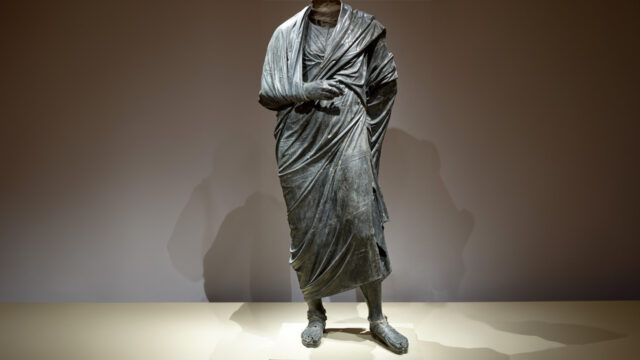
DRAPED Male Figure was held by the Cleveland Museum of Art since 1986, but it was seized by Manhattan District Attorney Alvin Bragg’s office in August as part of an investigation into more than a dozen pieces of artwork and antiquities looted from an archaeological site in Bubon in Turkey in the 1960s. — CLEVELANDART.ORG

A HEADLESS bronze statue that is more than 2,000 years old and worth $20 million is at the center of a legal fight between the Cleveland Museum of Art and Manhattan District Attorney Alvin Bragg, who has led a crackdown in New York on stolen antiquities he wants returned to their countries of origin.

The piece, titled Draped Male Figure, was held by the Cleveland museum since 1986, but it was seized by Mr. Bragg’s office in August as part of an investigation into more than a dozen pieces of artwork and antiquities looted from an archaeological site in Bubon in Turkey in the 1960s.

The museum, which says it acquired the statue from an art gallery in New York in 1986 for $1.85 million, sued Mr. Bragg on Thursday last week in federal court in Ohio to regain possession, arguing that available evidence was insufficient to connect the sculpture to Turkey. Bragg wants it repatriated.

In its complaint, the museum said it “does not question that the New York District Attorney sometimes gets it right and returns true stolen property to foreign nations. Based on the evidence adduced thus far and the opinions of experts available to the Museum, this is not one of those times.”

The dispute comes more than a decade since the government of Turkey asked museums in the US to return dozens of artifacts and works of art it claims were stolen from archaeological sites. Since Bragg took office last year, his office’s Antiquities Trafficking Unit says it has recovered and returned more than 1,000 items valued at more than $217 million to 27 countries.

“We are reviewing the museum’s filing in this matter and will respond in court papers,” said Doug Cohen, a spokesman for the district attorney.

Todd Mesek, a spokesman for the Cleveland museum, said it “takes provenance issues very seriously,” but declined further comment on the litigation.

Draped Male Figure is believed to depict Roman emperor and philosopher Marcus Aurelius, and was probably sculpted between 150 BCE and 200 CE. The statue is a male figure wearing flowing robes, with one arm in front of his body and the other tucked behind his back.

The piece was seized “in place” in August, meaning the physical statue remains at the museum — but not on display. In the lawsuit, lawyers for the museum asked a federal judge to declare the museum to be the lawful owner of the piece.

The case is Cleveland Museum of Art v. Alvin Bragg, 23-cv-02048, US District Court, Northern District of Ohio (Eastern Division). — Bloomberg

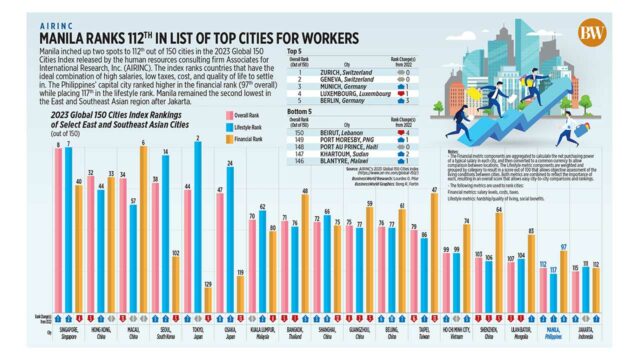
AIRINC: Manila ranks 112th in list of top cities for workers

Manila inched up two spots to 112th out of 150 cities in the 2023 Global 150 Cities Index released by the human resources consulting firm Associates for International Research, Inc. (AIRINC). The index ranks countries that have the ideal combination of high salaries, low taxes, cost, and quality of life to settle in. The Philippines’ capital city ranked higher in the financial rank (97th overall) while placing 117th in the lifestyle rank. Manila remained the second lowest in the East and Southeast Asian region after Jakarta.


AIRINC: Manila ranks 112th in list of top cities for workers

Schools need to ban cellphones

RACOOL STUDIO-FREEPIK

ASK ANY PARENT about the time their kids spend on mobile devices, and you’ll likely hear the same refrain: It’s too much. Excessive use of smartphones and social media is linked to rising rates of teenage depression and self-harm, while also damaging students’ academic performance and exacerbating achievement gaps. At this point, the question isn’t whether phones should be banned from classrooms, but why more schools haven’t done so already.

Evidence about the negative effects of mobile devices on learning is overwhelming. Large-scale international assessments have shown that anything beyond limited use of technology in the classroom harms academic performance. A 14-country study cited in a UN report this year found that merely being in proximity to smartphones disrupted learning for all ages, from preschool to college, with poorly performing students suffering the most.

Prompted by findings like these — and common sense — the British government announced this month that it will instruct schools to prohibit the use of mobile phones during the school day. Other European countries, including the Netherlands and France, have imposed similar bans. Such policies can be challenging to enforce, but in places that have followed through the gains have been striking. Bans on phones in two regions in Spain improved math test scores by the equivalent of more than half a year’s learning. A 2022 analysis of more than 100 Norwegian middle schools found that banning phones boosted students’ grades and test scores and increased their likelihood of attending an advanced high school. It also yielded bigger academic improvements than far more expensive policies, such as reducing class sizes or putting more computers in schools.

Despite these clear benefits, US schools seem to be moving in the wrong direction. As of 2020, 76% of public schools said that they prohibited the “non-academic” use of phones during school hours, down from more than 90% a decade earlier. By all indications, those restrictions are widely flouted. In response to a surge in smartphone use during the pandemic — fueled partly by misguided school closures — some districts appear to have abandoned even token efforts to keep devices out of kids’ hands. A survey released last month found that 97% of US adolescents say they use their devices during the school day, for a median of 43 minutes — with most of that time spent on social media, YouTube, and video games.

Arresting this trend is critical to helping students recover lost ground and avoid permanent blight to their careers and life prospects. European-style national bans would be unworkable in the US, where schools are controlled locally. But policy makers should emphasize the urgency of the issue. State legislatures should press schools to ban the use of phones for the duration of the school day, including during passing periods and recesses — and to confiscate them, if necessary. They should provide incentives to districts that demonstrate academic gains after imposing school-wide bans. They should also help schools pay for things like electronics-storage pouches and phone lockers.

Schools will no doubt get an earful from parents who oppose such bans. While acknowledging legitimate anxieties — such as how to reach a student during a crisis — they should hold firm and explain that emergency-contact protocols are more than sufficient.

It’s by now incontrovertible that, however essential to modern life, smartphones have no place in the classroom. The sooner schools remove them, the better off students will be.

BLOOMBERG OPINION

Boulevard Holdings says Boracay Beach Resort to welcome guests by 2026

LISTED Boulevard Holdings, Inc. (BHI) said its Boracay Beach Resort is expected to welcome guests by 2026 as a company’s subsidiary signed a license agreement to market the development as a property under the Radisson Collection brand. 

In a regulatory filing on Tuesday, BHI said its subsidiary Friday’s Holdings, Inc. forged an agreement with Radisson Hotels Asia Pacific Investments Pte. Ltd. on Oct. 20 to market the Boracay resort as part of its lifestyle luxury brand.

“Friday’s Boracay Beach Resort is expected to welcome our new and returning guests by 2026,” BHI said, adding that demolition is currently going on.

The resort stopped operations in March 2020 due to the coronavirus disease 2019 (COVID-19) pandemic.

Once built, BHI expects the resort to be one of the first five-star hotels to be aided by an international hotel brand on Boracay’s white beach.

According to BHI, Friday’s Holdings is set to build a new hotel that features about 110 room keys, two to four restaurants and bars, a jungle gym, an infinity pool with a lap pool, and a beach wedding pavilion. 

BHI said Friday’s Boracay is well-known “as it is perfectly positioned on Boracay’s eye-catching white beach and offers modern amenities with a natural charm” of a beachfront setting to make it one of the country’s most sought-after vacation spots.

Radisson Hotels Asia Pacific is an international hotel group with 10 brands and more than 1,160 hotels in operation and under development in Europe, the Middle East, Africa, and Asia-Pacific. — Revin Mikhael D. Ochave

ADVERTISEMENT
ADVERTISEMENT