Home Blog Page 3911

Bakery ‘prison’ uncovered in Ancient Rome’s Pompeii

POMPEII: PRISON BAKERY EMERGES - Pompeii Sites —POMPEIISITES.ORG

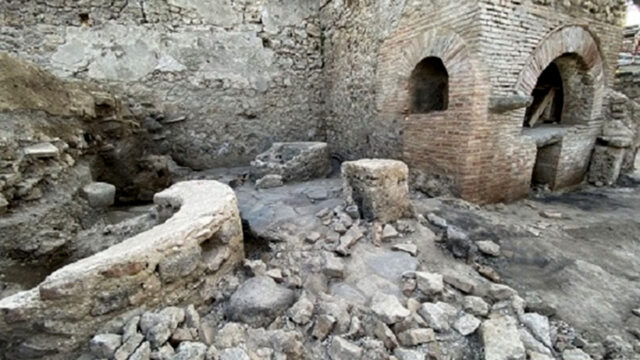
ROME — Archaeologists in the ancient Roman city of Pompeii have discovered a “bakery-prison” where slaves and donkeys were locked up to grind the grain needed to make bread, the archaeological site said on Friday.

A cramped room with no view of the outside world and small windows high in the wall with iron bars was uncovered during the excavations, which are part of a larger project to secure the slopes around the unexplored areas of the city.

Indentations in the floor coordinated the movement of the animals who were forced to walk around blindfolded for hours, the archaeological park statement said.

“It is a space in which we have to imagine the presence of people of servile status… it is the most shocking side of ancient slavery” and its “brute violence,” said Pompeii’s director Gabriel Zuchtriegel.

The bakery was part of the working quarters of a large house whose residential area was decorated with well-preserved frescoes.

Archaeologists discovered in August a small bedroom in a Roman villa near Pompeii that was almost certainly used by slaves, throwing light on their condition in the ancient world.

Pompeii and the surrounding countryside were covered by volcanic ash when Mount Vesuvius exploded in AD 79, killing thousands of Romans who had no idea they were living beneath one of Europe’s biggest volcanoes.

The eruption buried the city in a thick layer of ash, preserving many of its residents and buildings.

The site has seen a burst of recent archaeological activity aimed at halting years of decay and neglect, largely thanks to a recently concluded €105-million ($113 million) European Union-funded project. — Reuters

Christmas bonus

LIFEFORSTOCK-FREEPIK

Aegis’ “Christmas Bonus” is arguably one of the most popular Christmas songs in the country. It was released more than 20 years ago in 2000 by the Filipino pop-rock band; and since then the song has become a staple in every Filipino worker’s Billboard’s top Christmas hits, even antedating and at times out-performing Jose Mari Chan’s “Christmas In Our Hearts.” Every working person in the country can relate to the song; its core message hits straight to their hearts.

The song goes: “Sa t’wing darating ang Kapaskuhan Ang Christmas bonus, ating inaasahan; Sa mga kumpanyang pinagtatrabahuhan; Tunay natin itong kailangan; Kaya’t ibigay n’yo na ang aming Christmas bonus; Pati na ang 13th month pay para lahat, okay na okay.” (When the Christmas season comes, the Christmas bonus, we expect; To the companies we are employed in; We really need it; So give us our Christmas bonus; Even the 13th month pay so that everyone is truly okay.)

The Christmas bonus, as the lyrics say, is an expected (inaasahan) pay-out, but is it legally demandable? Aegis offers a vague answer: “Kaya’t ibigay nyo na…,” which could mean either just a mere request or a forceful legal demand. Which is which? As my students in law school would say, almost always inaudibly and at times interrogatively — “Sir, it depends?” It is correct though. The answer is — it could be either, depending on the circumstances.

The grant of a bonus in general is a management prerogative which cannot be forced upon the employer. It is something given in addition to what is ordinarily received by or strictly due the recipient. By its very definition and nature, a bonus is a gratuity or act of liberality of the giver, to which the recipient has no right to make a demand (Kamaya Point Hotel vs. NLRC, 1989).

The grant of a bonus, being a management prerogative, is not a demandable and enforceable obligation, except when the bonus is made part of the wage, salary, or compensation of the employee (Protacio vs. Laya Mananghaya, 2009) or it must have been promised by the employer and expressly agreed upon by the parties, or it must have had a fixed amount and had been a long and regular practice on the part of the employer, which then comes within the purview of the non-diminution of benefits principle under Article 100 of the Labor Code (American Wire Daily Employees Union vs. American Wire, 2005).

Whether or not a bonus forms part of wages depends upon the circumstances or conditions for its payment. If it is an additional compensation which the employer promised and agreed to give without any conditions imposed for its payment, whether by policy or practice, such as success of business or greater production or output, then it is part of the wage. But if it is paid only if profits are realized or a certain amount of productivity achieved, it cannot be considered part of the wages (Atok-Big Wedge vs. Atok-Big Wedge Mutual Benefit Association, 1953).

The other two exceptions are subject to the same qualification — i.e., the grant must be deliberate, consistent, and unconditional. Note further that the non-diminution principle is not necessarily violated if there is a replacement benefit or even if the grant is modified. Thus, if, for instance, a company converts the grant from being fully guaranteed to partly guaranteed and partly conditional on business exigencies and merit, there is arguably no diminution of benefits as the bonus remains to be there. More so then, if it is from conditional on business success to partly conditional on business success and merits.

With respect to the 13th month pay, although usually identified with a Christmas bonus because of the proximity in the timing of the grant, it is altogether separate and different. While, in a loose sense, the 13th month pay is a bonus, unlike a Christmas bonus which depends on the benevolence of the employer, the 13th month pay is mandated by law (PD 851). However, it must be noted that only rank-and-file employees who have served the company for at least one month are entitled, by law, to the 13th month pay. Thus, supervisors and managers cannot, as a matter of legal right, demand the 13th month pay; but once unilaterally granted to them deliberately, consistently, and unconditionally over a long period of time, it becomes a vested right on their part and a demandable obligation on the part of the employer, pursuant to the principle of non-diminution of benefits.

We can always argue that a Christmas bonus, by its very nature, is inherently conditional; however, it is always best for employers to make it clear to the employees the terms and conditions for the grant of the bonus, for the avoidance of doubt and to maintain their flexibility to modify or altogether withdraw the grant of the same. There is a built-in bias under our labor laws for workers such that in case of doubt, the doubt is resolved in their favor (Labor Code, Article 4).

Stripped of legalese, for employers — ‘tis the season of giving and as cliché as it may sound, it is better to give than to receive. For employees — ‘tis also the season of understanding and gratitude, and whatever it is that your employer will give, as and by way of Christmas bonus, know that it is better to count your blessing instead of sheep. You may not laugh all the way to the bank, but nonetheless sing à la Aegis — “Kaya’t ibigay n’yo na; Ang aming Christmas bonus; Nang maging maligaya tayong lahat!” (So give it already; our Christmas bonus; so that we can all be happy!)

Maligayang Pasko!

The views and opinions expressed in this article are those of the author. This article is for general informational and educational purposes only and not offered as and does not constitute legal advice or opinion.


Neptali B. Salvanera is a partner of the Labor and Employment Department (LED) of the Angara Abello Concepcion Regala & Cruz Law Offices or ACCRALAW.

(632) 8830-8000

nbsalvanera@accralaw.com

SEC renews call for companies to seek amnesty by Dec. 31

THE Securities and Exchange Commission (SEC) has called on companies to avail of the regulator’s amnesty program less than three weeks before the Dec. 31 deadline to avoid hefty fines. 

In a statement on Tuesday, the SEC said that failure to seek amnesty would subject noncompliant and suspended, or revoked corporations to a new scale of fines that would be implemented starting Jan. 1 next year. 

Launched in March, the SEC’s amnesty program allows erring corporations to pay a reduced penalty for the late and nonfiling of their general information sheet (GIS), annual financial statement (AFS), and official contact details mandated under Memorandum Circular No. 28 series of 2020. 

Under the SEC’s amnesty program, noncompliant corporations would pay a P5,000 fixed amnesty rate regardless of the number of reports and number of years that they failed to submit their reports, while suspended and revoked corporations would only pay 50% of their total assessed fines on top of a P3,060 petition fee. 

Starting Jan. 1 next year, domestic stock corporations with retained earnings of less than P100,000 and domestic nonstock corporations with a fund balance or equity of less than P100,000 would incur a basic penalty of P5,000 for the first offense for the late filing of their GIS or AFS, which would increase to P9,000 when the corporations reach the fifth offense. An additional P1,000 would also be imposed for every month of continuing violation.

The SEC would also double the penalty for non-compliance to P20,000 from P10,000.

In October, the SEC issued two separate lists totaling over 320,000 ordinary corporations that were encouraged to apply for the amnesty program for their failure to submit their GIS within five years from the date of incorporation or failure to submit their GIS for three times consecutively or intermittently within five years.

“Such corporations are encouraged to avail of the amnesty program to avoid getting their corporate registrations revoked or getting tagged as delinquent. Availing of the amnesty will also allow them to continue enjoying the benefits and privileges of being a registered business in the Philippines,” the SEC said.

Meanwhile, the SEC said it would “strictly enforce” the submission of reportorial requirements and implement the corresponding monetary policies, placement of corporations under delinquency status, and suspension and revocation of a corporation’s certificate of incorporation in accordance with Republic Act No. 11232 or the Revised Corporation Code, once the new scale of fines is implemented. — Revin Mikhael D. Ochave

Philippine Merchandise Trade Performance (October 2023)

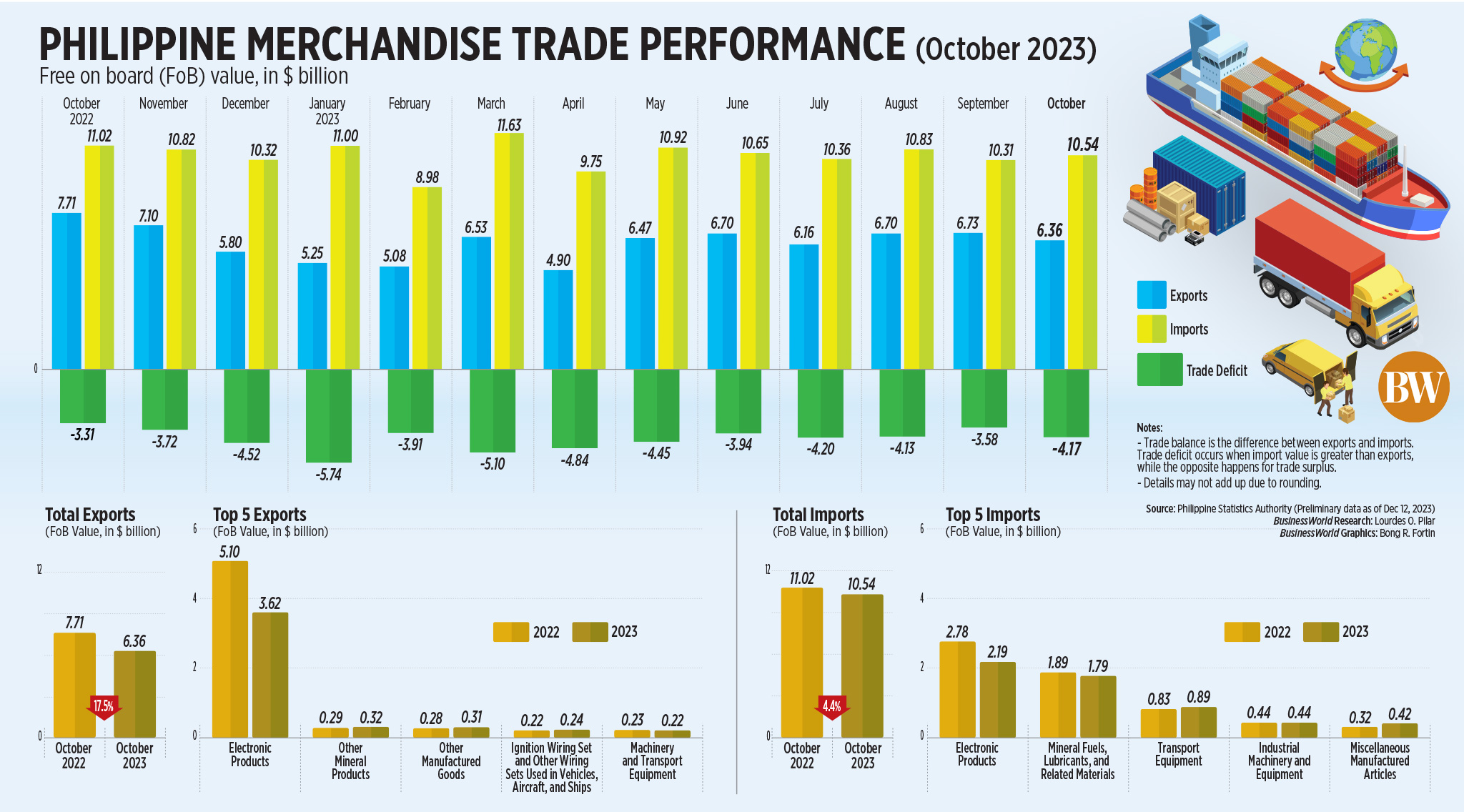
THE Philippines’ trade-in-goods deficit widened to a three-month high of $4.17 billion in October, as exports declined by double digits amid sluggish global demand. Read the full story.

Philippine Merchandise Trade Performance (October 2023)

How PSEi member stocks performed — December 12, 2023

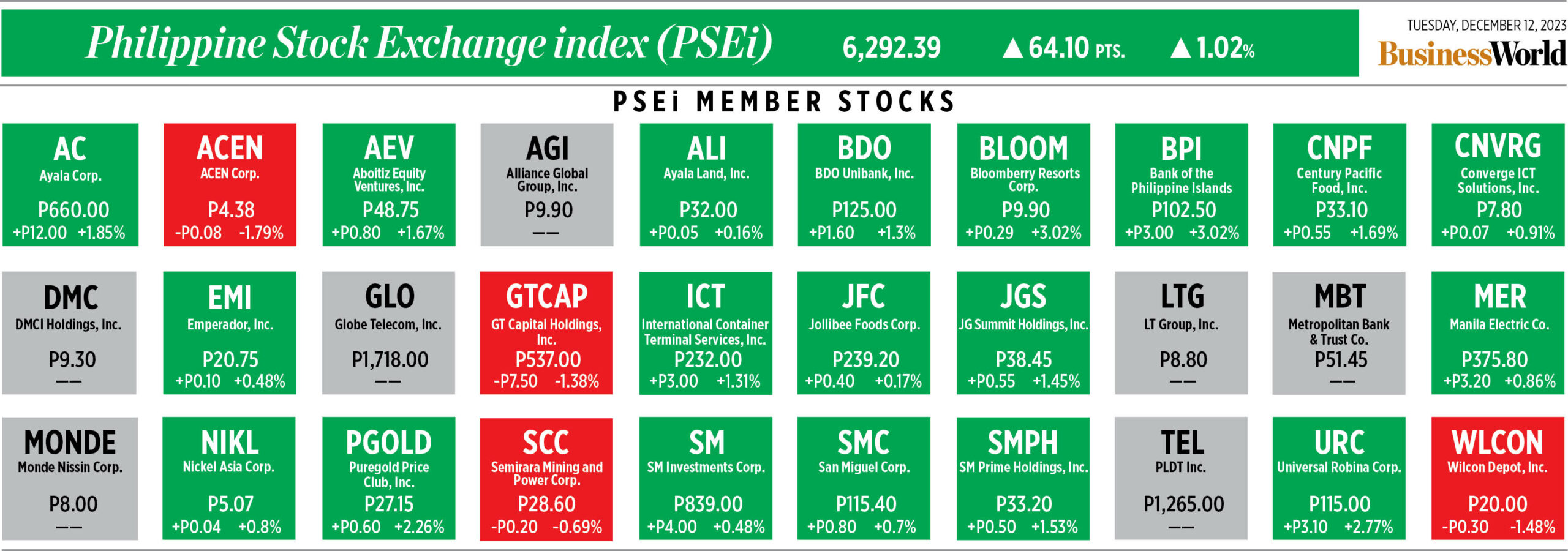
Here’s a quick glance at how PSEi stocks fared on Tuesday, December 12, 2023.


Peso rebounds before key US data

BW FILE PHOTO

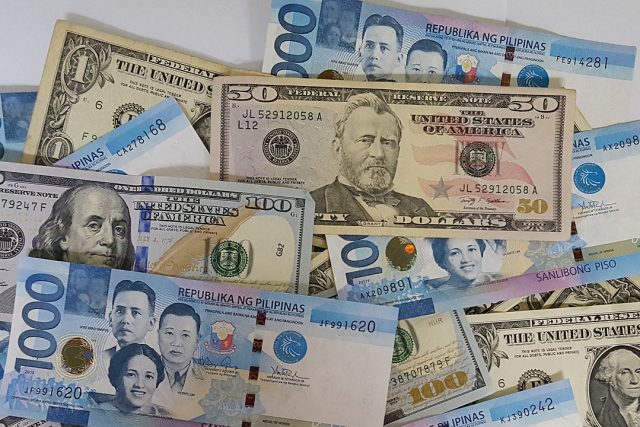
THE PESO strengthened anew against the dollar on Tuesday ahead of the release of the November US consumer inflation data overnight.

The local unit closed at P55.57 per dollar on Tuesday, rising by eight centavos from the near one-month low finish of P55.65 on Monday, data on the Bankers Association of the Philippines’ website showed.

The peso opened Tuesday’s session stronger at P55.60 against the dollar. Its intraday best was at P55.55, while its weakest showing was at P55.65 versus the greenback.

Dollars exchanged rose to $1.005 billion on Tuesday from $888.88 million recorded on Monday.

“The peso appreciated amid potentially a softer US consumer inflation report for November 2023,” a trader said in an e-mail.

The dollar slightly ahead of the release of November US consumer inflation data, Rizal Commercial Banking Corp. Chief Economist Michael L. Ricafort said in a Viber message.

The November US consumer price index (CPI) report was set to be released overnight.

In October, the US CPI was unchanged for the first time in more than a year following a 0.4% rise in September.

In the 12 months through October, the CPI was up by 3.2% after climbing by 3.7% in September.

The peso was also supported by the rollback in local fuel and energy prices, as it could help bring down inflation to the Bangko Sentral ng Pilipinas’ (BSP) 2-4% annual target, Mr. Ricafort added.

Headline inflation rose by 4.1% year on year in November, easing from the 4.9% in October and 8% in November 2022.

This was the slowest rate in 20 months or since the 4% seen in March 2022.

In the 11 months through November, headline inflation averaged 6.2%, faster than 5.6% in the same period last year. This is still above the BSP’s 2-4% goal.

For Wednesday, the trader said the peso could climb further as the Federal Reserve starts its two-day policy meeting.

The trader sees the peso moving between P55.40 and P55.64 per dollar on Wednesday, while Mr. Ricafort expects it to range from P55.45 to P55.65.

PSEi rises before US CPI data, policy meetings

BW FILE PHOTO

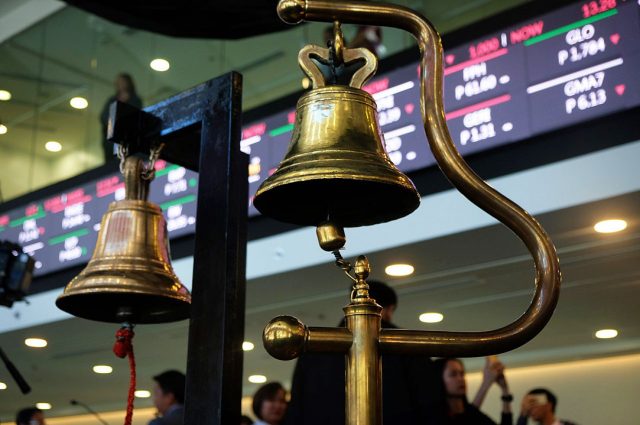
PHILIPPINE STOCKS rose on Tuesday to end a three-day skid as investors await the release of November US consumer price index (CPI) data and the policy meetings of the US Federal Reserve and the Bangko Sentral ng Pilipinas (BSP).

The bellwether Philippine Stock Exchange index (PSEi) climbed by 64.10 points or 1.02% to end at 6,292.39 on Tuesday, while the broader all shares index jumped by 25.81 points or 0.77% to close at 3,353.46. 

“The index surged on market-on-close buying as traders continued to position ahead of the release of US November inflation data as well as the much-awaited policy meetings of the Federal Reserve and Bangko Sentral ng Pilipinas,” China Bank Capital Corp. Managing Director Juan Paolo E. Colet said in a Viber message.

“This Tuesday, the local market rose… as investors took positive cues from Wall Street overnight amid expectations that US inflation further slowed down in November. Additionally, the anticipation that both the Federal Reserve and the BSP will be holding key policy rates amid cooling inflation in the US and at home contributed to the climb,” Philstocks Financial, Inc. Research and Engagement Officer Mikhail Philippe Q. Plopenio said in a Viber message.

The November US CPI report was set to be released overnight.

Meanwhile, the Fed will hold its final review for the year on Dec. 12-13, while the BSP’s Monetary Board will meet to discuss policy on Dec. 14.

The US central bank is widely expected to keep its target rate at the 5.25%-5.5% range for a third straight meeting this week.

It has hiked rates by a cumulative 525 basis points (bps) since it began its tightening cycle in March 2022.

On the other hand, a BusinessWorld poll last week showed 15 out of 17 analysts expect the Monetary Board to keep its target reverse repurchase rate steady at a 16-year high of 6.5% on Thursday, with the BSP remaining vigilant amid lingering risks to prices despite easing inflation recently.

The BSP has raised benchmark interest rates by a cumulative 450 bps since May 2022.

All sectoral indices closed higher on Tuesday. Financials went up by 25.76 points or 1.54% to 1,698.23; property rose by 24.53 points or 0.88% to 2,786.97; holding firms climbed by 50.94 points or 0.85% to 6,007.55; services increased by 12.21 points or 0.79% to 1,549.91; industrials added 56.92 points or 0.65% to end at 8,795.41; and mining and oil gained 21.33 points or 0.22% to close at 9,565.27. 

Value turnover dropped to P3.25 billion on Tuesday with 314.76 million shares changing hands from the P4.06 billion with 392.39 million issues seen on Monday. 

Advancers beat decliners, 97 to 61, while 55 names closed unchanged. 

Net foreign buying stood at P158.02 million on Tuesday versus the P32.81 million in net selling posted on Monday. — R.M.D. Ochave

North-South rail expected to start operating in 2027 — DoTr

JICA

THE Department of Transportation (DoTr) said it is hoping to begin partial operations of the North-South Commuter Railway (NSCR) by 2027.

In a statement, Philippine National Railways (PNR) General Manager Jeremy S. Regino said the construction of the Tutuban-Malolos (N1) and Malolos-Clark (N2) segments are on schedule, with full operations set for 2029. 

Partial operations of the Malolos, Bulacan to Clark, section of the NSCR project were initially scheduled for 2026, according to the PNR website.

The DoTr said that the partial operations from West Valenzuela to Malolos are expected to begin by the second quarter of 2027, while full operations will likely start in the third quarter of 2029.

The DoTr said right-of-way has been obtained by the contractor for four out of the six stations.

The 147-kilometer NSCR will connect Malolos, Bulacan with Clark International Airport, and Tutuban, Manila with Calamba, Laguna. 

The P873-billion project is being co-financed by the Japanese International Cooperation Agency and the Asian Development Bank. It will have 35 stations and three depots.

Once fully operational the entire NSCR system is projected to reduce travel time between Clark and Calamba to two hours, against the current four to 4.5 hours. — Ashley Erika O. Jose

Visitor arrival target set at 7.7 million for 2024

PIXABAY

THE Department of Tourism said on Tuesday that it hopes to attract 7.7 million international visitors and book at least P440 billion in tourist receipts next year.

“We have now recovered 95% of our visitor receipts (from) international arrivals and in conjunction with our 7.7 million target for international visitors for 2024, we are hopeful that we can reach the P440 billion mark next year for international receipts,” Tourism Secretary Maria Esperanza Christina G. Frasco said.

The 2024 target of at least P440 billion in tourist receipts would match the actual total for the year to date as of Dec. 12, 2023

“I understand that this is not yet our pre-pandemic number of over 8.2 million international arrivals, but what I can assure you is that we will push as hard as we can and fully activate our convergences with other government agencies in order to reach this target and bring us closer to pre-pandemic numbers,” she said.

Citing the United Nations World Tourism Organization, Ms. Frasco said that the Philippines posted a tourism industry recovery rate of 65.54%, exceeding the Asia and the Pacific average of 62% in the first nine months.

As of Dec. 12, the Philippines recorded 5.07 million international visitor arrivals.

“With the holiday break fast approaching we are confident that we will further reach the target that was set this year at 4.8 million international arrivals, underscoring our commitment to continuous growth and transformation in Philippine tourism,” Ms. Frasco said.

Asked whether 5.5 million international arrivals is achievable this year, she said: “It’s a moving target, as they say. And we’re hopeful that with the holiday rush, our international arrivals will be a little over 5 million.”

In the year to date as of Dec. 12, the top source market of international arrivals was South Korea which accounted for 1.34 million visitors.

Rounding up the top five source markets were the US (836,694), Japan (285,655), China (252,171), and Australia (238,487).

Ms. Frasco said that she has requested more direct flights to and from Italy and the UK.

“We have proposed this to Philippine Airlines and we’re hopeful that the organization will be able to provide the flights because they are in high demand,,” Ms. Frasco said.

She added that the department is also batting for more direct flights to the US and Europe.

“Meanwhile, we have also been in close collaboration with our international aviation partners that have actually added more flights to the country not just to Manila, but also to Cebu and Davao for certain international airlines,” she added. — Justine Irish D. Tabile

Palace orders agencies to prepare plans to mitigate El Niño impact

PHILSTAR FILE PHOTO

PRESIDENT Ferdinand R. Marcos, Jr. has ordered the Department of Science and Technology, the Department of National Defense, and other agencies to prepare programs that will mitigate the impact of El Niño, which will bring about a dry spell that is expected to last until the second quarter of 2024.

Science and Technology Secretary Renato U. Solidum, Jr. said at a Palace briefing on Tuesday that the National Action Plan for El Niño “will include a comprehensive strategy covering water security, food security and energy security.”

Mr. Solidum said its part of the plan, which will be executed with the Office of Civil Defense and the government weather service, known as PAGASA (Philippine Atmospheric, Geophysical and Astronomical Services Administration), seeks to minimize power interruptions and the outbreak of illnesses resulting from the weather phenomenon.

He said moderate to severe drought conditions are likely to occur between February and May.

In a Dec. 6 advisory, PAGASA said a strong El Niño has intensified in the Tropical Pacific, with sea temperature anomalies exceeding 1.5 degrees centigrade from normal levels.

Mr. Solidum said that 77% of the provinces in the country might experience drought, while 65% of the provinces may see a dry spell.

PAGASA defines a drought as three consecutive months of below-normal rainfall or two straight months of significantly below-normal rainfall. A dry spell means two straight months of below-normal rainfall.

At a meeting with the President on Tuesday, Defense Secretary Gilberto C. Teodoro, Jr. presented an online database on the impact of El Niño, state-run Radio Television Malacañang said in a Facebook post.

“We need to further intensify our efforts to make sure that we are ready for this, especially in the various fields that were already mentioned like health, water, agriculture, sanitation, and of course, peace and order; and we also need to involve everyone in this effort,” Mr. Solidum said. — John Victor D. Ordoñez

PHL 9-month metal output value rises by 7.28% on high nickel prices

BW FILE PHOTO

METAL production rose 7.28% year on year by value to P189.08 billion in the nine months to September, according to the Mines and Geosciences Bureau (MGB).

In a report, the MGB said nickel ore and other nickel byproducts accounted for 47.6% of the total, generating P89.99 billion during the period.

By volume, nickel direct shipping ore rose 24.08% year on year to 28.9 million dry metric tons (DMT), valued at P53.54 billion.

“Caraga, the nickel capital of the Philippines, accounted for 62% with 17.75 million DMT, followed by Mimaropa with about 15% or 4.43 million DMT, while Regions VIII and III accounted for about 14% or 3.94 million DMT and 9% or 2.53 million DMT, respectively,” it said.

Prices for nickel ore declined to $10.39 per pound during the period from $11.97 per pound a year earlier.

Gold accounted for 41.07% of metal output by value during the period with P77.65 billion. It was followed by copper at P18.79 billion and the combination of silver, chromite, and iron at P2.64 billion.

The price of gold increased 5.78% or $105.6 from a year earlier to $1,932.07 per troy ounce.

“The increased interest in gold investment brought about by the continued high inflation rate together with the economic slowdown pushed prices of these metals higher,” the MGB said citing analysts.

Gold production increased to 22,935 kilograms (kg) for the nine-month period.

Cagayan Valley accounted for 21% or 4,829 kg of the gold produced, followed by Bicol with 20% or 4,601 kg, and Davao region with 2,062 kg.

The average price of copper during the period fell to $3.9 per pound from $4.12 a year earlier.

The production of copper rose 2% to 195,533 DMT, with increased production accompanied by a decline in value to P18.79 billion.

Carmen Copper Corp. accounted for 56% of the total. The company reported an 11% increase in volume to 110,252 DMT.

“Both Philex Mining Corp. and OGPI (OceanaGold Philippines, Inc.) sustained production shortfalls of 11% and 3%, respectively,” the report said.

Silver prices rose 7.32% to $23.55 per troy ounce. Output fell 14% to 35,784 kg.

“Backed up by industrial demand in the solar sector, the price of silver, on the other hand, is projected to stay high,” it added.

Iron ore production rose 37% to 78,213 DMT, while chromite output grew to 67,877 DMT during the period.

The MGB said that due to the shift to renewable technology, critical minerals like gold, nickel, cobalt, copper, and iron, will continue to be in demand.

“Founded on this premise the outlook for the mining industry remains strong,” it added.

Asked to comment, Rizal Commercial Banking Corp. Chief Economist Michael L. Ricafort said that the supply chain for renewable energy and electric vehicles will continue to drive growth in the metallic minerals industry.

“Demand will be sustained by the shift towards renewable power from coal and other petroleum power sources amid the commitment by more companies and countries to reduce carbon emissions… these will sustain demand for mineral resources used as inputs,” Mr. Ricafort said in a Viber message.

Regina Capital Development Corp. Head of Sales Luis A. Limlingan said that the recovery of the Chinese economy will drive demand for critical minerals.

“Many will be watching whether China’s economy can recover heading into next year as they are one of the world’s major consumers and drivers of demand for metal prices,” Mr. Limlingan said in a Viber message.

The MGB also said that due to domestic nickel supply concerns in Indonesia, Chinese demand for nickel ore from the Philippines will rise.

It added that it expects 12 projects to start within the next six months, which could further boost exports given the high demand in global markets. — Adrian H. Halili


Supply of noche buena items sufficient for holidays — DTI

PHILSTAR FILE PHOTO/KNORR RELEASED

THE Department of Trade Industry (DTI) said the supply of items typically served in the Christmas feast — known in the Philippines as Noche Buena — will be adequate until the end of the holidays.

The DTI released this assessment of supply-demand conditions after meeting with the manufacturers on Monday.

“As part of our commitment to ensure that Noche Buena items remain affordable and of good quality this holiday season, we are intensifying our price monitoring efforts all over the country,” Trade Secretary Alfredo E. Pascual said in a statement on Wednesday.  

“Through this meeting with manufacturers, we aim to assure consumers that the DTI remains at the forefront of ensuring that the rights of consumers are protected,” he added.

The meeting was initially called to address reports of certain Christmas food products being sold above the prices indicated in the DTI’s Noche Buena price guide.

These include the Edam-style cheese product known as queso de bola, fruit cocktail, ham, all-purpose cream, and mayonnaise, the DTI said.

“In response, the manufacturers agreed to verify with their retail partners to address this concern,” the department said. 

“Further, some manufacturers in the meeting committed to intensify their own price and supply monitoring efforts to ensure that their products are sold in accordance with the Noche Buena price guide until the end of the year,” it added.

The DTI said manufacturers had confirmed the sufficiency of supply of Noche Buena items at a previous meeting.

“The manufacturers assured DTI of the sufficient supply and stability of prices during their meeting held on Nov. 7 prior to the release of the price guide,” the department said.

Mr. Pascual also called on manufacturers and retailers to adhere to the price guide, adding: “That is what the price guide is for — that consumers will be informed so they may exercise their right to choose.”

“I also instructed our price monitors to ramp up their activities,” he added. — Justine Irish D. Tabile

ADVERTISEMENT
ADVERTISEMENT