Home Blog Page 3892

Actor Matthew Perry died from ‘acute effects of ketamine’

Matthew Perry in a scene from Friends. — IMDB

LOS ANGELES — Friends star Matthew Perry died from the “acute effects” of the powerful sedative ketamine that, combined with other factors, caused the actor to lose consciousness and drown in his hot tub, according to an autopsy released on Friday.

The report from the Los Angeles County Medical Examiner came nearly seven weeks after Mr. Perry, 54, who publicly acknowledged decades of drug and alcohol abuse, was found by his live-in assistant floating face down and lifeless in the jacuzzi of his Los Angeles home.

Toxicology tests found ketamine, a short-acting anesthetic with hallucinogenic properties, in Mr. Perry’s body at high levels well within the range typically associated with general anesthesia used in monitored surgical care, the report said.

“Matthew Perry’s cause of death is determined to be from the acute effects of ketamine,” the autopsy concluded.

Coronary artery disease, the effects of the opioid-addiction medicine buprenorphine, also detected in his system, and drowning were listed as contributing factors in his death, which was ruled an accident.

The concentrations of ketamine in Mr. Perry’s body would have overstimulated his heart rate while depressing his breathing, likely leading him to lapse into unconsciousness before his face slipped below the water in the hot tub, the report said.

“The exact method of intake in Mr. Perry’s case is unknown,” the report said, adding that trace amounts of the drug showed up in his stomach. No recent needle marks were found on his body, it said.

Referred to as a “dissociative anesthetic hallucinogen” because it produces a feeling of detachment from pain, anxiety and the environment, ketamine can be injected, mixed with liquids, snorted as a powder, or smoked, according to the US Drug Enforcement Administration.

Autopsy findings suggested Mr. Perry may have been self-medicating with ketamine between medically supervised treatments with the drug.

According witness interviews cited in the report, Mr. Perry had been undergoing ketamine infusion therapy for depression and anxiety. But his last known treatment was a week and a half before his death, so the ketamine found in his system by medical examiners would have been introduced since that last infusion, the report said.

Mr. Perry’s Oct. 28 death came one year after publication of his memoir, Friends, Lovers, and the Big Terrible Thing, which chronicled his decades-long bouts with addiction to prescription painkillers and alcohol, a struggle he said came close to ending his life more than once.

Mr. Perry, best known for his role as Chandler Bing on the 1990s hit television sitcom Friends, had been sober for 19 months with no known substance abuse relapses before his death, according to interviews cited in the autopsy.

Investigators found no alcohol, illicit drugs or drug paraphernalia at scene of his death. Multiple nicotine vaping products and an inhaler were found in Mr. Perry’s living room. Injectables of the anti-diabetes medication tirzepatide and nicotine lollipops were in the refrigerator.

The actor had stopped smoking two weeks earlier, had been prescribed Tamoxifen — a hormone regulator usually taken for breast cancer prevention — for weight loss, and was receiving testosterone shots, the report said.

Non-toxic levels of some prescription medications were detected in Mr. Perry’s body, but no traces of alcohol, cocaine, heroin or other illegal narcotics were found, the report said.

As was widely reported since, Mr. Perry had played pickleball hours before his death, and a witness who knew the actor told investigators he seemed to be in “good spirits” when she last spoke with him days earlier, the report said. — Reuters


UHC: Health for all

SASUN BUGHDARYAN-UNSPLASH

Universal Health Coverage Day (UHC Day) is commemorated on Dec. 12 of every year. Spearheaded by the World Health Organization (WHO), the annual observance aims to celebrate the progress towards health for all and raise awareness on the need for strong and resilient health systems in achieving universal health coverage.

For UHC Day 2023, the WHO seeks to revitalize commitments towards accelerating UHC as countries recover from the devastating economic and social impacts of the COVID-19 pandemic. The agency noted that countries in the Western Pacific Region have made significant progress on the UHC service coverage index, which measures population coverage of essential health services based on tracer interventions that include reproductive, maternal, child health, infectious diseases, noncommunicable diseases and service capacity and access.

This year’s UHC Day theme is “Health for All: Time for Action,” emphasizing the need for immediate and tangible steps in creating the world we want. It calls for reflection on a decade of progress, challenges, and opportunities in advancing UHC. The campaign urges leaders to enact policies that guarantee equitable access to essential health services without financial hardship. It will also build on the momentum and outcome from the second United Nations High-Level Meeting on UHC in September 2023 — a renewed action-oriented political commitment that will refocus political attention and financial investments on accelerating progress.

While the index increased from 51 to 80 between 2000 to 2019, financial protection in the Region worsened during the same period as more households face catastrophic health expenditures or out-of-pocket payments above what they can afford. In 2000, one in 10 families faced catastrophic health expenditures in the Western Pacific. Today, one in five families cannot afford care. Across and within countries, persisting inequities in service coverage and financial hardship remain, which were further exacerbated by the pandemic, the WHO stated.

The Universal Healthcare Act is the first legislation of its type in the Western Pacific Region. The landmark law automatically enrolls all Filipino citizens in the National Health Insurance Program and prescribes complementary reforms in the health system. When fully implemented, it will give Filipinos access to the full continuum of health services they need, while protecting them from enduring financial hardship as a result.

The biopharmaceutical industry supports the WHO’s call for governments to “prioritize investments in health, and implement effective policies to protect the poorest and most vulnerable” to achieve universal health coverage for all people and reduce catastrophic health spending.

The Pharmaceutical and Healthcare Association of the Philippines (PHAP), representing the research-based pharmaceutical industry in the country, commits to continue working with the government for the full implementation of the UHC Act and the National Integrated Cancer Control Act (NICCA) that both have provisions to make healthcare and medicines more accessible.

PHAP recommends that to reduce private individual out-of-pocket spending, there is a need to increase public health spending and embed access to medicine programs at all levels of care. When these are employed by governments, private share in medicine spending is reduced to below 50%. Examples of these countries with reduced private share in medicines are Australia at 47%, Malaysia at 46%, South Korea at 42%, the United Kingdom at 41%, New Zealand at 32%, and Thailand at just 9%.

The implementation of medicine access strategies such as pooled procurement, introduction of outpatient drug benefit packages, and the use of value-based and risk-sharing agreements can be enabled by having increased and dedicated funding for medicines.

The innovative pharmaceutical industry also stands with the government and all key stakeholders in ensuring the full implementation of the UHC Act so that no Filipino is left behind in terms of access to health services and financial protection. As a key member of the UHC2030 Private Sector Constituency (PSC), we are strongly supportive of the PSC statement on private sector commitments drawing from the Action Agenda. The Action Agenda is a set of action-oriented policy recommendations aimed at country leaders to strengthen resilient and equitable health systems, advance universal health coverage and health security, and deliver health for all by 2030.

In line with the UHC2030 PSC statement, the industry is committed to incorporate UHC principles, including to leave no one behind, into our business; deliver innovations that respond to the needs of all people including underserved populations, and make these safe, affordable, accessible, and sustainable. There is also commitment to help strengthen the health workforce, responding to local context, priorities and needs; contribute to efforts to raise the finance available for UHC; and champion and engage in multi-stakeholder policy dialogues that advance UHC.


Teodoro B. Padilla is the executive director of Pharmaceutical and Healthcare Association of the Philippines (PHAP). PHAP represents the biopharmaceutical medicines and vaccines industry in the country. Its members are in the forefront of research and development efforts for COVID-19 and other diseases that affect Filipinos.

Jetour Ice Cream EV up for grabs in Megaworld raffle

PHOTO FROM JETOUR AUTO PHILIPPINES

JETOUR AUTO PHILIPPINES and Megaworld Lifestyle Malls have partnered for a Christmas promo that gifts a brand-new Jetour Ice Cream electric vehicle to a lucky shopper through the “Megaworld 12 Gifts of Christmas” raffle.

From Dec. 11 to 22, 2023, shoppers at Megaworld’s Southwoods Mall who make a single or accumulated purchase of P2,000 at any of its stores will be entitled to one raffle coupon. There will be 12 raffle prizes, with winners to be drawn on Dec. 23.

“Jetour and Megaworld’s desire to bring cheer and joy this Christmas season goes beyond the holidays as we begin a new chapter of cooperation between our brands,” shared Jetour Auto Philippines Managing Director Miguelito Jose. “Throughout 2024, Megaworld patrons will see more of Jetour’s stunning and desirable lineup at Lifestyle Malls. By bringing Jetour closer to the car buyer, we are making it easier for more Filipinos to drive home a sustainable mobility partner that will support their lifestyles.”

The Jetour Ice Cream EV will also be displayed at the ground level of Megaworld Southwoods Mall and the Venice Grand Canal Mall at Upper McKinley Hill in Taguig City from Dec. 11 to 23, as part of the “Megaworld 12 Gifts of Christmas” promotion.

The Jetour Ice Cream EV is a proper four-seat, city-based, everyday electric vehicle with comfort amenities such as air-conditioning, electric power steering, and contoured seats for four. It also has safety features such as a driver’s side air bag, an anti-lock braking system with electronic brakeforce distribution, three-point seat belts for all four passengers, Isofix mounting points, and a rear reversing camera. It has a range of up to 170 kilometers, and its 13.9-kWh lithium iron phosphate battery pack can be safely charged from zero to 100% at home in as little as eight hours using a standard household outlet.

At P699,000, the Ice Cream EV has a three-year/100,000-km vehicle warranty, and a “category-leading” eight-year/120,000-km battery pack warranty — not to mention “solid after-sales support” through Jetour Auto Philippines’ expansive 16-dealership nationwide network.

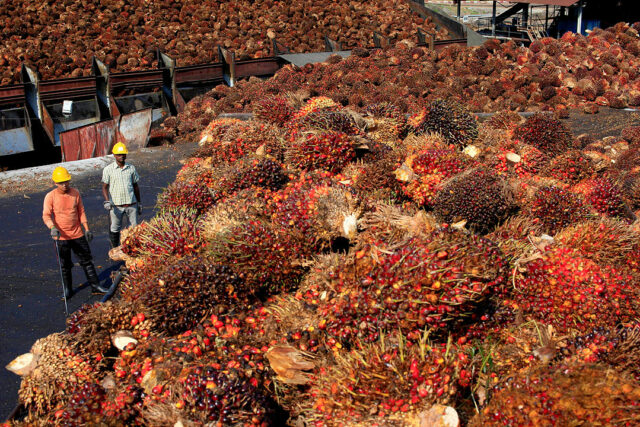
Palm oil watchdog adds new targets: climate emissions, small farms

REUTERS

JAKARTA — When the Roundtable on Sustainable Palm Oil (RSPO) was set up two decades ago, as the palm oil industry struggled in the wake of major Southeast Asian forest fires that provoked global outrage, reining in tropical forest losses was a top priority.

But today, critics question the palm oil watchdog’s continued relevance as it struggles to manage other fast-rising concerns, from the industry’s climate change impact to its limited benefits for small-scale farmers — and whether price-sensitive Asian buyers can be persuaded to buy greener oil.

Octogenarian MR Chandran — the head of Malaysia’s palm oil growers’ association when he helped create the global standard for sustainability — said reducing emissions and tackling climate change will be crucial in the coming decades.

“Addressing climate change (is something) we have to do,” Mr. Chandran, now an advisor to the watchdog, said at the organization’s 20th anniversary meeting last month. “Our carbon footprint has to be addressed.”

Palm oil is the world’s most widely used edible oil, found in everything from margarine to soap, but it has faced scrutiny from green activists and consumers, who say its production has provoked rainforest and peatland loss, fires and worker exploitation.

Since its start in 2004, the RSPO has grown to more than 5,500 member growers, traders, retailers and advocacy groups.

It has gradually tightened standards to include a ban on felling forests and converting peatlands for plantations, as well as greater protection for labor and land rights.

Cutting down forests has major implications for global goals to curb climate change, as trees absorb about a third of the planet-warming emissions produced worldwide, but release carbon back into the air when they rot or are burned.

The Kuala Lumpur-based RSPO recently completed a five-year review of standards and expects to roll out changes by mid-2024. No-deforestation rules — which founding father Mr. Chandran called the RSPO’s greatest achievement — will not be watered down, said chief executive officer Joseph D’Cruz, better known as JD.

But he also stressed that the industry should look to reduce emissions and tackle climate change. “We certainly have a lot of work being done to understand and minimize those GHG (greenhouse gas) emissions,” Mr. JD told the Thomson Reuters Foundation.

“But there is a qualitative shift from there to really looking rigorously at carbon through our entire lifestyle and supply chain, and demonstrating that we are really optimizing that — there is a lot more that we can do as an industry,” he added.

Mr. JD, who was appointed in March last year, said improving soil carbon and cutting methane releases from palm oil mills are some of what’s needed.

Over the last two decades, pressure from environmentalists and consumers has pushed big companies that produce, trade or buy palm oil to tackle labor abuses on plantations and commit to ending deforestation — with some success.

Deforestation rates in both Malaysia and Indonesia — the world’s top two palm oil producers — have fallen in recent years, according to nonprofit World Resources Institute.

But smallholders, who account for about 40% of palm oil plantation areas in Indonesia and Malaysia, have largely been left behind, say industry analysts.

Globally, there are more than 7 million small-scale palm oil growers and only about 170,000 are RSPO-certified.

“The greatest difficulty for RSPO is to be relevant to independent smallholder palm producers,” said Matthew Spencer, global director for landscapes at sustainable trade foundation IDH.

“As the gold standard for palm, it struggles to be simple and cheap enough to attract big numbers of smallholders.”

Joko Prasetyo is head of the Association of Independent Oil Palm Smallholders, a collective of RSPO-certified farmers on Sumatra island that is backed by Indonesian producer Musim Mas.

Mr. Prasetyo, who has a 10-hectare farm, has seen his yields rise 60% to 75% by adopting better farming practices through RSPO certification. But he does not receive a better income for the ethical oil he produces.

“I really want to have a premium price but, for now, with the benefits of increased yields we can offset it,” the 49-year-old said on the sidelines of conference.

Becoming RSPO-certified involved organizing a collective, planning fertilizer use, and carrying out tracking and accounting, all of which would not have been possible without the help from a major palm oil company, Mr. Prasetyo said.

“Small farmers really get very little benefit flowing back down to them,” said Grant Rosoman, a forest advisor at Greenpeace International.

Mr. Prasetyo is not alone in missing the premium price benefits RSPO certification is supposed to bring. RSPO-backed palm oil represents about 20% — or 15.4 million tons — of global production, but just 80% of certified oil is sold at a premium, according to the watchdog.

Smaller growers are often reliant on one mill located near their farms, which can impact demand and prices paid for certified fruit bunches, Mr. JD said.

While the RSPO certification scheme is backed by many major European buyers, boosting demand for sustainable palm oil in India, China and Indonesia — where buyers are more price-sensitive — will be important in the years to come.

These Asian markets care about sustainability and are trying to figure out how to build sustainability into their sourcing, said JD.

But without a boost in demand for certified oil from Asian markets, RSPO could lose its relevance, especially as the European Union and the United States increasingly turn to regulation in place of reliance on voluntary standards like RSPO, green groups said.

A new European Union law to curb deforestation, agreed last December and due to take effect within two years, will force global suppliers of commodities such as palm oil, soy and cocoa to prove their supply chains are not fuelling forest destruction.

The RSPO must now “crack the Asian market,” where the majority of palm oil is consumed, said IDH’s Spencer. — Thomson Reuters Foundation

ACEN shares sell-off mutes expansion moves

SHARES in ACEN Corp. went down last week to overshadow consecutive news of the Ayala-led energy firm’s business expansions as selling pressure persisted.

ACEN finished as the 13th most actively traded stock last week with a total of 115.681 million stocks worth P690.19 million changing hands, based on data from the Philippine Stock Exchange.

The firm’s shares closed at P4.40 apiece last Friday, 4.3% lower than the P4.60 close a week ago. For the year, the stock price has decreased by 42.3%.

China Bank Securities Corp. Research Director, Rastine Mackie D. Mercado, attributed ACEN stock movement to “fund flows and continued selling pressure.”

He added that the early week weakness of the stock was driven by net foreign outflows.

During the week, the renewable energy company grew in market volume, peaking at 63.883 million stocks traded last Friday. The rise in volume was driven by selling pressure on ACEN stocks leading to a lower price per share.

Mr. Mercado said in an e-mail that the selling pressure and foreign outflow for the stock was due to “investors repositioning their portfolios to avoid index laggards and take advantage of opportunities in index leaders.”

ACEN stock has been on a downtrend since its peak closing price of P5.45 apiece on Nov. 6.

Despite the near-term movement, Mr. Mercado is positive on the long-term trend of ACEN given its pipeline and the continued rollout of fresh power generation assets.

Similarly, Toby Allan C. Arce, head of sales trading at Globalinks Securities and Stocks, Inc., expects that the asset and portfolio growth of ACEN poses a positive outlook for the stock. 

“Over the course of the week, ACEN Corp. has secured loan facilities from several institutions to finance its renewable energy projects both here and abroad in an effort to reach its goal of having 20 GW (gigawatts) of installed renewables by 2030,” Mr. Arce said in a Viber message.

On Dec. 13, ACEN secured a green term loan with the Hongkong and Shanghai Banking Corp. Ltd. amounting to 75 million Australian dollars. On the same day, the company publicized the acquisition of a term loan facility worth P7 billion with Rizal Commercial Banking Corp. to support its renewable energy projects. 

Additionally, on Dec. 14, it secured the sustainability-linked loan facility with Bank of the Philippine Islands and the Asian Development Bank amounting to P11 billion.

“[The loan] provides them with access to capital for potential growth projects, debt refinancing, or other strategic initiatives. This could potentially boost investor confidence and lead to a positive stock price reaction in the days to come,” said Mr. Arce.

For the third quarter, ACEN reported a 20.1% growth in its net income attributable to equity holders of the parent company to P2.33 billion from P1.94 billion a year earlier. Year to date, it went up by 59.5% to P6.57 million from P4.12 million a year ago.

Mr. Arce projects ACEN’s full-year net income to reach P8.9 billion.

Mr. Mercado placed the company’s support level at P4.30 and resistance at P4.65.

“Support may range [from] P4.33 to P4.30, while resistance is estimated to range between P4.65 and P4.80,” Mr. Arce said. Andrea C. Abestano

Yields on government debt fall after central banks’ policy decisions

YIELDS on government securities (GS) traded in the secondary market ended lower last week, driven by policy decisions of both the Bangko Sentral ng Pilipinas (BSP) and central banks around the world.

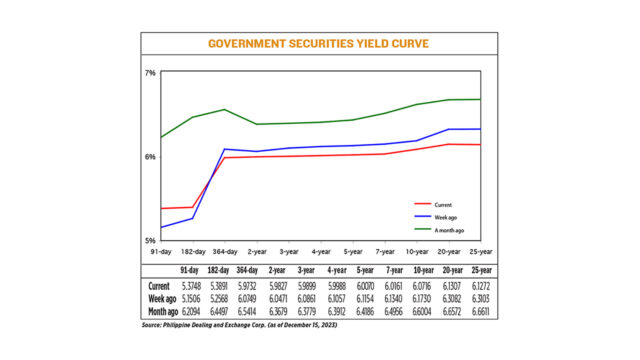
Bond yields, which move opposite to prices, fell by 6.37 basis points (bps) on average week on week, based on PHP Bloomberg Valuation Service Reference Rates as of Dec. 15 published on the Philippine Dealing System’s website.

Last week, rates were mixed across all tenors with yields on the 91-, and 182- day Treasury bills (T-bills) rising by 22.42 bps and 13.23 bps to 5.3748% and 5.3891%, respectively. Meanwhile, the 364-day T-bills went down by 10.17 bps to 5.9732%. 

Similarly, the belly of the curve went down as yields on the two-, three-, four-, five-, and seven-year Treasury bonds (T-bonds) fell by 6.44 bps (5.9827%), 9.62 bps (5.9899%), 10.69 bps (5.9988%), 10.84 bps (6.0070%), and 11.79 bps (6.0161%), respectively.

At the long end, the rates of the 10-, 20-, and 25-year debt papers also decreased by 10.14 bps (6.0716%), 17.75 bps (6.1307%), and 18.31 bps (6.1272%), respectively.

On Friday, total GS volume traded fell to P7.46 billion from P8.67 billion, a week earlier.

This weakness in volume traded is due to muted local market activity from the holiday season, a bond trader said.

The local bond market was significantly influenced by key monetary policy decisions, Lodevico M. Ulpo, Jr., vice-president, and head of Fixed Income Strategies at ATRAM Trust Corp., said in an e-mail.

“The US Federal Reserve maintained the federal funds rate at 5.25%-5.5%, signaling a potential end to its aggressive rate hikes and hinting at possible rate cuts in 2024, introducing a dovish tone,” he said. 

In the local scene, the central bank maintained its key rate at 6.5% aligning with the Fed’s cautious approach, he added.

However, he said that the reluctance of other central banks, such as the Bank of England and the European Central Bank to follow this dovish path suggests ongoing global monetary policy divergences.

“Such differences hint at a potential limit to how much global yields might decrease, indicating a likelihood of continued dislocations in the bond market,” he further explained. 

For the bond trader, the bond market was notably volatile this week amid the flurry of policy decisions from various major central banks both abroad and in the country. 

“The continued easing of US consumer and producer inflation in November has likewise firmed views that the US Federal Reserve might have already concluded its rate-hiking cycle,” the bond trader said. 

In November, headline inflation slowed to 4.1% from 4.9% in October and 8% a year ago, the weakest pace it and in 20 months or since the 4% in March 2022.

Still, the headline figure was above the central bank’s 2-4% target. Year to date, inflation averaged 6.2%, faster than 5.6% logged in January to November 2022.

On the other hand, US consumer prices unexpectedly rose in November as a decline in the cost of gasoline was more than offset by increases in rents, further evidence that the Federal Reserve is unlikely to pivot to interest rate cuts early next year, Reuters reported.

In the 12 months through November, the consumer price index increased 3.1% after rising 3.2% in October. The annual increase in consumer prices has slowed from a peak of 9.1% in June 2022, Reuters said.

Back home, the week saw the central bank maintaining its policy rates for the second straight meeting but hinting at a “tighter-for-longer” policy to anchor inflation expectations.

With these developments, the bond trader said that in totality, “these [news] were taken by market participants as potential leading cues for the expected monetary policy landscape in 2024.”

For Mr. Ulpo, given the US Fed’s dovish guidance, the Philippine bond market saw a significant shift, with yields falling across the curve, closely following the trend in US Treasuries.

“The absence of primary market auctions further amplified this movement, leading to a noticeable decline in yields, moving in parallel by about 15 to 25 bps,” he added.

For this week’s trading session, Mr. Ulpo sees yield movements likely to be more constrained within a trading range as the market heads into the holiday season.

“Despite the recent bullish sentiment and the overall firm fundamental backdrop for rates, the upcoming week might experience a quieter and more range-bound market behavior,” he said.

For the bond trader, likewise, yields will continue to move lower as the projected easing in the Fed’s preferred inflation gauge, the US personal consumption expenditure inflation could bolster the policy pause signaled by the US Fed in its latest December meeting. — Abigail Marie P. Yraola

Actor Andre Braugher had been diagnosed with lung cancer months before death — publicist

ANDRE BRAUGHER in a scene from Brooklyn Nine-Nine. — IMDB

LOS ANGELES — Emmy-winning actor Andre Braugher, best known for two television roles playing cops — one dramatic, the other comedic — was diagnosed with lung cancer months before his death this week at age 61, his publicist said on Thursday.

Mr. Braugher, who made his 1989 film debut in the Civil War drama Glory, playing a corporal in an all-Black Union Army infantry regiment, died last Monday after what his publicist, Jennifer Allen, originally described only as a brief illness.

She revealed on Thursday that he died of lung cancer just a few months after doctors diagnosed the disease in him.

Mr. Braugher co-starred alongside Andy Samberg in the TV police satire Brooklyn Nine-Nine for eight seasons, from 2013 through 2021, in the role of Captain Ray Holt, for which he received four Emmy nominations and two Critics Choice awards as best supporting actor in a comedy series.

In his role as a buttoned-down commanding officer known for deadpan one-liners, he was frequently the “straight man” of the comedic ensemble, once saying in an interview: “I feel like all these incredible comedians are the kites and I’m the string.”

He had established himself as a dramatic actor playing hard-charging Baltimore police detective Frank Pembleton in NBC’s Homicide: Life on the Street from 1992 to 1998, a breakout role for which he won his first Emmy in 1998, for lead actor in a drama series.

The Chicago-born, Julliard-trained performer also won an Emmy for lead actor in a miniseries in 2006 for the role of Nick Atwater in Thief.

Mr. Braugher was a regular on stage at the New York Shakespeare Festival, winning an off-Broadway Obie Award in 1997 for the title role in Henry V. He also played in Measure for Measure, Twelfth Night and As You Like It.

His most recent film role was as New York Times Editor Dean Baquet in She Said, a dramatization of the newspaper’s Pulitzer Prize-winning work exposing the sexual abuse and harassment of Hollywood mogul Harvey Weinstein. — Reuters

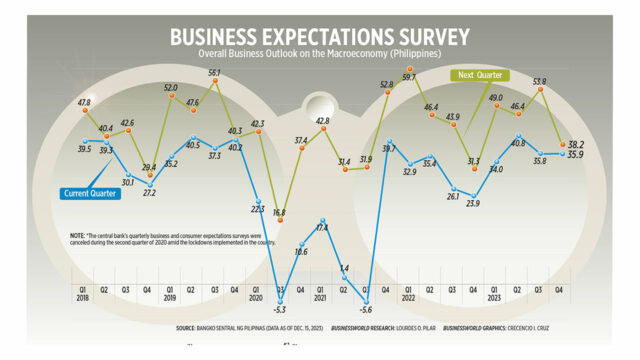
Business Expectations Survey

Business Expectations Survey

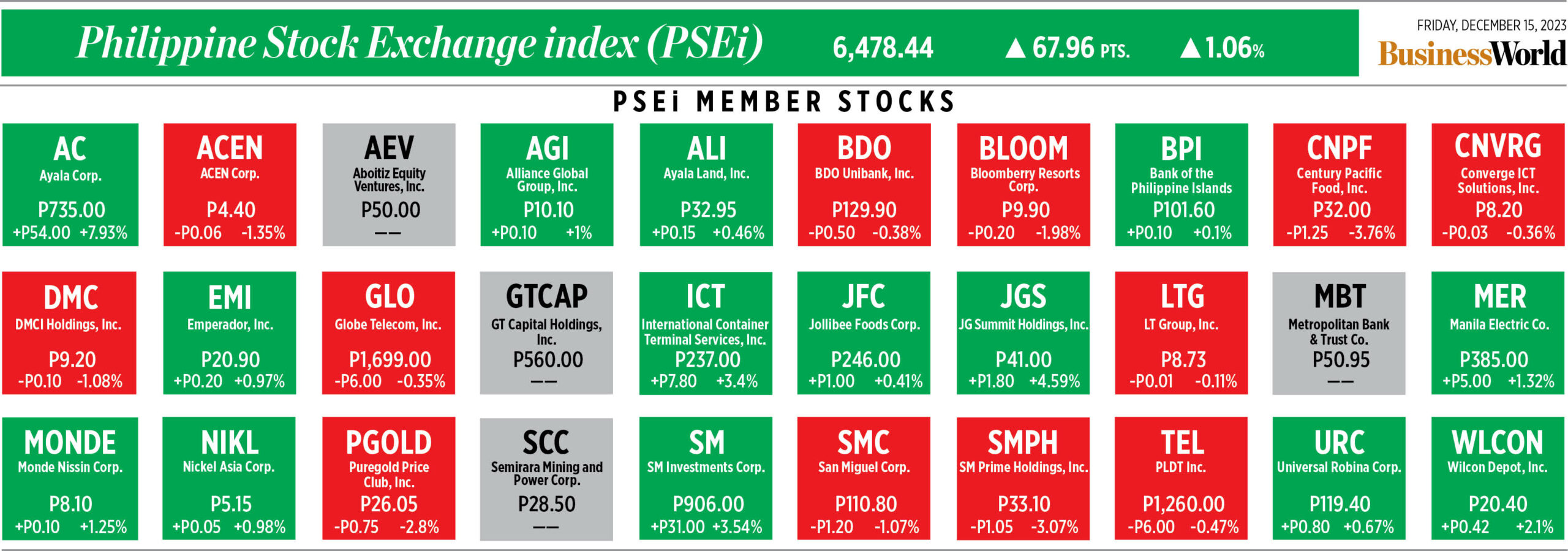
How PSEi member stocks performed — December 15, 2023

Here’s a quick glance at how PSEi stocks fared on Friday, December 15, 2023.


Philippines, Japan agree to rush talks for mutual defense pact 

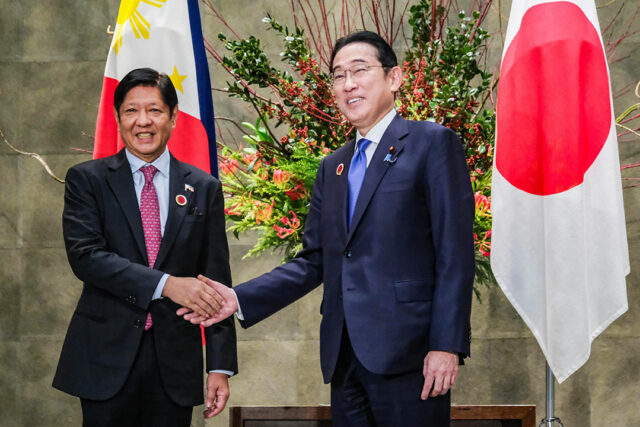
PHILIPPINE President Ferdinand R. Marcos, Jr. and Japanese Prime Minister Fumio Kishida hold a bilateral meeting during the ASEAN-Japan Friendship and Cooperation Commemorative Summit together with other ASEAN leaders at the Prime Minister’s Office, Tokyo, Japan on Sunday. — YUMMIE DINGDING/PPA POOL

By Kyle Aristophere T. Atienza, Reporter

STRONG allies, the Philippines and Japan have agreed to quicken talks on a possible deal that would give Japanese security forces easier access to facilities in the Southeast Asian nation. 

President Ferdinand R. Marcos, Jr. and Japanese Prime Minister Fumio Kishida “concurred to continue coordination to reach an early conclusion of the negotiations of the Reciprocal Access Agreement (RAA),” the Japanese Foreign Ministry said in a statement following the two leaders’ meeting on the sidelines of a Japan-ASEAN summit in Tokyo. 

“The two leaders also agreed to enhance cooperation between the coast guards of the two countries,” the ministry added. 

The Philippine leader said the possible reciprocal agreement will give his country “greater capability in terms of not only security, but also in terms of disaster preparedness and alleviation.” 

“That is something that really is very, very significant to us and will bring to us a greater capacity to maintain the peace in the South China Sea,” he told Mr. Kishida. 

In early November, the two countries agreed to begin formal talks on the proposed RAA, which is similar to Manila’s Visiting Forces Agreement with the United States and the Status of Visiting Forces Agreement with Australia. 

Also on Sunday, Mr. Marcos and Mr. Kishida witnessed the signing of a memorandum of cooperation between the Philippine Coast Guard and the Japanese Coast Guard, which came on the heels of China’s intrusions into Philippine waters in the South China Sea. 

In addition, a memorandum of cooperation was also exchanged between the two countries’ environmental agencies. 
 
PHL MUST BRACES FOR MORE AGGRESSIVE CHINA – EXPERTS 
The Philippines should brace for a more aggressive China as it tests the limits of the Manila’s mutual defense treaty with Washington, experts said on Sunday following an unusual swarming of Chinese ships inside Second Thomas Shoal last week. 

“China’s actions and its rhetoric indicate they will continue to escalate this situation in the belief that Manila’s resolve will break,” Raymond M. Powell, SeaLight director at the US-based Gordian Knot for National Security Innovation, said in an X message. 

From increasing the strength of its blockade, stationing vessels inside the shoal, to Chinese media articles advocating for a more muscular policy, “it seems clear that Beijing has not yet reached the point at which it is looking for off-ramps.” 
Mr. Powell reported last week that as many as 11 Chinese maritime militia vessels were inside Second Thomas Shoal while dozens more were clustered in the periphery on Dec. 11, just a day after the Chinese coast guard fired water cannons at Philippine resupply boats in the same waters.  

He then described the Dec. 11 incident as an “unusual invasion of the shoal’s interior,” which he said “appeared to have been a calculated show of force by Beijing.” 

But on Dec. 15, the Philippine military’s western command said the intensified swarming of Chinese vessels in Second Thomas Shoal cannot be considered an “invasion” yet. 

While there was a continuation of Beijing’s “swarming tactics” in the area where the BRP Sierra Madre is grounded, it may be premature to call it an invasion, the command’s spokesperson, Ariel Joseph Coloma, said. 

“As far as we are concerned, what we are seeing on the ground are the same old swarming tactics employed by the Chinese,” he told reporters. 

But on Sunday, Mr. Powell said the actions of China have been “pushing the limits of ‘armed attack’ on Philippine public vessels, which would invoke Article IV of the Mutual Defense Treaty.” 

The 1951 Mutual Defense Treaty compels both countries to defend each other in case of an armed attack on their armed forces, vessels, and aircraft, among other assets.  

The US and its former colony in May agreed on new guidelines for the treaty, with new provisions stating that the mutual defense commitments would be invoked if there were an armed attack on either country “anywhere in the South China Sea.” 

The new guidelines also specified that coast guard vessels are covered by the treaty.  

The two countries need to consider “asymmetric, hybrid and irregular warfare and grey zone tactics,” according to the new guidelines.  

Chinese coast guard and maritime militia vessels have been banking on non-military means, including blockades and dangerous maneuvers, to assert the expansive claims of Beijing in the South China Sea that a United Nations tribunal invalidated in 2015. 

Mr. Powell said the Philippines and the US need to discuss means of making clear to China the “real risks of continuing its escalation.” 

China wants to show that “it can get away with its belligerence in Philippine waters,” Don Mclain Gill, who teaches international relations at De La Salle University, said following the unusual swarming of Chinese vessels in Second Thomas Shoal. 

“It also wants to prove how the Philippines-US alliance is unable to address its assertiveness and provocations in the West Philippine Sea,” he said in a Facebook Messenger chat. 

Mr. Gill said China might also be trying to bend Manila’s “reinvigorated political will” to stand up for its national interest.  

“It is likely that Beijing will continue this strategy of trying to wear down its victim.” 

Armed Forces of the Philippines (AFP) Chief of Staff Romeo S. Brawner, Jr. and AFP Western Command chief Alberto B. Carlos were on board the small and wooden “Unaizah Mae 1” when it was rammed by the Chinese Coast Guard on Dec. 10 while the Philippine side was delivering food and supplies for its troops stationed on BRP Sierra Madre.  

The incident, in which China used water cannons that seriously damaged a Philippine vessel, prompted discussions on whether or not Beijing had committed an act of war. 

Following the Dec. 10 stand-off, the Philippine security sector said Manila was eyeing a new national strategy in the South China Sea to include “some adjustments.” 

“We have to make some adjustments given the recent developments and we hope to be able to present this to the President very soon,” National Security Council Assistant Director-General Jonathan E. Malaya said last week. 

BRP Sierra Madre, a World War II-era vessel, was grounded in Second Thomas Shoal in 1999 to serve as an outpost for Filipino troops following China’s seizure of Mischief Reef three years earlier. 

Victor Andres C. Manhit, president of Manila-based think tank Stratbase ADR Institute, called for national attention on the condition of BRP Sierra Madre, saying the Philippines would lose its control of the shoal once the ship becomes uninhabitable. 

“As the primary outpost in the West Philippine Sea, it is critical for the Philippines to refurbish BRP Sierra Madre,” he said in an e-mail. 

The restoration of BRP Sierra Madre was among the highlights of the proposed P5.768-trillion 2024 national budget, which was ratified by Congress on Dec. 11, months after the House of Representatives stripped several non-security departments of their confidential and intelligence funds to bolster the Philippines’ presence in the South China Sea. 

In August, Senator Francis Joseph “Chiz” G. Escudero said he would push for the allocation of at least P100 million for the restoration of BR Sierra Madre.

Peso may appreciate on dollar weakness, remittances

REUTERS

THE PESO could strengthen this week amid the dollar’s continued weakness, and supported by the seasonal increase in remittances.

The local unit closed at P55.655 per dollar on Friday, strengthening by 14 centavos from P55.795 on Thursday, based on Bankers Association of the Philippines data.

Week on week, however, the peso weakened by 35.5 centavos from its P55.30 close on Dec. 7.

The peso opened Friday’s session at P55.73 against the dollar. Its intraday best was at P55.65, while its weakest showing was at P55.75 versus the greenback.

Dollars exchanged fell to $846.7 million on Friday from $1.49 billion on Thursday.

The peso appreciated on Friday as the dollar weakened amid expectations of rate cuts by the US Federal Reserve in 2024, Rizal Commercial Banking Corp. Chief Economist Michael L. Ricafort said in a Viber message.

The US central bank kept the fed funds rate steady at the 5.25%-5.5% range for a third straight time during its Dec. 12-13 meeting, with Fed Chair Jerome H. Powell saying they are likely done hiking borrowing costs.

It raised rates by a total of 525 basis points (bps) from March 2022 to July 2023.

Mr. Ricafort added this could be matched by the Bangko Sentral ng Pilipinas (BSP) next year.

The BSP on Thursday kept its policy rate steady at a 16-year high of 6.5% for a second straight meeting but said it remained cautious amid lingering upside risks to inflation.

The Monetary Board has raised benchmark interest rates by 450 bps since it began its tightening cycle in May 2022.

For this week, the peso may continue to strengthen as the dollar’s weakness persists and as remittances continue to rise amid the holiday season, Union Bank of the Philippines, Inc. Chief Economist Ruben Carlo O. Asuncion said in a Viber message

“USDPHP (US dollar-Philippine peso exchange rate) may continue to track the USD weakness like that of today. Though the recent global market rallies wane, the USDPHP will be driven by peaking remittance inflows,” he said on Friday.

In October, cash remittances from overseas Filipino workers (OFWs) rose by 3% year on year to $3 billion, as migrant Filipinos sent more money home ahead of the holiday season.

The amount of money sent by OFWs was the highest in 10 months, or since the $3.16 billion in end-2022, data from the BSP showed.

Month on month, the 3% growth in cash remittances was faster than the 2.6% seen in September and marked the fastest remittances have risen since 3.7% in April.

For this week, Mr. Asuncion expects the peso to move between P55.40 and P55.90 per dollar, while Mr. Ricafort sees the peso ranging from P55.25 to P55.75. — Aaron Michael C. Sy

Shares seen to move sideways amid profit taking

PHILIPPINE shares are expected to move sideways for the trading week as analysts are projecting investors to book profits after the market’s strong finish last week. 

On Dec. 15, the Philippine Stock Exchange Index (PSEi) improved by 67.96 points or 1.06% to 6,478.44 while the broader all shares index jumped by 14.59 points or 0.43% to 3,409.55.

Compared with the earlier week, the main index climbed by 243.67 points from its 6,234.77 close on Dec. 7. 

Philstocks Financial, Inc. Senior Research Analyst Japhet Louis O. Tantiangco said in a Viber message that the local bourse was carried by strong trading activity.

“The local market had a good run last week, particularly the last two trading days, which were backed by strong trading activity. The US Federal Reserve’s signal of three possible 25-basis-point rate cuts next year proved to be a strong catalyst that can spur market optimism,” Mr. Tantiangco said. 

However, Mr. Tantiangco said the local bourse could move sideways during the upcoming trading week, warning of possible profit taking. 

“Next week, the policy easing prospects of the Fed may still provide support to the local bourse. However, we advise caution as the market’s steep rally last week opens the possibility of profit-taking,” Mr. Tantiangco said.

Mr. Tantiangco also said that the latest policy move of the Bangko Sentral ng Pilipinas (BSP) could influence the market’s movement next week.

On Dec. 14, the BSP opted to keep its key rate unchanged at 6.5% for a second straight meeting but signaled a “tighter-for-longer” policy until inflation expectations have become more firmly anchored.     

“Investors may also digest the results of the BSP’s latest consumer and business confidence surveys which have reflected less upbeat results with respect to sentiment on the economy’s future,” Mr. Tantiangco said, adding that the central bank’s “still tight policy outlook may weigh on sentiment.”

Online brokerage 2TradeAsia.com said in a market report that the local market was buoyed by the “dovish comments” of central banks for 2024. 

“Bulls went on a buying spree, boosted by central banks’ dovish comments for 2024. The PSEi breached the 6,400 key resistance level. The BSP maintained rates as expected, and similarly positive outlook for next year should only support our overweight case for local equities,” 2TradeAsia said. 

Last week, the US Fed kept its benchmark overnight borrowing rate at the 5.25% to 5.5% range amid easing inflation. It also hinted that there would be at least three rate cuts next year.

In its report, 2TradeAsia projected the immediate market support to range from 6,200 to 6,300, and the market resistance at the 6,600 level. 

“Markets hyper-fixated on interest rate cycle shifts tend to gyrate heavily in tandem with macro headlines. Take advantage of rallies to make quick profit off short-term trades, but do not lose sight of 2024, which is shaping up to be a year with more meaningful and impactful recovery,” it added. — Revin Mikhael D. Ochave

ADVERTISEMENT
ADVERTISEMENT