Home Blog Page 3877

Distinguished vehicles that deliver excellence

When the automobile industry began, cars were manufactured only for the affluent members of society. However, with the progress of the industrial revolution and technological advancements, automobiles became more affordable and accessible to the general public. Today, they have become a necessity for many people, and high-performance vehicles have become prevalent in various aspects of everyday life.

One of the most significant advancements in the automotive industry was the introduction of mass production techniques in the early 1900s. This strategy allowed for the production of affordable cars that the average person could purchase. As a result, the demand for automobiles increased steadily. Car manufacturers strived to make their vehicles more efficient, durable, and safer in the following years, leading to ground-breaking innovations such as seat belts, air bags, and anti-lock braking systems.

Later in the 20th century, there was a shift towards manufacturing high-performance cars as consumers expected more powerful and faster vehicles. Furthermore, technological advancements in the automotive industry have made high-performance cars more efficient and affordable. For instance, computer-aided design (CAD) and engineering have allowed car manufacturers to create more aerodynamic body shapes, lighter materials, and powerful engines. These advancements have led to the creation of faster, more fuel-efficient, and environmentally-friendly cars.

High-performance vehicles, also known as performance cars, are designed to deliver superior speed, power, and overall driving experience. They are characterized by their sportier design, high-performance accessories, and superior capabilities in terms of speed, cornering, and general performance.

From V8 found in muscle cars to the turbocharged V6 used in sports cars, these vehicles deliver incredible horsepower and torque.

In addition, high-performance cars are designed with great attention to detail, aiming to deliver exceptional handling and driving dynamics. They come equipped with advanced suspension systems, precise steering, and aerodynamic designs that enable superior control, responsiveness, and agility on the road.

To achieve impressive performance and speed, performance vehicles often employ lightweight materials in their construction. Carbon fiber, aluminum, and composites are commonly used to reduce the overall weight of the vehicle. This weight reduction allows for better acceleration, agility, and fuel efficiency, contributing to the car’s ability to optimize power and deliver its performance.

On the other hand, high-performance cars are not solely about their raw power. They also incorporate technology to amplify the driving experience. These vehicles come equipped with advanced features such as adaptive suspension systems, performance-enhancing traction control, and customizable driving modes. Moreover, high-performance cars often include sophisticated infotainment systems, digital instrument clusters, and driver-assistance technologies, to enhance comfort, convenience, and safety.

The design of these cars is created to draw attention that distinguish it from other vehicles. Hence, high-performance vehicles are characterized by sleek contours, aggressive lines, and efficient profiles.

High-performance cars are commonly linked with exclusivity and prestige. They embody the ultimate achievement in automotive engineering, and their ownership is highly sought after by enthusiasts and collectors all around the globe.

These vehicles are built to be fun to drive, often creating a desire to drive just by looking at them. While they offer an exhilarating driving experience, they typically come with higher price tags and maintenance costs compared to regular cars.

The automotive industry strives to exceed the boundaries of performance, engineering, and innovation. With the continuous advancements in technology, materials, and design, high-performance cars released this 2023 are expected to redefine the previous notions of what is possible on the road.

Lexus RC F

The Lexus RC F is a high-performance car that has earned a reputation as one of the top vehicles in its class in 2023. The car is powered by a 5.0-liter V8 engine that boasts an impressive 472 horsepower, making it the most powerful V8 engine in Lexus’ lineup.

With an acceleration time of 4.4 seconds for 0 to 60 mph and a top speed of 176 mph, the RC F gives drivers an exhilarating ride.

The latest model is equipped with a 10-speaker audio system with satellite radio, heated and ventilated leather front seats, and a heated steering wheel with a power-adjustable steering column. The RC F also features Lexus’ 2.5 Safety System+ suite of driver-assistance technology, including forward-collision warning and adaptive cruise control.

The exterior of the car is considered distinctive, with an aggressive style that sets it apart from its competitors. The interior is well-crafted and curated, providing a comfortable and enjoyable driving experience.

Lexus LC 500

The 2023 Lexus LC 500 is a luxurious and stylish vehicle that offers a perfect blend of performance, comfort, and elegance. It is equipped with a high-performance 5.0-liter V-8 engine that generates 471 horsepower and 398 pound-feet (lb-ft) of torque, making it a powerful and smooth-riding vehicle that competes with other luxury sports cars in the market.

The LC 500 comes with a quick-shifting 10-speed automatic transmission that provides smooth and responsive acceleration. Despite being heavier than its main competitors, the LC 500 offers a pleasant driving experience with precise steering and well-controlled handling.

Inside the car, the LC 500 offers a luxurious experience paired with advanced technology. The low instrument panel position, for instance, emphasizes a balance between function and comfort.

The vehicle has a more focused color palette with nine exterior colors, and its design is characterized by its flowing lines, large glass panel, and blacked-out rear pillars that create a floating roof appearance. Moreover, the LC 500’s unique light signature at night has taillamps inspired by the glow of a jet’s afterburners and ultra-compact, triple-projector LED headlamps.

Toyota GR Supra

The 2023 Toyota GR Supra, meanwhile, is a high-performance car that aims to enhance a person’s driving experience. One of the significant updates for the latest model is the inclusion of a six-speed manual transmission for the GR Supra 3.0 model.

The 2023 GR Supra offers a turbocharged 2.0-liter 4-cylinder engine with 255 horsepower and 295 lb-ft of torque, as well as a turbocharged 3.0-liter inline-six engine with 382 horsepower and 368 lb-ft of torque.

In addition, the latest model of the car has revised tuning for the suspension and steering systems, allowing additional wheelspin on one of the rear tires to help rotate the vehicle  around ultra-tight, hairpin turns.

The 2023 GR Supra comes with updated technology features, such as a color head-up display, navigation, wireless Apple CarPlay, and wireless smartphone charging, which were not available in previous models.

Moreover, the introduction of the manual transmission has been received positively, as it enhances the connection between the driver and the car, resulting in a more personalized and engaging driving experience. — Mhicole A. Moral


Establishing credit, managing cash flow through business credit cards

Digitalization is conquering the world, including in the finance sector as it makes cashless payments much more possible while keeping financial transactions more secure in a few taps. At present, cashless payments are being welcomed in various functions such as retail purchases and even in transportation.

One of the leading modes of cashless payment being widely used today is the use of credit cards. According to the most recent “Consumer Payment Attitudes Study” by Visa, the use of contactless cards, whether credit and debit, is coming in close behind e-wallets as the most preferred mode of cashless payments in Southeast Asia. The former garnered 80% of respondents in the study, while the latter tallied 83%. Moreover, in recent years, the use of cards in Southeast Asia has become a primary payment method for consumers and it varies throughout different markets; Singapore is leading at 82%, followed by Malaysia at 69%, and Vietnam at 57%. The Philippines, for its part, has online card payments as one of Filipinos’ top digital payment methods they currently use, garnering 50% of respondents from the country.

Credit cards have been one of the most convenient modes of cashless payments for consumers, and yet they can also be a tool to enhance financial management in businesses.

According to a recent poll conducted by United States-based Forbes Advisor, 29% of businesses sought funding through business credit cards in 2022, and 4.67% of respondents reported that they had used business credit cards as their primary source of funding to kick-start their businesses. The poll also found out that of those who utilized either a business or personal credit card to fund their business, 25.4% of respondents, or one in four users, chose to use a credit card due to restricted access to conventional financing alternatives.

Among small businesses in United Kingdom, meanwhile, Intuit’s Small Business Index Annual Report found that credit card expenditure for business is up by 22% since before the pandemic. In addition, from 32% in September 2022, the proportion of respondents who had used credit cards or loans to support their cash flow increased to 51%.

Using credit cards for businesses offers significant advantages. One of these is establishing business credit, which is found to be important in expanding one’s business. Business credit can be built by paying bills on time, paying more than the minimum, and not going over the credit limit. This, in turn, can increase a business’ credit line or loan approval at a lower interest rate in the future.

Also, with a business credit card that is not tied to one’s personal credit but reports exclusively to relevant business credit agencies, owners can keep their personal finances and business finances separate from each other.

Another advantage businesses can get from getting their own credit card is the ability to protect against cash flow disruptions during economic uncertainties.  JPMorgan Chase & Co., in a discussion about their research on the use of credit cards among small businesses, recognized that credit cards are part of a suite of cash flow management tools.

“Credit cards can be an alternative for cash liquidity, providing financing when firms cannot pay in cash,” JPMorgan Chase wrote on its website, adding nonetheless that maintaining adequate cash buffers remains important as credit cards are found to be not always accepted for the expenses small businesses face.

As to how small businesses used such cards, the financial services firm noted, “Many firms are consistently transactors or revolvers over one to two years, suggesting that their routine use of credit cards is either as a means of payment or as a financing instrument. Nevertheless, a core credit card feature is flexibility: card holders may choose each month whether to pay in full or revolve.”

“They offer a flexible line of credit, which can be particularly helpful for covering unexpected expenses or making strategic investments. Plus, many business credit cards offer reward or cashback incentives that, over time, can provide additional benefits,” Antony Smith, director at comparison site Business Expert, said in an article published by Institute of Chartered Accountants in England and Wales on its website.

Speaking of rewards, even business credit card users can earn rewards with every purchase, which can be used to cover expenses, such as payroll, utilities, software, and other subscriptions needed for one’s business. Some even offer cash-back benefits, meaning users can get a percentage back on your purchases.

As with any financial tool, nonetheless, it is important to mindfully use business credit cards, as every use and compliance to terms of use will factor into an organization’s credit score and overall financial health.

Businesses need to have clear rules about how they spend using their cards, like how much they can spend, and when they can use them. For effective cash flow management, restricting transactions to a specific amount, spending category, and specific day or time is crucial to reduce risk in your business.

According to CNBC Select, when choosing a credit card that is best for one’s business, owners should think about what kind of payment options they prefer and what rewards and perks would be most helpful for their spending.

In terms of tracking activities, many business credit cards set up alerts in texts and emails about transactions, letting them know every time their business made a purchase or if someone illegally uses your card. Businesses can also track their account through online or mobile banking. On top of these, nonetheless, it is important to ensure that the accounting team in the business looks over each statement and makes sure you, as the owner or manager, approves each line of item. — Angela Kiara S. Brillantes

Marcos to release EO on El Niño soon

PHILSTAR FILE PHOTO

PRESIDENT Ferdinand R. Marcos, Jr. is expected to issue an executive order (EO) on state efforts to brace for the impact of the El Niño which is expected to bring dry spells throughout the country next year, Defense Secretary Gilberto Eduardo C. Teodoro, Jr. said on Tuesday.

“The President will issue an order so that we can prepare for it (El Niño) early and find quick interventions and monitor the possible effects of Niño,” Mr. Teodoro, who heads the national task force on El Niño, told a Palace briefing following a Cabinet meeting.

At the same briefing, Science and Technology Secretary Renato U. Solidum, Jr. said a strong El Niño is expected to continue from the end of this month to January next year, adding that its effects would be felt until May.

He said the peak of the drought associated with El Niño would be in April, with about 63 provinces experiencing its effects. Mr. Solidum said this new forecast projects the peak earlier than May, as previously expected.

The Philippine Atmospheric, Geophysical and Astronomical Services Administration (PAGASA) defines a drought as three consecutive months of below-normal rainfall or two straight months of significantly below-normal rainfall. A dry spell means two straight months of below-normal rainfall.

Environment Secretary Maria Antonia Yulo-Loyzaga said Angat Dam in Bulacan, which is the source of potable water in the National Capital Region, still has enough supply for now but cited the need to produce useable water for residents that will be affected by dry spells and drought.

She said the province of Cavite is looking to start developing a bulk water project in January, also citing the Department of Environment and Natural Resources planned 135 water projects nationwide.

“The President’s instruction is to have our infrastructure investments be multi-purpose,” Ms. Loyzaga said at the same briefing in mixed English and Filipino.

“So that one investment in a kind of infrastructure can generate several values… whether for irrigation or eventually for water supply and distribution as well,” she said.

Mr. Marcos earlier said the Department of Agriculture was looking into the potential effect of El Niño on the prices of agricultural products for state agencies to come up with countermeasures.

The country’s task force on El Niño has developed an online interagency database that consolidate data on El Niño. — John Victor D. Ordoñez

WB sees faster remittance growth

Seafarers arrive at the Ninoy Aquino International Airport Terminal 1, Dec. 2, 2023. — PHILIPPINE STAR/MIGUEL DE GUZMAN

REMITTANCE FLOWS to the Philippines are projected to grow by 5% this year and next year, the World Bank (WB) said, as demand for Filipino migrant workers remains strong.

Data from the World Bank showed the Philippines remained the fourth-largest recipient of foreign remittances in the world this year with $40 billion, after India ($125 billion), Mexico ($67 billion), and China ($50 billion).

“Remittance flows to the Philippines — the largest recipient after China in the East Asia and Pacific region — are likely to reach $40 billion in 2023, growing at over 5% compared to under 4% in 2022,” the multilateral lender said in its latest Migration and Development brief.

For next year, remittance flows to the Philippines are expected to grow by around 5% to $42 billion.

The latest remittance growth projection is faster than the 2.5% growth penciled in by the World Bank in June.

The Bangko Sentral ng Pilipinas (BSP) expects remittances to grow by 3% this year and in 2024.

The World Bank said remittances to the Philippines account for about 48% of the total remittances to East Asia and the Pacific Islands, excluding China.

“The sustained growth in remittances flows to the Philippines was an outcome of a well-diversified set of host destinations across the world,” the World Bank said.

Remittances came from key source countries such as Hong Kong, China, Korea, Singapore, as well as the Middle East.

“The impact of the Filipino government’s proactive stance in negotiating specific deals with foreign governments such as Saudi Arabia to protect its workers also contributed to facilitating emigration to that country,” the World Bank said.

The multilateral lender said that remittances account for up to 10% of gross domestic product (GDP) in the Philippines, which indicates the “growing dependence of the East Asian economies on labor markets in the high-income countries of North America, Europe, East Asia, and Australia as well as the Gulf Cooperation Council (GCC).”

Remittance costs in the Philippines are also among the cheapest, the multilateral lender noted.

“The average cost of sending $200 to East Asia in the leading least cost corridors was generally under 3% in the second quarter of 2023, thus achieving the Sustainable Development Goal (SDG) target. The fees for sending money to the Philippines were the lowest among the least expensive destinations,” it said.

Remittances have become a crucial support for lower middle-income countries, the World Bank said.

“Remittances have become the premier source of finance for lower middle-income countries, exceeding the more volatile foreign direct investment flows in 2023 by more than $250 billion,” it said.

Remittance inflows can also be used to help support the country’s debt management.

“Remittances also can play an important role in improving a country’s ability to repay debt, due to their large size relative to other sources of foreign exchange, countercyclical nature, and indirect contribution to public finances,” the World Bank said.

It cited a 2017 framework by the World Bank and International Monetary Fund that showed the contribution of remittances to debt sustainability.

“Similarly, econometric results show that the inclusion of remittances in the denominator of the debt-to-export ratio in middle-income countries with large remittance receipts would improve the sovereign rating by one notch,” it said.

The World Bank said remittances are one of the few sources of private external finance that are likely to continue to expand in the next decade.

“As debt indicators have worsened in the lower middle-income countries, and sovereign risks increased, countries may benefit from efforts to attract diaspora investors who may view investment opportunities in their countries of origin through a more favorable lens than do institutional investors from the Global North,” it added. 

In the first 10 months of 2023, cash remittances rose by 2.8% to $27.49 billion.

By country source, the United States remained the biggest source of cash remittances at 41.5%. It was followed by Singapore (7%), Saudi Arabia (6%), Japan (5%), United Kingdom (4.8%), United Arab Emirates (4.1%), Canada (3.6%), Qatar (2.8%), Taiwan (2.7%), and South Korea (2.5%) — Luisa Maria Jacinta C. Jocson

New vehicle sales growth slows to 7.6% in November

Motorists are stuck in traffic along ESDA in Cubao, Quezon City, Nov. 7, 2023. — PHILIPPINE STAR/MIGUEL DE GUZMAN

NEW VEHICLE SALES jumped by an annual 7.6% in November, the slowest growth in 21 months as high interest rates weighed on consumer demand.

A joint report by the Chamber of Automotive Manufacturers of the Philippines, Inc. (CAMPI) and the Truck Manufacturers Association (TMA) showed new vehicle sales rose to 37,683 in November from 35,037 in the same month a year ago.

This was the weakest sales growth in 21 months or since the 7.3% contraction recorded in February 2022.

Month on month, vehicle sales slipped by 1.2% from 38,128 units sold in October.

“Total sales slightly declined on a month-on-month basis, but the industry still displayed a relatively strong performance in November,” CAMPI President Rommel R. Gutierrez said in a statement on Tuesday.

“Vehicle sales are being pushed by continued aggressive marketing activities and supply improvement across all brands,” he added.

However, consumer spending has slowed in recent months, reflecting the impact of soaring interest rates.

The Philippine central bank has raised borrowing costs by a cumulative 450 basis points between May 2022 and October 2023, bringing the key rate to a 16-year high of 6.5%.

CAMPI-TMA data showed sales growth of commercial vehicles and passenger cars slowed to single digits in November.

Sales of commercial vehicles, which made up nearly three-fourths of the monthly sales, went up by 7.7% to 28,114 units in November.

Month on month, commercial vehicle sales inched up by 0.3%.

Broken down, light commercial vehicle sales went up by 6% to 21,427 units, while sales of Asian utility vehicles increased by 13.6% to 5,609 units in November.

Sales of light trucks and heavy trucks increased by 20.9% and 14.5% to 649 and 95 units, respectively.

On the other hand, medium truck sales dipped by 0.9% to 334 units in November.

Meanwhile, passenger car sales increased by 7.1% to 9,569 units in November from 8,931 units a year ago.

However, sales of passenger cars dropped by 5.14% month on month.

Despite the slower growth in November, CAMPI-TMA members sold 390,654 units in the eleven-month period, up by 23.9% from 315,337 units a year ago.

For the January-to-November period, commercial vehicle sales jumped by 22.2% to 290,989 units, while passenger car sales rose by 29% to 99,665 units.

Mr. Gutierrez said the eleven-month tally puts the industry on track for full recovery to pre-pandemic levels.

“We already achieved 92% of our 2023 forecast in November; we may even exceed our sales forecast of 423,000 units if sales performance in the last three months is sustained,” said Mr. Gutierrez.

CAMPI earlier revised its 2023 sales target to 423,000 units from 395,000 units previously. If realized, this would be 20% higher than the 352,596 vehicles sold in 2022.

Toyota Motor Philippines Corp. remained the market leader with a 46.2% share as eleven-month sales rose by 15% to 180,480 units.

Mitsubishi Motors Philippines Corp. came in second with a 53.8% increase in sales to 71,833 units from January to November.

In third spot is Ford Motor Co. Phils., Inc. as sales jumped by 33.3% to 28,586 units.

Rounding out the top five were Nissan Philippines, Inc., which saw a 27.7% increase in sales to 24,743 units, and Suzuki Phils., Inc. whose sales fell by 8% to 16,676 units. — Justine Irish D. Tabile

Publishers, bookshops ride the digital wave spurred by pandemic

People browse piles of books at an event at The World Trade Center in Pasay City, Feb. 17, 2020. — PHILIPPINE STARMIGUEL DE GUZMAN

By Beatriz Marie D. Cruz, Reporter

ANDREA PASION-FLORES, a publisher based in Manila, is using the internet to sell books like hotcakes directly to consumers.

“Ours is basically a business-to-consumer model,” the entrepreneur, who owns independent Milflores Publishing, said in an e-mail. “The mainstream bookstores just can’t carry all the books that all the publishers produce.”

The digital age and limited movement spurred by the coronavirus pandemic strengthened the more direct publisher-to-reader relationship, said Kevin Ansel Dy, who heads the policy and industry research division of the National Book Development Board. 

“The internet has changed how distribution works,” he said in a video interview. “What that means for publishers is that I don’t necessarily have to go through a distributor. I can have more direct contact with my customers. I can have my own little store on Lazada or Shopee.”

The Philippine creative industry contributed 7.3% to the Philippine economy in 2022, slightly lower than a year earlier, according to data from the Philippine Statistics Authority. But the gross value was P1.6 trillion or 12.1% higher than in 2021. 

Media publishing and printing activities contributed P179.14 billion — 11% of the industry — to the Philippine economy last year.

Katrina Stuart-Santiago, who owns independent bookshop Everything’s Fine, said a direct relationship with buyers has helped the business promote its own books.   

Without the pressures of distributing to bigger bookstores, she and her managing publisher, Oliver Ortega, get to choose which books to sell.

Mr. Ortega said they sell books that are absent in mall-based bookstores.

“We want to curate books along certain themes like LGBTQ+, climate activism and the maritime conflict with China,” he said in an e-mail. Books with these themes are best sellers.

Ms. Santiago said the book EDSA Uno by her mother Angela Stuart-Santiago sold like hotcakes after the 1986 People Power revolution was removed as a 2024 holiday.

“Content that gets the most responses will always be the ones that engage with current issues,” she said.

Registered Philippine book sales more than tripled to P10.27 billion amid a coronavirus pandemic in 2021, according to a report by the National Book Development Board.

BOOK FAIRS
Faye Cura, a poet and co-founder of Gantala Press, said they started selling to their own press and independent bookstores to avoid high consignment fees.

“By selling our books in independent bookstores and pop-up fairs, we get to support small businesses and strengthen our community of people and groups that believe in our books and our advocacy,” she said via e-mail.

Gantala Press, which does not have a physical store, sells books on its website and at book fairs.

Calling itself the first and only publisher of titles about and written by women, a chunk of Gantala Press’ sales go to peasant and women support groups.

By staying independent, the publishing house manages to keep prices between P300 and P500.

Discounts from publishers usually dictate book prices, Ms. Santiago said. Printing presses owned by universities like the Ateneo de Manila University and University of the Philippines have been very generous in giving them discounts, allowing them to keep prices down, she added.

Books at Everything’s Fine cost as little as P295 and as much as P2,000, including foreign books, which are more expensive due to shipping and foreign exchange costs.

The digital economy did not only affect distribution but also book marketing.

“Interestingly enough, TikTok has been, perhaps in recent years, the top driver of awareness about a particular title,” Mr. Dy said.

Ms. Santiago calls readers who feature their books on social media platforms like Instagram and TikTok their “unsung heroes” because they drive sales.

Milflores Publishing earns more by selling directly to readers and bookstores like Fully Booked and independent bookshops.

“Bookstores, like most retail establishments, take a discount from the suggested retail price of a consumer item,” Ms. Flores, also the President of the Book Development Association of the Philippines, said. This is where they take their margins and expenses such as mall rentals and staff wages.

“When the consumer buys directly from the publisher, the publisher will earn more — as would the author in our case — because the royalty percentages are based on the net amounts received by the publisher,” she added.

Book fairs are also a living proof that Filipinos enjoy buying directly from publishers.

Ms. Cura expects fairs to be more accommodating to publishers that can’t afford regular booth fees.

“We hope that more small presses are given space in big book fairs to diversify the kinds of books that reach schools and the general public,” she said in Filipino.

Publishers and small bookshops have stood the test of time — including a global pandemic and the digital age — and has helped avid Filipino readers.

“The question has always been ‘How can we make the books that we want to read ourselves make a decent profit and ensure that the authors also earn from their work?’” Ms. Santiago said.

“It’s about selling the books that we like, the authors that we read. It’s about spreading the knowledge and creativity that we think are important to be exposed to. It’s about building a community of thinkers that seek to engage with the world in more complex and creative ways, which we think the best books and arts allow,” she added.

Big banks’ Q3 asset growth fastest in two quarters

BW FILE PHOTO

By Abigail Marie P. Yraola, Researcher

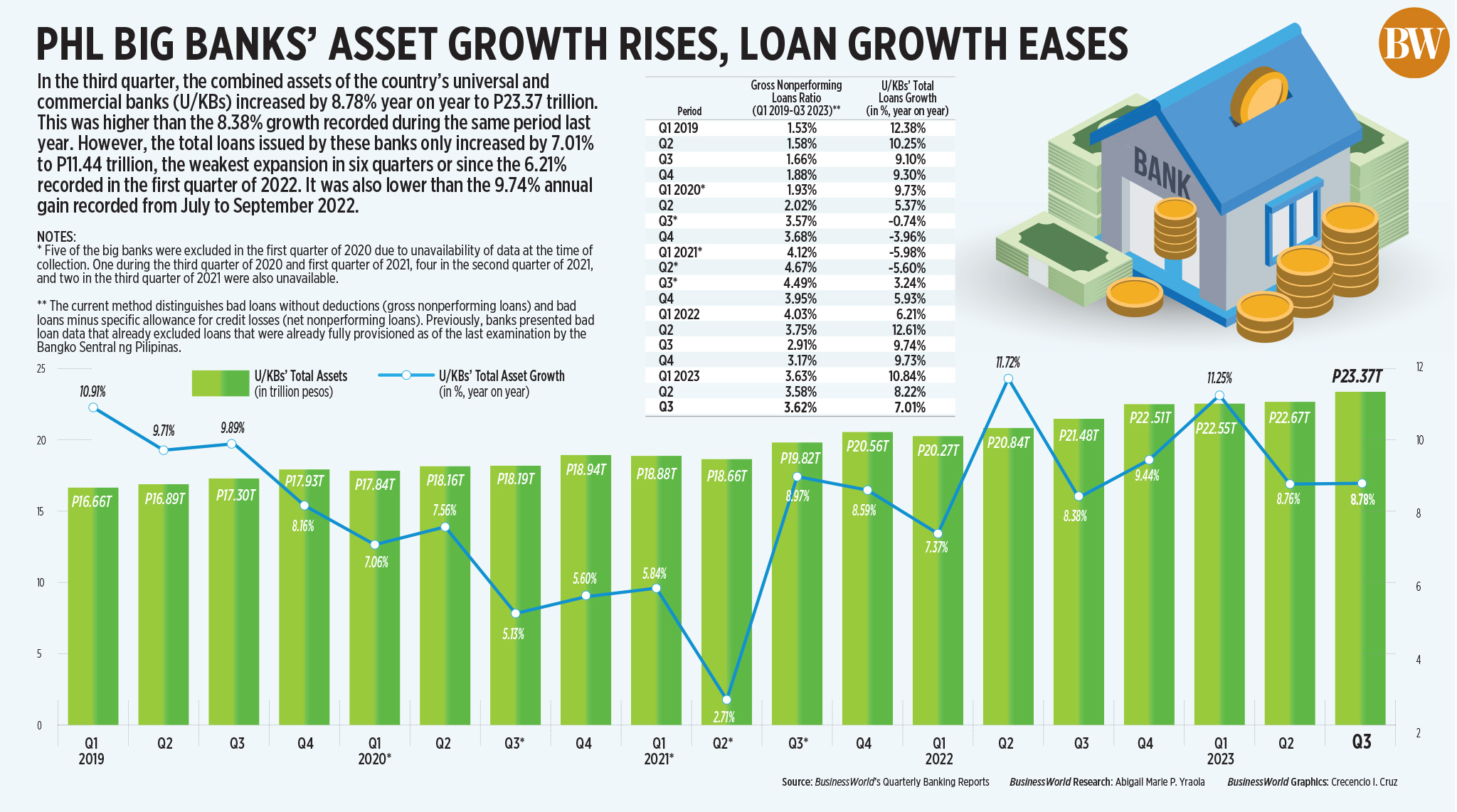
THE COMBINED ASSETS of the Philippines’ biggest banks rose by 8.78% in the third quarter, while lending growth slowed amid high borrowing costs.

The latest edition of BusinessWorld’s quarterly banking report showed the combined assets of 45 universal and commercial banks (U/KBs) increased by 8.78% year on year to P23.37 trillion in the July-to-September period from P21.48 trillion a year ago. 

This was a tad faster than the 8.38% growth logged in the same period last year and 8.76% in the second quarter.

PHL big banks’ asset growth rises, loan growth eases

Asset growth was the fastest in two quarters or since 11.25% in the first three months of 2023.

Meanwhile, total loans of these big banks inched up by 7.01% to P11.44 trillion in the third quarter, slower than the 9.74% growth posted a year ago.

The third-quarter loan growth was the slowest in six quarters or since the 6.21% growth in the first quarter of 2022.

The slowdown in lending was reflected in soaring borrowing costs, which discouraged consumers from taking out loans. The Bangko Sentral ng Pilipinas’ (BSP) key rate stood at a near 16-year high 6.25% in the third quarter.

In late October, the Monetary Board raised policy rates by 25 basis points (bps) in an off-cycle hike, which brought the benchmark rate to 6.5%. Between May 2022 and October 2023, the BSP has raised borrowing costs by a cumulative 450 bps.

Bad loans, also known as nonperforming loans (NPLs), jumped by 6.8% to P374.27 billion in the July-to-September period from P350.44 billion in the same period a year ago.   

This brought the NPL ratio — the share of soured loans to the total loan portfolio — to 3.62% from 2.91% in the same quarter a year ago.

Loans are considered to be nonperforming if any principal and/or interest are left unpaid for more than 90 days from the contractual due date or accrued interests for more than 90 days have been capitalized, refinanced, or delayed by agreement. 

Meanwhile, the nonperforming asset (NPA) ratio — the share of NPLs and foreclosed properties to total assets — further eased to 0.89% from 1.1% a year ago.

Relative to total assets, foreclosed real and other properties stood at 0.25% in the third quarter, lower than 0.28% posted in the same period last year.

Total loan loss reserves went up by 8.4% to P413.09 billion during the July-to-September period from P381.25 billion a year ago.

These big banks median capital adequacy ratio (CAR) — the lender’s ability to absorb losses from risk-weighted assets — reached 21.54% in the third quarter, better than the 19.6% median a year ago. However, this was lower than the 21.75% median CAR in the second quarter.

The ratio remained well above the regulatory minimum of 10% set by the BSP as well as the international minimum standard of 8% under the Basel III framework.

The median return on equity (RoE), which is an indicator of profitability, increased to 9.42% in the third quarter from 6.42% in the same quarter a year ago.   

The RoE, the ratio of net profit to average capital, measures the amount that shareholders make on every peso they invest in a company.

Sy-led BDO Unibank, Inc. (BDO) remained the largest bank in terms of total assets with P4.22 trillion, followed by Metropolitan Bank & Trust Co. (Metrobank) with P3.15 trillion and Land Bank of the Philippines (LANDBANK) with P3.1 trillion.

BDO also led the industry in lending with P2.63 trillion worth of loans issued, followed by Bank of the Philippine Islands (BPI) with P1.73 trillion and Metrobank with P1.4 trillion.

In terms of deposits, BDO led with P3.41 trillion, followed by LANDBANK with P2.74 trillion and Metrobank with P2.35 trillion.

Among banks with at least P100 billion assets, China Banking Corp. logged the fastest year-on-year asset growth of 21.16%, followed by Philippine Bank of Communications (15.23%) and Rizal Commercial Banking Corp. (14.63%).

Meanwhile, Standard Chartered Bank was the most aggressive lender with an annual increase of 31.08%, followed by Bank of Commerce with 20.66% and East West Banking Corp. with 18.42%

BusinessWorld Research has been tracking the financial performance of the country’s large banks on a quarterly basis since the late 1980s using banks’ published statements.

Driving sustainability and comfort with Lexus’ signature BEV

Lexus RZ 450e

The automotive industry is currently undergoing a significant global transformation due to the increasing awareness of sustainability and the demand for eco-friendly yet luxurious transportation options.

As concerns about environmental impact and climate change continue to grow, automakers are shifting their attention toward developing cleaner, greener, and more sustainable solutions.

Major car brands are now investing heavily in research and development to create innovative and sustainable electric alternatives. As a result, these vehicles are harnessing the power of renewable energy sources, significantly reducing greenhouse gas emissions and diminishing the industry’s carbon footprint.

Lexus, a luxury car brand based in Japan, seeks to address the importance of sustainability, technological innovation, and a seamless driving experience with their first battery electric vehicle (BEV) on the market — the Lexus RZ 450e.

Lexus’ flagship model is designed with precision and purpose, showcasing its commitment to pushing the limits of electric vehicle capabilities as the automotive industry enters the age of electrification.

Lexus Chief Engineer Takashi Watanabe said that the development of RZ strongly emphasizes the delivery of an incredible driving experience.

“The RZ has been developed with the aim of creating a unique Lexus BEV that feels secure to ride in, is pleasing to the touch, and is exhilarating to drive. Our vision is to use electrification technology as a means to enhance fundamental vehicle performance so that we can continue to pursue driving pleasure for all future generations,” said Mr. Watanabe.

Lexus’ electrification

At the heart of the RZ innovation lies the commitment to the Lexus Driving Signature, a philosophy that revolves around elevating the core characteristics of the brand — confidence, control, and comfort — in all driving situations.

Central to achieving this vision was the meticulous design, focusing on enhancing aerodynamics and energy efficiency.

The Lexus RZ boasts an impressive drag coefficient of 0.28 Cd, dedicated to minimizing air resistance by incorporating aerodynamic measures at every level.

The cabin shape is optimized to ensure smooth airflow on the outside and comfort inside. The belt molding sits flush with the bodywork, helping regulate the airflow and stabilize the car. The rear spoiler design contributes to handling and stability in straight-line driving and crosswinds without producing drag. The back door is shaped to adjust the airflow angle from the roof, reducing drag and contributing to the driver’s sense of the car being in firm contact with the road.

To further reduce drag, the car features a fully covered underfloor, with the front section featuring a dimpled surface that helps maintain stability at high speeds, and the rear features fins that direct airflow from the wheels.

Lexus RZ also comes with new e-Axles, the compact motor units used front and rear that work in conjunction with the new DIRECT4 all-wheel electronic drive torque control. The system adjusts the vehicle’s posture, traction, and power distribution according to the driving conditions.

In addition, the engineers and designers of Lexus RZ made it a priority to ensure that the cabin environment was calm and quiet. Lexus applied a three-part strategy: controlling the noise, preventing it from entering the cabin, and paying particular attention to the noise experienced in the rear seats.

The vehicle is equipped with the all-new Lexus Link multimedia platform, enabling faster operation and providing increased functions for connectivity, efficient planning and communication.

The RZ’s cockpit is an evolution of Lexus’ Tazuna concept to offer maximum convenience to the driver, featuring a precise arrangement of meters, controls, and displays that allow the driver to operate the vehicle with minimal hand and eye movements.

Partnering with premium audio equipment brand Mark Levinson, Lexus provides the vehicle with Pure Stage technology, which replicates the distinct sound features of specific performance venues, providing a unique and immersive sound experience. The car’s 10-speaker system ensures high-quality sound reproduction across all genres of music.

Safety features

The RZ also benefits from the latest generation of the Lexus Safety System +, which includes new and enhanced functions that work seamlessly in the context of a battery-electric vehicle, recognizing and responding to a wider range of accident risks.

The Pre-Collision System used by the RZ employs radar and camera technology that has a greater detection range and can recognize a broader range of hazards than before, including the risk of a head-on collision with traffic from the left or right when turning at an intersection.

The Lexus Safety System + package for the RZ also provides an Automatic High Beam or an Adaptive High-beam System (AHS) for automatic adjustment of the headlight beams to achieve optimal forward illumination without dazzling oncoming traffic. The RZ is the first Lexus to be equipped with AHS using a single bi-projector LED headlight.

The RZ uses the smooth and simple e-latch electronic door release system, which is linked to the car’s Blind Spot Monitor to provide Safe Exit Assist. This prevents doors from being opened in the path of cycles or vehicles approaching from the rear. Lexus estimates that this safety feature can prevent more than 95% of accidents caused by hazardous door openings.

Other safety features include the following: Emergency Steering Assist to keep the car stable within its traffic lane; Dynamic Radar Cruise Control (DRCC) to allow driver to customize inter-vehicle distance setting; Lane Departure Alert (LDA) and Lane Tracing Assist (LTA) to distinguish road markings; Deep Neural Network to recognize 3D objects in adjacent lanes or work zones; Road Sign Assist to recognize highway warning and command signs; and Advanced Park to move the car efficiently into parking spaces.

Battery

The RZ 450e is equipped with a 71.4-kWh lithium-ion battery, which is expected to retain at least 90% of its capacity after ten years of driving. The vehicle achieves energy consumption between 16.8 kWh and 18.7 kWh per 100 km in the combined Worldwide Harmonized Light Vehicles Test Procedure (WLTP) cycle.

The RZ comes with a compact and lightweight 11-kW onboard charger. When connected to a three-phase power supply, it only takes approximately 6.5 hours to fully recharge the battery. On the other hand, it will take about 10 hours when connected to a one-phase supply. The fastest way to recharge the battery is by connecting it to a DC fast-charging system, which can provide up to 80% charge in 30 minutes.

The all-new Lexus RZ 450e is available in several exterior finishes, including the new Aether Metallic, inspired by the blue sky, and the striking Sonic Copper. It is also available in Sonic Chrome, Sonic Quartz, Sonic Iridium, Graphite Black, and a bi-tone design with a black finish. The vehicle price starts at P4,828,000.

For more information, visit the Lexus website at lexus.com.ph or its Facebook (Lexus Philippines) and Instagram (@lexusph) pages. Android and iOS users can also get the latest updates and premium services via the MyLexus app.


Spotlight is BusinessWorld’s sponsored section that allows advertisers to amplify their brand and connect with BusinessWorld’s audience by enabling them to publish their stories directly on the BusinessWorld website. For more information, send an email to online@bworldonline.com.

Join us on Viber at https://bit.ly/3hv6bLA to get more updates and subscribe to BusinessWorld’s titles and get exclusive content through www.bworld-x.com.

Maximizing investment in a volatile environment with BDO Securities

Knowing how to properly invest, particularly in the stock market, is key to successful financial planning and thus in productively making money grow. Investors should constantly be aware of the latest developments in the economy and across industries, as well as how such trends affect the stock market in order for them to decide about their next moves for their respective portfolios, whether to buy, sell, or hold.

The performance of listed banks, for instance, have been affected by high inflation and borrowing costs during the third quarter of the year, according BDO Securities Research Head Abi Chiw.

“High inflation and borrowing costs during the quarter continued to curb credit demand with industry loan growth slowing further to 6.5% in September vs. 7.8% in June,” Ms. Chiw said in an email to BusinessWorld. “Nonetheless, banks are still able to deliver robust net interest income growth on higher loan margins and additional yield income from investment securities.”

The big banks, including BDO Unibank, Inc., were able to maintain earnings growth and double-digit return on equity (ROEs). Asset quality of their loan portfolios also remain strong despite the high interest rate environment, with nonperforming loan ratios still benign at 1.7%-2.0%, Ms. Chiw said.

Going forward, Ms. Chiw noted that economic trends affecting loan demand will likely to be monitored by market players. “Improving GDP growth and household incomes are likely to encourage consumer segment growth (credit cards, auto loans, home loans), while still elevated interest rates are seen to discourage companies from taking on new debt,” she said.

Regarding the impact of recent developments (BSP keeping interest rates at high levels and the Israel-Hamas conflict, to name a few) on the prospects of bank stocks in the coming quarters, banks generally benefit from higher-for-longer interest rates since it helps loan yields. However, prolonged periods of high interest rates may also bring about the risk of rising problem loans.

“Philippine banks and the BSP (Bangko Sentral ng Pilipinas) are monitoring the war between Israel and Hamas, since the risk of increasing tensions in the Middle East region may exert upward pressure to global oil prices and inflation, which in turn, would have negative spillover effects to economic growth and equity markets,” Ms. Chiw explained.

Ranked as one of the leading investment banks in the Philippines, BDO Securities, a BDO Capital & Investment Corp. subsidiary, is stepping up its game in helping Filipinos invest, from investment funds to bank stocks, fixed-income securities, and more.

Whether their clients seek to starting up, build, or expand their wealth, BDO Securities is there to serve Filipinos and guide them through achieving their financial goals. As a full-service brokerage firm, BDO has got clients covered with trading, diversification of investments, and research reports.


Spotlight is BusinessWorld’s sponsored section that allows advertisers to amplify their brand and connect with BusinessWorld’s audience by enabling them to publish their stories directly on the BusinessWorld website. For more information, send an email to online@bworldonline.com.

Join us on Viber at https://bit.ly/3hv6bLA to get more updates and subscribe to BusinessWorld’s titles and get exclusive content through www.bworld-x.com.

Alternergy raises P3-B equity since March IPO — president

ALTERNERGY Holdings Corp. announced on Tuesday that it has raised a total of P3 billion in equity this year, including an investment from the Government Service Insurance System (GSIS).

“Alternergy has raised a total of P3 billion in equity capital in the last nine months following our P1.62-billion initial public offering (IPO) in March this year,” Alternergy President Gerry P. Magbanua said in a stock exchange disclosure.

Alternergy said it has received P1.45 billion worth of perpetual preferred shares from GSIS, a deal that was signed last month.

“We are pleased to receive the GSIS investment which boosts our equity base,” Mr. Magbanua said.

He said that the recent capital-raising activities would enable the company to initiate the next phase of project development, focusing on the construction of the 86-megawatt (MW) Tanay and 55-MW Alabat wind power projects.

The company previously said that it had received certificates of award from the Department of Energy for the two projects under the Green Energy Auction (GEA) 2 program.

The GEA program is a competitive process for procuring renewable energy supply by offering capacities to qualified bidders at a set maximum or ceiling price.

The company aims to complete the Tanay wind farm in Rizal and the Alabat wind farm in Quezon province by the second quarter of 2024.

Last week, Alternergy announced that its board of directors had approved the appointment of BDO Capital & Investment Corp. as its mandated lead arranger for an up to P4 billion fixed-rate green corporate note issuance.

Alternergy aims to develop up to 1,370 MW of renewable energy sources, including onshore and offshore wind, solar, and run-of-river hydropower.

At the local bourse on Tuesday, shares of the company fell by three centavos or 4.05% to close at P0.71 apiece. — Sheldeen Joy Talavera

Opening new avenues for film discussion

Academic journal pursues unique questions about PHL cinema

IN ORDER to document today’s knowledge on Philippine film and the moving image, one would have to simultaneously focus on its history, its contemporary situation, and its future.

This is the very goal of film scholar and programmer Patrick F. Campos, who is editing the PELIKULA journal.

“I keep to heart researchers and readers 50 or 100 years from now so that they will have a resource to look back on to gain significant insight into what was happening during a specific conjuncture,” Mr. Campos told BusinessWorld in an online interview.

Published by the University of the Philippines Film Institute (UPFI), of which Mr. Campos was previously director, PELIKULA was revived in 2019 a full 20 years since it first began its short stint in 1999.

Since then, it has been tasked with commemorating Philippine cinema’s 100th anniversary, chronicling the alternative filmmaking movement spurred on by red-tagging and lockdowns, and celebrating the many films that have depicted momentous cultural changes over the last few years. The project, curated for specialists and general readers alike, publishes academic research, thought pieces, reviews, interviews, and visual essays. And it is no small feat to put together.

“As far as the last five volumes I’ve edited since 2019 are concerned, the vision has been to catalyze knowledge production on film and the moving image for posterity and the future,” Mr. Campos said.

In Volume 8, which comes out by the end of 2023, performance and film scholar Loujaye Sonido and programmer Merv Espina put together sets of essays on dance films, recorded choreography, experimental moving images, and multimedia works.

Another group of articles will revisit the history and productivity of sex cinema, known colloquially as bomba films. It will also tackle its political, economic, and commercial implications.

Mr. Campos said that PELIKULA emphasizes “looking at Philippine films in comparative ways, as regional phenomena, and through the lenses of history and politics.

“It explores new avenues for thinking and talking about Philippine cinema and the moving image, alternative questions we’ve not really pursued,” he said.

While the journal takes the form of a digital-format magazine, it is still academic, which means it publishes and highlights original research under a peer-review process.

On a poignant note, the eighth volume of PELIKULA is dedicated to the memory of oral historian, film programmer, cultural organizer, and archiving and regional filmmaking advocate Teddy Co, who passed away in November.

“He had been a supporter of PELIKULA’s revival in 2019. He understood that a cinema does not only succeed because of the films; it flourishes because of the film culture and the cinephiles surrounding it,” said Mr. Campos.

Volume 8 of PELIKULA: A Journal Of Philippine Cinema And Moving Image is coming soon this holiday season. For updates, visit pelikulajournal.com or https://www.facebook.com/pelikulajournal. — Brontë H. Lacsamana

Cosco plans to acquire 60% stake in Catuiran Hydropower 

RETAIL holding company Cosco Capital, Inc. has announced plans to acquire 60% of the outstanding shares in Catuiran Hydropower Corp., operator of the eight-megawatt hydroelectric plant in Naujan, Oriental Mindoro.

In a stock exchange disclosure on Tuesday, Cosco Capital said its board of directors approved the proposal at a meeting on Dec. 14.

The acquisition signals Cosco Capital’s strong interest in the renewable energy sector.

Earlier this year, the company announced that it was looking to venture into the renewable energy space, seeing the industry as a profitable portfolio in the medium and long term.

The listed company will acquire a total of 360 million shares, representing 60% of the outstanding shares of Catuiran, Cosco Capital said, without disclosing the amount of the transaction. 

The company added that the acquisition is below 10% of its total value.

For the third-quarter period, Cosco Capital reported an attributable net income of P1.82 billion, up by 1% from the P1.81-billion profit in the same period last year, driven by higher revenue for the period.

The company recorded a gross revenue of P52.89 billion for the third quarter, marking a 7.2% increase from the P49.36 billion recorded previously.

Incorporated in 1988, Cosco Capital has a portfolio of businesses in retail, real estate, wine and liquor, and oil and minerals.

At the stock exchange on Tuesday, shares in the company closed two centavos or 0.44% higher at P4.59 per share. — Ashley Erika O. Jose

ADVERTISEMENT
ADVERTISEMENT