Home Blog Page 3838

GoTyme Bank expects continued growth in customer base this year

GOTYME BANK expects to expand its customer base further this year as it plans to deploy more kiosks outside the Gokongwei ecosystem, with a focus on provincial areas.

“We are expanding our regional play and deploying to more provincial areas.  That said, we will maintain our urban and peri-urban track to reach Gen Zs and millennials,” GoTyme Bank Co-Chief Executive Officer (CEO) and Chief Commercial Officer Albert Raymund O. Tinio said in an e-mail last month.

The bank’s customer base is expected to continue growing this year, even as inflation and interest rates remain high, Mr. Tinio added.

“Customers will continue to look for a simple, straightforward approach to meet their financial transaction needs. Our commitment to human digital banking doesn’t end just because interest rates change,” he said.

The digital lender on Dec. 22 reached its end-2023 target customer base of two million, 14 months after it began commercial operations.

GoTyme Bank President and CEO Nathaniel D. Clarke said this was driven by the bank’s competitive savings interest rate and debit program.

This also came despite the economic headwinds the country faced during the year, he added.

“There is huge pent-up demand for a preferred banking experience that has previously been reserved for the top 5% of the population. Because of this, we are quite insulated from the macro environment,” he said.

GoTyme Bank’s product base will continue to expand this year to support customer growth, Mr. Clarke added.

“In the first half of 2024, we plan to launch several new investment products to include term savings and equities trading,” he said.

The online lender will also launch a buy now, pay later product, and will expand the micro, small, and medium enterprise loan product that it launched in partnership with PayMongo in November.

It is also planning to launch a person-to-person quick response or QR payment feature in February 2024, as well as an earned wage access payroll lending product, it previously said.

GoTyme Bank is a partnership between the Gokongwei group, which holds a 60% stake, and Singapore-based digital banking group Tyme, which has 40%.

It is one of the six online banks that got licenses to operate from the Bangko Sentral ng Pilipinas. — A.M.C. Sy

5 under-appreciated crime novels you should read

IT’S HARD for writers to break into the crime fiction market. It’s especially hard for authors who write in languages other than English or write on the anglophone periphery. Unless they are the big names of Nordic noir, translated crime novels are rarely advertised or placed in prominent positions in bookshops.

This is a shame because there is a lot of great crime writing going on around the world. Below we offer a list of five novels by writers from Italy, Japan, Israel, New Zealand, and Finland. They might have passed you by, but are well worth reading.

1. Out of Season by Antonio Manzini

Out of Season (Harper, 2018), translated by Anthony Shugaar, is an engaging novel from bestselling Italian author Antonio Manzini. This is part of a crime series centered on police chief Rocco Schiavone, who has been exiled to the town of Aosta in the Alps after a dust up with his superiors in Rome.

A city lover who likes the sun and light clothing, Schiavone finds it very hard to get used to a mountainous, gossipy town and its constant cold weather. Grumpy and endowed with a “Roman” (that is, very cynical) sense of humor, Schiavone is an “outsider” police detective. He is surrounded by a group of loyal subordinates, including the young and efficient Italo Pierron and Caterina Rispoli, but also the hopeless D’Intino who provides light moments in a series featuring gritty and violent crimes.

In this novel, spring has finally arrived and Schiavone investigates a kidnapping and brutal murder that intersect with a mysterious car accident. The chapters move between the point of view of Chiara, a young woman from a rich and influential family who has been kidnapped, and Schiavone’s efforts to find her before it’s too late.

Like much Italian crime fiction, this novel delves into the topical issues of gender violence, criminal organizations, and extortionate moneylending in an Italy experiencing a crippling economic crisis.

Despite the serious issues tackled, Out of Season makes for engaging and easy reading due to the character of Schiavone, his biting sarcasm, and his confronting (and irresistible) way of dealing with others.

2. The Aosawa Murders by Riku Onda

Crime fiction has a long history in Japan, something anglophone publishers are just starting to discover.

Pushkin Vertigo have published the classic detective novels of Seishi Yokomizo and Yukito Ayatsuji to great acclaim. Penguin has also gotten in on the act, releasing Seicho Matsumoto’s Tokyo Express in its Modern Classics series.

The focus on classic detective novels hasn’t distracted publishers from translating more contemporary works. Riku Onda’s The Aosawa Murders, published by Bitter Lemon in 2022 and translated by Alison Watts, is one remarkable example. Onda is the pen name of Nanae Kumagai, one of Japan’s leading contemporary crime writers.

The Aosawa Murders is one of the most interesting, innovative crime novels of recent years. The murder at the heart of the novel is the mass poisoning of 17 people who attend a party hosted by the Aosawa family. Only two people survive: the housekeeper and Hisako, the attractive, blind daughter.

The novel doesn’t follow the usual pattern of much crime fiction. It doesn’t directly offer an investigation into the murders. Rather, an unnamed narrator investigates an early true crime account of the murders by Makiko Seiga, a neighbor.

The novel consists of a series of interviews with Seiga, her brother, witnesses, police officers, and, finally, the surviving family member and prime suspect, Hisako.

What stands out is the one-sided nature of these interviews. One of the significant features of crime fiction is the strong voice of the detective. Think Raymond Chandler’s Philip Marlowe. Yet, in The Aosawa Murders, readers almost always receive the interviewees’ responses. Rarely do we hear the questions or comments made by the interviewer.

Readers, thus, have to piece together the mystery behind the writing of the true crime story before making sense of the crime itself. This allows the story to focus on the broader impact of the crime. The Aosawa Murders is literary crime fiction at its best.

3. Murder in Jerusalem by Batya Gur

The last instalment of Batya Gur’s Michael Ohayon crime series, Murder in Jerusalem, delves into Israeli society’s internal divisions and the troubled history of the state of Israel.

Ohayon is quiet and introspective and looks more like an intellectual than a policeman. His bookcase is filled with works by Chekhov, Gogol, Flaubert, Balzac, and Faulkner. He has a masters degree in Medieval history and started a PhD but abandoned a university career to marry his pregnant girlfriend. He is always in charge of complicated mysteries in which he makes use of his education to clear the smokescreen created by the villain.

In Murder in Jerusalem (Harper Collins, 2006), translated by Evan Fallenberg, the investigation starts with the death of Tirzah Rubin, a set designer for Israel’s state television station, who is found dead on the set of a film adaptation of a classic of Jewish literature, SY Agnon’s story “Iddo and Eynam.”

The tragedy is initially treated as an accident, but when the head of production, Matty Cohen, also dies, it becomes apparent the deaths are not accidental.

Ohayon is called to investigate what eventually becomes a multiple murder investigation with its roots in the Six-Day War. Ohayon’s investigation reveals the crimes are the consequences of past violence and injustice never acknowledged or addressed. This thought-provoking novel offers insight into the world of TV journalism while condemning state propaganda and extreme nationalism.

Murder in Jerusalem is also a powerful endorsement for a peaceful coexistence with a Palestinian state. Sadly, it provides very topical reading in these troubled times.

Readers may also be interested in Palestinian writer Adania Shibli’s Minor Detail, translated by Elisabeth Jaquette and published by Text (2020). Minor Detail recounts a historical crime during the war of 1948 and its present-day investigation by a Palestinian woman.

4. The Pain Tourist by Paul Cleave

A cold case involving a home invasion in which two people died nine years earlier in Christchurch, New Zealand, is at the center of the intricate plot of The Pain Tourist (Orenda Books, 2022).

The victims’ son, James, has revived from a coma with memories that might provide clues to the crime, and police detective Rebecca Kent is assigned the case.

Things get complicated for Kent, as she is also investigating the rape and murder of a woman by a notorious New Zealand serial killer, The Cleaner. Or is it a copycat murder?

The novel alternates between different perspectives. These include Kent’s investigations, the villain’s thoughts, and the memories James lived with during his years in a coma.

Readers of The Pain Tourist also become acquainted (or reacquainted) with Theodore Tate, the detective protagonist of four novels by Paul Cleave who ran the original investigation into the murder of James’ parents. Tate is now working as a consultant for true crime television shows. Thus, the novel explores the fascination of audiences with the dark side of the human mind and media exploitation of crime, (hence the title).

Moving between past and present, The Pain Tourist is a beautifully written page turner with a final twist.

5. The Healer by Antti Tuomainen

Crime fiction has always responded to the burning issues of its time and place. Currently, these are the crisis of democracy, social and economic inequality, gender and sexuality, legacies of colonialism, and environmental degradation.

Finnish novelist Antti Tuomainen’s The Healer (Harvill Secker, 2012), translated by Lola Rogers, is one of the first crime novels to have tackled climate change.

The Healer is set in the near future in Helsinki. Yet, the Finnish capital is unrecognizable. Unrestricted economic development has accelerated global warming. Floods, rising sea levels, plagues, pandemics, and war have led to the mass displacement of over 650 million refugees. Waterfront suburbs are under water.

This provides the setting for the search for a missing journalist, Johanna, who was investigating a number of brutal murders by a self-styled Healer. His motivation is to punish individuals who have contributed to the ensuing disaster.

Unsurprisingly, given the social breakdown, the police are uninterested in spending time looking for a missing woman. Instead, it falls to her husband, Tapani, a poet, to find his wife. He is assisted in this by a North-African climate refugee called Hamid.

The Healer is an example of “crimate” fiction. That is, novels that attempt to narrate the climate crisis through a criminal framework. The climate catastrophe is not a mere backdrop. It is a fundamental part of the story.

By setting the story in the near future, Tuomainen makes visible the slow violence caused by everyday practices. In doing so, he wants readers to reflect on how current acceptable behaviors may – in the fullness of time – be viewed as criminal.

Stewart King is an Associate Professor, School of Languages, Literatures, Cultures and Linguistics and Fellow of the Australian Academy of Humanities at Monash University. Barbara Pezzotti is a Senior Lecturer, School of Languages, Literatures, Cultures and Linguistics at Monash University. Both receive funding from the Australian Research Council.


Keeping the parol tradition alive

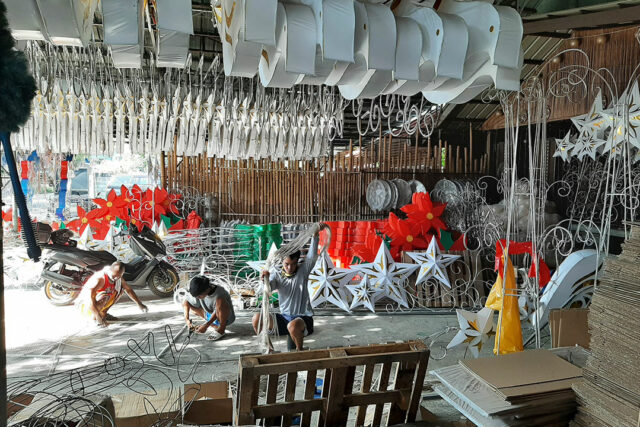
WORKERS of Rolren’s Lanterns and General Mdse. race to meet the all year round’s demand. Photo uploaded by Rolando S. Quiambao on Facebook on Oct. 6, 2022.

Ex-OFW’s venture into Filipino crafts draws global appeal

By Miguel Hanz L. Antivola, Reporter

MORE THAN its radiant appeal during the Christmas season, the parol persists as a handmade product etched with passion, skill, and unwritten Filipino traditions, according to lantern maker Rolando S. Quiambao.

“The parol is a tradition, and we play it by heart. Ang isang produktong walang kwento ay walang kwenta [A product without a story has no value],” Mr. Quiambao, co-owner of Rolren’s Lanterns and General Mdse., said in an interview with BusinessWorld.

“The parol characterizes our attitudes and lifestyles as Kapampangan,” he added. “There is no course or book on the parol. It was only passed down to us from generation to generation.”

When Mr. Quiambao retired as an overseas Filipino worker (OFW) and returned to the Philippines in the 1980s, he became an electrical repairman, who also offered to make a number of parol for rich households.

It did not take long for his friends to notice his creations and convinced him to sell his work on the street and make a living out of his childhood flair. The encouragement was measure enough for him to give it a shot, officially starting his parol-making venture in 1986.

“I tried it and enjoyed, even if [the parols were] in small quantities. You need big investments to make parols,” he said.

THE BIG BREAK
For Mr. Quiambao, the big break for the business came in 1995 when the local government of San Fernando, Pampanga commissioned him to decorate and enliven the city centers with his parols. The greater mission was to lift the spirits of people and traders forced to relocate due to the devastation caused by lahar from the Mt. Pinatubo eruption.
The plan worked and so, beyond the Christmas season, the mayor at the time assigned him and his two craftsmen to make more decorations for the city during festivals, graduations, and other celebrations.

“When our city suddenly became happy and the people returned, that is when we earned our break,” said Mr. Quiambao, who has since been called the “San Fernando Lantern King.”

This allowed him to seek financial support and guidance from government agencies for the business’ next move — hiring contractual workers for its large scale “decorative” arm, serving corporate clients beyond retail.

His brand, Rolren, continued to grow in popularity by traditional means: word of mouth. With the dawning of social media, his works became popular posts by local and international bloggers drawn to the annual San Fernando Giant Lantern Festival — the stage that crowned his business as champion many times over.

“We were suddenly visited by customers and traders who knew us as a legitimate factory where they can get their parols for cheap [prices],” said Mr. Quiambao, even going as far as to export to the United States and Canada. “We don’t stop. Our production is continuous all year round.”
At this point, Rolren expanded its product offerings to table lamps, corner lights, and chandeliers, partnering with architects, hotels, and local government units. His products were now tailored according to requests.

DEMAND: THE MAIN CHALLENGE
Even with a slight drop in retail sales, Mr. Quiambao noted how the market for the business is too big for them to accommodate, compounded by crunched time frames for orders.

“We pick our clients because we can’t cater to the whole market,” he said. “We don’t even have a website.”

“It is difficult to teach a laborious handcrafted skill — from cleaning and cutting the capiz (shells), to assembling, painting, and electrifying,” he added on preserving tradition and product quality. “It’s hairsplitting!”
A little innovation does offer solutions and Rolren came to adopt modern techniques. “We devise systems to lessen time and cost of production, said Mr. Quiambao. “We use some machines now, but the bending is a long handcrafted process.”
At present, the business has about 25 regular craftsmen — men and women with specific expert skills — for retail orders. It also has over 30 contractual workers for decorative orders and commissioned works.

“We only accommodate what our labor force can handle,” said Mr. Quiambao. “When we can’t [accommodate] any more, especially with decorative orders from LGUs, malls, and private companies, we disperse the tasks to subcontractors, offering them jobs.”
Even for exports, he said he prefers accepting orders from the United States and Canada due to ease of adapting to its supply voltage.

“It’s also difficult because the exporter or buyer sometimes chooses to get all the stocks of one design, so you don’t have anything to show for the next customer,” he said.

“What we do is we just keep stocking and never stop. We choose to see it as planting rice to harvest for the next season, per se,” he added.

HONORING TRADITION
More than its business component, Mr. Quiambao is keen on honoring the rich history behind the parol, even being researched and interviewed as a historian of such a tradition.

“It grew from small and simple candle covers during a religious activity we called the lubenas,” he said of the nine-night procession before Christmas, involving the patron saint of each barangay.

According to Mr. Quiambao, this parol display later evolved into the “royal rumble” called Ligligan Parul, or today’s Giant Lantern Festival, where the lanterns are bigger and more intricately designed.

“Our story is deep, from the shapes and parts of the parol, to its overall architecture, symbolic of the well-defined practices, attitudes, and colorful lives of the Kapampangan,” he asserted.

“The terminologies of the elders for the different parts make sense,” he added, noting the parol’s center star as siko-siko, named after the star-shaped angle of the elbow.

He also noted parol components such as the palimbon — from the word “procession” and is the part surrounding the main star like a procession; and the puntetas (from the word “end”), the decorative outer layer signifying the non-conformist attitude of the Kapampangan.

“There is a story and tradition behind the parol, which is why I think it persists even up to today,” said Mr. Quiambao.

VLL International to sell $2-B notes

VILLAR-LED property developer Vista Land & Lifescapes, Inc. said its unit had approved a $2-billion medium-term note program as part of capital raising efforts. 

In a stock exchange disclosure on Tuesday, Vista Land said VLL International, Inc. approved the program on Dec. 29 and hired DBS Bank Ltd. and HSBC as dealers for the offer, sale, and issuance of the notes.

The notes are guaranteed by Vista Land and units Brittany Corp., Crown Asia Properties, Inc., Camella Homes, Inc., Communities Philippines, Inc., Vistamalls, Inc., and Vista Residences, Inc.

Vista Land posted a 70% increase in net income to P8.2 billion in the first nine months, as consolidated revenue jumped by 18% to P27.4 billion.   

Shares of Vista Land at the local bourse gained 0.6% or a centavo to P1.69 each.  Revin Mikhael D. Ochave

Shift to parliamentary system

WIRESTOCK-FREEPIK

Although I happen to know Speaker Martin Romualdez’ admirable mother from college days, I really have no particular opinion about him as yet. I only see that he seems to be preparing for more important posts in the future, with the politicking that he is already doing this early.

However, it happens that I am of the same mind when it comes to the need to change our system of governance. I think that we should seriously consider and work towards a system where a unicameral parliament determines National Government policy; and perhaps, a president, elected by governors and mayors of chartered cities who coordinates execution of policy at the local levels.

In a recent direct-vote presidential election, we ended up electing a president who publicly and blatantly flaunted his powers and encouraged uniformed personnel to kill, kill, kill. In many respects, he acted irresponsibly, including suddenly doubling the salaries of these uniformed personnel by announcing it on television: a decision we are having to deal with today with budget shortfalls, including from huge retirement benefits of these uniformed personnel which we really can’t afford. Meanwhile, nurses and other critical medical personnel in this time of infectious diseases are underpaid or paid too late and so we are suffering from a shortage of health professionals who prefer to work overseas. Teachers are overworked and have difficulty being effective in their real work of developing their students’ learning skills. Even many of the best of them have gone abroad for better pay.

We also now have a senate that, with a few exceptions, is comprised of many weird characters, including ex-convicts, a killer police head, publicly exposed grafters, and relatives of famous and infamous characters. No less than one fourth of our senators are related to one another: there are two Villars, two Cayetanos, and two sons by different mothers of the notorious Erap Estrada.

The same thing seems to be happening to the world’s leading “democratic” power with an ex-president who, while facing all kinds of civil and criminal cases in court, continues to lead in political polls. The notorious Donald Trump, who even violated the US Constitution, could be re-elected as president once more in the American voters’ direct presidential elections.

With a few exceptions, it seems to me that Parliamentary systems seem to produce leaders who tend to be more intelligent and responsible than ordinary politicians. Look at Japan, France, Australia, New Zealand, and many European countries. Also, such systems seem to strengthen political parties, rather than just be led by popular personalities, qualified or not. It seems that leaders who are chosen by their elected peers tend to be more responsible than those chosen these days directly by the citizenry.

The rapidly evolving media situation, where social media are becoming more and more influential, and more and more available to even the rural poor, is making it difficult to ensure more accurate appreciation of the character of public personalities, including politicians. And those able to fund social media campaigns, including the use of fake news, have become more and more influential in shaping public opinion.

In our Constitutional Commission of 1986-87, the presidential system won over the Parliamentary system by only one vote: that of delegate Felicitas Aquino who became the wife of Executive Secretary Joker Arroyo. The Senate, of course, will do its best to prevent a conversion to a parliamentary system since they would naturally lose their jobs. And they are not sure they can win a seat in Parliament.

Voters are more likely to choose local leaders who will work with their party to select the Prime Minister and President. Chances are, these leaders, elected by their peers, will tend to be more intelligent and responsible than those elected directly by voters who, given the media situation, would not know any better.

Bad policy making and poor governance by the chosen leaders will be easier to reform since political parties and their allies can elect new leaders in less time than a national election would require. This means government could become more responsive.

It will not be easy to make the change happen to a Parliamentary-cum-presidential system. It will certainly not pass the Senate if the votes are separate as in legislation. It might take a people’s initiative.

Can the private sector mobilize and support such a campaign?


Teresa S. Abesamis is a former professor at the Asian Institute of Management and fellow of the Development Academy of the Philippines.

tsabesamis0114@yahoo.com

Collections from BSP’s coin deposit machines reach P297.78 million

Bangko Sentral ng Plipinas Governor Felipe M. Medalla (left) and Robinsons Retail Holdings, Inc. President and Chief Executive Officer Robina Gokongwei-Pe (right) inspect the coin deposit machine located in Robinsons Place Ermita in Manila. — KEISHA B. TA-ASAN

THE VALUE of coins collected though the coin deposit machines (CoDMs) of the Bangko Sentral ng Pilipinas (BSP) reached P297.78 million as of Dec. 15, the central bank said in a social media post on Tuesday.

This was 39.8% higher than the P212.94 million coins seen a month prior, central bank data showed.

A total of 93.62 million pieces of coins were deposited in the machines, up by 30.7% from the 71.62 million coins recorded a month before, the BSP said.

There were also 89,690 transactions made through the machines as of Dec. 15. 

The BSP and its retail partners launched the CoDMs earlier in June to promote efficient coin recirculation in the country. 

Through the project, the central bank aims to address the artificial coin shortage in the financial system and help ensure that only fit and legal tender currency is available for public use through the project. 

The BSP has deployed 25 coin deposit machines in retail establishments across Metro Manila and other nearby provinces in partnership with Filinvest Lifemalls Corp., Robinsons Supermarket Corp., and SM Retail, Inc.

All denominations of the BSP Coin Series and New Generation Currency Coins Series are accepted by the coin deposit machines.

Unfit and demonetized coins, foreign currency, and foreign objects are rejected by the machine and returned to the depositor.

The value of coins deposited in CoDMs may be credited to the depositor’s e-wallet account or converted into a shopping voucher for over-the-counter transactions.

The rollout of the machines in select retail establishments of the SM Store, Robinsons Supermarket, and Festival Mall is part of the first phase of the project’s implementation.

The BSP will determine if the project will be expanded to other regions and if the number of machines will be increased after one year. — Keisha B. Ta-asan

American Idol star Paula Abdul sues producer Nigel Lythgoe for sexual assault

A PUBLICITY shot featuring Paula Abdul, Ryan Seacrest, Simon Cowell, and Randy Jackson in American Idol. —IMDB.COM

US singer, dancer and American Idol star Paula Abdul filed a lawsuit accusing British television executive Nigel Lythgoe of sexually assaulting her when they worked together on two popular talent shows, according to court documents.

Abdul, who rose to fame as a chart-topping singer in the late 1980s, alleged in a lawsuit filed in Los Angeles County Superior Court on Friday that Lythgoe sexually assaulted her in an elevator during the early seasons of TV singing competition series American Idol.

Lythgoe, the producer of several hit television talent competitions, allegedly groped Abdul’s breasts and genitals, among other unwanted physical contact in a hotel elevator after a day of auditions for American Idol. Abdul tried to push him away and ran as soon as the elevator doors opened, court documents said.

Reuters was not immediately able to reach Abdul or Lythgoe for comment.

Lythogoe denied the allegations, according to TMZ.

“For more than two decades, Paula and I have interacted as dear — and entirely platonic — friends and colleagues,” he told TMZ. “Yesterday, however, out of the blue, I learned of these claims in the press and I want to be clear: not only are they false, they are deeply offensive to me and to everything I stand for.”

According to court documents, Abdul immediately reported the assault by Lythgoe, an American Idol producer at the time, to her representatives but did not take action for fear of losing her job, the lawsuit said.

Moreover, Abdul’s contracts prohibited her from speaking out, the lawsuit said.

Another alleged assault took place years later when Abdul worked as a judge on So You Think You Can Dance, according to court documents. The star, 61, enjoyed renewed popularity in the early 2000s starring as a judge on talent TV series.

The lawsuit alleges Lythgoe, 74, assaulted her on the couch of his Los Angeles home after a work dinner. Abdul again firmly rejected him and “immediately left Lythgoe’s home,” court documents said.

In the lawsuit, Abdul levels other allegations at the entertainment industry mogul, including that Lythgoe once called to taunt her and said it had been “seven years and the statute of limitations had run” on the alleged assaults.

The lawsuit alleged that the star also witnessed Lythgoe assault one of her assistants on So You Think You Can Dance.

The lawsuit was submitted days before the Dec. 31 filing deadline established under the California’s Sexual Abuse and Cover-Up Accountability Act. The legislation allows individuals to bring certain sexual abuse lawsuits that would otherwise have fallen outside the statute of limitations. — Reuters

Firecracker sales grow despite restrictions — retailer

PHILSTAR FILE PHOTO

THE SALE of firecrackers in the 2023 holiday season spiked with price drops and an increase in the number of manufacturers, even in the thick of safety regulations, according to a retailer.

“I already felt the strong demand on Dec. 24 unlike last year. I knew I had to increase my stock,” Elmer D. Bolbes, owner of BC Fireworks and Pyrotechnics stationed on Dr. A. Santos Avenue in Parañaque City since 2000, said in an interview with BusinessWorld.

He said that he raised his capital to P250,000 from P200,000 in 2022, also noting a fall in retail prices as the industry catered to an increased demand.

Mr. Bolbes sold a fountain tub for P350, down from P450 in the previous year; and a pack of 10 handheld sparklers at a good buy of P100, from P150 in the goodbyes to 2022.

He noted the competition among suppliers in Bocaue, Bulacan — the fireworks capital of the Philippines — as the main driver for the cutback, which he said grew to five major players from the previous two.

However, the Philippine National Police (PNP) was persistent this season in warning the public against prohibited firecrackers and discouraged online transactions as some sellers might lack the necessary permits.

On Dec. 29, the PNP conducted an inspection of fireworks dealers in Bocaue just to ensure their compliance to the rules under Republic Act 7183, the regulation on the sale, manufacture, distribution, and use of firecrackers and other pyrotechnic devices.

The effort resulted in the confiscation of over P190,000 worth of prohibited firecrackers nationwide, police said in a briefing days before the New Year. It added P17,550 during an inspection in Divisoria, Manila on Dec. 31, according to a Facebook post by the PNP’s Firearms and Explosives Office.

On Jan. 1, the Department of Health recorded 231 fireworks-related injuries from Dec. 21. Illegal fireworks made up 44% of the cases.

Additionally, Benjamin C. Abalos, Jr., Interior and Local Government secretary, urged all local government units to pass ordinances on firecracker bans, advocating for designated supervised fireworks displays instead.

Still, Mr. Bolbes said he remains bullish for firecracker sales come December 2024 with hopes of increasing his capital again for the holiday season.

“On Dec. 31 last year (2022), I finished my stock and closed shop at 3 p.m., only returning to Bocaue once to refill stocks,” he said. “But this year (2023), I even returned to Bocaue twice and closed at 7 p.m.”

He noted that people usually only flock to his stand on Dec. 31, but observed a favorable shift this season.

“Between Christmas and New Year, it is only this year (2023) that I got to sell P20,000 on a ‘slow’ day. This didn’t happen last year (2022),” he said. “They really get ready now [to light up].”

In the end, Mr. Bolbes’ acknowledged that the life of his business is in keeping the celebrations enjoyable and safe for everyone. So his parting shot in this interview was an advice to the public to maintain distance and take necessary safety precautions when handling firecrackers. — Miguel Hanz L. Antivola

Globe to prioritize cyber-security, digital inclusion efforts

GLOBE.COM.PH

GLOBE Telecom, Inc. would continue to explore emerging technologies to advance its cybersecurity and digital inclusion efforts, the listed telecommunication company said.   

The company ranked the highest among telecommunication companies in the 2023 digital inclusion benchmark conducted by the World Benchmarking Alliance, Globe Chief Sustainability and Corporate Communications Officer Maria Yolanda C. Crisanto said in an e-mailed statement on Tuesday.

“Our progress in the digital inclusion benchmark affirms our efforts to equip customers with the necessary skills to navigate the digital world,” she said. “We remain committed to uplifting digital technology.”

The World Benchmarking Alliance assesses company initiatives in advancing access to digital technologies. “Globe’s performance highlights its dedicated efforts in cyber-security, data privacy, child online safety and digital literacy,” the company said. 

It added it would prioritize cybersecurity and data privacy.

In a separate statement, Globe said it had blocked more than seven million bank-related spam and scam text messages in the nine months to September last year. 

It said blocked spam and scam text messages declined by 85%, which it attributed to its collaboration with banks and other financial institutions.

Last year, the telecommunication company said it had invested about $20 million (P1.1 billion) in a spam-blocking and detection system that functions continuously and can filter unwanted messages.

Globe’s share price added 0.87% or P15 to P1,735 each at the close of trading. — Ashley Erika O. Jose

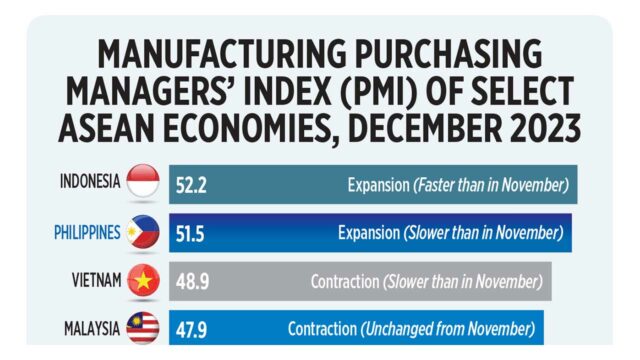
Manufacturing Purchasing Managers’ Index (PMI) of select ASEAN economies, December 2023

FACTORY ACTIVITY in the Philippines expanded at a slower pace in December, reflecting modest growth in new orders and output across the sector, S&P Global said on Tuesday. Read the full story.


Manufacturing Purchasing Managers’ Index (PMI) of select ASEAN economies, December 2023

How PSEi member stocks performed — January 2, 2024

Here’s a quick glance at how PSEi stocks fared on Tuesday, January 2, 2024.


Shares climb on expectations of easing inflation

BW FILE PHOTO

PHILIPPINE SHARES closed higher on the first trading day of 2024 as investor sentiment was lifted by expectations of slower inflation in December.

The benchmark Philippine Stock Exchange index (PSEi) jumped by 104 points or 1.61% to end at 6,554.04 on Tuesday, while the broader all shares index rose by 41.38 points or 1.2% to close at 3,465.97. 

“We welcome 2024 with hopes of a better performance for the stock market. We are also optimistic that our regulator will continue to support the initiatives we will introduce to boost participation and liquidity in the market,” PSE President and CEO Ramon S. Monzon said in a statement.

Shares rose on Tuesday as inflation likely slowed further last month, Philstocks Financial, Inc. Research Analyst Claire T. Alviar said in a Viber message.

“The possibility that inflation rate would settle within the 2-4% target of the government in December lifted market sentiment. Investors were also waiting for some economic data set to be released this week,” Ms. Alviar added. 

Headline inflation likely eased to 4% in December, according to the median estimate of a BusinessWorld poll conducted last week. This is within the 3.6-4.4% forecast of the Bangko Sentral ng Pilipinas (BSP) for the month.

If realized, December would mark the first time that inflation met the BSP’s 2-4% target and the slowest since the 3% print in February 2022.

At 4%, December inflation would be a tad slower than 4.1% in November and significantly lower than 8.1% in December 2022.

This would bring the 2023 inflation average to 6%, matching the BSP’s baseline forecast.

The Philippine Statistics Authority will release December inflation data on Friday.

“The market’s rally is due to the seasonally strong period of New Year’s optimism and growing interest rate cut bets in 2024,” First Metro Investment Corp. Head of Research Cristina S. Ulang added in a Viber message.

The majority of sectoral indices climbed on Tuesday. Holding firms rose by 217.37 points or 3.56% to 6,323.37; services increased by 37.45 points or 2.33% to 1,642.44; industrials went up by 85.71 points or 0.94% to 9,161.62; and financials added 7.73 points or 0.44% to end at 1,746.61.

On the other hand, mining and oil fell by 114.50 points or 1.14% to 9,885.93, and property dropped by 19.33 points or 0.67% to 2,835.61. 

“The mining sector was at the bottom, down by 1.14%, weighed by the performance of Nickel Asia Corp., which declined by 3.83%,” Ms. Alviar said. 

Value turnover dropped to P3.66 billion on Tuesday with 379.80 million issues switching hands from the P4.88 billion with 1.12 billion shares seen on Friday.

Advancers outnumbered decliners, 100 to 77, while 47 names closed unchanged. 

Net foreign buying rose to P443.11 million on Tuesday from P208.97 million on Friday. — R.M.D. Ochave

ADVERTISEMENT
ADVERTISEMENT