Home Blog Page 3833

Metro Retail breaks ground for Dalaguete, Cebu branch

METRORETAIL.COM.PH

LISTED Metro Retail Stores Group, Inc. said it held groundbreaking ceremonies for a Metro Supermarket branch in Dalaguete town, Cebu as part of its expansion efforts.

In a regulatory filing on Thursday, Metro Retail said the soon-to-rise store in Dalaguete is expected to boost the town’s economic growth, with more job opportunities for the community.

The company and the local government of Dalaguete signed a partnership agreement for the upcoming Metro Supermarket branch.

“The vision of Metro Supermarket goes beyond providing goods and services,” Metro Retail President and Chief Operating Officer Manuel C. Alberto said in the statement. “It is a commitment to being a responsible corporate citizen, supporting local initiatives, and becoming an integral part of the fabric of our community.”

Metro Retail has 64 stores in Luzon and the Visayas consisting of various store formats such as Metro Supermarket, Metro Department Store, Super Metro Hypermarket, and Metro Value Mart.

Shares of Metro Retail fell by 0.78% or a centavo to P1.27 each at the close of trading. — Revin Mikhael D. Ochave

Financial technology trends in 2024 and beyond

As we embark on the unfolding chapters of 2024, the world of financial technology (fintech) continues its dynamic evolution. This year brings forth a tapestry of trends shaping the industry, with each thread weaving a narrative of digital innovation, regulatory adaptations, and changing consumer landscapes. Let’s delve into these transformative shifts, backed by real-world examples.

One trend is the growth of decentralized finance (DeFi). This continues to dominate the fintech landscape, with platforms like Aave and Compound gaining prominence. These decentralized financial hubs provide lending and borrowing services, enabling users to earn interest or borrow assets without relying on traditional banking systems. Notably, projects like Terra are contributing to financial inclusion by offering stablecoins pegged to local currencies in regions with limited access to traditional banking services. In the Philippines, platforms like BloomX are facilitating decentralized currency exchange, offering users the ability to trade digital assets without the need for traditional intermediaries.

Another is the rise of Central Bank Digital Currencies (CBDCs), which are not just theoretical concepts; they are actively shaping the financial landscape. China’s Digital Currency Electronic Payment (DCEP) stands out as a tangible example, with ongoing pilot programs across various cities showcasing the potential of a government-backed digital currency. Additionally, the Bahamas has successfully implemented the Sand Dollar, demonstrating the practical implementation of a fully operational CBDC. The Philippines is still in the exploratory phase, with the Bangko Sentral ng Pilipinas (BSP) expressing interest in studying the potential implementation of a digital currency.

Artificial intelligence (AI) and machine learning (ML) are another pivotal trend in reshaping financial services. Wealthfront, a robo-advisory platform, employs AI to provide personalized investment advice, highlighting the marriage of technology and finance for individual benefit. On the frontlines of fraud prevention, companies like Feedzai utilize AI for real-time detection, exemplifying the role of technology in safeguarding financial transactions. Coins.ph, a mobile wallet in the Philippines, utilizes AI for fraud detection, ensuring secure and seamless transactions for its users.

Not to be left behind is the continued evolution of contactless payments and digital wallets, which have become integral to our daily transactions. Apple Pay and Google Pay, among others, are now household names. These digital wallets leverage NFC technology for secure and convenient transactions, minimizing the need for physical cash. Biometric authentication, as seen in mobile banking apps like Samsung Pay, further enhances the security of digital payment solutions. GCash and Maya, widely used mobile wallets in the Philippines, facilitate cashless transactions, bill payments, and even investments, contributing to the growing adoption of digital financial services. The convenience and security offered by digital wallets align with the broader global trend.

Sustainable finance and ESG (Environmental, Social, and Governance) investing are likewise gaining traction, with fintech platforms like Aspiration and Clim8 Invest leading the charge. Aspiration offers sustainable banking and investment options, allowing users to align financial goals with environmental and social values. In Europe, Clim8 Invest focuses on sustainable investing, offering a platform that facilitates investments in companies committed to climate change mitigation and environmental sustainability. In the Philippines, fintech platforms like Investree are incorporating ESG criteria into their lending and investment processes, allowing users to make socially responsible financial decisions.

The ongoing growth in fintech comes with its cybersecurity challenges. Companies like Forter specialize in AI-driven fraud prevention solutions, providing advanced tools for the detection and prevention of online transaction fraud. Addressing regulatory compliance is OpenVASP, an open-source project focused on developing a framework for Virtual Asset Service Providers (VASPs) to comply with global regulations related to anti-money laundering (AML) and counter-terrorist financing (CTF). In the Philippines, financial institutions are investing in advanced cybersecurity measures, incorporating AI and ML to detect and prevent fraudulent activities.

In conclusion, the financial technology landscape in 2024 is marked by tangible developments and real-world applications. DeFi, CBDCs, AI, contactless payments, sustainable finance, and cybersecurity are not just concepts but forces actively shaping the way we manage and interact with our finances. Fintech’s journey is one of collaboration between traditional financial institutions and nimble startups, promising a future that is both transformative and inclusive.

The views expressed herein are his own and do not necessarily reflect the opinion of his office as well as FINEX.


Reynaldo C. Lugtu, Jr. is the founder and CEO of Hungry Workhorse, a digital, culture, and customer experience transformation consulting firm. He is a fellow at the US-based Institute for Digital Transformation. He is the chair of the Digital Transformation IT Governance Committee of FINEX Academy. He teaches strategic management and digital transformation in the MBA Program of De La Salle University. The author may be e-mailed at rey.lugtu@hungryworkhorse.com

Dan Levy shows more solemn side in Netflix film Good Grief

DANIEL LEVY, Ruth Negga, and Himesh Patel in Good Grief. —IMDB.COM

LOS ANGELES — Schitt’s Creek creator and four-time Emmy winner Dan Levy is showing off a more serious side to himself as part of a multiyear film and TV deal with the streaming giant Netflix.

The maiden production is the film Good Grief, which Mr. Levy wrote, directed, and stars in. It follows his character, Marc, whose life is turned upside down when his husband, Oliver, played by Luke Evans, dies suddenly in an accident.

Marc must reconstruct his life with the help of his two best friends, Thomas, played by Himesh Patel, and Sophie, portrayed by Ruth Negga.

The movie, which starts streaming on Netflix on Jan. 5, is a drama which Mr. Levy hopes his fans will connect with even though it is outside the comedic work for which he is known.

“I think it’s very rare to be given an opportunity to do something so different from what people know you to do and that takes a leap of faith from, in this case, from Netflix to greenlight something that’s so different,” Mr. Levy said.

He feels that actors often get type-cast and must stay in the genre people expect them to be, so he is grateful for the chance to do something personal to him.

Although lighthearted, the film shows how friendship can help through the process of mourning.

“I think there’s this fear … that sharing your fears or your sadness is a burden on your friendships, but I think that is the greatest act of love ultimately,” Mr. Levy said.

To create the friendship bond, he arranged for Patel, Negga, and himself to connect over several weeks before shooting, including doing an escape room together in London, which Mr. Levy said had “everyone’s skill sets just put on display.”

Whether it is comedy or drama, he wants people to see that his work resonates across genres.

“I cared very deeply about Schitt’s Creek and I think the common theme here is that both of these projects have a very large heartbeat to them, and I hope will mean something to people in very different ways,” he said.

Mr. Levy’s multiyear deal with Netflix began in 2021. — Reuters

Philippines seen to be the 23rd largest economy by 2038

The Philippines is projected to be the 23rd largest economy by 2038 based on the latest edition of the World Economic League Table by London-based think tank Center for Economics and Business Research (CEBR). The country’s current standing is a 10-place jump from its 2023 rank of 33rd out of 190 economies.


Philippines seen to be the 23<sup>rd</sup> largest economy by 2038

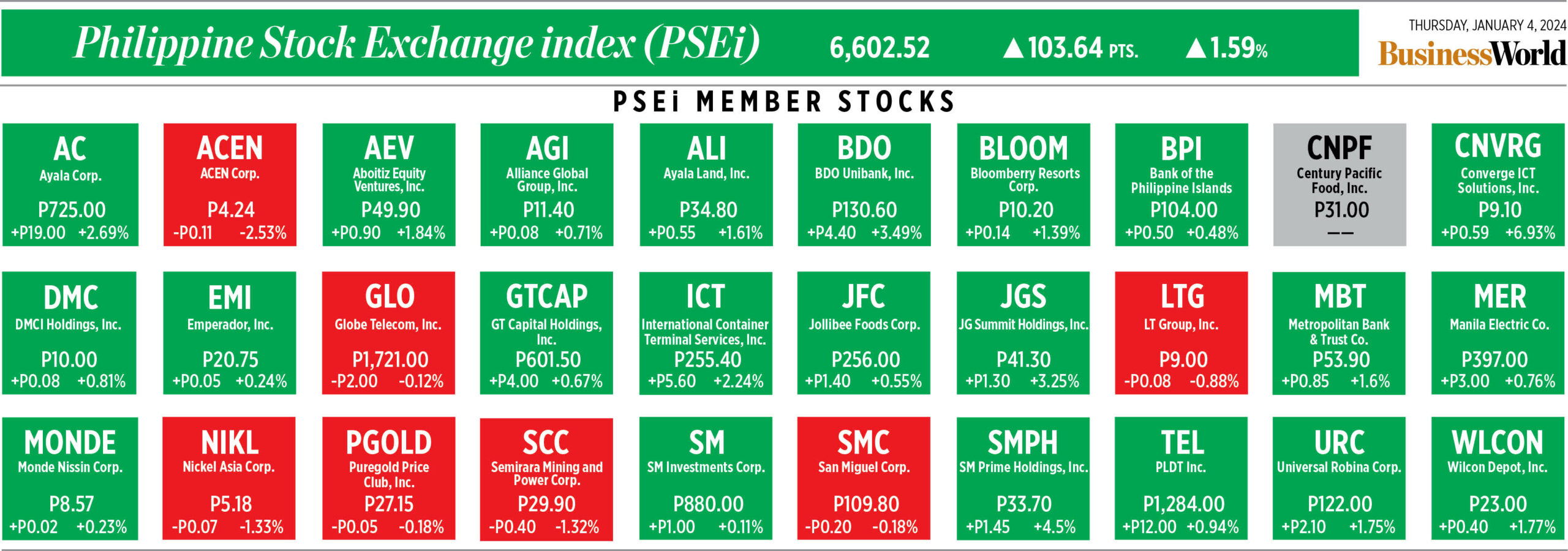
How PSEi member stocks performed — January 4, 2024

Here’s a quick glance at how PSEi stocks fared on Thursday, January 4, 2024.


Peso strengthens before Dec. inflation data release

BW FILE PHOTO

THE PESO rose further against the dollar on Thursday as Philippine inflation likely eased last month.

The local unit closed at P55.50 per dollar on Thursday, strengthening by seven centavos from its P55.57 finish on Wednesday, based on Bankers Association of the Philippines data.

The peso opened Thursday’s session steady at P55.75 against the dollar. Its intraday best was at P55.465, while it dropped to as low as P55.78 versus the greenback during the session.

Dollars exchanged dropped to $1.72 billion on Thursday from $1.88 billion on Wednesday.

The peso gained against the dollar on market expectations that headline inflation eased further in December, Rizal Commercial Banking Corp. Chief Economist Michael L. Ricafort said in a Viber message.

The Philippine Statistics Authority will release December consumer price index data on Friday.

A BusinessWorld poll conducted last week yielded a median estimate of 4% for December headline inflation, within the central bank’s 3.6-4.4% forecast and slower than 4.1% in November and 8.1% in December 2022.

If realized, December would be the first time that inflation was within the central bank’s 2-4% target and the slowest since the 3% print in February 2022.

This would bring the 2023 inflation average to 6%, matching the Bangko Sentral ng Pilipinas’ (BSP) baseline forecast.

The continued easing of inflation could prompt the BSP to cut rates within this year, Mr. Ricafort added.

BSP Governor Eli M. Remolona, Jr. said last month that the central bank will likely keep rates elevated until inflation is comfortably within its 2-4% goal.

The Monetary Board has raised borrowing costs by a cumulative 450 basis points (bps) from May 2022 to October 2023, bringing the policy rate to a 16-year high of 6.5%.

For Friday, Mr. Ricafort expects the peso to range from P56.40 to P55.60 per dollar. — AMCS

PSEi rebounds before December inflation data

BW FILE PHOTO

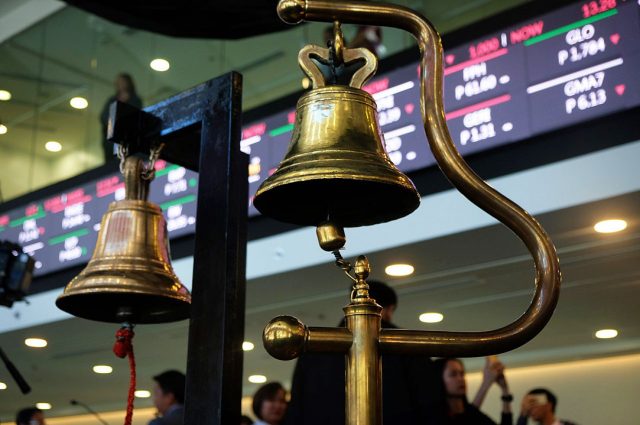
PHILIPPINE SHARES rebounded on Thursday amid expectations of better inflation data for December.

The Philippine Stock Exchange index (PSEi) gained 103.64 points or 1.59% to end at 6,602.52 on Thursday, while the broader all shares index rose 35.52 points or 1.02% to close at 3,485.76.

“This Thursday, the local market rose by 103.64 points to 6,602.52 on the back of hopes that headline inflation in the Philippines had further declined last December. Supporting the said hopes is the midpoint of the Bangko Sentral ng Pilipinas’ (BSP) 3.6-4.4% range forecast which is below the preceding month’s 4.1%,” Philstocks Financial, Inc. Research and Engagement Officer Mikhail Philippe Q. Plopenio said in a Viber message.

The Philippine Statistics Authority will release December consumer price index data on Friday.

A BusinessWorld poll last week yielded a median estimate of 4% for December headline inflation, within the BSP’s 3.6-4.4% forecast for the month. This is slightly slower than the 4.1% in November but significantly below the 8.1% in December 2022.

If realized, December could mark the first time that inflation met the central bank’s 2-4% target after 20 straight months. It would also be the slowest since the 3% print in February 2022.

This would bring the 2023 inflation average to 6%, matching the BSP’s baseline forecast.

“The index surged above the 6,600 level and reached its highest close in more than five months as investors positioned ahead of the release of the Philippine December inflation print on Friday,” China Bank Capital Corp. Managing Director Juan Paolo E. Colet likewise said in a Viber message.

“The PSEi bucked the fall of most Asian markets as traders bought up local stocks on expectations that domestic headline inflation last month cooled to 4%, which is within the BSP’s target inflation range,” Mr. Colet added.

Asian shares fell on Thursday as traders dialed back bets of steep and early rate cuts this year, with the minutes of the US Federal Reserve’s last meeting providing few clues on when US cuts might start, Reuters reported.

MSCI’s broadest index of Asia-Pacific shares outside Japan fell 0.17% and was headed for the third straight day of losses.

Back home, almost all sectoral indices ended higher on Thursday. Property increased by 78.36 points or 2.77% to 2,907.31; financials climbed by 30.76 points or 1.78% to 1,754.47; services rose by 25.86 points or 1.59% to 1,651.63; holding firms went up by 71.46 points or 1.13% to 6,360.48; and industrials added 33.14 points or 0.36% to end at 9,137.63. 

Meanwhile, mining and oil dropped by 77.40 points or 0.78% to 9,777.89. 

Value turnover climbed to P5.18 billion on Thursday with 461.64 million issues changing hands from the P3.11 billion with 182.7 million shares seen on Wednesday.

Advancers outnumbered decliners, 110 to 85, while 46 issues ended unchanged. 

Net foreign buying stood at P768.3 million on Thursday versus the P260.5 million in net selling seen the prior day. — R.M.D. Ochave with Reuters

ERC: Committee looking into Panay Island power outage

Line men fix an electric line in Payatas, Quezon City, March 13, 2022. Manila Electric Co. is implementing lower power rates this month. — PHILIPPINE STAR /MICHAEL VARCAS

THE Energy Regulatory Commission (ERC) said the Panay power outage has been referred to an interim grid management committee for investigation, adding that appropriate penalties will be imposed after the panel delivers its findings.

“After the investigation, if penalties are called for, then we will commence proper proceedings to allow the relevant parties to answer and, if answers are not acceptable, impose penalties,” ERC Chairperson Monalisa C. Dimalanta said in a Viber message.

The National Grid Corp. of the Philippines (NGCP) reported on Tuesday that multiple power plants tripped, including units of Panay Energy Development Corp. and Palm Concepcion Power Corp. (PCPC).

Due to the plant outages, some 452 megawatts (MW) became unavailable, causing the NGCP to raise a yellow alert on the Visayas grid.

The yellow alert was lifted at 9:01 p.m. on Tuesday.

According to an NGCP update on Thursday, some 244.6 MW of electricity is currently being generated by Panay power plants.

The Visayas grid will need about 300 MW to stabilize, and is awaiting the return of a 135-MW PCPC facility.

The plant is targeted to be synchronized with the grid between 10 p.m. and 12 midnight on Jan. 4.

Citing an initial report, Ms. Dimalanta said equipment failure at PCPC caused the plant to trip. Operators are waiting for the unit to cool down before it can be restarted.

MORE Electric and Power Corp., the sole electric distribution utility in Iloilo City, has been affected by the power disruption, as well as seven electric cooperatives on the island.

As of 2:30 p.m. on Thursday, almost 50% of MORE’s customers were still not receiving power, it said. The company has imposed rotational outages every three hours due to the insufficient power supply.

“We need to investigate this further because it is impossible that all plants just decided to go offline all at the same time, or that they all failed on their own at the same time,” Ms. Dimalanta said.

“There must be something that led to those serial consequences among the generation plants,” she added.

Ms. Dimalanta said there should have been systems in place to prevent such occurrences.

She said that NGCP can direct distribution utilities to drop load to reduce demand to the level of available supply, thereby stabilizing the system.

“The system operator also controls the dispatch of plants so it could have initiated measures also on that end,” she said.

“We are reviewing whether these measures were undertaken and whether they were enough, or if anything else can be improved,” she added.

The NGCP has said that load restoration will be done “conservatively, by matching loads to restored generation, to prevent repeated voltage failure.”

“The people must understand that we can only transmit power, we do not generate power,” it said in a statement on Wednesday.

Legislators have called on the NGCP and the Department of Energy (DoE) to look into the Western Visayas outages.

“The DoE and the NGCP must understand the gravity of this situation and act decisively to resolve it,” Senate President Juan Miguel F. Zubiri said in a statement. “They should get their acts together immediately.”

He said constant power interruptions hamper the livelihoods and the delivery of basic services to the region’s citizens.

Mr. Zubiri called on the DoE and NGCP to be transparent in implementing measures to address the outages.

Party-list Rep. France L. Castro called on the NGCP to take accountability for the blackouts that have left some parts of Panay without electricity since Jan. 2.

In a statement, she also called on MORE Electric and Power Corp., which supplies power to Iloilo City, to improve its coordination with the electric system grid operators.

“Does (MORE Power) even have a system to help protect the grid from collapsing, like a load dropping mechanism?” Ms. Castro said.

Senate Majority Floor Leader Joel J. Villanueva said the government needs a short-term and long-term strategy for dealing with power disruptions, include ensuring that power plants are properly maintained.

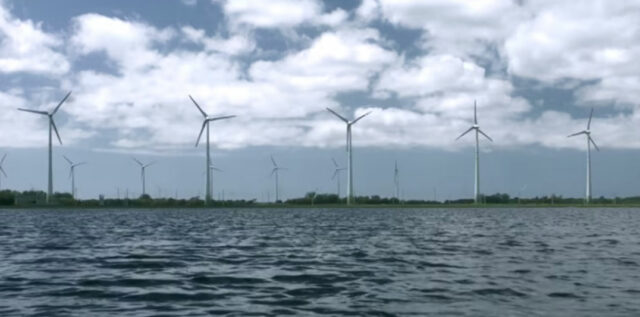
“We also need to continue exploring other sources of renewable energy such as wind and solar to keep up with the DoE’s goal of a power generation mix target of 35% by 2030,” he said in a statement.

Citing DoE data, Mr. Villanueva said about half of the power plants in the Philippines are at least 20 years old.

“The situation is no longer tolerable, and the DoE and the NGCP must urgently address this issue before irreparable damage is done to our communities,” Mr. Zubiri said. — Sheldeen Joy Talavera and John Victor D. Ordoñez


Rice imports hit 3.48 million MT as of late December

BW FILE PHOTO

THE PHILIPPINES imported 3.48 million metric tons (MT) of rice in 2023 as of late December, according to the Bureau of Plant Industry (BPI).

Rice imports in December up to the 28th of the month totaled 387.21 thousand MT, up 29.19% from a year earlier.

The Department of Agriculture (DA) said for the entirety of 2023, imports are expected to total 3.65 million MT, or below the 3.8 million MT projected by the US Department of Agriculture.

The DA has said that about 500,000 MT of rice are expected to arrive in December and January as the government seeks to build reserves for the peak of El Niño.

El Niño is expected to intensify between January and May, affecting about 63 provinces with droughts and dry spells, according to the government weather service, known as PAGASA (Philippine Atmospheric, Geophysical and Astronomical Services Administration).

The BPI reported that Vietnam remained the Philippines’ top supplier of rice with 84.27% of total imports. Shipments from Vietnam are expected to hit 2.94 million MT.

Thailand supplied 297.2 thousand MT and Myanmar 143.92 thousand MT.

The DA said that 75 thousand MT of rice was set to arrive from India by early January, part of a 295,00 MT rice allocation India granted the Philippines in October.

The Indian government issued the quota for non-basmati white rice to the Philippines. It had earlier banned all exports of non-basmati white rice to stabilize its domestic supply.

Arrivals from India have amounted to 13,758 MT, as of Dec. 28.

Meanwhile, the BPI has issued 824 sanitary and phytosanitary import clearances (SPSICs) for December covering the import of about 660.01 thousand MT of rice.

Agriculture Secretary Francisco Tiu Laurel, Jr. said he has instructed traders to use up their SPSICs for an additional 1 million MT of rice. The DA has imposed a 30-day deadline for traders to use their permits. — Adrian H. Halili

Agri export growth hindered by funding, capacity constraints

BW FILE PHOTO

By Adrian H. Halili, Reporter

AGRICULTURAL EXPORT growth will continue to be constrained by limited output and funding to develop the high-value crop sector, farmers said.

“Our problem with exports goes back to our problems in producing high-quality and competitively priced products on a consistent and sustainable basis, and in a way that is profitable for our farmers and market players,” Federation of Free Farmers National Manager Raul Q. Montemayor said in a Viber message.

Former Agriculture Undersecretary Fermin D. Adriano blamed the lack of funds allocated for high-value crops, as against the attention paid to rice production.

The Department of Agriculture (DA) has set aside about P31 billion in 2024 to improve rice production.

“For as long as research and development and extension services receive a pittance, and the DA does not properly play its role of training our agri-exporters on (sanitary and phytosanitary) standards of the various rich importing countries, export growth potential will be constrained,” Mr. Adriano said in a Viber message.

The DA has announced the preparation of a Philippine Agricultural Export Development Plan to increase exports of agriculture and fisheries products.

“Despite all the supposed concessions we gained from trade negotiations, our agricultural trade deficit has continued to increase, especially since our competitors are racing far ahead of us,” Mr. Montemayor added.

Agricultural exports declined 13.3% to $1.61 billion during the third quarter, accounting for 8.2% of total exports, according to the Philippine Statistics Authority.

The leading exports were edible fruit and nuts as well as peel of citrus fruit and melons, valued at $492.09 million, or 30.5% of the total.

He said that the DA needs to identify products to focus on for export while setting up a support system covering the process from production to domestic and international markets.

Malaking trabaho (It’s a big job) but there are many success stories, which we just need to promote and expand,” Mr. Montemayor added.

Meanwhile, Roy S. Kempis, a retired Pampanga State Agricultural University professor, said that agriculture products like mango, avocado, and durian are on demand in global markets but can benefit from further support.

“Philippine mango is preferred for its sweetness, texture and appropriate amount of fiber both in the export and domestic markets,” Mr. Kempis said in a Viber message, citing the potential for expanding the crop.

He added that the government could increase farmland dedicated to avocado and durian.

Mr. Kempis said technical and management training is needed by producers and exporters.

He said increasing the planting area, improving pest management and irrigation systems, and building community processing areas, will support the growth of such exportable crops, as will more access to credit.

“Exporting and financial literacy are two other areas that agriculture and food producers and exporters could be trained in,” he added.

Upskilling, streamlined gov’t seen improving business performance in 2024, PCCI says

PHILSTAR FILE PHOTO

THE Philippine Chamber of Commerce and Industry (PCCI) said that 2024 could be a better year for business as the government and private sector seek to address ease of doing business (EoDB), power, and upskilling issues.

“With all these efforts… and all those good individuals who were recently appointed to help us address the issues (of) EoDB, power and upskilling and reskilling of our labor, we are optimistic that 2024 will be a better year,” said PCCI President Enunina Mangio in a television interview.

She said foreign business organizations’ own forecasts are signaling that the Philippines could be the fastest growing economy in Southeast Asia.

“PCCI assumes that this growth will be driven by resilient domestic consumption, increased government spending, infrastructure projects and a gradual recovery in some sectors. We see the economy gradually and moderately growing,” she added.

She cited the need to strengthen its foreign relations and work on achieving remittance targets from overseas Filipino workers.

The reliance on remittances “is why reskilling of our laborers is very important,” she added.

Ms. Mangio said that the PCCI recognizes that the business sector has the responsibility to help the government in reviving the economy.

“That is why we are taking a more proactive role in helping the national and local governments champion initiatives that will make our enterprises more competitive and our important sectors more attractive to local and foreign investors,” she said. — Justine Irish D. Tabile

FEF proposes relaxing foreign ownership restrictions in Constitution

ELECNOR

THE Foundation for Economic Freedom, Inc. (FEF) is proposing amending the Constitution’s economic provisions to allow 100% foreign ownership of land, utilities, educational institutions, and mass media.

“We believe that the removal of restrictive economic provisions sends a clear and compelling message to foreign investors, signaling a warm welcome to investment and business operations in the Philippines,” the FEF said in a statement on Thursday.

“The restrictions in the 1987 Constitution serve as constraints to developing areas of the economy where the Philippines has great promise such as mass media and renewable energy. The existing constitutional restrictions limit investments that we need to develop our creative industries,” it added.

The FEF proposed to amend the following sections of the Constitution to allow 100% foreign ownership: Section 2, Article XII (National Patrimony and Economy); Section 3, Article XII (National Economy and Patrimony); Section 7, Article XII (National Patrimony and Economy); Section 10, Article XII (National Patrimony and Economy); Section 11, Article XII (National Patrimony and Economy); Section 4, Article XIV (Education, Science and Technology, Arts, Culture, and Sports); and Section 11, Article XVI (General Provisions).

The FEF also proposed the following amendments to the Filipino First provisions of the Constitution:

Section 19, Article II (Declaration of Principles and State Policies): From “The State shall develop a self-reliant and independent national economy effectively controlled by Filipinos” to “The State shall develop a self-reliant and independent national economy for the benefit of all Filipinos.”

Section 10, Article XII (National Economy and Patrimony): From “…In the grant of rights, privileges, and concessions covering the national economy and patrimony, the State shall give preference to qualified Filipinos…” to “…in the grants of rights privileges, and concessions covering the national economy and patrimony, the State shall give preference to qualified investors.”

Removing such restrictions in the Constitution could help policymakers respond more effectively to both global and domestic economic changes, the FEF said.

Congress may still install safety nets within the constitution to ensure economic and social development, it added.

“We strongly emphasize that constitutional amendments should be limited exclusively to economic provisions. This focused approach reduces the risk of political controversy and division, ensuring the swift passage of crucial amendments to the economic provisions of the Constitution,” the FEF said.

However, the FEF noted that amending the constitution alone won’t sufficiently attract foreign investors as the government still needs to improve on upholding the rule of law, improving infrastructure, and ensuring ease of doing business.

Policy analyst and lawyer Michael Henry L. Yusingco said allowing 100% foreign ownership is not expected to boost foreign direct investments (FDI) significantly.

“But if we also fix our power issues, labor productivity issues, and transportation issues, then the amendment of the economic provisions can lead to a boost in FDI specifically in the sectors concerned like education, mass media and power generation,” he said via messenger.

“To boost our FDI, we also need to solve basic problems like power costs, labor costs and other costs of doing business,” he added.

Meanwhile, University of the Philippines-Los Baños Economics Senior Lecturer Enrico P. Villanueva said there is a risk politicians will take advantage of the amendment process to advance their interests.

“Government should focus its energies and resources instead on making the domestic business climate attractive. Costs of doing business should be lower (energy, transport, fees, bureaucracy, etc.), he said in a social media message.

Mr. Villanueva noted that the definition of public services was eased under the Duterte administration to attract foreign investors, but FDI did not increase significantly.

Mr. Yusingco also cited the Retail Trade Liberalization Act and the New Public Service Act as instances of the government seeking to remove obstacles to foreign ownership. — Aaron Michael C. Sy

ADVERTISEMENT
ADVERTISEMENT