Home Blog Page 3829

PAWS renovated by interior design students

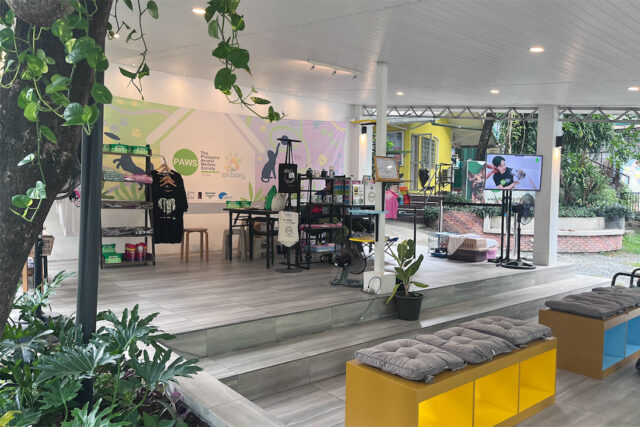
WITH the aim to provide relief and comfort for rescued pets, a group of young designers renovated the reception and recovery areas of the Philippine Animal Welfare Society (PAWS) Animal Rehabilitation Center, a non-government organization’s shelter in Loyola Heights, Quezon City.

Founded in 1954 by British educator Muriel Jay, the low-cost clinic provides veterinary services to pets of the indigent community. Its services include the spaying and neutering of cats and dogs saved from neglect or cruelty.

Entitled Alwán, a Filipino word for serenity and relief from sorrow, the project was an initiative of Interior Design Program students of the De La Salle-College of Saint Benilde (DLS-CSB). It aligns with PAWS’ mission to alleviate suffering and stigma surrounding lost or abandoned furry companions.

The PAWS waiting lounge was designed to be spacious to accommodate and offer an engaging area for personnel and guests. The space has small ramps for puppies. It likewise features steps for active kittens to access elevated places without excessive jumping. Cozy chairs with cushions are available for adoptive owners and donors who continuously drop by the sanctuary.

The students used the colors blue, green, and yellow to suggest warmth, hope, and the power of nature in the 10 recuperation pens intended for isolation and specialized care for the distraught and distressed animals. The facilities were likewise refurbished and designed for easy access to foster the practice of humane treatment and a nurturing environment.

Indoor plants such as selloum and moses-in-the-cradle, plus photos give an eco-friendly experience for visitors.

Under the guidance of Benilde Interior Design mentor IDr. Randy Pabona, the team was comprised of Kelly Andrei Abad, Angelika Mae Aguilar, Julia Pamela Alfonso, Zenisa Claire Asuncion, Rudi Jenelle Concepcion, Athena Mae Cruz, Carla Gionna Dayanghirang, Dorisa Gwen De Joya, Jameela Durrani-Khan,  Kathryn Lauren Enorme, Sophia Margarett Ferrer, Alaine Nicole Hernandez, Franchezka Johnna Jumarang, Gabrielle Grace Luy, Kaila Gabrielle Miranda, Cyra Therese Muyano, Mary Antoinette Nery, Jhemmar Vincent Riguerra, Victor Raphael Santos, Eddie Shi, and Winona Alyssa Te.

The students organized fundraising activities such as bazaars, merchandise sales, and raffle draws to gather resources for the project.

Their concepts, journey, and construction process can be seen in an exhibit at the Ayala Malls, Manila Bay. For more information about Alwán, visit https://www.facebook.com/thealwan2023.

Vaccination across the life stages

NATIONAL CANCER INSTITUTE-UNSPLASH

Over the next decade, changes in population demography, disease epidemiology, and the availability of new vaccines will increase the need to reach different age groups across the life course, according to the World Health Organization (WHO).

Life-course immunization will open opportunities for immunization services to be integrated with other health programs. This has the potential to provide a more people-centered approach to health across each stage of life.

Immunization programs that are better integrated in the wider health system can more comprehensively address population health needs over time, make efficient use of resources, and improve health outcomes, especially of those who are underserved, the WHO said.

Vaccine experts who spoke during the “Injecting Hope” seminar-workshop held in Manila reiterated the WHO’s message that vaccination across life stages protects all populations from vaccine-preventable diseases.

The two-day event was organized by the Philippine Press Institute in partnership with the Pharmaceutical and Healthcare Association of the Philippines (PHAP) and member Pfizer Philippines, along with the Philippine Medical Association (PMA), Philippine Foundation for Vaccination, and Philippine Alliance for Patient Organizations.

“Getting the recommended vaccines does not end when a child reaches one year of age. Vaccines during school age, adolescence, and adulthood are equally important,” stressed Dr. Janis Bunoan-Macazo, Department of Health (DoH) Program Manager for the National Immunization Program (NIP).

In line with its thrust on life-course immunization, the DoH through the NIP, provides free vaccines during pregnancy (tetanus-diphtheria), neonatal age (BCG, hepatitis B vaccine), infancy (oral polio vaccine, inactivated polio vaccine, DPT-HepB-Hib, pneumococcal conjugate vaccine, measles-mumps-rubella). Also included are childhood (measles-containing vaccine, tetanus-diphtheria), adolescence (human papillomavirus vaccine, measles-containing vaccine, tetanus-diphtheria), and adulthood (flu vaccine, pneumococcal polysaccharide vaccine).

Dr. Benito Atienza, immediate past president of the PMA, suggested ways to promote life-course immunization in the country. These are, among others, instituting annual National Vaccination Days for all Filipinos, and creating a synchronized and digital national individual immunization record database.

He also recommended requiring immunization records for school enrolment and updated immunization records for high school and college enrolment. Another way forward is including vaccine history in annual physical examinations for employment and incorporating lectures on immunization by vaccine experts in the science subject for grade school and high school.

Older adults or the elderly must get their recommended vaccines, as they are considered vulnerable or at-risk populations, said Dr. Lourdes Carolina I. Dumlao.

As president of the Philippine Society of Geriatrics and Gerontology, she explained that the elderly undergo natural changes in their immune system (immunosenescence) as well as chronic inflammation (inflammaging) that results in a progressive decrease in the aging body’s ability to trigger effective antibody and cellular responses against infection and vaccinations.

Dr. Dumlao cited the US Centers for Disease Control and Prevention-recommended vaccines for individuals ages 65 and older. These are vaccines for COVID-19, Haemophilus influenzae b (Hib), hepatitis A and hepatitis B, herpes zoster (shingles), influenza (flu), measles-mumps-rubella, meningococcal A/C/W/Y, meningococcal B, pneumococcal, tetanus-diphtheria-pertussis, and varicella (chickenpox).

Variant-specific COVID-19 vaccinations are important to protect priority populations such as the elderly who are at risk of hospitalization and complications, said Dr. Rontgene Solante, Chairman of Adult Infectious Diseases and Tropical Medicine, San Lazaro Hospital.

He noted that the recent increase in cases of influenza-like illnesses (ILIs) in the country is due to new COVID-19 variants of concern (VOCs) causing new infections and hospitalizations. At the same time, these VOCs are co-circulating with other respiratory viruses, such as influenza, parainfluenza, rhinovirus (the common cold), adenovirus, enterovirus, and respiratory syncytial virus (RSV).

Dr. Solante said that long-term vaccination programs should include vaccines for COVID-19 aside from other vaccine-preventable diseases like influenza and pneumonia as part of life-course immunization for vulnerable populations. He also recommended surveillance and tracking of ILIs to prevent outbreaks.

The year 2024 must be the time to kickstart life-course immunization so that families and individuals could get the needed protection from vaccine-preventable diseases amidst developments that could impact health this year.


Teodoro B. Padilla is the executive director of Pharmaceutical and Healthcare Association of the Philippines (PHAP). PHAP represents the biopharmaceutical medicines and vaccines industry in the country. Its members are in the forefront of research and development efforts for COVID-19 and other diseases that affect Filipinos.


Jetour Auto Alabang opens

From left are Jetour Auto Alabang General Manager Dante Calma, Jetour Auto Alabang Dealer Principals Dexter Co and Rachel Villanueva, Jetour Auto Philippines Managing Director Miguelito Jose, Barangay Alabang Chair Christine May ‘Tintin’ Abas-Ding, and Jetour Auto Philippines Marketing Director May De Los Santos. — PHOTO FROM JETOUR AUTO PHILIPPINES

JETOUR AUTO PHILIPPINES and Autoflare Corp. recently opened Jetour Auto Alabang, the first of the Autoflare’s expected series of dealerships. Located within the entertainment and business area of the busy metropolitan city of Muntinlupa, it has a showroom display space able to accommodate five vehicles.

Customers south of the metropolis can access the latest value-for-money models from the brand, such as the Jetour X70 seven-seat crossover, X70 Plus three-row crossover, Dashing compact crossover, and Ice Cream electric vehicle.

Jetour Auto Alabang features a unique valet service for Jetour owners who schedule their vehicles for preventive maintenance service. Customers only need to book their car’s service appointment and hand over the vehicles to the dealership. From there, a dedicated service team will handle the maintenance work offsite.

“Jetour Auto Alabang has been with us from the start, and its presence in the south of Metro Manila ensures our customers have easy and convenient access to quality service in the area,” shared Jetour Auto Philippines Managing Director Miguelito Jose. “We are truly honored to have Autoflare Corp. join us in this journey.”

Established in April 2021, Autoflare Corp. is a multi-brand car dealership group. Jetour is Autoflare’s first venture into brand-new car sales. Allied with the Autospeedygo Group, Autoflare is managed by automotive industry veterans whose decades of dealership sales and after-sales operations experience “ensure utmost customer satisfaction.”

“Autoflare’s partnership with Jetour symbolizes our trust and belief in the quality, reliability, and potential of Jetour to become a highly sought-after car brand in the Philippines,” said Autoflare Corp. President Rachel Ann Villanueva. “Aside from our partnership to introduce Jetour to the Philippines, Autoflare is also committed to provide premium service through Jetour Auto Alabang. This dealership is the first of many between Autoflare and Jetour as we work hand-in-hand to provide more Filipinos true value-for-money mobility and a car ownership experience like no other.”

For more information, call 0968-881-8315.

World food price index ends 2023 some 10% below 2022 levels

REUTERS

LONDON — The United Nations (UN) food agency’s world price index ended last year about 10% below its 2022 level, with values in December also down from the previous month, helping further ease concerns over global food price inflation.

The Food and Agriculture Organization’s (FAO) price index, which tracks the most globally traded food commodities, averaged 118.5 points in December, down 1.5% from November and 10.1% below December 2022 levels.

For 2023, the index averaged 13.7% below year earlier levels, with only sugar prices higher over the period. The FAO’s sugar price index did, however, decline 16.6% in December from November.

This was “mainly driven by the strong pace of production in Brazil, along with reduced use of sugarcane for ethanol production in India,” the UN agency said in a statement.

The FAO’s cereal price index rose 1.5% in December from November, as wheat, maize, rice and barley prices all rose amid hindered shipments from major exporting countries.

For the year, however, cereal prices were 15.4% below their 2022 average as markets are well supplied with the exception of rice. The largest price falls were in vegetable oils, with the price index slumping 1.4% in December, from November, and a substantial 32.7% drop for the year.

The FAO’s meat price index dipped 1.0% in December from November and was down 1.8% year on year, while the December diary price index rose 1.6% month on month, but was down 16.1% from a year earlier. — Reuters

Gov’t debt yields go up

YIELDS on government securities (GS) mostly climbed last week as investors turned cautious ahead of the release of December inflation data and amid rising US Treasury rates.

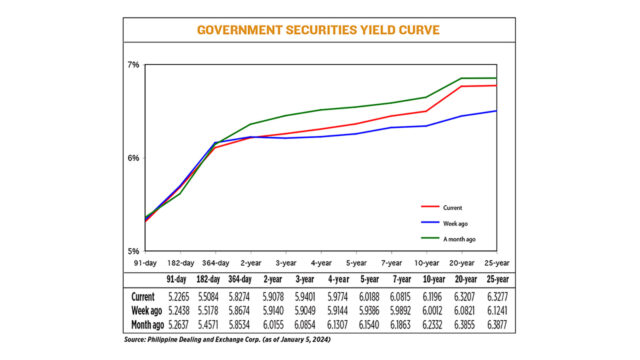
GS yields, which move opposite to prices, rose by an average of 6.89 basis points (bps) week on week, based on PHP Bloomberg Valuation Service Reference Rates data as of Jan. 5 published on the Philippine Dealing System’s website.

Higher rates for most Treasury bond (T-bond) tenors drove the week-on-week rise in GS yields.

At the belly, the three-, four-, five-, and seven-year T-bonds saw their yields climb by 3.52 bps (to 5.9401%), 6.3 bps (5.9774%), 8.02 bps (6.0188%), and 9.23 bps (6.0815%), respectively.

The long end saw bigger increases as the 10-, 20-, and 25-year debt jumped by 11.84 bps, 23.86 bps and 20.36 bps to yield 6.1196%, 6.3207%, and 6.3277%, respectively.

Meanwhile, the two-year bond saw its rate inch down by 0.62 bp to 5.9078%.

Yields on the short-tenored Treasury bills (T-bills) likewise dropped. Rates of the 91-, 182- and 364-day T-bills went down by 1.73 bps, 0.94 bp and 4 bps to 5.2265%, 5.5084% and 5.8274%, respectively.

Total GS volume picked up to P15.05 billion on Friday from P14.06 billion on Dec. 29.

“Yields on the belly to the long end were pushed higher during the first week of the year… Local market participants took a defensive stance ahead of the CPI (consumer price index) release as US Treasuries’ yields also rose,” Alessandra P. Araullo, chief investment officer at ATRAM Trust Corp., said in a Viber message.

“Better-than-expected local consumer price index data, and recent offshore developments showing a still rescinding US labor market justifies investor defensive throughout the week with traded volume on staying on the low side,” added Ms. Araullo.

Inflation slowed to 3.9% in December, settling within the central bank’s 2-4% target range for the first time in nearly two years, amid easing prices of food and utilities.

Preliminary data from the Philippine Statistics Authority (PSA) released on Friday showed the overall year on year increase in prices of widely used goods and services eased to 3.9% in December from 4.1% in November and 8.1% a year ago.

This was the slowest reading in 22 months or since the 3% reading in February 2022 and was a tad lower than the 4% median estimate in a BusinessWorld poll. It was also within the 3.6% to 4.4% estimate given by the Bangko Sentral ng Pilipinas (BSP) for the month.

For 2023, headline inflation averaged 6% for 2023, slightly faster than 5.8% in 2022 and marking the second straight year that the CPI exceeded the BSP’s 2-4% target.

This was also the fastest print in 14 years or since the 8.2% full-year average in 2008, at the height of the global financial crisis.

Meanwhile, the yield on the benchmark 10-year note rose 6 basis points to 4.051%, Reuters reported. On the week, the 10-year’s yield rose 13.1 basis points, the largest weekly gain since mid-October.

GS yields moved sideways with an upward bias amid the lack of catalysts and as the December CPI print was within expectations, a bond trader said in a Viber message.

“Global yields were trending higher as well, adding to pressure on local bond market,” the bond trader said.

For this week, the trader said the Bureau of the Treasury’s (BTr) T-bond and T-bill auctions could drive GS yields.

“Expect yields to trade sideways with an upward bias,” the bond trader said.

“For this week, there will be a five-year bond issuance, which is expected to clear at a 5.875-6.125% coupon rate. This will gauge the appetite of the local GS market as we anticipate for more developments locally and offshore,” Ms. Araullo likewise said.

Minutes of the BSP’s December meeting, which are scheduled for release this week, could also affect GS trading, she added.

The BTr will offer P30 billion in new five-year T-bonds on Tuesday. — L.O. Pilar with Reuters

How PSEi member stocks performed — January 5, 2024

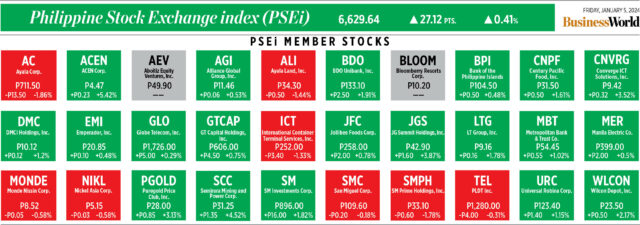
Here’s a quick glance at how PSEi stocks fared on Friday, January 5, 2024.


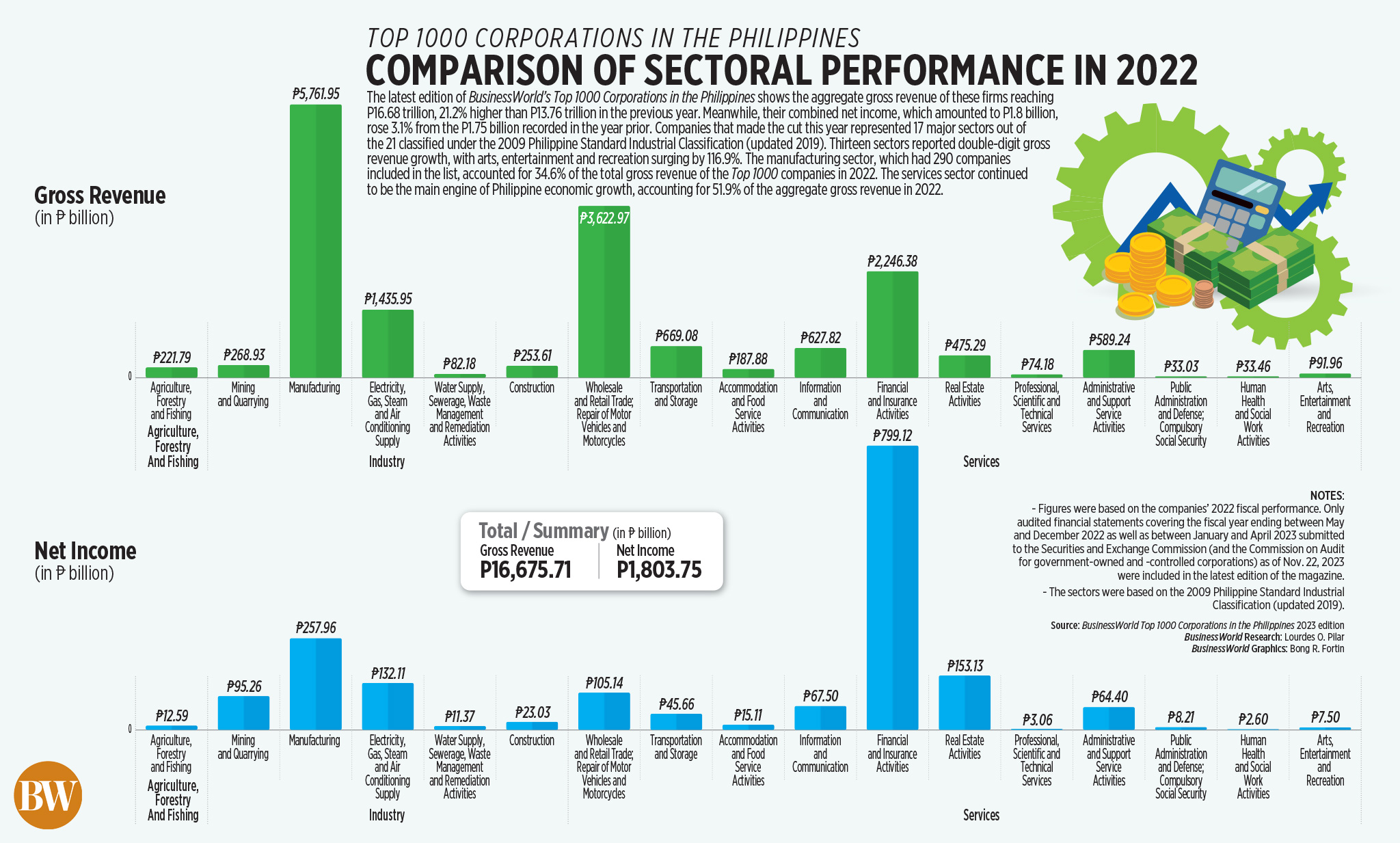
Top 1000 Corporations in the Philippines: Comparison of sectoral performance in 2022

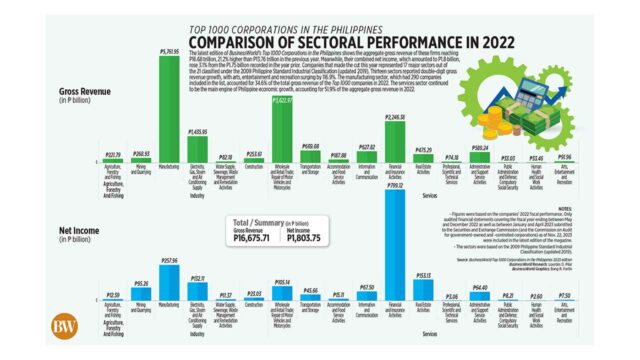
THE TOP 1,000 corporations in the Philippines showed resilience in 2022 after posting a combined gross revenue of P16.68 trillion, as economic activity picked up after pandemic-related restrictions were lifted. Read the full story.


Top 1000 Corporations in the Philippines: Comparison of sectoral performance in 2022

Stocks may drop on profit taking, lack of leads

REUTERS

PHILIPPINE SHARES may decline this week due to profit taking and amid a lack of major trading drivers.

The Philippine Stock Exchange index (PSEi) climbed by 27.12 points or 0.41% to end at 6,629.64 on Friday, while the broader all shares index rose by 16.76 points or 0.48% to close at 3,502.52.

Week on week, the PSEi rose by 179.6 points or 2.78% from its 6,450.04 finish on Dec. 29.

“The local market started the week on a positive note, rising 2.78% to 6,629.64. The market’s technical reading has also been bullishly biased. The market has been on an uptrend since bottoming last Oct. 31, 2023,” Philstocks Financial, Inc. Senior Research Analyst Japhet Louis O. Tantiangco said in a Viber message.

“The local bourse greets the New Year on a high note, breaking past 6,600 on the first week of trading in 2024,” online brokerage 2TradeAsia.com said in a market report. 

However, for this week, stocks may drop on profit taking as investors look for positive catalysts, Mr. Tantiangco said.

“Investors are expected to look for clues on inflation and monetary policy outlook,” he said.

“To sustain the momentum, the market is seen to need more positive catalysts. While the decline of inflation last December is seen to have helped in lifting sentiment, investors are still expected to look further, primarily how the inflation trend and the BSP’s (Bangko Sentral ng Pilipinas) policy path will be this year,” Mr. Tantiangco added.

Inflation slowed to 3.9% in December from 4.1% in November and 8.1% a year ago, the Philippine Statistics Authority reported on Friday. This was the slowest reading and was the first time the consumer price index (CPI) settled within the BSP’s 2-4% target in 22 months or since the 3% in February 2022.

The December print was also a tad lower than the 4% median estimate in a BusinessWorld poll and was within the 3.6% to 4.4% estimate given by the BSP for the month.

For 2023, headline inflation averaged 6%, slightly faster than the 5.8% in 2022 and marking the second straight year that the CPI exceeded the BSP’s 2-4% target.

This was the fastest print in 14 years or since the 8.2% full-year average in 2008, at the height of the global financial crisis.

The BSP said risks to the inflation outlook remain significantly on the upside, citing possible inflationary pressures from higher transport charges, increased electricity rates, rising oil prices, and elevated food prices due to strong El Niño conditions.

“Looking ahead, the Monetary Board deems it necessary to keep monetary policy settings sufficiently tight until a sustained downtrend in inflation becomes evident,” the central bank said on Friday.

The market will also await the release of latest labor and foreign direct investments data this week, Mr. Tantiangco said.

Meanwhile, 2TradeAsia.com put the PSEi’s immediate support for the week at 6,500 and resistance at 6,700-6,750. — R.M.D. Ochave

Peso may be broadly steady vs dollar

BW FILE PHOTO

THE PESO could be broadly steady against the dollar this week, supported by the continued inflow of remittances and as interest rates remain elevated.

The local unit closed at P55.57 per dollar on Friday, weakening by seven centavos from its P55.50 close on Thursday, Bankers Association of the Philippines data showed.

Week on week, the peso depreciated by 20 centavos from its P55.37 close on Dec. 29.

The peso opened Friday’s session steady at P55.50 against the dollar. Its intraday best was at P55.475, while its weakest showing was at P55.78 versus the greenback.

Dollars exchanged jumped to $2.05 billion on Friday from $1.72 billion on Thursday.

The peso depreciated against the dollar on Friday after the Bangko Sentral ng Pilipinas (BSP) said it would limit its intervention in the foreign exchange market, Rizal Commercial Banking Corp. Chief Economist Michael L. Ricafort said in a Viber message.

BSP Governor Eli M. Remolona, Jr. said last week they will finalize a new framework this year to make the peso more competitive and reduce restrictions in the foreign exchange market.

The peso was also dragged lower by a stronger dollar after the US jobs report eased expectations of a rate cut by the US Federal Reserve soon, Mr. Ricafort added.

The monthly nonfarm payrolls report showed the US economy added 216,000 new jobs in December, Reuters reported.

The jobless rate held steady at 3.7%, down from most forecasters’ expectations for it to rise, prompting concerns that the Fed’s long battle to tame inflation may have further to run.

The US central bank last month kept the fed funds rate unchanged at 5.25-5.5% for the third straight time after it hiked borrowing costs by a cumulative 525 basis points (bps) from March 2022 to July 2023.

The Federal Open Market Committee will hold its first policy meeting this year on Jan. 25-26.

For this week, the peso could be “relatively stronger and stable” amid expectations of elevated interest rates, Oikonomia Advisory & Research, Inc. President and Chief Economist John Paolo R. Rivera said in a Viber message.

The Bangko Sentral ng Pilipinas raised borrowing costs by 450 bps from May 2022 to October 2023, bringing the policy rate to a 16-year high of 6.5%.

The Monetary Board will hold its first meeting this year on Feb. 12.

The peso will also continue to be supported by remittances, Mr. Rivera said.

“With the sustained influx of remittances, the strength of the peso is reinforced. As the holiday season ends and the new year starts, we can expect minimal movements in the exchange rate next week given the prevalent conditions I mentioned,” he said.

For this week, Mr. Ricafort sees the peso ranging from P55.35 to P55.85. — AMCS with Reuters

Marcos inks Ease of Paying Taxes Act

PPA POOL PHOTO

By Kyle Aristophere T. Atienza, Reporter

PRESIDENT Ferdinand R. Marcos, Jr. has signed into law the Ease of Paying Taxes Act, a measure that seeks to update the country’s taxation system and boost government revenues.

The act, which amends several sections of the National Internal Revenue Code of 1997, introduces several tax reforms, including the simplification of the filing process for small and medium enterprises, according to the Presidential Communications Office (PCO).

In a statement over the weekend, the PCO said the important features of the law include the classification of taxpayers into micro, small, medium, and large and the classification of value-added tax refund claims into low-, medium-, and high-risk.

Under the law, tax returns can be filed — either electronically or manually — with any authorized agent bank, Revenue District Office, or authorized tax software provider.

It also eliminates the distinction between documentation and basis of sales of goods and services and ensures availability of registration facilities to non-Philippine resident taxpayers.

The law removes the Value Added Tax (VAT) official receipt as a requirement for substantiating refund claims and input and output taxes, making the VAT invoice the sole supporting document required in declaring output taxes and claiming input taxes for both sale of goods and services.

Under the law, only medium and high-risk VAT refund claims are subjected to auditing. The Commissioner of Internal Revenue shall explain any denial of VAT refund claims within the 90-day VAT refund claim window, and the decision can be appealed within 30 days from receipt of the denial.

The new law enforces a 180-day process period on claims for refund of erroneous or illegal tax collection, increases the fees for the mandatory issuance of receipts for each sale and transfer of goods and services to P500 from P100, and reduces the number of income tax return pages to two from four pages, the PCO said.

The new law also mandates the Bureau of Internal Revenue (BIR) adopt an integrated and automated system for facilitating basic tax services and set up an electronic and online data and information system, it added. It also requires the BIR to boost its technology capabilities in line with the goal to digitalize its services.

“The law’s implementing rules and regulations shall be promulgated 90 days from the effectivity of the Act after the consultation of the Finance Secretary with the BIR, and the private sector,” the measure read.

“The law’s implementing rules and regulations (IRR) shall be promulgated 90 days from the effectivity of the Act after the consultation of the Finance Secretary with the BIR, and the private sector,” the PCO said.

House Ways and Means Chair Jose Maria Clemente S. Salceda, in a statement, noted that the law exempts overseas Filipino workers, who do not acquire any income in the Philippines, from income tax.

“[The new law] brings our tax administration system to the digital world — allowing the BIR to shift to a full digitalization,” he said.

Jeepney drivers decry being unjustly accosted over non-consolidation

PHILSTAR

By Jomel R. Paguian

TRANSPORT group Manibela claimed that some public utility jeepney drivers have been apprehended by authorities for not having consolidated franchises, despite new guidelines allowing them to operate until Jan. 31.

In an interview with BusinessWorld recently, Manibela president Mar Valbuena said some jeepney drivers who refused to apply for consolidation were apprehended by Land Transportation Office (LTO) enforcers, who allegedly informed that they could not ply their routes anymore.

“What the LTO enforcers do is they tell our members that they cannot operate starting the next day, force them to go home, leaving passengers no choice but to alight from the vehicles,” he said in Filipino.

The LTO did not immediately respond to a message seeking comment on the matter.

Under the Public Utility Vehicle Modernization Program (PUVMP), jeepney drivers and operators are mandated to merge their separate franchises into a cooperative or corporation by Dec. 31, 2023, to obtain franchises for modern public utility vehicle (PUV) units.

But while the Land Transportation Franchising and Regulatory Board (LTFRB) decided to push through with the year-end deadline, unconsolidated PUVs were permitted to operate until Jan. 31 — a month-long grace period beyond the deadline.

Mr. Valbuena said the LTO did not follow the extension granted to them and instead insisted on apprehending some of their members.

“Status quo should be upheld. We should not be apprehended unless we violate traffic rules,” he said. “But they (LTO enforcers) question our legal entitlement despite an order allowing us to operate until the end of the month.”

Manibela said apart from Metro Manila, incidents of unjust apprehension were reported by their members in Isabela, Cebu, Bacolod, and Iloilo.

Meanwhile, another transport group Pagkakaisa ng mga Samahan ng Tsuper at Operator Nationwide (PISTON) argued that the proposal of some lawmakers to extend the deadline for franchise consolidation is “meaningless,” demanding a more inclusive program for a just transition in public transport.

PISTON communications officer Jan Atienza told BusinessWorld “franchise consolidation directly transfers public transport into the hands of big business owners and corporations. It contradicts the nature of public transport as a public service that should not be corporatized or privatized.”

Manibela earlier expressed the same stance on the issue, clarifying that they instead clamor for an extension of their franchises and provisional authorities to ply their units even without consolidating.

HOUSE PANEL TO INVESTIGATE ALLEGED PUVMP ANOMALIES
THE HOUSE Committee on Transportation is set to start a probe into alleged anomalies in the implementation of the PUVMP, a lawmaker said on Sunday.

In a statement, transportation panel head Antipolo Rep. Romeo M. Acop said Speaker Martin G. Romualdez sought the investigation after reports of alleged instances of corruption and irregularities in the jeepney modernization campaign.

“We cannot allow corruption to take root in the implementation of the modernization program, he said. “If we are to proceed with the modernization of our PUVs, we must make sure there is not even a whiff of irregularity.”

The congressman said the panel could proceed with the probe under the rules of the House of Representatives even without a resolution or privilege speech.

Over the weekend, Mr. Romualdez called on the Department of Transportation (DoTr) to review its implementation of the PUVMP, which transport groups have opposed citing the risk of increasing the number of unemployed Filipinos.

“We are responding to the directive of Speaker Romualdez to investigate these very serious allegations,” Mr. Acop said. “We will get the consensus of members of the committee of so we can start our hearings by Wednesday. — with a report from John Victor D. Ordoñez

Congressional probe on cutting aid to SHS students sought

PHILIPPINE STAR/ WALTER BOLLOZOS

By John Victor D. Ordoñez, Reporter

A PHILIPPINE lawmaker has filed a resolution seeking an investigation on recent memos issued by the Commission on Higher Education and the Department of Education (CHED) that cut off financial aid to senior high school (SHS) students.

“This issue highlights the failure of the government during the transition period that it even failed to simply call for a thorough consultation with all the stakeholders but now is unilaterally removing the subsidies for these students,” Party-List Rep. France L. Castro said in the resolution filed on Jan. 5

In a memo dated Dec. 18, the CHED said it is discontinuing the senior high school program in state universities and colleges (SUCs) and local universities and colleges (LUCs).

The agency, in a separate memo, had also cut off financial aid for Grades 11 and 12 students in these public colleges.

Ms. Castro reiterated the need for consultations with teachers and students before the education agencies implemented the memos.

There are about 17,751 Grade 11 students and 2,030,451 Grade 12 students enrolled in SUCs and LUCs, according to the DepEd.

Senators have called on DepEd and CHED to ensure students are not displaced in phasing out the senior high school program, especially in the provinces.

CHED Chairman Prospero E. de Vera III earlier said there was no legal basis to continue the SHS program since the transition period for the K to 12 program, which was from school years 2016-2017 to 2020-2021, is over.

“It is the duty of the House of Representatives to exercise its oversight function in ensuring that government programs and initiatives, particularly those concerning education are in line with the principles of equity, transparency and accountability,” Ms. Castro said.

ADVERTISEMENT
ADVERTISEMENT