Home Blog Page 3817

Barcelona edges lowly Barbastro to progress in Spanish Cup

BARCELONA were made to work hard against fourth-tier opponents as they booked their place in the last 16 of the Copa del Rey on Sunday with a 3-2 win at Barbastro, while Sevilla, Real Sociedad and Valencia earned narrow victories to progress.

Fermin Lopez opened the scoring for Barca in the 18th minute with a tap-in from a low cross from Raphinha, who then made it 2-0, collecting a fine long ball from young debutant Hector Fort in the 51st minute.

Despite Barcelona looking dominant, Adria de Mesa lifted the spirits of the home crowd when he capitalized on a loose ball in the box to pull one back for Barbastro in the 60th minute.

Barbastro went close to equalizing, before substitute Robert Lewandowski made no mistake from the penalty spot to extend Barca’s lead with two minutes to go.

Barbastro’s Marc Prat made it 3-2 in stoppage time also with a penalty, but the hosts could not prevent Xavi Hernandez’s side sealing the win.

Elsewhere, an own goal by Einar Galilea early in the second half was enough for Real Sociedad to claim a 1-0 away win over Malaga.

LaLiga side Las Palmas were beaten 2-0 at second-tier Tenerife with first-half goals from Jose Maria Amo, who was later sent off for a second booking, and Luismi Cruz. The visitors were also reduced to 10 men after Julian Araujo was sent off in the 76th minute.

Sevilla beat Racing Ferrol 2-1 thanks to a goal from Brazilian defender Marcao, who dedicated his first-half effort to his father who passed away on Saturday, and another from Juanlu Sanchez, who scored late in the game.

Fran Manzara had equalized for Racing but received a second yellow card to be sent off in the 75th minute.

Villarreal’s clash against Unionistas Salamanca was suspended after power failures at the Reina Sofia stadium. Villarreal had taken the lead with a goal from Ilias Akhomach before Alfred Planas’s late penalty sent the game to extra time.

The Spanish FA later announced the match will resume on Monday.

Last season’s Cup runners-up Osasuna struggled to overcome third-division Castellon, with the match going to extra time before Jose Arnaiz’s goal clinched a 1-0 victory.

Valencia also had to dig deep to earn a 2-1 win at 10-man Cartagena after extra time, with Sergi Canos and Jose Luis Gaya scoring to send the LaLiga side into the next round despite the hosts having led most of the game.

Athletic Bilbao made light work of Eibar in a 3-0 win, with all three goals coming in the first half, as Asier Villalibre netted a brace and Iker Muniain also got on the scoreboard.

The round-of-16 draw will be held on Monday, with fixtures scheduled for Jan. 17. — Reuters

Marcos December approval, trust ratings go up

PHILIPPINE STAR/KRIZ JOHN ROSALES

By John Victor D. Ordoñez, Reporter

PHILIPPINE President Ferdinand R. Marcos, Jr.’s approval and trust ratings improved in December amid his forceful stance against what many Filipinos see as Chinese aggression in the South China Sea.

The President’s approval rating went up by 3 points to 68% from a quarter earlier, while his trust score added 2 points to 73%, Pulse Asia Research, Inc. said in a statement on Monday, citing the results of its Dec. 3-7 poll.

Mr. Marcos had majority approval scores in every area (62% to74%) and class (63% to 69%), the research firm said.

His approval rating rose by 15 points among Filipinos in Class E, while his disapproval rating increased by 12 points in the Visayas region, Pulse Asia said.

Vice-President Sara Duterte-Caprio’s approval rating improved by a point to 74%, while her trust score rose by 3 points to 78%. Her approval rating dropped by 12 points in the Visayas region.

“Appreciation is the predominant sentiment regarding the quarterly performance of the President and Vice-President (68% and 74%, respectively),” Pulse Asia said.

Senate President Juan Miguel F. Zubiri’s approval rating went down by a point to 49%, while Speaker Ferdinand Martin G. Romualdez’s score slipped by 2 points to 39%.

“The performance ratings of these government officials are essentially constant during the period September 2023 to December 2023,” Pulse Asia said. “This observation holds true at the national level as well as in all areas and classes.”

Filipinos approved of the Marcos government’s programs for overseas Filipino workers (78%), helping calamity-stricken areas (76%), protecting the environment (62%) and promoting peace and defending territorial integrity (61%).

“The government went through a series of populist moves to stave off further drops in its ratings, including ill-fated rice price caps and speeding up of the Maharlika Investment Fund,” Leonardo A. Lanzona, who teaches economics at the Ateneo de Manila University, said in a Facebook Messenger chat.

Mr. Marcos had imposed a price ceiling on rice at P41 a kilo for regular milled rice and P45 for well-milled rice on Sept. 5 to temper inflation. He lifted the price cap a month later.

The President in November appointed his adviser on investments and economic affairs Rafael D. Consing, Jr. to head the Maharlika Investment Corp., which will oversee the Philippines’ first sovereign wealth fund.

“To some extent, the moves seem to have succeeded in the lower income and urban classes, but in spite of all its efforts, it seems to have managed only a few insignificant points as disapproval in certain areas remained,” Mr. Lanzona said.

Filipinos who were dissatisfied with how the government was handling inflation jumped to 73% from 56% in September. Only 9% of Filipinos said they approved of state efforts against rising prices. 

Disapproval of the government’s efforts to reduce poverty also went up by 8 points to 39%, while Filipinos who frowned at the state’s anti-corruption efforts rose by 10 points to 33%.

Seven of 10 Filipinos said controlling prices was the most urgent issue that the government must address. Increasing worker pay came in second at 40%, followed by creating more jobs at 28% and reducing poverty at 25%.

Philippine inflation slowed to 3.9% in December from 4.1% in November, according to the local statistics agency, the slowest in 22 months.

In a statement on Friday, National Economic and Development Authority Secretary Arsenio M. Balisacan said the country’s inflation task force would seek to boost farm output to ease inflationary pressures especially on the poor.

“It makes sense that Mr. Marcos retained his ratings if only because there’s not much change in his policies,” Hansley A. Juliano, a political science professor at the Ateneo, said in a Messenger chat.

“Any disapproval of inflation policies can be outweighed by general support/not rocking the boat on other aspects, especially because there is not much disagreement even from the opposition on what to do.”

Pulse Asia interviewed 1,200 Filipino adults on Dec. 3 to 7 for the poll, which had a ± 2.8% error margin.

Analysts laud Maharlika plan to invest in NGCP

NGCP.PH

A PLAN by the Philippines’ first sovereign wealth fund to invest in the state-owned power grid makes both economic and security sense, analysts said.

“Government investment in the National Grid Corp. of the Philippines (NGCP) is a good first move,” Calixto V. Chikiamco, Foundation for Economic Freedom (FEF) president, said in a Viber message on Monday.

NGCP is the sole and exclusive concession and franchise for the operation of the country’s power transmission network.

Mr. Chikiamco said NGCP should not have been privatized since it’s a public utility. “Government presence in NGCP can help influence its activities toward the public good. NGCP is also highly profitable, and the Maharlika Investment Corp. (MIC) should earn from its investment.”

The presidential palace at the weekend said MIC President and Chief Executive Officer Rafael Jose D. Consing, Jr. had fully endorsed Speaker Martin G. Romualdez’s proposal for the MIC to invest in NGCP.

Mr. Consing said the fund’s investment in NGCP could lower energy costs and result in “a more reliable and resilient grid.” It could also foster public-private partnerships in the energy sector, he added.

NGCP spokesperson Cynthia Alabanza did not immediately reply to separate Viber messages sent on Sunday and Monday seeking comment.

She told the ABS-CBN News Channel on Monday funding had never been an issue for NGCP.

“You have big business then with access to funding,” she said. “Issues are really [on] the recovery from the Energy Regulatory Commission’s rate-setting, government support in the form of permitting and of course, expropriation and help with right of way.”

“The Maharlika Investment Fund’s investment in NGCP should be the first step toward removing foreign interference in the nation’s energy sector,” Terry L. Ridon, a public investment analyst and convenor of InfraWatch PH, said in a Facebook Messenger chat.

Enrico P. Villanueva, who teaches money and banking at the University of the Philippines Los Banos, said the plan is good for the economy and national security.

“Returns are good, and we need a close watch on the grid,” he said in a Facebook Messenger chat. “I support the investment in terms of purchase of shares precisely because of concerns about NGCP ownership,” he added.

“It should focus on buying out the shares of the State Grid Corp. of China, or significantly dilute its shares to reduce Chinese influence in NGCP’s management and operations,” he added.

Two Filipino companies — Monte Oro Grid Resources Corp. and Calaca High Power Corp. — each has a 30% stake in NGCP. The State Grid Corp. of China has a 40% interest.

It has been 15 years since NGCP got its franchise “and power deficiency problems still occur partly or largely due to transmission problems,” Bienvenido S. Oplas, Jr., president of think tank Minimal Government Thinkers, said in a Viber message.

“The MIC has political muscle and government signature that can match the political clout and muscle of NGCP being the only remaining private monopoly nationwide and has China government clout,” he said.

He added that removing the influence of China’s state-owned power company from NGCP is needed now more than ever amid souring Philippine relations with its neighbor over their South China Sea dispute.

On the other hand, Ateneo de Manila University economics professor Leonardo A. Lanzona said NGCP does not need the MIC’s investment.

“The NGCP is a private firm that was given a franchise to take care of the country’s energy and grid needs,” he said in an e-mail. “Why should the government now be involved? Is it not the responsibility of NGCP to take care of its resources and to increase it when needed?”

Mr. Lanzona said the state should fund energy-related projects in other ways.

“It is interesting how the MIC has evolved from being a sovereign fund into an investment fund into a development fund and now to an energy fund,” he said. “The way its managers are talking about it is as if there is no cost involved in spending these funds.”

The Partido Manggagawa also opposed the planned investment.

“We have consistently opposed the creation of MIC, and witnessing public funds being diverted to support an unsound investment proposal only strengthens our opposition,” it said in a statement. — Kyle Aristophere T. Atienza, Luisa Maria Jacinta C. Jocson and Jomel R. Paguian

Lawmakers seek probe of Jan. 2 blackouts in Western Visayas

BW FILE PHOTO

TWO SENATORS on Monday filed separate resolutions seeking to investigate the blackouts in Western Visayas in central Philippines on Jan. 2 that supposedly led to at least P1.5 billion in economic losses.

“Considering that past investigations and probes have not yielded palpable results, an even more comprehensive, thorough and extensive examination needs to be conducted,” Senator Ana Theresia N. Hontiveros-Baraquel said in Senate Resolution 890.

She also cited the need to review the concession agreement between the National Transmission Corp. and the National Grid Corp. of the Philippines (NGCP).

NGCP spokesperson Cynthia P. Alabanza did not immediately reply to a Viber message seeking comment.

Senator Francis N. Tolentino filed a similar resolution, saying the power failures had caused about P1.5 billion in economic losses for Iloilo City alone.

“Through the adoption of new solutions including infrastructure upgrades, improved maintenance schedules and the exploration of alternative energy resources, these power disruptions will be the bane to the continuous and uninterrupted growth and prosperity of the region,” he said in Senate Resolution 894.

President Ferdinand R. Marcos, Jr. on Saturday said NGCP should take responsibility for the power failures.

Ilocos Norte Rep. and presidential son Ferdinand Alexander A. Marcos also filed a resolution seeking a separate House of Representatives probe.

“The review should include the possible separation and transfer of the systems operation function from the NGCP to another entity which could carry out such function more efficiently,” he said in House Resolution 1534.

“Streamlining will enable the NGCP to focus on the construction and operation of the transmission grid,” he said in a statement.

Congressmen should also consider authorizing the Energy Regulatory Commission (ERC) to fine NGCP P2 million a day for failing to comply with regulatory rules, Mr. Marcos said. The fine could also be equivalent to 1% of the cost of a delayed project, he added.

Mr. Marcos said Congress should consider imposing a special tax on NGCP as a power concessionaire.

On Jan. 2, a yellow alert was raised for the Visayas grid after several power plants tripped, including the units of Panay Energy Development Corp. and Palm Concepcion Power Corp., according to an NGCP report. The yellow alert was lifted at 9:01 p.m. on Tuesday.

In a Jan. 5 statement, the NGCP said it has “fully restored all affected feeders on Panay Island and normalized transmission operations in the area.” — John Victor D. Ordoñez and Beatriz Marie D. Cruz

CHED tells state universities: Decide now on whether to keep senior high programs

PHILIPPINE STAR/ WALTER BOLLOZOS

By Jomel R. Paguian

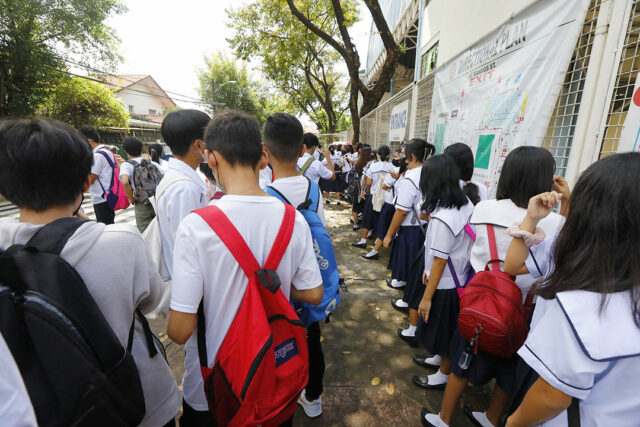
THE COMMISSION on Higher Education (CHED) said on Monday that it is up to government-funded universities and colleges to decide whether or not they would continue offering senior high school (SHS) programs.

In a press briefing, CHED Chairman Prospero E. De Vera, III still made it clear that state universities and colleges (SUCs) and local universities and colleges (LUCs) are no longer required to offer the program under the law.

However, Mr. De Vera said the boards of regents of SUCs and LUCs could decide on retaining their respective SHS programs; but in doing so, they should decide immediately on their plans.

Asked by reporters when they should finalize their decisions, the CHED chair replied: “They should take this up and discuss this immediately so that we will know the situation on the ground, and we will know the options available and possible.”

Mr. De Vera said that when deciding to continue SHS programs, public universities should assess the capability of Department of Education (DepEd) schools in their areas to deliver the additional two years of high school education.

SUCs and LUCs may consider extending their SHS programs if they deem it necessary to meet the demand in some areas.

“If there is capacity in regular (DepEd) high schools, that’s where students should go. Because the SUCs also need the facilities for their own students because their enrollment has also increased tremendously,” said Mr. De Vera.

“There is no one-size-fits-all decision on this because the SUCs are differently located, they have different capacities, and they have different facilities. That is why it is the SUCs who should look into this,” he added.

In a memorandum issued last month, the CHED reminded public universities to terminate their SHS programs, which were initially intended to be offered only during the K-12 transition period which was from school years 2016-2017 to 2020-2021.

P3B to fix school buildings OK’d

PHILIPPINE STAR/ WALTER BOLLOZOS

THE DEPARTMENT of Budget and Management (DBM) has approved the release of P3.049 billion for the repair of government school buildings throughout the country.

The DBM said the release will cover the funding requirements for the repair and rehabilitation of elementary and secondary school buildings.

“An amount of P1.861 billion was initially released from the total authorized appropriations of P4.911 billion, which will be utilized for the rehabilitation, renovation, repair and improvement of kindergarten, elementary, and secondary school buildings following the Repair All Policy,” the DBM said.

The funding will be released to the Department of Public Works and Highways under the 2023 General Appropriations Act. — Luisa Maria Jacinta C. Jocson

Germany, PHL eye improved ties

THE FOREIGN ministers of Germany and the Philippines are set to meet in Manila this week to discuss further boosting bilateral ties, particularly in maritime cooperation, trade and investments.

The Philippine Department of Foreign Affairs (DFA) confirmed on Monday the visit of German Foreign Minister Annalena Charlotte A. Baerbock on Jan. 11-12 and her meeting with host country counterpart, Secretary Enrique A. Manalo.

“There is a commonality between the Philippines and Germany when it comes to a rules-based order, and it’s also interesting that the German Minister will be visiting the Coast Guard,” DFA Spokesperson Ma. Teresita C. Daza told reporters in a virtual briefing. “Hopefully, the meeting will result discovering what other training programs can by Germany to the Philippine Coast Guard.”

She said the meeting would celebrate the 70th anniversary of Philippine-Germany diplomatic relations. 

While in town, Ms. Baerbock is also scheduled to visit the Technical Skills Development Authority offices.

The Philippines wants to expand its trade with Germany, especially in terms of electronics and bananas.

In 2022, Germany was the Philippines’ 12th largest trading partner with trade amounting to P4.7 billion that year, Ms. Daza noted. There are about 31,660 Filipinos based in Germany, she added. — John Victor D. Ordoñez

Bill on cheaper rice pushed

Rice dealers display rice in Trabajo Market, Sampaloc, Manila, Aug. 10, 2023. — PHILIPPINE STAR/EDD GUMBAN

A CONGRESSMAN is not giving up on the Marcos administration’s campaign promise to drive down rice prices to P20 a kilo, filing a bill in September that not only seeks to make that happen but also ensure that rice farmers make a profit.

“If we want to attain [the price of] P20 per kilogram of rice, the [proposed] Cheaper Rice Act is the solution, which we should prioritize in passing,” Party-list Rep. Wilbert T. Lee said in a statement on Monday.

His House Bill No. 9020 even seeks to impose an additional P5 to P10 in the price of rice on sold by farmers to the Department of Agriculture to ensure profit. “If profit is ensured, farmers will increase their production and supply, which will help lower rice prices in the market,” Mr. Lee said in Filipino.

He added that rice profit would discourage farmers from selling their lands and may even pass on their farming practices to its next generations.

The bill also seeks the creation of the Rice Incentivization, Self-Sufficiency, and Enterprise (RISE) Program, which would develop a pricing structure for palay, a payout system for farmers, and a regular monitoring system for palay and rice prices.

It also proposes the creation of a price stabilization fund to shoulder the payouts and subsidies for farmers in buying and producing palay.

The committee expected to manage the fund will be headed by the Secretary of Trade and Industry and a “Rice Czar” to be appointed by the President.

During a House committee meeting in August last year, Agriculture Undersecretary Leocadio Sebastian said it “may be difficult” to bring rice prices down to P20 in the next two years, contrary to a campaign promise made by President Ferdinand R. Marcos, Jr. — Beatriz Marie D. Cruz

Gov’t touts farm roads built

PHILSTAR FILE PHOTO

THE PHILIPPINE government has built around 67,328.92 kilometers of farm-to-market roads last year, which is more than half of its goal of building 131,410.66 km in six years, President Ferdinand R. Marcos, Jr. said on Monday.

“It is a testament to the magnitude of accomplishment of the government,” he said in a video posted on his Instagram account. “It is a connection between all the different communities, but of course its main purpose is to connect the markets and the producers — to our agricultural sectors.”

He said the past year’s accomplishments amount to about 51% of the administration’s goal to build over 131,000 km of farm-to-market roads in his six-year term. 

Last November, the Department of Agrarian Reform (DAR) said it had won technical approval for building modular steel bridges for farm-to-market roads. The project would cost P28.23 billion to implement.

Lawmakers had allotted over P17.27 billion in this year’s P5.768-trillion national budget to build these roads. Congress also included about P31 billion to aid farmers implement projects to boost rice production. — John Victor D. Ordoñez

House leader backs ‘Cha-cha’

PHILSTAR FILE PHOTO

A LEADER in the House of Representatives supported on Monday proposals to change the 1987 Constitution, saying the amendments should not come later as it would give the impression that politicians are merely attempting to extend elected officials’ terms of office.

“It is better to initiate Charter change (“Cha-cha”) long before the 2028 presidential elections, so that the public can rest assured that this is no attempt to extend President [Ferdinand R. Marcos Jr.]’s term,” Albay Rep. Jose Ma. Clemente S. Salceda, who heads the House Ways and Means Committee, said in a statement.

“The time to do it is now, when there is also enough time to do it before the 2025 midterm elections.

“It is natural and normal for democracies to revise their Constitutions, to suit the evolving needs of the times, as well as to adjust for conditions that framers did not foresee,” he said.

Mr. Salceda noted that the United States Constitution, which heavily inspired the Philippines’ own charter, has been amended 27 times.

“In contrast, we have not amended the 1987 Constitution for almost 40 years now, despite having provisions that obviously require revision. In many ways, we are unnatural for the way we hold the 1987 Constitution as if it were unerring,” Mr. Salceda said.

Before Congress adjourned for the Christmas break, House Speaker Ferdinand Martin G. Romualdez revived talks to amend the 1987 Constitution to ease economic restrictions.

The lower chamber in March passed Resolution of Both Houses No. 6, calling to amend the Constitution through a constitutional convention. The measure was not approved in the Senate.

Last week, Albay Rep. Edcel C. Lagman said municipal mayors were allegedly asked to give P100 for every constituent that signs a petition to amend the Constitution through a people’s initiative.

“If the campaign for people’s initiative to amend the Constitution is inspired by noble and patriotic motives, then why buy the people’s will?” he said in a statement.

Mr. Lagman added that the act violates Section 261 of the Omnibus Election Code in relation to Sec. 19 of the Initiative and Referendum Act. — Beatriz Marie D. Cruz

Dividends from state-owned firms up 46% in 2023

DIVIDENDS generated by government-owned or -controlled corporations (GOCCs) rose 46% in 2023, the Department of Finance (DoF) said.

In a statement on Monday, the department said that its Privatization and Corporate Affairs Group collected P99.98 billion in dividends from GOCCs last year.

“The increased dividend collection is a result of fiscal discipline that the DoF continues to instill in GOCCs. These dividends will help manage our deficit and will be used to support the country’s development needs,” Finance Secretary Benjamin E. Diokno said.

The Bangko Sentral ng Pilipinas (BSP) was the top contributor in 2023, with dividends amounting to P55.61 billion.

The Philippine Deposit Insurance Corp. remitted P14.05 billion, while the Philippine Amusement and Gaming Corp. contributed P6.96 billion.

Other top contributors were the Philippine Ports Authority (P4.44 billion), the Power Sector Assets & Liabilities Management Corp. (P3.15 billion), the Philippine Charity Sweepstakes Office (P2.67 billion), the Philippine National Oil Co. (P1.68 billion), the Subic Bay Metropolitan Authority (P1.52 billion), the National Transmission Corp. (P1.48 billion), the Philippine Reclamation Authority (P1.35 billion) and the Clark Development Corp. (P1.21 billion.)

As of Dec. 31, a total of 51 GOCCs remitted dividends to the Bureau of the Treasury.

By law, GOCCs are required to declare and remit at least 50% of their net earnings to the National Government.

“The dividends have been a major source of non-tax revenues to fund the accelerated implementation of programs on infrastructure and various social and economic programs of the government,” the DoF added. — Luisa Maria Jacinta C. Jocson

Palay production targeted to exceed 20 million MT in 2024

REUTERS

THE palay production target has been set at no less than 20 million metric tons (MT) this year, the Department of Agriculture (DA) said.

“Last year, our target was 20 million MT, so it shouldn’t be below than (that),” DA Spokesperson Arnel V. de Mesa told reporters on Monday.

Mr. De Mesa added that the DA is taking steps to mitigate the impact of El Niño on rice production during the dry season.

“The harvest (tends to be higher) during the wet season, because the area planted to rice is bigger especially for rain-fed areas. El Niño will hit during the dry season and the water in the dams is still good,” he added.

The El Niño is expected to bring dry spells and drought to 63 provinces.

The government weather service, known as PAGASA (Philippine Atmospheric, Geophysical and Astronomical Services Administration), has said that the most intense phase of El Niño may run until the second quarter.

President Ferdinand R. Marcos, Jr., has ordered the creation of an interagency task force to address the effects of the weather phenomenon.

“Our mitigation measures are already in place. One of our strategies is to plant hybrid (seed), at least 1 million hectares, this dry season due to their higher yields,” Mr. De Mesa said.

He added that the DA is expecting the land planted to hybrid seed to offset the loss of riceland that cannot be cultivated due to the lack of water.

Meanwhile, Mr. De Mesa said that rice prices will continue to rise entering the lean months between harvests.

“Right now, rice prices are a bit higher because we are entering the lean season, and we have no more local production,” he added. “Our only source is imports and the price of imports is high right now.”

The DA has said that it is expecting 500,000 MT of imported rice to arrive as the government builds up reserves in preparation for the worst of El Niño.

The government has also extended the lowered tariffs on rice via Executive Order No. 50. Rates for rice imports were kept at 35% regardless of the minimum access volume and country of origin.

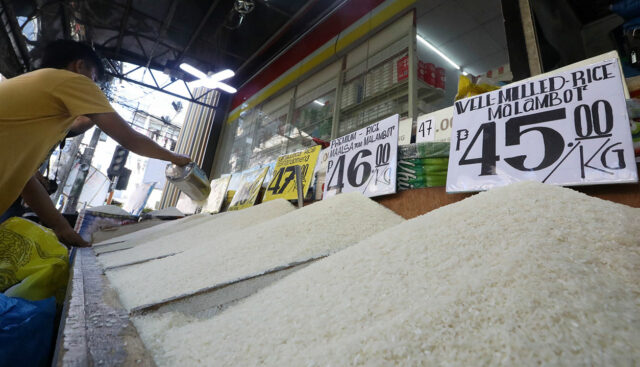
As of Jan. 8, the price of well-milled rice in Metro Manila markets was P40-55 per kilogram, while regular-milled rice was fetched P43 to P52 per kilo. 

On the other hand, imported well-milled rice was selling for P50 to P58 per kilo. — Adrian H. Halili

ADVERTISEMENT
ADVERTISEMENT