Home Blog Page 3815

The rise of revenge property investing in PHL

FIREWORKS explode over Rockwell Center in celebration of the New Year in Makati City, Philippines, Jan. 1, 2024. — REUTERS

WE’VE HEARD of revenge spending and dining in 2022 and 2023 and how personal consumption expenditures helped sustain Philippine economic growth the past two years. Filipinos also did a lot of revenge travel in the past 24 months, resulting in a substantial increase in domestic tourists, local visitor receipts, average daily rates and hotel occupancies across the Philippines.

But what appears to be becoming mainstream now is revenge investing. And massive property investments are not just trickling in from the affluent market but also from the young and millennial workforce. In fact, some developers are actively targeting this young segment given their rising purchasing power and the potential of their disposable incomes to further surge in the years to come.

What’s also quite surprising is that these young buyers of residential units are acquiring properties not just for end-use but also as investments, banking on the properties’ live-work-play-shop features, proximity to public infrastructure, and the units’ attractiveness as possible sources of passive income once turned over.

UNDERSTANDING DEMAND OR LUXURY UNITS
While the millennial buyers help fuel the demand for affordable to lower mid-income residential units and have become a key segment to target for some developers, we cannot deny the fact that the demand for the upscale to luxury units remains strong, with take-up mainly coming from the affluent market.

Colliers has seen the upscale and luxury segments’ resilience even at the height of the pandemic in 2020 and 2021. Now that the property market is rebounding, especially the residential market, developers are lining up their luxury projects to tap demand from an affluent and discerning segment.

Over the past few years, local developers have aggressively partnered with foreign firms and we see more pronounced joint ventures (JV) with foreign property firms moving forward.

Take-up  for upscale to luxury projects remains strong with demand focused on major business districts such as Fort Bonifacio, Makati CBD and Ortigas Center. Colliers believes that the luxury and ultra luxury segments will likely remain resilient amid the rising interest and mortgage rates. We attribute it to investors mainly banking on the capital appreciation potential of these upscale and luxury residential projects.

ROOM FOR PRICE ACCELERATION
Colliers sees the rising interest rates as among the headwinds in the residential market, especially their potential impact on mortgage rates.

Despite higher interest rates, Colliers has seen a stable demand for upscale to ultra luxury condominium projects in Metro Manila. Over the past few years, we have also recorded a healthy level of price increases for these residential projects. 

Colliers Philippines believes that the increase in prices will only result in investors and end-users looking for greater amenities as well as innovative facilities.

Due to Metro Manila traffic, there will be greater demand for connectivity to master planned communities and topnotch concierge services.  With more luxury and ultra luxury projects being launched in Metro Manila, Colliers Philippines sees the rise of more discerning buyers. Hence, developers need to further innovate and differentiate in a highly competitive luxury residential segment.

Based on regional prices, it appears that there is still room for further expansion of Metro Manila prices on a per square meter basis. What we can conclude based on this regional comparison is that the Philippines is barely scratching the surface. The price per square meter of Metro Manila’s most expensive condominium units is much cheaper compared to the most expensive ones in more affluent cities such as Hong Kong, Tokyo, and even Bangkok.

SUSTAINED GROWTH TO FUEL PROPERTY
Overall, we are optimistic with the Philippines’ strong macroeconomic fundamentals. The Philippine economy continues to expand despite soaring commodity prices and global geopolitical headwinds. The country remains one of the fastest-growing economies in Asia, primarily backed by resilient personal consumption and private investments.

Sustained recovery is likely to benefit major economic sectors including property development. The luxury and ultra luxury condominium segments showed resilience during the pandemic. Hence, it won’t be startling to see these developments proliferating in the near to medium term as the Philippines recovers from the pandemic.

The luxury and ultra luxury projects are also likely to benefit from the reopening of Philippine tourism and the return of foreign employees. Affluent investors are likely to continue buying luxury units as they upgrade, bank on potential price appreciation, and look for a viable hedge against inflation.

CASHING IN ON PROPERTY’S VIABILITY AS AN INVESTMENT OPTION
Revenge property investing is likely to persist, especially for the Philippines where investors do not have several options to choose from. Colliers sees young buyers and the affluent investors continuously looking for residential units that have strong rental prospects and potential for price appreciation.

Colliers Philippines believes that developers should highlight their projects’ attractiveness for lease or potential for capital value growth, whether targeting local buyers or foreign investors.

With tempered launches and availability of substantial number of ready for occupancy (RFO) units in Metro Manila, we expect aggressive marketing initiatives from property firms over the next 12 months. Developers should also curate promotions and offerings based on their target markets, whether overseas Filipino workers (OFW), young local investors, or the experienced and affluent buyers.


Joey Roi Bondoc is the research director for Colliers Philippines.

Gov’t hikes T-bill award on strong demand

BW FILE PHOTO

THE GOVERNMENT raised the volume of Treasury bills (T-bills) it awarded for a second straight week on Monday at mixed rates as demand continued to climb amid expectations that the Bangko Sentral ng Pilipinas (BSP) will keep borrowing costs higher for longer.

The Bureau of the Treasury (BTr) raised P19 billion via the T-bills it offered on Monday, above the original P15-billion program, as total bids reached P46.875 billion or more than thrice the amount on the auction block.

“The auction was 3.1 times oversubscribed,… prompting the committee to double the accepted volume of non-competitive bids for the 91- and 182-day T-bills,” the BTr said in a statement.

Broken down, the Treasury raised P7 billion from the 91-day T-bills, above the P5-billion program, as tenders for the tenor reached P18.36 billion. The three-month paper was quoted at an average rate of 5.102%, 3.8 basis points (bps) below the 5.14% seen last week. Accepted rates ranged from 4.98% to 5.25%.

The government also raised P7 billion through the 182-day securities, above the planned P5 billion, as bids for the paper reached P16.91 billion. The average rate for the six-month T-bill stood at 5.582%, inching up by 0.4 bp from the 5.578% quoted previously, with accepted yields ranging from 5.29% to 5.7%.

Meanwhile, the BTr borrowed P5 billion as programmed via the 364-day debt papers as bids for the tenor reached P11.605 billion. The average rate of the one-year T-bill went up by 14.4 bps to 5.973% from 5.829% previously. Accepted rates were from 5.83% to 6.025%.

At the secondary market on Monday, the 91-, 182-, and 364-day T-bills were quoted at 5.2265%, 5.5084%, and 5.8274%, respectively, based on PHP Bloomberg Valuation Service Reference Rates data provided by the Treasury.

T-bill rates were mixed on Monday as “investors considered prospects that the BSP will keep policy rates unchanged,” a trader said in an e-mail.

The central bank will likely keep benchmark interest rates elevated in the coming months until inflation settles within their 2-4% annual target, BSP Governor Eli M. Remolona, Jr. said last month.

The BSP last month kept its policy rate unchanged at a 16-year high of 6.5% for a second straight meeting.

The central bank raised benchmark interest rates by a cumulative 450 basis points from May 2022 to October 2023 to help bring down elevated inflation.

Headline inflation slowed to 3.9% in December from 4.1% in November and 8.1% in the same month a year ago, the Philippine Statistics Authority reported last week. This marked the first time the consumer price index (CPI) settled within the central bank’s 2-4% target and was the slowest in 22 months or since the 3% reading in February 2022.

However, for 2023, inflation averaged 6%, faster than 5.8% in 2022 and marking the second straight year that the CPI exceeded the BSP’s 2-4% target.

The Monetary Board will hold its first meeting this year on Feb. 15.

Strong US jobs data recently also affected T-bill rates on Monday, the trader added.

The monthly nonfarm payrolls report showed the US economy added 216,000 new jobs in December, Reuters reported.

The jobless rate held steady at 3.7%, down from most forecasters’ expectations for it to rise, prompting concerns that the US Federal Reserve’s long battle to tame inflation may have further to run.

The Federal Open Market Committee will hold its first policy meeting this year on Jan. 30-31.

On Wednesday, the BTr will auction off P30 billion in new five-year Treasury bonds (T-bonds).

The Treasury wants to raise P195 billion from the domestic market this month, or P75 billion via T-bills and P120 billion through T-bonds.

The government borrows from local and foreign sources to help fund its budget deficit, which is capped at 5.1% of gross domestic product this year. — A.M.C. Sy with Reuters

OECD’s Global Minimum Tax: The good and the bad

FREEPIK

A few months ago, the Philippines joined the OECD/G20 Inclusive Framework on Base Erosion and Profit Shifting (BEPS) as a member in a move to reaffirm its commitments in upholding tax fairness and combating tax avoidance schemes.

So, what does this Inclusive Framework on BEPS entail?

All in all, there are 15 actions set out under the framework, each seeking to address a particular issue related to tax avoidance. For instance, the first action outlined under the framework is “Tax Challenges Arising from Digitalization.”

In our previous column*, we discussed how the digitalization of the economy brought with it several problems when it comes to taxation. Specifically, it allowed large tech companies to be able to evade their tax obligations by hiding their income in tax havens. The scope of this issue necessitates the reliance on a global approach.

To address this issue, the Organization for Economic Cooperation and Development (OECD) has developed the Two-Pillar Solution.

The first pillar concerns itself with the determination of the taxation nexus and the tax base for large multi-national companies (MNCs). The second pillar concerns itself with the establishment of a global minimum corporate tax rate for MNCs. These two pillars ensure that MNCs would no longer be able to hide their income away in countries which impose practically zero taxes.

The Two-Pillar Solution, however, has its pros and cons.

The main advantage of the Two-Pillar Solution is that it can address the issue of excessive tax avoidance or, the worse version, tax evasion. It would ensure that the corporations would be liable for taxes in the countries that they are operating in. By the OECD’s own updated estimate, the Two-Pillar Solution would result in an annual global revenue gain of $220 billion (as opposed to their previous estimate of $150 billion) for Pillar Two, and up to $36 billion for Pillar One.

This also addresses the issue of how to tax tech companies since, given the scope of their operations, there have been difficulties in imposing taxes on them.

Another advantage is that it would lead to a fairer distribution of tax rights. Due to the way MNCs operate, it is possible for them to produce parts of a product in Country A, manufacture the product in Country B, and sell the product in Country C. By laying down rules on how to determine the applicable tax jurisdiction, the Two-Pillar Solution ensures that the company won’t just get to pick to get taxed at the country with the lowest tax rates.

However, as noted above, it has its disadvantages as well.

A major criticism against the Two-Pillar Solution or, specifically, the imposition of the global minimum tax is that it can be disadvantageous to developing countries.

Given the choice of investing in a developed country and a developing country, it is not difficult to guess that a corporation would rather invest in a developed country, especially given the likelihood of already established institutions, infrastructure, and technology. One of the ways that developing countries can become a viable investment option is by offering lower tax rates or offering tax incentives.

The imposition of the global minimum tax affects that option for developing countries. They would have to comply with the minimum rates.

For instance, in the Philippines, the present corporate income tax rate is, generally, 25%. At first glance, the imposition of a global minimum tax of 15% would not affect the Philippines since the present tax rate is already above 15%. However, the Philippines also grants tax incentives such as income tax holidays, tax exemptions, and enhanced deductions.

In other words, the global minimum income tax would affect the power of a developing country to offer incentives or to lower its tax rates as a way of attracting foreign investment.

Another criticism against the Two-Pillar Solution is that it is complex and would actually add to taxpayers’ compliance burden. Tax solutions that increase the compliance burden would be counterproductive as they could increase non-compliance arising from such complexity and would not be beneficial for countries, given the trend of simplifying tax systems all over the world.

Finally, another criticism is the narrowness of its scope. Pillar One covers only MNCs with €20 billion in annual revenue, while Pillar Two only applies to MNCs with €750 million in annual revenues. Converted to the Philippine Peso, this would equate to P1.3 trillion in the case of Pillar One, and P45 billion in the case of Pillar Two.

Despite these flaws, something must be done. At the present, MNCs are able to get away with not paying taxes. In the Philippines, while tech companies generate millions of dollars, they have paid zero in taxes to the Bureau of Internal Revenue.

Still, any proposal that seeks to adopt the OECD’s Two-Pillar Solution must consider these advantages and disadvantages. On Feb. 27, tax experts and representatives from international organizations, including the OECD, will be attending the 2024 International Tax and Investment Conference, organized by the Asian Consulting Group, a tax advisory firm based in Quezon City, to discuss the various tax initiatives and proposals that could address various issues, especially in the Digital Economy. Among the topics to be covered during the conference is the OECD’s Two-Pillar Solution. For more information, about the conference, visit www.acg.ph or e-mail <mon@acg.ph>.

* Finding solutions to economic and tax issues — BusinessWorld Online (https://tinyurl.com/ysgl7zsr)

This article reflects the personal opinion of the author and does not reflect the official stand of the Management Association of the Philippines or MAP.


Raymond “Mon” A. Abrea is an MPA/mason fellow at the Harvard Kennedy School. He is a member of the MAP Tax Committee and the MAP Ease of Doing Business Committee, co-chair of Paying Taxes on Ease of Doing Business Task Force, and chief tax advisor of the Asian Consulting Group.

map@map.org.ph

mon@acg.ph

House of Investments ventures into financial services, property sectors

FREEPIK

YUCHENGCO-LED conglomerate House of Investments (HI) on Monday said it is expanding its portfolio by entering the financial services and property sectors.

In a regulatory filing, HI said it would make financial services a core investment, replacing construction.

The move will create a new financial services unit under HI, which comprises Malayan Insurance, Sun Life Grepa Financial, Inc., and its existing 40% stake in RCBC Trust Corp., the company said.

According to the company, its venture into financial services is part of its diversification efforts and its “ambition to play a more substantial role in the Philippine financial industry.”

HI is undertaking a P15.7-billion share swap agreement in which it would issue new shares in exchange for stakes in three companies.

“HI will hold 77.32% of MICO Equities, Inc., which owns Malayan Insurance Co. (non-life insurance); 51% of Sun Life Grepa Financial (life insurance); and 49% of Grepa Realty Holdings, Inc. (GRHI),” the conglomerate said.

The main asset of GRHI is the Grepalife Building, which stands on a 5,000-square meter land along Sen. Gil J. Puyat Ave. in Makati.

HI also said it is set to increase its property portfolio in 2024 with the upcoming ownership of GRHI as well as multiple properties.

“Aiming to be an extensive conglomerate, we are putting in the groundwork necessary to make HI a bigger and better company,” HI Director, President, and Chief Executive Officer Lorenzo V. Tan said. 

“This initiative is centered on the reorganization of the group to amplify its overall value proposition, demonstrating HI’s continuous business development and its pursuit of growth opportunities across multiple sectors,” Mr. Tan added.  

On Jan. 2, HI said that it acquired a 184-hectare property in Tarlac province through its newly incorporated and wholly owned subsidiary Tarlac Terra Ventures, Inc.

The property is situated at Central Techno Park in Luisita Industrial Park and is seen to provide future revenues for HI.

HI is developing a 28-storey office building along Sen. Gil Puyat Ave. via its 60% stake in San Lorenzo Ruiz Investment Holdings and Services.

In 2022, HI secured full ownership of A.T. Yuchengco Centre in Bonifacio Global City, Taguig.

“These activities align with its vision to tap into the growth potential of the Philippine real estate market,” the listed company said.  

“As HI embarks on this new phase of expansion, it reinforces its position as a versatile and dynamic player in the Philippine business landscape,” it added.

HI announced the expansion plans following its recent move to divest its former construction subsidiary EEI Corp.

The listed conglomerate said on Jan. 5 that it sold 4.5% of EEI Corp. to Singaporean firm Shenton Resources Pte. Ltd. for an undisclosed amount.

In May last year, HI sold a 14.35% stake in EEI to Industry Holdings and Development Corp. for P1.08 billion.

Shares of HI rose by 26 centavos or 8.07% to P3.48 apiece on Monday. — Revin Mikhael D. Ochave

Urban planning in the Philippines should shift to environmental realities, says expert

THE SUN rises behind buildings as seen from the Mabini Bridge in Manila, June 16, 2023. — PHILIPPINE STAR/MIGUEL DE GUZMAN

URBAN PLANNING in the Philippines must prioritize climate and geographical realities for holistic development, according to an expert.

“Our political constructs of provinces and regions don’t fit with the natural constructs of the ridges of mountains, watersheds, and river systems,” Paulo G. Alcazaren, urban planner and landscape architect, said in an interview with BusinessWorld.

When it comes to urban planning, he said it is important to consult economists, earth scientists, and physical planners and “just leave the politicians outside the door.”

Mr. Alcazaren suggested the government delineate the country’s 16 major river systems into areas for comprehensive planning to effectively manage resources and mitigate climate impact.

This will include benefits toward agricultural productivity, sustainable resource extractions, and proper expansion of urban settlements, he said.

Mr. Alcazaren noted there seems to be a focus on using concrete revetments, which “actually exacerbates flooding problems, and eventually compromises the ability of these river systems to adapt to climate change.”

“So we’re pouring trillions of vessels of concrete in the wrong place,” he added.

However, any sound comprehensive plan will imply a paradigm shift in governance structure, which Mr. Alcazaren noted as the main hurdle in realizing urban development.

“It’s a matter of developing and tweaking the priorities of National Economic and Development Authority (NEDA) and Department of Public Works and Highways (DPWH), even their whole framework for economic development, based on climate change realities and not political agendas,” he said.

Additionally, there are only about 7,000 environmental or urban planners in the Philippines, with limited skillsets in large-scale planning for towns and cities, according to Mr. Alcazaren.

He also said that local government units have outdated or cut-paste comprehensive land use plans, alongside physical frameworks that lack sense when paired with private real estate development.

“We are seeing a shift to focus on public infrastructure to address issues of mobility, specifically getting away from car-centric planning to mass transport,” he said.

“And we are only doing it after the fact that we expand our cities beyond our ability to cope with its problem, so we put the cart before the horse.”

Looking ahead, Mr. Alcazaren said secondary cities, such as Metro Iloilo, Tacloban, Lingayen, and Batangas, are governed by progressive administrations and have doubled down on urban plans.

“It’s easier to solve the urban problems of individual cities that are fairly independent of each other,” Mr. Alcazaren said, suggesting Metro Manila to be governed as a province to bridge cooperation among local government units.

“The myth that people have of urban planning is gleaming tall buildings, like those in BGC (Bonifacio Global City) and Makati. But it does not work for everyone in that place.”

Mr. Alcazaren noted that Metro Manila only has one to two square meters of open, accessible space — below the World Health Organization standard of nine.

“Urban development is where everyone has affordable housing, safety, can get to where they want to go without owning a car, has opportunities for education and livelihood, and has access to open green public space,” he said. — Miguel Hanz L. Antivola

Top 10 proposals to have blackout-free Philippines

The new year started badly in Panay Island — which is subdivided into four provinces (Iloilo, Capiz, Aklan, and Antique) with an estimated population in 2023 of 5.5 million people — when on Jan. 2 there was a huge power blackout which lasted many hours. Then it affected the island-province of Guimaras and the rest of the Visayas grid.

See these reports about it last week in BusinessWorld: “Panay power plant outages raise yellow alert in Visayas” (Jan. 2), “‘Improved planning’ needed after Panay outages — NGCP” (Jan. 3), “ERC: Committee looking into Panay Island power outage” (Jan. 4), and, “DoE plan must elevate energy security to top priority item, think tank says” (Jan. 7).

This piece will briefly discuss 10 proposals to avoid a similar event and the annual yellow-red alerts in the country. Three are related to power generation, three to transmission, two to distribution, and two to pricing and taxation. Here we go.

1. Overall power generation must expand. Generation must expand by 7-8 terawatt-hours (TWH) per year until 2026, then 8-9 TWH/year until 2030, from an average of 5-6 TWH/year in 2021-2022. Medium-term GDP growth targets and projections for the Philippines are 6-7.5% yearly until 2028, and this will require a huge increase in available power.

We should have an agnostic policy on power sources, with no favoritism for intermittent and variable renewables, and a focus on higher gigawatt hour (GWh) generation and not GW installed capacity. This is because intermittent sources have high GW capacity but low GWh output due to their low energy density and low capacity.

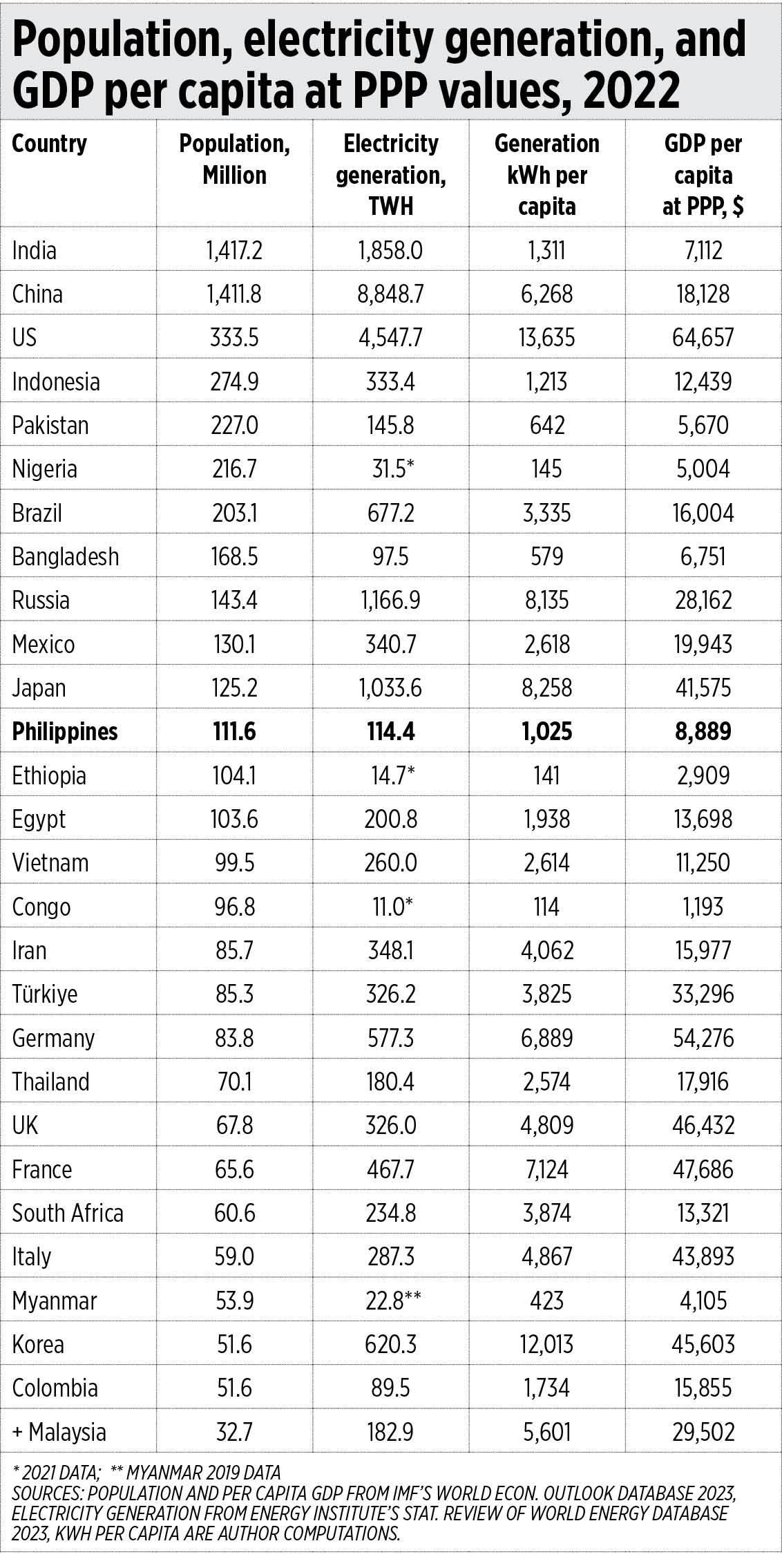
2. Aim for the generation of 2,000 kilowatt hour/person (kWh/person) by 2030 from only 1,025 kWh/person in 2022. Our ASEAN neighbors already had higher kWh/person generation than the Philippines in 2022: Indonesia had 1,213, Thailand had 2,574, Vietnam had 2,614, and Malaysia had 5,600. In the accompanying table I list the countries with the biggest populations (50 million people or more) plus their electricity generation (TWH), their electricity generation in kWh per capita, and their GDP per capita. I did not include Tanzania (61.5 million) and Kenya (50.6 million) because I cannot find available data on their electricity generation as of deadline.

3. Hasten the entry of nuclear energy that will greatly expand our power generation capacity.

Related to the generation issue, see the following BusinessWorld reports this month: “Market for AS power enters pilot operations” (Jan. 3), “Where’s the Philippine Energy Plan?” (Jan. 3), “Philippine energy companies bullish, eye 2024 demand surge” (Jan. 5), and, “3 gencos to supply Meralco’s 1,800-MW power requirement” (Jan. 8).

4. The National Grid Corp. of the Philippines (NGCP) must finish many long-delayed interconnection and transmission expansion projects (Mindanao-Visayas, Cebu-Negros, Iloilo-Negros, etc.). Islands with power-deficits cannot get additional supply easily from islands with power surpluses because of the unfinished or unexpanded transmission lines.

5. The NGCP must strictly comply with the Grid Code, especially when it comes to redundancy reserve requirements and getting reliable contingency reserves (CR). In the Panay Island blackout of Jan. 2, when PEDC Unit 1 (55.8 MW) tripped or conked out, the needed ancillary services (AS) and strong CR by NGCP were absent. Neither did it implement auto/manual load dropping (ALD/MLD) to reduce demand. Power demand continued at nearly 400 MW even though the supply declined from 356 MW to only 301 MW by 12:06 p.m. Two hours later, the other generating plants in the island also tripped, leading to the automatic tripping of distribution utility (DU) feeders, and entire island’s four provinces suffered from involuntary “Earth Hours.” I remember former Energy Secretary Al Cusi repeatedly pounding on the need for NGCP to finish long-delayed transmission projects, and to get reliable AS to avoid frequent yellow-red alerts.

6. The Energy Regulatory Commission (ERC) should disallow the use of battery energy storage systems (BESS) as CR. From what I read, the NGCP got BESS as its CR — this is bonkers because BESS are unreliable, small, and cannot store much energy when it is frequently cloudy and/or not windy. Only fossil fuel plants can provide reliable CR.

7. There should be more mergers and consolidations, not fragmentation, of energy providers. There are many small electric cooperatives (ECs) which do not have economies of scale and are viable only due to politics and protection by the National Electrification Administration (NEA). In my province — Negros Occidental — there are five ECs; in neighboring Negros Oriental, there are three ECs. That makes eight ECs in one island, with ERC having to monitor eight separate entities. No economies of scale mean a lack of capacity to strengthen the infrastructure against strong storms and earthquakes — even against falling trees! — leading to the occasional blackout. Existing strong distribution utilities (DUs) must remain consolidated and not divided.

8. Expand the Retail Competition and Open Access (RCOA) at a lower consumption threshold, with more retail electricity suppliers (RES) to provide more customized services to more clients, especially in areas covered by inefficient ECs. More generation plants will come in to serve more RES and more contestable customers.

9. End price controls via a primary-secondary price cap at the Wholesale Electricity Spot Market (WESM). The most expensive electricity is no electricity — in other words, blackouts. Quantify the damage done to manufacturing production, to offices and home appliances; the damage resulting from using candles (more fires) or gensets (more noise and air pollution); the damage caused by dark streets (more crimes and road accidents). A jump in the WESM price from P5/kWh to, say, P30 for a few hours is still better than “cheap but not available” power — blackouts. More peaking plants must come in and provide additional supply when needed and they should be undeterred by price controls.

10. End taxation discrimination in favor of more intermittent wind-solar. Wind and solar power generators have many tax-free privileges, and this leads to more unstable grids that will require more AS, resulting in higher overall prices.

There should be major changes in the country’s environment and energy policies, the end of climate alarmism, and the end of ecological central planning and power rationing in favor of intermittent, unreliable, and non-dispatchable on demand energy.


Bienvenido S. Oplas, Jr. is the president of Bienvenido S. Oplas, Jr. Research Consultancy Services, and Minimal Government Thinkers. He is an international fellow of the Tholos Foundation.

minimalgovernment@gmail.com

BSP signs MoU with BAIPHIL

Bangko Sentral ng Pilipinas main office in Manila. — BW FILE PHOTO

THE BANGKO SENTRAL ng Pilipinas (BSP) and the Bankers Institute of the Philippines (BAIPHIL) signed a memorandum of understanding (MoU) last month to strengthen their collaboration aimed at enhancing productivity among banks. 

The central bank formalized its long-standing partnership with the BAIPHIL by signing the MoU on Dec. 13, 2023 at the BSP’s head office in Manila, the BSP in a statement on Monday.

“The collaboration of BSP and BAIPHIL will go a long way in reaching out to our common stakeholders by providing support to banks toward productivity enhancement through research, information exchange, and education,” BSP Governor Eli M. Remolona, Jr. said.

Under the MoU, the BSP and the BAIPHIL will work together to develop capacity-building sessions for bank employees, officers, and directors. 

The MoU also covers the sharing of subject matter experts and research materials that are non-confidential, the BSP said. 

The partnership will also include advocacies for digital finance, financial literacy, financial inclusion, sustainable finance, legislative initiatives, and other reforms.

The BSP and BAIPHIL also agreed on joint research and publications on banking, monetary policy, and economic issues. 

The parties also agreed to exchange information on learning and training opportunities and regularly hold consultations on the conduct of seminars, conferences, and capacity-building.

“This MoU commits us to work together more closely toward our common goal of professional development for banking professionals, financial literacy, and financial inclusion for the underserved and unbanked,” BAIPHIL President Racquel B. Mañago said. — Keisha B. Ta-asan

Comic book on K-pop BTS charts group’s rise to stardom and military service

FAME- BTS —TIDALWAVECOMICS.COM

NEW YORK — A new comic book chronicles the rise to stardom of South Korea’s K-pop music sensation BTS and their recent transition to military service.

TidalWave Comics has added the 22-page book to its FAME series, which uses the comic medium to shine a light on musical acts.

Since their 2013 debut, BTS have become a worldwide sensation with their upbeat hits and social campaigns aimed at empowering youth.

The glossy chronicles how the seven singers became famous — and their switch from pop stars to soldiers.

All able-bodied men in South Korea aged between 18 and 28 must serve in the military for between 18 and 21 months as part of efforts to defend against nuclear-armed North Korea.

Some have won exemptions or served shorter terms, including Olympic medalists and prize-winning classical musicians. Some lawmakers had called for BTS to be exempt.

But in December 2022 the eldest member Jin joined the army, and the others followed, with the final four beginning their duty last month. Fans have pledged to wait until 2025 for them to perform as a group again.

The book will be released in both print and digital formats and soft and hardcovers on Jan. 10. — Reuters

AirAsia unifies aviation business

BW FILE PHOTO

MALAYSIA-BASED airline group Capital A Berhad, operator of budget carrier AirAsia Philippines, is transferring its aviation business to AirAsia X Berhad (AAX) to improve its aviation operations and strengthen financial performance, a company official said on Monday.

Capital A Berhad said it had entered into a non-binding agreement with its unit AirAsia X for the sale of its aviation businesses — AirAsia Berhad and AirAsia Aviation Group Ltd.

“We will combine Malaysia AirAsia and AirAsia Aviation Group, which [includes] Indonesia, the Philippines, Thailand, and Cambodia,” Capital A Chief Executive Officer Tony Fernandes said during an online briefing.

The move “positions AirAsia X to become the overarching regional aviation provider for all short and medium-haul routes under the AirAsia brand name,” Capital A Berhad said in a separate media release.

The definitive sale and purchase agreement are still being finalized, Mr. Fernandes said, adding that the transaction is expected to be signed in the next two weeks.

He said the restructuring would also allow Capital A to focus on its other companies, which include logistics aviation services and a digital services platform.

“Shareholders of Capital A will eventually be shareholders of AirAsia Aviation Group and Capital A. Eventually, AirAsia X and AirAsia will be merged into one airline. We will have a pure aviation group,” he said.

AirAsia X said the acquisition will provide the company “unparalleled advantages” and strengthen its market position by enhancing its financial performance.

“These strategic acquisitions serve as pivotal milestones in AAX’s post-PN17 revival strategy, bolstering our financial stability and enhancing our market positioning,” AirAsia X Chairman Dato’ Fam Lee Ee said.

Last year, AirAsia X exited its PN17 status, which is a classification issued by the Malaysian bourse to companies in financial distress.

“We are confident that by separating the aviation business from Capital A, the non-aviation businesses within the group, which we feel are currently undervalued by the market, will also be recognized for their intrinsic value and potential,” Mr. Fernandes said.

Mr. Fernandes added that the group needs to raise capital as it intends to add more fleet in Indonesia and the Philippines as the two are the group’s growth drivers.

“Really our growth is going to be very heavily driven by the Philippines and Indonesia on top of Malaysia and Thailand, which have a lot of growth. We really want to grow in Indonesia and the Philippines,” he said.

The group is looking to launch flights to the US by the end of this year, citing that it sees potential in the Philippines due to the growing demand in tourism.

The Philippines recorded 5.45-million international visitors in 2023, surpassing its 4.8-million target, the Tourism department said. This year, the agency is targeting 7.7-million visitors.

“By the end of this year, our first re-entry to Europe. And eventually, we’re going to go back to North America and South America. Manila will be a very good hub into America, and Thailand will be a great hub into Europe,” the group said.

For this year, AirAsia said it is working to fully restore its fleet as it seeks to reactivate 191 aircraft by the first quarter of 2024 with 166 already in operation. — Ashley Erika O. Jose

RCBC to offer $500M in sustainability notes in return to offshore debt market

PHILSTAR FILE PHOTO

RIZAL COMMERCIAL Banking Corp. (RCBC) is set to return to the offshore bond market and is looking to raise at least $500 million from an offering of senior unsecured sustainability notes.

The benchmark-sized bonds will be offered under the bank’s $3-billion medium-term note program, the Yuchengco-led bank said in a disclosure to the local bourse on Monday.

The bonds will be issued under RCBC’s Sustainable Finance Framework.

The note offering circular will uploaded to and in accordance with the Singapore Exchange Securities Trading Ltd.’s rules, RCBC said.

The bank was scheduled to hold investor calls on the offer on Monday.

RCBC has tapped Australia and New Zealand Banking Group Ltd., Citigroup Global Markets Ltd., and SMBC Nikko Securities (Hong Kong) Ltd. as the joint bookrunners for the offering, it said on Monday.

The lender in 2020 increased the size of its medium-term bond program to $3 billion from $2 billion previously.

So far, RCBC has raised $1.6 billion from the offshore debt market under its current medium-term note program, with its last offering held in August 2020, from which it raised $300 million through Tier 1 securities.

The bank saw its net income decline by 28.35% year on year to P2.81 billion in the third quarter as its interest expenses more than doubled and as non-interest income declined.

RCBC’s shares went up by five centavos or 0.22% to end at P22.90 apiece on Monday. — AMCS

How minimum wages compared across regions in December

(After accounting for inflation)

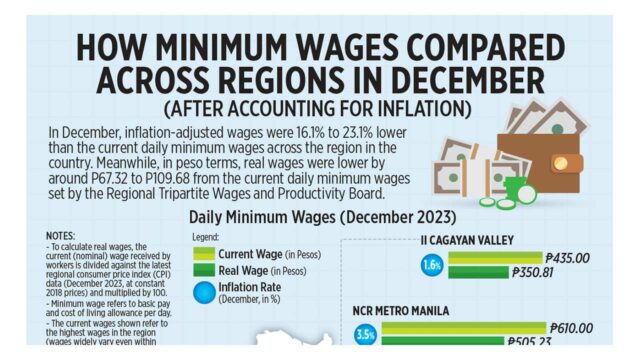
In December, inflation-adjusted wages were 16.1% to 23.1% lower than the current daily minimum wages across the region in the country. Meanwhile, in peso terms, real wages were lower by around P67.32 to P109.68 from the current daily minimum wages set by the Regional Tripartite Wages and Productivity Board.


How minimum wages compared across regions in December

Can we make New Year’s resolutions work for the planet?

IAN SCHNEIDER-UNSPLASH

IF THERE’S A MONTH dedicated to self-betterment, it’s dark and dreary January. The gyms are full, the pubs are empty, and green juices are flying off the shelves. At least for now.

Even with the best of intentions, the vast majority of New Year’s resolutions don’t last very long at all. Many goal-setters give up on their commitments within just three months. We’re now in the second week of January, and some of you may have already slipped up on your promises. There’s no judgement here; your columnist has already watered down one of her ambitions (we’re doing “damp” January now).

But such faltering is important to note because we’re going to need permanent behavior changes in order to meet our emissions targets. Consumer decisions won’t halt climate change alone, but collectively we can make the task much easier by, for example, reducing demand for fossil fuels or carbon-intensive products. The question is how to make that happen, especially when our psychology makes voluntarily changing habits very difficult.

One reason for our collective annual failure is that we don’t tend to set goals for ourselves in a useful way, making them large without specificity or accountability. Setting a goal to “save money” is nearly useless without a target and an action plan to support it — such as, for example, setting aside $100 a month to reach a $1,200 target.

With that in mind, these might be more useful framings for things you could do to reduce your environmental impacts.

Instead of vowing to eat a more planet-friendly diet, you should narrow down what that means. If you’re not already a vegetarian or vegan, the best thing you could do to reduce your emissions is to cut out red meat, particularly beef. It might be more achievable to focus on a positive action rather than a subtractive one: Instead of the main target being to cut beef from your diet entirely, you could set a target to eat, say, five plant-based meals a week and find recipes — or menus — that you’re excited to try.

Likewise, food waste is responsible for around 6% of total greenhouse gas emissions — three times that of aviation. But it’s quite hard to measure how much you’re wasting at home — or it’s easy to shut your eyes as you drop bags of slimy salad, long forgotten at the back of the fridge, into the bin — making it a difficult target to remain accountable to. But setting a goal to create meal plans, or batch cook, or find ways to be creative with leftovers should naturally lead to a reduction in wastage.

Other behavioral changes we’ll need to see widely adopted include investing in an electric vehicle or heat pump, insulating homes, buying energy-efficient appliances and using public transport or active modes like cycling for appropriate journeys.

If we all committed to doing better for the planet, it’d help shift demand to cleaner technologies, show clear policy support for green measures, and reduce our energy consumption. But there are plenty of issues with relying purely on individual agency.

For example, consider the effects of inequality on our individual abilities to change. Insulation measures, heat pumps, and electric vehicles all require sizable investments. Supermarkets in poorer neighborhoods often have fewer varieties of fresh produce which inhibits the ability of residents to adopt healthier, more plant-based diets. Changing or forming better habits requires a cognitive effort which will be harder for some than it is for others. While one household may have the time to commit to cycling to work or meatless Mondays, another might be focused on economic survival.

That’s why we need policy — carbon taxes, subsidies, public information campaigns — to support behavior change. But it’s a touchy subject that many politicians are reluctant to act forcefully on. In the UK, the importance of behavior change is recognized, with the stated goal being to make it “easier and more affordable for people to shift towards a more sustainable lifestyle while at the same time maintain[ing] freedom or choice and fairness,” according to energy minister Lord Callanan. There are grants for heat pumps and the Great British Insulation Scheme, which offers free or cheaper insulation measures, for example.

But that doesn’t go far enough, with the House of Lords Environment and Climate Change Committee calling the government’s approach “seriously inadequate.” It doesn’t help that UK Prime Minister Rishi Sunak arguably made it a point of pride as he gears up for the next election, announcing last year that he had “scrapped” several imaginary policies including a meat tax and compulsory car-sharing.

Good policy to support sustainable lifestyle choices will not unfairly burden those who can least afford it, but it will make green options the no-brainer. Governments should not shy away from nudging people to behave more greenly with public engagement and price signals. After all, sometimes we all need a little help to do the right thing.

BLOOMBERG OPINION

ADVERTISEMENT
ADVERTISEMENT