Home Blog Page 3809

Axelum opens hospital in Northern Mindanao

FACEBOOK/SAN ISIDRO POLYMEDIC GENERAL HOSPITAL

LISTED coconut product maker Axelum Resources Corp. has branched out into healthcare by opening its first hospital in Misamis Oriental.

The listed Philippine company launched through civic affiliate AMDG Foundation the 100-bed San Isidro Polymedic General Hospital in Gingoog City, Misamis Oriental, it said in a stock exchange filing on Wednesday.

The medical center offers a suite of services including hemodialysis, emergency room, intensive care, extended laboratory and diagnostics, radiology, surgery, delivery room, neonatal, outpatient clinics, pharmacy and other essential amenities, Axelum said.

“At Axelum, our overarching goal is to combat poverty through livelihood, education and now through healthcare,” Axelum President and Chief Executive Officer Romeo I. Chan said in the statement. “We believe that every Filipino deserves access to quality medical services and modern facilities.”

The company aims to provide professional healthcare to the local community and indigenous people of Northern Mindanao.

The company said the project was launched though AMDG Foundation and in partnership with the Cagayan de Oro Polymedic Medical Group.

Axelum said the hospital seeks to serve more than 350,000 residents and has a long-term aspiration to become a premier end-referral hospital in the region. It also aims to expand into highly specialized treatments and services.

Axelum had a net loss of P428 million in the nine months ended September, a reversal of its P717.28-million net income a year earlier. Revenues fell by 19% to 4.28 billion.

Shares of the company inched up by 0.88% to close at P2.30 each. — Adrian H. Halili

Democracy will get a reckoning in Asia this year

FREEPIK

A RECORD NUMBER of people are heading to the polls around the world this year, including in Asia. This is particularly significant for the region because with the exception of Japan, South Korea, and Taiwan, the Asia-Pacific region is seeing a significant increase in populism and authoritarianism, harking back to an era when strongmen presidents ruled with an iron fist. Hundreds of millions of votes won’t necessarily mean more democracy.

There are a few reasons for this. We have already seen the rise of less democratic leaders in the Netherlands and Italy, and there is a corresponding trend in Asia. China’s alternative model of governance, which prioritizes economic development over civil liberties, is increasingly appealing. Many voters have become disenchanted with Western democracies in a post-Brexit, post-Trump world, and are actively looking for something else. Combine that with social media amplifying the message of candidates who can now bypass a press struggling to keep them accountable, and it helps explain the allure of more authoritarian leadership. Artificial intelligence tools will only make things worse, as the proliferation of fake news, misinformation and disinformation inundate the timelines of a largely young and often unquestioning voter demographic.

Asia’s liberal credentials are under significant pressure, according to figures from the International IDEA’s Global State of Democracy (GsoD) Initiative. Only a tiny minority live in a high-performing democracy, with institutions appearing stuck.

From Bangladesh in the coming week to Pakistan and Sri Lanka toward the end of 2024, voters will be having their say. Three of the most consequential elections will be held in Taiwan, Indonesia, and India. Their outcomes will determine the region’s future and democratic trajectory in years to come.

TAIWAN IS THE BRIGHT SPOT
The island is a bright spot among less democratic neighbors. Taiwanese will choose their next president and legislature on Jan. 13. For the most part, they are expected to be vibrant, free, and fair, with an engaged electorate. Voters want a new administration that will manage issues like the economy and jobs but also navigate the difficult and tricky relationship with China. Taiwan regularly scores well on the annual Freedom House report on the state of liberties in countries around the world. Threats to its democracy are mainly external. Beijing poses the biggest existential risk and concerns have been building in the past few years over the Chinese government’s efforts to influence policymaking, media, and the democratic infrastructure.

It wasn’t always like this. For several decades, Taiwan was ruled under a dictatorship, harshly regulated by martial law that was finally abolished in 1987. In fact, it was Southeast Asia in the 1990s and early 2000s that seemed to be the beacon for the golden age for democratization, serving as a model for other developing countries. At that time, Indonesia, which will hold presidential elections on Feb. 14, was just beginning its experiment with democracy and decentralization, after the toppling of strongman dictator and former President Suharto. The rest of the region was also in relatively good shape.

Today, though, as Joshua Kurlantzick, senior fellow for Southeast Asia at the Council for Foreign Relations, noted recently, it is a long way from that promising period. Timor-Leste is the only fully free democracy in the region, according to Freedom House’s rankings, despite its poverty and isolation.

INDONESIA LOOKING BACK
Indonesians will almost certainly elect the former general and alleged human-rights violator Prabowo Subianto as their next president, along with the eldest son of the incumbent Joko Widodo as vice-president. Many have questioned why in a country of 270 million people, the man most likely to lead is a throwback to the old authoritarian era, the Orde Baru, as it was called, the 32-year rule under Suharto marked as one of the most corrupt and dictatorial in Southeast Asia’s history.

Those who fought against the old order are asking themselves what Prabowo’s ascendancy means for Indonesia’s democracy, and whether it implies a fresh role for the military in politics. That Prabowo’s past has failed to make a dent in his popularity is a testament to his social media game, which has seen him use the image of a cute and cuddly grandfatherly figure to appeal to younger voters. In another ominous sign, the choice of Gibran Rakabuming Raka as his running mate has raised concerns that nepotism and cronyism — hallmarks of the Suharto era — are making a comeback.

INDIA’S ‘MODI FACTOR’

Over several weeks in April and May, India will hold elections for over 600 million registered voters to determine whether Narendra Modi’s ruling Bharatiya Janata Party (BJP) will govern the world’s most-populous nation for five more years. All the signs point toward another Modi victory. The BJP is playing up his personal popularity, what’s often called the “Modi factor.”

The BJP is celebrating the results of the Dec. 3 state polls that gave it huge wins in the Hindi belt states of Chattisgarh, Madhya Pradesh, and Rajasthan. The opposition Indian National Congress won in the southern state of Telangana. There is no denying Modi’s pull — he regularly ranks as the most popular leader in the world. It is true that under his rule India has become more globally significant and has enjoyed impressive economic growth. But minorities feel less welcome and safe than ever before, with one report noting that the ruling party and affiliated groups were behind most hate speech incidents against Muslims during the first half of last year. Laws are passed quickly through a parliament, which meets for fewer and fewer days, and a once vibrant and free press has now largely been muzzled or accommodates the BJP and Modi’s hardline Hindu message.

It would be understandable then to feel dispirited and demoralized by the state of Asia’s democracy in 2024. Indeed, simply writing this column has made me wonder whether the experiment with this system of government has failed in the region. Still, it would be churlish to begin the new year with limited optimism, and it is in the very mechanisms of democracy that I keep the faith. Ultimately, voters must and should decide on whether their elected officials are delivering on promises. It would be wise for those in office and those who put them there to remember that the real power rests with them, the people. Another election is hopefully just one term away.

BLOOMBERG OPINION

Filipinos expect data leaks, job losses from AI this year

FREEPIK

MAJORITY of Filipinos expect more online data leaks and growing artificial intelligence (AI) adoption to affect their jobs this year, according to global market research company Ipsos.

It also found that Filipinos expect decreased use of social media platforms this year.

The Ipsos Global Advisor 2024 Predictions survey showed the Philippines was one of the top countries with these expectations, with the share of respondents agreeing with these three categories at about 11% above the global average.

The company surveyed 34 countries through its online platform, with 1,000 respondents coming from the Philippines.

The report showed that 64% of Filipino respondents believe their personal data could be leaked on the Internet, higher than the global average of 55%.

The Philippines was the second most attacked country by web threats in 2022, with 39,387,052 internet-borne threats detected, according to data from Kaspersky. It recorded 24,737 crypto-phishing cases, 15,732 mobile malware cases, and 50 mobile banking Trojan cases in 2022.

Sam Jacoba, founding president of the National Association of Data Protection Officers of the Philippines, likewise expects more incidents of cyberattacks this year.

“The government, private sector, and communities of practice have to be more vigilant,” he told BusinessWorld in an interview. “Do not let up in awareness, education, training, certification, and consistent hardening of critical infrastructure.”

Meanwhile, AI continued to affect the livelihood expectations of Filipinos, with 73% of respondents believing that growing adoption of the technology will likely lead to job losses versus the global average of 64%.

Some 48% of Filipinos said AI is unlikely to help create new jobs, above the 44% global average.

Data and analytics firm GlobalData said generative AI job posts spiked in the third quarter of last year amid competition in the digital landscape, with medium- and long-term talent plans in development for adaptability.

Analytics from the employment-focused social media platform LinkedIn also showed a 2.4 times increase in job posts mentioning AI in Southeast Asian markets from three years ago, with a 1.7 times growth in applications versus those that do not mention it.

It observed that 76% of Filipino professionals expect a significant change in their jobs driven by AI, with 55% already using generative AI, citing efficiency and productivity benefits.

Sergio R. Ortiz-Luis, Jr., president of the Employers Confederation of the Philippines, told BusinessWorld that the labor force must recognize and adapt to both challenges and opportunities presented by technological advancements.

“Job seekers and employees need to adapt to maintain their availability for the job market,” he said. “Know what areas they can skill themselves in.”

Meanwhile, 56% of Filipinos expect to use social media less this year, higher than the 41% global average. — Miguel Hanz L. Antivola

ACEN completes purchase of Indonesia wind projects

ACENRENEWABLES.COM

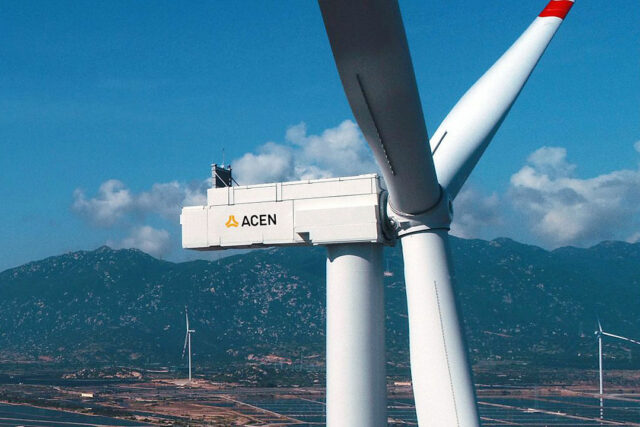
AYALA-LED ACEN Corp. said its unit has completed the acquisition of three late-stage wind projects from Indonesia-based Barito Renewables, Inc.

In a stock exchange disclosure on Wednesday, the listed energy company said ACEN Renewables International Pte. Ltd. through unit ACEN Investments HK Ltd. completed the purchase of shares from UPC Renewables Asia Pacific Holdings Pte. Ltd. for the three wind development assets.

The projects have a combined potential capacity of 320 megawatts (MW) and are in South Sulawesi, Sukabumi, and Lombok provinces in Indonesia.

ACEN acquired the shares at a price that is “less than 10%” of its book value.

On Dec. 15, ACEN HK and Barito Renewables unit PT Barito Wind Energy signed the purchase deal with UPC Renewables.

“Following the signing of the respective share transfer deeds, Barito Wind owns 51% of the three development assets, while ACEN HK owns the remaining 49%,” ACEN said.

In February 2022, ACEN said it had completed the acquisition of UPC Renewables’ shares in ACEN Australia, making it its wholly owned unit.

ACEN Australia is the joint venture holding company of unit ACEN Renewables International and UPC Renewables for ACEN’s energy projects and investments in Australia.

To date, ACEN has about 4,430 MW of attributable capacity spanning the Philippines, Vietnam, Indonesia, India, and Australia.

ACEN’s share price gained 1.16% or 5 centavos to close at P4.35 each. — Sheldeen Joy Talavera

The price of road use

PHILIPPINE STAR/WALTER BOLLOZOS

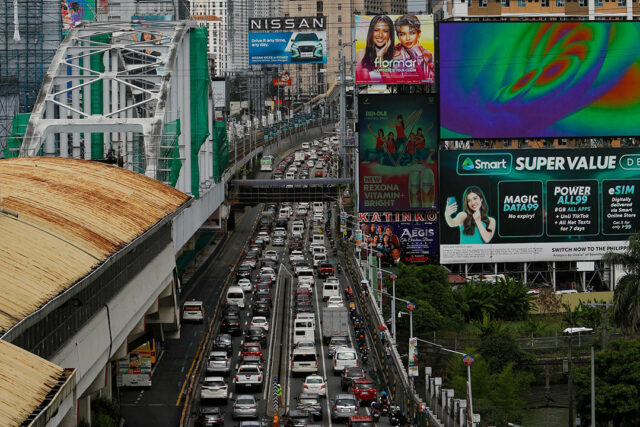
Over the years it has been called many things: motor vehicle registration fee, motor vehicle user’s charge, and by 2024, motor vehicle road user’s tax. But essentially, these are all the same thing. It is a fee that vehicles owners pay to the government for the right to own, and presumably use, a motor vehicle on Philippine roads. It is the price to pay for the privilege of using roads.

And by this year, with the blessing of the House and the Senate, such fees will go up by 5% every year for all motor vehicles from 2026 onwards. For 2024 and 2025, there will be fixed rate hikes. But public utility and for-hire vehicles will get a 50% discount, while motorcycles and tricycles will be exempt. Obviously, the heavier the vehicle, the higher the fee.

I do not agree with the plan as approved by the House. And I hope the Senate can still make changes to the bill. It is as if the government wants private vehicle owners to swap their cars for motorcycles. Or to take public transportation, even when such is still severely lacking. In my opinion, if it is a road user’s tax, then all road users must pay. No discounts, no exemptions.

Taxes or fees or charges are paid for several reasons, which include: for the government to raise revenues; to collect money from road users for road improvement and road safety projects; to pay for the “negative externalities” of motor vehicle use such as emission and carbon footprint; in this case, to fund public transport modernization; and, even to dissuade excessive vehicle ownership through a “luxury” tax, etc.

Last month, the House of Representatives approved the proposed Motor Vehicle Road Users’ Tax (MVRUT) law to replace the annual registration fee called the Motor Vehicles Users Charge or MVUC. The fees collected will partly go to projects to modernize public transportation and to road crash prevention programs. Previously, MVUC collections partly went to the Special Road Fund of the Public Works department.

Obviously, the government desperately needs money and that raising the fees now primarily aims to fund the 2024 budget, which is the largest ever national budget in Philippine history. But if the intention is also to raise money to fund public transport modernization projects, then why discount fees paid by public utility and for-hire vehicles? The fund aims to benefit them.

And why exempt motorcycles and tricycles? As a revenue-generating measure, each centavo raised from the proposed law will matter. If I am not mistaken, there are now more motorcycles than cars on our roads. So, motorcycles’ revenue potential is high. Then, why exempt them from the fee or tax? All road users must pay, maybe including motorized scooters, motorized personal mobility devices, and perhaps even electric motor vehicles.

The House Committee on Ways and Means intends for the proposed MVRUT to be “a critical fiscal tool against traffic congestion and the overuse of the country’s road infrastructure.” Again, if this is the case, even motorcycles and tricycles occupy road space and contribute to congestion and “overuse” of roads? So why exempt them? And why give discounts to PUVs and for-hire vehicles such as school buses, tourist buses, transport network vehicles like Grab cars, and for-hire fleet vehicles, etc.?

The present MVUC is based on vehicle weight, with vehicles owners paying up to P4,000 depending on the type and weight of their units. Under the proposed law, this can go up to as high as P11,000 by 2025, with a guaranteed increase of 5% annually starting 2026. The heavier the vehicle, the higher the fee.

This I can understand as road damage and maintenance cost is impacted mostly by vehicle weight — the heavier the vehicle the bigger the road impact and damage. But even motorcycles and tricycles weigh something, and contribute to road damage. And yet, unlike the present MVUC, two-wheelers and three-wheelers will be exempt from the higher “registration” fees? Also, does this mean that motorcycles and tricycles will no longer be “registered”? Or that they will still be paying the old fees?

Moreover, the negative externalities or negative impact of vehicle use go beyond road space and damage; and time wasted in traffic jams. There is also vehicle pollution and possible accidents involving people other than the vehicle owner. So, more than just vehicle weight, perhaps emission and carbon footprint should also be taken into consideration.

In the last 20 years, we have been taxing vehicles based on their price, and computing registration fees based on their weight. There was a time when vehicles were taxed based on engine size and passenger capacity. If vehicles will continue to be taxed based mainly on price or value, then maybe registration fees should also consider engine size and not just weight. Thus, an emission charge may be necessary. But there should not be any exemptions, even for motorcycles and tricycles.

I believe the proposed MVRUT law requires more study. And if exemptions or discounts are to be given, then this should be for vehicles for seniors and persons with disabilities (PWD), or those who are particularly disadvantaged by the public transport system. To some degree, the proposed law appears anti-safety and anti-PWD by favoring motorcycles with exemptions and PUVs with discounts. Neither vehicle types are helpful or convenient to seniors and PWDs.

Moreover, while I lack data to support this, road observation leaves one with the impression that motorcycles are less safe than cars particularly for seniors, PWDs, and children. And yet, to an extent, the proposed law indirectly pushes the market towards this type of vehicle for owners to save on annual recurring costs. Even while safety enforcement is seemingly deficient.

After 20 years, perhaps it is time to raise registration fees. And maybe fees should be indexed to inflation. However, other than vehicle weight, pollution and emission should also be taken into consideration. In addition, motorcycles and tricycles should not be exempted from new fees. And all road users must pay, in full, even PUVs and for-hire vehicles.


Marvin Tort is a former managing editor of BusinessWorld, and a former chairman of the Philippine Press Council

matort@yahoo.com

Term deposit yields slip before inflation report

BW FILE PHOTO

TERM DEPOSIT YIELDS slipped on Wednesday amid expectations of slower December headline inflation, which could lead to monetary policy easing this year.

The term deposit facility (TDF) of the Bangko Sentral ng Pilipinas (BSP) fetched bids amounting to P368.126 billion on Wednesday, above the P300-billion offering and the P242.295 billion in tenders for the P230-billion offer a week ago.

Broken down, tenders for the seven-day papers reached P203.117 billion, higher than P160 billion auctioned off by the central bank and the P137.115 billion in bids for a P120-billion offering seen the previous week.

Banks asked for yields ranging from 6.5525% to 6.6175%, a wider and lower margin compared with the 6.6% to 6.63% band seen a week ago. This caused the average rate of the one-week deposits to decrease by 1.64 basis points (bps) to 6.5983% from 6.6147% previously.

Meanwhile, bids for the 14-day term deposits amounted to P165.009 billion, above the P140-billion offering and the P105.180 billion in tenders for the P110 billion auctioned off on Dec. 27.

Accepted rates for the tenor were from 6.5625% to 6.65%, lower than the 6.6% to 6.68% margin seen a week ago. With this, the average rate for the two-week deposits dropped by 1.99 bps to 6.6203% from the 6.6402% seen in the prior auction.

The BSP has not auctioned off 28-day term deposits for more than three years to give way to its weekly offerings of securities with the same tenor.

The term deposits and the 28-day bills are used by the central bank to mop up excess liquidity in the financial system and to better guide market rates.

Term deposit yields went down on Wednesday as inflation likely eased last month, Rizal Commercial Banking Corp. Chief Economist Michael L. Ricafort said in a Viber message.

A BusinessWorld poll last week yielded a median estimate of 4% for December headline inflation, within the BSP’s 3.6-4.4% forecast for the month. This is slightly slower than the 4.1% in November but significantly below the 8.1% in December 2022.

If realized, December could mark the first time that inflation met the central bank’s 2-4% target after 20 straight months. It would also be the slowest since the 3% print in February 2022.

This would bring the 2023 inflation average to 6%, matching the BSP’s baseline forecast.

The Philippine Statistics Authority will release December consumer price index data on Friday.

TDF yields dropped after global crude oil prices hit two-week lows, which could bring inflation down towards the central bank’s 2-4% target in the near term, Mr. Ricafort said, and support rate cuts this year.

At its December meeting, the Monetary Board left its policy rate unchanged at a 16-year high of 6.5% for a second straight meeting.

The central bank raised borrowing costs by a total of 450 bps from May 2022 to October 2023.

The Monetary Board will hold its first policy meeting for this year on Feb. 15.

Markets are also pricing in 150 bps in rate cuts from the US Federal Reserve as early as March or May, Mr. Ricafort added.

The Fed kept borrowing costs unchanged at 5.25-5.5% in December after hiking rates by 525 bps from March 2022 to July 2023. — Keisha B. Ta-asan

Dining In/Out (01/04/24)


The Peninsula celebrates the Feast of the Three Kings

THE PENINSULA Manila brings the holiday season to a close with the Celebration of the Feast of the Three Kings on Jan. 6, Saturday. From 11 am to noon, the Three Kings will visit The Peninsula Manila, bringing with them presents for children. There will be special celebrations starting with a parade around the hotel bringing the Three Kings from the East — Melchor, Gaspar and Balthazar — to The Lobby before proceeding to Escolta restaurant where a buffet lunch awaits guests. The Three Kings lunch buffet price is P3,000 and available from noon to 2:30 p.m. The Feast of the Three Kings is also a time for indulging one’s sweet tooth. Visit The Peninsula Boutique for a taste of Roscon de Reyes (P990), a traditional Spanish brioche-like sweet bread that represents the three kings’ crowns that’s eaten on the Feast of the Three Kings which celebrates Epiphany when the Three Kings came to visit the baby Jesus in Bethlehem. For inquiries or further information call 887-2888, extensions 6691 and 6694 (Restaurant Reservations), e-mail diningpmn@peninsula.com or visit peninsula.com.


New drinks, food, and merch at PHL Starbucks stores

NOW available is The Starbucks’ Winter selection, featuring a variety of new drinks. January also sees new dishes and new merchandise that fit the post-holiday season. The new Starbucks Winter Beverages are: Honey Plum Pure Matcha Latte, topped with plum cold foam and sweet plum sprinkles (available in hot, iced); Vienna Creamy Latte, Starbucks espresso infused with vanilla mascarpone cheese with vanilla seeds, topped with mocha sauce, a creamy mascarpone cheese foam and sprinkles of burnt caramel powder (available in hot, iced, or blended variants); and Coconut Double Mocha Macchiato, espresso, white mocha sauce, coconut milk and mocha drizzle (available in hot, iced, or blended variants). The collection of Starbucks Winter Food includes returning favorites and new dishes. Returning favorites are the Mango Float Cake, a buttery cake layered with mango mousse and soft and crunchy meringue, finished with mango buttercream icing; and My Valentine Doughnut, a doughnut filled with vanilla custard filling. New items are: No Sugar Added White Belgian Chocolate and Pecan Cookie, Acai Berry Bowl Cheesecake, Mixed Berries Yogurt Parfait, Roasted Chicken Caesar Parmesan Cheese and Sun-dried Tomatoes on Focaccia, and the Smoked Bacon and Mushroom Bake. Starbucks Winter Merchandise is available in all Starbucks stores and on the Starbucks flagship store on Lazada and Shopee while supplies last. There is the Guardian Dragon and Its Keeper and 2024 Zodiac Collection which includes Zodiac Dragon inspired mugs and lifestyle items celebrating the Year of the Dragon. Philippine exclusives are the FY24 Coffee and Tea Tumbler which comes with 10 free Tall vouchers for coffee and tea beverages, and festive mugs focusing on scenic views and festivities in different parts of the country. Finally, there is the Starbucks Winter Coffee collection, which is available in all Starbucks stores while supplies last. These are the Single-origin Guatemala Casi Cielo, Single-origin Honduras Marcala, and the Costa Rica Tres Rios.


Mercato Centrale launches new market at Bridgetowne

LAST December, Mercato Centrale launched their latest addition near the Bridgetowne Obstacle Course and The Victor statue in Bridgetowne, Pasig. This newest addition to Mercato Centrale’s markets offers a diverse range of freshly prepared meals, artisanal snacks, and gourmet refreshments. With a focus on quality, variety, and convenience, the market endeavors to cater to the tastes and needs of both athletes and spectators alike. The market is open every week from Thursday to Sunday (4 to 10 p.m.) and offers a combination of live music, chilled beverages, and different cuisines from its vendors. Throughout 2023, Mercato Centrale has actively supported small food businesses across their various markets, including Mercato Food Park, Mercato High StrEAT, Mercato Centrale HQ, and Mercato Centrale at McKinley West in Taguig.


Krispy Kreme is giving away 500,000 doughnuts in 2024

SPOT HAPPY with Krispy Kreme this 2024 and be one of the lucky customers to get a dozen from the more than 500,000 Original Glazed Doughnuts that the American doughnut brand will be giving away for 2024. For the Spot Happy campaign, customers have to spot happy moments in their day and magnify their happiness using the Original Glazed Doughnut as their lens. Krispy Kreme unveiled its Spot Happy video, https://fb.watch/j1Ip_pW1ar/, which shows how. Krispy Kreme stores will be holding the 365 Days of Happy, during which every day in more than 100 stores nationwide for 365 days, will give one dozen Original Glazed doughnuts for free to guests who qualify in their Spot Happy surprise criteria of the day. There are no announced instructions. Just visit a nearby store, and fit the day’s special rule. 365 Days of Happy will run until the end of the year in select stores nationwide, https://bit.ly/SpotHappyMoments.


FairPrice potato chips and nuts now available in supermarkets

PARTY appetizers and at home snacking get a sophisticated twist with FairPrice’s range of potato chips and nuts, including the award-winning Truffle Potato Chips. These new chips and nuts can be enjoyed on their own or paired with food and drinks. Made from 100% fresh potatoes, the crispy FairPrice Potato Chips can be prepared in a bowl with dips, like tomato salsa, cheese, and garlic aioli. For an appetizing pre-dinner experience pair the Truffle Potato Chips with a bottle of wine. Then there is FairPrice’s range of nuts such as Baked Almonds and California Pistachios, which are sourced from the USA. The chips can be found at leading supermarkets in Metro Manila now. FairPrice California Pistachios and Baked Almonds are available at SM Supermarket, Landmark Supermarket, and South Supermarket. FairPrice will also be launching a wider range of nuts in Philippine supermarkets in the coming months. FairPrice’s range of potato chips and nuts are exclusively distributed in the Philippines by High Tower, Inc.


Jollibee offers Mix Match Combos

WHILE customers often seek things that offer the best value for their money, they sometimes feel that they need to settle for less. That is not the case with Jollibee’s Mix Match Combos, where each option combines value and flavor. These combos offer a variety of Jollibee’s best-tasting products, for a filling and wallet-friendly meal — for P75, they can select a main and a side, enjoying savings of up to P45.  First, the customer has to choose one main dish (Yumburger, Jolly Spaghetti, a Burger Steak, or Tuna Pie), then choose one side (Peach Mango Pie, Coke Float, Jolly Crispy Fries, Choco Sundae, or Pineapple Juice). Jollibee’s Mix Match Combos are available nationwide for P75 via dine-in, take-out, or drive-through.

Angel investor community to help foster Philippine startups’ growth

TRUSTPAIR.COM

PRIVATE-PUBLIC startup platform QBO Innovation Hub wants to build a community of angel investors to help foster growth for the Philippines’ startup industry.

The company closed last year’s initiatives with its AQTIVATE angel investing short course and summit, in partnership with the United States Embassy in the Philippines and IdeaSpace Investments.

“We believe unlocking private capital plays a key role in fueling growth within the startup landscape in the Philippines,” Katrina Rausa Chan, executive director at QBO Innovation Hub, said in a statement on Wednesday.

“We’re committed to cultivating the next generation of local angel investors, and in doing so, significantly increasing the volume of investments and opportunities for early-stage ventures in the years ahead,” she added, noting they aim to develop 1,000 angel investors through the program.

Pauline Anderson, US Embassy deputy director for public engagement, said their initiatives with QBO “promote inclusive economic growth” and “establish a globally competitive and innovative industry and services sector.”

Securing capital continues to be a challenge among entrepreneurs, QBO said, which is a gap that angel investors can bridge. A collaborative and knowledgeable network of people who share insights and strategies could help them tap these investors, it added.

“Not only do angel investors seize the opportunity to yield profit, but also significantly influence the trajectory of promising startups,” Ms. Chan said.

In an interview with BusinessWorld during the Philippine Startup Week 2023, she said strengthening business education, funding mechanisms, mentoring programs, and international exposure opportunities are the keys to boosting the local startup industry. — M.H.L. Antivola

PLDT unit expands digital services for Pinoys abroad

PLDT, Inc. on Wednesday said its international retail arm is expanding its digital services through a one-stop shop platform that offers online shopping and e-gift vouchers to Filipinos overseas.

“This is another way for us at PLDT Global and TINBO (Tindahan ni Bossing) to engage with our Filipino communities overseas by providing them with more options to care for their loved ones back home,” President and Chief Executive Officer Albert V. Villa-Real said in a statement.

Overseas Filipino workers can now buy Lazada and Shopee e-gift vouchers for their families in the Philippines via TINBO. They can buy and send Lazada or Shopee vouchers to their loved ones as gifts — a convenient and more practical alternative than the traditional balikbayan boxes, PLDT said.

“Plus, the e-gift vouchers allow their family members or recipients the opportunity to buy the items that they like from the online shopping apps,” it added.

Powered by PLDT Global, TINBO is a marketplace that allows Filipinos around the world to buy load, send food vouchers, e-gifts, healthcare PINs from mWell, and even gaming PINs for their families in the Philippines.

They can buy a Smart virtual number through TINBO, letting them receive one-time passwords from their e-wallets and e-banks in the Philippines like Maya.

TINBO also gives overseas Filipinos access to a convenient and secured online bill payment platform for their Philippine utilities and other digital services while outside the Philippines.

PLDT’s share price lost 0.24% or P3 to P1,272 each at the close of trading in Manila.

Hastings Holdings, Inc., a unit of PLDT Beneficial Trust Fund subsidiary MediaQuest Holdings, Inc., has a majority stake in BusinessWorld through the Philippine Star Group, which it controls. —  A.E.O. Jose

Top 10 trends in global public debt in 2023

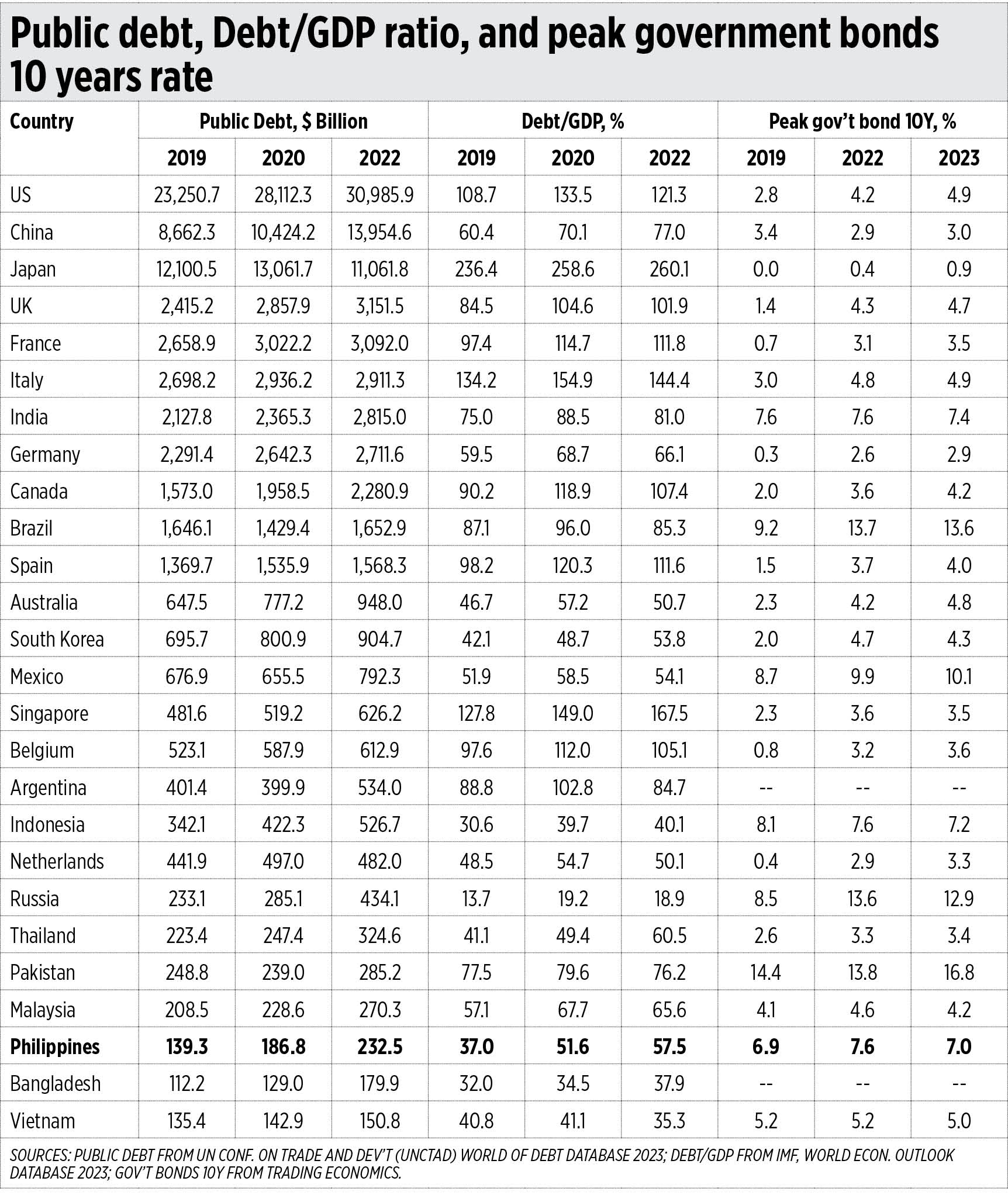
Continuing this column’s “Top 10” series for 2023, we look at government debt indicators. Below are the 20 countries with the largest public debt (Russia is the 20th) plus six other major indebted Asian countries. Here are the emerging trends.

1. The US remains the most indebted country in the world with $31 trillion in 2022. By end-2023, this has gone up to $34 trillion, according to the latest data from fiscaldata/treasury.gov. China, with $14 trillion in 2022, is second and Japan, with $11.1 trillion, is third but this is a decline from $13.1 trillion in 2022.

2. A big jump in public debt occurred in 2020 during the dictatorial global lockdown and the mandatory shutdown of many tax-paying businesses. This happened while expenditures kept rising as governments continued paying their personnel and bureaucracies plus creating new welfare programs. All countries in the table accompanying this story showed this trend except Brazil, Mexico, Argentina, and Pakistan. I think the decline was due to their currency appreciation that affected the conversion to US dollar value. Then these four countries’ public debt jumped in 2022.

3. The Philippines breached the $200-billion mark with $224.6-billion public debt in 2021. It then rose to $232.5 billion in 2022. Vietnam was correct not to have breached the $200 billion in debt level.

4. The government debt/GDP ratio jumped in 2020 for all countries in the table. From 2019-2020, these countries had big increases in percentage points: the US went from 109% to 134%, the UK from 85% to 105%, Italy from 134% to 155%, Canada from 90% to 119%. In Asia, it seems that the Philippines has had the biggest increase, from 37% to 52%. The countries that saw the smallest increases were Bangladesh, Vietnam, and Pakistan.

5.  The debt/GDP ratio in 2022 has declined from 2020 levels except seven Asian countries. These were China, Japan, South Korea, Singapore, Thailand, the Philippines, and Bangladesh. It seems many of these Asian countries contracted long-term debt that remained high even after dictatorial lockdowns were lifted in most countries.

6. The peak rates of 10-year government Treasury bonds doubled or tripled from 2019 to 2022 for Europeans. This was also the case for Japan, South Korea, and Australia. US rates touched 5% in some intra-day trading sometime last October (see table).

7. All G7 industrialized countries except Germany have debt/GDP ratios above 100%. This means fiscal discipline and responsibility is not in their vocabulary as they keep inventing new ways of spending (welfare, war, etc.) on top of existing ones. Asian countries, except Japan and Singapore, have ratios below 100% and somehow practice fiscal restraint.

8. Some rich countries suffered credit rating downgrades. The US went from Moody’s Aaa stable to Aaa negative last November. France went down from S&P’s AA stable to AA negative in December 2022. Italy went from S&P’s BBB positive to BBB stable in July 2022. In a way these are indicators of waning trust in their financial and fiscal capacity to service their long-term debt obligations.

9. The rise in price and value of alternatives to fiat money are additional indicators that many investors are slowly shying away from the US dollar and other currencies, anticipating small to big crashes in value. Gold is at an all-time high at $2,000+ per troy ounce, Bitcoin is recovering to $45,000+ and Ethereum is recovering to $2,300+, among others. Countries holding tens or hundreds of billions of dollars in US public debt will be scratching their heads if the dollar value would significantly depreciate and crash.

10. Most countries and governments are trending towards more profligate public spending and expanded borrowing instead of practicing more fiscal discipline and restraints. The Philippines and other Asian countries should actively and consciously aspire to reduce their debt/GDP ratio and retire much of their public debt — not via higher taxation but the privatization of certain government assets and corporations.

The Philippines’ economic team, headed by Finance Secretary Benjamin Diokno, has been very explicit about their stated goal of reducing the country’s debt/GDP ratio to below 60% by 2025, reducing the deficit/GDP ratio to 3% by 2028. I support their fiscal goal and I would add that we should aspire to have a debt/GDP ratio of 37% or lower by 2028. The numerator (public debt) should significantly decline via privatization of government assets. The denominator (GDP size) should keep expanding, with growth of 6-8% yearly. With more market-oriented reforms to encourage more private business dynamism and competition, the ratio will decline.


Bienvenido S. Oplas, Jr. is the president of Bienvenido S. Oplas, Jr. Research Consultancy Services, and Minimal Government Thinkers. He is an international fellow of the Tholos Foundation.

minimalgovernment@gmail.com

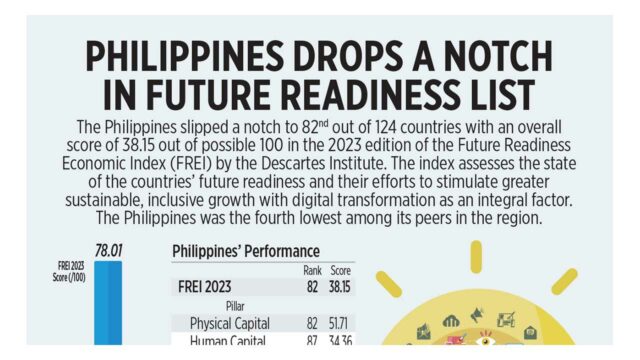
Philippines drops a notch in future readiness list

The Philippines slipped a notch to 82nd out of 124 countries with an overall score of 38.15 out of possible 100 in the 2023 edition of the Future Readiness Economic Index (FREI) by the Descartes Institute. The index assesses the state of the countries’ future readiness and their efforts to stimulate greater sustainable, inclusive growth with digital transformation as an integral factor. The Philippines was the fourth lowest among its peers in the region.


Philippines drops a notch in future readiness list

Gov’t fully awards fresh 3-year bonds

BW FILE PHOTO

THE GOVERNMENT made a full award of the new three-year bonds it offered on Wednesday even as the coupon was higher than secondary market levels following the increase in global crude oil prices amid geopolitical tensions.

The Bureau of the Treasury (BTr) raised P30 billion as planned from the fresh three-year bonds it auctioned off on Wednesday as total bids reached P53.279 billion, almost twice as much as the program.

The bonds were awarded at a coupon rate of 6%. Accepted yields ranged from 5.75% to 6% for an average rate of 5.9%.

The coupon fetched for the tenor was 7.9 basis points (bps) higher than the 5.921% quoted for the three-year bond at the secondary market prior to the auction, based on PHP Bloomberg Valuation Service Reference Rates data provided by the Treasury.

“Bond yields ticked higher this week, tracking the increase in global crude oil prices amid the ongoing conflict in the Red Sea,” a trader said in an e-mail.

The 10-year US Treasury yield briefly popped above 4% overnight for the first time in two weeks before closing at 3.9406%, up 8 basis points on the day, Reuters reported.

Early on Wednesday, oil prices were marginally higher after closing lower on Tuesday. US crude futures drifted 0.1% higher to $70.43 a barrel, after dropping more than 1% on Tuesday, while Brent was flat at $75.86 a barrel.

Iranian-backed Houthis rebels in Yemen have vowed to continue their attacks on shipping in the Rea Sea until Israel halts the conflict in Gaza, and warned that it would attack US warships if the militia group itself was targeted.

Houthi militants fired two anti-ship ballistic missiles into the southern Red Sea, though no damage was reported, the US Central Command said late on Tuesday.

Still, the average rate fetched for the three-year bond was slightly lower than the secondary market level amid expectations that the US Federal Reserve will cut rates as early as March, Rizal Commercial Banking Corp. Chief Economist Michael L. Ricafort noted in a Viber message.

The US central bank last month kept the fed funds rate unchanged at 5.25-5.5% for the third straight time after it hiked borrowing costs by 525 bps from March 2022 to July 2023.

Mr. Ricafort added that the lower average rate came as the market expects slower inflation in December.

A BusinessWorld poll last week yielded a median estimate of 4% for December headline inflation, within the central bank’s 3.6-4.4% forecast and slower than the 4.1% in November and the 8.1% in December 2022.

If realized, December would be the first time that inflation was within the central bank’s 2-4% target and the slowest since the 3% print in February 2022.

This would bring the 2023 inflation average to 6%, matching the Bangko Sentral ng Pilipinas’ baseline forecast.

The Philippine Statistics Authority will release December consumer price index data on Friday.

The BTr wants to raise P195 billion from the domestic market this month, or P75 billion via Treasury bills and P120 billion through T-bonds.

The government borrows from local and foreign sources to help fund its budget deficit, which is capped at 5.1% of gross domestic product this year. — A.M.C. Sy with Reuters