A MAN rides a bicycle along a bike path on the Pont de Bir-Hakeim bridge near the Eiffel Tower in Paris, France, Jan. 19, 2023. — REUTERS
PARIS – Paris hotels are tripling their prices to more than 1,000 euros ($1,092) on average for the opening night of the 2024 Olympic games, according to a consumer organization study.
UFC-Que Choisir said a late-December poll of 80 three- and four-star hotels showed that on the night of July 26, the day of the Olympics’ opening ceremony on the banks of the Seine river, a double room will cost 1,033 euros ($1,128) on average, compared to 317 euros two weeks earlier on the night of July 12.
It also said 50% of these hotels reported being already fully booked that night, while 30% required a minimum booking of at least two nights and some as many as five nights.
The average required minimum stay was 3.4 days, for an average cost of 867 euros per night, UFC added.
“Olympic room rates! Paris hotels are not holding back, their room rates are on fire,” UFC said.
It said one three-star hotel had hiked its price for a double room to 2,083 euros compared to 304 euros two weeks earlier, while one four-star hotel required a minimum booking of four nights at 2,095 euros per night.
Paris’s tourism office expects some 16 million people to visit the wider Paris region for the Olympics and Paralympics, putting pressure on every level of the housing and hotel market.
Airbnb has called on Parisians to put up their homes for rent during the games in order to keep prices down.
North of Paris, in the Seine-Saint-Denis area where the Olympic Village is under construction, thousands of migrants, asylum seekers and Roma squatting empty buildings have been evicted, aggravating the city’s homelessness problem.
The games will run from July 26 to Aug. 11. — Reuters
BEIJING – China’s military will conduct routine patrols with its naval and air forces in the South China Sea from Wednesday to Thursday, the military’s Southern Theater Command said, as ongoing tensions simmer in the region over disputed territories.
China’s military did not say where exactly the patrols would be held but they were announced as the Philippines and the United States were carrying out a two-day joint patrol in the highly strategic waterway, a move that likely irked Beijing.
The maritime exercises between Manila and Washington which began on Wednesday are the second in less than two months, and follow Beijing’s warning to the Philippines that any miscalculation in their escalating dispute in the South China Sea would bring a resolute response.
“What we are witnessing is the U.S. and China engaging each other in a dangerous game of shadowboxing in the South China Sea,” international studies professor Renato de Castro said.
China’s military said troops in the area will be on high alert at all times, and will defend national sovereignty, security and maritime rights.
The patrols also aim to deter activities that disrupt the South China Sea and create “hot spots,” the military said on its Southern Theater Command’s Wechat account.
Beijing and Manila have traded sharp accusations in recent months over several run-ins in the South China Sea, including charges that China rammed a ship earlier this month carrying the Philippine armed forces chief of staff.
“Chinese actions are pushing (the Philippines) further to U.S. arms. China has no one to blame for closer U.S.-Philippine security relations but itself,” De Castro added.
The Philippine military said on Wednesday their second joint patrol this week involves four vessels from the Philippine navy and four ships from the U.S. Indo-Pacific command that include an aircraft carrier, a cruiser and two destroyers.
Last week, the Philippines said it was not provoking conflict in the South China Sea, responding to China’s accusation that Manila was encroaching on Beijing’s territory.
China has repeatedly warned the Philippines of breaching areas of the South China Sea it considers its territory. China claims almost the entire South China Sea, while the Philippines refers to the part of South China Sea within its exclusive economic zone as the West Philippines Sea.
China said the Philippines has relied on U.S. support to continually provoke China.
The Philippines and the U.S. first launched joint patrols in November, and security engagements between the treaty allies soared last year amid growing tensions in the South China Sea. — Reuters
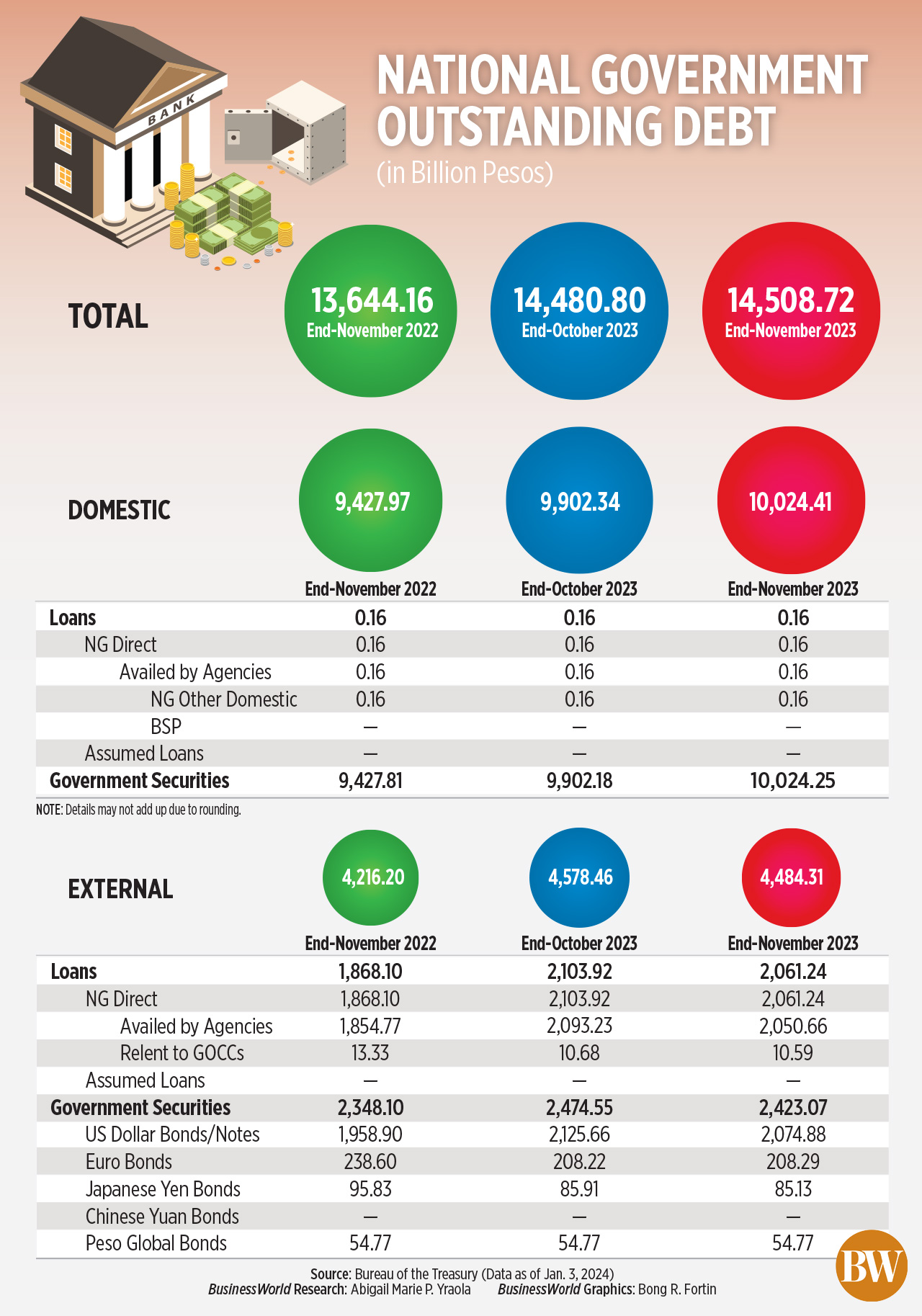
THE NATIONAL Government’s (NG) total outstanding debt hit a fresh high of P14.51 trillion as of end-November, the Bureau of the Treasury (BTr) said on Wednesday.
The outstanding debt inched up by 0.2% from P14.48 trillion as of end-October, data from the BTr showed.
“NG’s debt stock increased by P27.92 billion or 0.2% month over month, primarily due to the net issuance of domestic securities,” the BTr said in a press release.
Year on year, the debt stock rose by 6.3% from P13.64 trillion.
Outstanding debt went up by 8.1% from P13.42 trillion as of end-December 2022.
More than two-thirds or 69.1% of total outstanding debt as of end-November came from domestic sources.
As of end-November, domestic debt increased by 1.2% to P10.02 trillion from P9.9 trillion a month earlier due to the net issuance of government securities.
Domestic debt also rose by 6.3% from P9.43 trillion in the same period a year prior.
“New domestic debt issued during the month totaled P171.091 billion while principal redemption amounted to P45.14 billion, underlying a net issuance of P125.95 billion,” the BTr said.
“The increase was partially offset by the P3.87-billion effect of peso appreciation on foreign currency-denominated domestic securities,” it added.
Data from the Treasury department showed the peso closed at P55.451 against the dollar as of end-November, strengthening by P1.357 or 2.4% from P56.808 as of end-October.
Meanwhile, external debt, which accounted for 31% of the total, slipped by 2.1% to P4.48 trillion as of end-November from P4.58 trillion as of end-October.
However, external debt rose by 6.4% from P4.22 trillion a year ago.
“For November, the lower level of external debt was due to the net repayment of foreign loans amounting to P1.08 billion and favorable foreign exchange movements, wherein the P109.37 billion reduction attributed to peso appreciation against the US dollar far exceeded the upward adjustment linked to third-currency appreciation of P16.3 billion,” the BTr said.
Broken down, external borrowings consisted of P2.06 trillion in loans and P2.42 trillion in global bonds.
As of end November, the NG’s overall guaranteed obligations slid by 12.2% to P353.14 billion from P361 billion as of end-October.
Year on year, guaranteed debt declined by 8.9% from P388 billion.
“The decline in the level of guaranteed debt was attributed to the net repayment of both domestic and external guarantees amounting to P1.21 billion and P3.5 billion, respectively,” the BTr said.
“In addition, the peso appreciation against the US dollar further trimmed P4.07 billion (from guaranteed debt). These more than offset the P0.92-billion effect of third currency appreciation on similarly denominated guarantees,” it added.
China Banking Corp. Chief Economist Domini S. Velasquez said the government incurred more debt to support budget financing.
“The increase in government debt was likely driven by the financing needs of government projects and programs. However, this growth was likely limited by lower market interest rates and the appreciation of the peso during the month,” she said.
Rizal Commercial Banking Corp. Chief Economist Michael L. Ricafort said the record high NG debt was due to new borrowings to fund the budget deficit.
For 2023, the government has set a budget deficit ceiling of P1.499 trillion, equivalent to 6.1% of the gross domestic product (GDP).
“Looking ahead to 2024, we expect the government to increase its borrowings to fund the 2024 budget which is 9.5% higher than that of last year,” Ms. Velasquez said.
“On a positive note, the expected downtrend in market yields and further strengthening of the peso will help moderate debt growth. However, we think that the proposed tax reforms are crucial to ensure that the budget deficit and government debt remain at manageable levels,” she added.
Mr. Ricafort said the government’s outstanding debt could still increase in the coming months due to the maiden issuance of Sukuk bonds worth $1 billion last December.
“Continued budget deficits, though narrower from year ago levels, could still lead to additional borrowings/debt by the national government,” he said.
For 2023, the government plans to borrow P2.207 trillion, consisting of P1.654 trillion from domestic sources and P553.5 billion from foreign sources.
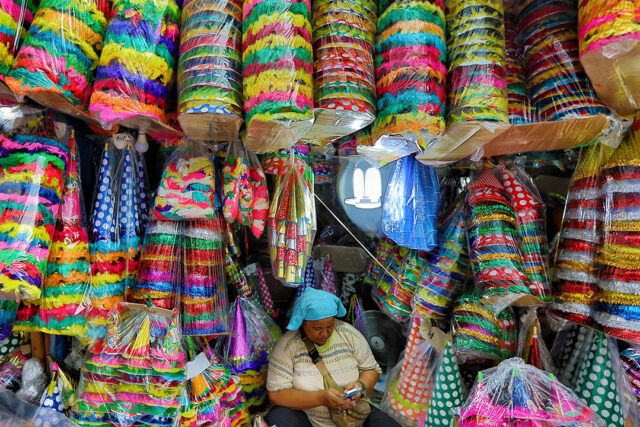
A vendor waits for customers at Divisoria market, Dec. 30, 2023. — PHILIPPINE STAR/WALTER BOLLOZOS
THE PHILIPPINE ECONOMY may grow by 5.6% this year as easing inflation could help boost consumption, MUFG Global Markets Research said.
In a report, MUFG Global Markets said the Philippine gross domestic product (GDP) is forecast to expand by 5.6% this year, picking up from the likely 4.8% GDP growth in 2023.
However, the growth forecast is below the Philippine government’s 6.5% to 7.5% growth target for 2024.
“We think that headwinds to domestic demand from elevated food and energy prices should gradually fade over time, but the growth rebound will probably be more evident from the second half of 2024 onwards, assuming no further food supply shocks,” it said.
Philippine GDP growth accelerated to 5.9% in the third quarter, mainly driven by faster government spending, while private consumption slowed. This brought the nine-month GDP growth average to 5.5%, still below the government’s 6-7% full-year target.
“The more stable external environment, coupled with stable USDPHP (US dollar-Philippine peso exchange rate), should also help Bangko Sentral ng Pilipinas (BSP) keep rates on hold through the next few months, and to start the rate-cutting cycle from the second half of 2024, as such helping investment and private consumption activity,” the research firm said.
MUFG Global Markets Research expects the BSP to cut interest rates by 50 basis points (bps) this year. This would bring the benchmark rate to 6% by end-2024, from the current 16-year high of 6.5%.
The Monetary Board has raised borrowing costs by a cumulative 450 basis points (bps) from May 2022 to October 2023 to tame inflation.
“We think the Philippine central bank will remain cautious for now, even as it looks more likely now that the Fed will start its rate-cutting cycle in 2024, together with the recent progress in bringing inflation down. This is also because upside risks to inflation are still present,” the research firm said.
Markets are anticipating the US Federal Reserve will begin cutting rates this year as inflation eases. At its December meeting, the Fed had forecast 75 bps in rate cuts for 2024.
“We think the Philippines’ central bank would prefer to take its lead from the Fed and wait for the US rate-cutting cycle to be clearly underway, before commencing its rate cuts,” it said.
For this year, MUFG Global Markets Research said Philippine inflation is seen to slowly return to the upper end of the BSP’s 2-4% target band if there are no more supply shocks.
“We expect the Philippines’ CPI (consumer price index) to fall into the central bank’s upper half of the inflation target by the first quarter 2024, and to stay around that range through the course of 2024… There are nonetheless still upside risks to inflation stemming from food supply shocks, possible transport fare hikes, and minimum wage increases,” it added.
BSP Governor Eli M. Remolona, Jr. said last month the central bank will likely keep benchmark interest rates higher for longer until inflation settles at around 3%.
MUFG Global Markets Research said the Philippine peso will likely underperform in 2024, as the current account deficit is seen at -3% of GDP and the central bank beefs up its foreign exchange reserves.
It expects the peso to end at P55.40 per dollar by the first quarter of 2024, and by P55 per dollar by yearend.
“Our forecasts imply some underperformance in PHP against other Asian FX (foreign exchange), but to a lesser extent than before, with lower global oil prices and fading of domestic food supply shocks helping to contain both inflation pressures and the current account deficit,” it said. — AMCS
THE PRICE AND SUPPLY of electricity in the Philippines are seen to be challenged this year due to warm weather but may be offset by the power capacity expansion from renewables.
Jose M. Layug, Jr., president of Developers of Renewable Energy Advancement, Inc., said he is anticipating supply challenges, especially during the summer months.
“No matter how we tried to maintain all these coal-fired plants, the point is they are already old so you should expect these power plants to break down very often and that’s why we need new capacities,” he said in a virtual interview.
“Otherwise, we will have an issue on supply, and we will be placing yellow alerts,” he added, referring to the warning when reserves fall below a designated safety margin.
In 2023, the Philippines was placed under yellow and red alerts several times due to sudden plant outages. The Department of Energy (DoE) had expected 12 yellow alerts last year. Red alerts are raised when the supply-demand balance deteriorates further, signaling the possibility of rotational brownouts.
For 2024, the DoE has so far not projected any potential yellow and red alerts as it banks on new solar power plants that will be coming in, which it said will be “favorable” under an El Niño scenario.
Latest data from the state weather bureau Philippine Atmospheric, Geophysical and Astronomical Services Administration showed that a moderate El Niño would continue to persist and intensify in the coming months.
Energy Secretary Raphael P.M. Lotilla is expecting a favorable status in electricity supply this year as he anticipates the completion of power transmission projects.
“We did manage to contain the weakness in 2023, and 2024 promises to be better. But of course, from the supply side, and we hope that by 2024, we shall also finish a number of major transmission connections, but of course, there remain threats,” he told reporters in an interview last month.
Privately owned National Grid Corp. of the Philippines (NGCP) holds the sole and exclusive concession and franchise for the operation of the country’s power transmission network, which links power generators and distribution utilities to deliver electricity nationwide.
NGCP has already energized some of its transmission projects such as the P10.2-billion Hermosa-San Jose 500-kilovolt transmission line. It is currently working on the full completion of the Mindanao-Visayas Interconnection Project (MVIP).
Majah-Leah V. Ravago, an energy economist from the Ateneo de Manila University, said increasing power generation means investing in transmission projects.
“You cannot address the problem that you’re just looking at generation because the consumption of electricity is a whole system in itself,” she said in a virtual interview.
“You cannot look at increasing generation without accompanying investment in transmission and distribution. We have many cases like that,” she added.
Two decades after the Electric Power Industry Reform Act was passed, electricity rates in the Philippines are still one of the highest in the region as there are still a lot of inefficiencies in the system.
The Philippines’ per capita consumption of electricity is low relative to its neighbors due to high power prices brought on by inefficiency and reliability issues, according to Ms. Ravago.
Citing data from the World Bank and the United Nations, she said that the country’s per capita consumption was at 975.61 per kilowatt-hour (kWh) in 2022.
This is relatively lower compared with the country’s peers in the Association of Southeast Asian Nations (ASEAN) such as Singapore (9,168.82 per kWh), Malaysia (5,318.78 per kWh), Indonesia (2,662.31 per kWh), and Thailand (1,210.67 per kWh).
Electricity consumption in the country is expected to grow by nearly four times the 2018 level by 2040, Ms. Ravago said.
“If we are to meet that growth by 2040, it means that electricity consumption has to grow. It means demand is growing, it has to be met by supply. Otherwise, we would have electricity price increases,” she said.
To meet the demand, she said that the government should address regulatory bottlenecks both for generation and transmission.
Since power generation is privately led in the Philippines — which attracts investments — the government should instead focus on facilitating these capital inflows, easing regulatory burdens, and expanding transmission, Ms. Ravago said.
“We just need to make sure that the other related infrastructure, transmission lines, and ports are also upgraded in time of these projects going online,” Mr. Layug said.
Data from the DoE showed that wind, natural gas, and solar dominated most of the indicative projects, or those currently in the pre-development stage, as of August 2023 with a capacity of 34,080.50 megawatts (MW), 7,987.60 MW, and 7,811.86 MW, respectively.
‘THE WAY TO GO’ Renewables are seen to be able to offset a rise in electricity prices and mitigate the high prices of oil and coal.
“This year… the private sector is happy about how the government, particularly the DoE, has convinced and has signaled to the private sector that renewables are the way to go,” Mr. Layug said.
As of end-2022, the share of renewable energy (RE) in the country’s power generation mix was about 22%. The government has set a target of increasing this to 35% by 2030, then 50% by 2040.
“We all know that the cost of RE is now more optimal, more affordable especially for the consumers, so we’re happy with that and we hope the government continues its forward-looking planning of the energy sector in the Philippines by continuously pushing for renewable as part of the energy mix,” Mr. Layug said.
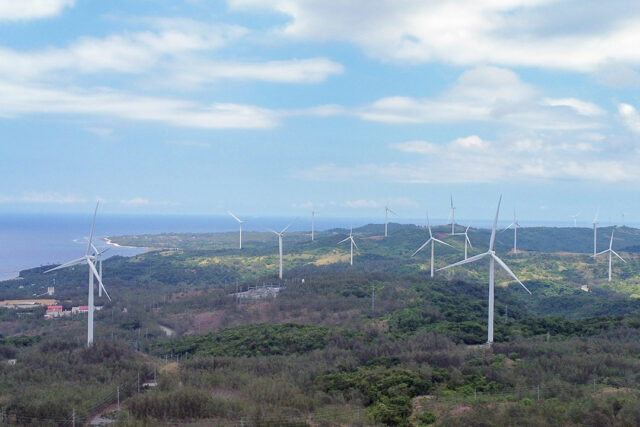
Within RE technologies, solar and wind energy are seen to drive the growth of renewables.
“In the next three years, I still see solar onshore and onshore wind to dominate. With, hopefully, waste-to-energy [projects] catching up a little bit,” Mr. Layug said. “We hope to see floating solar and offshore wind to dominate.”
As of October, the DoE has awarded around 1,300 RE contracts, promising a total potential capacity of about 130,000 MW.
Of the total, 225 wind energy contracts have been awarded with the highest combined capacity of 83,079.3 MW. This was followed by 356 solar energy projects with 27,889 MW and 430 hydropower projects with a capacity of 18,924.4 MW.
“We are in a good position to implement reforms necessary to energy transition,” Ms. Ravago said, citing the moratorium on new greenfield coal power plants and the liberalization of the RE sector.
BUDGET SECRETARY AMENAH F. PANGANDAMAN — PHILIPPINE STAR/KRIZ JOHN ROSALES
THE 2025 national budget will focus on keeping inflation under control, addressing the economic scarring from the pandemic, boosting infrastructure investments, and adapting global trends in digital transformation, the Department of Budget and Management (DBM) said.
Budget Secretary Amenah F. Pangandaman last week issued the National Budget Call in a memorandum, asking government agencies to begin preparing their budget proposals for 2025.
The proposed 2025 national budget is set at P6.12 trillion, according to the Development Budget Coordination Committee. This is 6.1% higher than the P5.768-trillion national budget for 2024.
“The Fiscal Year 2025 budget aims to continuously address the socioeconomic issues our country has been facing, e.g., high food prices, increasing fuel prices, and the scars that the pandemic has left, among others,” the DBM said.
The government is targeting 6.5-7.5% gross domestic product (GDP) growth this year, but the outlook is clouded by risks to inflation, tight borrowing costs, and a global slowdown.
To tame inflation, the Bangko Sentral ng Pilipinas (BSP) has tightened interest rates by 450 basis points from May 2022 to October 2023, bringing the key rate to a 16-year high of 6.5%.
Aside from addressing economic issues, the 2025 spending plan will also support infrastructure investments, with emphasis on flagship infrastructure projects approved by the National Economic and Development Authority.
“However, increased infrastructure spending will not, in any way, detract from the full support provided to the poorest, lagging, climate change and disaster risk vulnerable areas nor the social sector, and basic public services,” the DBM said.
The government also seeks to adopt emerging global trends on digital transformation to boost and foster efficiency, effectiveness, and transparency of service delivery.
The 2025 budget will also include funds for capacity-building programs for local government units (LGUs) such as competency-enhancing interventions, resource generation, public financial management, leadership and development planning, among others.
This is aimed at helping LGUs in assuming the devolved functions and services from the National Government, as mandated by the Supreme Court’s Mandanas-Garcia ruling.
The DBM said the proposed 2025 budget and its priorities will be anchored on the government’s commitment to achieve the 2030 Agenda for Sustainable Development.
“With six years remaining until the 2030 Agenda, there is a need to accelerate the progress or reverse the negative trends to achieve the global goals of establishing a transformative vision towards economic, social, and environmental sustainability,” it said.
The 2025 budget proposals should include the priorities and policy directions of the Marcos administration, citing the government’s medium-term fiscal framework, the eight-point socioeconomic agenda and the Philippine Development Plan for 2023-2028.
However, due to the impact of the country’s debt burden and competing demands from government agencies, the budget allocation for 2025 will be optimized.
“As part of the evaluation process, the government will consider how the agencies utilized their previous year budget and the implementation progress of their mandated programs and projects to ensure that only those agency proposals, which are implementation-ready, are included in the budget,” the DBM said.
The DBM said agencies should provide the necessary supporting documents such as concrete program plans and designs that outline procurement and implementation milestones.
The budget should also ensure regional plans are in line with national priorities “to achieve equitable regional investment opportunities and growth,” it added.
“In particular, the National Government’s 2025 budget shall provide funds for agencies’ regional programs which are responsive to the needs of the poorest, disadvantaged and lagging LGUs,” the Budget department added.
According to the DBM memorandum, government agencies should submit their signed hard copies of the 2025 budget proposals between March 25 and April 22.
The proposed 2025 national budget will be submitted to Congress on July 22. — Keisha B. Ta-asan
Passengers wait inside the Ninoy Aquino International Airport Terminal 3 in Pasay City, Oct. 29, 2022. — PHILIPPINE STAR/ MIGUEL DE GUZMAN
By Ashley Erika O. Jose, Reporter
AIRLINE companies in the Philippines are expected to sustain their gains this year as airport investments including the rehabilitation of the country’s major gateway drive investor sentiment, analysts said.
“It is a positive sign that major airlines are investing in fleet and network buildup,” Juan Paolo E. Colet, managing director at China Bank Capital Corp., said in a Viber message on Wednesday. “In addition, airport investments and efficiencies, such as through the privatization and rehabilitation of the Ninoy Aquino International Airport (NAIA), will help create more favorable conditions for the airline industry.”
The Department of Transportation has set the signing of the concession agreement for the rehabilitation, operation and maintenance of NAIA by March after attracting four bidders for the upgrade project.
Easing inflation and growing travel demand are also expected to drive the profitability of local airlines this year, Mr. Colet said.
The Philippines recorded 5.45-million international visitors in 2023, surpassing its 4.8-million target, the Tourism department said. This year, the agency is targeting 7.7 million visitors.
“Airlines saw a recovery last year given normalizing travel conditions and revenge travel,” Rastine Mackie D. Mercado, research director at China Bank Securities, said in an e-mail. “We expect continued improvements this year, with the International Air Transport Association expecting Asia-Pacific international passenger volumes to surpass 2019 levels.”
The attributable net income of PAL Holdings, Inc., the listed operator of flag carrier Philippine Airlines (PAL), climbed by 33.3% to P4.28 billion in the third quarter from a year earlier. Consolidated revenue rose by 16.7% to P47.13 billion.
Its nine-month attributable net income more than doubled to P15.16 billion.
Cebu Air, Inc., had P1.28 billion in attributable net income in the third quarter, reversing a net loss of P2.54 billion a year earlier. Revenue rose by 38.5% to P23.34 billion.
For the nine months to September, Cebu Air posted an attributable net income of P5.03 billion, reversing a net loss of P12.05 billion a year ago.
Airlines are expected to post modest gains due to the challenging economic environment, Toby Allan C. Arce, head of sales trading at Globalinks Securities and Stocks, Inc. said.
“At the global level, net profitability is anticipated to remain well below the cost of capital in both years,” he said in a Viber message. “While the airline industry’s profits in 2024 are expected to show a slight improvement over 2023, the return on invested capital is projected to lag behind the cost of capital in both 2023 and 2024.”
Airline revenues are expected to outpace expenses, Mr. Arce said, adding that while operating expenses would increase, profits might rise slowly as further interest rate cuts seem unlikely.
Meanwhile, some operational challenges might continue this year, pulling down optimism on the demand side, Mr. Mercado said.
“Some operational challenges are seen to persist into 2024 as the backlog in aircraft maintenance for some widely used aircraft may weigh on capacity,” he said.
Cebu Air earlier said it would cut fleet growth this year as engine maker Pratt & Whitney (P&W) inspects A320/321 NEO aircraft engines worldwide after suspected issues.
The company said it expects a number of its aircraft to be affected in 2024, adding that inspections would ensure the safe operation of its P&W-powered fleet.
“The major issues for airlines, as they look to ramp up capacity, have been the supply chain slowdown, delivery delays and engine problems that have caused aircraft to be grounded,” Mr. Arce said.
MAYNILAD Water Services, Inc. on Wednesday said it would build four reservoirs worth P2.8 billion that will add 211 million liters (ML) of water to its storage capacity by 2026.
The four reservoirs will be built in Quezon City, Valenzuela, and Muntinlupa, it said in a statement.
“Households in elevated areas are typically affected by low water pressure whenever the demand goes up,” Maynilad Chief Operating Officer Randolph T. Estrellado said. “Having more reservoirs will help to maintain supply availability despite strong water withdrawals from households in low-lying areas, so we’re building more of these storage facilities in strategic locations.”
The projects form part of Maynilad’s P220-billion service enhancement program for 2023 to 2027.
Some Maynilad customers have had to endure low water pressure to no water due to the company’s repair and maintenance activities, including two scheduled shutdowns last year at its Putatan treatment plant in Muntinlupa City.
In January 2023, the Metropolitan Waterworks and Sewerage System ordered Maynilad to rebate P27.48 million to customers in areas served by its Putatan facility.
The company has 37 operational reservoirs that can store 751 ML of treated water supply. This increased from 10 reservoirs with 400 ML storage capacity after it rehabilitated 13 reservoirs and built 14 new ones since 2007.
“With the construction of four new reservoirs until 2026, the company’s total combined water-storage capacity will reach 962 ML,” Maynilad said.
Maynilad is seeking a 10-year extension of its concession deal with MWSS to Jan. 21, 2047, to coincide with its 25-year legislative franchise.
Maynilad serves Manila, except portions of San Andres and Sta. Ana. It also supplies water in Quezon City, Makati, Caloocan, Pasay, Parañaque, Las Piñas, Muntinlupa, Valenzuela, Navotas, and Malabon.
The utility also supplies water to the cities of Cavite, Bacoor, and Imus, and the towns of Kawit, Noveleta, and Rosario, all in Cavite province.
Metro Pacific Investments Corp., which has a majority stake in Maynilad, is one of three Philippine units of Hong Kong-based First Pacific Co. Ltd., the others being Philex Mining Corp. and PLDT Inc.
Hastings Holdings, Inc., a unit of PLDT Beneficial Trust Fund subsidiary MediaQuest Holdings, Inc., has an interest in BusinessWorld through the Philippine Star Group, which it controls.
Meanwhile, Manila Water Co., Inc. said it had ended a 25-year bulk water supply deal with Pangasinan.
In a stock exchange filing, the east zone concessionaire said unit Manila Water Philippine Ventures, Inc. (MWPV) ended the deal effective Dec. 31 after the province failed to fulfill some conditions, which it did not detail.
Jeric T. Sevilla, head of Manila Water’s corporate strategic affairs group, and corporate communications head Dittie L. Galang did not immediately reply to separate Viber messages seeking comment.
In January 2022, the parties signed a concession agreement for the project with a capital expenditure of about P8 billion. It was supposed to give Pangasinan 200 million liters per day (MLD) more of water.
Last month, Manila Water said unit Cebu Manila Water Development, Inc. had terminated its water supply contract with the Metropolitan Cebu Water District after more than a decade.
Cebu Manila Water is a joint venture of Manila Water Consortium, Inc., which is owned by MWPV, and the provincial government of Cebu.
The parties entered into a joint investment agreement in 2012 for the development, operation and maintenance of a bulk water system that will supply at least 35 MLD of potable water.
Shares of Manila Water gained 1.97% or 36 centavos to close at P18.64 each.
WE’RE sure a lot of us are playing a form of fridge Tetris (that is, rearranging our leftovers in the refrigerator to make them fit) after the end of 2023’s holiday season. So BusinessWorld asked some experts for their suggestions on how to recycle the goodies that are clogging up the ref and freezer. As we welcome 2024, we’re doing it without repeated servings of ham and lechon paksiw, and serving up “scraps” with style.
CCA MANILA
The chef-instructors at the Center for Culinary Arts Manila (CCA Manila) were generous enough not only to share their favorite holiday recipes, but also to provide solutions for their inevitable leftovers. Chef Miguel Lorino gave us his recipe for pork asado (available on the BusinessWorld online version of this piece) and the chic mantou sandwiches that could come after.
Pork Asado
Yield: 6 servings
Ingredients:
60 ml vegetable oil
60 gm minced garlic
1 kg cubed pork shoulder
480 ml water
180 ml soy sauce
10 gm star anise
10 gm hydrated banana blossom
150 gm brown sugar
Ground black pepper to taste
Salt to taste
Procedure:
Begin by heating oil in a large pot and sautéing garlic until aromatic.
Add pork, cooking until it turns a golden hue.
Combine water, soy sauce, star anise, banana blossom, and brown sugar with the pork and simmer until tender.
Season with salt and pepper, and serve warm.
MantouPorkAsado with Pickled Cucumbers
Yield: 6 servings
Ingredients:
60 ml vinegar
10 gm white sugar
10 gm grated ginger
5 gm crushed black peppercorns
100 gm thinly sliced cucumber
12 pcs steamed pandan mantou
Sliced pork asado (leftovers) as needed20 gm red onion
50 gm sliced tomatoes
Procedure:
Boil vinegar and sugar together.
Remove from heat and add ginger, peppercorns, and cucumbers to marinate.
For assembly, stuff the mantou buns with pork asado, pickled cucumbers, onions, and tomatoes, then serve.
Meanwhile, chef Anne Atanacio gives us a post-holiday breakfast idea using the ubiquitous Christmas ham, and a solution for the lucky grapes left behind on the table after displaying them for luck.
Ham and Chicken Spread Recipe
Ingredients:
1 cup chopped Christmas ham
1 cup chopped roasted chicken
1 stalk of celery, chopped
1 bunch of grapes, chopped
1 cup gated leftover cheese
1 cup mayonnaise
Salt and pepper to taste
Procedure:
Mix all ingredients in a bowl until well combined.
Spread generously on bread for a satisfying meal.
Whipped Fruit Salad
Ingredients:
750 gm Drained fruit cocktail
2 cups Red grapes
2 packs All-purpose cream, chilled overnight
1 can Condensed milk
Procedure:
Whip the all-purpose cream until light and fluffy.
Fold in the fruit cocktail, grapes, and condensed milk.
Refrigerate overnight for the best flavor.
ONE WORLD DELI
Over at One World Deli, the new place to be to get food from all around the world, their chefs George Bustamante and Angela Villaroman offered up their recipes for leftover Turkey Stew and Roast Beef Sandwiches.
Turkey Stew
Ingredients:
Turkey meat, cut into bite-sized pieces
Turkey bones
1 cup Carrots
1 cup Celery
1 cup Onions
2 tablespoons of flour
1/4 cup chopped parsley
Leftover vegetables
1/4 cup of cream
Salt and pepper to taste
Procedure:
Debone the turkey and cut the meat into bite-sized pieces.
Place the bones in a stock pot and fill with water, let it simmer for 30-45 minutes.
Sauté one cup carrots, one cup celery, and one cup onions in butter. Add two tablespoons of flour and, once cooked, add the turkey stock and let simmer for 10 minutes, continuously stirring.
Add 1/4 cup of chopped parsley and any leftover cooked vegetables that you may have, and let simmer.
Add turkey meat and 1/4 cup of cream. Add salt and pepper to taste. Enjoy with crusty bread or leftover mash.
Cut the bread, butter one side of each slide, toast on a griddle.
Spread the horseradish sauce on the buttered side, and assemble the sandwich. Arugula at the bottom, then generous layers of thinly sliced roast beef, cheese, and onions.
CITY OF DREAMS MANILA
Over at City of Dreams Manila, chef Edmundo San Jose from modern Filipino restaurant Haliya shared with us how to serve leftover lechon in a relatively healthy way. What’s more, this Ensaladang Lechon (roast suckling pig salad) shares some similarities with one of Haliya’s signature dishes, Binalot na Cochi.
Shred the leftover lechon or cochinillo meat and set aside.
Optional: make adobo flakes from leftover adobo.
Prepare pork liver salsa by combining tomatoes, shallots, jalapeño, coriander, spring onion, and homemade pork liver sauce. Set aside.
Assembly / plating:
Prepare the butterhead lettuce.
To make individual portions, place the leftover lechon or cochinillo on each butterhead lettuce leaf.
Top with jalapeño, atchara, garlic aioli, shallots, adobo flakes, and coriander.
PUREFOODS
Finally, from the source of a lot of the hams (and beer) on our tables, the San Miguel Corp. provided us with some recipes for what to do with all that leftover ham and cheese.
Boscaiola Frittata
Ingredients:
Two tbsp Magnolia Gold Butter
UnsaltedOne can (198 gm) button mushrooms, pieces and stems, drained
Three cloves garlic, mincedOne stalk
(5 gm) parsley, chopped (1 tbsp)
200 grams Purefoods Fiesta Ham, diced or cut into thin strips
1/4 tsp iodized fine salt
1/8 tsp pepper
Six Magnolia Brown Eggs, beaten
1/2 cup Magnolia Fresh Milk
1/2 cup grated Magnolia Queso de Bola
Procedure:
In an eight-inch frying pan over medium heat, melt butter and sauté mushrooms, garlic, parsley, and ham. Season with salt and pepper.
Meanwhile in a large bowl, combine eggs, milk, and cheese. Pour over the mushroom-ham mixture in the pan.
Cover and cook over lower heat until set. Check doneness by sticking a toothpick in the middle. Toothpick should be clean and without egg mixture when taken out.
Add some chopped vegetables to add color, nutrition, and to further extend dish. Serve with muffins, sliced bread or rice.
Fiesta Ham Beer Stew
Ingredients:
Two tbsp Magnolia Butter-licious!
One red onion, chopped
Six cloves (20 gm) garlic, chopped
One (1 kg) package of Purefoods Fiesta Ham, sliced
One pack (300 gm) marble potatoes, cut in half
One bottle (330 ml) San Miguel Beer Pale Pilsen
One cup beef stock
1/4 tsp iodized fine salt
Two bay leaves
Five black peppercorns
One (250 gm) carrot, cubed
One (100 gm) green bell pepper, chopped
One (100 gm) red bell pepper, chopped
Procedure:
In a pot over medium heat, melt margarine and sauté onion, garlic, and ham until lightly browned.
Add marble potatoes, beer, stock, salt, bay leaves, and peppercorns. Cover and simmer for 8 minutes.
Add carrot and simmer for 10 minutes or until tender. Add bell peppers and simmer for 1 minute.
Note:
The base recipe is good also for leftover Purefoods Jamon Royale and Purefoods Chinese Ham. Adjust salt further for Chinese Ham. If a saucy dish is desired, thicken the dish with a cornstarch mixture (1:1). Stir in while mixture is simmering until the sauce thickens. — Joseph L. Garcia
IT’S THE end of December, which means my inbox is flooded with pitches for mocktails, apps, and lifestyle gurus ready to help you sober up after the excess of the holidays. So-called “Dry January” — initially intended as a public health campaign — is now as fully commercial as Christmas and New Year’s Eve.
But according to data from Morning Consult, fewer people in the US participated in Dry January in 2023. Older generations show the least interest. That’s a shame, because the health benefits of consuming less alcohol couldn’t be clearer.
Maybe one way to get more on board would be to extol moderation rather than abstinence. For some, a dry-as-the-desert January can feel daunting — maybe you don’t want to forgo the celebratory glass of champagne for a birthday or anniversary, or skip the fancy cocktail at a restaurant you’ve been waiting months to try. If you’ll cave once or twice, why bother at all?
But there are still health benefits to a “damp” January, where drinkers pare back rather than abstain. Even a moderate month can offer one of the biggest benefits of Dry January: reflecting on one’s relationship with alcohol.
That means noticing why you have the impulse to grab a drink — for example, how often is it a response to stress? Does it feel daunting to mingle at a party without a glass of wine in your hand? Is one nightly drink turning into two or three?
Whether dry or damp, January can also be a chance to take inventory of how your body feels on less booze. If your sleep improves, your mind is clearer in the morning, or you don’t find yourself reaching for the Advil or Tums as often, your body might be telling you to consider more than just a month of moderation.
That’s a message worth listening to, especially for women, who are catching up to men when it comes to alcohol use disorder — a trend that is especially worrisome when considering women are more vulnerable to the worst health effects of drinking.
But even a damp January requires a plan, says George Koob, director of the National Institute on Alcohol Abuse and Alcoholism. “You can’t wiffle waffle and get chaotic about it.”
To avoid wiffling and waffling, Mr. Koob shares a few principles of self-regulation: monitoring, strength, and standards. Set a goal for how often you plan to abstain (your standards), have the internal fortitude to stay the course (your strength), and keep track of your progress (monitoring).
Monitoring can be as simple as jotting down how many drinks you’ve had on a sticky note or as involved as formally signing up through an app. If you’re someone that thrives on closing all the rings on your Apple Watch or seeing a badge appear on Strava, an app might provide the right kind of motivation.
In theory, these apps can also help with the “strength” side of staying the course by offering reminders and tips like mocktail recipes or strategies for socializing without liquid courage. Try Dry, a free app from Alcohol Change UK, a charity that helped to popularize Dry January over a decade ago, will also tally up your weekly savings from forgoing booze.
One thing to leave off your plan for a more sober month: THC. Companies making cannabis-infused drinks are eager to step in to fill the glasses left empty during Dry January. One firm, Cann, is going so far as to try to rebrand the month as “Cannuary,” and in an e-mail pitch said transactions tripled in January and February of 2023 during its campaign to convert alcohol drinkers to marijuana users.
When I asked Mr. Koob if these companies were offering a reasonable substitute during Dry January, his answer was immediate and emphatic: No. “In a sense, you’re self-medicating if you have to substitute one psychotropic substance for another,” he says. And while cannabis companies like to argue that THC is much safer than other social lubricants, that doesn’t mean it’s benign; rather, its effects on the body are much different (and less comprehensively studied) than alcohol.
As Nora Volkow, director of the National Institute on Drug Abuse, part of the National Institutes of Health, told Bloomberg earlier this year, “both are associated with harms and both can lead to addiction.” It would be a mistake to turn Dry January into High January.
That’s an especially important message for younger generations. Surveys show Gen Z and millennials are increasingly interested in taking a more moderate approach to alcohol, but are also clearly the target audience for these cannabis companies.
Whether your January is bone-dry or moderately damp, it’s well worth the effort. If done right, the benefits of taking a break can linger well past the marketing schtick of a sober month. One study in the UK showed that people who took a January break continue to be more balanced in their drinking six months later. That’s an outcome that can make a real difference in our health. —Bloomberg Opinion
LISTED coconut product maker Axelum Resources Corp. has branched out into healthcare by opening its first hospital in Misamis Oriental.
The listed Philippine company launched through civic affiliate AMDG Foundation the 100-bed San Isidro Polymedic General Hospital in Gingoog City, Misamis Oriental, it said in a stock exchange filing on Wednesday.
The medical center offers a suite of services including hemodialysis, emergency room, intensive care, extended laboratory and diagnostics, radiology, surgery, delivery room, neonatal, outpatient clinics, pharmacy and other essential amenities, Axelum said.
“At Axelum, our overarching goal is to combat poverty through livelihood, education and now through healthcare,” Axelum President and Chief Executive Officer Romeo I. Chan said in the statement. “We believe that every Filipino deserves access to quality medical services and modern facilities.”
The company aims to provide professional healthcare to the local community and indigenous people of Northern Mindanao.
The company said the project was launched though AMDG Foundation and in partnership with the Cagayan de Oro Polymedic Medical Group.
Axelum said the hospital seeks to serve more than 350,000 residents and has a long-term aspiration to become a premier end-referral hospital in the region. It also aims to expand into highly specialized treatments and services.
Axelum had a net loss of P428 million in the nine months ended September, a reversal of its P717.28-million net income a year earlier. Revenues fell by 19% to 4.28 billion.
Shares of the company inched up by 0.88% to close at P2.30 each. — Adrian H. Halili
A RECORD NUMBER of people are heading to the polls around the world this year, including in Asia. This is particularly significant for the region because with the exception of Japan, South Korea, and Taiwan, the Asia-Pacific region is seeing a significant increase in populism and authoritarianism, harking back to an era when strongmen presidents ruled with an iron fist. Hundreds of millions of votes won’t necessarily mean more democracy.
There are a few reasons for this. We have already seen the rise of less democratic leaders in the Netherlands and Italy, and there is a corresponding trend in Asia. China’s alternative model of governance, which prioritizes economic development over civil liberties, is increasingly appealing. Many voters have become disenchanted with Western democracies in a post-Brexit, post-Trump world, and are actively looking for something else. Combine that with social media amplifying the message of candidates who can now bypass a press struggling to keep them accountable, and it helps explain the allure of more authoritarian leadership. Artificial intelligence tools will only make things worse, as the proliferation of fake news, misinformation and disinformation inundate the timelines of a largely young and often unquestioning voter demographic.
Asia’s liberal credentials are under significant pressure, according to figures from the International IDEA’s Global State of Democracy (GsoD) Initiative. Only a tiny minority live in a high-performing democracy, with institutions appearing stuck.
From Bangladesh in the coming week to Pakistan and Sri Lanka toward the end of 2024, voters will be having their say. Three of the most consequential elections will be held in Taiwan, Indonesia, and India. Their outcomes will determine the region’s future and democratic trajectory in years to come.
TAIWAN IS THE BRIGHT SPOT The island is a bright spot among less democratic neighbors. Taiwanese will choose their next president and legislature on Jan. 13. For the most part, they are expected to be vibrant, free, and fair, with an engaged electorate. Voters want a new administration that will manage issues like the economy and jobs but also navigate the difficult and tricky relationship with China. Taiwan regularly scores well on the annual Freedom House report on the state of liberties in countries around the world. Threats to its democracy are mainly external. Beijing poses the biggest existential risk and concerns have been building in the past few years over the Chinese government’s efforts to influence policymaking, media, and the democratic infrastructure.
It wasn’t always like this. For several decades, Taiwan was ruled under a dictatorship, harshly regulated by martial law that was finally abolished in 1987. In fact, it was Southeast Asia in the 1990s and early 2000s that seemed to be the beacon for the golden age for democratization, serving as a model for other developing countries. At that time, Indonesia, which will hold presidential elections on Feb. 14, was just beginning its experiment with democracy and decentralization, after the toppling of strongman dictator and former President Suharto. The rest of the region was also in relatively good shape.
Today, though, as Joshua Kurlantzick, senior fellow for Southeast Asia at the Council for Foreign Relations, noted recently, it is a long way from that promising period. Timor-Leste is the only fully free democracy in the region, according to Freedom House’s rankings, despite its poverty and isolation.
INDONESIA LOOKING BACK Indonesians will almost certainly elect the former general and alleged human-rights violator Prabowo Subianto as their next president, along with the eldest son of the incumbent Joko Widodo as vice-president. Many have questioned why in a country of 270 million people, the man most likely to lead is a throwback to the old authoritarian era, the Orde Baru, as it was called, the 32-year rule under Suharto marked as one of the most corrupt and dictatorial in Southeast Asia’s history.
Those who fought against the old order are asking themselves what Prabowo’s ascendancy means for Indonesia’s democracy, and whether it implies a fresh role for the military in politics. That Prabowo’s past has failed to make a dent in his popularity is a testament to his social media game, which has seen him use the image of a cute and cuddly grandfatherly figure to appeal to younger voters. In another ominous sign, the choice of Gibran Rakabuming Raka as his running mate has raised concerns that nepotism and cronyism — hallmarks of the Suharto era — are making a comeback.
INDIA’S ‘MODI FACTOR’
Over several weeks in April and May, India will hold elections for over 600 million registered voters to determine whether Narendra Modi’s ruling Bharatiya Janata Party (BJP) will govern the world’s most-populous nation for five more years. All the signs point toward another Modi victory. The BJP is playing up his personal popularity, what’s often called the “Modi factor.”
The BJP is celebrating the results of the Dec. 3 state polls that gave it huge wins in the Hindi belt states of Chattisgarh, Madhya Pradesh, and Rajasthan. The opposition Indian National Congress won in the southern state of Telangana. There is no denying Modi’s pull — he regularly ranks as the most popular leader in the world. It is true that under his rule India has become more globally significant and has enjoyed impressive economic growth. But minorities feel less welcome and safe than ever before, with one report noting that the ruling party and affiliated groups were behind most hate speech incidents against Muslims during the first half of last year. Laws are passed quickly through a parliament, which meets for fewer and fewer days, and a once vibrant and free press has now largely been muzzled or accommodates the BJP and Modi’s hardline Hindu message.
It would be understandable then to feel dispirited and demoralized by the state of Asia’s democracy in 2024. Indeed, simply writing this column has made me wonder whether the experiment with this system of government has failed in the region. Still, it would be churlish to begin the new year with limited optimism, and it is in the very mechanisms of democracy that I keep the faith. Ultimately, voters must and should decide on whether their elected officials are delivering on promises. It would be wise for those in office and those who put them there to remember that the real power rests with them, the people. Another election is hopefully just one term away.