Home Blog Page 3781

Guinness World Records reviews evidence related to ‘world’s oldest dog’ title

OLDEST DOG EVER — GUINNESS WORLD RECORDS

LISBON — Guinness World Records (GWR) said on Tuesday it was conducting a formal review of the “world’s oldest dog” title it gave to a Portuguese dog named Bobi who died last year. The move follows complaints by veterinarians who raised doubts over his age.

Bobi was a purebred Rafeiro Alentejano who spent his life in a village in central Portugal. GWR originally said the creature lived for 31 years and 165 days, breaking a record held since 1939 by an Australian cattle-dog that died at 29 years and five months.

Bobi, who died in October last year, was declared the world’s oldest dog in February.

Bobi’s breed, traditionally used as sheepdogs, has a normal life expectancy of 12-14 years.

A spokesperson for GWR said the review into Bobi’s record was ongoing and it included looking over evidence again, seeking new evidence, reaching out to experts and those linked to the original application.

“While our review is ongoing, we have decided to temporarily pause applications on both the record titles for oldest dog living and (oldest dog) ever until all of our findings are in place and have been communicated,” the spokesperson said.

Bobi’s owner, Leonel Costa, said in a statement on Tuesday that after his dog’s death, “an elite within the veterinary world … tried to give people the idea that Bobi’s life story was not true.”

According to Mr. Costa, some veterinarians were upset because he attributed Bobi’s longevity to factors including a steady diet of “human food” rather than pet food, which he said was often recommended by those in the sector.

“Everything would be different if we had said he (Bobi) ate pet food for three decades,” Mr. Costa said, adding that all requirements requested by the GWR were met.

Mr. Costa said GWR has not reached out to him.

No action has yet been taken regarding any record holders, GWR said. It added that any action would be determined by the review’s outcome.

Prior to his death, Bobi still loved walks but had become less adventurous, Mr. Costa previously told Reuters. His fur was thinning, his eyesight had worsened, and he needed to rest more than in earlier years. — Reuters

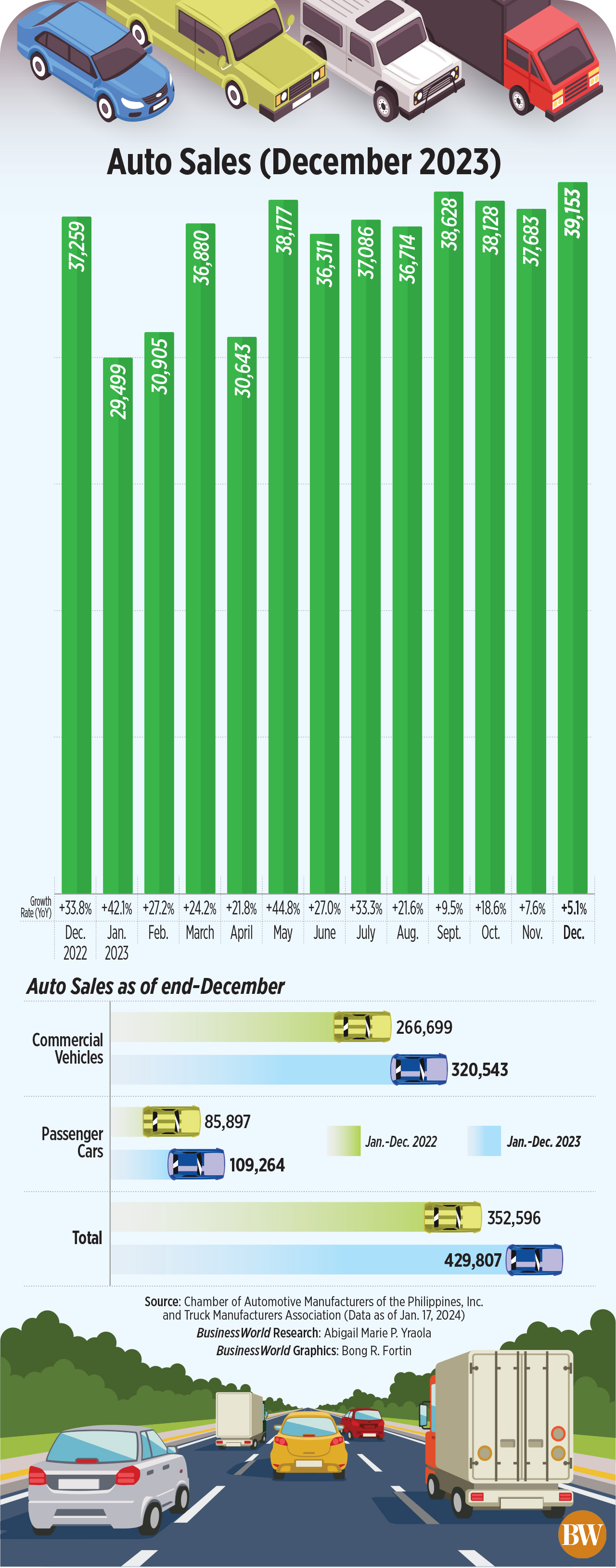
Auto Sales (December 2023)

VEHICLE SALES rose by an annual 22% in 2023, surpassing the industry’s target, a report showed, as consumer demand remained robust despite elevated inflation and rising interest rates. Read the full story.


Auto Sales (December 2023)

Stolen Picasso, Chagall paintings found in Antwerp house

BRUSSELS — Belgian police have found stolen Picasso and Chagall paintings in a basement in the city of Antwerp, local authorities said on Tuesday, adding that the artworks are still in good condition.

The paintings, Picasso’s Tête and Chagall’s L’homme en prière, were stolen from an art collector in Tel Aviv, Israel, in 2010 and are worth $900,000.

At the time of the theft, $680,000 worth of jewelry was stolen as well but only the paintings have been found.

Local police had started an investigation when a source informed them that a Belgian national was offering both artworks for sale.

The local prosecutor said the main suspect has been arrested. — Reuters

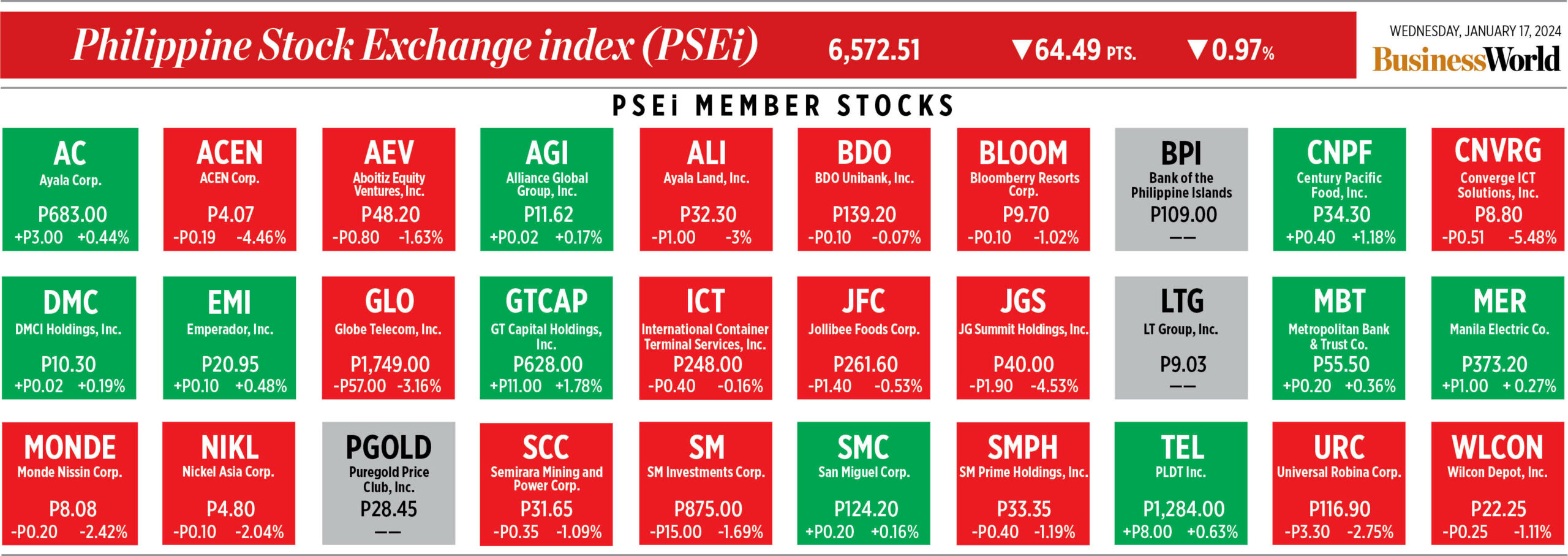
How PSEi member stocks performed — January 17, 2024

Here’s a quick glance at how PSEi stocks fared on Wednesday, January 17, 2024.


Pharma industry targets bigger share of DoH drug procurement

By Justine Irish D. Tabile, Reporter

THE pharmaceutical industry said it is hoping to supply more drugs to the Department of Health (DoH) this year en route to hitting a 10% growth target to P300 billion for market size.

The Philippine Pharmaceutical Manufacturers Association (PPMA) made the projection on the sidelines of the ProPak Philippines 2024 briefing.

PPMA President Higinio Porte, Jr. valued the Philippine pharmaceutical market at P275 billion last year.

“We are looking at an increase of 10% this year, just a little bit bigger than last year. We are looking at growing it to about P300 billion but that doesn’t include imported vaccines, as those are separately procured by the government,” Mr. Porte told reporters on Wednesday.

To achieve the target, Mr. Porte said that pharmaceutical manufacturers are seeking a bigger share of the DoH’s drug procurement program.

Domestic manufacturers supply only 5% of the DoH’s drug needs, with the rest imported.

“So the target in the next eight years is to bring it up to 50%. We are starting with anti-tuberculosis (medicine) as most of them are imported,” he said.

Two members of the PPMA have put in bids to supply tuberculosis medication and have been issued notices of award, he said.

Mr. Porte said the industry cannot yet produce human immunodeficiency virus (HIV) treatments domestically. The government dispenses free drugs to HIV sufferers at selected hospitals.

“Unfortunately, the anti-HIV products are still patented so we cannot just manufacture them. Aside from that, we do not have the raw materials to do that,” he said.

“So the way to go is to partner with the technology innovators and import semi-finished anti-HIV tablets or capsules and then we will package it here so they can be considered local,” he added.

The PPMA is also seeking pharmaceutical procurement programs to give domestic producers more preferential treatment.

“Currently, what the government is promoting is for local manufacturers to match the price of the foreign manufacturers,” Mr. Porte said, noting that the current preferential policy for Philippine producers applies if their price is within 15% of the bids of foreign manufacturers.

“But we don’t want it to be that way … what we want is for the government to prefer local manufacturers. That is what we are pushing for,” he added.

By the next decade, domestically produced pharmaceutical products are projected to account for 60% of the market.

“Right now, only 32% of the value of the market consists of local drugs. So… by 2030, we want 60% of that to be from local,” Mr. Porte said.

“And the biggest opportunity for that is in the government requirements because the implementation of Universal Health Care will benefit a lot of Filipinos; therefore, the government will be needing more medicine,” he added.

Mr. Porte said the 60% goal has been capped because the industry cannot produce all of the Philippines’ needs.

“We do not have capability to produce biotechnology products and if we want to invest in that, there will be no economies of scale,” he said.

“For example, vaccines. We cannot produce vaccines here in the Philippines and sell it to other countries because vaccines produced in other countries are a lot cheaper,” he added.

Pharmaceutical manufacturers also said that the global economic crisis has caused packaging materials to increase in cost by up to 30%.

“These are being absorbed by the manufacturers because the price increase that we can implement at most is only 5-8%. So we absorb these price increases for the moment, but we are expecting for the economy to stabilize and all the prices of the raw materials will follow through,” Mr. Porte said.

The 4th International Processing and Packaging Trade Event for the Philippines or ProPak Philippines, set for Jan. 31 to Feb. 2, is expected to attract 200 exhibitors.

For this year’s edition, ProPak Philippines will be expanding its focus from food and beverages to include pharmaceutical and nutraceutical industries.

PSEi dips as China growth falls below forecast

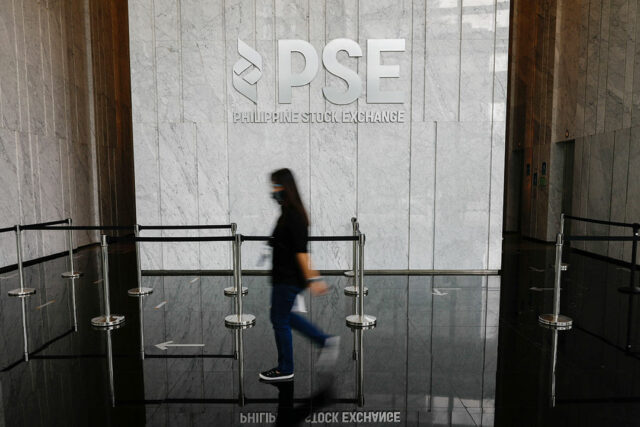
The lobby of the Philippine Stock Exchange in Taguig City, Sept. 30, 2020. — REUTERS

By Revin Mikhael D. Ochave, Reporter

THE PHILIPPINE Stock Exchange Index (PSEi) declined for the second straight day on Wednesday, tracking the drop in most Asian stocks after China’s fourth-quarter growth figures failed to meet expectations, analysts said.

The main index fell by 0.97% or 64.49 points to close at 6,572.51, while the broader all-share index declined by 0.84% or 29.57 points to 3,476.66.

“Most Asian stocks dropped after China’s fourth-quarter gross domestic product (GDP) figures fell below expectations at 5.2%, lower than the 5.3% forecast by analysts,” Philstocks Financial, Inc. research analyst Claire T. Alviar said in a Viber message. “This further weighed down on sentiment since China is one of our top trading partners.”

Investor sentiment was also dampened by expectations that the government won’t hit economic growth targets through 2025 given high interest rates.

“Market sentiment was dampened by the anticipation of the Bangko Sentral ng Pilipinas that GDP growth might fall short of the government’s targets through 2025 due to the impact of high interest rates,” Ms. Alviar said.

At its December meeting, the Development Budget Coordination Committee kept its growth target of 6-7% for 2023.

But it lowered the high end of the target this year to 6.5-7.5% from 6.5-8%, while keeping the 6.5-8% goal for 2025 to 2028.

The local bourse declined along with Hong Kong and Chinese stock markets after the release of Chinese economic data, Luis A. Limlingan, head of sales at Regina Capital Development Corp., said in a Viber message.

“Philippine shares continued to slide with Hong Kong and China equities plunging after the latest growth print showed that the second-largest economy grew at the slowest pace in three decades when excluding pandemic [figures],” he said. 

Sectoral indexes declined across the board, led by mining and oil which fell by 2.01% or 191.64 points to 9,305.75. The property index lost 1.61% or 46.55 points to 2,836.02, while holding firms dropped by 1.19% or 75.85 points to 6,290.34.

Industrials went down by 0.99% or 90.75 points to 9,048.45; services slid by 0.73% or 12.07 points to 1,624.33; and financials decreased by 0.04% or 0.77 points to 1,838.20.

“Among the index members, GT Capital Holdings, Inc. was at the top, increasing by 1.78%. However, Converge ICT Solutions, Inc. lost the most by 5.48%,” Ms. Alviar said. 

Value turnover rose to P6.68 billion with 590.13 million issues on Wednesday changing hands from the 501.41 million issues worth P5.98 billion on Tuesday. 

Decliners outpaced advancers 108 against 80, while 50 names were unchanged.

Net foreign buying reached P63.22 million on Wednesday, lower than the P461.86 million net foreign inflows a day earlier.

Peso weakens after hawkish Fed cue

BW FILE PHOTO

By Aaron Michael C. Sy, Reporter

THE PESO weakened against the dollar on Wednesday after hawkish remarks from a US Federal Reserve official.

It closed at P55.93 a dollar, 10 centavos weaker than its P55.83 finish on Tuesday, according to Bankers Association of the Philippines data posted on its website.

The peso opened at P55.97 against the dollar, appreciated to as much as P55.835 and depreciated to as much as P56.125.

Dollars exchanged went up to $1.74 billion from $1.62 billion a day earlier.

The peso was dragged down by signals from Fed Governor Christopher J. Waller, who said rate cuts have to be “methodical,” pushing back against market expectations of about six rate cuts this year, Michael L. Ricafort, chief economist at Rizal Commercial Banking Corp., said in a Viber message.

“The peso depreciated amid hawkish remarks from Fed official Waller who hinted at less aggressive rate cuts in 2024,” a trader also said in an e-mail.

The US is “within striking distance” of the Federal Reserve’s 2% inflation goal, but the central bank should not rush to cut its benchmark interest rate until it is clear lower inflation will be sustained, Mr. Waller said on Tuesday, according to Reuters.

Regardless of when rate cuts begin, Mr. Waller said the Fed should proceed “methodically and carefully” and not make the sort of large, fast reductions used when the Fed was trying to bail out the economy from a shock or a pending downturn.

Mr. Waller’s remarks countered market expectations that the Fed would start cutting rates at its March meeting and lop perhaps 1.5 percentage points from the benchmark policy rate by the end of the year. After he spoke, traders pared bets that the Fed would in March reduce the key rate that has been kept at 5.25% to 5.5% since July.

The Federal Open Market Committee raised borrowing costs by 525 basis points (bps) to 5.25-5.5% from March 2022 to July 2023.

It will hold its first policy meeting of the year on Jan. 30-31.

The trader expects the peso to remain weak against the dollar on Thursday amid expectations of a firm US retail sales report.

The trader expects the peso to move between P55.85 and P56.05 a dollar, while Mr. Ricafort sees it ranging from P55.80 to P56.

Agri department floats rice output enhancement program of P1.3 trillion

PHILIPPINE STAR/WALTER BOLLOZOS

THE Department of Agriculture (DA) said a program to expand rice output and minimize post-harvest losses would require investment of about P1.3 trillion over a number of years.

“The Philippines needs to invest at least P1.3 trillion over the next few years to boost rice production, reduce wastage of agricultural products, and ensure food security,” Agriculture Secretary Francisco Tiu Laurel, Jr., said in a statement on Wednesday.

He added that the funds will support irrigation projects for over 1.2 million hectares of farmland.

The proposed amount is equivalent to nearly a quarter of the 2024 national budget of P5.77 trillion.

Mr. Laurel said on Tuesday that the DA will start investing in more post-harvest facilities for rice and corn.

He said that the DA would need about P93 billion over the next three years to make a dent into post-harvest losses of about P10.7 billion, equivalent to 23 days of rice consumption.

The DA is hoping that output of palay or unmilled rice this year does not fall below 20 million metric tons, equal to the production target in 2023.

Part of the DA’s plan to reduce food waste is to build more cold storage facilities to stockpile vegetables and high-value crops, with which it hopes to smooth out supply in periods of shortage or take excess produce off the market during bumper crops.

The DA has allocated P1 billion for funding such projects in 2024, with a projected requirement of another P5 billion over the next three years.

Its first facility to be constructed will rise on a 1.3-hectare site at the Food Terminal, Inc. (FTI) complex in Taguig City at a cost of about P500 million.

“The 5,000-pallet position cold storage facility in FTI will take at least 12 months to complete,” the DA said.

Mr. Laurel said local governments should take the lead in assessing supply conditions for vegetables and high-value crops, citing the devolution of some agricultural functions.

“The DA will assist, nonetheless, in resolving these perennial problems,” he added.

He has that in the past 40 years, there has been no significant government investment in post-harvest facilities. — Adrian H. Halili

Tourism, construction expected to drive growth this year — NEDA

PHILSTAR FILE PHOTO

ECONOMIC GROWTH this year will be driven by a rebound in tourism and construction, the National Economic and Development Authority (NEDA) said.

“In our case, we have drivers of growth that we are pushing for, like international tourism. We think that that will be another driver of growth this year. And then of course, construction in terms of the Build Better More and our public mass housing project… will be a big factor in accelerating growth,” Undersecretary Rosemarie G. Edillon said on the sidelines of a briefing on Wednesday.

The government is targeting 6.5-7.5% growth this year, reducing the upside from its previous target of 6.5-8%.

In the nine months to November, gross domestic product (GDP) grew 5.5%. To meet the lower end of the government’s 6-7% goal for 2023, the economy would need to grow by 7.2% in the fourth quarter.

The Philippine Statistics Authority will release fourth-quarter and full-year 2023 GDP data on Jan. 31.

The Department of Tourism has said that the tourism industry generated P404.02 billion in revenue in the 10 months to October, up 190%.

The government hopes to spend the equivalent of 5-6% of GDP on infrastructure annually.

Most multilateral institutions’ growth forecasts for the Philippines for 2024 would miss the government’s target. The World Bank expects GDP to grow by 5.8% while the Asian Development Bank sees growth expanding 6.2% this year.

Ms. Edillon also noted the potential of the blue economy. “It’s untapped. It consists of so many economic activities that can be done along the shore, the coast, and the waters themselves.”

Last month, the House of Representatives approved on second reading a bill that seeks to establish a framework for a blue economy that would sustain marine ecosystems and resources.

Ms. Edillon said that the blue economy could be worth more than a trillion pesos.

“We first need to have that framework to develop the blue economy. So that will include the resorts that will include the diving spots; the maritime sector, which will include ocean energy. We want to make sure that first of all, it’s guided by the framework,” Ms. Edillon said.

“And of course, it should support sustainable development, because we want the next generation to still have this resource,” she added. — Luisa Maria Jacinta C. Jocson

Gov’t urged to move faster in setting up jobs plan council

DOLE REGION 12

By John Victor D. Ordoñez, Reporter

THE GOVERNMENT must move faster in assembling the council tasked with executing the plan to create quality jobs, with projections of growing unemployment worldwide adding to the urgency, according to a labor group.

“Our policymakers now face the challenge of stimulating quality economic growth, growth that not only creates jobs but also improves working conditions, strengthens societal resilience and ensures sustainability,” Jose G. Matula, president of the Federation of Free Workers (FFW), said in a Viber message.

“The FFW strongly advocates for the immediate constitution of the ‘Trabaho para sa Bayan’ council, ensuring tripartite representation.”

In its 2024 World Employment and Social Outlook report published last week, the International Labour Organization (ILO) said the global unemployment rate is expected to grow to 5.2% this year, from 5.1% last year.

It said about two million more people are expected to be looking for jobs this year.

The ILO also urged countries to boost productivity as about 58% of workers worldwide remain engaged in informal work.

In September, President Ferdinand R. Marcos, Jr. signed into law a bill authorizing the creation of a national employment roadmap and an inter-agency body to draft a national strategy for job generation.

The law aims to boost the competitiveness of the workforce through upskilling and reskilling.

National Economic and Development Authority Secretary Arsenio M. Balisacan has said the law will “facilitate stronger coordination and partnership among relevant agencies and stakeholders for the efficient implementation of employment programs.”

The unemployment rate eased to an 18-year low in November of 3.6%, the Philippine Statistics Authority said.

Job quality remained unchanged that month, as the underemployment rate, the share of the employed who are seeking more work or longer hours, stayed at 11.7%.

“The FFW urges the Philippine government to align with international standards, focusing on creating a more equitable society through improved employment and labor practices,” Mr. Matula said.

Investments conferred CREATE incentives valued at P1.1 trillion

PROJECTS benefiting from incentives under the Corporate Recovery and Tax Incentives for Enterprises (CREATE) Law generated investments exceeding P1 trillion, the Department of Finance (DoF) said.

In a social media post, the DoF said that the CREATE Act attracted P1.1 trillion worth of investments between August 2021 and December 2023. The projects are expected to generate 102,304 jobs.

The Fiscal Incentives Review Board approved 51 applications involving capital worth P843.9 billion, projected to generate 33,278 jobs.

Meanwhile, 881 applications were approved by investment promotion agencies, generating P207 billion in investments and expected to create 69,026 jobs.

Signed into law in 2021, CREATE was designed to provide relief to businesses recovering from the pandemic through reduced corporate income tax rates and rationalized fiscal incentives.

The CREATE MORE bill is currently being considered by the House of Representatives, to better harmonize CREATE with its implementing rules and regulations. — Luisa Maria Jacinta C. Jocson

Coconut tree planting goal set at 8.5M seedlings

CENTURYPACIFIC.COM.PH

THE Philippine Coconut Authority (PCA) is gearing up to plant 8.5 million coconut seedlings this year as the government moves to refresh the country’s coconut plantations.

In a statement, PCA Administrator Bernie F. Cruz said that the number of seedlings represents the full extent of its nursery capacity.

“We made use of remaining funds from previous years to partner with supportive LGUs and cooperatives to establish nurseries and expand our sources of planting materials, in compliance with (President Ferdinand R. Marcos, Jr.’s) directives,” Mr. Cruz added.

“We are also maximizing our resources and stepping up our efforts in our regular planting programs,” he added.

He said that the PCA is expecting further expansion of its tree planting program in the coming years due to a significant rise in parent trees being used to produce seedlings.

Last year, Mr. Marcos ordered the PCA to draft a plan for the rehabilitation of the coconut industry, including the planting of 100 million coconut trees by 2028. The rehabilitation plan aims to address the advancing age of the bearing trees.

“While the planting goal is for 2028, he told us to abide by a plan that looks ahead in terms of fully rehabilitating the coconut industry, and to ensure that every peso invested is well-spent,” Mr. Cruz said.

In 2023, the PCA planted more than 2.1 million seedlings.

A medium-term replanting plan assumes that the PCA will plant 20 to 25 million seedlings annually between 2023 and 2028.

In order to meet the planting targets, the PCA established the Task Force for Massive Coconut Planting and Replanting and Productivity Enhancement.

The group was primarily charged with forging partnerships with LGUs, coconut farmers’ organizations, and cooperatives, as well as the private sector. — Adrian H. Halili

ADVERTISEMENT
ADVERTISEMENT