Home Blog Page 3772

Philippines to propose ASEAN AI regulatory framework, House speaker says

STOCK PHOTO | Image by Rawpixel.Com from Freepik

The Philippines plans to propose the creation of a Southeast Asian regulatory framework to set rules on artificial intelligence (AI), based on the country’s own draft legislation, the speaker of its Congress said on Wednesday.

At the World Economic Forum in Davos, Martin Romualdez said the Philippines would present a legal framework to the Association of Southeast Asian Nations (ASEAN) when it chairs the bloc in 2026.

“We’d like to give as a gift to the ASEAN a legal framework. … Digitization, even in our economic policy is very, very much right up there as a priority,” he said.

“Alongside that is cybersecurity, and the concomitant concerns and issues as generative artificial intelligence, a field that needs a lot of support and regulation. We feel that in ASEAN, we can capitalize and optimize these developments, but within a framework of regulatory support for this.”

Regulators globally are racing to draft regulations to govern use of generative AI, which is stirring excitement and fear about its potential to reshape industries.

Such a move could be a challenge in ASEAN, a region of nearly 700 million people and 10 countries with widely divergent rules governing censorship, intellectual property, misinformation, social media and use of the internet.

The country’s proposal would contrast sharply with the steps taken so far by ASEAN states, which have taken a business-friendly approach to AI regulation, according to a draft of an ASEAN “guide to AI ethics and governance” seen and reported by Reuters in October.

That voluntary guide would reduce the compliance burden and allow for more innovation in the region, some technology executives have said.

Romualdez said legislation on generative AI was especially important for the Philippines because of its crucial business process outsourcing sector, which was “now under severe threat.”

“It’s a very vulnerable sector in a very, very bright industry today. But we see a transformation of personnel and upskilling of these personnel to a level to support generative AI will be likely a very, very logical direction to take,” Romualdez said.

“It is incumbent upon us in Congress to come up with a legal framework that will not just fit the Philippines, but will be very, very appropriate for the ASEAN.” — Reuters

Coinbase, SEC lock horns in US court over crypto securities

Coinbase logo | https://www.coinbase.com/

A federal judge in Manhattan on Wednesday grilled Coinbase and the US securities regulator about their divergent views on whether and when digital assets are securities, in a case closely watched by the cryptocurrency industry.

Coinbase has asked the court to dismiss the Securities and Exchange Commission’s lawsuit alleging the largest U.S. crypto exchange is flouting its rules.

Judge Katherine Polk Failla on Wednesday heard arguments from both sides, focusing her questions on the legal precedent defining securities, and the attributes of several crypto tokens traded on Coinbase and elsewhere that the regulator has deemed investment contracts.

Ms. Failla did not decide the matter from the bench, noting she was still weighing some questions after the more than four-hour hearing.

The judge’s ruling is likely to have implications for digital assets by helping to clarify the SEC’s jurisdiction over the sector.

The case is one of a slew the SEC has brought against the crypto sector. The agency focused initially on companies selling digital tokens, but under the leadership of chair Gary Gensler has targeted firms offering trading platforms and clearing activity, and acting as broker-dealers.

The SEC sued Coinbase in June, saying the firm facilitated trading of at least 13 crypto tokens, including Solana, Cardano and Polygon, which it said should have been registered as securities.

The Securities Act of 1933 outlined a definition of the term “security,” yet many experts rely on a U.S. Supreme Court case to determine if an investment product constitutes a security. A key test is whether people are contracting to invest in a common enterprise with the expectation of profit.

Coinbase, the world’s largest publicly traded cryptocurrency exchange, has argued that crypto assets, unlike stocks and bonds, do not meet that definition of an investment contract, a position held by the vast majority of the crypto industry.

Lawyers for the SEC argued that securities differ from purchases of collectibles like baseball cards or even Beanie Babies, referencing a 1990s trend in which Americans bought the dolls with the expectations they would rise in value.

Patrick Costello, SEC assistant chief litigation counsel, argued that the crypto tokens at the heart of the case support a larger “enterprise,” making them akin to an investment contract.

“When the value of the network or the ecosystem increases, so does the value of the (associated) token,” he said.

Still, Ms. Failla told SEC attorneys she was “concerned” that the agency was asking her to “broaden the definition of what constitutes a security.”

The SEC said buyers of digital assets, even on secondary markets such as Coinbase’s platform, were purchasing the tokens as investments akin to stock shares or bonds.

But Coinbase’s lawyers disagreed, noting that buyers of such tokens were not signing contracts entitling them to proceeds of a common enterprise.

“I’ll tell you this: I think there would have been a lot of surprise to find that an investment contract didn’t have anything to do with a contract,” said William Savitt, a lawyer for Coinbase.

The judge appeared dismissive of Coinbase’s argument that the lawsuit implicates the so-called major questions doctrine. That legal principle is based on a Supreme Court ruling that says federal agencies cannot regulate without specific congressional authorization.

The SEC in its lawsuit also targeted Coinbase’s “staking” program, in which it pools assets to verify activity on blockchain networks and takes commissions, in exchange for “rewards” to customers. The SEC said that program should have been registered with the agency. – Reuters

US bank profits fall as competition for deposits erodes lending margins

PEXELS-PIXABAY

 – Several large US regional banks reported lower profits on Wednesday, in a further sign that the income boost from interest rate hikes by the Federal Reserve is starting to wane.

Charles Schwab, Citizens Financial and US Bancorp said that, along with one-off charges, the rising cost of retaining customer deposits ate into fourth-quarter net interest income (NII), the difference between what banks earn from lending and pay on deposits.

Fed rate hikes last year aimed at taming inflation boosted many lenders’ NII, a core business for most regional banks. But growing competition for deposits from the country’s biggest banks is eating into their profits and in some cases subduing loan growth.

Big banks have benefited from an exodus of deposits from small institutions, which were seen as riskier, after Silicon Valley Bank and two other regional lenders collapsed last year.

Potential Fed rate cuts this year will likely further dent NII, some banks have warned.

Charles Schwab’s quarterly profit fell 47%, partly due to a 30% drop in NII on higher deposit costs. Schwab paid an average of 1.37% on deposits, compared to 0.46% a year earlier, it said.

Citizens reported a 71% decline in profit, with NII down 12%. US Bancorp’s profit fell 14% as NII dropped 4.2%. On Tuesday, PNC Financial, another big regional lender, said profits shrank, with NII contracting 8%.

Citizens warned that its NII this year could be 6% to 9% below the $6.24 billion it made in 2023. Shares of Charles Schwab dropped 1.3%, US Bancorp fell 1.7%, while Citizens was up 1.9%.

“For banks, loan demand would be fairly tepid through the first half of the year, and then start to pick up again in the second half,” Citizens Financial CEO Bruce Van Saun told Reuters in an interview on Wednesday.

At 11 US regional banks with assets of $50 billion to $100 billion, analysts expect earnings per share to drop from 2023 mostly due to increased deposit costs, according to LSEG estimates, Reuters previously reported.

The KBW regional bank index was last down 1%, in line with the broader market. Still, it is up about 10% since March when the industry crisis erupted, and some analysts think the sector remains attractive despite NII declines.

“It seems logical that the recent trend higher in share prices is met with near-term turbulence (from both NII softness and normalizing credit trends) – however, we believe the regionals remain attractive over the next 12-18 months as we fully price in the 2025 outlook,” Citi analysts wrote.

As with the largest US lenders which reported earnings on Friday, regional banks also took big one-time charges to replenish the Federal Deposit Insurance Corporation’s (FDIC) deposit insurance fund, which was dented by the crisis.

JPMorgan, Bank of America, and Citigroup posted lower profits on Friday, in part due to lower NII.

Executives at these top banks were generally upbeat on the economy, noting American consumers remained resilient even as defaults on consumer loans are returning to pre-pandemic levels.

But major questions hang over markets, including whether the economy will avoid a recession and, as inflation eases, when the Fed will start to cut rates. Strong US retail sales data on Wednesday showing the economy on a solid footing cast further doubt over market expectations of a Fed rate cut in March.

“I am a little on the cautious side,” JPMorgan Chief Executive Jamie Dimon told CNBC on Wednesday when asked about the US economy.

Speaking to FOX Business Network’s “Mornings With Maria” at Davos on Wednesday, Bank of America CEO Brian Moynihan said the daily debate about where the Fed will take rates continued to create uncertainty for consumers and businesses.

“When the Fed’s done, then the capital markets reopen. Then people say, OK, 3.5 to 4% unemployment rate. I got my job, I got my wages, you know, things settle in.” – Reuters

AI buzzes Davos, but CEOs wrestle with how to make it pay

STOCK PHOTO | Image by Gerd Altmann from Pixabay

 – Bright banners tout the promise of artificial intelligence along the main promenade of Davos, but executives at the World Economic Forum (WEF) say they are grappling with how to turn early demos into money-makers.

The arrival of OpenAI’s viral ChatGPT triggered a frenzy of venture investment and an abrupt change of course inside the world’s biggest technology companies since late 2022.

This year, several CEOs at the WEF meeting in Davos told Reuters that the latest generative AI still has a lot to prove.

Cloud and internet security company Cloudflare NET.N CEO Matthew Prince told Reuters that the months ahead may even feel like an “AI letdown”.

“Everyone’s like, yeah, I can build these cool demos, but where’s the real value?” he said, echoing a theme among business leaders attending the WEF meeting.

ChatGPT’s rapid rise is in some ways an outlier.

In the first two months since its November 2022 launch, the chatbot reached an estimated 100 million users, making it one of the fastest growing applications in history.

The program brought so-called generative AI to consumers’ fingertips, letting people write a short prompt and generate a poem, school essay or gather information as if with a search engine. It also proved a good collaborator for developing ideas in “low stakes, not business-critical use cases,” said Victor Riparbelli, CEO of AI video generation startup Synthesia.

But “the enterprise is definitely not really ready” for this chat-based AI, he said in an interview.

One problem Riparbelli cited is there is no clear path to end so-called “hallucinations,” or false content generated by AI. While computer scientists have developed methods for constraining places from which chatbots can draw responses, business leaders may not want the risk.

Other concerns, said IBM’s IBM.N Europe, Middle East & Africa Chair Ana Paula Assis, are stopping chatbot AI from reproducing human biases, and regulation.

“Clients are still very worried about how they bring those solutions within the boundaries of regulations and compliance,” she said.

Premier Li Qiang of China said in Davos that AI has to serve the common good but must be appropriately governed, because it “poses risks to security and to our ethics.” And China’s President Xi Jinping wants the United Nations to play a central role in AI discussions, U.N. Secretary-General António Guterres said Wednesday.

Meanwhile, some 90% of 1,400 C-suite executives said they were waiting for generative AI to take a step beyond recent hype or were doing only limited experimentation and pilots, survey results published by consultancy BCG showed.

Big tech companies including Microsoft, Alphabet’s Google and Amazon.com have pressed ahead, courting thousands of businesses to give the latest AI a try.

Some have marketed message-drafting, meeting-summarizing AI as a way to save employees time. Google, which has long used AI in its products, is experimenting with a chatbot-like collaborator it calls Bard.

And Microsoft CEO Satya Nadella said at a company event in Davos Wednesday that AI is poised to grow productivity and potentially accelerate science itself.

Yet businesses’ revenue and profit from recent efforts remain unclear.


‘GET REAL ABOUT AI’

While one Davos sign exhorted passers-by, “Let’s get real about AI,” efforts to find a market for it have led developers to consider diverse places.

Cohere, a high-profile AI startup that is focused on enterprises, views helping salespeople as one revenue path.

“It’s going to be on the sales side and making sales teams more productive,” Cohere CEO Aidan Gomez told Reuters. The hope would be “helping them do more outreach, more follow-ups, and automating a lot of that process.”

By contrast, medicine is more complicated. While speeding up note-taking for doctors is a worthy task for AI, automating the medical profession is not, as this could risk lives, said Gomez.

“We should be focused on assisting humans, not replacing doctors and having a chatbot doctor,” Gomez said.

Novartis CEO Vasant Narasimhan said the drugmaker was working with Microsoft with the aim of more widely rolling out AI to give samples to staff who submit 20 to 30,000 regulatory responses a year. The “next opportunity,” he said at Microsoft’s event, would be AI for drug design.

Tejpreet Chopra, CEO of BLP Group, a major wind and solar operator in India, told Reuters he is ready to incorporate AI chat technology “but only for internal use for writing good English, not for content.”

Elections are a high-stakes area concerning AI companies, as voters around the world head to the polls in 2024.

Regarding the use of AI in misinformation campaigns, Gomez said Cohere’s policies prohibit impersonation, while Riparbelli said Synthesia does not allow customers to make political content through its AI video platform.

OpenAI, which also bans abusive impersonation through its technology, on Monday said it is working with the National Association of Secretaries of State in the U.S. and will start directing users to CanIVote.org for election-related questions.

Understanding how content is created is a key concern among companies and policymakers, said Arati Prabhakar, director of the White House Office of Science and Technology Policy.

“If (people) see a video or an image, they should be able to know whether it is AI-generated or human generated,” Prabhakar told Reuters in an interview.

For Srini Pallia, an executive at technology services and consulting company Wipro, the AI buzz at Davos is loud and clear, filling the void left by crypto.

“You know the conversations – it’s AI, AI and more AI,” Pallia said. – Reuters

Tesla slashes Model Y prices in Europe after China price cuts

MILAN CSIZMADIA-UNSPLASH

Tesla has slashed prices of its Model Y cars across Europe including in Germany, a week after the company cut prices in China in the face of uncertain electric-vehicle demand.

The cuts, as well as lowered price targets from brokerages UBS and Wells Fargo, sent Tesla’s shares down nearly 3%, adding to what has been a poor start for the stock in 2024.

Germany-listed rivals Mercedes Benz Group, Volkswagen and Bayerische Motoren Werke fell between 2.3% and 3.3%. In the United States, Ford Motor and General Motors were down 2% and 1.1%, respectively.

Tesla reduced prices in Germany for its Model Y Long Range and Model Y Performance by 5,000 euros to 49,990 euros ($54,340) and 55,990 euros respectively, representing a discount of 9% and 8.1% compared to their previous prices.

It also cut the price of Model Y rear-wheel drive models by 4.2%, according to data on Tesla’s website.

In France, the company reduced its Model Y prices by as much as 6.7%. Prices were cut by up to 10.8% in Denmark.

In the Netherlands, prices for the Model Y were slashed by up to 7.7% and, Tesla cut prices by between 5.6% and 7.1% in Norway, CNBC reported.

While no reason was given for the move, EV demand has generally been slowing as a deduction in state subsidies and high borrowing costs prompt buyers to rethink big purchases.

Tesla struggled in Germany in 2023, posting a 9% decline in new registrations to 63,685 vehicles, against an 11.4% increase in EV sales in Europe’s top economy, according to figures from the German federal motor authority KBA.

As a result, Tesla lost its crown as the largest seller of EVs in Germany to Volkswagen, which took a 13.5% share of the market compared to Tesla’s 12.1%.

On Wednesday, Wells Fargo and UBS cut their price targets on Tesla’s stock by more than 8% and nearly 11%, respectively. The stock has already declined about 11.5% so far in January, based on the last closing price.

The latest price cut comes after Tesla announced last week that it would suspend most of its car production at its factory near Berlin from Jan. 29 to Feb. 11. The company blamed a lack of components due to changes in transport routes because of attacks on vessels in the Red Sea.

Germany’s EV subsidy program, originally intended to apply until the end of 2024, ended prematurely last month, a move that was expected to hit German carmakers already struggling to bring down prices to levels offered by Chinese and US competitors. – Reuters

What is the outlook for UK inflation in 2024?

REUTERS

 – British inflation edged up in December to 4.0% from November’s 3.9%, according to figures released on Wednesday, but many economists think it could return to the Bank of England’s 2% target by April or May, sooner than in other countries.

That would also be far earlier than the BoE forecast at the start of November when it predicted inflation would stay above target until late 2025.

December’s surprise increase – which was driven largely by one-off effects from tobacco duty and air fares – comes after two months of much bigger-than-expected falls in the pace of price growth.

Here are more details about the outlook for inflation.


WHY HAS INFLATION BEEN FALLING?

British consumer price inflation peaked at 11.1% in October 2022, driven by surging European gas prices after Russia’s invasion of Ukraine in February that year, as well as by higher food prices and lingering disruption from the COVID-19 pandemic.

Since then, oil and gas prices have fallen while food prices are increasing less quickly.

At the peak, household bills including energy costs were contributing nearly 4 percentage points to the inflation rate, food prices added 2 percentage points and transport more than 1 percentage point.

Now household bills and transport costs are generally falling and lowering inflation by 0.5 and 0.2 percentage points respectively.

Food price inflation remains high at 8.0% in December, contributing 0.9 percentage points the overall 4.0% increase.


HOW DOES UK INFLATION COMPARE TO OTHER COUNTRIES?

British inflation in December was just below France’s 4.1% and above Germany’s 3.8% and the United States’ November reading of 2.1%, according to internationally comparable HICP measures provided by Britain’s Office for National Statistics. Across the euro zone as a whole, inflation was also lower than in Britain in December at 2.9%.

For much of 2023, British inflation was rather higher than in other advanced economies, due in part to Britain’s high reliance on gas for heating and power generation, and regulation that led to household energy bills rising and falling several months later than elsewhere.


WHEN WILL UK INFLATION RETURN TO TARGET?

Dutch bank ING and consultants at Capital Economics say British CPI will return to 2% in April – sooner than in the US or euro zone, even after December’s inflation surprise.

Citi, Deutsche Bank and Oxford Economics have predicted that inflation will fall to 2% or lower from the second quarter.

April is likely to see a 15% reduction in regulated energy tariffs which will lower the inflation rate by 1.5% while food price inflation is on track to slow towards 2%, ING predicts.

The BoE forecast at the start of November that inflation would average 4.6% in the final quarter of 2023 – compared with 4.2% in Wednesday’s data – and exceed 3% throughout 2024. It will update its forecasts on Feb. 1.


WHAT ARE THE RISKS INFLATION DOESN’T RETURN TO 2%?

For the BoE, rapid wage growth is the biggest challenge to returning inflation to 2% and keeping it there.

Before the pandemic, when inflation stayed close to 2%, wage growth was typically around 3%. After it, pay growth accelerated, reaching nearly 8% in mid-2023, excluding bonuses.

Higher wage bills risk being passed on to consumers through higher prices. Surveys suggest many employers plan to raise pay by around 5% this year, while the minimum wage – a big influence on hospitality and retail pay – is due to rise by 10% in April.

Many economists expect inflation will edge up again in January, when a 5% rise in regulated energy tariffs took effect.

Disruption to shipping in the Red Sea, linked to the conflict in Gaza, could impact prices too though so far the impact on Britain’s economy has been limited.


WHAT DOES IT MEAN FOR THE BANK OF ENGLAND?

Economists think lower inflation will allow the BoE to start cutting interest rates, probably from around the middle of 2024.

Financial markets see a 50-60% chance of an initial quarter-point rate cut in May, rising to a near certainty by June. They expect Bank Rate – currently 5.25% – to fall to around 4.25% by the end of this year.

The BoE’s stance for months has been that interest rates will need to stay high for an “extended period”.

BoE Chief Economist Huw Pill warned last year that big falls in inflation caused by lower energy prices should not make the central bank “declare victory prematurely”. – Reuters

Early coal-fired plant retirement seen significantly reducing PHL emissions

PHILSTAR FILE PHOTO

THE early retirement of coal-fired power plants could prevent 290 metric tons of carbon dioxide (MtCO2) from the Philippines’ annual emissions, a climate data advocacy group said.

“Coal plants coming offline in megawatts affect the overall stability of the system, at the expense of consumers and the economy,” Isabella Suarez, Southeast Asia lead at TransitionZero, said in a statement on Wednesday.

“The Philippines will need to make critical policy decisions for the early retirement of the coal fleet to be not only feasible, but imperative for businesses,” she added.

The non-government organization (NGO) said the volume of CO2 that will not be released as a result of plant retirements is equivalent to nearly double of the Philippines’ annual emissions which were at 155.38 MTCO2 in 2022.

However, buyouts for early retirement could cost between $19,198 per megawatt (MW) to $2.8 million per MW. There is a need for “clear policy direction” by incentivizing energy players on their move to early retire coal plants, it said.

“Amid high marginal abatement costs due to the country’s tariff structures, TransitionZero found early coal retirement by five years and replacement with renewables could be feasible with tailored deal structures, robust selection criteria, and incentives for early movers under the Philippine Energy Transition Plan (PETP),” it said.

The NGO warned that without early retirement, unabated coal will persist until 2051, raising stranding risks.

“Lack of abatement measures also exposes businesses to the risk of stranding due to changing regulatory, business, and political climate, while exposing consumers to the impacts of high coal prices,” TransitionZero said.

Coal accounts for about 60% of the Philippines’ energy mix, while renewable energy supplies about 22% of the total.

According to Energy Undersecretary Rowena Cristina L. Guevara early plant decommissioning and repurposing is one of the government’s energy transition strategies.

“It is impossible to do (decommissioning) alone, so we decided that we are going to concentrate on renewable energy. We’ll do it aggressively,” she said at a forum on Wednesday.

The government is targeting to increase the share of renewables in the power mix to 35% by 2030 and to 50% by 2040.

Ms. Guevara said the second round of the Green Energy Auction (GEA) Program is expected by the third quarter.

The capacity not awarded during the GEA 2 in July will be offered again. The DoE issued notices of award for 105 winning bids, covering projects generating 3,440 MW, well below the 11,600-MW capacity on offer.

The GEA program hopes to promote renewable energy as a primary source of energy through competitive selection. — Sheldeen Joy Talavera

Vehicle sales surpass target in 2023

Vehicles clog the South Luzon Expressway. — PHILIPPINE STAR/RUSSELL PALMA

By Justine Irish D. Tabile, Reporter

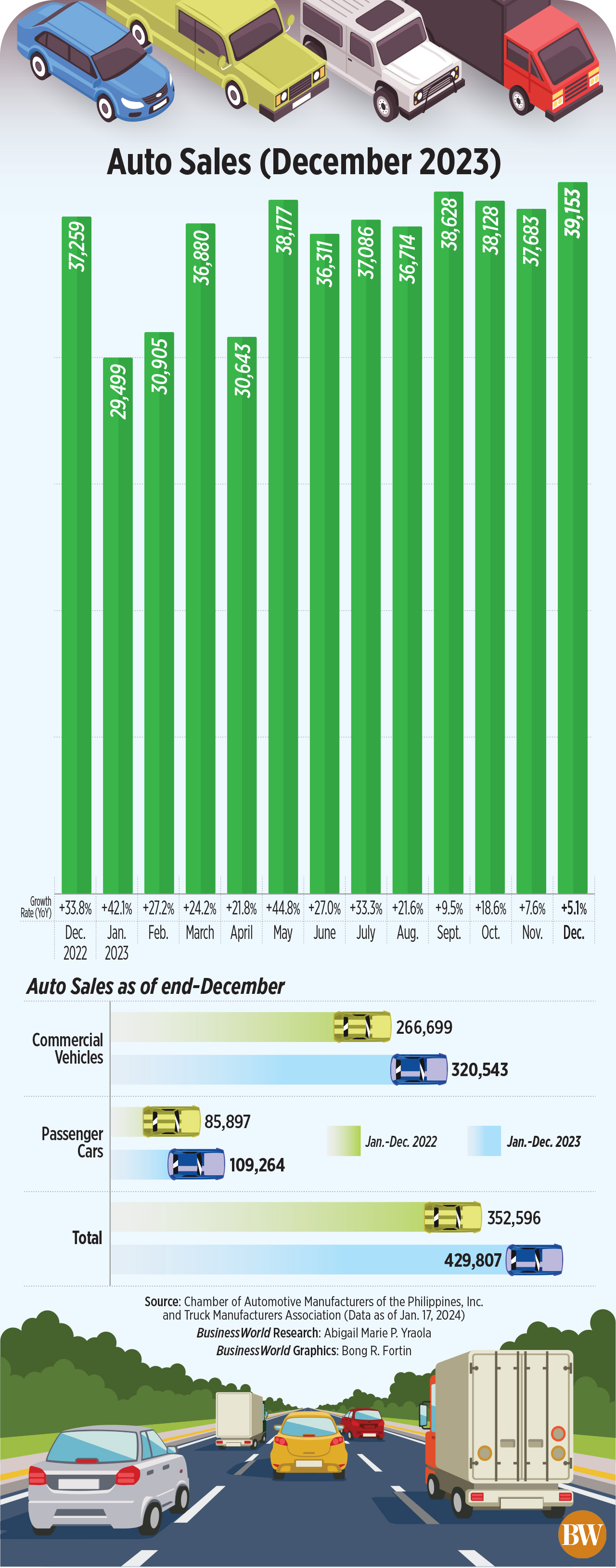
VEHICLE SALES rose by an annual 22% in 2023, surpassing the industry’s target, a report showed, as consumer demand remained robust despite elevated inflation and rising interest rates.

A joint report of the Chamber of Automotive Manufacturers of the Philippines, Inc. (CAMPI) and the Truck Manufacturers Association (TMA) showed total vehicle sales last year reached 429,807, a 21.9% increase from the 352,596 units sold in 2022.

It also surpassed the industry’s 423,000 revised sales target by 1.6%. CAMPI-TMA’s original sales target was 395,000 units.

Auto Sales (December 2023)In a statement, CAMPI noted the strong year-on-year sales growth was mainly due to “sustained consumer demand, easier access to credit, and improved supply conditions across all brands.”

“2023 was a very strong year for the industry and we are very excited about 2024,” CAMPI President Rommel Gutierrez said in a statement on Wednesday.

For the January-to-December period, commercial vehicle sales jumped by 20.2% to 320,543 units, while passenger car sales rose by 27.2% to 109,264 units.

The higher sales of commercial vehicles were driven by the 30.5% growth in Asian utility vehicles (AUVs) and 18.3% rise in light commercial vehicles.

Mr. Gutierrez said that the industry is hoping to reach record-breaking sales in 2024, banking on the country’s growth and new car models.

“Positive economic outlook, new model introductions and the electrification trend are expected to contribute to a record-breaking sales this year,” he said.

Economic managers are targeting 6.5-7.5% gross domestic product (GDP) growth for 2024.

Sought for comment, Rizal Commercial Banking Corp. Chief Economist Michael L. Ricafort said that the double-digit sales growth could also be attributed to the country’s favorable demographics and employment data, which he said was at the strongest in at least 18 years.

“Furthermore, lower downpayment and other promos and perks offered by some automakers also helped spur greater demand for vehicles,” he said.

Mr. Ricafort noted that the limited mass and public transport system also pushed consumers to purchase vehicles, especially with the release of new models including hybrid and electric vehicles.

For the coming months, he said that the easing trend in headline inflation towards the target of the central bank at 2%-4% would support local policy rate cuts.

“This would reduce borrowing costs for automotive loans which would also lead to some increase in vehicle sales that are financed by loans,” Mr. Ricafort added.

China Banking Corp. Chief Economist Domini S. Velasquez said that the downtrend in inflation may have provided consumers with more flexibility in their budgets, allowing them to make big-ticket purchases.

“Recovery from the pandemic may also have encouraged consumers to purchase vehicles for increased mobility, as more companies adopted return to office, and as demand for leisure travel increased,” she said.

“Looking ahead, vehicle sales will likely continue to post decent growth on the back of improved consumer confidence due to cooler inflation and lower borrowing costs with the possible interest rate cuts this year,” she added.

SINGLE-DIGIT INCREASE
In December last year, new automotive sales went up by an annual 5.1% to 39,153 units from 37,259 in December 2022. This was the slowest growth in 22 months or since the 7.3% contraction recorded in February 2022.

Month on month, vehicle sales jumped by 3.9% from 37,683 units sold in November.

Mr. Gutierrez said that the end-of-year deals spurred sales in the month of December.

Sales of commercial vehicles, which made up nearly three-fourths of the monthly sales, went up by 3.2% to 29,554 units in December. Month on month, commercial vehicle sales jumped by 5.1% from 28,114 units sold in November.

Broken down, light commercial vehicle sales declined by 2.3% to 22,102 units, while sales of AUVs surged by 29.5% to 6,558 units in December.

Sales of medium and heavy trucks dropped by 22.5% and 6.9% to 286 and 54 units, respectively.

On the other hand, light truck sales went up by 5.3% to 554 units in December.

CAMPI-TMA data showed sales of light, medium and heavy trucks all had a double-digit decline versus November’s tally.

Meanwhile, passenger car sales jumped by 11.4% to 9,599 units in December from 8,614 units a year prior.

Month on month, sales of passenger cars inched up by 0.31% from 9,569 in November.

Toyota Motor Philippines Corp. remained the market leader with a 46.54% share as full-year sales rose by 14.9% to 200,031 units.

Mitsubishi Motors Philippines Corp. came in second with a 47.3% increase in sales to 78,371 units from January to December.

In third spot is Ford Motor Co. Phils., Inc. as sales jumped by 26.8% to 31,320 units.

Rounding out the top five were Nissan Philippines, Inc., which saw a 27.9% increase in sales to 27,136 units, and Suzuki Phils., Inc. whose sales fell by 7.5% to 18,454 units.

BSP may trim policy rates by 50 bps this year

The main office of the Bangko Sentral ng Pilipinas in Manila. — BW FILE PHOTO

THE BANGKO SENTRAL ng Pilipinas (BSP) may cut by 50 basis points (bps) this year and 100 bps in 2025 amid easing inflation, ANZ Research said, adding the central bank still needs to be cautious in the coming months.   

ANZ Research said in a report dated Jan. 17 that the faster-than-expected deceleration of inflation in December should prompt the BSP to deliver rate cuts this year, earlier than previously projected.   

It said the BSP is likely to begin rate cuts in the fourth quarter, instead of its earlier expectation of the first quarter of 2025.

“We are penciling in 50-bp cut in 2024 and another 100 bps in 2025. Our new terminal rate forecast of 6% by yearend 2024 (that is, real rate at 2.5%) will also manage external imbalances,” ANZ Research said.

The BSP kept its policy rate steady at a 16-year high of 6.5% at its December meeting. This was after the Monetary Board tightened rates by 450 bps from May 2022 to October 2023 to help bring down elevated inflation.

Philippine headline inflation slowed to 3.9% in December from 4.1% in November and 8.1% a year ago. This was the first-time inflation returned to within the 2-4% target in nearly two years.   

Still, full-year inflation stood at a 14-year high of 6% in 2023. This was above the 5.8% in 2022 and marked the second straight year that average inflation breached the BSP’s 2-4% target.

ANZ Research said the 3.9% inflation print in December should be comforting to the BSP, although it will require additional evidence it will stay within the 2-4% target band in the coming months before it considers rate cuts.   

BSP Governor Eli M. Remolona, Jr. earlier said there is still a need to keep policy settings tighter for longer until inflation expectations are firmly anchored. The BSP also stands ready to adjust interest rates as necessary should risks further escalate.

The BSP will have its first policy review for this year on Feb. 15.

“The other obstacle for a policy pivot is the trade deficit, which widened anew in October and November 2023,” the research firm said.   

The Philippines’ trade deficit widened to a seven-month high of $4.69 billion in November, wider than the revised $4.39-billion gap in October, latest data from the local statistics agency showed.   

For January to November, the trade deficit narrowed to $48.98 billion from the $53.72-billion gap a year earlier.

“With the Marcos administration retaining its commitment towards capex spending even amid fiscal consolidation, import demand may continue to improve through 2024. This may deepen external imbalances if exports do not pick up significantly,” ANZ said.

It said lower interest rates in the US will enhance financial inflows to the Philippines and support the peso, which would mitigate the impact of a likely wider trade deficit this year, the research firm said.    

“Our current forecasts are for the US Fed to deliver 100 bps of rate cuts this year, with the first rate cut materializing in the third quarter,” ANZ said.   

The US Federal Reserve hiked borrowing costs by 525 bps from March 2022 to July 2023, bringing its benchmark overnight rate to a range between 5.25% and 5.5%.

Murray Collis, chief investment officer for fixed-income Asia ex-Japan at Manulife Investment Management (MIM), said the BSP is expected to mirror the Fed’s policy easing starting in the second quarter.

“The December 3.9% print helped the view that the BSP is done [hiking rates], so the focus has now shifted to policy easing. With the expected five rate cuts from the Fed, and as inflation continued to moderate, we expect the BSP to follow suit to maintain that interest rate differential,” he said in an online briefing on Wednesday.

Mr. Collis said the Philippine central bank remains hawkish and reiterated “monetary policy will likely continue to be tight on the back of these inflation risks.”

MIM sees Philippine headline inflation to average in the low 4% range this year.

For 2024, the BSP sees average inflation at 3.7%. — Keisha B. Ta-asan with inputs from AMCS

DoF studies carbon tax, emissions trading system

Smog is seen over Metro Manila in this photo. — PHILIPPINE STAR/MIGUEL DE GUZMAN

By Luisa Maria Jacinta C. Jocson, Reporter

THE DEPARTMENT of Finance (DoF) is studying the establishment of a “responsive and economically sensitive” system of carbon pricing for the country, its top official said.

“The development of carbon pricing instruments through a carbon tax and emissions trading system (ETS) is one of the crucial steps we are undertaking towards a greener future,” Finance Secretary Ralph G. Recto was quoted as saying in a speech.

“Carbon pricing instruments serve as a powerful fiscal tool, allowing us to incorporate the social and external costs associated with carbon emissions,” he added.

The DoF held a technical working group meeting on Tuesday to discuss the development of carbon pricing instruments. Among the attendees were representatives from the World Bank, the Economic Consulting Associates, the Asian Development Bank, and the United Nations Development Programme (UNDP).

The Finance department under then-Secretary Benjamin E. Diokno earlier said it was studying a carbon pricing system to encourage businesses to shift to sustainable practices. Former Finance Secretary Carlos G. Dominguez III had also proposed a carbon tax under the outgoing administration’s fiscal consolidation plan, which was initially expected to be implemented in 2025.

A carbon pricing scheme encourages companies to reduce their own emissions in order to minimize their tax exposure. Proceeds typically go towards supporting greenhouse gas mitigation projects.

The Philippines currently does not have any explicit form of carbon pricing.

“Despite our miniscule contribution to global carbon emissions at 0.48%, the Philippines bears the brunt of the worsening effects of global warming,” Mr. Recto said.

The Philippines is targeting to reduce greenhouse gas emissions by 75% by 2030.

Mr. Recto said the system aims to push businesses and individuals to reduce their carbon footprint and ultimately contribute to a low-carbon economy.

“All these while helping us mobilize financial resources to bolster our fiscal space for stronger economic recovery,” he added.

The Finance chief also noted that it will be crucial to identify an “optimal combination” of pricing instruments that is mutually beneficial to all stakeholders.

“We must extend our focus beyond mere transformations within industrial sectors. Emphasizing research and development for low-carbon technologies and incentivizing behavioral change is equally crucial,” Mr. Recto said.

A study by the International Monetary Fund (IMF) last year showed that the Philippines could generate up to $7 billion in revenues through a carbon pricing scheme.

Implementing a carbon price of $50 per ton by 2030 could reduce carbon dioxide emissions to 144 million tons or 13% below baseline levels, it added.

“The work should also not just focus on ambition, it should assess the fiscal impact — how different sectors will be affected, how jobs will be affected — so that the policy makers around here can see the different dimensions of the problem and can adopt a policy that is environmentally sustainable, socially just, and economically sound,” World Bank Country Director for the Philippines Ndiame Diop was quoted saying.

The Department of Environment and Natural Resources (DENR) is also working with ADB and UNDP to explore carbon markets and carbon trading.

Meanwhile, the Climate Reality Project Philippines manager Nazrin Camille D. Castro said that the Finance department’s study on carbon pricing is a welcome development, however, it must be approached with “utmost caution,” especially for tools such as ETS.

“The Philippines, at the moment, faces limitations in institutional capacity, regulatory infrastructure, and data management. If left unaddressed, these can cripple any form of ETS, making it more of a burden than a solution,” she said in a Viber message.

“Any future ETS must be meticulously designed and shielded by robust safeguards. Stringent caps, aligned with the Philippine Nationally Determined Contribution, are crucial to ensure genuine climate progress,” she added.

Ms. Castro said there is a need for good governance and strict regulations to “prevent market manipulation and leakages that will allow polluters to simply shift their emissions to unregulated sectors or regions, negating the overall reductions.”

“Equity must also be a cornerstone of our approach. ETS can disproportionately harm low-income communities through cost pass-through, job losses, and worsened pollution if permit allocation and trading mechanisms are not designed fairly,” she said.

“ETS should be designed with a transparent allocation process, revenue redistribution for clean energy projects in affected areas, and auctions designed to favor smaller companies,” she added.

Ms. Castro said the DoF must also ensure that the ETS prioritizes direct emission cuts as companies should not be encouraged to rely on offsets.

“Offsets, while tempting, are a slippery slope. Their unreliability casts doubt on actual emissions reductions at source… A sustainable future cannot be built on isolated strategies. It demands a holistic approach. Carbon pricing and ETS are pieces of a broader puzzle. We implore the DoF to pursue them alongside essential measures like renewable energy investments, energy efficiency promotion, and ecosystem protection,” she added.

DBM calls for swift passage of rightsizing, procurement reforms

MALACANANG.GOV.PH

By Keisha B. Ta-asan, Reporter

THE SWIFT PASSAGE of measures to rightsize the government and streamline procurement processes would help agencies and local government units (LGUs) improve their budget utilization, the Department of Budget and Management (DBM) said.

“When we asked the agencies on their catch-up plans for spending, the common issue they stated is the procurement system. The process is rigid, difficult, and tedious,” DBM Secretary Amenah F. Pangandaman said in mixed English and Filipino at the Kapihan sa Manila Bay forum on Wednesday.

The DBM has also been pushing for amendments to the procurement law, including the adoption of a single electronic portal known as the Philippine Government Electronic Procurement System for all procurement activities from planning to implementation.

The department has also sought the passage of the National Government Rightsizing Program, which seeks to streamline the bureaucracy to improve public services. The House of Representatives has approved its version of the bill, while Senate Majority Leader Emmanuel Joel J. Villanueva filed a counterpart measure Senate Bill (SB) No. 2502 earlier this month.

“We hope (the bills) will be passed this quarter because the Senate will have another recess by Holy Week (April),” Ms. Pangandaman said.

She said the DBM is pushing for the rightsizing measure to ensure government workers are more responsive.

“We don’t want to remove personnel in the government,” she said.

Ms. Pangandaman said the Asian Development Bank (ADB) is providing technical assistance to the DBM in studying the rightsizing program.

The DBM also wants Congress to approve a bill that will institutionalize the cash budgeting system. The Budget Modernization bill is among the priority legislative measures identified by President Ferdinand R. Marcos, Jr.

Under the cash budgeting system, all authorized appropriations will be made available for obligation and disbursement only until the end of each fiscal year.

“We get a lot of requests from the LGUs, even in the National Government, to teach them and capacitate them on how to use their budget, prioritize their spending, and even contract management,” Ms. Pangandaman said.

Meanwhile, Ms. Pangandaman said amendments to the Mandanas-Garcia Ruling, which took effect in 2022 and grants LGUs a larger share of national taxes, are being reviewed.

“More or less the ruling is suspended because we’re reviewing Executive Order (EO)No. 138. But we’re already giving LGUs the revenue they need.”

“That’s why we need to boost their capacity building. When you give a lot of funds to a certain LGU, they should know where to spend these funds,” she said.   

She also noted that the DBM and other agencies still have consultations with LGUs in various cities and municipalities.

“We don’t expect LGUs to do big-ticket projects. That’s why we’re reviewing (EO No. 138) to identify what projects and programs the LGUs can do,” she said.

Ms. Pangandaman hopes the budget utilization rate of government agencies will be higher this year compared to a year ago.

Latest data from the DBM showed that the cash utilization of agencies stood at 93% as of end-November.

The DBM said it is also targeting to release all special allotment release orders (SAROs) for 2024 in the first quarter.

“We’ll give all the money to the implementing agency and then they will take care of the implementation. And then, they can just request if they need cash for payments,” she added.
A SARO is a specific authority issued to agencies to incur obligations not exceeding a given amount during a specified period for the purpose indicated.

NOT FOR ‘CHA-CHA’
In a statement on Wednesday, the DBM chief said she respects and upholds the fiscal autonomy granted by the Constitution to the Commission on Elections (Comelec).

“The Constitution grants fiscal autonomy to the Comelec and declares that its approved annual appropriations shall be automatically and regularly released,” Ms. Pangandaman said.

The DBM statement was released amid concerns on how the Comelec’s P14-billion budget in the 2024 General Appropriations Act, which includes the additional P12-billion budget allocated by the Bicameral Conference Committee, would be used to finance the proposed Charter change (Cha-cha) or people’s initiative.

According to Ms. Pangandaman, the Comelec can use its allocated budget for several activities such as the preparation of national and local elections, overseas absentee voting, registrations, and among other initiatives. 

“An additional P12 billion was allocated by Congress to the Comelec. This is lodged under the regular operations line item of the agency… It is not intended specifically or solely to fund the proposed Charter change,” she said. 

“It is the Bicameral Committee — the Senate and the House — that added the amount (P12 billion) upon the request of Comelec. They have the discretion to use the said amount for a plebiscite if the government decides to pursue any change, or if the people’s initiative will be continued,” she added.

The DBM allocated a P2-billion budget for the Comelec in the 2024 National Expenditure Program. This is P17.4 billion lower than the commission’s initial proposal of P19.4 billion.

Upon the appeal made by Comelec to restore their budget during budget hearings, the Bicameral Conference Committee approved P14 billion, which translates to an increase of P12 billion from the initial P2-billion budget proposal of Comelec.

Yes, we have lots of bananas

VILLA SOCORRO FARM’s first export sales in the USA.

Villa Socorro Farm has a corporate — and punny — bent as it looks at maximizing its banana chip biz

WHILE Marcial Aaron may have had a dream job (he was chief executive officer of Unilever’s Food Division), it turns out that his true dream could be found in his roots.

In the About page of his family’s Villa Socorro Farm, he said, “It all started as a dream: I grew up in a farming community. My grandparents and parents were farmers. Naturally, I wanted to become a farmer too!”

Mr. Aaron graduated with a degree in Chemical Engineering from De La Salle University and rose to the top post at the multinational company. Today, he and his family run Villa Socorro Farm, named after his wife, Socorro, “as an open love letter to her.”

Villa Socorro Farm has several products, ranging from banana chips to banana fiber, and the family has taken up the banana business quite seriously. For example, while Mr. Aaron is billed as Founding Father and Farmer on their website, his wife Socorro is called “Pusong Ina” as a joke on banana hearts — the banana-related puns are everywhere — but she’s also Vice-President for Integrated HR and Administration. Their children, Raymund and Diana, are called The Banana Chief (and Vice-President for Integrated Operations and Sales) and Señorita Banana (and Vice-President for Integrated Marketing), respectively. The younger Mr. Aaron even signed his e-mails to BusinessWorld with “Puno ng Puso (full of heart).”

Right now, Villa Socorro’s banana chips, branded Sabanana Banana Chips, can be found not only in shelves around the Philippines, but also in 18 other countries (including in Korea, Singapore, Australia, Saudi Arabia, the US, France, Holland, and Norway, among others).

CORPORATE DISCIPLINE
While the farm was initially acquired in 1998, Sabanana was launched in 2006, after the senior Mr. Aaron retired from Unilever in 2004. The younger Mr. Aaron discussed how his father’s background aided in setting up the brand. “Bringing in the corporate discipline helped a lot especially during the early stages of setting up the business. Having the structured approach in the corporate world brought in an organized, process-oriented management of the business that’s often disregarded by start-up entrepreneurs, and more so businesses in the field of Philippine agriculture.”

While banana chips are best known as bus stop snacks made usually by backyard entrepreneurs, Mr. Aaron talked about what they did differently. The chips are made from the Philippine saba banana which are washed, peeled, sliced, cooked, and packed within 24 hours. “There were mostly only home-based brands like you mentioned and there was no top-of-mind brand for banana chips. We saw this as an opportunity to be that brand,” he said.

“We started by investing in the improvement of our packaging material that allowed us to export. We also just really put ourselves out there and tried out different channels for our products. We started by selling to canteens in offices and schools that had low competition. We then targeted pasalubong (souvenir) stores. We eventually got some recognition and got into chain supermarkets that led to visibility to potential exports partners.”

Mr. Aaron said that last year they sold half a million 100-gram packs. The chips come in different flavors: the original traditional sweet blend, Smoky Barbecue, Roasted Garlic, Simply Lite, and Chocnut.

LOCATION LOCATION LOCATION
Location is also key for the farm: located in Pagsanjan, Laguna, Mr. Aaron praises the produce of the region. “We believe the saba grown in our region are the best variety in the Philippines. They are smaller but packed with flavor,” he said. While banana is their primary crop, other plants are grown within the farm as well: “Our bananas are naturally grown and we also practice intercropping because in doing so, fruit-bearing trees like lanzones, rambutan, mangosteen would act as a wind-breaker for when we get hit by a strong typhoon whereas the bananas hold plenty of water to keep the soil moist during dry season.”

This approach also led them to create other products: for example, furniture is made from mahogany trees felled by storms in the property (initially planted by the senior Mr. Aaron to protect their crops). The farm also dabbles in fiber, using a machine awarded by the Department of Science and Technology (DoST) to process banana trunks into fiber, which the younger Mr. Aaron said would have been otherwise converted into biowaste.

“It’s not so much just about the ‘special’ qualities of the banana, but mainly the mindset and sustainability approach of Villa Socorro Farm. We see waste products of one process as a potential raw material for another and that keeps us searching for new uses these materials,” he said.

The farm also serves as a resort, and was even used as a location for the 2000 Kevin Costner-starrer Thirteen Days.

SOCIAL ENTERPRISE
Villa Socorro Farms is operated by the Aarons as a social enterprise. While the tag is easily attached to many businesses today, Mr. Aaron goes into detail into how exactly they help the farmers and the surrounding community. “We only grow around 2% of the bananas we use for the banana chips manufacturing facility. Most of the supply (comes) from over 220 partner-farmers we have within our area. We offer training programs in farming best practices and provide them with planting materials if necessary. We then buy back their harvests to provide them sustainable livelihood in farming,” he said. Mr. Aaron told us a story about one of their partner farmers, called Kuya Willy. Kuya Willy had once told him, “Daig ko pa nag-oopisina (I’m better off than some who work in an office).”

At the heart (pun intended) of the business is a family. “Even going further deeper into the core of what we do is the heart or iyung puso (his pun). We wanted to turn our values into value by creating this social enterprise. After all, ‘socorro’ in Spanish means ‘help,’ and we truly want to be of service to our community and country.”

Working on farms isn’t usually rewarding in the Philippines. It’s backbreaking work (there’s even a nursery rhyme about it), and the rewards are few. According to data from the Philippine Statistics Authority (PSA), the country’s nominal wage rate of agricultural workers in 2019 averaged P331.10 per day. “On the average, male farm workers were paid at P335 per day, higher than the average wage rate of female farm workers at P304.60 per day,” the PSA’s website said. Villa Socorro Farm’s base in Region IV’s Calabarzon area had the highest daily wage rate, pegged at P399.08, while Central Visayas had the lowest at P276.43.

The Aarons are trying to change the narrative of farming by how they operate.

“We’ve only looked at farming as simply being out in the sun planting all day,” he said. “In reality today, it goes further beyond that. When we look at it as an agribusiness, then it becomes as engaging, challenging and exciting as any other career path. It’s an industry that will never cease having a market. One of our basic needs is food, which is why it is important that this industry is not overlooked. At the end of the day, agriculture offers opportunities for bountiful harvests that can be financially rewarding, paired with positive impact to people and the planet, it can be such a fulfilling and lucrative career.

“We only hope to continue becoming a testament of its endless possibilities.”

Sabanana Banana Chips can be found at their online store (villasocorrofarm.com) and also at Roots Collective and Kultura. — Joseph L. Garcia

ADVERTISEMENT
ADVERTISEMENT