Home Blog Page 3741

Japanese man sentenced to die for killing 36 in animé studio arson

TOKYO — A Japanese man was convicted and sentenced to death on Thursday for the arson and killing of 36 people at famed animé studio Kyoto Animation in 2019, public broadcaster NHK said.

The deadly attack on the Kyoto-based studio, better known as KyoAni, had sent shockwaves not only through Japan where violent crime is rare, but also overseas given the studio’s far-reaching fan base and the audacity of the crime.

Shinji Aoba, now 45, had set the studio ablaze by dousing the entrance area of the building with petrol, also injuring 32. Mr. Aoba himself suffered heavy burns and underwent intensive treatment for nearly a year.

Media have reported that Mr. Aoba held a grudge against the studio, known for the series Violet Evergarden and other popular works, believing that it had plagiarized his novel, an allegation that KyoAni has denied.

A pillar of Japanese pop culture, animé has become a major cultural export, winning fans around the world.

The incident prompted condolences from world leaders and business executives such as Canadian Prime Minister Justin Trudeau and Apple Chief Executive Tim Cook.

Japan and the United States are the only Group of Seven (G7) nations that carry out capital punishment. — Reuters

Tesla CEO Musk: Chinese EV firms will ‘demolish’ rivals without trade barriers

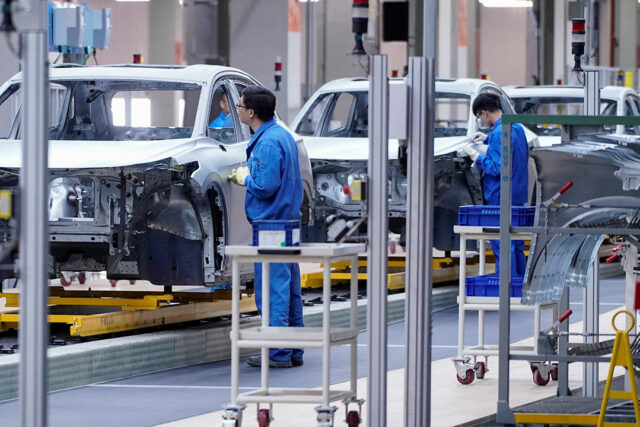
Employees work on assembly line during a construction completion event of SAIC Volkswagen MEB electric vehicle plant in Shanghai, China Nov. 8, 2019. — REUTERS/ALY SONG

SAN FRANCISCO — Tesla CEO Elon Musk said on Wednesday that Chinese automakers will “demolish” global rivals without trade barriers, underscoring the heat the US electric vehicle market leader faces from the likes of BYD, who are racing to expand worldwide.

Mr. Musk’s comments come after Warren Buffett-backed BYD – with its cheaper models and a more varied lineup -overtook Tesla as the world’s top-selling EV company last quarter, despite the US automaker’s deep price cuts through 2023.

Chinese car companies were the “most competitive” and “will have significant success outside of China, depending on what kind of tariffs or trade barriers are established,” Mr. Musk said on a post-earnings call with analysts on Wednesday.

“If there are no trade barriers established, they will pretty much demolish most other car companies in the world,” he said. “They’re extremely good.”

Mr. Musk has reason to be concerned.

He sparked a price war last year to woo consumers hit with high borrowing costs, in turn squeezing Tesla’s margins and worrying investors. On Wednesday, Mr. Musk warned Tesla was reaching “the natural limit of cost down” with its existing lineup.

Tesla plans to start producing a cheaper, mass market compact crossover codenamed “Redwood” mid-2025 to compete with inexpensive rivals, Reuters reported on Tuesday. Mr. Musk on Wednesday confirmed that Tesla expects to start production of its next-generation EV at its Texas factory in the second half of 2025.

But Chinese EV makers, adept at keeping costs in check with a stable supply chain, are moving fast. With rising competition and excess capacity in China, many are now working on rapidly expanding their foreign footprint after years of state subsidies helped boost domestic sales.

“The completeness and resilience of China’s multi-decade state-directed battery materials processing infrastructure build out is biting hard,” said Ross Gregory, a partner at Melbourne-based consultant New Electric Partners.

China’s SAIC Motor, for instance, has been placing orders for more vehicle vessels in its fleet to counter shipping costs as it looks to boost sales overseas.

Still, brand awareness of Chinese car companies in the United States is extremely low and their reliability, durability and safety is middling, so they have a long way to go to win US market share, said Spencer Imel, a partner at consumer insights firm Lansgton.

“They enjoy high demand in China with innovation such as in-car technology and battery swapping,” Mr. Imel said. “That, we believe, will be an important ingredient and a differentiator in their future growth overseas.”

Mr. Musk’s comments also come as the US presidential election picks up pace. President Joe Biden has said China was determined to dominate the EV market and that he “won’t let that happen”.

Former President Donald Trump, who is the frontrunner for the Republican nomination for president this year, has signaled that he would double down on stronger tariffs if elected, calling for a universal 10% tariff on all imports into the US and revoking China’s most-favored-nation trading status.

Mr. Musk on Wednesday said there was “no obvious opportunity” to partner with Chinese rivals but Tesla was open to giving them access to its charging network and licensing other technologies such as self-driving.

Europe has also taken a protectionist stance towards Chinese EV makers. Last year, the European Commission launched an investigation into whether to impose punitive tariffs to protect EU producers against cheaper Chinese EV imports it says are benefiting from state subsidies.

More than tariffs, the US and Europe need policies that will give their automakers the time to build a diversified supply chain, said New Electric’s Gregory. — Reuters

Australia govt reshapes tax cuts to woo low-income voters, rejects inflation risks

REUTERS
SYDNEY — Australia’s center-left Labor government on Thursday made changes to planned tax cuts, trimming benefits to the wealthy while giving low-income earners more breaks, in a bid to win back voters who are battling higher living costs.
Under the new policy, people earning up to A$135,000 ($88,763) will fall into lower tax brackets from July 1. Tax breaks for some high-income earners will nearly halve, with the savings redirected to those on low incomes.
“Our government will deliver a tax cut for every single Australian taxpayer. All 13.6 million taxpayers, not just some. Everyone who works and who pays tax will benefit,” Prime Minister Anthony Albanese said in a speech.
“This is a plan for middle Australians that delivers for every Australian taxpayer right up and down the income ladder.”
Addressing concerns the move could add to price pressures, Mr. Albanese said the Treasury has informed the government the revised tax breaks would not stoke inflation, with the policy being broadly revenue neutral and supporting jobs.
Treasurer Jim Chalmers has discussed the changes with Michele Bullock, the governor of the Reserve Bank of Australia, who expects there would be no implications from the tax changes on the central bank’s inflation forecast, Albanese added.
Opposition leader Peter Dutton said Albanese had “completely and utterly destroyed his credibility” for breaking an election pledge that he would not modify the tax policy which was legislated by the previous government in 2019.
“The Australian public won’t support a liar as prime minister,” Dutton told radio station 2GB.
Albanese defended the shift in policy saying more people, especially those in low-income groups, would benefit. A person on an average income of around A$73,000 will get a tax cut of A$1,504, which is A$804 more than prior estimates.
Australian households are under broad financial pressure from high inflation, which spiked as high as 7.8% in December 2022, before slowing to 5.4% in the third quarter of 2023.
That has dented Albanese’s ratings since his 2022 election win. Two polls out last month showed his disapproval ratings outstripped his approval numbers. – Reuters

Japan business leaders return to China seeking to bolster cooperation

A GENERAL VIEW shows Beijing’s skyline on a sunny day in this file photo. — REUTERS
BEIJING — An unusually large delegation of about 200 Japanese business leaders arrived in China this week to bolster economic relations in the first such visit in more than four years and in the face of geopolitical headwinds that have strained bilateral ties.
Japanese economic delegations had visited China every year since 1975, but those visits lapsed during the COVID-19 era when China largely shuttered its borders due to its stringent pandemic policies.
During their visit this week, the Japanese business delegates, which included Masakazu Tokura, chairman of the powerful Keidanren, as the Japan Business Federation is known, are due to meet with Chinese Premier Li Qiang on Thursday.
Ties between Japan and China have become strained after the world’s second- and third-largest economies clashed over issues from Japan’s release of treated radioactive water into the ocean to detention of Japanese citizens on suspicion of espionage.
Japan’s curbs on export of advanced chipmaking equipment to China have also fanned Chinese accusations that Japanese Prime Minister Fumio Kishida’s government was following in the United States’ footsteps in “containing” China’s economic development.
But during a rare meeting between Kishida and Chinese President Xi Jinping in November, both men agreed their countries ought to pursue mutually beneficial relations.
China’s top diplomat, Wang Yi, has since said the two sides should first establish a “correct mutual understanding” and “make it clear” they are cooperative partners rather than threats to each other.
Japan is heavily reliant on China, where Japanese companies have for years invested in building manufacturing supply chains and forged relationships with local partners.
China was both Japan’s top export market, at $145 billion, and its single biggest source for imports, at $189 billion, in 2022.
But the number of Japanese firms planning to expand in China fell below 30% for the first time according to an annual survey published late last year, with some firms citing concerns about economic uncertainty and others highlighting geopolitical risks.
China last year arrested a Japanese executive, an employee of the drugmaker Astellas Pharma, on suspicion of espionage. The move has had a chilling effect on business, Japanese officials say.
A growing number of Japanese businesses are also grappling with slumping China sales due to rising local competition, China’s uncertain economy and negative Japanese sentiment in the wake of the wastewater release from the Fukushima facility.
Procter & Gamble said earlier this week sales of its SK-II beauty brand tumbled 34% in Greater China in the December quarter due to “temporary” headwinds for Japanese brands and soft market conditions.
Japanese EV parts maker Nidec Corp on Wednesday slashed its full-year profit forecast by nearly a fifth, blaming intensifying price competition in China.
Japanese automakers from Toyota and Nissan are also battling a market share fall in China as they lag behind local rivals in electric vehicle offerings in the world’s biggest auto market. – Reuters

Taiwan president-elect says he hopes for continued firm US support

Honor guards raise a Taiwanese flag at the Presidential Palace in Taipei, Taiwan Oct. 10, 2023. — REUTERS
TAIPEI — Taiwan president-elect Lai Ching-te said on Thursday he hopes that the United States can continue to firmly support Taiwan, as he met the first group of US lawmakers to visit Taipei since he won election earlier this month.
Mr. Lai, from Taiwan’s ruling Democratic Progressive Party (DPP) and the current vice president, will take office on May 20. China, which claims Taiwan as its own territory, believes he is a dangerous separatist and has rejected his offers of talks.
Meeting with the leaders of the US House of Representatives Taiwan Caucus, Republican Representative Mario Diaz Balart, and Democratic Representative Ami Bera, Lai said democracy and freedom were core shared values with the United States.
“Taiwan is situated in the first island chain and stands on the frontline of China’s authoritarian expansionism. This makes Taiwan a crucial strategic location. Stability across the Taiwan Strait is extremely important to regional and global peace and prosperity,” Lai said.
Mr. Lai added he would continue to defend the cross-Taiwan Strait status quo of peace and stability.
“I hope the United States can continue to firmly support Taiwan, deepen bilateral cooperation and relations and work with other democratic partners to ensure peace and prosperity in the region,” he said.
“I also hope that the two co-chairs and our friends in the US Congress can continue to support Taiwan in bolstering its self-defense capabilities.”
Taiwan’s government rejects China’s sovereignty claims, saying only Taiwan’s people can decide their future.
The United States is Taiwan’s most important international backer and arms seller despite the lack of formal diplomatic ties. – Reuters

North Korea says it tested new strategic cruise missile

REUTERS
SEOUL — North Korea said it tested its new strategic cruise missile on Wednesday, state media KCNA reported on Thursday, confirming what the South Korean military said the day before.
The missile dubbed “Pulhwasal-3-31” is currently under development and the test-firing had no impact on the security of neighboring countries, the state media said, adding it had “nothing” to do with the regional situation.
The test was also part of the process of updating the country’s weapon system, the report said, citing The Missile Administration.
South Korea’s Joint Chiefs of Staff said it believed the firing was to test upgrades of existing missiles’ capabilities.
On Wednesday, the South Korean military said the North had fired multiple cruise missiles towards the sea off its west coast at around 7 a.m. (2200 GMT on Tuesday) while Seoul’s defense minister, Shin Won-sik, condemned the launches as a serious threat to his country.
“Strategic” typically refers to nuclear-capable weapons.
North Korea carried out its first test of a cruise missile with possible nuclear strike capabilities in September 2021.
On Thursday, South Korea said it was starting mass production of medium-altitude reconnaissance drones with the goal of deploying them in 2027 to improve surveillance capabilities and contribute to defense exports.
North Korea’s cruise missiles usually generate less interest than ballistic missiles because they are not explicitly banned by any UN Nations Security Council resolutions.
But analysts have said intermediate-range, land-attack cruise missiles were no less a threat than ballistic missiles and are a serious capability for North Korea.
Cruise missiles and short-range ballistic missiles that can be armed with either conventional or nuclear bombs are seen as particularly destabilizing in the event of conflict as it can be unclear which kind of warhead they are carrying. – Reuters

P25-B sought for early child development — Unicef

Kindergarten students engage in art activities during class in Marikina classes, Aug. 25, 2022. — PHILIPPINE STAR/WALTER BOLLOZOS
A United Nations body said the government should allocate P25 billion, or at least 10% of the education budget, in early childhood education (ECE), given the growing skills gap and preschool enrolments.
In a statement, the United Nations Children’s Fund (Unicef) said investments are needed for “increased salaries and training programs among child development workers, construction of new child development centers, supplementary feeding programs,” and other operating expenses.
Informal Unicef surveys showed day care workers in disadvantaged areas receiving an honorarium of as low as P1,000 per month, less than the average salary of P5,000 for non-permanents.
A study with the Early Childhood Care and Development (ECCD) Council noted 48% of ECE worker respondents were college graduates, 50% had attended less than two trainings, and 22% were tenured.
“We need to make being a child development worker a dignified profession,” Behzad Noubary, deputy representative for programs at Unicef Philippines, told reporters in an e-mailed press statement on Wednesday.
“They have the right to decent and fair wages, learning opportunities to improve or gain new skills, and various forms of support to improve their work,” he said.
“Every child deserves access to quality early childhood education,” he added, noting a growth in ECE enrolment, which stands at 27%, according to the Department of Social Welfare and Development.
“Low investments in ECE mean that child development workers are falling behind their peers in other countries.”
Unicef has been providing policy recommendations to the Second Congressional Commission on Education for professionalized early learning systems, alongside aligning Kindergarten to Grade 3 standards with the ECCD Council and the Education department.
It has also started implementing a competency-based professional development system for child development workers. – Miguel Hanz L. Antivola

Trump and Biden shift focus to general election rematch as Haley fights on

STOCK PHOTO | Image by Isabella Fischer from Unsplash
MANCHESTER, New Hampshire — Donald Trump and Joe Biden attacked each other on Wednesday as they prepared for a likely general election rematch in November after Trump’s win in New Hampshire’s Republican presidential primary made his White House nomination increasingly likely, although his last remaining rival Nikki Haley vowed to stay in the race.
Former Republican President Trump’s back-to-back wins in nominating contests put him on an almost certain path toward a general election contest with Democratic President Biden. Both turned their fire on each other after Trump’s New Hampshire victory over Haley on Tuesday night.
Mr. Biden’s reelection campaign issued a statement saying it is “now clear that Donald Trump will be the Republican nominee,” and repeated warnings that the former president is a threat to democracy.
Mr. Trump took to his social media platform Truth Social to repeat unfounded allegations that Mr. Biden and his Justice Department were engaged in political persecution, following the multiple criminal indictments of Trump last year.
But Ms. Haley, who served as Trump’s UN ambassador and is now his sole opponent for the Republican nomination, pledged to take that race to South Carolina, which votes on Feb. 24, and beyond.
In a speech to supporters in South Carolina on Wednesday night, Ms. Haley said US voters deserved a better option than a Biden-Trump rematch, “and we’re going to give it to them.”
She also repeated her challenge to Mr. Trump to debate her. “Bring it Donald, show me what you got!” she declared to cheers.
The Republican nominating race has months to go, but Mr. Trump is seeking to knock Haley out and become the presumptive nominee quickly.
In South Carolina, Trump, Mr. 77, will be looking to embarrass Ms. Haley, 52, by defeating her in her home state. Ms. Haley is aiming for an upset delivered by voters who twice elected her as governor.
Ms. Haley has three rallies scheduled in South Carolina in the coming days, and her campaign released two new ads as part of a $4 million ad buy in the state.
One attacks Mr. Biden, 81, as “too old” and Mr. Trump as “too much chaos,” and calls a reprisal of the 2020 election a “rematch no one wants.” The other says she delivered “thousands of jobs, lower taxes, tough immigration laws” as governor from 2011 to 2017.
Republicans have largely coalesced around Mr. Trump, however, putting pressure on Ms. Haley to drop out. Mr, Trump has racked up endorsements from most of South Carolina’s leading Republican figures. Opinion polls show him with a wide lead there.
HARD PRESS
Over the last several weeks, South Carolina US Representative Joe Wilson, South Carolina Governor Henry McMaster, and South Carolina Speaker of the House Burrell Smith have been calling state legislators and other local officials to push them to endorse Mr. Trump, according to two people with knowledge of the calls.
Trump senior adviser Jason Miller touted a new website focused on attacking Ms. Haley, haleyfacts.com, which criticizes her for her plan to scale back Social Security entitlements to keep the program solvent and for proposing a gasoline tax hike when she was governor.
Ford O’Connell, a Republican consultant based in Florida and a former Trump surrogate, said he expected the Trump campaign to pull out all the stops now against Ms. Haley.
“The plan in South Carolina is to embarrass Nikki Haley. The key is to make sure that the donors don’t fund her any further,” Mr. O’Connell said.
Joel Tenney, a Christian evangelist who was part of Mr. Trump’s faith coalition in Iowa, said he planned to travel to South Carolina next week as a volunteer to help target the state’s large base of evangelical voters.
Mr. Trump has remained popular with that voting bloc, winning a majority of white evangelicals as part of his commanding victory in Iowa earlier this month.
Ms. Haley has said she has a better chance of beating Mr. Biden than Mr. Trump, who faces multiple criminal charges, including for his efforts to overturn his 2020 election loss.
Mr. Biden, who won the Democratic primary in New Hampshire after voters wrote his name in on the ballot, was endorsed by the United Auto Workers on Wednesday.
“Instead of talking trash about our union, Joe Biden stood with us,” UAW President Shawn Fain said in a fiery speech that referred to Trump as a “scab.”
Mr. Trump is the first Republican to sweep competitive votes in both Iowa and New Hampshire since 1976, when the two states cemented their status as the first nominating contests.
Tuesday’s vote was the first one-on-one matchup between Mr. Trump and Ms. Haley, after Florida Governor Ron DeSantis, once seen as Trump’s most formidable challenger, dropped out on Sunday and endorsed the former president.
Ms. Haley, who placed third in Iowa and lost to Mr. Trump by 11 percentage points in New Hampshire, refused to bow out.
“This race is far from over,” Ms. Haley told supporters at a post-election party in Concord, challenging Trump to debate her.
At his own party in Nashua, Mr. Trump opened his speech by mocking Haley, calling her an “imposter” and saying: “She’s doing, like, a speech like she won. She didn’t win. She lost. She had a very bad night.” – Reuters

No new taxes this year, says Recto

PEOPLE ride a trolley on a train track in Manila, Philippines, July 6, 2023. — REUTERS

By Luisa Maria Jacinta C. Jocson, Reporter

FINANCE SECRETARY Ralph G. Recto said on Wednesday that he does not plan to introduce new taxes as elevated inflation remains a “most urgent concern.”

At a press briefing, the new Finance chief said he will not pursue his predecessor’s proposals to tax junk food and increase excise taxes on sweetened beverages.

“There are no plans of imposing additional new taxes. I think our first job is to collect what is on the table. That’s why we are planning with the Bureau of Internal Revenue (BIR) and the Bureau of Customs (BoC) commissioners to improve efficiency,” Mr. Recto said.

Amid the current economic challenges, he said the government should not rely solely on implementing new or additional taxes.

“Inflation is high. When you impose taxes, that is also inflationary. So, I don’t think that now is the time to impose very high taxes,” Mr. Recto added.

Inflation remains elevated amid rising food and energy costs. In 2023, full-year inflation stood at a 14-year high of 6%. The Bangko Sentral ng Pilipinas (BSP) sees inflation easing to 3.7% this year.

Mr. Recto said the Department of Finance (DoF) is currently in the process of “tweaking” the current tax proposals to take into account these inflationary pressures. These fine-tuned tax proposals will be presented before the Legislative-Executive Development Advisory Council by Thursday, and to senators by next week.

“The fine-tuning (of these tax proposals) will be on what is fairer, number one. What is easy to collect, number two. What is practical. That’s how we’re looking at it,” the Finance chief said.

Mr. Recto said there are no plans to impose any new consumption-based taxes for at least this year.

He is not keen on pushing for a tax on junk food and an increase in excise taxes on sugary drinks, which were proposed by then-Finance Secretary Benjamin E. Diokno.

“I don’t think that’s on the table… Those two proposals were in one proposal which was scrapped by the DoF and I don’t intend to put it back,” he said.

Mr. Recto also said the DoF is tempering the proposed hike in motor vehicle user charges, which was approved on third reading at the House of Representatives in December.

“Today, 50% or thereabouts of vehicles are unregistered. If you impose higher taxes, maybe more vehicles will not register. I think we have to temper some of these increases because like I said, they’re also inflationary,” he added.

Meanwhile, Mr. Recto also said that he supports the current version of the military and uniformed personnel (MUP) reform, which requires only new entrants to contribute to the pension fund.

“The government has a social contract with our MUPs. And based on the law, we promised them a certain pension. So, I think the government should respect that,” he said, noting the Senate version reflects that stance.

“What we can do for the reform is all new entrants, for example, by Jan. 1, 2025, will have a different pension system similar to what civilians have, that they will contribute now to, let’s say, the Government Service Insurance System. There will be a contribution system moving forward,” he said.

Mr. Diokno had previously pushed for requiring all MUPs to contribute due to the risk of a “fiscal collapse” from the current system.

Instead of raising taxes, the Finance secretary said the department will be focusing on optimizing the performance of the BIR and BoC through “creativity, transparency, and efficiency in tax and customs administration.”

“We have to increase our revenues by 15% this year. That’s part of the plan, to be able to finance the National Development Plan or to finance the budget for that matter and to follow our fiscal consolidation plan,” he added.

The DoF said it is targeting to raise P4.3 trillion in revenues this year. Broken down, the BIR is expected to generate P3 trillion, the BoC is tasked to collect P1 trillion, and the Bureau of the Treasury (BTr) is expected to raise P300 billion.

Mr. Recto called on the BIR to expedite the implementation of the Ease of Paying Taxes Act; ensure efficient taxpayer service and intensify its tax enforcement and compliance efforts.

To further boost revenue generation, he said that both agencies must “put an end to corruption” and accelerate digitalization programs.

ADDRESSING INFLATION
Inflation remains the “most urgent concern” that the government must address, Mr. Recto said, citing growing geopolitical tensions and trade restrictions.

“It’s imperative that we find ways and means to reduce inflation. Now, there are two ways of doing that. One is the Monetary Board, to address demand inflation… the other is the response of the government, particularly in food and agriculture. We have to increase our productivity in agriculture to address inflation,” he added.

Mr. Recto took his oath as a member of the Monetary Board on Monday, filling the last spot on the central bank’s seven-member policy-making body.

The Monetary Board will hold its first policy meeting this year on Feb. 15. The benchmark rate is currently at a 16-year high of 6.5%, after the BSP hiked rates by 450 basis points since May 2022.

“I’m not saying that the central bank will reduce interest rates, but if inflation does go down, then naturally, the central bank will reduce interest rates,” Mr. Recto said.

‘MANAGEABLE’ DEBT
Mr. Recto said he is “not that much concerned” about the current level of the National Government’s (NG) outstanding debt.

“It’s not the size of the debt, but your ability to pay (that is important). Nominally, the debt looks high (but) it’s roughly 60% of gross domestic product (GDP), but which is very manageable,” he said.

The NG’s total outstanding debt hit P14.51 trillion as of end-November. Debt as a share of GDP stood at 60.2% at the end of the third quarter, still slightly above the 60% threshold considered by multilateral lenders to be manageable for developing economies.

“I think we’re on track to bringing that debt-to-GDP ratio down. But I don’t think we should sacrifice growth in the process. I think the best way to grow the economy, or the best way to raise revenue, is to grow the economy and to expand the tax base. So, we will endeavor to do that,” he said.

Asked about his thoughts on calls for Charter change, Mr. Recto, a former congressman and senator, said that he supports the rationale behind the push to open up more segments of the economy.

“Frankly speaking, that is a prerogative of Congress. If you look at the Constitution, the Executive branch has no role there. Having said that, there are segments in society that think that you need to further liberalize the economy. That’s why they’re pushing for amendments in the economic provisions of our Constitution. I support that initiative,” he said.

“Personally, I’ve not gotten instructions from the President, but I think the President, to attract more investments, would be amenable to amend the Charter, to liberalize further the economy,” Mr. Recto added.


Economic czar backs move to return to pre-CREATE regime

Office of the Special Assistant to the President for Investment and Economic Affairs Secretary Frederick D. Go — PHILIPPINE STAR/KRIZ JOHN ROSALES

PRESIDENTIAL INVESTMENT adviser Frederick D. Go said he is making it a priority to address investor concerns by implementing reforms such as restoring the power of the investment promotion agencies (IPAs) to grant incentives and simplifying value-added tax (VAT) rules for locators in economic zones.

The head of the Office of the Special Assistant to the President for Investment and Economic Affairs (OSAPIEA) on Wednesday said he is spearheading reforms and programs to make sure the Philippines becomes globally competitive.

In particular, Mr. Go said his office is working with Congress to tweak provisions of the Corporate Recovery and Tax Incentives for Enterprises (CREATE) law and Tax Reform for Acceleration and Inclusion law.

“Both laws have generated serious concerns for foreign direct investors, particularly exporters, and I have put this on top of our to-do list. So, we are working with Congress to bring back certainty in our laws, providing confidence to investors of predictability and firm implementation of policies that protect their investments,” he said at the Ease of Doing Business Briefing organized by the Anti-Red Tape Authority.

Mr. Go said he wants to give back IPAs their “powers” over locators in their economic zones, in order to “protect companies from regulatory inconsistencies and ambiguities and excessive bureaucracy and red tape.”

“This will reduce the processing time for incentive applications and revert us back to the pre-CREATE regime,” he added.

The House Ways and Means Committee on Tuesday approved the CREATE MORE bill, which amends provisions of the CREATE law. The bill seeks to reinstate the power to grant tax incentives to IPAs, which was removed under the CREATE law and transferred to the Fiscal Incentives Review Board (FIRB).

Mr. Go said his office will work with Congress to clarify and simplify VAT zero-rating rules for locators in economic zones.

“We’re working with Congress to address the ambiguity on the coverage of VAT zero-rating incentives, ensuring that the law is clearly worded to avoid room for conflicting interpretations by the implementing agencies,” he said.

“This will streamline the advisory process by limiting required documents and reasons for denial to those specified by law and allowing claimants the opportunity to request for reconsideration before a final decision is made,” he added.

Another issue being prioritized by OSAPIEA is the clarification of transitory provisions under the CREATE law.

“For this, we are also working with Congress to explicitly state that the non-income tax-based incentives, particularly VAT zero-rating and VAT and duty exemption, are not subject to the sunset period and that registered business enterprises may enjoy them for as long as they are registered in good standing with an IPA,” Mr. Go said.

Mr. Go said he is also considering a sunset period of 12 years for enterprises to enjoy pre-CREATE incentives.

At the same time, Mr. Go said that his office will also pursue other reforms to address long-standing issues in Customs administration to curb smuggling, reduce misdeclaration, and prevent the entry of substandard goods.

“Through the proposed implementation of green border inspection and digitalized invoicing, we hope to institute a proper and efficient oversight of tradable goods coming into the country,” he said.

The OSAPIEA is also looking into several reforms to boost listings and participation in capital markets.

“We have since taken action on various recommendations to reduce frictional costs, improve ease of doing business and boost the Philippine stock market through a whole-of-government approach,” Mr. Go said.

The OSAPIEA is considering proposals to reduce sales tax, harmonize withholding taxes, and cut broker’s commissions, he added.

For the Philippines to secure much-needed investments, Mr. Go said it is important to “harmonize inter-agency activities.”

“My office has identified our priority sectors. First, mining, particularly nickel and copper; second, semiconductors or microelectronics; third, agriculture; fourth, steel and fifth, the pharmaceutical industry,” he said. — J.I.D.Tabile

First Islamic banking unit in Philippines set to open

The first Islamic banking window in the Philippines will soon be operational this month in Cotabato City. — REUTERS

By Keisha B. Ta-asan, Reporter

THE PHILIPPINES’ first Islamic banking unit will soon be operational this month in Cotabato City, an official from the Bangko Sentral ng Pilipinas (BSP) said.

BSP Deputy Governor Chuchi G. Fonacier said there are a lot of players, both foreign and domestic, that are interested in setting up an Islamic bank or an Islamic banking unit (IBU) in the Philippines.

“(The BSP) already granted an Islamic banking license to a particular branch that will open soon in Cotabato. I think, within this month, it will open,” she said, adding that the bank will be releasing more details soon.

In July last year, Ms. Fonacier said one traditional lender has been given license to do Islamic banking for a particular branch in Mindanao.

Before the Monetary Board gave its first IBU license, the Philippines only had one Islamic bank. This is the state-owned Al Amanah Islamic Investment Bank, which is a subsidiary of the Development Bank of the Philippines and created by a presidential decree in 1973.

At the same time, Ms. Fonacier said a branch of a foreign bank is also interested in doing Islamic banking in the Philippines to cater to the unserved Muslim market in Mindanao.

The central bank has been encouraging lenders to get into Islamic banking after the sector was opened to new players.

In April 2022, the BSP issued Circular No. 1173, which approved the modified minimum capitalization requirement for conventional banks with an IBU.

The goal of the circular was to provide flexibility in licensing an IBU of qualified traditional banks and give more Filipinos access to Shari’ah-compliant banking products and services.

Under the guidelines, conventional commercial banks or subsidiary banks of a universal bank that meet the minimum capital requirement for their respective banking category are allowed to operate an IBU within a transitory period not exceeding five years.

BSP Deputy Governor Francisco G. Dakila, Jr. earlier said there are at least five foreign banks that are exploring the establishment of either a stand-alone Islamic bank or an IBU in the Philippines.

Amendments and reforms to Islamic banking licensing, Shari’ah governance, and taxation have been instrumental in attracting more players into the sector.

The government also issued policies to implement the Islamic Banking Law and the provisions on Islamic banking under the Bangsamoro Organic Law.

Last month, the Shari’ah Supervisory Board (SSB) in the Bangsamoro Autonomous Region in Muslim Mindanao (BARMM) conducted its first board meeting to discuss how to further promote Islamic banking transactions and products in Mindanao and in the rest of the country. 

The SSB was formed to implement the shared mandate under Republic Act No. 11054, or the Bangsamoro Organic Law, to boost Islamic banking and finance in the BARMM and to complement the BSP’s Shari’ah Governance Framework for Islamic banks and Islamic banking units

“The SSB is a convergence of expertise in Islamic jurisprudence and contemporary finance. It will strengthen Shari’ah oversight on Islamic banking and finance while complementing existing conventional governance frameworks,” BSP Governor Eli M. Remolona, Jr. earlier said. 

Islamic banking is based on the principles of Shari’ah Law. In Islamic banking, interest is prohibited, while in conventional banking, interest is the main source of income.

Products from Islamic banks or IBUs are usually asset-backed and involve trading or renting of assets, while conventional banking treats money as a commodity and lend it against interest as its compensation.

In 2022, the Bureau of Internal Revenue issued Revenue Regulation 17-2020, which states that Islamic banking transactions and other conventional transactions should be taxed equally.

“By applying the same regulations to conventional and Islamic banks — with supplemental guidelines for the unique features of Islamic banking — the BSP enables a level playing field that allows Islamic banks to thrive and serve all Filipinos,” the central bank had said.

BSP targets to complete a blueprint for cross-border payments this year

ASEAN.ORG

THE BANGKO SENTRAL ng Pilipinas (BSP) is targeting to complete a blueprint for instant cross-border payments this year, which is expected to be one of the more affordable multinational remittance services in the market, according to an official.

“The BSP is working on cross-border payments. We will be completing the blueprint of this scheme this year,” BSP Deputy Governor Mamerto E. Tangonan said.   

The central bank is targeting to implement cross-border payment connectivity in the next two years as it seeks to keep up with its Association of Southeast Asian Nations (ASEAN) peers.   

In March last year, the BSP and four other central banks in the region announced they will connect their domestic instant payment systems (IPS) through the Bank for International Settlements’ (BIS) Nexus Project.

The Nexus, a prototype developed by the BIS Innovation Hub Singapore Centre, connects payment system operators with the Eurosystem’s TARGET Instant Payment Settlement (TIPS), Malaysia’s Real-time Retail Payments Platform (RPP) and Singapore’s Fast and Secure Transfers (FAST).

In November 2022, the BSP signed a memorandum of understanding (MoU) with other central banks in the ASEAN region to strengthen collaboration on regional payment connectivity (RPC).

The RPC is expected to contribute to accelerating economic recovery and promoting growth as it aims to foster a more inclusive financial ecosystem by enabling fast, seamless, and cheaper cross-border payments across the region.   

The cooperation will include a number of modalities, including quick response (QR) code and fast payments.

According to Mr. Tangonan, Filipinos who have their own domestic e-wallet accounts or bank accounts, will be able to send money in local currency to a counterparty in Malaysia, Singapore, Thailand, and Indonesia.

“We have a large Filipino community based in Singapore. We anticipate that this will bring a lot of benefits for them because we’re working to make this one of the least expensive cross-border remittance service in the market,” he said.

He also said cross-border fund transfers may start first with person-to-person (P2P) transactions, before the BSP can do merchant payments.   

For merchant payments, Mr. Tangonan said that if a Filipino goes to another country in the ASEAN region, there would be no need to convert pesos into other currencies. 

“If you buy from merchants or if you pay restaurants (in another country), you can scan their QR codes,” he said. “You can use their standard QR code (even if) you’re using a Philippine account in your mobile app, and you’ll be able to pay.”

Tourists from other countries who are visiting the Philippines would also be able to scan the BSP’s QR Ph, he said.   

“We’re going to start regional, but the outlook is global. This is a solid stepping stone for us to be able to reach and offer this network service to other regional payments networks,” he said.   

He added that the countries in the Middle East, North America, and Europe are hosts of large Filipino communities which would be able to benefit from cross-border payment services.   

PROJECT AGILA
Meanwhile, Mr. Tangonan said the Philippine central bank will assess and publish a report on Project Agila, the BSP’s wholesale Central Bank Digital Currency (CBDC) pilot project that was previously known as Project CBDCPh.

“We’re doing this because wholesale CBDC presents to us huge opportunities for even increasing the safety and efficiency of large value payments,” he said.   

“In our previous assessment, (there are) huge benefits that can be gained from using wholesale CBDCs for cross-border payments. I’m talking large value payments and not just P2P remittance,” he said.   

Last year in September, the BSP designated Hyperledger Fabric as the distributed ledger technology for Project Agila. The central bank has said that the technology will allow data and transactions to be recorded, shared, and synchronized across a distributed network of different participants.

There are six financial institutions participating in the pilot project: BDO Unibank, Inc.; China Banking Corp.; Land Bank of the Philippines; Rizal Commercial Banking Corp.; Union Bank of the Philippines; and Maya Philippines, Inc.

Meanwhile, the observing financial institutions for the succeeding stages include Citibank N. A. Manila, China Bank Savings, Wealth Development Bank Corp., and SeaBank Philippines, Inc.

Mr. Tangonan also said the BSP is working with the Bureau of Treasury to increase the efficiency of access to government securities, corporate bonds, or other similar securities.   

“Our goal is (every) small amount… will be within the reach of Juan and Maria,” he said. “(CBDCs) will broaden access to government securities, which is good for the government, the issuer, and also good for the public because they can earn more from their savings.”

CBDCs are issued as central bank liabilities. Since 2021, the BSP has been reviewing use cases for wholesale CBDCs, as well as the potential risks and use of CBDC payments among financial institutions.

The BSP earlier said it sees opportunities from CBDCs, such as being an additional option for monetary policy action, boosting competition and innovation among financial industry players, and improved financial inclusion. — Keisha B. Ta-asan

ADVERTISEMENT
ADVERTISEMENT