Home Blog Page 3729

Australia brushes aside Indonesia 4-0 to reach Asian Cup quarters

AL RAYYAN, Qatar — Australia beat Indonesia 4-0 in the first game of the Asian Cup knockout stage on Sunday to advance to the quarterfinals after a feisty match at the Jassim bin Hamad Stadium.

Indonesia had not beaten Australia in 43 years and, despite the south-east Asian side’s loud supporters vastly outnumbering the Australian fans in the tiny arena, it was Graham Arnold’s side who prevailed after capitalizing on their chances.

“Credit to Indonesia, I think they made it tough. Physically, they were very big and strong. It was a tough game. The quality that we’ve got up front came through today,” Mr. Arnold told reporters.

Indonesia started the game on the front foot and gave their opponents an early scare with an effort on goal but Australia took the lead in the 12th minute when Jackson Irvine’s cross was deflected into the net by defender Elkan Baggott.

Australia weathered the storm as Indonesia attempted to find a way through their staunch defense, before Mr. Boyle gave them a two-goal cushion on the stroke of halftime when he connected with Gethin Jones’s cross to head in at the far post.

But goal celebrations were muted amid some concern as Mr. Boyle took a few moments to get back to his feet but the 30-year-old soon got up and dusted himself off before continuing.

’BLANKED OUT’
“I honestly don’t know, I just blanked out for a second. These balls are quite hard,” Mr. Boyle said with a laugh.

“The ball was in the box and I threw myself at it… I fell weirdly and I was a bit dazed but I was alright to continue.”

The Indonesian fans in red and white tried their best to spur on their team but Australia remained composed, although they nearly found themselves in trouble when Mr. Jones deliberately tripped Rafael Struick off the ball in retaliation.

The foul occurred right in front of Mr. Arnold, who angrily threw a water bottle to the turf expecting a red card. But the referee only cautioned Mr. Jones, who was immediately taken off by Mr. Arnold.

Craig Goodwin came on as a late substitute and the forward made an instant impact when he pounced on a rebound to score in the 89th minute while towering defender Harry Souttar made it 4-0 moments later with a glancing header from a set piece.

Australia will play either Saudi Arabia or South Korea in the quarterfinals.

Indonesia were the lowest-ranked team in the knockout stage, sitting 121 rungs below Australia, and coach Shin Tae-yong said he was proud of his young side regardless of the four goals they conceded. — Reuters

Ex-Allianz execs raise funds for carbon credit-backed insurance

REUTERS

LONDON — An insurance start-up founded by three former Allianz executives that aims to guarantee companies buying carbon credits get the permits they’ve paid for has closed the biggest European climate-focused seed funding round in more than a year.

CarbonPool raised 10.5 million Swiss francs ($12.17 million) in the round led by Heartcore Capital and Vorwerk Ventures, two executives told Reuters, alongside HCS Capital, Revent Ventures and former Allianz board members Axel Theis and Christof Masher.

That is the second-biggest climate finance seed funding round globally and the biggest in Europe since the start of 2023, industry tracker PitchBook said.

The company’s approach guarantees companies buying carbon credits will receive the permits they have ordered even if the issuer cannot deliver them – for example, if the forest backing a credit is destroyed by wildfires.

CarbonPool plans to do this by buying high-quality carbon credits that it will keep on its balance sheet and pay out when needed.

Uncertainty on whether permits will be delivered is one issue holding back market growth, co-founder and Chief Operating Officer Nandini Wilcke told Reuters.

“(Buyers) are in the uncomfortable position that right now there’s no guarantee that the offsets they buy in advance are actually going to materialise and… in the number that they’re expecting and reporting on in their financial disclosures.

“Insurance is basically the missing piece.” The approach, currently being assessed by the Swiss regulator, is previously unreported.

Data gathered between 2000 and 2023 and shared with Reuters by industry tracker AlliedOffsets shows the average issuance success rate for carbon permits was just 45%.

Failure to secure the expected credits can leave corporate buyers short of those needed to meet their climate goals.

While companies issuing carbon permits can already insure the assets that back them, no provider currently pays for the value of the carbon credit itself.

“If you have a fire, what they pay you back is the amount of money you spent to put those trees in the ground,” said Peter Fernandez, CEO of Brazilian carbon removal start-up Mombak, which is backed by investors including AXA Investment Managers and Bain Capital.

“They don’t pay you back the carbon credits that you lost, which is a much more expensive thing.”

“What we need is ‘you lose carbon credits, you get back carbon credits’.” — Reuters

China, HK sign arrangement on reciprocal recognition of civil, commercial cases

Wikimedia Commons

HONG KONG — China’s Supreme Court and Hong Kong’s Department of Justice said on Monday that they signed an arrangement on the reciprocal recognition and enforcement of judgements in civil and commercial cases effective immediately in both places.

The arrangement reduces the need for parties to re-litigate the same dispute in the mainland and Hong Kong courts, reducing the risks, legal costs and time usually associated with the cross boundary enforcement of such judgements, Hong Kong’s Department of Justice said in a statement.

It is unclear how the reciprocal recognition and enforcement arrangement would work in practice as there has been no previous precedent with the mainland.

Hong Kong is the only jurisdiction to have an arrangement with the mainland on reciprocal recognition and enforcement of judgements with such a wide coverage, it said.

The move comes as Hong Kong prepares to enact a new round of national security laws this year known as Article 23 that is expected to further tighten China’s grip, and include counter-espionage legislation that could strengthen official control over foreign institutions.

When Hong Kong reverted from British to Chinese rule in 1997, Beijing promised the city a high degree of autonomy including the right to free speech and protest.

Western critics say Beijing has reneged on those promises amid the current national security law crackdown that has been used to arrest over 280 pro-democracy activists and politicians including leading China critic Jimmy Lai.

Lai’s trial has become a diplomatic focal point and a key test for the financial hub’s judicial independence and freedoms, with diplomats including those from the US, Britain, the European Union, Canada, and Australia in attendance.

Justice Secretary Paul Lam said that the new civil and commercial arrangement showcased the unique advantages enjoyed by Hong Kong under the “one country, two systems” formula that the city is governed under.

It will make the option of choosing Hong Kong with its common law system which the “international business community is familiar with and have confidence in, as the jurisdiction to resolve any contractual dispute more attractive,” knowing that a Hong Kong judgement may be recognised and enforced all over the mainland, Mr. Lam said.

“This will be conducive to enhancing Hong Kong’s status as an international legal and dispute resolution services centre. It may also make investors and business people from other countries more ready to explore investment and business opportunities on the mainland.” — Reuters

Marcos says maritime cooperation a cornerstone in Vietnam visit

PRESIDENT FERDINAND R. MARCOS, JR. — PNA PHOTO BY ALFRED FRIAS

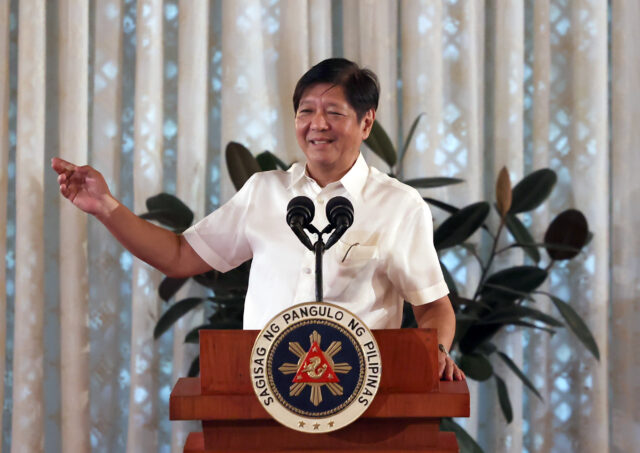
MANILA — President Ferdinand R. Marcos Jr. on Monday said talks on maritime cooperation between the Philippines and Vietnam would be one of the cornerstones forged in a strategic partnership with its Southeast Asian neighbor.

“We hope to strengthen this aspect during my visit to promote peace and stability in our region,” Mr. Marcos said in a statement before leaving for Hanoi for a two-day state visit.

Mr. Marcos is expected to meet Vietnam’s top officials and work on agreements on coastguard cooperation and rice supply. Vietnam is a major rice exporter and the Philippines is one of the world’s biggest importers of the grain.

The President said he hopes his visit would bring their relations to greater heights and “usher in a new era of friendship and cooperation”, with talks on trade, investment, education, and tourism, as well as “regional and multilateral issues of concern.”

Vietnam and the Philippines have overlapping claims in the South China Sea, but have generally friendly relations compared to the heightened tensions between Manila and Beijing over disputed waters.

Ties between the Philippines and China have deteriorated this past year, coinciding with a tougher stand by Manila and overtures by Marcos to forge stronger military relations with the United States.

The South China Sea, a conduit for more than $3 trillion in annual ship-borne commerce, is claimed almost entirely by China via a U-shaped line policed by its vast coastguard fleet, which cuts into the exclusive economic zones of Vietnam, the Philippines, Malaysia, Brunei, and Indonesia.

In 2016, the Permanent Court of Arbitration in the Hague said China’s claims had no legal basis, a decision Beijing has rejected. — Reuters

With generals barred, Myanmar junta sends bureaucrat to ASEAN meeting

FREEPIK

Military-ruled Myanmar sent a bureaucrat to Monday’s meeting of Southeast Asian foreign ministers in Laos, Indonesia’s top diplomat said, adding the move was in line with ASEAN’s policy on the conflict-torn country’s attendance.

Myanmar’s ruling generals remain barred from key meetings of the Association of Southeast Asian Nations (ASEAN) over their failure to implement a peace plan agreed with the bloc two months after a 2021 coup that unleashed chaos in the country.

ASEAN has a policy of inviting Myanmar to send what it calls a “non-political” representative instead, but the junta has in the past two years declined, furious over what it calls ASEAN interference in its internal affairs.

Indonesian Foreign Minister Retno Marsudi, in a text message to Reuters, said Myanmar’s acting permanent secretary of its foreign ministry, Malar Than Htike, was in Laos for Monday’s talks.

The information was confirmed by two other diplomatic sources.

“The point is there’s no changes in ASEAN policy,” Retno said. “Myanmar shall not affect ASEAN decision making.”

Retno last year led a behind-the-scenes effort to try to start dialogue between warring parties in Myanmar, where pro-democracy militias allied with a shadow government and ethnic minority armies have waged a rebellion against the junta.

The military government has refused to take part in dialogue with what it calls “terrorists”.

Myanmar has been locked in crisis since the 2021 coup, with at least two million people displaced by fighting and human rights groups accusing the junta of excessive use of force and widespread atrocities against civilians, which it denies. — Reuters

Malaysia ex-finance minister charged with failing to declare assets

KUALA LUMPUR — Malaysia on Monday charged a former finance minister for failing to comply with a notice to declare assets under the country’s anti-corruption laws, amid a crackdown on graft involving prominent political and business figures.

Daim Zainuddin, 85, a key ally of former Prime Minister Mahathir Mohamad, pleaded not guilty. If convicted, Daim faces a maximum jail term of five years and can be fined up to 100,000 ringgit ($21,159.54).

Daim, who served as finance minister from 1984 to 1991 and from 1999 to 2001, entered court on Monday in a wheelchair and his lawyer cited health issues when asking for bail.

Malaysian Prime Minister Anwar Ibrahim, who campaigned on a reformist platform, has vowed to tackle high-level corruption but has faced accusations of using the country’s anti-graft agency to target political rivals. Anwar has said he does not interfere in the agency’s investigations.

Daim was charged following an investigation by the Malaysian Anti-Corruption Commission (MACC) into the former minister based on information contained in the Pandora Papers – a massive leak of financial records in 2021 that revealed offshore assets held by politicians and public figures worldwide.

The MACC last month seized Ilham Tower, a 60-storey building in Malaysia’s capital Kuala Lumpur, as part of its probe into Daim.

Daim’s wife, Na’imah Abdul Khalid, was also charged in court last week for failing to disclose assets to the anti-corruption commission. She pleaded not guilty.

Daim has described the probe against him as a “political witch-hunt” led by the anti-graft agency and Anwar, who succeeded him as finance minister in 1991.

The MACC said last month it had acted independently according to the law when opening investigations against Daim in February 2023.

Anwar and Mahathir have been locked in a decades-long off-on rivalry that saw Anwar, a one-time protege of the elder statesman, jailed for charges he said were politically motivated.

Anwar was pardoned and became prime minister in 2022, after more than two decades as an opposition leader, vowing to combat corruption and focus on the economy. — Reuters

Pilots’ union reaches deal with Taiwan’s Eva Air, averting strike

STOCK PHOTO | Image by Stefan Fluck from Unsplash

TAIPEI — A pilots’ union late on Sunday reached a deal with Taiwan’s Eva Airways to avert a strike that had been threatened over the crucial Lunar New Year holiday in a dispute over salaries and working conditions.

Taoyuan Union of Pilots said last week its members had voted to authorize a strike after accusing Eva of not raising salaries enough and employing too many foreign pilots. The union, which represents mostly long-haul pilots, had raised the prospect of striking over the week-long Lunar New Year holiday starting next month.

After talks facilitated by the government, the union said it had reached a four point agreement with the airline, with Eva agreeing to raise salaries and only hire foreign pilots if there is a “special need”.

Eva, in a statement to the Taiwan stock exchange, said it had reached a “consensus” with the union and confirmed it had signed the agreement.

Eva shares rose more than 5% on Monday morning, compared with a flat broader market.

Employee salaries and benefits will continue to be improved in the future, the airline added in a separate statement.

Vice Premier Cheng Wen-tsan witnessed the signing of the agreement, Taiwan’s transport ministry said.

Eva, best known internationally for the Hello Kitty livery on some of its jets, operates flights to many destinations around Asia as well as to North America, Europe. and Australia. It is Taiwan’s second-largest carrier after China Airlines. — Reuters

Philippines and US intend to hold ‘2-plus-2’ meeting in March, envoy says

BW FILE PHOTO

MANILA – The Philippines and the United States intend to hold a “2-plus-2 meeting” of top diplomatic and defence officials in Manila in March, the Philippine ambassador to Washington said on Monday.

In a phone message, Jose Manuel G. Romualdez confirmed a Nikkei report citing sources on the discussions. He said there is an “intention” to hold a meeting, and the plan is “still a work in progress.”

US Secretary of State Antony Blinken and Secretary of Defense Lloyd Austin are expected to meet with counterparts Enrique A. Manalo and Gilberto C. Teodoro Jr. in March, the first of such dialogue in the Philippines since the format began in 2012, Nikkei reported.

Romualdez did not respond to a question on what will be the agenda of the planned meeting, which comes at a time of simmering tensions between the Philippines and China over the South China Sea.

The Philippines is a treaty ally of the United States.

There was no immediate comment from the Philippines’ defense secretary, the Philippine foreign ministry and the US State Department. A spokesperson at the US embassy in Manila said they had nothing to announce at this time.

The top foreign and defense officials of the United States and the Philippines met in Washington in April, resuming high-level dialogues after a seven-year halt that underlined moves by Philippine President Ferdinand R. Marcos Jr.’s government to reaffirm ties strained by his predecessor’s anti-US stance. — Reuters

GDP growth likely slowed in Q4 — poll

Philippine economic growth may have slowed in the fourth quarter of 2023. — PHILIPPINE STAR/WALTER BOLLOZOS

By Abigail Marie P. Yraola, Researcher

THE PHILIPPINE ECONOMY may have slowed in the fourth quarter of 2023, which likely resulted in gross domestic product (GDP) growth falling below the government’s full-year target, according to analysts.

GDP likely expanded by 5.7% in the October-to-December period in 2023, based on a median forecast of 20 economists polled by BusinessWorld, slower than the 5.9% growth in the third quarter and the 7.1% expansion in the same period in 2022.

The poll also yielded a median estimate growth of 5.5% for the full year of 2023, missing the Development Budget Coordination Committee’s 6-7% GDP growth target.
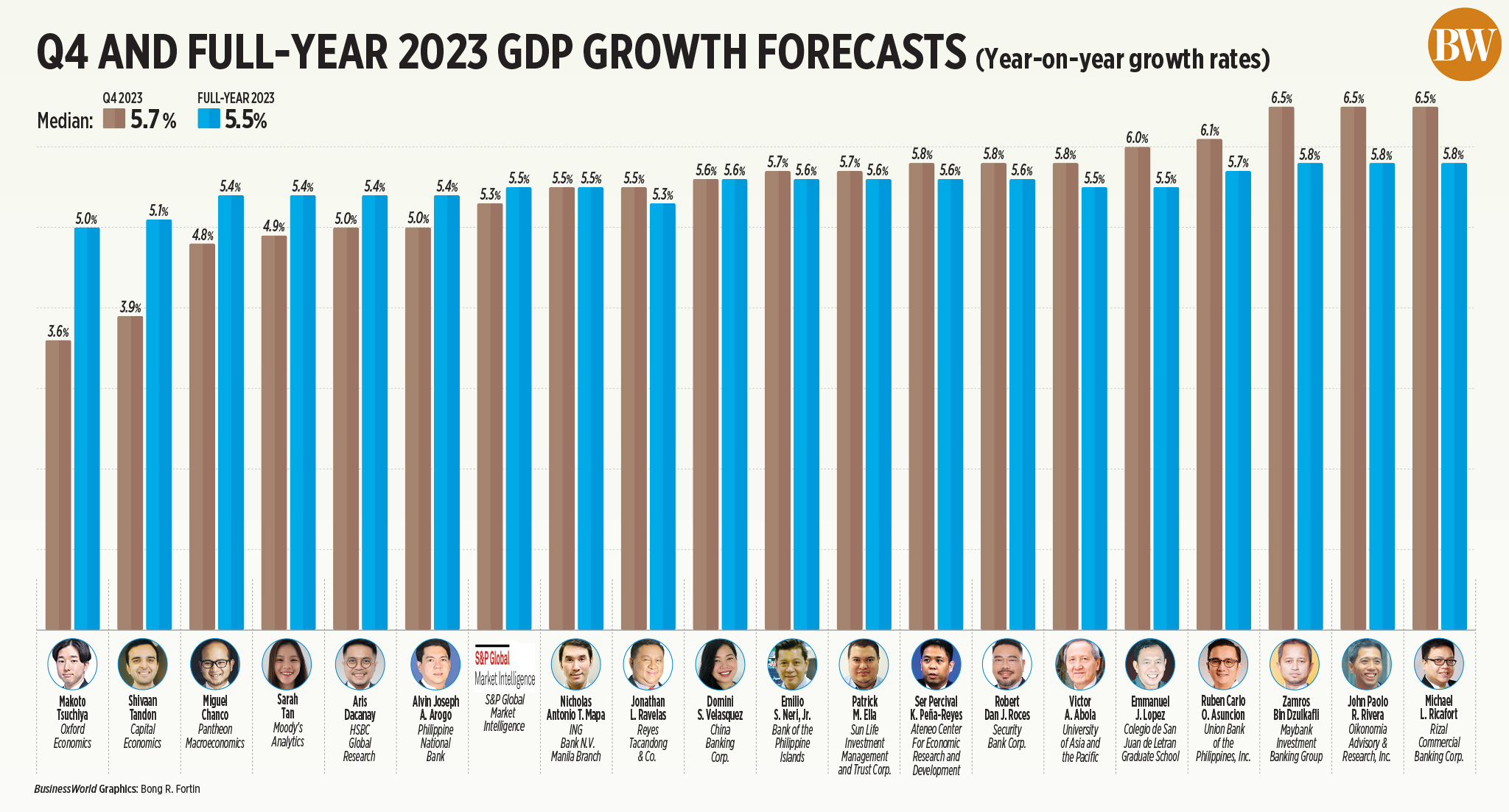
Q4 and Full-year 2023 GDP Growth Forecasts

If realized, the full-year growth estimate for 2023 would be slower than the 7.6% expansion in 2022 and the slowest since the 9.5% contraction in 2020.

The BusinessWorld poll’s 5.5% GDP median estimate for 2023 is lower than the World Bank’s estimate of 5.6% and the Asian Development Bank’s estimate of 5.7% but higher than the International Monetary Fund’s estimate of 5.3%.

The Philippine Statistics Authority (PSA) will release the fourth-quarter and full-year 2023 GDP data on Wednesday (Jan. 31).

Economists said that slower growth in the last three months of 2023 was primarily due to reduced domestic demand and consumer spending.

“The slowdown from the previous quarter was likely due to lower consumer spending and export growth,” Makoto Tsuchiya, economist at Oxford Economics said.

He noted the pent-up demand in certain service sectors is fading, while soft global growth and maturing recovery in the tourism sector led to an export slowdown.

For Zamros Bin Dzulkafli, economist at Maybank Investment Banking Group, the fourth-quarter GDP growth was driven by domestic demand due to ongoing infrastructure projects, a pickup in government spending, and low unemployment rate.

HSBC ASEAN (Association of Southeast Asian Nations) economist Aris Dacanay said that the country is still exposed to a slump in global demand but is expected to be among the fastest-growing economies in the region even with risks tilted to the upside, thanks to the robust and resilient labor force.

In the third quarter of 2023, GDP expanded by 5.9%, due to the pickup in government spending which ended three straight quarters of slowing growth.

Meanwhile, merchandise exports dropped by 0.5% to $5.78 billion in December, slower than the 7.5% decline in December 2022. This resulted in exports contracting by 7.6% to $73.52 billion in 2023.

Similarly, imports fell by 5.1% to $9.79 billion in December, bringing the full-year import haul down by 8.2% to $125.95 billion.

This brought the full-year trade deficit to $52.42 billion from the $57.65-billion gap in 2022, narrowing by 9.1%.

Meanwhile, latest PSA data showed that the unemployment rate slipped to 3.6% in November 2023. This marked the lowest rate of unemployment since April 2005, when the statistics agency revised its definition of unemployment to refer to people aged 15 years and older, who do not have a job, are available for work, and are actively seeking employment.

In November, the number of unemployed Filipinos decreased by 12.3% or 257,000 to 1.83 million from 2.09 million in October 2023.

“We believe that the unhealthy rise in consumer prices and a sharp increase in interest rates weighed down household spending and fixed capital formation,” Alvin Joseph A. Arogo, economist at Philippine National Bank, said in an e-mail.

He also added that government spending and reduced imports cannot sustainably drive a strong rate of economic expansion due to fiscal constraints.

Headline inflation slowed to 3.9% in December bringing the full-year 2023 average to 6%, the highest reading since the 8.2% posted in 2008.

Meanwhile, the central bank kept its benchmark interest rate at a 16-year high of 6.5% in its latest policy meeting. The central bank hiked interest rates by a cumulative of 450 basis points between May 2022 and October 2023 in its efforts to tame inflation.

Due to broad-based weakness, the Philippine economy slowed from the third quarter, said Shivaan Tandon, economist at Capital Economics.

“Admittedly, price pressures eased in the last quarter, which will have supported real incomes. But this is likely to have been partially offset by other factors… Elevated interest rates are also likely to have weighed on domestic demand,” he said in an e-mail exchange.

Sarah Tan, an economist from Moody’s Analytics, said the economy likely expanded by 4.9% in the fourth quarter, supported by the improvement in private consumption due to easing inflation, a tight labor market, and robust remittances.

She added that government agencies ramped up spending by yearend, while a softening global economy likely moderated private investment and trade.

Cash remittances coursed through banks during the January-to-November period grew by 2.8% to $30.211 billion, falling below the Bangko Sentral ng Pilipinas’ (BSP) remittance growth projection of 3% for 2023.

GLOBAL SLOWDOWN
In 2023, Ms. Tan said monetary tightening and the global economic slowdown impacted the Philippine economy.

“High borrowing costs kept Philippine households and businesses cautious in their spending through 2023, capping private consumption and investment growth,” she added.

Miguel Chanco, chief emerging Asia economist at Pantheon Macroeconomics, said that the economy seems to have suffered a general reduction in domestic demand in the fourth quarter, but this may have been offset by a boost in net trade due to a pullback in imports.

He also added that external developments impacted exports, but the main concern was the slowdown in private consumption growth throughout the entire year.

“Monetary policy affects the economy with a lag, and the BSP’s overly aggressive rate hiking cycle, in our view, will continue to depress domestic demand this year, as it did in the last 12 months,” he said.

For Nicholas Antonio T. Mapa, senior economist at ING Bank N.V. Manila, the economy is less reliant on global developments and more driven by domestic factors. He noted GDP could have expanded at a faster pace if the BSP had not hiked interest rates aggressively.

This could have also resulted in a negligible and negative contribution from capital formation during the second and third quarters of 2023.

Gross capital formation — the investment component of the economy — fell by 1.6% in the third quarter of 2023, ending nine straight quarters of growth.

OUTLOOK
For this year, economists expect slower economic growth due to the global slowdown, decelerating inflation, and declining interest rates, among others.

Economic managers target GDP growth to settle within 6.5%-7.5% in 2024.

“We think most of the headwinds will likely persist into 2024. Particularly, the impact of past monetary tightening will continue to weigh on domestic demand even if the BSP pivots to rate cuts during the year, as monetary policy works with lags,” Oxford Economics’ Mr. Tsuchiya said.

He also added that the global economic slowdown will weigh on external demand.

Maybank’s Mr. Dzulkafli said he expects slower growth in the first quarter of 2024 due to elevated food inflation, high-interest rates, and global uncertainty. However, growth is expected to pick up in the second half of the year as the central bank is seen to start cutting policy interest rates.

Ser Percival K. Peña-Reyes, director of the Ateneo Center for Economic Research and Development, said he has a cautious outlook for 2024, adding the economy’s performance would depend on the ability to attract investments.

Domini S. Velasquez, chief economist at China Banking Corp., said that the economy will improve in 2024 due to slowing inflation, monetary easing in the second half of the year, and an increased government budget.

“However, we note that the economy would still have to contend with headwinds such as a global economic slowdown and heightened geopolitical tensions,” she added.

Diwa Guinigundo, Philippines analyst at GlobalSource Partners said that there are still risks to economic growth this year, adding that if geopolitical tensions persist, supply chains may not be mitigated while the drift towards geo-economic fragmentation could weaken international trade.

Resource-wise, he said that the current level of public debt could cause a diversion of public funds from the provision of infrastructure and social services to debt servicing.


BSP says ready to hike rates if Q4 growth remained ‘strong’

BANGKO SENTRAL ng Pilipinas Governor Eli M. Remolona, Jr. — COURTESY OF BANGKO SENTRAL NG PILIPINAS

By Keisha B. Ta-asan, Reporter

THE BANGKO SEntral ng Pilipinas (BSP) is ready to deliver more policy rate hikes this year if economic growth picked up in the last quarter of 2023, its governor said on Friday.

BSP Governor Eli M. Remolona, Jr. said fourth-quarter gross domestic product (GDP) may be higher than the 5.9% growth in the third quarter.

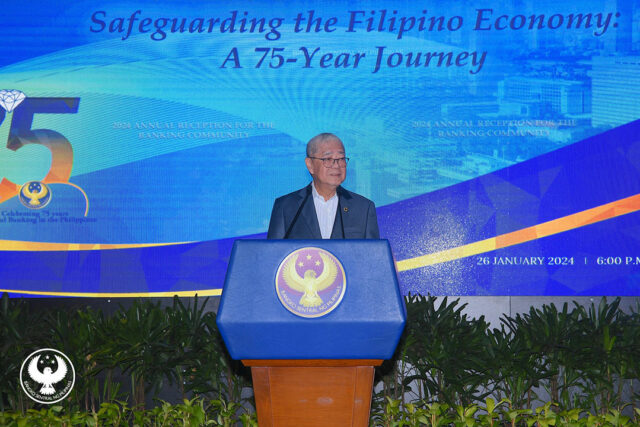
“If the growth is strong, that gives us a bit more room to hike,” he told reporters on the sidelines of the 2024 Annual Reception for the Banking Community.

Mr. Remolona said the Philippine central bank is still hawkish despite easing inflation and talks about rate cuts this year.

He noted the Philippine economy could still take on further monetary policy tightening by the BSP.

“But the natural rate, we estimate… is very imprecise. Which means, we could hike and it’s still okay, but we’re not sure because it’s an imprecise (estimate),” he said.

However, gross domestic product (GDP) growth may have slowed down in the fourth quarter of 2023, as a BusinessWorld poll of 20 economists yielded a median forecast of 5.7%.

If realized, this would be slower than the 5.9% growth in the third quarter and the 7.1% expansion in the same period in 2022.

The BusinessWorld poll also yielded a median estimate of 5.5% GDP growth for the entire 2023, missing the Development Budget Coordination Committee’s 6-7% full-year target. This is slower than the 7.6% expansion in 2022 and the slowest since the 9.5% contraction in 2020.

The Philippine Statistics Authority (PSA) will release the fourth-quarter and full-year 2023 GDP data on Jan. 31.

Meanwhile, Mr. Remolona said that a rate cut is possible this year amid easing inflation.

“Yes, it’s possible within the year. But maybe the first semester is too soon. We’ll see,” he said in mixed English and Filipino.

He also noted that inflation will continue to be low in January due to base effects, but inflation may still pick up in the second quarter of this year.   

Based on PSA data, headline inflation eased to a 22-month low of 3.9% in December from 4.1% in November. It marked the first time that inflation eased within the BSP’s 2-4% target after 20 straight months, from a peak of 8.7% in January 2023.

For the full-year, inflation accelerated to 6% in 2023 from 5.8% in 2022. It breached the 2-4% target band for the second straight year amid soaring food and oil prices.

Finance Secretary Ralph G. Recto said borrowing costs may go down this year in the Philippines and in the United States but “nothing is set in stone.”

“We expect interest rates to go down in the second half, but that will depend on the external environment. So far, the market consensus is inflation and interest rates will go down globally, in the US, and in the Philippines,” he said in mixed English and Filipino.

Mr. Recto said policy rate cuts would not only lower the government’s borrowing costs, but it would also be easier for investments to come into the country.

The newly appointed finance chief took his oath as a member of the Monetary Board last week, representing President Ferdinand R. Marcos, Jr.’s Cabinet at the BSP’s highest policy-making body.

The central bank also said the full impact of the Monetary Board’s aggressive tightening may be felt this year, but authorities are still ready to adjust borrowing costs if necessary.

In an open letter to Mr. Marcos, Mr. Remolona said the BSP paused its tightening in the second half last year due to the slowdown in headline and core inflation.

However, when prices and inflation expectations picked up, the BSP responded with an off-cycle rate hike in October 2023. Since then, the Monetary Board has held fire and kept borrowing costs steady.

“The pause in policy interest rate adjustments has allowed the BSP to further observe and assess how firms and households continue to respond to tighter monetary policy conditions, as lagged effects of prior policy interest rate adjustments are expected to manifest fully in 2024,” he said.

The central bank’s key interest rate currently stands at 6.5%, the highest in 16 years. This was after the BSP emerged as the most aggressive central bank in the region after raising key policy rates by 450 basis points (bps) from May 2022 to October 2023.

Mr. Remolona said inflation may settle within the 2-4% of the government in 2024 and 2025, as shown by the central bank’s baseline forecast. The central bank sees inflation averaging 3.7% this year and 3.2% in 2025.

“However, the balance of risks to the inflation outlook continues to be significantly skewed towards the upside for 2024 and 2025,” he said.

The BSP chief said higher transport fares, increased electricity rates, upticks in oil and food prices due to supply constraints, and the impact of a strong El Niño weather event until the second quarter this year are upside risks to the inflation outlook.

“Should these risks materialize, the BSP’s risk-adjusted forecasts indicate that inflation could settle above target at 4.2% in 2024 before reverting towards the target band at 3.4% in 2025,” he said.

Thus, it is crucial for the government to implement non-monetary measures given the upside risks to food and transport prices, Mr. Remolona said.

“On the part of the BSP, we stand ready to adjust monetary policy settings as necessary to mitigate second-round effects and better anchor inflation expectations, as we continue to prioritize safeguarding price stability in line with our primary mandate,” he added.

The BSP will hold its first policy meeting this year on Feb. 15.

Charter change needs to be limited to just economic provisions — NEDA secretary

BUILDINGS at the Makati central business district are seen in this file photo. — PHILIPPINE STAR/ MIGUEL DE GUZMAN

By Luisa Maria Jacinta C. Jocson, Reporter

NATIONAL ECONOMIC and Development Authority (NEDA) Secretary Arsenio M. Balisacan said that he would prefer that any amendments to the Constitution only be restricted to its economic provisions.

“All these economic restrictions in the Constitution, especially with all these major developments in the region, there are so many other places to go for investment. You can go to Thailand, Indonesia, Vietnam, or Cambodia,” Mr. Balisacan told reporters on the sidelines of the Bangko Sentral ng Pilipinas’ (BSP) 2024 Annual Reception for the Banking Community on Friday.

“If you don’t fix or make our country open to investment, they won’t come to us. We need all these investments,” he added.

Asked if he would prefer limiting the amendments to just the economic provisions, Mr. Balisacan said: “That’s what we’ve been saying. It has to be. Otherwise, you may create more uncertainty. At least the economic provisions, you know what’s in there.”

President Ferdinand R. Marcos, Jr. last week said he supports proposals to amend the economic provisions of the 1987 Constitution, which he said was “not written for a globalized world.”

However, he was not in favor of allowing full foreign ownership of land, media and power generation.

Mr. Balisacan said that opening up the economy will further encourage competition and benefit the public.

“We really need to put competitive pressure on the economy so that efficiency can improve, quality of goods and services can improve, prices are contained at competitive levels… That’s what we don’t get if we have so much concentration on just a few hands,” he said.

“They also bring in new technologies, new ways of doing things. We need those kinds of externalities in the economy. There are many benefits of being open, not just growth in the short term. It creates dynamics,” he added.

The government has been implementing reforms to further open up sectors of the economy. In 2022, it amended the 85-year-old Public Service Act (PSA) to allow full foreign ownership in telecommunications, domestic shipping, railways and subways, airlines, expressways and tollways, and airports.

“As far as the economy is concerned, we need to open the economy, whether by constitutional amendments or other means, but that can only go so far with other laws,” Mr. Balisacan said.

Mr. Balisacan said that one sector that can be opened to foreign ownership is education to boost the quality of learning, research, and innovation.

Last week, senators issued a statement opposing a proposal for both chambers of Congress to vote jointly to revise the Constitution.

The Constitution may be amended either through a constitutional convention composed of delegates, by Congress sitting as a constituent assembly or through a people’s initiative.

GROWTH PROSPECTS
Meanwhile, Mr. Balisacan said that he is “hopeful” that gross domestic product (GDP) growth in the last quarter of 2023 will outperform economic growth in the third quarter.

“I haven’t seen the numbers, but I hope it will be good, because our leading indicators are good, like our labor market (figures),” he said.

A BusinessWorld poll of 20 economists showed that GDP likely expanded by 5.7% in the fourth quarter. If realized, this would be slower than the 5.9% growth in the third quarter and the 7.1% expansion in the same period in 2022.

The economy grew by 5.5% in the nine-month period. To meet the lower end of the government’s 6-7% goal for 2023, GDP would need to grow by 7.2% in the fourth quarter.

Fourth-quarter and full-year 2023 GDP data is set to be released on Jan. 31.

Mr. Balisacan also said economic growth will be driven by easing inflation.

“(The economy) is largely domestic… I think despite the high inflation, domestic spending is quite robust. Of course, it could have been much better if inflation had declined faster than what we’ve seen. The fact that inflation is seen to continue to decline should give confidence to our people,” he added.

Inflation eased to 3.9% in December, the lowest print in 22 months.

Last year, inflation averaged 6%. This marked the second straight year that inflation breached the central bank’s 2-4% target.

PPP PROJECTS
Meanwhile, Mr. Balisacan said that the NEDA is studying the possibility of a public-private partnership (PPP) to help finance the Bataan-Cavite Interlink Bridge project.

“We would want to see the Bataan-Cavite bridge eventually as a PPP. If it’s profitable, it may be attractive for the private sector,” he said.

The private sector may take on the operations and management of the bridge and eventually buy the project’s debt, Mr. Balisacan said.

“If it’s profitable enough, even the debt can be transferred to the private sector so they can continue servicing the debt, pay back the government, those kinds of things,” he added.

Last month, the Asian Development Bank (ADB) approved up to $2.1 billion in financing for the bridge, which will link the provinces of Bataan and Cavite across Manila Bay.

The project involves the construction of a 32.15-kilometer (km) “climate resilient” bridge, 24 km of marine viaducts and eight kilometers of approach road.

Mr. Balisacan said that NEDA is also hoping to push for airport PPP projects.

“The only one been approved for Swiss challenge is Laguindingan…if we do well in the Laguindingan airport, that would be a good window for doing the other airports. We have so many other projects that are candidate for PPPs,” he said.

At a Palace briefing on Friday, Mr. Balisacan announced that the NEDA Board approved the negotiated parameters, terms, and conditions of the upgrade, expansion, operations, and maintenance of the Laguindingan International Airport Project in Northern Mindanao.

The project will now undergo the comparative challenge process following the recently enacted PPP Code.

“Prospective challengers will be given 90 days from the publication of the invitation for comparative proposals to submit their proposals. The original proponent will be given 30 calendar days to match responsive comparative proposals. If no comparative proposals are received, the project shall be awarded to the original proponent by May 2024,” Mr. Balisacan said.

DTI invites creative startups to jump-start businesses with IDEA, ADVanCE programs

The programs and services of the Marikina Creative and Innovation Hub were officially unveiled during the launch event held last Dec. 4 at the Center for Innovation and Technology for Enterprises (CITE), Marikina City. Introduced as well during the launch was the 2nd cohort of DTI’s IDEA Program and ADVanCE Program. Present during the event were (seated, from L-R) Dir. Lilian Salonga, DTI-CIG; Usec. Rafaelita Aldaba, DTI-CIG; Congresswoman Stella Quimbo, Marikina City, 2nd District Representative; OIC Regional Director Ma. Sofia Narag, DTI-NCRO; and Vishal Aditya Potluri, social sector specialist, Asian Development Bank; (standing, from left) ED Maria Rita Matute, DCP; DED Lucky Lopez, DCP; OIC Asst. RD Revelyn Cortez, DTI Region IV-A; Aurelien Chu, co-founder, Eskwelabs; Bing Icamina, team leader, Certeza + Techno Earth JV; Asst. Sec. Domingo Tolentino, Jr., DTI-ROG; Jojo Flores, co-founder Plug and Play Tech Center; Jay Fajardo, CEO Launchgarage; Jundio Salvador, president of PCCI-New Marikina; Roger Py, Jr., PFFI; Sam Ang, consultant, ADB; and Engr. Liza Lopez.

The Department of Trade and Industry (DTI), through the Competitiveness and Innovation Group (CIG), is looking for creative startup companies to onboard to its two programs designed to support and strengthen the creative industries in the Philippines.

The DTI-CIG, led by Undersecretary Rafaelita M. Aldaba, in partnership with startup accelerator Launchgarage, has launched the creatives edition of the Incubation, Development, and Entrepreneurial Assistance (IDEA) and Accelerating Development, Valuation, and Corporate Entrepreneurship (ADVanCE) programs aimed at providing customized support to creative startups in the Philippines to help them become market- and investment-ready.

“The programs are a testament to the Philippine government’s belief in the immense potential of Filipino creativity and entrepreneurship. By providing the much-needed support and platform, we are setting the stage for creative startups to not only thrive locally but also make a significant impact on the global stage. The creative sector is a vital component of our economy and cultural identity, and through initiatives like these, we aim to foster an environment where ideas can flourish, talents are honed, and success stories are born,” Ms. Aldaba said.

The Philippine creative industries play a significant role in the national economy. Data from the Philippine Statistics Authority (PSA) revealed the creative economy amounted to P1.60 trillion in 2022, contributing 7.3% to the country’s gross domestic product (GDP). Furthermore, the sector was responsible for employing almost 7 million Filipinos that year.

The IDEA for Creatives edition will onboard 10 early-stage creative startups and enterprises to support and enhance their entrepreneurial capacity and readiness. Under the program, selected startups will participate in various educational workshops aimed at transforming their inventive business concepts into successful enterprises. Each will be paired with experienced mentors and coaches to guide them in their startup journey.

The program culminates with a showcase event, where startups can present their ventures to program stakeholders, angel investors, venture capitalists, corporate representatives, and key figures in the ecosystem.

Early-stage startups that are operating in the Philippines with a minimum viable product, registered or in the process of registration to the Securities and Exchange Commission (SEC) or DTI, with 60% of its founders Filipino, and with at least two founders committed to the IDEA program, are eligible to apply.

Meanwhile, an initial pool of 10-15 startups will be chosen to participate in the ADVanCE for Creatives. After the preliminary screening, they will be assessed based on organizational capacity, business maturity, and readiness levels. From there, five participating startups will be selected to proceed to the acceleration phase and undergo intensive training based on the specific interventions identified from the needs assessment.

To be eligible, startups should be in their growth and expansion stage and are based in the country with at least two years of operations with revenue, SEC or DTI-registered, with 60% of its founders Filipino, and with at least two founders committed to the ADVanCE program.

DTI welcomes all creative startups within the domains of audiovisual media, digital interactive media, creative services, design, publishing and printed media, performing arts, visual arts, traditional cultural expressions, and cultural sites to apply to the programs.

“We call on all eligible creative startups to seize this unparalleled opportunity. Join us in this endeavor to transform your innovative ideas into successful enterprises and become part of a movement that celebrates and elevates Filipino talent and ingenuity,” Ms. Aldaba shares.

The IDEA and ADVanCE programs are aligned with Republic Act 11337, or the Innovative Startup Act, aimed at providing benefits and programs to strengthen, promote, and develop the Philippine startup ecosystem. Their latest cohorts will focus on the creative industries in accordance with Republic Act No. 11904 or the Philippine Creative Industries Development Act (PCIDA), which mandates the development of a vibrant and globally competitive Philippine creative sector by protecting and enhancing their rights and boosting economic capacities.

The application period is until Jan. 31. To know more about the programs and submit applications, interested parties can visit the official websites of the IDEA program-creatives edition (https://bit.ly/IDEAforCreatives) and the ADVanCE program (https://bit.ly/ADVANCEforCreatives), as well as the DTI-CIG Facebook page.

ADVERTISEMENT
ADVERTISEMENT