Home Blog Page 3710

Central bank sees 2.8-3.6% inflation in January

Fuel retailers implemented another round of pump price hikes on Tuesday. -- Photo by EDD GUMBAN/PHOTO

By Keisha B. Ta-asan, Reporter

HEADLINE INFLATION may have settled within 2.8-3.6% in January due to lower vegetable and sugar prices, the Bangko Sentral ng Pilipinas (BSP) said on Wednesday.

The BSP’s month-ahead forecast shows that inflation likely further eased from the 22-month low of 3.9% in December and 8.7% in January 2023.

The lower end of the forecast or 2.8% could be the slowest since 2.3% in October 2020 amid the coronavirus pandemic.

January would also mark the second straight month that inflation would settle within the BSP’s 2-4% target.

The Philippine Statistics Authority will report January inflation data on Feb. 6.

“Higher prices of some agricultural items like rice, meat, fruits and fish, along with increased petroleum prices, electricity and water rates, annual adjustment in sin taxes, and the depreciation of the peso are the primary sources of upward price pressures for the month,” the BSP said.

Data from the Department of Agriculture showed that as of Jan. 31, prices of regular milled rice had risen to as much as P53 per kilo from P52 on Dec. 29.

Fuel retailers implemented price hikes in January. For the month, pump price adjustments stood at a net increase of P4.40 a liter for gasoline, P2.90 a liter for diesel and P0.85 a liter for kerosene.

Manila Electric Co. (Meralco) earlier said the rate for a typical household went up by P0.6232 to P10.9001 per kilowatt-hour (kWh) in January.

Metro Manila’s two main water concessionaires also began implementing higher rates in January. Manila Water Co. raised rates by P6.41 per cubic meter, while Maynilad Water Services, Inc. hiked rates by P7.87 per cubic me-ter.

The peso also weakened to the P56-a-dollar mark in January, closing the month at P56.275 on Wednesday, down by 90.5 centavos or 1.6% from its P55.37 finish on Dec. 29, 2023.

“Lower prices of vegetables and sugar could contribute to downward price pressures,” the BSP said.

The central bank said it would continue to monitor developments that could affect the inflation and growth outlook.

Makoto Tsuchiya, an economist at Oxford Economics Japan, said inflation might have hit 2.5% in January due to favorable base effects despite price pressures from some commodity items.

“The sequential pickup among food items will likely remain manageable, although daily prices suggest there might be a scope for a further pickup in the coming months given weather-related disruptions,” he said in an e-mail.

Market players are concerned with how El Niño would affect food prices. The phenomenon, which affects local agricultural production, is expected to last until the second quarter of the year, according to the state weather bureau.

Mr. Tsuchiya said the BSP might start cutting policy rates in the second quarter despite easing inflation.

“Just as January inflation is suppressed by favorable base effects, we expect the year-on-year inflation rate to pick up in the second quarter as the base effects turn less favorable,” he said.

Last year, inflation peaked at 8.7% in January before it gradually slowed to 4.7% in July. Inflation picked up again in the third quarter before easing back to the 2-4% target in December.

Full-year inflation stood at 6% in 2023, up from 5.8% in 2022 and breaching the BSP’s 2-4% target for the second straight year.

“That said, we think the inflation rate will remain within the BSP’s target, and our expectation for the US Fed to start cutting in the second quarter should also boost the bank’s confidence in easing monetary policy,” Mr. Tsuchiya added.

BSP Governor Eli M. Remolona, Jr. earlier said the Monetary Board might cut borrowing costs this year, but policy easing in the first half may be too soon amid risks to the inflation outlook.

The Monetary Board hiked key policy rates by 450 basis points (bps) from May 2022 to October 2023 to tame inflation and stabilize the peso, making it the most aggressive central bank in the region.

After raising the policy interest rate by 350 bps in 2022, the BSP increased the target reverse repurchase rate by another 100 bps throughout 2023. This brought the key rate to 6.5%, the highest in 16 years.

The BSP’s risk-adjusted inflation forecast is at 4.2% this year and 3.4% for 2025. Meanwhile, its average inflation baseline forecast is at 3.7% for 2024 and 3.2% for next year.

The BSP is scheduled to have its first policy review of the year on Feb. 15.

2023 debt-to-GDP ratio ends at 60.2%

BW FILE PHOTO

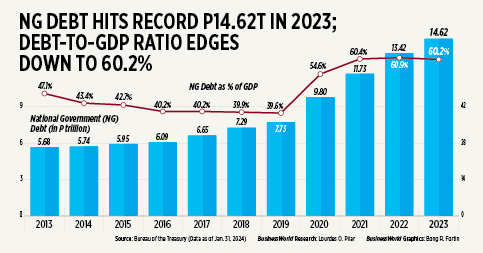
THE National Government’s (NG) outstanding debt as a share of gross domestic product (GDP) further eased to 60.2% at the end of 2023, the Bureau of the Treasury (BTr) said.

Treasury data showed that the NG’s outstanding debt hit a record P14.62 trillion as of end-2023, 8.92% or P1.2 trillion higher than a year earlier.

The ratio was lower than 60.9% at the end of 2022. It was also below the 61.2% target under the government’s Medium-Term Fiscal Framework.

However, it was still slightly above the 60% threshold considered by multilateral lenders to be manageable for developing economies.

“Our debt right now remains at a very manageable level, and we are on track to bringing down the debt-to-GDP ratio to less than 60% by 2025. We have a sound and prudent strategy in place to effectively manage our debt and financ-ing requirements,” Finance Secretary Ralph G. Recto said in a statement.

Data from the BTr showed the bulk or 68.5% of the debt portfolio came from domestic sources, while the remaining 31.5% was from foreign creditors.

Domestic debt rose by 8.79% to P10.02 trillion as of end-December from P9.21 trillion in 2022. It slipped by 0.06% from the previous month due to the net redemption of government securities.

The domestic borrowing mix was composed almost entirely of government debt.

“Gross issuance of domestic debt in December 2023 totaled P29.69 billion, while principal payments amounted to P36.08 billion, resulting in a net repayment of P6.39 billion,” the BTr said.

“Meanwhile, the effect of local currency appreciation against the US dollar on debt stock valuation further trimmed P0.09 billion from the December total,” it added.

Data from the Treasury showed that the peso closed at P55.418 at end-December, appreciating by 0.71% from the P55.815 close at end-December 2022.

Meanwhile, foreign borrowings jumped by 9.21% to P4.6 trillion from P4.21 trillion in 2022. Month on month, it went up by 2.54% from P4.48 trillion.

The BTr said the increase was due to the net availment of foreign debt worth P88.4 billion, including the administration’s maiden Sukuk bond and the disbursement of program loans worth $300 million from the Asian Develop-ment Bank (ADB).

External debt consisted of P2.48 trillion in global bonds and P2.11 trillion in loans.

Last year, the Philippine government raised $3 billion from its dollar bond issuance in January; $1.26 billion from its retail dollar bond offering in October; and $1 billion from the Sukuk bond issuance in December.

“Furthermore, the impact of third-currency adjustments against the US dollar added P28.45 billion, which was slightly offset by the P2.67-billion effect of peso appreciation against the US dollar,” the BTr added.

As of end-December, the NG’s overall guaranteed obligations inched lower by 1.05% to P349.44 billion from P353.14 billion in end-November.

Year on year, guaranteed debt fell by 12.43%.

ING Bank N.V. Manila Senior Economist Nicholas Antonio T. Mapa said while the debt-to-GDP ratio is on a steady decline, there is still a need to further bring down the ratio. The debt-to-GDP ratio was 39.6% in 2019.

“The direction is welcome, but we hope the pace of consolation can improve given that we are a good year out from the lockdowns,” he said in a Viber message. “As long as we stay at these levels, we remain susceptible to potential rating actions should growth slow considerably.”

Union Bank of the Philippines, Inc. Chief Economist Ruben Carlo O. Asuncion said the government has been ramping up its fiscal consolidation efforts.

“I think they have really prioritized debt and deficit management in the last few months of 2023. There was a catch-up plan for spending, but NG spending was hardly felt in fourth-quarter GDP as we have seen,” he said in a Viber message.

The Philippine economy grew by 5.6% in last quarter, bringing the full-year average to 5.6%. Government spending contracted by 1.8%.

“My thinking is that they will continue to consolidate and not set out to sacrifice the future. We should expect more of this in 2024 and they will carefully tread the fiscal landscape (with no new taxes, as asserted by the new DoF secretary) making sure that we maintain our sovereign credit ratings as we move forward,” Mr. Asuncion added.

Under the Medium-Term Fiscal Framework, the government is targeting to bring down its debt-to-GDP ratio to 60% this year.

According to the Budget of Expenditures and Sources of Financing, NG outstanding debt is expected to reach a record P15.84 trillion this year.

This year, the NG’s borrowing plan is set at P2.46 trillion. Broken down, this is composed of P1.85 trillion in domestic borrowings and P606.85 billion from external sources. — Luisa Maria Jacinta C. Jocson

Asian economies ‘on track’ to fuel global growth — IMF

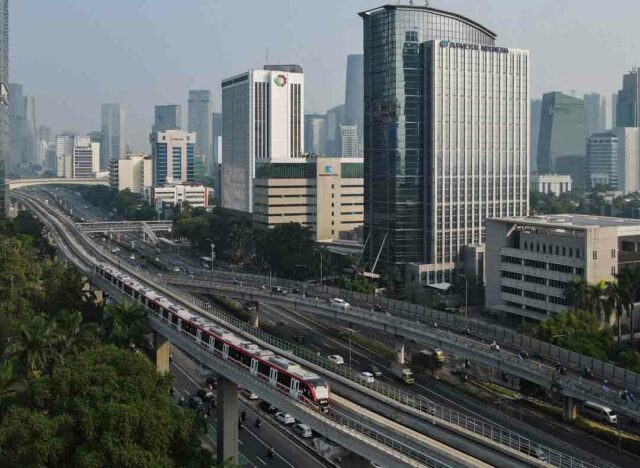
A view shows the Light Rail Transit (LRT) train in Jakarta, Indonesia, Aug. 23, 2023. -- REUTERS/Willy Kurniawan

ECONOMIES in the Asia region are expected to continue contributing significantly to global growth, as Asian central banks loosen monetary policy later this year amid easing inflation, the International Monetary Fund (IMF) said.

Krishna Srinivasan, director of the IMF’s Asia and Pacific Department, said the multilateral lender now expects Asia to grow by 4.5% this year, up from 4.2% projected in October.

“Overall, Asia is on track to deliver again two-thirds to global growth in 2024, as it did in 2023,” he said at a news conference on Wednesday.

For 2023, the IMF said Asia is projected to have expanded by 4.7%, slightly faster than its previous forecast of 4.6% amid higher-than-expected economic activity in China and India.

Average inflation in the region also fell to 2.6% in 2023 from 3.8% in 2022, Mr. Srinivasan said, noting there is swift progress particularly in emerging economies.

“Many regional central banks are on course to reach their inflation targets in 2024. Provided policy makers hold steady until inflation is firmly re-anchored, the scope for monetary easing may emerge later in the year,” he said.

However, growth in the region may ease to 4.3% in 2025 as the Chinese economy is largely expected to slow down, he said.

Meanwhile, IMF Regional Office for Asia and the Pacific Director Akihiko Yoshida said the Philippine economy would likely rebound in 2024 from the slowdown in 2023.

“We expected growth in the Philippines to bottom out in 2023 before bouncing back to 6% in 2024,” he said at the news briefing.

The Philippine economy grew 5.6% in 2023, falling short of the 6-7% full-year target as exports and state spending declined, Philippine Statistics Authority data showed.

Gross domestic product (GDP) in 2023 was slower than 7.6% in 2022. However, this was a tad higher than the 5.5% median estimate of 20 economists in a BusinessWorld poll last week.

The IMF said on Tuesday it had raised its GDP growth outlook for the Philippines to 6% this year from the 5.9% forecast it gave in October due to a likely stronger recovery in investments and exports.

“While the outlook for the Philippine economy is favorable, risks to the near-term growth outlook is tilted to the downside due to persistently high inflation necessitating the further tightening of monetary policy, weaker global economic growth, intensification of geoeconomic fragmentation, and tighter financial global conditions,” Mr. Yoshida said.

Even though price pressures dissipated in recent months, he noted that Philippine inflation might only approach the midpoint of the central bank’s 2-4% target in the second half.

“The risks to the inflation outlook are tilted to the upside, reflecting risks of food price surges, and potential second-round effects,” he said.

RISKS TO OUTLOOK

Mr. Srinivasan said though the outlook has improved for the region, the financial situation is still volatile, as tighter-than-expected conditions in the United States or in Asia could put pressure on industries and economies with large debt.

Differing monetary policy moves in the US and in Asia could also trigger sharp exchange rate movements this year, which could lead to depreciation pressures for currencies in the region, the IMF official said.

“If so, central banks should avoid being distracted by temporary turbulence and focus firmly on price stability,” he said.

He also cited other risks such as a more “drawn-out correction” in China’s property sector, which could reduce demand for the regions’ export.

He added that rising risks of geopolitical fragmentation could affect the region’s global trade integration.

“We already see evidence of negative effects in the form of longer and less efficient supply chains. The threat of higher shipping costs reinforces risks to trade,” Mr. Srinivasan said. — Keisha B. Ta-asan

Aboitiz group, partner get PCC nod for $1.8-B Coca-Cola PHL acquisition

THE ABOITIZ group and its partner Coca-Cola Europacific Partners plc (CCEP) have received approval from the Philippine Competition Commission (PCC) to jointly acquire soft drinks giant Coca-Cola Beverages Philippines, Inc. for $1.8 billion, the group’s holding company Aboitiz Equity Ventures, Inc. (AEV) said on Wednesday.

The PCC approved the transaction on Jan. 25, the listed holding company said in a disclosure to the stock exchange.

Aboitiz Equity Ventures will have a 40% beneficial ownership in Coca-Cola Beverages Philippines, while CCEP will hold a 60% stake, the company also said.

Coca-Cola Beverages Philippines serves as the exclusive bottler and distributor of the products of US-based multinational corporation The Coca-Cola Co.

CCEP Aboitiz Beverages Philippines, Inc., incorporated in December, will acquire 100% of the share capital of Coca-Cola Beverages Philippines, according to the Aboitiz company.

Aboitiz Equity Ventures said that the Coca-Cola company in the Philippines “benefits from attractive profitability and growth prospects.”

The transaction, the Aboitiz company said, aligns with its portfolio diversification strategy to enter the branded consumer goods spaces.

“The parties expect to close the transaction towards the end of February 2024 after receipt of the PCC approval and upon completion of the remaining conditions,” it added.

The transaction was “based on an enterprise value of $1.8 billion on a cash-free, debt-free basis which was arrived on a willing buyer, willing seller basis,” the company also said.

Aboitiz Equity Ventures and CCEP, which is engaged in consumer goods manufacturing, selling, and distributing an extensive range of primarily non-alcoholic ready-to-drink beverages, will acquire, through the holding com-pany, 2,447,956,683 shares of class A common stock with a par value of P2 and 1,000 shares of class B common stock with a par value of P1.

In the first nine months of 2023, AEV reported a 16% drop in its net income dropped 16% to P18 billion from P21.4 billion in 2022.

Shares of AEV rose by 55 centavos or 1.15% to P48.50 apiece on Wednesday. — Revin Mikhael D. Ochave

Rockwell Land eyes P5-billion loan for capex

ROCKWELL Land Corp.’s board has greenlit a P5-billion term loan facility as part of a plan to finance the company’s capital expenditures (capex), the Lopez-led company said on Wednesday.

In a regulatory filing, the property developer said that the loan facility, with a term of up to seven years, is with Metropolitan Bank & Trust Co.

“The proceeds of the loan will be used to fund capital expenditures, land acquisitions, and other investments,” Rockwell Land said.

Rockwell Land is the real estate subsidiary of Lopez-led First Philippine Holdings Corp. The company holds properties in the residential, office, retail, and leisure segments.

Some of the company’s properties include Rockwell Center and Power Plant Mall in Makati, as well as Rockwell Business Centers in Ortigas and Mandaluyong.

For the January to September period, Rockwell Land recorded a 26% increase in its attributable net income to P2.52 billion from P2 billion in 2022.

The company’s revenues increased by 6% to P13.33 billion compared to P12.47 billion.

Shares of Rockwell Land closed unchanged at P1.44 apiece on Wednesday. — Revin Mikhael D. Ochave

Globe, British Embassy tie up to boost cyber defenses

GLOBE TELECOM, Inc. announced on Wednesday a partnership with the British Embassy in Manila to strengthen digital infrastructure defenses in response to growing cybersecurity concerns.

“Cybersecurity must be a top priority for both the United Kingdom and the Philippines in order to ensure the safety and security of our citizens and promote economic development and prosperity,” British Ambassador to the Philippines Laure Beaufils said in a statement.

Philippine organizations faced around $1 million in losses over the past year due to cybersecurity incidents, according to a reported by connectivity cloud company Cloudflare, Inc.

Cloudflare identified insufficient investment as the main challenge for the country in cybersecurity preparedness, while many firms consider cybersecurity a top concern.

Globe has invested roughly $90 million in cybersecurity measures alone and an additional $20 million to improve its blocking system and detection of spam and scam text messages, the telco said in a statement.

International cooperation and public-private partnerships are among the strategies identified to address cybersecurity concerns, according to the Ayala-led company.

“The commitment from Globe Group and the British Embassy to assist the Philippine government in its cybersecurity efforts emphasizes the global nature of cyber threats and the importance of collaborative approaches to ad-dress these challenges effectively,” Globe said.

“The reason why scams and spam messages are so rampant now is because they (fraudsters) want to get customer data. And so we’re impressing upon our customers and partners the importance of having the right cybersecurity culture and using the appropriate cybersecurity solutions,” said Irish Salandanan-Almeida, chief privacy officer of Globe.

The company also said cybersecurity capacity building in the Philippines needs to be intensified to combat the increasing digital threats.

At the local bourse on Wednesday, shares in the company gained P10 or 0.58% to end at P1,738 each. — Ashley Erika O. Jose

Philippines’ energy security in the hands of innovation, people

The new 33-MVA digital substation operated by AboitizPower distribution utility Davao Light in Binugao, Toril addresses growing electricity demand in the southern part of Davao City.

Successfully navigating adversities and opportunities in the power sector in 2024 and beyond is largely hinged on the quality of the people tasked to manage it and their capacity to learn and innovate, said Aboitiz Power Corp. (AboitizPower) President and CEO Emmanuel Rubio.

But headwinds to the industry’s talent pipeline like a brain drain and a labor shortage continue to persist, owing to a very competitive global market, as well as competency gaps and skills mismatches.

“These talents must be viewed not just as technical specialists but as architects of tomorrow’s grids, guardians of the energy supply chain, and masters of harnessing clean energy sources,” the executive said.

“The energy landscape is evolving from a singular focus on fossil fuels to a complex mix of renewables, intelligent grids, and smart technologies. We require a diverse pool of science, technology, engineering, and mathematics or STEM talent to maintain the momentum of our nation’s progress.”

The launch of AboitizPower’s massive transformative purpose of Transforming Energy for a Better World (left), encompassing efforts to decarbonize, decentralize, and digitalize; the latter as exemplified by the company’s National Operations Control Center or NOCC (center) that monitors and controls 22 renewable energy facilities all from one location.

A secure and reliable power supply, a smarter and more flexible grid, and a system run by competent energy stewards are crucial to achieving and sustaining energy security.

Energy security is vital to supporting economic growth targets of 6.5%-7.5% in 2024 and 6.5%-8% in 2025 to 2028, all the way to reaching a potential of becoming a trillion-dollar economy by 2033, as forecasted by S&P Global.

The Energy Department projects that electricity demand will increase by 6.6% every year until 2040. At the same time, the Philippines’ power generation mix is being transitioned to have 35% renewable energy by 2030 and 50% by 2040.

“In AboitizPower, we encourage our team members to be ingenuine and creative as these are traits that sustain an industry that is in a perpetual lookout for the next leap in better and cleaner technologies,” Mr. Rubio said.

In helping build the country’s first Techglomerate with the rest of the Aboitiz Group, AboitizPower is carrying out its digitalization, decentralization, and decarbonization strategies, with the latter targeting a 50-50 thermal-renewable portfolio mix in the next ten years.

“Whenever feasible, we introduce new technologies and innovations in our power plants and distribution utilities to maintain the availability and efficiency of these facilities, as well as improve customer service,” Mr. Rubio shared.

“While the business of power generation and distribution is a profitable endeavor as it is, AboitizPower also intends to shape the decentralization of energy in the Philippines to create smarter and more sustainable communities,” he added.

The launch of AboitizPower’s massive transformative purpose of Transforming Energy for a Better World (left), encompassing efforts to decarbonize, decentralize, and digitalize; the latter as exemplified by the company’s National Operations Control Center or NOCC (center) that monitors and controls 22 renewable energy facilities all from one location.

AboitizPower’s investments in technology include its National Operations Control Center or NOCC, which allows for the operation, monitoring, and controlling of 22 renewable energy facilities all from one location. The company also utilizes digital twin technologies, which is a virtual replica of a power plant that mimics its operational processes and systems, enabling it to detect faults and glitches within a virtual environment.

AboitizPower distribution utilities like Visayan Electric and Davao Light are also modernizing its substations, which steps down high voltage from the grid to distribution level voltages appropriate for the electrical consumption of homes, businesses, and industries. With digitalization, these substations were converted from using analog measurement data and binary status information into digital data which can be easily monitored by a central control station 24/7.

Diversity in the AboitizPower workplace enables women like Engineer Nesvelle Mae Pascua-Amper (right) to thrive in a traditionally male-dominated industry.

“I can’t stress enough that embracing technology is a collaborative endeavor,” Mr. Rubio said. “At AboitizPower, we believe in the power of education. We work with leading universities, cultivate scholarship programs, and establish training centers to nurture a future-ready ensemble of talent equipped with diverse skills and perspectives.”


Spotlight is BusinessWorld’s sponsored section that allows advertisers to amplify their brand and connect with BusinessWorld’s audience by enabling them to publish their stories directly on the BusinessWorld website. For more information, send an email to online@bworldonline.com.

Join us on Viber at https://bit.ly/3hv6bLA to get more updates and subscribe to BusinessWorld’s titles and get exclusive content through www.bworld-x.com.

It takes two to tango in Samira

SAMIRA’S Foie Gras on a Pineapple Waffle

IN THE hands of Josh Boutwood (the man behind Helm, The Test Kitchen, Savage, and Ember) and Chele Gonzalez (his Gallery by Chele is a consistent placer in Asia’s 50 Best Restaurants list), a Wednesday dinner turned out to be a night to remember.

The collaboration between the two chefs at Anya Resort Tagaytay’s restaurant, Samira by Chele Gonzalez, is part of its Culinary Collections series. On Jan. 24, Mr. Gonzalez hinted at more collaborations with Cavite neighbor Rhea Rizzo (heading Mrs. Saldo’s), and Metronome’s Miko Calo.

THE DINNER
The meal started off with Mr. Boutwood’s Mango, Tuna, Ginger — a thin carabao mango tart filled with fermented soybean emulsion, smoked tuna, and pickled ginger. This had a strangely earthy flavor coupled with the strong fish, with a great burst of freshness. The meal continued with Samira’s Foie Gras on a Pineapple Waffle (luxurious and somewhat comfortable), and then their combined, one-night-only Standish Oysters with Caviar and Kombu (the oysters were very sweet, followed by the acidic zing of the yuzu gel).

Everyone’s favorite that evening was Ember’s Adlai, Mushroom, and Comte cheese risotto: earthy, creamy, and enchanting. This was paired with a fizzy Alvarinho, which cut through the creaminess and brightened up the grain. Everybody at the table looked back on this pairing with fondness, and it was rated the best pairing of that evening.

Not to be outdone, Mr. Gonzalez released his signature octopus, charred and grilled and served on paprika parmentier: perfect as usual. With a Tasmanian Trout Tartare, both dishes were a praise to the oceans. Mr. Boutwood also had his own seafood dish — a refreshing Seabass with Burnt Cauliflower Puree, paired with a roe sauce and dill oil.

Both chefs rolled up their sleeves for the main course, an Iberico Pork Chuleta, with parsnips and wild mustard. Most of the guests were silent at the first bite, which was perfectly tender and very expressive of Iberico pork’s unique flavor.

While we liked Mr. Gonzalez’ Cheese Ice Cream and Grilled Strawberries, it was Ember’s signature dessert, Chocolate, Chocolate, Chocolate (dark chocolate cremeux and white chocolate espuma with caramelized white chocolate poured over it all) was that evening’s sinning winner.

MUTUAL ADMIRATION
While Mr. Gonzalez is known for his frequent collaborations (we attended at least two of his collaborative dinners last year), Mr. Boutwood doesn’t make much noise about his (though he did count six of them last year).

“I am a believer in collaborations. I think collaborations are a wonderful opportunity for two chefs that have different mentalities when it comes to cooking,” he said. “Ultimately, the goal is something delicious. The exchange of cultures when it comes to cuisines is more important.”

He added, “I’m very selective as well with who I do my collaborations with, obviously. There has to be a connection. It’s like getting paired with a dancer. You want to have that level of connection to the chef.”

And what a partner he has with Mr. Gonzalez, about whom he said: “He’s very determined. He’s focused when it comes to cooking. It’s extraordinary.

“I don’t want him to hear my compliments, right?” he said jokingly. “But he has this ability to understand an ingredient very well. He has a deep understanding of his cuisine and culture.”

For his part, Mr. Gonzalez told us about his partner’s strengths. “He’s very easy to deal with. He is calm; he is focused. An open mind.”

Mr. Gonzalez had his own thoughts about collaborations: more than gimmicks, they’re a way for chefs to learn more about the craft, through each other.

“Even when you have a lot of experience and your level of cooking is very high, you still need to keep updating yourself. How do you do that? How can you keep learning? You need to still be out there and keep knowing and learning more. Eating in good restaurants gives you the palate and the understanding of how chefs cook at a high level — but also collaborations. Collaborating is a way to see how people cook, understand food, do techniques. It’s a very motivating way to learn.”

PLANS FOR 2024
Both chefs were reticent about their plans this year (though they said they had lots).

Mr. Boutwood said, “We will — I hope we will — open one more restaurant within the year.” Mr. Gonzalez said, “You will know. I have a lot of things going on.”

Santi Elizalde, the president and CEO AHG Hotels and Resorts — which manages Anya, Niyama, Club Punta Fuego, Ylang-Ylang Spa, and Amara Residences, among others —  was a bit chattier about his plans, significant since Anya celebrates its 7th anniversary in 2024. He said they are targeting locations in Palawan, Mindanao, and maybe even the Mountain Province, in about three to five years.

“What we want to do is continue to develop the brand, strengthening the brand, and then obviously trying to [go] forward by putting up more properties; more resorts,” he told BusinessWorld. — Joseph L. Garcia

PLDT board OK’s plan to invest P2B in Radius Telecom

PLDT Inc.’s board of directors has agreed to subscribe to 2.49 million shares in Radius Telecom, Inc., representing 34.9% of its equity interest for P2.12 billion, the Pangilinan-led company said on Wednesday.

In a stock exchange disclosure on Wednesday, PLDT said the proposed investment is a strategic move to expand its market share by leveraging Radius Telecom’s fiber facilities.

Under PLDT’s proposed investment, the company’s board of directors approved the subscription to 2.49 million shares of common stock in Radius priced at P849.28 each, pending the execution of definitive agreements.

Radius Telecom provides data and internet services and offers cloud services to businesses and small and medium enterprises.

It is a wholly owned subsidiary of Paragon Vertical Corp., a unit of e-Meralco Ventures, Inc.

China Bank Capital Corp. Managing Director Juan Paolo E. Colet said PLDT is likely to fully acquire Radius Telecom.

“Radius will benefit from PLDT’s extensive expertise in the broadband business. Depending on market dynamics, it’s also possible that PLDT may fully acquire Radius down the road,” Mr. Colet said.

Radius Telecom’s fiber facilities include 150 enterprise buildings, over 200 residential multi-dwelling units, and more than 200 villages.

“This is a strategic move for PLDT as it seeks to expand rapidly in the lucrative broadband market. We expect this deal to generate important synergies and cost efficiencies for both companies,” Mr. Colet said.

“This equity stake allows PLDT to have a substantial influence on Radius Telecoms and aligns with a strategic move to fortify its market position,” Globalinks Securities and Stocks, Inc. Head of Sales Trading Toby Allan C. Arce said in a Viber message.

This move could potentially lead to synergies by combining technological expertise, expanding service offerings, or enhancing customer experience, Mr. Arce said.

“PLDT can benefit from this extensive network by expanding its market coverage and improving its ability to serve both enterprise and residential customers,” he said.

At the stock exchange on Wednesday, shares in the company closed P3 or 0.24% lower at P1,272 apiece.

Hastings Holdings, Inc., a unit of PLDT Beneficial Trust Fund subsidiary MediaQuest Holdings, Inc., has a majority stake in BusinessWorld through the Philippine Star Group, which it controls. — Ashley Erika O. Jose

Cognac at $4,000 bumps up against luxury shoppers’ new limits

LOUISXIII-COGNAC.COM

INTERNATIONAL distillers have for years been concocting niche formulations to justify charging drinkers ever higher prices. Diageo Plc’s Japanese-inspired limited edition of Johnnie Walker Blue, for example, is blended to extract umami flavors and sells for £300 ($382).

The strategy, borrowed from the luxury goods industry, is called premiumization, and it’s delivered record profits. But drinkers in many countries appear to have had enough of forking out ever-more per bottle, a shift that threatens to upend the business model.

Last Friday, Remy Cointreau SA, whose Remy Martin Louis XIII Cognac sells for $4,000, warned that US market conditions had worsened over the past year. Retailers are discounting heavily, and rising interest rates have cut distributors’ ability to finance new stock.

The post-pandemic recovery in China was slower than expected. And Remy reckons stubborn inflation will limit sales in Europe.

“This year is going to be crunch time for a lot of drinks companies,” said Siobhan Gehin, senior partner at consultancy Roland Berger. “Premiumization is still the right strategy but it’s increasingly coming under pressure. Apart from the really high-end customer, even consumers who would have paid a premium are considering their spending because of ongoing pressures on their budgets.”

Remy’s results don’t bode well for Diageo, which was set to update investors on Tuesday. In November, its shares plunged 12% after a profit warning blamed on Latin America and the Caribbean. Now the revival of its North America business looks shaky too. (See related story on this page.)

“The US is the most important thing, the biggest source of profit for the company,” said Kevin Dreyer, Co-CIO of Value at Gabelli Funds, which has a stake in the company worth around £25 million. COVID-era stimulus checks drove spending there, but that has now settled down. “It’s all about getting that business stabilized and growing again,” Mr. Dreyer added.

The strategy of premiumization tapped into lucrative trends: a desire to drink less but better, and the rise of the middle class in countries like China where more expensive whisky signals prosperity. A stock of aging liquors like cognac and whisky has constrained supply, buoying prices.

But drinking habits are changing. In Diageo’s last fiscal year, “premium-plus” — spirits costing $50 or more a bottle — represented 57% of its net sales growth, down from 71% a year earlier.

The shift echoes what’s happening in the luxury sector more broadly. LVMH Moët Hennessy Louis Vuitton SE, whose shares surged Friday after it reported sales gains for the end of last year, said it doesn’t plan to raise prices further in 2024. Its resilience fueled investor optimism that the luxury industry can continue to grow even if its pricing power moderates.

Other luxury companies are also showing the limits of consumers’ willingness or ability to keep splashing out more for the same items they’ve long coveted. Swiss watchmaker Swatch Group AG’s sales last year fell short of estimates — in part because it wasn’t able to hike prices enough to offset the strength of the Swiss franc.

“You cannot ask the consumer just to pay more because the demand is bigger, or the demand is exceeding what you have,” Swatch Chief Executive Officer Nick Hayek said in an interview this week. “Even rich people are not stupid.”

Diageo is trying to come up with ways of cushioning the impact of consumers buying less expensive drinks. In Latin America, new Johnnie Walker Blonde is priced between Johnnie Walker Black and Johnnie Walker Red. But unlike cosmetics conglomerate L’Oréal SA, for example, which has fared well in the cost-of-living crisis, Diageo doesn’t have a budget unit.

Big Booze still has some structural advantages. Drinkers are switching from beer and wine to spirits. “They have brands that are hundreds of years old that have been through wars and diseases, famine, droughts, prohibition in the US, economic booms, crashes, supply disruption,” said Donny Kranson, portfolio manager at Vontobel Asset Management, of Diageo. “If management keeps the brands relevant, invests in their capabilities and the strategic stock, the brands will continue to be good for hundreds more years at least.”  Bloomberg


Diageo soothes investors on Latin America woes

LONDON — Shares in Diageo recovered on Tuesday after initially falling 4%, as the world’s top spirits maker reassured investors it was taking steps to fix problems in Latin America and stem declines elsewhere.

The maker of Johnnie Walker whisky and Tanqueray gin just missed analysts’ sales estimates on Tuesday, largely due to a massive decline in Latin America where it is struggling with a buildup of unsold stock.

It also saw a drop in North America — its biggest market, where the company has been losing market share.

“We are not satisfied with these results, and I personally am restless to get this business to perform to its full potential,” Chief Executive Officer Debra Crew, who took the helm in June, told journalists.

The business was resilient, and had a track record of navigating global volatility, she later added in a presentation to investors.

In November, Diageo warned that sales in Latin America and the Caribbean were set to decline by more than 20%. On Tuesday, it reported a 23% drop, and said it expected a further decline of 10% to 20% in the second half.

Unsold stock has built up in Latin America following a slowdown in demand for expensive spirits. Diageo said in November it became aware of the problem at a relatively late stage.

The admission hurt investor confidence and put a spotlight on Crew just months into her tenure, with some shareholders worried about how the business would handle bigger threats, including a decline in market share in North America.

Crew said on Tuesday Diageo was taking steps to prevent problems in Latin America recurring, such as improving data collection and testing new technology to better monitor sales throughout its distribution network.

Latin America only accounts for around 11% of sales but is a high margin business and therefore had a bigger impact on Diageo’s organic operating profit.

That fell 5.4%, more than forecast by analysts. Diageo said it expected a further decline in the second half but at a slower rate. — Reuters

A taste of Japan at Glorietta’s roof deck

HALF of what used to be Glorietta 3’s mostly empty roof deck has been transformed into Japantown, bringing a mix of known and new restaurants, as well as a feel of Japan in its decor.

“Ayala Malls has always been committed to bringing new experiences to our customers. With the clamor for travel, we want people to experience Japanese culture without leaving the city. What better way to get a sense of place but through culinary tourism — having a taste of authentic and contemporary flavors that the destination offers,” said Sherlene Cruz, Ayala Malls Glorietta General Manager in an e-mail to BusinessWorld.

BusinessWorld was toured around Japantown at Glorietta 3’s fourth level (right beside another remodeling project, its K-Park) on Jan. 28. Ms. Cruz, speaking about these developments and future attractions in Ayala Malls, pointed out that “These unique and curated food precincts are already present in Ayala Malls Vertis and Ayala Malls Manila Bay, but both are indoors.”

While there were seven restaurants in the itinerary, we chose to spend time in the two restaurants where we had not yet dined — Mitsuyado Sei-Men and Musashi Maru.

The other restaurants are Ramen Nagi (a staple), Hakata Ton-ichi (which also serves ramen), Coco Ichibanya (specializing in Japanese-style curry), 102 Izakaya (small plates and grilled meats), and Shaburi and Kintan, serving Japanese steaks at a buffet comparable to the ones found in more posh hotels.

As for Mitsuyado Sei-men, a sensation when it first opened in Bel-air and other Makati districts outside the central business district, we had their Cheese Tsukemen, which are ramen noodles dipped into a broth, but this time, the noodles were coated in a cheese sauce. It was a strangely tangy combination that works, Meanwhile the scallop sashimi at Musashi Maru (where apparently Japanese nationals like to eat; which should say something about its quality) is a must-try.

Other attractions in Japantown include an LED screen that could be a focal point for performers and events (during our visit, there was a fair showing off Japanese crafts and costumes that one could rent and wear; as well as musicians and DJs).

The square also boasts of the Omniverse Museum which features pop culture memorabilia.

Asked if the open-air design was a result of post-pandemic planning, Ms. Cruz said, “The roof deck actually opened in 2019, before the pandemic.  The integration of outdoor and indoor has always been part of Ayala Malls DNA and this is another way of executing it with a specific ‘theme.’ The open-air concept became accessible and provided a respite for customers who would want to take a breather and relax amidst a busy mall setting.”

Japan Town is at Level 4, Glorietta 3, Ayala Center, Makati City. — Joseph L. Garcia

BPI sees higher 2024 profit after merger with RBC

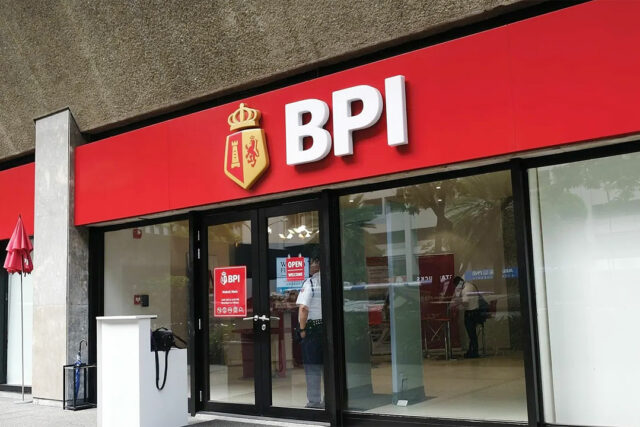
BPI FACEBOOK PAGE

BANK of the Philippine Islands (BPI) expects to post better earnings this year than in 2023 following its merger with Robinsons Bank Corp. (RBC), which it expects to fully integrate into its systems within two years.

“I think the merger is positive. I think in 2024, we will show more income than 2023, definitely. I’m very confident of that,” BPI President and Chief Executive Officer Jose Teodoro K. Limcaoco told reporters during the annual reception for the banking community last week.

“It will take about two years to transform all the RBC branches because you have to change the logos,… we have to change the systems, we have to move the people who are RBC accountholders and move them to BPI systems. So, our integration plan will take about two years,” Mr. Limcaoco added.

The integration process could result in increased expenses, but RBC’s expected contribution to BPI’s earnings could help offset these costs, he said.

“Obviously, there are expenses to integration, but they’re more than covered by the profitability of Robinsons Bank as a standalone. I think the business opportunities that come from the Robinsons Bank merger far outweigh the expenses,” Mr. Limcaoco added.

BPI will also be able to tap RBC’s products and clients, as well as the Gokongwei group’s suppliers and partners, he said.

The Ayala-led bank previously said it expects its net income to climb by 5-6% and its revenues to rise by around 7% as a result of its merger with RBC.

BPI saw its attributable net income grow by 33.33% year on year in the third quarter of 2023 to P13.47 billion amid higher revenues. It has yet to release its fourth-quarter and full-year 2023 results.

The merger between BPI and RBC took effect on Jan. 1, with BPI as the surviving entity.

Following the transaction, BPI has taken over RBC’s 20% stake in digital lender GoTyme Bank, a joint venture between the Gokongwei Group and Tyme, which is one of the six entities granted an online banking li-cense by the BSP.

Meanwhile, RBC’s shareholders now hold approximately 6% of the resulting outstanding capital stock of BPI.

Its shares went up by 20 centavos or 0.18% to close at P110.60 apiece on Wednesday. — AMCS

ADVERTISEMENT
ADVERTISEMENT