Home Blog Page 3709

Accountability and action are keys to brand growth this year — report

By Miguel Hanz L. Antivola, Reporter

Filipino prosumers are expecting brands to develop deeper and more diverse community connections through eco-social accountability and action, according to a report.

Advertising agency Havas Ortega released on Thursday its 2024 trends report for prosumers which they said represent 15-20% of the local population at the edge of new beliefs, attitudes, technologies, and brands.

“Brands must adapt by focusing on meaningfulness, social responsibility, and sustainability,” the report said.

Prosumers is a term which refers to individuals who are both consumers and producers.

The report added brand should also consider engaging with digital communities as well as back causes such as mental health and environmental sustainability.

“Transparency, authenticity, and real action in addressing social and environmental issues will also be key for brands in maintaining consumer trust, patronage, and loyalty,” it added.

The report identified five themes expecting to influence brand strategies this year: a search for meaning, social activism, community engagement, mental health awareness, and environmental responsibility.

The search for meaning is driven by a spirit of reflection and reprioritization due to the pandemic and recent economic challenges, Phil Tiongson, data science director at Havas Ortega Group Philippines, said during a briefing.

“Brands should transform themselves as conduits of meaningfulness and catalysts of self-reflection through the stories that they put out in the media,” the also report noted.

Findings from the report showed 60% of respondents claim to boycott brands that have neglected climate change issues.

It added that 82% believed that large companies are more equipped to make necessary climate-responsive changes, with 83% saying those should be “the first ones to pay the price.”

Moreover, 41% believed companies are the “primary culprits” of environmental crises.

“Aware of the power they hold to make informed choices and effect change, more Filipinos will be seen supporting brands that align with their deeply held values,” it said.

Brands are also called on to “find their stand” on soicial issues, among them diversity and gender equality, and continuously include “climate change and sustainability issues into their core marketing, operating, and business strategies.”

The Havas Orega report says as consumers grow increasingly aware of these issues, brand indifference or neutrality becomes unacceptable.

Additionally, the call to uplift marginalized voices (57%) and diverse communities (93%) among advertising efforts is expected to grow louder.

“Filipino consumers demand brands to not just be purely about business anymore, but a driver of meaningful social connections and interactions,” the report said.

“They call for a better use of powerful platforms through a combination of listening, understanding, and positive engagement with people of various backgrounds,” it added.

AboitizPower wins Anvil Award for CSR docuseries

Receiving the award is AboitizPower Corporate Brand Communications & Sustainability SAVP Meg Racho (2nd from right) and members of the brand and sustainability team.

A short video docuseries that shows the lives of people and communities that benefit from various social programs of Aboitiz Power Corporation (AboitizPower) won a Silver Award in the 59th Anvil Awards under the Public Relations – Corporate Social Responsibility/Good Governance category.

The project, entitled “Kwentong AboitizPower,” tells stories of positive impact in the energy firm’s host communities through its subsidiaries Therma Visayas Inc., Therma Power-Visayas Inc., Visayan Electric Company, Hedcor Inc., and Davao Light and Power Company.

Programs showcased in the docuseries include digital skills training and employment for stay-at-home mothers, the construction of learning facilities for the youth, and the giving of livelihood opportunities to persons with disabilities. The prestigious Anvil Award is presented annually by the Public Relations Society of the Philippines to recognize outstanding public relations programs, campaigns, and tools. Receiving the award is AboitizPower Corporate Brand Communications & Sustainability SAVP Meg Racho (2nd from right) and members of the brand and sustainability team.


Spotlight is BusinessWorld’s sponsored section that allows advertisers to amplify their brand and connect with BusinessWorld’s audience by enabling them to publish their stories directly on the BusinessWorld website. For more information, send an email to online@bworldonline.com.

Join us on Viber at https://bit.ly/3hv6bLA to get more updates and subscribe to BusinessWorld’s titles and get exclusive content through www.bworld-x.com.

A new era of Philippine Fashion: Filipino designers are about to take over New York with ‘Filipinxt’

Led by Filipinos for Filipinos and the world, the grand fashion presentation brings Manila to Manhattan as it celebrates Pinoy style and culture

Being one of the major fashion capitals in the world, New York has been a dream destination for many Filipino designers. Creativity thrives everywhere in the Big Apple, where the industry’s biggest brands and personalities make their mark. That’s why for many, showcasing their works in New York guarantees to put their name on the map.

It’s a belief that empowers New York-based fashion designer Bessie Besana and restaurateur Rob Mallari-D’Auria. The two are on a mission to open doors of opportunity in New York for Filipino designers with “Filipinxt,” a fashion event putting Filipino style and heritage at the forefront.

“Our goal is to bring the ingenuity of Filipino talent and, hopefully, get them recognized by the mainstream market,” Bessie says. “We want to bring this to the New York Fashion Week scene.”

“‘Filipinxt’ is a vehicle to give Filipino artists of all sorts a platform for a global career,” Rob adds.

The show will take place at the historic 4W43 Building on May 5. Designed by Clarence S. Luce for David H. King, Jr. between 1890 and 1891, the landmark is a place known by New Yorkers. It offers the perfect venue to spotlight the best of Filipino fashion with its Renaissance Revival architecture and innovative event spaces. With its location being a stone’s throw away from Times Square in midtown Manhattan, “Filipinxt” already made waves with the launch of its digital billboard at the iconic spot, giving everyone a first glimpse of how bold and revolutionary the show will be for Filipino fashion.

For its maiden show, “Filipinxt” will present the collections of four Filipino designers, whose creations have captured the essence of local creativity that the world deserves to see. Leading the pack is Bessie, who made his mark by creating dreamy silhouettes that celebrate the beauty of the human form. Also set to grace the runway of “Filipinxt” are the minimalist and contemporary works of Manila-born Los Angeles-based designer Veejay Floresca. Davao’s Wilson Limon of NiñoFranco will dazzle New York with his modern play on local tapestries. Completing the list is Michael Leyva, the designer behind the classic and opulent pieces that have been seen all over the globe.

“Filipinxt” — a play of words combining the gender-neutral -x suffix with “Filipino” and “next” — is all about representing Filipino creativity on all fronts. Apart from Bessie and Rob, also on board is Yancy Trinidad, an experienced producer and creative director. He will be directing “Filipinxt,” which will feature a grand twin runway to best present the collections. Meanwhile, Filipino documentarian Kenneth Anderson will chronicle what goes on and behind the runway to give everyone an all-access view of “Filipnxt,” from its creation down to its final moments.

“We are not only showcasing the designers because the director of our show is also a Filipino,” Bessie muses. “We are also tapping other Filipino talents in the community. We are not only limiting ourselves to the Filipino designers. We want the Filipino talents in different areas to be showcased in this show.”

“This is the time for Filipino designers and brands to step up, to be on par with New York Fashion Week,” Rob says. “We have the talent; we have what it takes to conquer the global stage. We just have to do it right. With the people we have now in ‘Filipinxt,’ we can make it happen.”

For more information, follow @filipinxt.show on Instagram and Facebook. Contact +1 917-724-6061 and info@manilatomanhattan.com for more details.


Spotlight is BusinessWorld’s sponsored section that allows advertisers to amplify their brand and connect with BusinessWorld’s audience by enabling them to publish their stories directly on the BusinessWorld website. For more information, send an email to online@bworldonline.com.

Join us on Viber at https://bit.ly/3hv6bLA to get more updates and subscribe to BusinessWorld’s titles and get exclusive content through www.bworld-x.com.

Musk seeks Tesla shareholder vote on moving incorporation to Texas

MILAN CSIZMADIA-UNSPLASH

Tesla will hold a shareholder vote to transfer its state of incorporation to Texas from Delaware, CEO Elon Musk said on Thursday, days after a judge invalidated his $56 billion pay package at the electric vehicle (EV) maker.

On Tuesday, Delaware judge Kathaleen McCormick called the 2018 share-based pay package, the largest in corporate America, “an unfathomable sum” that was unfair to shareholders and found it was negotiated by directors who appeared beholden to Musk.

“Never incorporate your company in the state of Delaware,” Mr. Musk posted on social media X shortly after the ruling and also started a poll asking if Tesla should now incorporate in Texas. More than 87% of the over 1.1 million votes cast were in favor of the shift.

“The public vote is unequivocally in favor of Texas! Tesla will move immediately to hold a shareholder vote to transfer state of incorporation to Texas,” Mr. Musk said in his latest post on X, formerly known as Twitter.

Mr. Musk has more than a small interest in Texas.

He shifted Tesla’s corporate headquarters from Palo Alto, California to Austin, Texas in 2021 after criticizing California’s regulations and taxes, and also clashing with health officials at the start of the COVID-19 pandemic over reopening a factory in Fremont.

One of the EV maker’s gigafactories is in Texas, where it is also planning an over $750 million expansion. It is also building a lithium refinery in the state, aiming to produce enough for about 1 million EVs by 2025.

Mr. Musk’s other companies, like SpaceX and The Boring Company, also have operations in Texas.

DELAWARE DEALINGS

More than 65% of Fortune 500 companies and over half of all US publicly traded companies are incorporated in Delaware, lured by the state’s business-friendly legal framework and tax policies, according to Harvard Business Services, a firm offering Delaware business formation services.

The pay ruling is not the first time that Mr. Musk has suffered a setback in the state.

Ms. McCormick was the same judge who oversaw Twitter’s July 2022 lawsuit against Mr. Musk after he tried to back out of his contract to buy the social media platform for $44 billion. The judge rejected his delaying tactics and Musk finally went through with the deal to buy the company that is now known as X.

“I recommend incorporating in Nevada or Texas if you prefer shareholders to decide matters,” he said in another post on X after Ms. McCormick’s ruling on his pay package.

Mr. Musk has also recently said he would be uncomfortable growing the automaker to be a leader in artificial intelligence (AI) and robotics without having at least 25% voting control of the company, nearly double his current stake. — Reuters

India’s finance minister unveils budget with focus on poor, women, youth, and farmers

SHRESHTH GUPTA-UNSPLASH

NEW DELHI — India’s Finance Minister Nirmala Sitharaman said on Thursday the economy was going through a profound transformation, as she rose to present the government’s last budget to parliament before a national election due by May.

The government is focused on improving conditions for the poor, women, youth, and farmers, Ms. Sitharaman said, setting the tone for welfare schemes to be announced in these areas.

Weak growth in wages and high inflation has hurt lower income earners, particularly in rural areas, impacting their ability to spend on even items of daily use.

Ms. Sitharaman will be looking to step up cash schemes for the poor, experts say.

The interim budget for 2024/25 is being seen as an economic manifesto for Prime Minister Narendra Modi’s ruling party and will give clues to the market on its plans for fiscal consolidation, borrowings and future taxation policy.

“The economy has undergone a profound transformation,” Ms. Sitharaman said to the thumping of desks.

Mr. Modi is leading the election race by a distance because of his personal popularity and the government is under little pressure to announce populist schemes, analysts say.

There are weak spots in the economic picture, though. While the economy is seen growing at a record beating 7.3% for the financial year ending March 31, 2024, consumption — which accounts for close to 60% of GDP — has remained weak growing at just over 4%. — Reuters

Japan Inc opens door to more women directors, but managers remain rare

PEOPLE wear face masks at Shinagawa station during the rush hour in Tokyo, Japan, April 20, 2020. — REUTERS
TOKYO — Mitsuko Tottori’s appointment as Japan Airlines’ next president makes her something of a rarity in Japan – a female head of a well known company.
While Japanese firms have rapidly lifted the number of female board members in recent years, most are outside directors. Change from within is slower in coming.
Under pressure from the Japanese government, the Tokyo Stock Exchange (TSE) and foreign investors, firms have been scrambling to improve diversity, including on their boards, bringing in external directors who are often lawyers, academics, and accountants.
But the diversity push isn’t as broad as it could be, critics and governance experts say. Some 30% of women directors sit on multiple boards, double the percentage of men, according to a study of all TSE-listed firms by governance consultancy ProNed.
This reflects Japan’s difficulty in promoting from the inside – both board members and company executives – after years of neglecting to cultivate a pipeline of potential women managers, they say.
Traditionally, many Japanese companies had rigid hiring systems classifying employees as either “career track” or “non-career track” – with the non-career workers often the women who did administrative work.
“It’s very difficult to convince people of the value of diversity when they haven’t seen it in action,” Keiko Tashiro, a director and vice president of Daiwa Securities, told Reuters in Davos earlier this month. Since 2005, Daiwa has had measures in place to train new generations of female leaders.
Tashiro is one of the most senior women in Japanese finance, where, like many industries, the top echelons remain overwhelmingly male.
Women account for only 13.4% of directors and executive officers at the 1,836 firms listed on the TSE’s “prime” market, and of these a mere 13% are internal hires.
“Many companies say they don’t want to promote unqualified females too quickly,” says Yuko Yasuda, a director at governance consulting firm Board Advisors Japan. “It may be an excuse.”
There are signs of change. Yasuda says more than half of inquiries for board posts are for women and clients are increasingly looking for direct management experience.
IMPOSTER SYNDROME
Finding women with experience, however, is challenging. Up to now, many Japanese women haven’t even entertained the prospect of becoming managers.
“Imposter syndrome is especially strong in Japan,” said a spokesperson for HR services provider Recruit Holdings.
The owner of platforms such as job listing website Indeed and company review website Glassdoor, Recruit has made changing this mindset central to its initiatives supporting women’s careers.
“We encourage people to further their careers by having various experiences early on,” the spokesperson said.
To extend opportunities for management training to a wider pool of candidates, Recruit’s domestic subsidiary has created a checklist of core competencies necessary to perform each first-line management position.
It says this helps undo unconscious biases that in the past would privilege “macho” qualities, such as the capacity to work at all hours, and has raised the number of female candidates for each position by a factor of 1.7 and that of men by 1.4.
But initatives such as these take years to filter through to the top, leaving ambitious Japanese women with few role models to inspire and guide them.
Tottori told a JAL press conference earlier this month that she hoped her appointment would encourage women who are struggling with their careers or big life events.
Notwithstanding Tottori, the current crop of female leaders often come from privileged backgrounds or have made immense sacrifices to succeed at work, said Etsuko Tsugihara, founder and CEO of public relations firm Sunny Side Up Group and one of only around 14 women heading a “prime” listed Japanese firm according to a Kyodo and Teikoku Databank study as of January 2023. The company has since moved to the “standard” market.
“When I went to the hospital to give birth, I came straight from the office. Then I was back at work two weeks later,” Tsugihara recalled. “It put off other women from doing the same.”
Now the employee welfare program at Tsugihara’s firm encourages work-life balance for both female and male staff and supports long-term life planning by subsidising blood screenings, fertility-related hormonal tests and even egg freezing.
“To be a role model you have to have a healthier, richer life,” Tsugihara said. – Reuters

Hong Kong court convicts four for rioting after 2019 legislature storming

REUTERS
HONG KONG — A Hong Kong court on Thursday found four people guilty of rioting after the legislature of the financial centrewas stormed during pro-democracy protests in 2019, joining eight others who had pleaded guilty to charges over the incident.
Hundreds of protesters stormed Hong Kong’s Legislative Council building on July 1, 2019, after a protest march against a proposed extradition bill that would have allowed authorities to send individuals to mainland China for trial.
District Court Judge Li Chi-ho found four people including Ho Chun-yin, actor Gregory Wong, Ng Chi-yung and Lam Kam-kwan guilty of rioting.
Lam was also convicted of criminal damage, while reporters Wong Ka-ho and Ma Kai-chung were acquitted of rioting but found guilty of “entering or staying in the precincts of the chamber”.
During the trial, Gregory Wong told the court he entered the legislative council solely to deliver two chargers to reporters who were covering the break-in by protesters.
According to video evidence played by the prosecution, Wong left the chamber immediately after delivering the chargers to a reporter in a yellow vest.
Another defendant, Lam Kam-kwan, told the court he was detained in China in August 2019 following the storming of Legco during which he was forced to write a repentance letter.
Three Hong Kong police officers met him in Shenzhen and said he had to cooperate or else he would not be able to return to Hong Kong. Police officers denied his claims during a cross-examination by the defense.
Eight people who earlier plead guilty to rioting included the former president of the University of Hong Kong’s student union, Althea Suen, and pro-democracy activists Ventus Lau and Owen Chow.
Hong Kong’s district court sets a maximum of seven years in prison for rioting. – Reuters

US strikes multiple drones in Yemen, American official says

STOCK PHOTO | Image by Isabella Fischer from Unsplash
WASHINGTON — The United States struck up to 10 unmanned drones in Yemen that were preparing to launch, a US official said late on Wednesday, amid escalating tensions from the war in Gaza spreading through the region.
A US Navy ship also shot down three Iranian drones and a Houthi anti-ship ballistic missile in the Gulf of Aden, the US military’s Central Command said in a statement. There were no injuries or damage reported, it said.
The Iran-aligned Houthi militants, who control the most populous parts of Yemen, have launched a wave of exploding drones and missiles at commercial vessels in the Red Sea and Gulf of Aden in recent weeks, calling it a response to Israel’s military operations in Gaza and a show of solidarity to Palestinians.
The Houthi campaign has disrupted international shipping.
The United States and Britain have launched strikes on Houthi targets in Yemen and returned the militia to a list of “terrorist groups.”
The Houthis, earlier on Wednesday, said their naval forces carried out an operation targeting an “American merchant ship” in the Gulf of Aden hours after firing missiles at US Navy destroyer Gravely.
Houthi attacks on ships in and around the Red Sea have slowed trade between Asia and Europe, raised fears of supply bottlenecks and alarmed major powers concerned that the Gaza war may become a regional conflict.
US President Joe Biden said earlier in January that strikes on Houthi targets would continue even as he acknowledged they may not be halting their attacks.
Israel’s assault on the Hamas-run Gaza Strip followed a surprise attack by Hamas militants on southern Israel on Oct. 7, killing 1,200. The Gaza health ministry says nearly 27,000 people have been killed in the fighting since. – Reuters

Fed’s Powell sees lower rates on the horizon as inflation ebbs, US economy bounces ahead

WASHINGTON — Federal Reserve Chair Jerome Powell, in a sweeping endorsement of the US economy’s strength, said on Wednesday that interest rates had peaked and would move lower in coming months, with inflation continuing to fall and an expectation of sustained job and economic growth.
Powell, speaking after the end of a two-day policy meeting, declined to declare victory in the US central bank’s two-year inflation fight, vouch that it had achieved a sought-after “soft landing” for the economy or promise that rate cuts would come as soon as the Fed’s March 19-20 meeting, as investors had hoped in the run-up to this week’s policy decision.
“Inflation is still too high. Ongoing progress in bringing it down is not assured,” Powell said after the Fed’s policy-setting committee kept the benchmark overnight interest rate in the 5.25%-5.50% range and announced that rate cuts would not be appropriate until there is “greater confidence that inflation is moving” towards the central bank’s 2% target.
But in almost every other way during a 48-minute session with reporters Mr. Powell offered an unhedged round of good news about the status of an aggressive war on inflation that many economists felt would tilt the US into recession and throw millions out of work with the highest and fastest rate hikes in roughly 4 decades.
“The executive summary would be growth is solid to strong … 3.7% unemployment indicates the labor market is strong … We’ve got six good months of inflation data and an expectation that there’s more to come,” the Fed chief said. “Let’s be honest, this is a good economy.”
Mr. Powell said rate cuts would come once the Fed becomes more secure that inflation will continue to decline from a level it still characterizes as “elevated,” at least on a one-year basis, with the personal consumption expenditures price index, a key measure used by policymakers, at 2.6% on an annual basis as of December.
But he also suggested it was just a matter of time before that conviction kicks in.
Inflation is already below 2% when measured on a seven-month basis and the Fed has pledged rate cuts would begin before the one-year rate reaches the target level.
After Mr. Powell all but ruled out a cut at the March meeting, investors in contracts tied to the Fed’s policy rate keyed in on May 1 as the day the central bank will begin lowering that rate from the level it has held since last July.
While Mr. Powell’s comments lay out a rosy economic scenario in a presidential election year that could lean heavily on public attitudes about inflation and wages, they were nonetheless a short-term blow to investors who had been expecting rate cuts to start as early as seven weeks from now.
US stocks fell after Mr. Powell’s comments and closed sharply lower on the day, while the dollar rose against a basket of currencies. US Treasury yields also dropped.
“It is clear that the Fed are in no hurry to ease as rapidly as the market prices, with further promising inflation data still required in order to unlock the first rate reduction,” said Michael Brown, a market analyst at Pepperstone.
The outcome of the meeting also pushed back against calls from labor advocates for reductions in order to protect the current low unemployment rate at a time when some feel there may be developing weaknesses in the economy.
BANK, CREDIT RISKS DROPPED
Those risks were brought home on Wednesday when New York Community Bank announced an unexpected loss, an echo of banking troubles last spring that the Fed hopes have been put to rest. The latest policy statement from the central bank’s Federal Open Market Committee, however, removed language, put in place following the failures in 2023 of Silicon Valley Bank and other lenders, that said the banking system is “sound and resilient” – a fact that in normal times would not need to be stated.
The Fed also dropped references to the uncertain impact of tight credit on households and businesses and the “lags” with which changes in monetary policy are felt in the economy, a hint that US central bankers feel the current best-case outcome may endure absent some sort of unexpected shock.
Overall, the changes made to the policy statement codify what has been a developing Fed “pivot” that ends roughly two years in which the central bank’s bias has been towards moving rates higher and the risks seen as tilted towards those posed by escalating prices.
“Our policy rate is likely at its peak for this tightening cycle and that, if the economy evolves broadly as expected, it will likely be appropriate to begin dialing back policy restraint at some point this year,” Mr. Powell said.
Risks to the Fed’s dual employment and inflation goals “are moving into better balance,” the Fed’s policy statement said. “In considering any adjustments to the target range for the federal funds rate, the Committee will carefully assess incoming data, the evolving outlook, and the balance of risks.”
By contrast, the Fed’s prior statement, issued on Dec. 13, had laid out the conditions under which it would consider “any additional policy firming,” language that excluded any consideration of rate cuts.
Fed officials did not issue new economic projections at their meeting this week. As of the Dec. 12-13 meeting, policymakers envisioned cutting the policy rate by 75 basis points over the course of this year, an outlook that will be updated at the Fed’s meeting in March. – Reuters

IMF board OKs Argentina loan program review, unlocking $4.7 billion

BUENOS AIRES — The International Monetary Fund (IMF) on Wednesday approved the most recent review of its $44 billion program with Argentina, allowing for the disbursement of $4.7 billion.
The fund said in a statement that even as key program targets were missed through the end of last year “due to severe policy setbacks,” it approved waivers of non-observance.
“Program targets were modified, in line with the authorities’ initial actions and ambitious plans to bring the program back on track,” the fund said.
The board also approved an extension of the program through Dec. 31, 2024, “along with some rephasing of planned disbursements within the existing envelope of the program.” The IMF did not supply more details on the changes.
The government and IMF staff recently agreed on the seventh review of the program, which was delayed amid a change of government as President Javier Milei took office on Dec. 10.
“The new administration is taking bold actions to restore macroeconomic stability and begin to address long-standing impediments to growth,” said IMF Managing Director Kristalina Georgieva in the statement.
She said that “inconsistent policies of the previous government” had left a “difficult inheritance.”
Earlier this week the IMF slashed its forecast for Argentina’s 2024 GDP to a 2.8% contraction from a previous view of a 2.8% expansion, mostly due to the expected effects of the new government’s proposed reforms.
Wednesday’s approval brings disbursements within the $44 billion program to $40.6 billion, the fund said.
The fund said following a recent devaluation and “exchange rate realignment,” the new policies should “continue to secure reserve accumulation goals.”
According to the latest data reported by the central bank, Argentina’s reserves rose to $27.6 billion on Wednesday from $25.1 billion at the close of Tuesday. – Reuters

2023 Philippine economic growth slows to 5.6%

THE Philippine economy grew by 5.6% in 2023, falling short of the government’s full-year target as state spending and exports declined and high interest rates dampened consumption.  Read the full story.

GDP grows 5.6%, falls short of target

People flock to Divisoria ahead of the holiday season, Dec. 21, 2023. — PHILIPPINE STAR/WALTER BOLLOZOS

By Luisa Maria Jacinta C. Jocson, Reporter

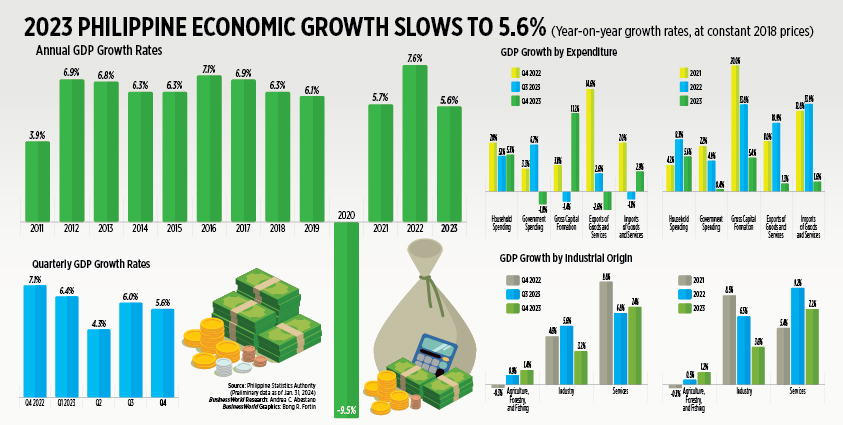
THE Philippine economy grew by 5.6% in 2023, falling short of the government’s full-year target as state spending and exports declined and high interest rates dampened consumption.

Data from the Philippine Statistics Authority (PSA) showed that gross domestic product (GDP) in 2023 was much slower than the 7.6% expansion in 2022.

However, the full-year GDP was higher than the median 5.5% growth estimate in a BusinessWorld poll of 20 economists last week.

“While this growth is below our target of 6-7% for this year, this keeps us in the position of being one of the best-performing economies in Asia,” National Economic and Development Authority (NEDA) Secretary Arsenio M. Balisacan said.

In the fourth quarter, GDP expanded by 5.6%, slower than the revised 6% GDP growth in the third quarter and the 7.1% expansion in the fourth quarter of 2022. It was also below market expectations, based on a BusinessWorld poll that yielded a 5.7% estimate.
Mr. Balisacan earlier said the economy would had to grow by at least 7.2% in the fourth quarter to meet the lower end of the government’s 6-7% target.

Among Asian countries with available data, the Philippines’ fourth-quarter growth was also just behind Vietnam (6.7%) and ahead of China (5.2%) and Malaysia (3.4%).

On a seasonally adjusted quarterly basis, Philippine GDP grew by 2.1% in the fourth quarter, slower than 3.8% a quarter earlier.

Mr. Balisacan said that economic growth could have been faster if not for the impact of elevated inflation and high interest rates last year.

Inflation averaged 6% in 2023, marking the second straight year that it breached the Bangko Sentral ng Pilipinas’ (BSP) 2-4% target range.

“Expectedly you would have achieved higher growth if inflation was not that high,” he said.

To tame inflation, the Monetary Board hiked borrowing costs by a total of 450 basis points (bps) from May 2022 to October 2023, bringing the key rate to a 16-year high of 6.5%.

“The long-term effects of these (tightening), you will feel it a few quarters down the line. This slowing down that we are seeing is possibly the effect of past increases in interest rates early last year and even in 2022,’’ Mr. Balisacan added.

GOV’T SPENDING DOWN

Data from the PSA also showed that government spending contracted by 1.8% in the fourth quarter, a reversal of the 6.7% growth in the previous quarter and 3.3% a year ago.

For the full year, government spending posted flat growth of 0.4%, slower than the 4.9% in 2022.

Mr. Balisacan said that slower state spending was due to the government’s fiscal consolidation plan.

“It was intentional that the growth in government spending was not too high in 2023 because we want to achieve fiscal consolidation. That means lowering the fiscal deficit and government debt but still be able to provide enough for social protection,” he added.

Government spending contracted by 7.1% in the second quarter, hurting growth and prompting the Finance and Budget departments to order agencies to accelerate spending and improve budget use.

Meanwhile, household final consumption jumped by 5.3% in the fourth quarter, faster than 5.1% in the previous quarter but slower than 7% a year earlier.

In 2023, household spending expanded by 5.6%, much slower than 8.3% in 2022. Private consumption accounts for about three-fourths of the economy.

The top contributors to fourth-quarter consumption were restaurants and hotels (16.2%), transport (12.2%) and recreation (7.3%). On the other hand, spending on clothing and footwear declined by 1.4%.

Mr. Balisacan said the data reflect an improvement in the jobs market and sustained growth in remittances.

“However, we are concerned about the low growth in food spending due to high food prices, though inflation has moderated in recent months,” he added.

The NEDA chief said the government would “relentlessly manage” inflation by strengthening agricultural value chains, using trade policies to support production and prevent anti-competitive practices.

Gross capital formation — the investment component of the economy — jumped by 11.2% in the October-December period, faster than 3.3% a year ago. This was also a turnaround from the 1.4% decline in the third quarter.

“The robust investment expansion during the quarter was driven by significant growth in fixed capital (10.2%), particularly the expansion of durable equipment (14.6%),” Mr. Balisacan said.

For the full year, gross capital formation rose by 5.4%, slower than 13.8% d a year ago.

Exports of goods and services shrank by 2.6% in the fourth quarter, a reversal of the 2.6% growth in the previous quarter and 14.6% expansion a year earlier. This brought the full-year growth to 1.3%, slower than 10.9% in 2022.

“The weak global economy weighed heavily on our export sector… The decline came mainly from the deep contraction in goods exports (11.6%), although service exports grew by 12.3%,” Mr. Balisacan said.

“We expect the growth in services to maintain its trajectory as international tourism rebounds,” he added.

Meanwhile, imports grew by 2.9% in the fourth quarter, a turnaround from the 1.1% contraction in the third quarter. However, it was slower than the 7% expansion in the previous year.

Imports expanded by 1.6% in 2023, slower than 13.9% in the previous year.

Net primary income from the rest of the world surged by 97.7% in the fourth quarter, faster than 59.9% a year ago.

The full-year figure jumped by 96.6%, faster than 77.3% a year earlier.

Gross national income (GNI) — the sum of the country’s GDP and net income received from overseas — rose by 11.1% in the fourth quarter, higher than 9.3% a year ago. For 2023, GNI grew by 10.5%, quicker than 9.9% in 2022.

On the production side, all sectors registered growth. Service expanded by 7.4% in the October-to-December period, slowing from 9.8% in 2022. Services growth eased to 7.2% in 2023 from 9.2% in 2022.

Industry grew by 3.2% last quarter, slower than 4.6% a year earlier. This brought full-year industry growth to 3.6%, much weaker than 6.5% a year ago.

Agriculture, forestry and fishing growth inched up to 1.4% in the October-December period, a turnaround from the 0.3% contraction in the previous year. In 2023, the sector posted growth of 1.2%, better than 0.5% in 2022.

‘WORK HARDER’

Despite missing the 2023 growth goal, the NEDA chief said he is still confident about meeting the 6.5-7.5% GDP growth target this year. The Development Budget Coordination Committee (DBCC) is expected to meet soon to reassess its macroeconomic assumptions.

“I don’t think (we) are giving up this early, it is only the first (month) of the year and now you want to say reduce the 6.5%, that is too defeatist,” Mr. Balisacan said.

He said the government should work harder to meet its growth goals and monitor risks such as El Niño and geopolitical tensions.

Capital Economics Emerging Asia economist Shivaan Tandon said private consumption might remain muted this year.

“GDP growth remained well above trend in the fourth quarter, but we don’t expect this strength to last as the deceleration in credit growth feeds through to weaker growth in domestic demand over the coming quarters and the external sector continues to struggle,” he said in a note.

ANZ Research economist Debalika Sarkar and Chief Economist Sanjay Mathur in a note said they kept their GDP growth projection at 5.6% this year.

“Private consumption should settle at the 2023 pace amid stabilizing employment and income growth. Overall fiscal support should moderate with the 2024 budget deficit projected to decline to 5.1% of GDP from an esti-mated 6.1% in 2023. These should be partially offset by a modest improvement in exports,” they added.

Metrobank Research in a bulletin said it sees growth averaging 6% this year “on the back of decelerating inflation and interest rate cuts.”

“The Philippines appears relatively insulated from external shocks, i.e., geopolitical risks, as the sources of growth continue to be largely from domestic consumption and services as well as the bright spots seen in the recovery of tourism, overseas Filipino workers’ remittances and business process outsourcing revenues,” it said.

HSBC Global Research economist Aris Dacanay said he expects growth to settle at 5.3% this year, but noted risks are tilted to the upside.

Meanwhile, Manulife Investment Management Philippines Head of Equities Mark Canizares said in a commentary that they are optimistic about growth prospects this year.

“We have a positive outlook for the Philippine economy based on the improving macroeconomic picture. The decline in inflation back to BSP’s target of 2-4% could open up the possibility of easing rate policy and boosting economic growth this 2024,” he said.

However, Mr. Canizares flagged risks such as supply shocks that could come from El Niño, geopolitical tensions and a global economic slowdown.


ADVERTISEMENT
ADVERTISEMENT