By Andreas Kluth
THE ERA of nuclear arms control officially ends this week. On Feb. 5, New START*, the last such treaty between the United States and Russia, will expire. That doesn’t necessarily mean that Washington and Moscow will begin deploying more than the 1,550 strategic warheads each that the treaty stipulated; both of them should, and probably will, observe the old limits for a while longer. Nonetheless, the moment is a milestone.
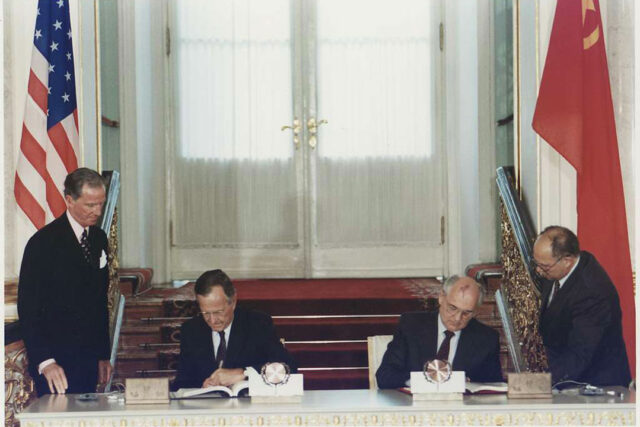
It marks the first time since the iciest Cold War when no formal arms-control regime will limit the two atomic superpowers. In that way the expiry of New START is yet another step out of a world in which the great powers restrained themselves with rules, and into a brave new world of anarchy, in which the only rules are the whims of strongmen.
On paper, a few vestiges of the previous era remain. Some 178 countries still abide by a multilateral treaty that bans the explosive (as opposed to computer-simulated) testing of fission or fusion bombs. And 191 states still subscribe, in theory, to The Treaty on the Non-Proliferation of Nuclear Weapons (abbreviated NPT), in force since 1970. The signatories include the five powers with the largest nuclear arsenals, who in Article VI explicitly commit to negotiate “in good faith” to achieve “general and complete disarmament.”
In practice, none of these long-standing promises is worth the paper it’s written on. America’s president, Donald Trump, and several of his advisers have mused about restarting nuclear testing. That would trigger competitive rounds of testing by China, Russia, and others and amount to a strategic own goal.
And Article VI of the NPT has become a joke. Instead of negotiating disarmament, all nine nuclear powers, including the five acknowledged in the NPT, are “modernizing” their arsenals. The US, for example, is projected to spend a staggering $1.7 trillion over 30 years to upgrade its nuclear missiles, submarines, bombers, and warheads. China is adding to its arsenal as fast as its can, striving for functional parity with the US and Russia within a decade. North Korea (which quit the NPT in 2003) is also growing its stash.
Worse yet, most of the nuclear powers are simultaneously investing in more exotic nukes — to be used in outer space, for instance, or mounted on deceptive torpedoes or “glide” vehicles as opposed to plain-vanilla ballistic missiles. As during the Cold War, they’re once again incorporating tactical nukes (which New START didn’t regulate at all) into their plans and scenarios.
Tactical nukes are bombs that may have “smaller” yields and can be launched at shorter ranges, at least when compared with strategic weapons, which are meant to take out entire cities in an adversary’s homeland. The theoretical purpose of tactical weapons is to win battles in a regional war, say, rather than devastating an enemy during an all-out nuclear holocaust.
Tactical nukes are inherently destabilizing, as Geoff Wilson, Christopher Preble, and Lucas Ruiz at the Stimson Center have shown. Their proponents like to argue that these bombs, because their fallout is limited, are more “usable.” But that’s exactly the problem. Once the nuclear taboo is broken, the idea that the ensuing escalation can be controlled is a “mirage,” as George Shultz, a former secretary of state, once told Congress.
For starters, all nuclear powers would have a so-called discrimination problem. Faced with an incoming volley, they wouldn’t know whether they were under a strategic or tactical attack. By the perverse logic of “use it or lose it,” states would feel they have to launch their own weapons while they still can.
The bewildering complexity and diffusion of these dangers are such that the Bulletin of the Atomic Scientists last week reset its famous Doomsday Clock to 85 seconds to midnight, where midnight represents catastrophe. That’s the closest to apocalypse the clock has ever stood since the metaphor was created in 1947 — closer even than during the Cuban Missile Crisis, say.
What should be done about this fiasco? Some experts, and parts of Trump’s MAGA movement, have concluded that the US, for one, must accelerate its nuclear build-out and grow its arsenal to match a coordinated attack from both Russia and China.
That doesn’t follow at all, says Richard Fontaine, a former national-security official and diplomat who runs the Center for a New American Security. In nuclear strategy, you don’t get safer by adding up the warheads of your adversaries and then matching the total, he told me. What matters is that even if Russia teamed up with China in a coordinated attack, “the US would retain a survivable second-strike capability.” In that sense, the old logic of deterrence survives, because any enemy contemplating a first strike on the US “would have to be prepared to be destroyed.”
The peril lies less in a first strike out of the blue (as in the movie A House of Dynamite, for instance) than in a spiral of miscalculations that could lead to uncontrolled, and possibly unintended, escalation. Paradoxically, even policies meant to be purely defensive could make the situation worse rather than better.
Trump’s beloved Golden Dome is an example. A continental anti-missile shield — even if it were technically feasible and affordable, which it probably isn’t — could invite disaster. America’s adversaries would fear that the US could feel immune to retaliation once the dome’s interceptors in space go live. They would then be tempted to destroy those interceptors and sensors with nuclear explosions in space. Or they might plan attacks that don’t go through space — with submarines or drones, for instance. However they react, America and the world would be not more but less safe.
Trump gets other things wrong too. By insulting America’s allies in Europe and Asia, he’s casting doubt on America’s nuclear “umbrella” and forcing them to consider building their own nukes. That would prompt their regional adversaries to do the same. More nuclear powers always means more risk; just think of the many times India and Pakistan have gone to the brink.
And yet Trump grasps the big picture as well as any of his predecessors did. He’s repeatedly called nukes the world’s greatest existential threat. “There’s no reason for us to be building brand-new nuclear weapons. We already have so many,” he has said; “You could destroy the world 50 times over, 100 times over. And here we are building new nuclear weapons, and they’re building nuclear weapons.”
The only way to reduce this existential threat is to return to negotiations, ideally three-way talks among Washington, Moscow, and Beijing which then include other nuclear powers over time. Russia’s Vladimir Putin, disingenuously or not, has indicated that he would be receptive. China’s Xi Jinping has so far made clear he’s not ready for talks, because his goal is parity with the other two.
That’s what Trump must set out to change. He claims to have good chemistry with Putin, so he should use it — but without mixing the fate of Ukraine into the conversation. He also thinks he has Xi’s ear. The problem is that Trump keeps distracting himself with problems of his own making, such as trade wars or the fate of TikTok, of all things.
If Trump and his advisers had any strategic bone in their bodies, they would invert this dynamic and emphasize the existential. He would invite all nuclear leaders to stipulate — as Ronald Reagan and Mikhail Gorbachev once did — that a “nuclear war cannot be won and must never be fought.” Then they would start talking about de-risking, discussing every weapon system in turn. Just in case this process should eventually lead to a modicum of trust, they could use that to haggle about everything else.
BLOOMBERG OPINION
*START stands for Strategic Arms Reduction Treaty.