Home Blog Page 365

PSEi down 2% as economic growth disappoints
BW FILE PHOTO

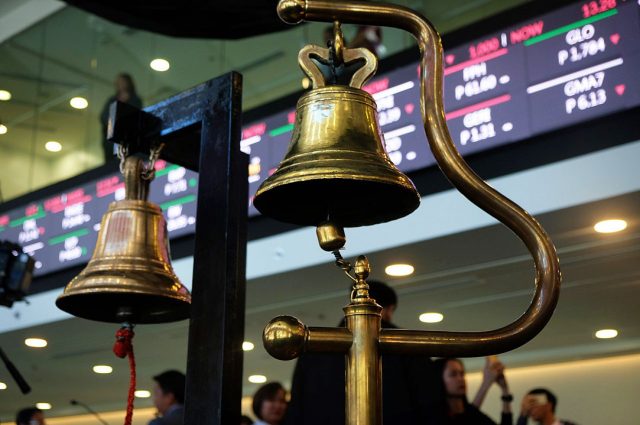
PHILIPPINE STOCKS posted their biggest single-day drop since November as weak gross domestic product (GDP) data triggered a sell-off.

The Philippine Stock Exchange index (PSEi) plunged by 2.08% or 132.42 points to end at 6,223.36, while the broader all shares index fell by 1.36% or 49.01 points to close at 3,548.03.

This was the PSEi’s largest single-day decline since it lost 2.49% or 142.64 points on Nov. 14, ending at 5,584.35. This was also the index’s worst close in nearly a month or since Jan. 5’s finish of 6,164.53.

The main stock benchmark opened Thursday’s session at 6,365.46, rising from Wednesday’s finish of 6,355.78 and already its best showing for the session. After the release of the GDP report, the index slid to the 6,200 level, hitting an intraday low of 6,215.80.

“The market sank as investors sought shelter following a dismal GDP growth print, suggesting that the desired economic rebound eluded the country despite the holiday boost,” AP Securities, Inc. said in a market note.

“The PSEi ended lower amid strong, broad-based selling pressure after GDP figures came in below expectations,” Regina Capital Development Corp. Head of Sales Luis A. Limlingan said in a Viber message. “Investor sentiment weakened as the softer growth data raised concerns over the country’s near-term economic outlook.”

Philippine GDP growth slowed to 3% in the fourth quarter from 5.3% in the same period a year prior and the revised 3.9% print in the third quarter. This was the slowest print in nearly five years or since the 3.8% contraction in the first quarter of 2021. Outside of the pandemic, this was the worst since the 1.8% growth recorded in the fourth quarter of 2009, or during the Global Financial Crisis.

This brought full-year 2025 GDP growth to 4.4%, well below the government’s 5.5%-6.5% goal. This was slower than 2024’s 5.7% and was the weakest annual expansion since the 3.9% in 2011, counting out the 9.5% contraction in 2020 due to the pandemic.

These were well below the 4.2% and 4.8% median estimates for fourth-quarter and full-year 2025 GDP growth in a BusinessWorld poll.

Most sectoral indices closed in the red. Financials plunged by 2.48% or 52.67 points to 2,064.05; property decreased by 2.47% or 55.59 points to 2,191.47; services went down by 1.99% or 51.88 points to 2,548.24; holding firms fell by 1.51% or 77.20 points to 5,003.71; and industrials retreated by 0.7% or 63.27 points to 8,945.36.

Mining and oil rose by 1.17% or 221.49 points to 19,149.65.

Decliners outnumbered advancers, 124 to 75, while 56 names closed unchanged.

Value turnover inched up to P7.55 billion on Thursday with 1.34 billion shares traded from the P7.53 billion with 1.58 million issues that changed hands on Wednesday.

Net foreign selling was at P406.24 million on Thursday, a reversal of the P463.37 million in net buying recorded in the previous session. — A.G.C. Magno


Surge in meat imports fails to ease pork, chicken prices

REUTERS

By Vonn Andrei E. Villamiel

MEAT IMPORTS surged to record levels in 2025, though the added supply failed to translate to lower retail prices for pork and chicken, analysts said.

Jayson H. Cainglet, executive director of the Samahang Industriya ng Agrikultura, told BusinessWorld via Viber that pork and chicken imports last year accounted for between 40% and 50% of domestic consumption for such products.

The Bureau of Animal Industry reported that meat imports rose 13.38% to a record 1.64 million metric tons (MMT) in 2025.

Pork imports rose 16.09% to 851,760 metric tons. Chicken imports increased 14.47% to 540,522 metric tons.

Mr. Cainglet said retail prices of livestock and poultry commodities did not decline even with imports adding to the available supply.

“Retail prices of pork and chicken remain elevated. The promise of tariff reduction to reduce retail prices of pork and chicken, similar to rice, has failed miserably,” he said.

The Philippine Statistics Authority (PSA) reported that the retail prices of pork shoulder rose 8.54% to P357.21 per kilo in 2025. Chicken prices at retail rose 7.2% to an average of P214.85 per kilo.

Mr. Cainglet said that, instead of lowering retail prices for consumers, lower-priced imports primarily affected upstream markets and weakened farmgate prices.

“Cheaper imported meat only contributed to oversupply and downward pressure on farmgate prices, often below the cost of production for both our hog raisers and poultry growers,” he said.

In November, the Department of Agriculture reached an agreement with industry groups to raise the floor price for live hogs to P210 per kilo, following a steep drop in prices to around P150 to P180 per kilo, which represents little more than breakeven cost.

Elias Jose M. Inciong, chairman of the United Broiler Raisers Association, told BusinessWorld that, given the surge of import volumes in 2025, current tariff rates are not protecting the poultry industry.

“With the volumes, our opponents can no longer say that we are protected by high tariffs. Even if you impose the 40% tariff, (the price of imported chicken) will still be lower than the farmgate price of live chicken,” he said via Viber.

Former Agriculture Undersecretary Fermin D. Adriano said however that the increased prices are due to supply gaps, particularly for pork because of African Swine Fever.

In addition, “fast-food chains are growing, and local production cannot meet demand. And our population is growing, including those in the middle-income bracket, who consume more protein,” he told BusinessWorld via Viber.

Mr. Adriano said that despite a surge in import volumes last year, supply is insufficient and local production is growing slowly.

The PSA reported that hog production, which accounted for the bulk of livestock output, fell 2.7% to 1.66 MMT in 2025.

Offshore block in south Palawan offered to petroleum explorers

BW FILE PHOTO

THE Department of Energy (DoE) said it is offering an offshore area in the Southern Palawan Basin for petroleum exploration.

Demujin F. Antiporda, director of the DoE’s Energy Resource Development Bureau, told BusinessWorld, that the potential service contract covers about 500,000 hectares.

Mr. Antiporda said the nominated area is the 15th and offered for exploration under the Philippine Conventional Energy Contracting Program.

The DoE has scheduled a pre-challenge conference on Feb. 2. Interested parties will have 60 days to submit proposals before the bids are opened on March 16.

According to a 2023 department circular, three modes of awarding petroleum service contracts are available: nomination of an area of interest, offering of pre-determined areas, and direct negotiation.

Mr. Antiporda said the DoE has endorsed four contracts for approval by President Ferdinand R. Marcos, Jr.

The hydrogen contracts cover 212,105 hectares in Western Luzon and 494,041 hectares in onshore blocks in Leyte.

The DoE also awarded two petroleum service contracts covering 103,034 hectares in the Northwest Palawan Basin and 58,683 hectares in the Visayas Basin.

In 2025, the government awarded petroleum and hydrogen service contracts for exploration in the Sulu Sea, Cagayan, Cebu, Northwest Palawan, Eastern Palawan, and Central Luzon.

Companies with service contracts can embark on their work programs, which include geological and geophysical studies, seismic surveys, and drilling activities, as appropriate, to assess the potential of the resource.

Earlier this year, the government also awarded a fresh petroleum service contract to PXP Energy Corp. and its partners to continue production at the Galoc Oil Field off northwest Palawan. —  Sheldeen Joy Talavera

PHL receives rice supply feelers from Pakistan

FREEPIk

THE PHILIPPINES is considering importing rice from Pakistan to diversify sourcing and cut reliance on traditional suppliers, the Department of Agriculture (DA) said.

In a statement on Thursday, the DA said a delegation from Pakistan met with Agriculture Secretary Francisco P. Tiu Laurel, Jr. and expressed interest in supplying rice to the Philippines due to a surplus in Pakistan.

The DA said any imports would be “carefully calibrated” to domestic needs as the government moves towards achieving ongoing rice self-sufficiency.

“The Philippines welcomes Pakistan rice, but we will limit imports strictly to what the country needs. We will not over-import; food security comes first,” Mr. Laurel was quoted as saying in the statement.

The Philippines is the world’s largest buyer of rice, importing 3.37 million metric tons of the staple grain in 2025 even after it imposed a four-month import ban. The country relies on overseas suppliers to fill gaps caused by weather disruptions and rising demand.

In 2025, Vietnam accounted for 81.46% of Philippine rice imports, while shipments from Pakistan made up just 2.26% of the total, the Philippine Rice Research Institute reported.

The DA said any prospective rice imports from Pakistan would remain supplemental to domestic production and would need to comply with regulatory, sanitary, and quality requirements.

Meanwhile, the DA said Pakistan expressed interest in Philippine products like buffalo meat and other agricultural products such as coconuts, seaweeds, and fish.

“This is about widening our engagement with countries that are not necessarily our near neighbors, in the spirit of world trade and cooperation. Countries need to help each other by exchanging products to strengthen food security on both sides,” Mr. Laurel said. — Vonn Andrei E. Villamiel

Intra-Asia, Asia-Europe trade seen driving maritime industry growth

EN.WIKIPEDIA.ORG

THE MARITIME industry’s growth will be largely supported by intra-Asia and Asia-Europe trade, Dachser Intelligent Logistics said.

In a report, it said sea freight volume in intra-Asia trade and Asia-Europe will continue to grow even though global demand overall could slow down.

“Fleet growth remains significant, supply and demand are relatively balanced, supported by blank sailings and vessel scrapping. Freight rates are expected to stabilize into early 2026, although uncertainty remains due to high operating costs and ongoing geopolitical developments,” it said.

The report was circulating at a maritime conference called to discuss the shipping outlook for the Philippines.

“The advantage that we have in the Philippines is that we have such a strong footing in the maritime industry, especially in manpower,” UTS Philippines, Inc. Chief Technology Officer Louiery Reyes Sincioco told BusinessWorld on the sidelines of the conference on Thursday.

The maritime sector stands to benefit from adopting machine learning technologies, such as AI, to enhance vessel optimization and route planning, while also improving safety and other operational processes, he said, adding that cybersecurity issues have not had a major impact as yet, though preparations are needed.

“The Philippine maritime sector has not encountered major cyberattacks yet. We should modernize our systems, because we move very slowly in the industry. I know that is a challenge because that is very expensive,” he said.

He said cyberattacks could result in navigation failures, cargo disruptions, and other safety threats.

In 2026, the Philippine Ports Authority (PPA) said it is projecting stronger growth in cargo and passenger traffic, driven by investments in port efficiency.

This year, the PPA said it is expecting cargo volume to rise 4.03% to 320.94 million metric tons (MMT), driven mainly by the foreign cargo segment.

The PPA said foreign cargo volume is estimated to rise 4.28% to 202.73 MMT in 2025. Domestic cargo volume could rise 3.61% to 118.22 MMT, with container throughput estimated to grow 3.94% to 8.88 million twenty-foot equivalent units.

Norwegian Ambassador to the Philippines Christian Lyster said the industry faces challenges from stricter climate and sustainability regulations, though the ongoing digital transformation presents opportunities.

“Maritime cybersecurity has become (a shared concern), while digitalization through enhanced vessel connectivity, AI, and other advanced technologies offer significant opportunities for efficiency and innovation,” he said. — Ashley Erika O. Jose

Virac Airport project attracts 8 bidders, 3 for Tacloban Airport

CAAP

EIGHT CONTRACTORS bid for the P264.62-million Virac Airport Development Project, while three put in offers for the P455.90-million Tacloban Airport project, according to the Department of Transportation (DoTr).

The Virac project covers the site development as well as the construction of a control tower. The winning bidder will be given 720 days to complete the project, the DoTr said following the opening of bids on Thursday.

Meanwhile, the Tacloban project, which will have a 600-day completion timetable. The project covers the construction and upgrade of landside and airside facilities. — Ashley Erika O. Jose

Silence surrounding RACE funding alarms metalworkers’ association

REUTERS

THE Philippine Metalworkers’ Alliance (PMA) said the government needs to clarify funding for the Revitalizing the Automotive Industry for Competitive Enhancement (RACE) Program, which was among the vetoed items under the 2026 national budget.

According to the group, the uncertainty caused by the government’s silence on the RACE program “threatens not only industrial growth but the jobs and livelihoods of Filipino workers across the automotive value chain.”

The government has already clarified the possible funding sources for the Comprehensive Automotive Resurgence Strategy (CARS), which had also been subject to a Palace veto.

“The government’s silence on where to get the money is deafening. It speaks volumes about where their priorities lie,” PMA National President Narciso Lozano said in a statement on Thursday.

“For workers, this is not an abstract budget debate. This is about whether Filipino metalworkers will still have stable jobs, decent wages, and a future in manufacturing — or whether we allow good industrial jobs to slowly disappear,” he added.

According to the group, the automotive industry supports assembly plants, parts manufacturing, metalworking, electronics, logistics, transport, and service workers.

“When government support weakens, workers are the first to feel the impact through layoffs, contractualization, and plant closures,” it said.

“RACE is critical because it opens opportunities for more firms, more plants, and more workers to participate in automotive manufacturing,” Mr. Lozano said.

“Without it, the industry becomes narrower, more fragile, and more vulnerable to import dependence,” he added.

He said the government’s industrial policy should also be viewed in the context of worker security.

“You cannot claim to protect workers while defunding the very programs that sustain industrial employment. A country that abandons manufacturing abandons its workers,” he added.

The group said that the government should not treat CARS and RACE as competing budget items.

“The two programs are complementary: CARS sustains existing production and employment, while RACE expands the industry, creates new jobs, and strengthens long-term competitiveness,” Mr. Lozano said.

“The government must fund both CARS and RACE in 2026 — not choose one over the other. Filipino workers deserve no less,” he added. — Justine Irish D. Tabile

Dismal Q4 GDP in line with expectations, but rebound expected this quarter — PCCI

People flock to Divisoria ahead of the holiday season, Dec. 21, 2023. — PHILIPPINE STAR/WALTER BOLLOZOS

THE Philippine Chamber of Commerce and Industry (PCCI) said that it expects the economy to regain momentum in the first quarter, after falling short of  growth targets last year.

“The 3% growth rate in the fourth quarter of 2025 was an aftereffect of the corruption scandal,” PCCI President Ferdinand A. Ferrer said in a statement on Thursday.

“It was expected because the government reduced or even stopped public spending,” he added.

He said gross domestic product (GDP) had been running at a 5.5% pace prior to the corruption scandal engulfing flood control and other infrastructure projects.

“Recovery is now imperative. We must focus on corrective and preventive measures to ensure that this kind of disruption will not happen again,” he said.

In particular, he said that the government should adopt blockchain technology in the 2026 national budget to ensure that every peso is accounted for.

On the other hand, Makati Business Club (MBC) Executive Director Rafael ASG Ongpin called for reforms in transparency, governance, and ease of doing business (EoDB).

“MBC believes that key legislation, like the Freedom of Information bill, amendments to the Bank Secrecy law, and institutionalizing a budget process more open to public scrutiny, are important to economic development,” he said.

“The government should also make sure that EoDB practices are well implemented while LGU-level and agency-level digitalization initiatives (such as one-window portals) are ramped up,” he added.

Federation of Philippine Industries Director for Policy Roberto F. Batungbacal said that though the manufacturers posted a record of P4.29 trillion in gross value added, the “composition of growth points to a continuing structural gap.”

“(Manufacturing) expansion slowed to 3.6% and remained concentrated in food, while many capital-intensive industries lagged overall manufacturing growth,” he said via Viber.

“From an industry policy perspective, this highlights the need to deepen the manufacturing base beyond consumption-led segments,” he added.

He cited the need for a well-sequenced, state-backed industrial strategy to help reduce import dependence, strengthen domestic supply chains, and support more resilient long-term growth. — Justine Irish D. Tabile

TNT Tropang 5G even series to 2-2 versus San Miguel Beermen

FACEBOOK.COM/PBAOFFICIAL

Game on Friday
(Ynares Center-Antipolo)
7:30 p.m. – TNT vs San Miguel Beermen (Game 5)
Series tied, 2-2

IT’S DOWN to a virtual best-of-three so expect rivals San Miguel Beermen (SMB) and TNT to leave nothing in the tank to get the critical edge as they dash closer to the finish.

The Tropang 5G dragged the defending champions Beermen to a 2-2 deadlock in the PBA Philippine Cup finals with an emphatic 110-87 rout in Wednesday’s Game 4 after finally delivering what coach Chot Reyes called a “complete game.”

And now the challenge for TNT is to repeat this in the 7:30 p.m. tiff at the Ynares Center-Antipolo where the victor gets to move to the doorstep of the coveted crown.

“I think the most important thing was we put a whole, complete game together. The only thing that we wrote on the board before Game 4 was 48. We wrote that number because that’s the way to beat a team like this — to play good basketball for 48 minutes,” said Mr. Reyes after stopping SMB’s 3-1 plan.

“In Game 3, we played well for 36 minutes and we lost in the end (89-95). Game 2 (92-111 loss), we played a very poor first half. Fortunately (Wednesday), we were able to come and deliver for the entire 48 minutes.”

Denied last time, the Beermen look to notch win No. 3 on their second try.

Game 4 was a test of the Tropang 5G’s character after they let a winnable position in the previous match slip away in the final 41 seconds, burned by CJ Perez’ insane late explosion.

Mr. Reyes’ troops passed theirs with flying colors.

“I thought we played great defense but CJ made a couple of super plays and there’s nothing you can do but keep your hand. Yun ang pinag-usapan namin — all we can do is just to move on to the next,” said Mr. Reyes.

Now it’s the Beermen’s turn to prove their worth and recover from their bad loss two nights ago.

Notes: If he would have his way, TNT’s RR Pogoy would like to return to action in the all-important Game 5 after re-injuring his hamstring in the second period of Wednesday’s match. Mr. Pogoy, who missed the first two games, admitted it was he who insisted on getting back to active duty again. But with a tricky injury, it’s still doubtful if the team would give him clearance to play on Friday. — Olmin Leyba

Team Filipinas to hold training camps in Manila and Balesin and tune up matches in Australia

TEAM FILIPINAS — PFF.ORG.PH

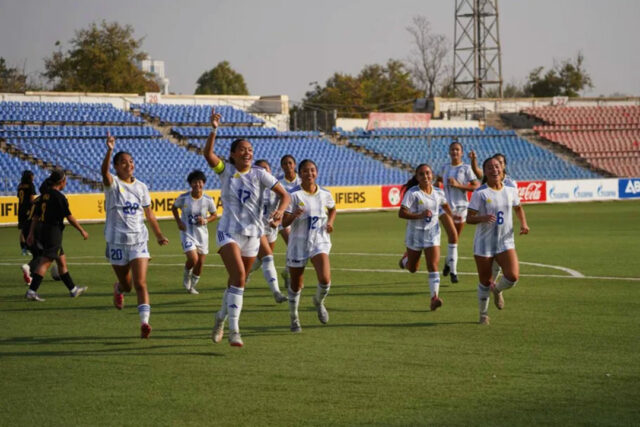
A MONTH after its historic triumph in the Southeast Asian (SEA) Games, the Philippine women’s football team reassembles in the next couple of days for its buildup for the AFC Women’s Asian Cup.

In a joint press conference with Philippine Sports Commission (PSC) Chairman Patrick Gregorio, Philippine Football Federation (PFF) President John Gutierrez said the Filipinas will hold training camps in Manila and Balesin before flying to Australia for the March 1 to 21 meet.

Tuneup matches against two Australian clubs Down Under will highlight the preparations for the coming Group A matches against the hosts in Perth and South Korea and Iran in Gold Coast in the FIFA Women’s World-qualifying Asian tilt.

“They have a very good league in Australia so these friendlies with two first-division teams will help the team in its preparation,” said Mr. Gutierrez.

The PFF chief said Pagcor and property developer Alphaland have come in as sponsors. And it’s because of this partnership with Alphaland that made the 10-day camp in Balesin a possibility.

“There is a FIFA-certified field sa Balesin Island. Now we get to reward the girls for some rest and recreation after their win in the SEA Games and we totally seclude them in the island to prepare for the AFC,” he said.

Meanwhile, Mr. Gutierrez reported that football fields — full-sized and half-sized — are set to rise all over the country through grants from FIFA, AFC and Asean Football Federations amounting to $2.7 million to $3.6 million. He asked the PSC for help to find lands for such projects.

Mr. Gregorio assured the PFF and other national sports associations with similar needs of the PSC’s assistance in tapping government facilities that are “underutilized” as potential sites of “training centers.”

“Were now closely coordinating with DepEd and all State Universities and Colleges. They have thousands of hectares of land but they do not have the funds to develop sports facilities,” he said.

The PSC chief said this is a similar setup with UP, which allowed the PSC to construct a world-class facility for beach volleyball. — Olmin Leyba

Real Madrid, PSG miss automatic qualification at frenetic group-stage finale

LONDON — Real Madrid missed out on automatic qualification for the Champions League knockout rounds as they crumbled to a 4-2 defeat at Benfica on a frenetic final night of group-stage action across Europe on Wednesday.

Kylian Mbappé’s goal had put the 15-time winner on course for the win it needed to secure a top eight finish, but its night ended in chaos as Jose Mourinho’s Benfica roared back.

Benfica was still heading for elimination despite leading 3-2 but goalkeeper Anatoliy Trubin scored its fourth goal in the 98th minute — a header that meant the Portuguese giants crept into the playoffs on goal difference in 24th spot.

Real, who began the night third but ended it ninth and could face Norwegian upstarts Bodo/Glimt in the playoffs, also had Raul Asencio and Rodrygo sent off in stoppage time.

Holders Paris Saint-Germain (PSG) also slipped out of the top eight as it could only draw 1-1 at home to Newcastle United — a result that left both sides facing a playoff despite starting the final night in the automatic places.

Liverpool thrashed Qarabag 6-0 to end its group campaign in style and finish in third place — Alexis Mac Allister scoring twice and Mohamed Salah also among the goals.

Barcelona began the evening in ninth spot but spared itself a playoff tie as it came from a goal down to beat Copenhagen, 4-1. Goals from Robert Lewandowski, Lamine Yamal, Raphinha and Marcus Rashford ensured they finished fifth, one place behind surprise package Tottenham Hotspur who won 2-0 at Eintracht Frankfurt.

Chelsea trailed 2-1 at Napoli but two goals by Joao Pedro earned it a 3-2 win to clinch sixth spot while defeat left Napoli down and out in 30th place.

That meant five of the six English clubs are in the last 16 and could yet be joined by Newcastle.

DRAMA GALORE
Portugal’s Sporting grabbed a last-gasp 3-2 win at Athletic Bilbao thanks to a goal by Alisson Santos to snatch a top eight spot and effectively relegate Real Madrid to the playoffs.

Manchester City beat Galatasaray, 2-0, at home to jump from 11th to eighth and spare itself a repeat of last season when it failed to reach the last 16 after losing to Real Madrid in the playoffs.

Arsenal, who like Bayern Munich was already assured of a top eight finish, became the first club in the new 36-team group format to finish with a 100% record, beating bottom club Kairat Almaty, 3-2. Runners-up Bayern ended with a 2-1 victory at PSV Eindhoven that left the Dutch club eliminated.

Just like last season, UEFA’s expanded Champions League group stage has proved a masterstroke with the suspense lasting to the final seconds of the eighth round of fixtures.

Before the 18 matches kicked off only four of the 36 clubs were definitely eliminated and only Arsenal and Bayern Munich were guaranteed to be in the last 16.

Several who started outside the top eight needed wins and other results to go in their favor with Barcelona, Manchester City and Sporting seizing their chance.

Erling Haaland and Rayan Cherki were on target for City.

Inter Milan got the win it required, beating Borussia Dortmund 2-0 away but, like fellow Italians Juventus, will have to take its chances in the playoffs.

Juventus could only draw 0-0 at Monaco. Dortmund missed out on being seeded for the playoffs, ending 17th.

Nowhere was the drama more compelling than at Atletico Madrid’s Metropolitano Stadium where Diego Simeone’s side hosted Norway’s Bodo/Glimt. Atletico led through Alexander Sorloth’s goal and at one point were into the top eight but Bodo, who stunned Manchester City last week, hit back with goals by Fredrik Sjovold and Kasper Hogh for a remarkable 2-1 win to put the Arctic Circle debutants in 23rd and into the playoffs. — Reuters

Obiena tops International Springer-Meeting in Germany

EJ OBIENA — REUTERS

EJ OBIENA delivered his first golden performance of the season on his road back to redemption after ruling the International Springer-Meeting at the Lausitz Arena in Cottbus, Germany on Thursday.

The reigning Asian and Southeast Asian champion cleared 5.77 meters (m) to deliver his first triumph of the year as he continues to climb from No. 11 in the world and back to old, highest rank a year ago at No. 2.

Mr. Obiena actually shared the victory with the Netherlands’ Menno Vloon, who also had a 5.77 on his second attempt.

The tie was supposed to be settled via a jump off but organizers decided to go out of tradition and award the gold to both Mr. Obiena and Mr. Vloon.

“Brick by brick, we build,” said Mr. Obiena.

It came just a few days after snaring a bronze with a 5.65 m in the 6th ISTAF Indoor in Dusseldorf. — Joey Villar

ADVERTISEMENT
ADVERTISEMENT