US President Vice President Kamala Harris delivers remarks in the East Room of the White House in Washington, U.S., Feb. 23, 2024. — REUTERS
US VICE-PRESIDENT Kamala Harris bluntly called out Israel on Sunday for not doing enough to ease a “humanitarian catastrophe” in Gaza as the Biden administration faces increasing pressure to rein in its close ally while it wages war with Hamas militants.
Ms. Harris, speaking in front of the Edmund Pettus Bridge in Selma, Alabama, where state troopers beat US civil rights marchers nearly six decades ago, called for an immediate ceasefire in Gaza and urged Hamas to accept a deal to release hostages in return for a 6-week cessation of hostilities.
But she directed the bulk of her comments at Israel in what appeared to be the sharpest rebuke yet by a senior leader in the US government over the conditions in the coastal enclave.
“People in Gaza are starving. The conditions are inhumane and our common humanity compels us to act,” Ms. Harris said at an event to commemorate the 59th anniversary of “Bloody Sunday” in Alabama. “The Israeli government must do more to significantly increase the flow of aid. No excuses,” Ms. Harris said.
Her comments reflected intense frustration, if not desperation, within the US government about the war, which has hurt President Joseph R. Biden with left-leaning voters as he seeks re-election this year.
Ms. Harris said Israel must open new border crossings, not impose “unnecessary restrictions” on aid delivery, protect humanitarian personnel and convoys from becoming targets, and work to restore basic services and promote order so that “more food, water and fuel can reach those in need.”
The United States carried out its first air drop of aid in Gaza on Saturday and Ms. Harris is scheduled to meet with Israeli war cabinet member Benny Gantzon Monday at the White House, where she is expected to deliver a similarly direct message.
Israel boycotted Gaza ceasefire talks in Cairo on Sunday after Hamas rejected its demand for a complete list naming hostages that are still alive, according to an Israeli newspaper.
“Hamas claims its wants a ceasefire. Well, there is a deal on the table. And as we have said, Hamas needs to agree to that deal,” Ms. Harris said. “Let’s get a ceasefire. Let’s reunite the hostages with their families. And let’s provide immediate relief to the people of Gaza.”
‘FIGHT FOR FREEDOM IS NOT OVER’ After concluding her remarks about the Middle East, Ms. Harris, the first Black and Asian American woman to serve as No. 2 to the commander-in-chief, turned her attention to the events of Selma and the ongoing effort to address racial inequality.
“Today we know our fight for freedom is not over,” she said. “Because in this moment we are witnessing a full-on attack on hard fought, hard won freedoms, starting with the freedom that unlocks all others: the freedom to vote,” Ms. Harris said, citing laws in states across the country that ban ballot drop boxes, limit early voting and, in Georgia, made it illegal to give food and water to people waiting in line to vote.
At the beginning of their time in office, Mr. Biden appointed Ms. Harris to lead their administration’s efforts to advance voting rights, but the effort largely fizzled without enough votes in Congress to pass new laws on the issue.
Mr. Biden has said democracy is on the ballot in the 2024 election, in which he is likely to face former President Donald Trump, the frontrunner for the Republican presidential nomination who sought to overturn the results of the 2020 election that Mr. Biden won. — Reuters
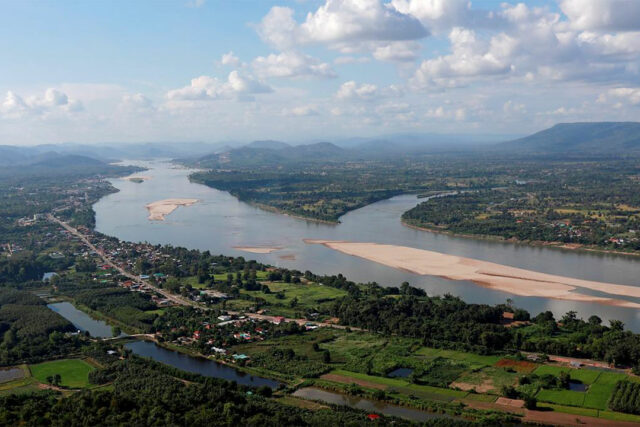
A view of the Mekong river bordering Thailand and Laos is seen from the Thai side in Nong Khai, Thailand, October 29, 2019. — REUTERS
BANGKOK — Unsustainable development threatens the health and diverse fish populations of the Mekong river, with one-fifth of fish species in Southeast Asia’s main artery facing extinction, a report by conservation groups said on Monday.
The Mekong, stretching nearly 5,000 km (3,000 miles) from the Tibetan Plateau to the South China Sea, is a farming and fishing lifeline for tens of millions of people in China, Laos, Myanmar, Thailand, Cambodia and Vietnam.
Threats to its fish include habitat loss, conversion of wetlands for agriculture and aquaculture, unsustainable sand mining, introduction of invasive species, worsening climate change and hydropower dams fragmenting the flow of the river and its tributaries, according to the report compiled by the World Wildlife Fund and 25 global marine and wildlife conservation groups.
“The biggest threat right now, and a threat that’s still potentially gaining momentum, is hydropower development,” said fish biologist Zeb Hogan, who heads the Wonders of the Mekong, one of the groups behind the report.
Dams alter the flow of the world’s third-most biodiverse river, change water quality and block fish migration, he said.
Proliferating Chinese-built hydroelectric dams upriver have blocked much of the sediment that provides essential nutrients to tens of thousands of farms in the Mekong River Delta, Reuters reported in 2022.
Some 19% of the 1,148 or more fish species in the Mekong are heading towards extinction, said the conservationists’ report, “The Mekong’s Forgotten Fishes,” adding that the number may be higher as too little is known about 38% of the species to gauge their conservation status.
Among those facing extinction are 18 species listed as “critically endangered” by the International Union for Conservation of Nature, including two of the world’s largest catfish, the world’s largest carp and the giant freshwater stingray.
“Some of the largest and rarest fish… anywhere on earth occur on the Mekong River,” Mr. Hogan said.
Fish depletion in the Mekong – which accounts for over 15% of the world inland catch, generating over $11 billion annually – could harm food security for at least 40 million people in the Lower Mekong basin whose livelihood depends on the river, the report said.
Hogan said it was “not too late” for countries in the delta to coordinate efforts to reverse the adverse impacts on the fish population.
“If we take action, collectively take action, to develop the river sustainably, there’s still hope,” he said. — Reuters
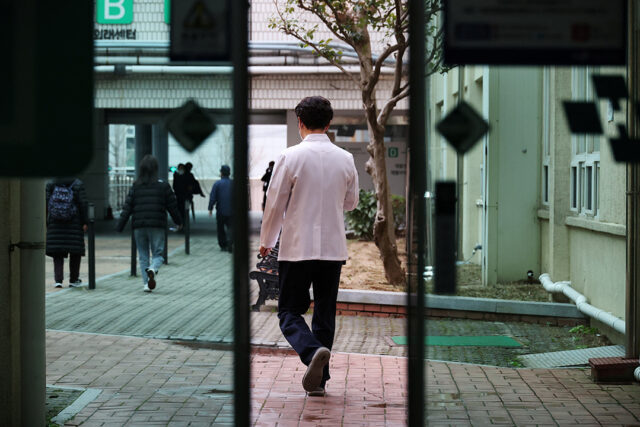
A MEDICAL WORKER walks at Pusan National University Hospital in Busan, South Korea, Feb. 21, 2024. — REUTERS
SEOUL — South Korea’s health minister said on Monday authorities will start inspecting hospitals in order to take legal action against trainee doctors who have ignored an ultimatum to end a walkout over government plans to increase medical school admissions.
Around 9,000 resident and intern doctors, or about 70% of the country’s total, have walked off the job since Feb. 20, leading to the cancelation of some surgeries and treatments and straining emergency departments.
The government had warned the protesting trainee physicians they could face administrative and legal penalties, including the suspension of their medical licenses and fines or a jail term if they did not return to work the end of last month.
“From today, we plan to conduct on-site inspections to confirm trainee doctors who have not returned and take action according to the law and principle without exception,” Health Minister Cho Kyoo-hong told a televised briefing.
“Please keep in mind that doctors who have not returned may experience serious problems in their personal career path.”
For protesting doctors who returned to the field, Mr. Choo said the government would consider extenuating circumstances when contemplating any action against them.
Later, Vice Health Minister Park Min-soo told a briefing that the government would take steps to suspend the medical licenses of some 7,000 trainee doctors who had left their jobs.
Up to now, there has been little sign of either side backing down. Thousands of South Korean doctors held a mass rally on Sunday organized by the Korean Medical Association (KMA), which represents private practitioners, defying official calls for the trainee physicians to return to work.
The World Medical Association, a group representing physicians, said in a statement on Sunday it “strongly condemns the actions of the Korean Government in attempting to stifle the voices of elected leaders within the Korean Medical Association,” adding it affirmed the right of doctors to collective action, including strikes.
The young doctors who are protesting say the government should first address pay and working conditions before trying to increase the number of physicians.
The government says the plan to increase the number of students admitted to medical schools by 2,000 starting in the 2025 academic is needed in a rapidly ageing society with one of the lowest numbers of doctor-to-patient ratios in developed economies of 2.6 doctors per 1,000 people.
The plan to boost medical school admissions is popular with the public, with about 76% of respondents in favor, regardless of political affiliation, a recent Gallup Korea poll found.
Some critics, however, accuse President Yoon Suk Yeol’s government of not consulting enough and of picking a fight over the issue ahead of parliamentary elections in April. — Reuters
ZURICH — Switzerland voted decisively to increase pension payments for the elderly in a referendum on Sunday, as concern over living costs and support for a stronger social safety net trumped questions about how to afford it.
Provisional official results published by the government showed over 58% of voters backed the extra pension, a 13th monthly payment per year, with less than 42% against, a more emphatic victory than final polls had suggested.
The measure, which was promoted by the Swiss Trade Union Federation and left-of-centre parties, also needed the backing of a majority of Switzerland’s 26 cantons to pass. Most supported it, with opposition strongest in lower-tax cantons.
“This step is really a huge milestone from a union perspective,” Lukas Golder of polling firm gfs.bern told SRF.
The government, business lobbies and parliament, which currently leans to the right, had rejected the proposal as financially unsound. Swiss voters have in the past been cautious about backing measures viewed as risky for business.
The pension vote contrasts with referenda in recent decades in which Switzerland clearly rejected proposals that would have shortened the working week and given people more holidays.
Concern about the cost of living is widespread in the wealthy country. Zurich, Switzerland’s biggest conurbation, tied with Singapore as the world’s most expensive city in a study published in November by the Economist Intelligence Unit.
Mery, a 65-year-old Zurich voter, said increased pension payments made sense.
“I’m retired now and so obviously I would like a bit more,” she said, declining to give her full name. “It should allow me to give a little something to my grandchildren.”
It is not clear how the pension boost, which should take effect from 2026, will be funded. Opponents say it could spark tax hikes or spending cuts, and weigh on younger Swiss.
Switzerland’s minimum old age and survivors (AHV) pension is 1,225 Swiss francs ($1,393) a month, and the maximum 2,450 francs. For couples it is capped at 3,675 francs.
Swiss also voted on an initiative to raise the statutory retirement age, which was comfortably defeated.
Voters in Zurich also approved a local proposal to extend runways at the city’s airport, the busiest in Switzerland. — Reuters
Mobile services provider Smart Communications, Inc. (Smart) has announced its exclusive ticket redemption promo to make it so much easier for Filipino fans to get hold of tickets to the much-anticipated “+-= ÷x Tour” or the “Mathematics Tour” of global music icon Ed Sheeran happening at the SMDC Festival Grounds on Saturday, March 9.
Sheeran, who has been rocking his tour since April 2022, is expected to perform songs from his latest album alongside his old chart-toppers like “Tides,” “I’m A Mess,” “Shivers,” “The A Team,” “Castle On The Hill,” “Perfect,” “Lego House,” “Shape Of You,” and “Thinking Out Loud,” among others.
As an added treat to fans, viral British singer Callum Scott and hit Filipino band Ben&Ben are set to front-act for the Grammy-winning artist.
How to redeem Ed Sheeran concert tickets from Smart
Smart Prepaid and Smart Postpaid subscribers who are excited to do the math may redeem their tickets by exchanging their points on the Smart App, which is downloadable on Apple App Store and Google Play Store.
A specific number of points is required to claim a ticket in different categories. Subscribers may also augment their points by topping up promos. The more points, the better the chances of redeeming higher category tickets.
To redeem tickets, subscribers may follow these steps:
Download the Smart App then sign-up or Log-in to your account.
Once in, go to Rewards, then Under Redeem Rewards, tap the Ed Sheeran ‘Mathematics Tour 2024’ in Manila ticket you want to redeem.
Click Redeem button on the pop-up screen to confirm redemption. Subscriber will receive a notification and text message for successful redemption and instructions on how to claim their tickets.
Get ready for a music and visual spectacle
This Manila leg is the 60th stop for “mathematics” and the 10th stop for Sheeran this 2024. Sheeran, who was last here for his “Divide” concert back in 2018, is known to switch up the visual spectacle during his live outings via larger-than-life LED setups and awesome firework displays timed perfectly with each song performance.
Subscribers can rely on the Smart network as they instantly post and share photos, videos, reels, and stories about their favorite moments in the concert with their friends and loved ones via their go-to apps.
Sheeran’s 2024 concert follows a string of world-class acts that Smart brought closer to subscribers, including the Asia Artist Awards 2023, TWICE 5th World Tour “Ready To Be,” and Harry Styles’ “Love on Tour.”
To stay updated about the latest exclusive perks and awesome experiences for Smart subscribers, follow Smart’s official accounts on Facebook, Instagram, YouTube, and TikTok.
Spotlight is BusinessWorld’s sponsored section that allows advertisers to amplify their brand and connect with BusinessWorld’s audience by enabling them to publish their stories directly on the BusinessWorld Web site. For more information, send an email to online@bworldonline.com.
Join us on Viber at https://bit.ly/3hv6bLA to get more updates and subscribe to BusinessWorld’s titles and get exclusive content through www.bworld-x.com.
MELBOURNE — Top lithium producer Australia and major nickel suppliers Indonesia and the Philippines could team up to develop regional battery storage systems, the head of Philippine energy firm ACEN said on Monday.
“It is worth noting that there is concentration of risk for lithium battery production, with over 70% being produced in China alone,” ACEN CEO Eric Francia told delegates to an Australia-ASEAN summit in Melbourne.
“With Australia being the top lithium producer globally, and Indonesia and the Philippines being the top nickel producers,
there are potentially opportunities to establish a regional supply chain and cater to the significant demand for battery storage within our region,” he said.
Any opportunities for electric vehicle batteries would make sense to be in Thailand, while Indonesia may offer more opportunity for large scale battery production, especially as solar power is helping to green the country’s power supply, he added on the sidelines of the event. — Reuters
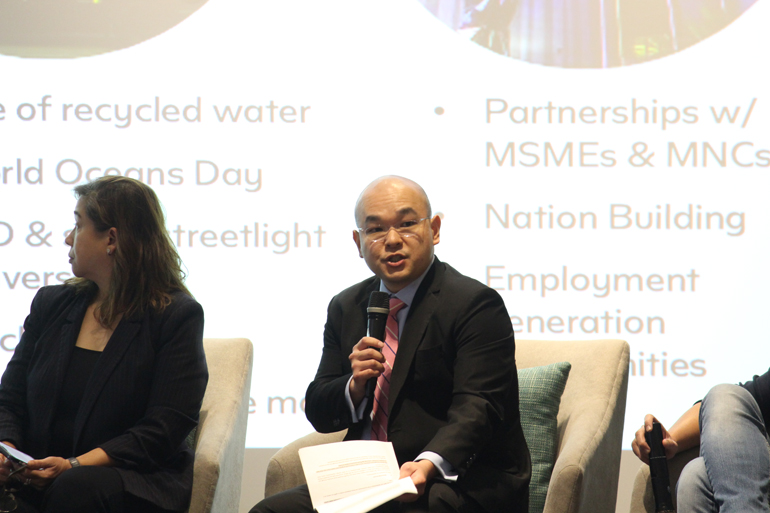
Panel discussion during the BusinessWorld Insights and Project KaLIKHAsan forum themed “The Shift to Green Development” last Jan. 26 at Seda Manila Bay. From L-R: Cathy Rose A. Garcia of BusinessWorld (moderator), Jolan Formalejo of Aboitiz InfraCapital Economic Estates, Gie Garcia of NEO, Alexis L. Ortiga of SM Prime’s Commercial Properties Group, and David Leechiu of Leechiu Property Consultants — Photos by Earl State R. Lagundino
Open doors, hurdles insustainable PHL real estate explored in BusinessWorld Insights forum
By Angela Kiara S. Brillantesand Mhicole A. Moral, Special Features and Content Writers
Natural disasters and sustainability issues have highlighted the vulnerability of traditional infrastructure, prompting a reevaluation of development strategies. Green and resilient real estate development is a strategy that aims to reduce the carbon footprint of buildings while also making them more resistant to natural disasters. This approach is crucial for the environment, as buildings are responsible for a significant number of carbon emissions.
Thus, since the real estate industry is a vital player in the economy, shifting towards green and resilient development can have a positive impact on both the environment and the economy. The opportunities and challenges in realizing such positive impact were explored last Jan. 26 in the BusinessWorld Insights and Project KaLIKHAsan forum themed “The Shift to Green Development” at Seda Manila Bay.
Delivering the keynote presentation, Angelo Tan, country lead for Climate Business Department (CBD) at the International Finance Corp. (IFC), discussed the complexities and opportunities to achieving sustainable real estate.
Mr. Tan emphasized the need for partnerships and the growth of the private sector as a crucial engine for growth in emerging markets like the Philippines.
“Our mandate at the Climate Business Department is to make sure that development is done that’s good for the environment. And when we work with the real estate sector, that means that we need to channel private capital toward climate smart investments,” Mr. Tan explained.
IFC is specifically mandated to collaborate with the private sector in addressing investments related to sustainability. In particular, the IFC’s goal at the Climate Business Department covers a wide range of sectors, including green buildings, renewable energy, electric mobility, waste management, and green cities.
However, Mr. Tan said that the organization does not merely invest in profitable ventures as it ensures that the projects it supports contribute to positive societal development.
“[W]e have a dual mission, ending extreme poverty and boosting shared prosperity in emerging markets. But in 2024, we launched an ambitious new vision and vision for the World Bank Group, and that’s to create a world free of poverty on a livable planet,” he said. “So anything that we now do, it has to be toward development that has a positive impact for the environment. How does that work translate to real estate? When we say sustainable real estate, this is what we mean.”
Keynote Speaker Angelo Tan, country lead for Climate Business Department at the International Finance Corp.
Mitigation and adoption
Mr. Tan emphasized the importance of adopting a green, resilient, and inclusive approach to real estate development since buildings contribute up to 40% of global carbon emissions. The construction and operation of buildings release greenhouse gases (GHG), contributing to the vicious cycle of global warming. The consequences, according to Mr. Tan, are particularly severe in regions like the Philippines, where the impact of climate change is compounded by exposure to frequent and severe disasters.
To break the cycle of environmental degradation, Mr. Tan stressed the importance of a dual approach involving both climate change mitigation and adaptation. Mitigation, he explained, focuses on reducing GHG emissions through measures such as energy-efficient building designs, passive housing, and the use of sustainable technologies like LED lighting. On the other hand, adaptation acknowledges the reality of climate change and aims to enhance resilience against its effects.
Challenges in green development
Mr. Tan identified cost as a primary barrier to the widespread adoption of green and resilient building practices. While various green measures have become more accessible and affordable, there is still an additional cost associated with building green. For developers working in lower-income segments, this added cost poses a significant challenge, as it makes selling prices higher and may deter potential buyers.
“A lot of [green] measures, they’re now much more affordable. So, there’s no excuse for anyone not to do green. But the cold, hard reality is there is an additional cost to doing green,” said Mr. Tan.
The complexity of green development, particularly in terms of certification, was another major challenge highlighted. Developers face additional costs for certifying their projects as green to avoid greenwashing. Mr. Tan emphasized the importance of third-party validation but acknowledged the financial burden it places on developers, particularly in the lower-income housing market.
He added, “There’s an additional cost to certifying as green. Why do you need to certify? Because we want to avoid greenwashing. We don’t want any developer to claim that they’re green without third-party validation. And what happens when you certify a project? You pay architects and engineers to look at your plans, visit the site, do a site audit, and make sure that the building was constructed according to how it was designed.”
In addition, the lack of green building education and expertise, especially among smaller developers outside metro areas, adds to the complexity.
The speaker also identified cultural resistance to change, described as “nakagisnan” (sticking to traditional ways), as a barrier to green development. Some CEOs and CFOs still prioritize financial benefits without fully considering the environmental and social aspects of building practices, he said.
Opportunities in sustainable buildings
Mr. Tan also highlighted key points where businesses and investors are recognizing the importance of sustainable practices.
He noted the Philippines’ leadership in net zero buildings, with the first EDGE zero carbon building in the world located in the country. The ABCs of EDGE zero carbon, which stands for advanced energy efficiency, building retrofits, carbon offsets, and renewables, are explained as the key components of achieving net zero buildings.
“We need to make our buildings more efficient and more to consume less energy. Because what’s the use of having renewable energy if the building is an energy-guzzling building? Then you’re not really making a huge difference. So, we need to make our buildings more energy efficient, and by our standard, 40% energy efficiency. And that way, that standard is now being used by other organizations, 40% improvement over base case,” Mr. Tan explained.
Mr. Tan added that working across building typologies and reaching out to the provinces to transform the industry towards a more green and resilient Philippines is important to achieve the ambitions to be raised towards a more sustainable future.
A long-term investment
The forum also brought industry leaders and experts to discuss how real estate is improving building management and operations responsibly and sustainably.
Alexis L. Ortiga, vice-president for the Commercial Properties Group at SM Prime
Alexis L. Ortiga, vice-president for the Commercial Properties Group at SM Prime, shared that adopting green buildings should be considered a long-term yet smart investment.
“We need to think of sustainability as a marathon instead of a sprint. Green buildings are smart long-term investments, from installing double-glazed windows that lessen the load of AC use, to using gray water and energy recovery technologies that boost efficiency, decrease energy usage, and lower utility bills. The benefits in the long run will far outweigh the costs of today’s investments,” Mr. Ortiga said during the panel discussion of the forum.
For Gie Garcia, co-managing director and chief sustainability officer of NEO, the shift to green buildings should start in optimizing energy-efficient resources then gradually transitioning to renewable power.
David Leechiu, chief executive officer of Leechiu Property Consultants
Leechiu Property Consultants Chief Executive Officer David Leechiu pointed out that the green office market is up and thriving as the green shift among buildings is resulting in a much higher demand for green buildings.
For instance, real estate offices like those from SM Offices have embedded sustainable practices and strategies into their buildings, such as sky garden, walk bridges, bike facilities, and bike lanes, which promote sustainability and wellness of individuals.
Moreover, most demand is coming from multinational companies that aim to deliver more sustainable and green spaces.
“[M]ultinational companies have a high preference for developments that are green because, for one, it’s also integrated into their corporate goals and targets. It’s also part of their values,” Aboitiz InfraCapital Economic Estates Vice-President for Inventory Generation Jolan Formalejo shared.
Concrete steps
The panel also noted the importance for developers to look at green certification, as this can put buildings into a stronger position, minimizing carbon footprint while catering to the needs and demands of occupants, investors, or stakeholders.
Gie Garcia, co-managing director and chief sustainability officer of NEO
According to NEO’s Ms. Garcia, green certification is important depending on the developer’s goals. Some use green certifications because it is advantageous, while others who solely aim for energy-efficient buildings, might not need green building certification but need to ensure compliance with the government’s requirement.
Retrofitting is also noted by the forum’s speakers as a means of making existing buildings more energy-efficient and sustainable.
Retrofitting is the best option for green buildings, Ms. Garcia remarked; nonetheless, embarking on this still depends on whether the building was properly maintained.
Mr. Ortiga of SM Prime, however, shared that retrofitting buildings is not always necessary because other companies are already embedding sustainable practices and strategies without them realizing it, and that’s more than enough.
Besides retrofitting, green buildings need environmental policy and management systems the most.
Jolan Formalejo, vice-president for Inventory Generation at Aboitiz InfraCapital Economic Estates
“For our developments, we have more than five certified green professionals in the company that ensures the continuous efforts are being done to continuously implement efficiency into the into the buildings that we operate.” Mr. Formalejo of Aboitiz InfraCapital said.
It was also noted that besides acquiring materials and technology fit for green buildings, developers and tenants should embrace sustainable practices such as efficient energy consumption, waste management, giving back to nature, as well as cultural reconnection with nature.
Education’s role
The forum also pointed out the significance of education as a starting point in the shift to sustainable real estate.
According to NEO’s Ms. Garcia, sustainable development starts with the younger generation and should be ingrained in their mindset for it to be effective.
IFC’s Mr. Tan mentioned in his keynote the ongoing efforts to bridge this gap through programs offered at universities.
“We’ve partnered with Polytechnic University of the Philippines and National University, so architecture and engineering students at their fourth year can study DfGE (Design for Greater Efficiency). UP has tropical architecture. But beyond that, we don’t have a lot of green architecture education,” Mr. Tan shared, adding that it takes time to get students to absorb information on sustainable development and thus to put that to action.
This forum is part of PhilSTAR Media Group’s initiative titled “Project KaLIKHAsan: Creative Solutions for a Sustainable Future,” which brings together the group’s print, digital, and on-ground platforms to raise the cause of meaningful, concrete sustainability in our industries and communities.
This BusinessWorld Insights forum was presented in partnership with SM Prime and is sponsored by Aboitiz InfraCapital, Megaworld, and RLC Residences; with the support of official venue partner Seda Manila Bay Hotel and official media partner The Philippine STAR.
SYDNEY – Australia said on Monday Indo-Pacific and Southeast Asian countries are facing serious defense threats as it set aside more funds for a maritime security pact with ASEAN countries during a summit with the Southeast Asian bloc.
Foreign Minister Penny Wong said Australia would invest A$64 million ($41.8 million) over four years, including A$40 million in new funding, which would contribute to the security and prosperity of the region, consistent with the priorities of Southeast Asian countries.
“We face destabilizing, provocative and coercive actions including unsafe conduct at sea and in the air,” Ms. Wong said in a speech at the summit, adding free and open sea lanes in the South China Sea was critical for the region’s trade.
“What happens in the South China Sea, in the Taiwan Strait, in the Mekong subregion, across the Indo-Pacific, affects us all.”
China claims almost the entire South China Sea, a conduit for more than $3 trillion of annual ship-borne commerce, including parts claimed by the Philippines, Vietnam, Indonesia, Malaysia and Brunei. The Permanent Court of Arbitration in 2016 said China’s claims had no legal basis.
Philippines Secretary of Foreign Affairs Enrique Manalo said the South China Sea was of strategic importance that holds a promising future.
“However, such future will only be possible if nations in the region resolved to uphold cooperation, over confrontation and diplomacy over the use or the threat of use of force,” Mr. Manalo said in his speech.
The Philippines is ramping up efforts to counter what it describes as China’s “aggressive activities” in the South China Sea, which has also become a flashpoint for Chinese and U.S. tensions around naval operations.
Mr. Manalo said the arbitration is part of international law and nations in the region must stand firmly together in opposing actions that contradict or are inconsistent with it.
Australia last year said it would conduct more joint patrols with Philippines in the South China Sea.
Melbourne is hosting the summit from Monday to Wednesday to mark 50 years of Australia becoming the first external partner of ASEAN. — Reuters
A boy picks out a book at Hernando Guanlao's communal library in Makati, Metro Manila, Philippines, Feb. 7, 2024. -- REUTERS
MANILA – “A good book is easy to find” reads the sign on Hernando Guanlao’s two-storey home located on the outskirts of the Philippines’ main financial district which he has turned into a public library where anyone can borrow books for free.
Called the Reading Club 2000, Mr. Guanlao’s library showcases a wide variety of books he hopes will inspire people, especially young curious minds to read, especially at this time when reading ability among Philippine students remains low.
“The books that one can see here are those used in K-12 (elementary books), novels which students and enthusiasts can make use of,” the 72-year-old man said at his home crammed with thousands of books in stacks.
“There are also spiritual books for those who are looking for religious knowledge, hardbound and softbound books, autobiographies, and many different genre’s that one can enjoy, all for free,” he said.
What started as a 50-book display on the sidewalk fronting his home more than two decades ago, Mr. Guanlao’s collection has grown exponentially over the years, thanks to a steady supply of books from donors, some of whom opted to stay anonymous.
“They just leave boxes of books outside my house,” said Mr. Guanlao, who has also started shipping reading material to public schools in far-flung communities.
Philippine students are facing learning setbacks with math, science and reading scores among the lowest in the world, according to the Program for International Student Assessment.
“My mission is to give away used and donated books to others at no cost and to promote education through literature,” Mr. Guanlao said. — Reuters
AN AERIAL photo of Philippine-occupied Thitu Island, locally known as Pag-asa, in the contested Spratly Islands. — REUTERS
MANILA – The Philippines on Monday deployed a coastguard vessel to carry out a two-week patrol mission in waters north and east of the country to intensify its maritime presence and check on Chinese research vessels that were spotted in Benham Rise.
Benham Rise, which sits off the Philippines’ east coast, is a vast area declared by the United Nations in 2012 as part of the country’s continental shelf. Manila in 2017 renamed it “Philippine Rise.”
The Philippine Coast Guard (PCG) said in a statement its vessel will patrol the waters to conduct maritime domain awareness, intensify its presence in the northern Luzon island and monitor local fishermen.
“We will also check the reported Chinese research vessels in Benham Rise,” PCG spokesperson Armando Balilo said.
Benham Rise, said to be rich in biodiversity and fish stocks, is not in the South China Sea and Beijing has made no claim to it.
China is however involved in a territorial dispute with the Philippines over islands in the South China Sea, which Beijing claims almost entirely despite a 2016 arbitration ruling that said its claim had no legal basis under international law.
Ray Powell, director of SeaLight at the Gordian Knot Center for National Security Innovation, said on platform X on Friday that two Chinese research vessels left a port in Longxue Island in Guangzhou on Feb. 26 and were “loitering” northeast of Benham Rise, within the Philippines exclusive economic zone.
There was no immediate comment from the Chinese embassy in the Philippines. — Reuters
Inflation likely accelerated in February as prices of food and power increased. — PHILIPPINE STAR/MIGUEL DE GUZMAN
By Luisa Maria Jacinta C. Jocson, Reporter
HEADLINE INFLATION likely quickened in February amid higher prices of key commodities like food, electricity and fuel, analysts said.
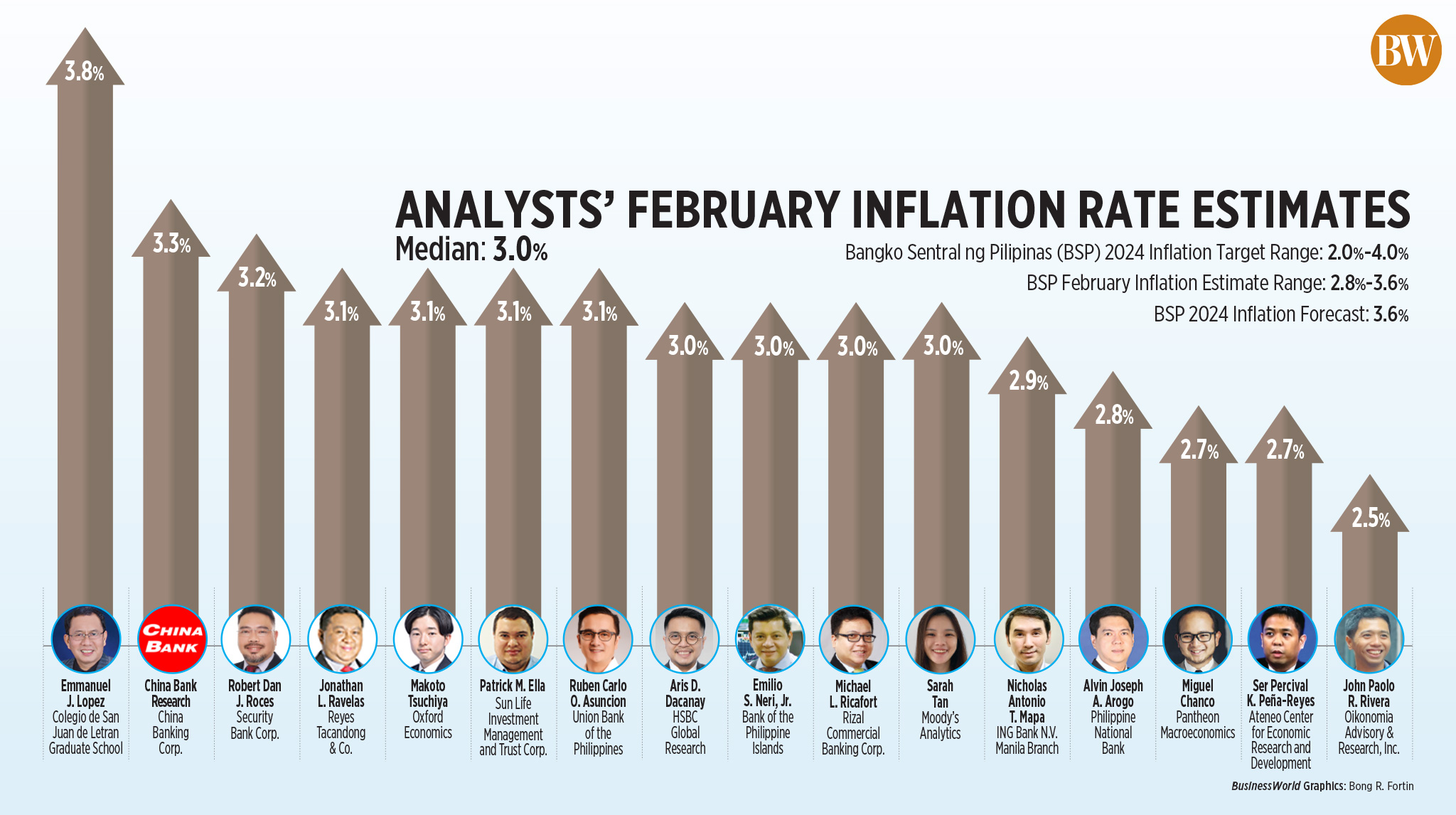
A BusinessWorld poll of 16 analysts yielded a median estimate of 3% for the consumer price index (CPI) in February. This is within the 2.8-3.6% forecast of the Bangko Sentral ng Pilipinas (BSP) for the month.
If realized, February inflation would be slightly faster than the 2.8% print in January but much slower than 8.6% in the same month a year ago.
It would also mark the first time that inflation picked up on a month-on-month basis since September 2023.
February would also mark the third straight month that inflation was within the BSP’s 2-4% target range.
The Philippine Statistics Authority (PSA) is set to release February inflation data on Tuesday (March 5).
“We look for headline inflation to accelerate a touch to 3% year on year in February from 2.8% in January,” Sarah Tan, an economist from Moody’s Analytics, said in an e-mail.
“Key factors driving upward price pressures include higher prices of key agricultural goods such as rice and meat produce, an increase in electricity rates as well as higher petroleum prices,” she added.
Data from the Agriculture department showed that as of Feb. 29, the price of a kilogram of local well-milled rice ranged from P48 to P55 from P37 to P45 in the same period a year ago. Regular-milled rice rose to P50 per kilogram from P32 to P40.
ING Bank N.V. Manila Senior Economist Nicholas Antonio T. Mapa said that rice continued to be a main driver of inflation.
“High domestic rice prices and a hike in electricity rates also fanned inflationary pressures during the month. Global rice prices slightly eased by the end of February but its impact on domestic prices will likely take some time before taking effect,” HSBC economist for ASEAN Aris Dacanay said in an e-mail.
China Bank Research also noted electricity rates rose in areas serviced by Manila Electric Co. (Meralco), as well as parts of Visayas and Mindanao, during the month.
The overall rate for a typical household rose by P0.5738 to P11.9168 per kilowatt-hour (kWh) in February from P11.3430 in the previous month, Meralco said. This was due to an increase in the generation charge, which accounts for almost 80% of a consumer’s monthly electricity bill.
“Also, the Department of Energy reported an increase in crude oil prices due to supply-side constraints coming from the Organization of the Petroleum Exporting Countries output caps and lingering conflicts along the Red Sea,” Ms. Tan added.
In February alone, pump price adjustments stood at a net increase of P1.05 a liter for gasoline, P1.55 a liter for diesel and P0.35 a liter for kerosene.
Meanwhile, analysts said that fading base effects have also contributed to the potential uptick in inflation.
“Inflation for February could pick up to 3% year on year mathematically due to some easing of the high base effects,” Rizal Commercial Banking Corp. Chief Economist Michael L. Ricafort said in an e-mail.
Mr. Dacanay also noted the “unfavorable” base effects due to the peak in inflation in January 2023, which stood at a 14-year high of 8.7%.
“Without any sudden change in policy or external conditions, these unfavorable base effects will likely remain in place until July of this year and can potentially push inflation to breach the central bank’s 2-4% target band sometime in the second quarter,” he added.
RISKS TO OUTLOOK In the coming months, analysts said inflation may spike in the middle of the year.
“Looking ahead, we anticipate inflation will breach the BSP’s 2-4% target again from April to July due to base effects. However, average headline inflation will likely settle within target this year,” China Bank Research said.
Philippine National Bank economist Alvin Joseph A. Arogo flagged risks to the inflation outlook, such as the El Niño weather event.
“Our baseline estimates assume that amid the wearing-off of base effects, there will be a transitory spike in prices because of the threats from El Niño, possible Middle East conflict escalation, and lagged impact of minimum wage hikes,” he said in an e-mail.
The latest bulletin from the state weather bureau showed that the El Niño will likely persist until May.
Earlier estimates by the central bank showed that the dry weather pattern could impact inflation by 0.02 percentage point.
“We expect some volatility in the inflation readings over the next few months given the El Niño weather pattern could strengthen and keep food prices elevated,” Moody’s Analytics Ms. Tan said.
“We understand that we are now experiencing El Niño, however, we note that other crops appear to have prices either falling or more behaved. If authorities can find a way to lower the cost of rice, we could see inflation well under control,” Mr. Mapa added.
Fading base effects and the El Niño could cause inflation to peak at 5% in the June-July period before easing to 3.5% in September, Union Bank of the Philippines, Inc. Chief Economist Ruben Carlo O. Asuncion said.
POLICY CUT Despite the potential uptick in inflation, analysts expect the BSP to keep rates steady until it begins policy easing in the middle of the year.
Sun Life Investment Management and Trust Corp. economist Patrick M. Ella said he expects the BSP to cut rates starting June.
“Should February’s inflation print settle within the BSP’s target range of 2% to 4%, this will give the BSP confidence to keep its policy rate steady when they next meet on April 4,” Ms. Tan said.
The BSP kept its benchmark rate steady at 6.5% at its February meeting. The central bank raised borrowing costs by 450 basis points (bps) from May 2022 to October 2023.
“Our base case at the moment is that the Monetary Board will start normalizing (cutting) rates in May, by 25 bps, with 2024 likely to see a total of 100 bps in reductions,”Pantheon Chief Emerging Asia Economist Miguel Chanco said.
ING’s Mr. Mapa also said the BSP will remain on hold as long as the US Federal Reserve keeps rates unchanged.
THE NATIONAL GOVERNMENT’S (NG) gross borrowings increased to P2.193 trillion in 2023 amid a rise in external debt, the Bureau of the Treasury (BTr) reported.
Data from the BTr showed that total borrowings went up by 1.38% last year from P2.163 trillion in 2022.
This was also slightly below the P2.207-trillion borrowing program for the year.
Gross external debt jumped by 7.49% to P559.035 billion last year from P520.091 billion in 2022. This was higher than the P553.5-billion targeted borrowings from foreign sources.
External debt was composed of P204.279 billion in program loans, P163.607 billion in global bonds, P135.858 billion in new project loans and P55.291 billion in Islamic certificates.
In January, the Philippine government raised $3 billion from a US dollar bond issuance and its second global bond offering under the Marcos administration.
It also generated $1 billion from the sale of its maiden offering of Sukuk bonds in December.
Meanwhile, gross domestic debt slipped by 0.6% to P1.634 trillion last year from P1.643 trillion in 2022. This accounted for 74.5% of borrowings during the year.
The BTr was expected to borrow P1.654 trillion from domestic sources last year.
Broken down, it raised P1.18 trillion from fixed-rate Treasury bonds (T-bonds), P252.091 billion from retail T-bonds, P119.531 billion from Treasury bills (T-bills).
It also collected P71.78 billion from retail onshore dollar bonds and P15 billion from tokenized bonds.
The Marcos administration offered its first retail dollar bonds in late September. It also conducted its first-ever sale of tokenized Treasury bonds in November.
In December alone, gross borrowings jumped by 55% to P92.096 billion from P59.434 billion a year ago.
Domestic borrowings resulted in a net redemption of P6.186 billion versus the P32.956-billion debt in the same month in 2022.
The BTr raised P20 billion from fixed-rate T-bonds while T-bills stood at a net redemption of P26.186 billion.
On the other hand, external debt skyrocketed (271.2%) to P98.282 billion in December from P26.478 billion.
This consisted of P26.285 billion in new project loans, P16.706 billion in program loans, and the P55.291 billion raised from the Sukuk offering.
Rizal Commercial Banking Corp. Chief Economist Michael L. Ricafort said that the single-digit growth in borrowings may be due to the narrower budget deficit.
The NG’s fiscal deficit narrowed by 6.32% to P1.51 trillion in 2023 from P1.61 trillion in the year earlier.
This brought the deficit-to-gross domestic product (GDP) ratio to -6.2% at the end of the year, a tad higher than the -6.1% government target but lower than the -7.3% ratio recorded at end-2022.
The budget deficit ceiling is set at P1.39 trillion this year, or 5.1% of GDP.
“Low growth in borrowings would bode well to temper the growth in the outstanding National Government debt stock and would help bring down the debt-to-GDP ratio to below the international threshold of 60%,” Mr. Ricafort added.
The debt-to-GDP ratio stood at 60.2% at the end of 2023. This was lower than 60.9% at end-2022 and the 61.2% target set by the government.
Mr. Ricafort said that possible policy easing in the middle of the year could also reduce borrowing costs.
“Possible Fed rate cuts later this year that could be matched locally could somewhat help ease debt servicing costs and overall borrowings,” he added.
The Federal Reserve raised its policy rate by 525 basis points (bps) to 5.25-5.5% from March 2022 to July 2023.
Analysts anticipate that once the Fed begins cutting rates, the Bangko Sentral ng Pilipinas (BSP) will soon follow.
From May 2022 to October 2023, the Monetary Board raised borrowing costs by 450 bps, bringing the benchmark rate to 6.5%.
The government’s borrowing program for this year is set at P2.46 trillion, with P1.85 trillion to be raised from the domestic market and P606.85 billion from foreign sources.
In February, the government raised P584.86 billion from its offering of five-year retail Treasury bonds. — Luisa Maria Jacinta C. Jocson