Home Blog Page 35

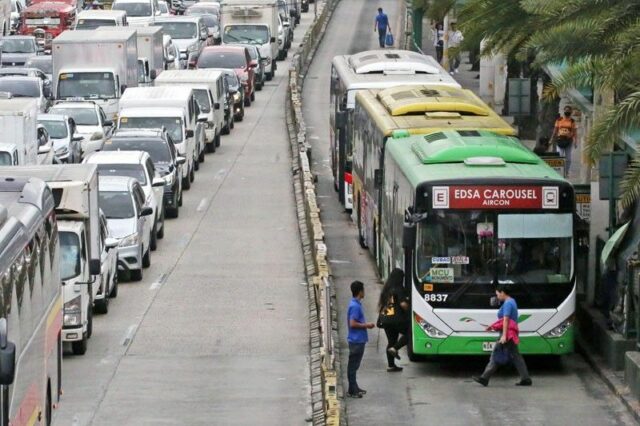
More EDSA Busway stations seen next year

PHILIPPINE STAR/EDD GUMBAN

THE Department of Transportation (DoTr) said it expects to open additional Busway stations along Epi-fanio de los San-tos Avenue (EDSA) next year.

“By the first quarter, we are going to add three more stations,” Transportation Acting Secretary Giovanni Z. Lopez said at an event last week.

The DoTr said additional stations will open in Cubao, Magallanes, and the Parañaque Integrated Terminal Exchange (PITX).

Separately, Undersecretary for Road Transport and Infrastructure Mark Steven C. Pastor said the DoTr will be focusing on upgrading EDSA Busway stations rather than working on the planned privatization for its operations and maintenance.

“(Privatization) is not our priority at this point due to the fuel price increases. The agency wants to focus on ensuring that there is public transportation available, but we are looking at solicited bids after completing the station upgrades,”  Mr. Pastor told reporters on the sidelines of a briefing.

The DoTr has said that it hopes to privatize the EDSA Busway system by 2026 or 2027.

The EDSA Busway Project initially involved the financing, design, construction, procurement of low-carbon buses, route planning, and operations and maintenance of the busway, according to the Public-Private Partnership (PPP) Center.

For this year, the DoTr is projecting 70 million passengers for EDSA Busway, citing greater effi-cien-cies due to mod-ern-iz-a-tion.

In a notice of award dated Dec. 29, 2025, the DoTr announced that the P251.06-mil-lion con-tract for the design and con-struc-tion of the new busway sta-tions and foot-bridges was awarded to Uni-mas-ters Con-glom-er-a-tion, Inc.

The EDSA Busway, a ded-ic-ated bus lane along Metro Manila’s main ring road, cur-rently has 23 sta-tions oper-at-ing round-the-c-lock. — Ashley Erika O. Jose

Gov’t to repay CARS participants by 2027

REUTERS

THE government is expected to repay car manufacturers participating in the Comprehensive Automotive Resurgence Strategy (CARS) program by next year, the Department of Trade and Industry (DTI) said.

“I have already resumed signing the TPCs (tax payment certificates),” Trade Undersecretary Ceferino S. Rodolfo told reporters on the sidelines of the Manila International Auto Show last week.

“(Payments) will be completed in 2027,” he said.

In January, the government said obligations incurred due to the CARS program will be funded with savings from the Department of Public Works and Highways’ (DPWH) 2025 budget.

President Ferdinand R. Marcos, Jr. had vetoed P4.32 billion in unprogrammed appropriations in the 2026 budget meant for the CARS program.

CARS participants awaiting payments are Toyota Motor Philippines Corp. (TMP), Mitsubishi Motors Philippines Corp. (MMPC), and several auto parts markers.

Any remaining validated requirements that have not yet been issued TPCs and are not funded by the 2026 General Appropriations Act may be included in the proposed 2027 budget, according to the joint statement issued earlier this year by the DTI, the Department of Finance (DoF) , and the Department of Budget and Management (DBM). 

If included in the 2027 National Expenditure Program, CARS funding will be subject to cash programming to ensure these are settled, the agencies said.

Launched in 2015 through Executive Order No. 182, the CARS program sought to incentivize domestic vehicle manufacturing.

Fiscal support was given to automotive companies that domestically produced at least 200,000 units of an enrolled vehicle model within six years.

The registered manufacturers included TMP, which manufactures the Vios sedan, and MMPC, which produces the Mirage hatchback and Mirage G4 sedan. — Beatriz Marie D. Cruz

ECC permit process to go ‘on wheels’ for SMEs

DENR FACEBOOK PAGE

THE Department of Environment and Natural Resources (DENR) said it will make the permit process for environmental clearance certificates (ECCs) available in cities and municipalities to ease the travel burden on small and medium enterprises (SMEs).

In a statement on Sunday, the DENR said the “Permitting on Wheels” program will bring these services directly to cities and municipalities once a month, eliminating the need for applicants to travel to regional offices.

“For years, securing environmental permits and clearances meant that entrepreneurs… had to take days off work and spend heavily on transportation to reach distant regional government offices,” Environment Secretary Juan Miguel T. Cuna said in the statement.

The DENR said the program will be launched nationwide on April 14-15. Simultaneous rollouts are also planned in other key cities and municipalities.

Personnel from the Environmental Management Bureau will be deployed on site to assist applicants with requirements related to air and water quality management, environmental impact assessments, hazardous waste, and chemicals management, it said.

Applicants may also file permits on site, including those for tree cutting, importing chainsaws, wildlife transport, and related certifications.

The DENR said the mobile hubs will provide real-time validation of documents, allowing applicants to address deficiencies immediately with the help of technical staff.

The service will also include assistance for filing online applications, particularly for those unfamiliar with digital systems.

The DENR said the initiative is expected to reduce delays in applications for permits such as Certificates of Non-Coverage, wastewater discharge permits, and hazardous waste registrations.

The two-day rollout will include lectures on environmental compliance and system walkthroughs. A livestream will also be made available for those unable to attend in person.

The DENR said it plans to make the program a permanent monthly service following the launch. — Vonn Andrei E. Villamiel

DoE rules out travel for ASEAN energy meetings

FREEPIK/PVPRODUCTIONS

THE Department of Energy (DoE) will turn to virtual meetings for Association of Southeast Asian Nations (ASEAN) energy discussions, citing the need to save energy with fuel prices remaining volatile due to the fighting in the Middle East.

In a statement on Sunday, the DoE said the shift to virtual covers the succeeding meetings of the ASEAN energy sector, following the successful hosting of the ASEAN Special Senior Officials Meeting on Energy in Bohol in January.

The Philippines sets the agenda on ASEAN matters during its chairmanship this year.

“Even as we adjust the format of our meetings, the Philippines remains fully committed to delivering a productive and results-oriented ASEAN energy chairmanship,” Energy Secretary Sharon S. Garin said.

“By moving the meetings online, we can use resources more prudently, remain responsive to current realities, and sustain close coordination with our fellow ASEAN Member States and partners,” she added.

The government is seeking to recalibrate the hosting of ASEAN 2026 by scaling down nonessential activities “in order to save on expenses and focus on the most important.”

The DoE’s remaining engagements include  sub-sector meetings in April and May, the Senior Officials Meeting on Energy in June, and the ASEAN Ministers on Energy Meeting in September.

The virtual format is not expected to diminish the Philippine role in advancing ASEAN’s energy agenda.

“The Philippines will continue to advance regional priorities that strengthen energy security, enhance resilience, and support a more connected and future-ready ASEAN energy landscape,” the DoE said.

The DoE likewise  affirmed its commitment to sustained engagement with ASEAN Member States, the ASEAN Secretariat, the ASEAN Centre for Energy, and dialogue partners throughout the chairship period to ensure that discussions remain substantive, coordinated, and outcome-driven. — Sheldeen Joy Talavera

Balancing growth, innovation, and trust in PHL banking

IN BRIEF:

• Philippine and Asia‑Pacific banks are prioritizing growth and upside risk management while adapting to rapid digital transformation amid rising regulatory, technological, and competitive pressures.

• Banks must balance innovation with trust by strengthening governance, cybersecurity, operational resilience, and legacy systems, while adopting technologies such as AI and blockchain.

• Long‑term success depends on future‑ready skills, adaptive leadership, and a mindset that embraces continuous change while maintaining confidence among customers, regulators, and stakeholders.

Asia-Pacific (APAC) and Philippine narratives continue to be about growth and dealing with upside or growth risks, as opposed to downside risks that would correctly describe economies that went through crises. Banks continue to update their decision-support, compliance, and risk management models in parallel with their transformation and innovation initiatives while meeting heightened expectations from regulators, customers, and investors. To navigate this complexity effectively, a focused and balanced portfolio will enable banks to drive synergies across the organization and unlock value from upside risk opportunities. This requires a shift from merely mitigating risks to actively embracing upside potential, grounded in a strong foundation of trust.

This is the second article of the Financial Regulatory Outlook series, which builds on insights from the SGV Knowledge Institute event, “Global Shifts, Local Impact: Navigating the Next Wave of Banking Regulation.”

The previous article presented insights from the EY Global Regulatory Outlook, which was issued against a backdrop of increasingly rapid technological innovation and a changing competitive landscape that is becoming more ecosystem-based and ‘friendlier’ to nontraditional players. This environment presents new risks for banks, particularly in relation to the digital world, with big-tech companies and nimbler entrants threatening profitability and making the regulatory direction less clear.

This underscores the need to create both regulatory and management frameworks that strike a balance between allowing for change and innovation while ensuring financial sector stability and protecting customers and the public.

However, innovation in banking is inherently challenging. Banks operate within complex business models, rely heavily on legacy core systems, and are subject to intense regulatory scrutiny. These challenges can be understood through recurring paradoxes that banks must continuously manage. The resulting tensions drive the need for banks to have more adaptive and resilient models.

MANAGING TECHNOLOGY RISK IN A DIGITAL‑FIRST ENVIRONMENTDigital transformation efforts will accelerate on multiple fronts during the next five years as banks continue to embrace widespread transformation programs to meet shifting customer needs, stay ahead of new competitors and achieve operational excellence.

These efforts are closely aligned with the BSP’s overarching digital transformation strategy, which encourages financial institutions to shift toward digital-first banking to improve convenience, inclusion, and efficiency. At present, major banking institutions are actively integrating artificial intelligence (AI) for fraud detection and credit scoring, as well as blockchain payment rails to streamline operations and expand access to financial services.

Despite the significant opportunities presented by digital innovation, cybersecurity and technology risks — including risks associated with the design, development, and deployment of digital systems and infrastructure — remain a top priority for banks. Bank leaders continue to be confronted with the risk-vs. opportunity paradox, particularly around AI adoption: assessing whether AI will introduce new and complex risks or strengthen the bank’s ability to identify, manage, and mitigate risk more effectively.

Recognizing both the promise and the risks of innovation, regulators have introduced measures such as the Financial Services Cyber Resilience Plan (2024-2029) to promote industry-wide coordination, enhance defenses against evolving cyberthreats, and safeguard stakeholder trust.

Balancing innovation and growth with trust, resilience, and regulatory compliance is critical to long-term success. Achieving this balance requires banks to design and adopt innovation-friendly governance frameworks, with clearly defined risk limits, accountabilities, and decision rights embedded directly into business-as-usual operations.

DUAL‑TRACK TECHNOLOGY TRANSFORMATION
Robust and reliable technology is essential to enable successful banking transformation and sustain continuous innovation and growth. However, while the adoption of new technologies is critical, core banking system disruptions are unacceptable, given the “always on, always available” nature of banking services and the sector’s reliance on uninterrupted operations to maintain customer trust, financial stability, and regulatory compliance.

Banks operate within highly complex and interconnected environments, often reinforced by legacy core banking systems that are deeply embedded in critical business processes. Beyond managing vast volumes of sensitive customer and transaction data, important business services depend on legacy platforms, layered architectures, and extensive policy frameworks. These interdependencies heighten the risk that system changes, upgrades, or migrations may disrupt critical services, making transformation initiatives particularly challenging.

Philippine banks are increasingly adopting a dual-track approach to technology transformation, balancing the need to protect mission‑critical legacy systems while simultaneously deploying new digital capabilities.

Under this model, banks deploy new digital tools to enhance existing systems through familiar channels and interfaces, minimizing disruptions to day-to-day operations and reducing change risks for both customers and employees. Similarly, legacy technology can be “wrapped” with new features, functionality, and AI-based user experiences without exposing the institution to the operational and regulatory risks of full system replacement — a key consideration in the Philippine regulatory environment.

BUILDING FUTURE‑READY TALENT
As technologies continue to evolve at pace, banks must ensure their talent keeps up to sustain transformation momentum. People are at the core of successful transformation; hence, banks need to continuously upskill their workforce to adopt emerging technologies.

According to the Global Bank Risk Management Survey 2024, the APAC region faces the most significant challenges in attracting and retaining cybersecurity talent. Digital growth across the region is accelerating faster than talent development, resulting in a widening skills gap. In the Philippines and other emerging markets, there is a strong foundation of technical talent, but capability gaps remain due to limited exposure to advanced cybersecurity roles, enterprise-scale environments, and governance, risk, and regulatory frameworks.

Over the next five years, risk professionals anticipate the need for more specialized skill sets across both the first and second lines of defense to address increasingly complex and fast-evolving risks. Bank leaders must therefore proactively define the skills required for the future and implement a deliberate strategy to develop and acquire these capabilities while continuing to retain and strengthen expert talent in core areas.

Workforce shifts are inevitable. As AI tools increasingly meet basic analytical needs and automate routine tasks associated with traditional risks, teams are expected to move from today’s pyramid (with more workers in junior roles) to tomorrow’s diamond shapes (with more senior-level specialists with stronger judgment, domain expertise, and decision-making capabilities).

As this transition accelerates, leaders must also address widespread concerns about AI’s potential to replace jobs. Successfully navigating this shift will require clear communication, targeted upskilling, and a strong focus on redeploying talent toward higher-value activities.

DRIVING ORGANIZATIONAL ADAPTABILITY
While technology enables transformation, its success in financial institutions ultimately depends on people and effective leadership. While investments in digital platforms, cybersecurity tools, AI, and data analytics are critical, their impact will remain limited unless organizational culture, leadership behaviors, and ways of working evolve in parallel. Transformation success ultimately lies in how people think, act, and collaborate.

As Philippine regulations increasingly focus on technology risk, cyber resilience, data governance, ESG, and AI, the ability of banks to adapt is being tested beyond traditional compliance capabilities. Meeting these demands requires not only new tools and frameworks, but also greater agility, judgment, and cross-functional collaboration across the organization.

To succeed, leaders must enable people to work adaptively, experiment creatively and think differently. People and teams may need convincing that continuous improvement is a requirement for long-term success and that while change is difficult, its long-term benefits far outweigh the short-term disruption it creates.

SUSTAINABLE GROWTH THROUGH TRUSTED INNOVATION
As banks continue to pursue growth through rapid digital innovation, maintaining trust and resilience is more critical than ever. The industry’s path forward will be shaped by how effectively it manages the inherent paradoxes of innovation: adopting new technologies while protecting mission-critical systems, building future-ready skills while retaining core expertise, and driving continuous change without eroding confidence among customers, regulators, and stakeholders.

By adopting adaptive operating models, innovation-friendly risk frameworks, and a mindset that treats change as constant, banks can unlock upside opportunities while reinforcing long-term trust from stakeholders.

This article is for general information only and is not a substitute for professional advice where the facts and circumstances warrant. The views and opinions expressed above are those of the authors and do not necessarily represent the views of SGV & Co.


Charisse Rossielin Y. Cruz is a Business Consulting Partner and the Insurance Sector Deputy Leader, and Eleonor L. Camot is a Financial Services Consulting Senior Director, both of SGV & Co.


Eala faces Fil-Canadian Fernandez at Porsche Grand Prix in Stuttgart

ALEX EALA — FACEBOOK.COM/PORSCHETENNIS

PHILIPPINE tennis will be in full display as homegrown bet Alexandra “Alex” Eala and Filipina-Canadian stalwart Leylah Fernandez collide an intriguing and rare duel to start the Porsche Tennis Grand Prix on Monday in Stuttgart, Germany.

The match is set at late afternoon at the posh Porsche Arena pending delays of the first matches, promising an explosive duel for the first time between two of the world’s fast-rising stars today.

Ms. Eala, 20, has become one of the international crowd darlings this year after a magnificent run that pushed her to a career-best ranking of No. 29 in the Women’s Tennis Association (WTA) rankings.

She has slipped to No. 46 after falling short from replicating a Final Four finish in the Miami Open but is expected to climb the ladder anew after kickstarting her clay campaign in the Upper Austria Ladies Linz Open last week.

Ms. Eala reached the second round and fell to former French Open champion Jelena Ostapenko of Latvia for the first time, 6-4, 7-5, after winning their first two meetings.

The 23-year-old Ms. Fernandez, whose mother is a Filipina but was born and grew up representing Canada, boasts a higher ranking at No. 25 and reached a career-best of No. 13.

She’s best known as a finalist in the 2021 US Open, bowing to another young star in now 23-year-old Emma Raducanu of the United Kingdom, to mark her rise in world tennis.

Ms. Fernandez, who’s fresh from a Round of 16 finish in the Charleston Open in the United States, also has five WTA titles compared to Ms. Eala’s one to loom as the heavy favorite.

Ms. Eala advanced to the Stuttgart main draw from the qualifying round as a late replacement of Paris Olympic gold medalist and No. 37 Qinwen Zheng of China, who withdrew due to injury.

Both Mses. Eala and Fernandez are left-handed for an added spice as they rev up for the much-awaited queen of clay tourney at the Roland Garros in Paris on May 24 to June 7.

The winner gets a shot against either world No. 8 Jasmine Paolini of Italy or a qualifier in Round 2.

Aside from Ms. Paolini as the No. 5 seed in Stuttgart, also in the fray are top-ranked players in world No. 2 Elena Rybakina of Kazakhstan, No. 3 Coco Gauff of the USA, No. 4 Iga Swiatek of Poland, No. 4 Elina Svitolina of Ukraine, No. 10 Mirra Andreeva of Russia, No. 12 Karolina Muchova of Czechia and No. 13 Ekaterina Alexandrova of Russia to complete the Top 8 seeds. — John Bryan Ulanday

NU blasts win-less Lady Warriors, earns Final Four slot in UAAP Season 88 women’s volleyball tourney

NU LADY BULLDOGS vs UE Lady Red Warriors — JOAQUI FLORES/UAAP

Games on Wednesday
(UST Quadricentennial Pavilion)
9 a.m. – UE vs DLSU (Men)
11 a.m. – UE vs DLSU (Women)
3 p.m. – AdU vs UP (Men)
5 p.m. – AdU vs UP (Women)

TITLEHOLDER National University (NU) made short work of cellar-dweller University of the East (UE), 25-19, 25-14, 25-14, and clinched its fifth straight Final Four stint in the UAAP Season 88 women’s volleyball on Sunday at the UST Quadricentennial Pavilion.

Peaking at the right time, the three-peat seeking NU Lady Bulldogs notched their third win in a row and improved to 9-3 while staying on track to securing the second twice-to-beat incentive next to unbeaten De La Salle University (12-0).

NU now has a two-game lead over Adamson University and University of Santo Tomas, at joint third with 7-5 slates, in a race for the coveted second seed as all teams await for either a traditional or stepladder Final Four format.

“Hopefully, it does not end just in the top four, hopefully we get to be up there. We want that twice-to-beat advantage and we want to play in the championship games,” said mentor Regine Diego as NU seeks to spoil La Salle’s outright finals in the penultimate playdate on Sunday at the Mall of Asia Arena.

NU, despite a first-round loss in four sets, poses the biggest threat on the automatic finals passage bid of La Salle, which also has the win-less UE in its schedule prior.

The Lady Bulldogs, whose last match is against Santo Tomas next Wednesday, made sure to prepare for that by dodging any possible scare from the UE Lady Warriors with the easy win in 84 minutes.

Team captain Vange Alinsug, super rookie Sam Cantada and Arah Panique teamed up with 11 points each while Alexa Nichole Mata and Chams Maaya added eight and six points, respectively.

No player finished in double figures once again for the Lady Warriors (0-12), who absorbed their 26th straight loss since last season.

Skipper Van Bangayan and Khy Cepeda had seven and five points, respectively, for the Lady Warriors entering a tall order against the mighty Lady Spikers this Wednesday at the same venue.

In the men’s division, Leo Ordiales scored 12 points as five-peat champion NU clinched a twice-to-beat incentive with a 25-16, 25-21, 25-15 win against UE (2-10). — John Bryan Ulanday

Karl Eldrew Yulo settles for seventh in Gymnastics World Cup Series in Croatia

KARL ELDREW YULO — FACEBOOK.COM/ PHILIPPINEGYMNASTICS

KARL ELDREW YULO was slowed down by foot issues and fatigue and finished only seventh in the FIG Artistic Gymnastics World Cup Series in Osijek, Croatia over the weekend.

The 18-year-old younger brother of world and Olympic champion Carlos managed just 13.600 and failed to make it to the podium this time.

Former Olympic gold winner Artem Dolgopyat of Israel topped the event with a 14.500 while Briton Harry Hepworth and another Israeli Noam Berkovich copped the silver and bronze with a 14.433 and 14.000, respectively.

Exhaustion may have also played a big part in Mr. Yulo’s performance dip as he had competed in four series legs where he had hauled a total of one gold in Antalya, Turkey last month and a pair of bronzes in Cairo, Egypt less than a week ago.

Mr. Yulo hopes the pain eases a bit as he was shooting for a medal in the horizontal bar finals as of this writing. — Joey Villar

Trail Blazers can clinch No. 8 seed with win vs Kings

THE Portland Trail Blazers look to secure the No. 8 position in the Western Conference when they host the woeful Sacramento Kings on Sunday in the regular-season finale for both clubs.

The Trail Blazers put themselves in position to nab a spot in the key 7 vs. 8 play-in contest by routing the visiting Los Angeles Clippers, 116-97, on Friday night.

Portland (41-40) and Los Angeles share the same record but the Trail Blazers hold the tiebreaker edge due to having a better record in Western Conference games.

The big deal between being No. 8 or No. 9 is this: Teams in the 7-8 game earn a playoff berth with one win with the loser receiving a second chance. The teams in the 9 vs. 10 pairing need two wins to get in.

Portland is well aware of what’s at stake against the Kings.

“We’ve got one game left in the regular season,” Trail Blazers interim coach Tiago Splitter said after Friday’s contest. “We‘ve got to finish the job here.”

Portland certainly played with more urgency than the Clippers. The Trail Blazers outscored Los Angeles, 30-13, in the final quarter.

The Trail Blazers racked up 12 steals, four by reserve Matisse Thybulle.

“We had an outstanding performance defensively,” Splitter said. “A lot of guys did a good job.”

All-Star forward Deni Avdija led the offensive surge with 35 points. It marked his 14th game of 30 or more points this season.

“He was aggressive, he was getting to the paint, he was finding teammates and getting to the free-throw line,” Splitter said of Avdija. “Nothing new I can say about him.”

Shaedon Sharpe returned from a 28-game absence due to calf and fibula injuries to play 15 minutes off the bench against the Clippers. The guard, who last played on Feb. 6, had eight points and four rebounds.

The Trail Blazers are 3-0 against the Kings this season but the Dec. 18 contest in Portland was a wild battle.

Portland pulled out a 134-133 overtime win behind two free throws from Avdija with 1.5 seconds left to cap his 35-point outing. Sacramento forced the OT with an electric 17-2 burst to end regulation. The Kings’ DeMar DeRozan had 33 points, including the tying 3-pointer with 7.8 seconds left.

On Sunday, the Kings (22-59) will be looking to avoid the second 60-loss campaign in franchise history. Sacramento went 17-65 in the 2008-09 campaign.

The Kings have performed well this month with three wins in five games. Sacramento just split a home-and-home with the Golden State Warriors, losing 110-105 on the road on Tuesday and following up with a 124-118 home win on Friday.

Devin Carter scored a career-high 29 points while Maxime Raynaud added 23 for the Kings in their home finale.

“Couldn’t get any better, and the way we did it was also awesome,” Raynaud said afterward. “I mean, it was a very physical game. Obviously people were talking on both sides the whole time. It was pretty well fought, pretty close till the end, so the best way to go out.”

DeRozan sat out the past two games due to right hamstring soreness and will sit out Sunday as well. He turns 37 in August and is under contract for next season.

“I’ve been doing this for 17 years, it’s beyond a blessing,” DeRozan said of his career. “But it’s been a tough year for us.”

Carter also established career bests of six 3-pointers and nine rebounds on Friday. The first-round pick (No. 13 overall) in 2024 has played in 73 games (11 starts) over his two NBA seasons.

“It’s just the confidence,” Carter said of his big outing. “I put the work in. At the end of the day, I just imagine being in the gym working by myself. That’s all it is.” — Reuters

Belgium stuns United States to reach Billie Jean King Cup Finals

BELGIUM knocked out 18-time champion the US to qualify for the Billie Jean King Cup Finals on Saturday, as Britain, Italy, Kazakhstan, Spain, Ukraine and Czech Republic also secured places in the season-ending team event alongside host China.

Belgium sealed qualification in Ostend, where world number 149 Greet Minnen completed the upset with a 7-5, 6-3 victory over Iva Jovic, sending her team back to the finals for the first time since 2022.

Britain booked its spot with a 3-1 win against Australia in Melbourne, wrapping up the tie with victory in the doubles after taking a commanding 2-0 lead from Friday’s singles matches.

Harriet Dart and Jodie Burrage sealed the contest with a 6-3, 6-4 win over Storm Hunter and Ellen Perez, ending the Australian pair’s unbeaten doubles run in the Billie Jean King Cup dating back to November 2022.

Champion Italy also progressed after a 3-1 home win over Japan on clay in Velletri. Holding a 2-0 advantage overnight, Jasmine Paolini and Sara Errani clinched the tie by defeating Shuko Aoyama and Eri Hozumi, 6-2, 7-5 in the doubles.

Ukraine booked a return to the finals for a second straight year with a dominant 4-0 victory over Poland in Gliwice.

Lyudmyla Kichenok and Nadiia Kichenok secured the decisive point with a 7-5, 6-7(4), 6-3 win over Maja Chwalinska and Martyna Kubka, and then Oleksandra Oliynykova completed a perfect couple of days for Ukraine with a 6-4, 6-1 win over Linda Klimovicova. — Reuters

2026 Masters

The third round of the 2026 Masters was supposed to be a coronation. Instead, it became a slow unraveling that revealed, in equal measure, the fragility of control and the inevitability of pressure at Augusta. For two days, Rory McIlroy had made the course just about compliant to his every fancy. He built a six-shot lead, the largest ever heading into the third round, and the confidence with which he handled the course indicated an early coronation. Certainly, the narrative wrote itself: defending champion, career Grand Slam already secured, poised to join the rarefied company of back-to-back winners.

As often happens in the hallowed grounds of Georgia’s pride, however, fate intervened. By Saturday afternoon, the same layout that yielded birdies in abundance seemingly began to show its selfish side. A double bogey at Amen Corner followed by uncharacteristic missteps had McIlroy battling par. By day’s end, his lead was gone. Just ahead, Cameron Young put up a bogey-free 65 in a clinical manner: fairways, greens, score. That he entered the week in form and fresh from a Players Championship victory serves only to underscore the point that momentum is critical in golf.

Still, the tournament refuses to reduce itself to a duel. Augusta, true to character, has drawn in a crowded cast: Sam Burns a stroke back, Shane Lowry buoyed by a moment of brilliance, and Scottie Scheffler lurking after a career-low 65 on the course. The leaderboard, tightly packed, suggests that caution will not be rewarded today. Instead, it is poised to crown the player best able to combine smarts with skill and, to be sure, no small measure of good fortune.

Above all else is Augusta itself. This year, it has drawn its share of criticism, with protagonist deeming it too fast, too exacting, too punitive. That said, the evidence suggests otherwise. The same terrain that exposed McIlroy’s susceptibility to pressure allowed others to surge. And, if anything, the setup has distilled the Championship; it has asked for precision off the tee, discipline into the greens, and, above all, restraint throughout. Those who have obliged remain. Those who have not are quite literally scattered.

Needless to say, the final round arrives with not insignificant tension. What appeared to be academic just 24 hours earlier has become far more compelling. No longer insulated by a lead, McIlroy must now confront the very uncertainty he hitherto held at bay. Young, for his part, stands on the cusp of a defining breakthrough; never mind that Augusta has undone many in similar positions. Around them is a field within reach. A humdinger awaits.


Anthony L. Cuaycong has been writing Courtside since BusinessWorld introduced a Sports section in 1994. He is a consultant on strategic planning, operations and human resources management, corporate communications, and business development.

Fuel shortages from Iran war threaten Asia’s biggest food staple

Farmers inspect rice crops affected by floods in La Union in this Oct. 12, 2021 file photo. — PHILIPPINE STAR/MICHAEL VARCAS

Harvest-ready rice fields are lying idle and farmers are deciding whether to skip planting for the coming season, as spiking fuel and fertilizer costs from the war in the Middle East hit one of the world’s biggest rice-growing regions.

Across Southeast Asia, tens of millions of smallholders are struggling to find affordable crop nutrients as well as the diesel needed to run tractors, irrigation pumps and rice planters. In Thailand, some farmers are leaving the crop in the ground as it’s too expensive to harvest.

The scarcity of supplies underscores how the six-week war in Iran has upended global trade and raised concerns around food shortages. As well as driving oil prices higher, the near-closure of the Strait of Hormuz – which remains largely blocked despite a temporary ceasefire – has choked a vital route for fertilizer and fuel deliveries, with Asia particularly affected.

“There’s a lot of panicked farmers,” said Patrick Davenport, director and co-founder of BRM Agro, an integrated rice farmer and miller in Cambodia, where roughly three-quarters of the population lives in rural areas. “Most are involved in agriculture – and they’re all hurting,” he said.

Rice is a staple for more than half of the world’s population, as well as a livelihood for rural communities across a region where agriculture still accounts for a large share of economic activity. Farmers struggling with input costs that have doubled or even tripled are also finding themselves squeezed by persistently low prices, at least for now.

Weighed down by ample inventories, benchmark prices for Thai white rice 5% broken fell to a decade-low in late October and have recovered only a little since then, spending most of last month below $400 a ton.

“Margins are super tight, and that means they will plant less,” said Máximo Torero, chief economist at the United Nations’ Food and Agriculture Organization, noting that a further 20- to 30-day closure of Hormuz would affect the availability of food as soon as the second half of the year. The input shortages can only be resolved if vessels can begin moving through the strait again. “I don’t see any other solution,” he said.

In Cambodia, some growers are reluctant to proceed this month without a guaranteed return, said Davenport, whose company works with about 2,000 farmers. Around a 10th have said they won’t plant unless they can secure a fixed price for the new crop.

In the Philippines, the world’s top rice importer and also a major producer, paddy-rice output could fall by at least 10% this year, according to Raul Montemayor, national manager for the Federation of Free Farmers Cooperatives Inc. That could amount to about 2 million tons of lost rice given projected national output of 20.3 million tons.

“That’s a very big possibility, and the reduction will be felt during the next harvest season in September or October,” said Montemayor.

The shortage of inputs couldn’t have come at a worse time for rice farmers in Southeast Asia, many of whom grow two or more crops a year and are currently straddling the seasons. Harvesting of dry-season fields is in progress, while planting is beginning for the main wet-season paddy crops in Thailand and the Philippines.

“That’s when all these fuel costs start mattering a lot. Fertilizer costs will matter a lot. Availability will matter a lot,” said Alisher Mirzabaev, senior scientist for policy analysis and climate change at the International Rice Research Institute. “On the food-security side, we are buffered by the existing stocks — but we should not get complacent.”

Elsewhere in Asia, the main plantings in India — a major grower — remain a couple of months away, while China has been more insulated from the energy and fertilizer shocks.

But in Vietnam’s Mekong Delta, where rice is grown three times a year, farmers are barely breaking even as they collect the main paddy crop. With production costs surging, some growers are considering scaling back to just two crops, said Pham Van Nhut, a 63-year-old farmer in the southern province of Vinh Long.

Some farmers in Thailand, meanwhile, have chosen not to harvest the rice crop that’s ready now or are delaying collection, leading to a decline in quality. The dry-season crop in March-April could fall by around 19% from the same year-earlier period, according to a March 31 report by the Bangkok-based Kasikorn Research Center.

Planting for this year’s main crop in Thailand is due to start in weeks, and while it’s unlikely that growers will halt production entirely, output will be limited by how much fertilizer can be procured, said Pramote Charoensilp, president of the Thai Agriculturist Association, which represents tens of thousands of farmers across much of the country.

With the disruptions set to last, farmers are seeking creative ways to reduce their dependence on imported fertilizers and fuel. Some are switching from rice to corn, which needs less water from diesel-fed irrigation machines. BRM, the company in Cambodia, is accelerating plans to scale up bio-organic fertilizer production and seeking suppliers of electric tractors and solar-powered water pumps to reduce fuel use.

But options are limited for many others who depend on rice for their livelihoods, leaving them little alternative but to continue planting — even if that means absorbing losses.

“We have no choice,” said Ruel Bantugan, a rice farmer in the Philippines’ Bataan province. “We just need to gamble and plant again, rather than leave the land idle.” — Bloomberg

ADVERTISEMENT
ADVERTISEMENT