Home Blog Page 3438

On the power reserves market and the cost of different energy sources
The Independent Electricity Market Operator of the Philippines (IEMOP) held a media briefing last week on March 28. Among the topics discussed was the Philippines reserves market that began operation on Jan. 26, 2024.

RISE IN RESERVES AND STABLE ELECTRICITY
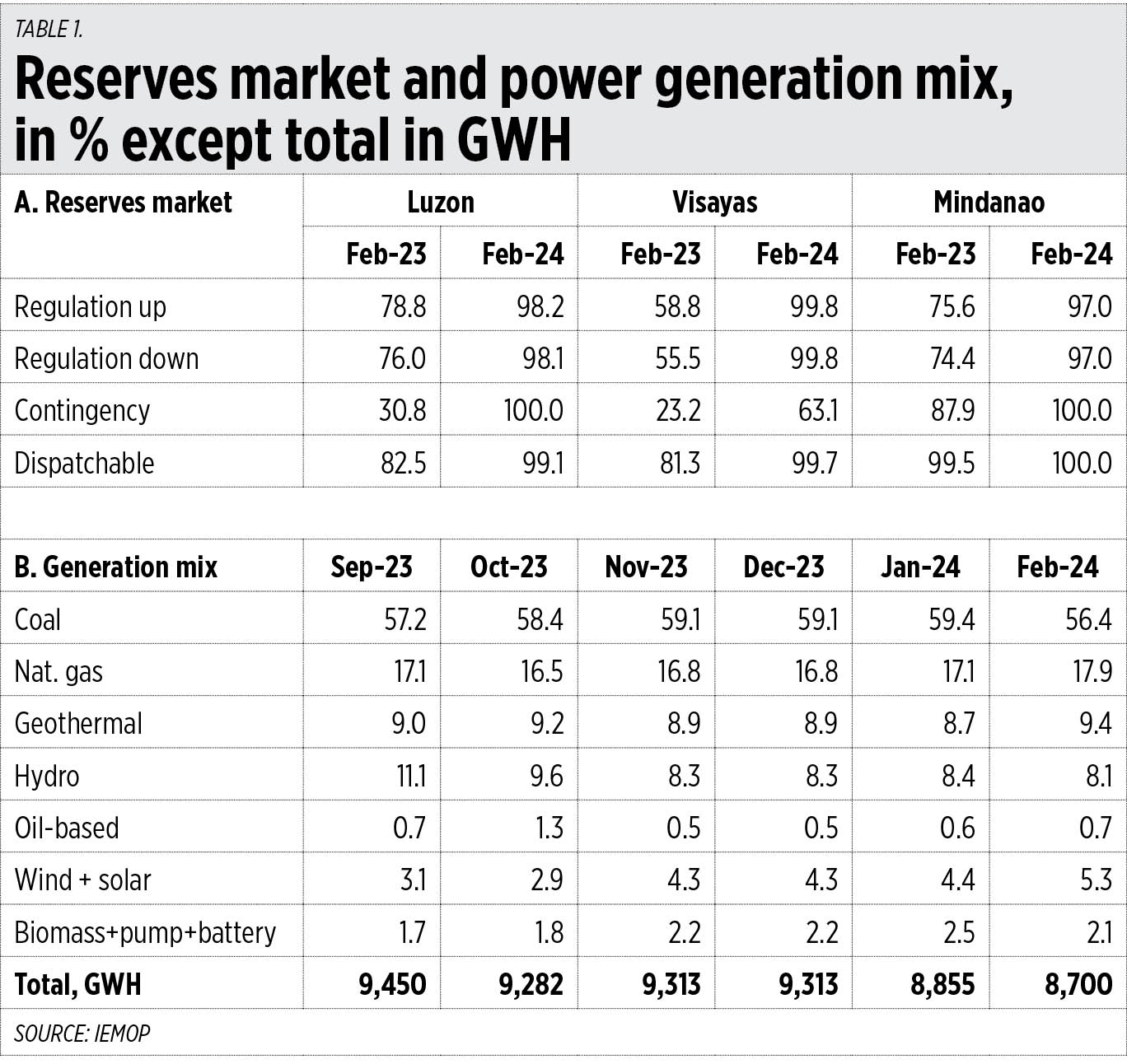
The IEMOP showed data that the reserves of the National Grid Corp. of the Philippines (NGCP) have improved significantly starting February. In the Luzon grid for instance, the contingency reserves have increased from 31% in February 2023 to 100% in February 2024. IEMOP added that “For increased reliability in power grid operations, total scheduled capacity should meet the required level of reserves (i.e., 100%).”

These high contingency reserves mean the likelihood of a blackout is almost zero as any big power plant having an unscheduled shutdown or prolonged maintenance shutdown can be covered by the high level of ancillary services (AS). In my previous article, “10 lessons from the PHL Nuclear Trade Mission to Canada” (March 21), I lambasted the huge increase in the AS rate, meaning the higher transmission charge in our monthly electricity bill which can contribute to higher overall inflation. Now I understand that the pain of a higher transmission charge is less than the gain of a low chance of any blackout. After all, the most expensive electricity is no electricity.

Also covered in the IEMOP media briefing was the power generation mix nationwide. Coal, the most publicly demonized energy source, remains the main savior, the reason why the Philippines does not suffer from daily “Earth Hours” (the celebrate darkness campaign). Meanwhile, the publicly beloved wind/solar power can contribute a measly 3-5% of the total power generation in the country. This is technically insignificant and if relied on, will ensure that “Earth Hours” are guaranteed to happen every single day in the country (see Table 1).
Thank you, NGCP, for finally doing what you should have done many years ago — ensuring adequate reserves and sparing the country from horrible frequent yellow-red alerts yearly. Thank you too, coal generated power plants, for enduring the irrational attacks of the climate activists and giving us lights and air conditioning every day and night.

But there is a question mark on the action of the Energy Regulatory Commission (ERC) which suspended the price determination methodology of the reserves market. No price stability means no supply stability for reserves and hence we might go back to the ugly situation of frequent yellow-red alerts.

That is a topic for another column.

PEPIF 2024 IN ILOILO CITY
The Philippine Electric Power Industry Forum (PEPIF) 2024, organized by IEMOP, will be held tomorrow, April 5, at the Iloilo Convention Center (ICON) in Iloilo City. The conference theme is “Powering a Sustainable and Secure Energy Future for the Country.”

Among the speakers will be Iloilo City Mayor Jerry P. Trenas, top officials of the Department of Energy led by Secretary Raphael Perpetuo M. Lotilla,  ERC Chairperson and CEO Monalisa C. Dimalanta, National Electrification Administration Administrator Antonio Almeda, National Transmission Corp. President and CEO Fortunato Leynes, NGCP Head of Transmission Planning Redi Remoroza, Aboitiz Renewables, Inc. President and COO James Villaroman, MORE Electric President and CEO Roel Castro, Napocor President and CEO Fernando Roxas, ACEN Corp. COO Miguel de Jesus, and IEMOP President and CEO Richard Nethercroft.

They will discuss the Philippines’ energy transition plan via more renewables. Not in the program is a discussion on nuclear power development as part of energy security for the Philippines. Luckily, I saw a new paper on nuclear energy price competitiveness.

PAPER ON LCOE PHILIPPINES ENERGY
The paper, “Comparative Analysis of the Levelized Cost of Electricity of Selected Power Generation Technologies in the 2020-2040 Philippine Energy Plan” (March 2024, 49 pages) was written by Dr. Arturo E. Romero, Jr., a geophysicist and new Department of Science and Technology Balik Scientist who will be based at the Philippines Nuclear Research Institute (PNRI).

The focus of his study is the computation of the levelized cost of electricity (LCOE) of various energy sources. LCOE is defined by the author as “the sum of all discounted cost of the facility normalized by the total power produced over its technical life. It focuses on plant level financials without considering system-wide interplay of power supply and demand, dispatchability and crowding of the grid systems and the effects on electricity pricing.”

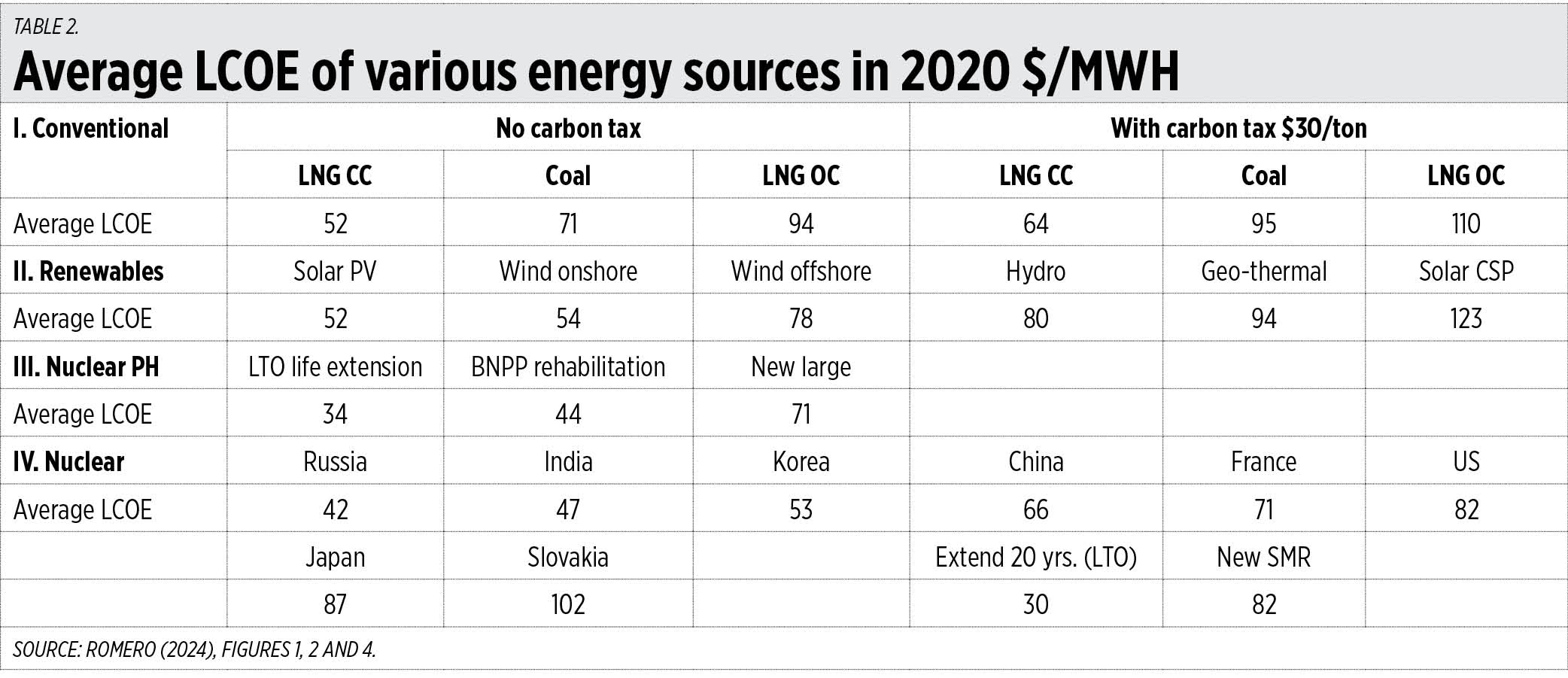
The author produced several charts and figures on the computed LCOE of Philippines’ existing and potential energy sources. From the math model and data he gathered, the results show that the cheapest LCOE is to rehabilitate and refurbish the Bataan Nuclear Power Plant (BNPP) which will have an average LCOE of only $44/megawatt hour (MWh), the second lowest to nuclear long-term operation (LTO) life extension at only $34/MWh.

The next cheapest LCOE comes from a liquefied natural gas (LNG) combined cycle (CC) gas turbine and from solar photovoltaic (PV) at $52/MWh. LNG open cycle (OC) has a high LCOE of $94/MWh if there is no carbon tax included. The most expensive LCOE would be from concentrated solar power (CSP) at $123/MWh (see Table 2).
Thank you, Dr. Romero for producing the numbers. And thank you, PNRI and its Director Dr. Caloy Arcilla, for getting this brilliant mind back to the Philippines.

As an economics researcher and writer, my main concern is how the Philippines can attain high economic growth and sustain this for many years in order to create more jobs and entrepreneurs for Filipinos and Philippines-based businesses. Having expensive electricity and intermittent, unstable and blackout-friendly energy sources are inconsistent with the goal of sustained high growth.

I like this observation made by Lino Bernardo, Head of Energy Transition Projects of Aboitiz Power, among my co-participants at the Philippines Nuclear Trade Mission to Canada last month in Toronto. He said:

“While the first nuclear power plants are expected in the 2030s, other baseload technologies must continue to provide the much-needed power this decade and into the next. Beyond the generation of stable electricity, the country should also look to harness the potential of nuclear energy in the academe, industry, and medicine, through atomic particle research, radioisotopes as industrial tracers, and radiation for diagnosis and therapy procedures, respectively. We need to prepare in terms of policy, regulation, and education to ensure safety and proper waste management in nuclear power generation and further.”

Energy security will help attain overall economic security. People can work productively even when the sun is not shining, and the wind is not blowing. They can walk the streets safely at night under bright lights, travel long distance via trains that run on electricity, and so on.


Bienvenido S. Oplas, Jr. is the president of Bienvenido S. Oplas, Jr. Research Consultancy Services, and Minimal Government Thinkers. He is an international fellow of the Tholos Foundation.

minimalgovernment@gmail.com

Integrated Micro-Electronics widens losses to $109.19 million

GLOBAL-IMI.COM

AYALA-led Integrated Micro-Electronics, Inc. (IMI) widened its net loss to $109.19 million last year due to one-time losses.

“The group net loss was at $109.2 million, with one-time losses of $106.1 (million) related to the sale of STI Enterprises Ltd. (STI) and impairment of goodwill and certain assets,” IMI said in a stock exchange disclosure on Wednesday.

IMI saw a 6% decline in revenue to $1.3 billion in 2023, led by factors attributable to its non-wholly owned subsidiary group including the shorter fiscal year of STI, which was divested on Oct. 31 last year.

The company’s non-generally accepted accounting principles operating income rose 29% to $12 million in 2023 from $9.3 million in 2022.

“Wholly owned subsidiaries maintained the momentum from 2022, with revenues on par with the previous year, and better profitability margins netting a reported net income of $13 million, an improvement of 14% versus 2022,” IMI said.

IMI President Jerome S. Tan said the company’s core businesses were able to build on the recovery of 2022 led by “intensive collaboration with customer and supplier partners.”

“The company is operating with a higher level of efficiency through savings obtained from direct material cost reductions and restructuring of overhead costs as we continue to ramp up new businesses in the electric vehicle and energy management projects that we won in the past three years,” Mr. Tan said.

IMI is the manufacturing unit of AC Industrial Technology Holdings, Inc., which is a subsidiary of Ayala Corp.

The company specializes in electronics for long product life cycle segments such as automotive, industrial electronics, and more recently, the aerospace market.

On Wednesday, IMI shares dropped by 2.84% or six centavos to P2.05 apiece. — Revin Mikhael D. Ochave

Bank of Commerce sets 2024 Annual Stockholders’ Meeting via remote communication on April 30


Spotlight is BusinessWorld’s sponsored section that allows advertisers to amplify their brand and connect with BusinessWorld’s audience by publishing their stories on the BusinessWorld Web site. For more information, send an email to online@bworldonline.com.

Join us on Viber at https://bit.ly/3hv6bLA to get more updates and subscribe to BusinessWorld’s titles and get exclusive content through www.bworld-x.com.

National Government outstanding debt

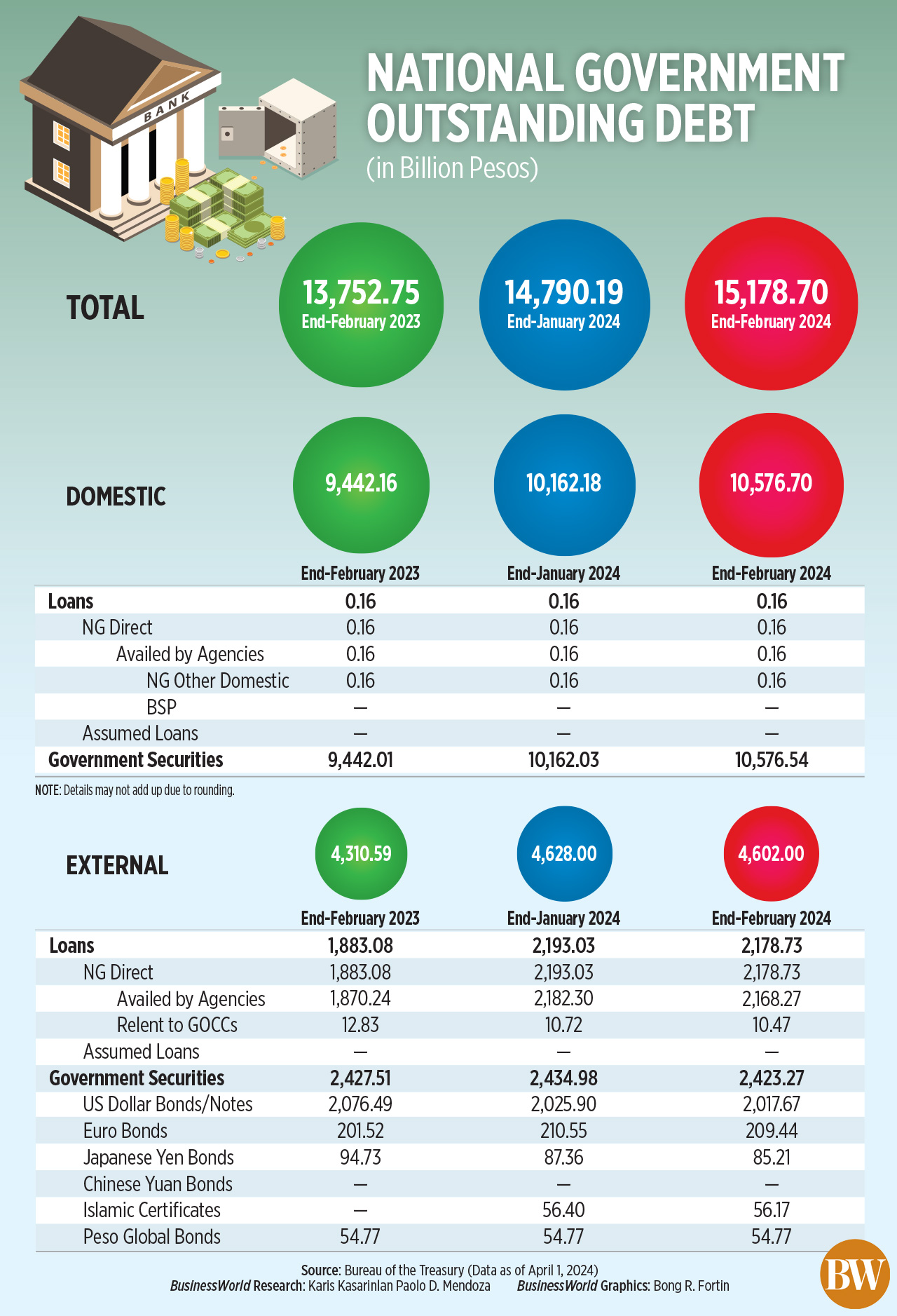
THE National Government’s (NG) outstanding debt hit a fresh high of P15.18 trillion as of end-February, the Bureau of the Treasury (BTr) reported. Read the full story.


National Government outstanding debt

Taking digital banking to the next level with data modernization

TRUSTPAIR.COM

By David Irecki

EVEN in times of business uncertainty, enterprises can count on customers’ expectations for convenience and seamless transactions. Arguably, recent years have shown that nowhere is this more evident than in financial services.

Sure enough, banks have responded to this by vigorously pursuing digital transformation, with the Bangko Sentral ng Pilipinas saying that the volume of digital payments rose to 42.1% of total transactions in 2022 from 30.3% in 2021.

However, despite outcomes like 30% of the unbanked and underbanked entering the financial system between 2019 and 2021, financial services are grappling with digital fragmentation.

Digital sprawl’s impact is far-reaching as it impedes interoperability. With many mission-critical business processes distributed across a slew of applications, businesses are mired in chaos. In real terms, this lack of cohesion makes it harder to get the data to identify new opportunities for driving financial inclusion.

In addition, while the technology stack of the average financial services provider has changed, customer expectations have not. Banks will still need to be able to demonstrate that they can provide lifetime value for customers, with offerings that are tailored to their evolving financial needs.

THE FUTURE IS CONNECTED
All too often, decision-makers view compliance and customer satisfaction as separate and unrelated to each other. However, to meet the growing demands for financial inclusion and improved digital channel experiences in the Philippines, acknowledging the inherent connectedness of both is critical to refining workflows and improving operational processes. And this will likely come to define the near-term banking landscape, with McKinsey noting in a report this year that the rise of a tech-savvy bankable population is driving strong demand for mobile payments and other tech-driven financial sub-sectors. Clearly, this dynamic environment is a great opportunity for early adopters to gain a foothold, while laggards will fall by the wayside and struggle to stand out in an increasingly crowded field.

Data — more specifically their ability to move freely for swift and accurate decision-making — are essential here. Through information on preferences, needs and behavioral patterns, financial services providers can deepen their knowledge of existing and potential future customers. But with digitalization only contributing to banks’ ever-growing volumes of data, the question then is how do financial services providers in the Philippines holistically manage all the information they possess to deliver offerings that strike a chord with the communities they serve?

BETTER, MORE INCLUSIVE BANKING VIA INTEGRATION
To realize growth opportunities for digital banking in the Philippines, an ecosystem that encourages collaboration and seamless data sharing is non-negotiable. Simply put, this is a prerequisite for conducting the operational and analytical mapping needed to solve the complexities around customer processes.

Typically, a modern customer relationship management (CRM) system is the first port of call, but this needs to be done with process management and application integration in mind, too. Failing to ensure that the various tools and solutions across a company’s digital architecture are connected will only lead to information technology (IT) complexity and bring about an environment fraught with disparate applications that don’t work optimally.

To ensure the business is not saddled with technical debt and reduced returns on IT investments, a cloud-native integration system, or integration platform as a service (iPaaS), can connect the entire organization to ensure each department and their systems work in step.

Through an intelligent and powerful iPaaS, banks also do not need to get rid of their legacy systems, as it allows these older tools to still communicate effectively with newer, cloud applications. This addresses a specific problem identified by EY as a key stumbling block for the sector in the region, where financial services in the Asia Pacific were found struggling the most with trying to migrate legacy architecture and integrate multiple systems among sectors surveyed. By easily and quickly building interoperability across their digital architecture, financial services providers can overcome this hurdle while pursuing IT investment opportunities that prime them to realize returns.

With strong appetite for digital banking in the Philippines, financial services players that take the initiative can gain an early advantage in a market that has spectacular potential for growth. By leveraging modern middleware, Philippine banks can unshackle themselves to achieve more efficient operations that not only maximize returns on tech spend, but also drive speed-to-value from IT investments, because when it comes down to it, customers want to know that their financial services providers understand their needs and will be a key partner throughout their financial journey. Only with data that are actionable, accurate, and accessible will this be achievable for providers.


David Irecki is the director of Solutions Consulting, APJ at Boomi.

Loaded with bullet points

RAWPIXEL.COM/FREEPIK

ESPECIALLY during the pandemic (now, seemingly so long ago) the use of PowerPoint presentations for virtual meetings was almost obligatory — can you see my screen? Anyone giving a talk without any visual aid (complete with quotations from Epictetus or Oscar Wilde lifted from the net) is considered unprepared.

A presentation, based on occasional glances at written talking points on a clipboard, seems too arcane, having gone out with the white board with pentel pen scribblings by the speaker himself. The visuals are now almost movie-screen sized in the background. The TED talk type of presenter strolls around the stage like a stalker with a clicker and an audio headset, like those used in stage musicals.

Where will the visual aid be without cartoons (you don’t have to laugh) and the punchy phrasing of short subject headings, called “bullet points.”

The bullet point is credited to Robert McNamara, who was president of Ford Motors before he joined “the best and the brightest” to serve as Secretary of Defense during the Vietnam War under US President John Kennedy, and then Lyndon Johnson. As an efficiency expert and management luminary, he wanted brief and effective presentations.

McNamara discovered that even complex situations could be summarized by metrics (numbers that can be compared and turned into ratios) and crisp phrases or “bullet points.” A complex situation was boiled down to a phrase to give the impression of being more manageable — body count on the rise.

Consultants use bullets for their situation analyses. These are routinely used for pitches to get new clients.

Bullets are a list of four items on a slide to allow the eye to focus on just a few phrases on the screen. There is no text to support the bullets. Otherwise, it’s a speed-reading contest between presenter and presented. The bullets serve as take-off points for lengthier (but not too lengthy) explanations.

Punchy and dramatic words are preferred. If department heads do not talk with each other, going off in uncoordinated directions with no mind to resources being sapped or the impact of such actions on the company, such a situation is captured in two words: “silo mentality.” It is good to pick words not found in ordinary conversation (Can I see your silo?) so that they smack of divine revelation and allow the prophet to explain his riddle. The picture for this bullet point is a storage structure for wheat.

Characters are not named and instead described by their behavior, usually dysfunctional (note spelling). A “change agent” (good) is different from a “loose cannon” (bad), even if they’re trying to do the same thing which is to upend the status quo.

Bullet points render the most complex issues accessible in short punchy descriptions. The exit of key managers and their joining the competition can be dismissed with the phrase “high executive churn rate.”

Bullet points address short attention spans. The need for concision may be due to a busy schedule. Or it may be a case of an inability to hold three different thoughts (love, life, and the pursuit of happiness) while chewing doughnuts and sipping iced cafe latte’ at the same time.

Statistics tend to overwhelm us. Some numbers are thrown away as irrelevant. Bullet points connect the dots on the remaining ones to draw a specific picture. Stories are a way of explaining reality. The new field of “behavioral economics” looks at non-monetary considerations in decision-making and points to the power of “framing.” Is a food item that is 90% fat-free the same as one with 10% fat?

Why is the price of a particular stock moving up? The story can be as simple as the undue interest of a particular acquiring party and the prospect of a struggle with a competing party or the incumbent shareholders for control. The bullet point, “acquisition target” is enough for sideline players to jump onto the bandwagon. Of course, the whole chase can fall through — closing conditions fail.

Bullet points are the headlines of the narrative like “unrealistic projections” or “debt overload.” Talking points can describe social relationships too. Complex human behavior can be simplified in pithy bullet points — too clingy, high maintenance, existentialist outlook, eye candy, or brain-damaged.

Bullets can be loaded and aimed at the screen. They capture the direction of the narrative… and hopefully the attention of the attendees.


Tony Samson is chairman and CEO of TOUCH xda

ar.samson@yahoo.com

Brussels seeks UNESCO heritage mark for puppetry, flower carpet

FLOWERCARPET.BRUSSELS

BRUSSELS — Brussels is looking to protect two of its historical traditions: rod puppetry and a 1,680-square-meter flower carpet rolled out every second year in front of the Belgian capital’s city hall, by granting them the UNESCO intangible cultural heritage status.

“Those two things are really part of our heritage, of our identity, they’re part of our folklore, and we want to make sure they are preserved for the future,” said the city’s state secretary for heritage, Ans Persoons.

“When we think of protecting the past it should not only be about bricks and architecture, but it should also be about our traditions and our culture.”

Following the filings, UNESCO designations might follow in December 2025.

Nicolas Geal, whose family theater is the only Brussels venue keeping the centuries-old tradition of rod puppetry alive, said the UNESCO listing might save the art form from oblivion.

“This way, maybe some other people will start new initiatives,” said Mr. Geal, speaking in his Theatre Toone, which sits in Brussels’ historical center and features several shows a week, its repertoire ranging from Dracula to Faust.

The rod puppetry tradition originates from traveling carnival theaters in the Renaissance and was widely popular during the 19th century. Nowadays, puppeteers concealed behind a screen bring puppets to life during shows by pulling their rods.

Just a stone’s throw away is the city’s fabled historic main square, or Grand Place, the setting for the biennale flower carpet tradition that attracts some 200,000 spectators each time.

Brussels laid its first flower carpet — a scented display that tracks its origins to Mediterranean countries in the 14th century — some 50 years ago. The next one is due in August, with around half a million begonias or dahlias for the design. — Reuters

Jollibee Foods Corp. commits S$90 million to boost brands in Asia-Pacific

LISTED fast food giant Jollibee Foods Corp. (JFC) has committed S$90 million worth of capital through Titan Dining II LP (Titan Fund II) to support the growth of the company’s brands in the Asia-Pacific region.

The company said its wholly owned subsidiary Jollibee Worldwide Pte. Ltd. (JWPL) will infuse the capital in the Titan Fund II, which has a size of S$100 million.

 “The fund… will be used (for) strategic investments in food and beverage concepts with the objective to further grow Asia-Pacific food service brands and/or bring strong global food service brands to Asia-Pacific,” JFC said.

JWPL will have a 90% participating interest in Titan Fund II. The fund will be managed by Titan Dining Partners II Ltd., which consists of individuals with extensive experience in the food and beverage sector in the Asia-Pacific region.

In January, JWPL hiked the fund size of Tim Ho Wan brand owner Titan Dining LP to S$450 million from S$350 million to fund the store expansion plans and working capital requirements of Tim Ho Wan and the completion of other projects.”

As of end-February, JFC operates 6,902 stores worldwide, consisting of Philippines with 3,336 and international at 3,566.

Of its international stores, 557 in China, 388 in North America, 344 in Europe, the Middle East and Africa, 789 with Highlands Coffee mainly in Vietnam, 1,172 with The Coffee Bean & Tea Leaf, and 316 with Milksha.

JFC shares fell by 2.1% or P5.20 to P242 apiece on Wednesday. — Revin Mikhael D. Ochave

16 Richest Filipinos in Forbes’ 2024 World’s Billionaires List

FILIPINO TYCOON Manuel B. Villar, Jr. is now ranked among the top 200 richest people in the world, as his estimated net worth surged to a record $11 billion (around P621 billion) this year, according to Forbes. Read the full story.


16 Richest Filipinos in Forbes’ 2024 World’s Billionaires List

Hyundai IONIQ 5 N charges on with 2024 World Performance Car award victory

IONIQ 5 N named 2024 World Performance Car, signaling fourth major victory for all-electric IONIQ 5 lineup in the last three years

Hyundai Motor Company continued its winning streak at the World Car Awards with the IONIQ 5 N high-performance electric vehicle (EV) named the 2024 World Performance Car. This is Hyundai IONIQ 5 lineup’s fourth major World Car Awards win in the last three years. Today’s victory solidifies IONIQ 5 N’s position as a frontrunner in the market as it continues to outpace EV rivals with its outstanding high-performance technology.

“We are thrilled and honored to receive the prestigious World Performance Car award for our IONIQ 5 N,” said Jaehoon Chang, President and CEO of Hyundai Motor Company. “This recognition is a testament to Hyundai’s commitment to pushing the boundaries of electric performance and innovation. It is truly gratifying to see our efforts rewarded with a total of seven World Car Awards titles in the last three years. We are proud to continue our winning streak and solidify Hyundai’s position as a leader in the global EV industry.”

World Car Awards announced the winners of this year’s competition at a ceremony during the 2024 New York International Auto Show (NYIAS). Hyundai Motor’s many nominations reflect its growing stature on the global stage and build on its past success at the World Car Awards. The brand’s IONIQ 5 and IONIQ 6 took back-to-back triple victories in 2022 and 2023 in the World Car, World Electric Vehicle and World Car Design categories.
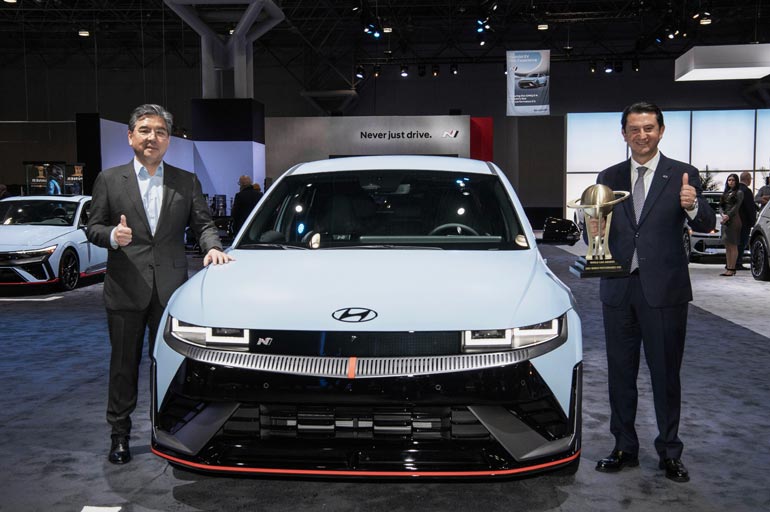
“On behalf of the entire N team, it’s very gratifying to receive this well-earned recognition from the prestigious World Car Awards jury,” said José Muñoz, President and Global COO of Hyundai Motor Company. “We dedicate this amazing award to our passionate customers who appreciate high-performance vehicles, and we pledge to continue to deliver vehicles that excite and inspire. We are thrilled to lead the charge in this new era of electric performance vehicles and are committed to continually challenging the limits of engineering possibilities for smart mobility.”

Introduced in July 2023 as Hyundai N’s first EV, IONIQ 5 N represents a new segment of driver-focused high-performance EVs through new technologies and elevated racetrack capability, signaling the first step in N’s electrification strategy. It combines the standard IONIQ 5’s Electric Global Modular Platform (E-GMP) with N’s motorsport-bred technologies and leverages N’s expertise from electrified ‘Rolling Labs’ to maximize the EV’s high-performance capabilities. IONIQ 5 N has been widely praised in the media as ‘groundbreaking’, a ‘game-changer’, and the ‘benchmark’ for high-performance EVs. IONIQ 5 N also won Top Gear’s 2023 Car of the Year Award and set the fastest electric SUV lap time at the Nürburgring Nordschleife by Germany’s ‘Sport Auto’.

“IONIQ 5 N represents a defining moment for Hyundai N and our electrification strategy. By combining our E-GMP platform with N’s motorsport expertise, we have created a groundbreaking high-performance EV that has set a new benchmark in the industry,” said Till Wartenberg, Vice President and Head of N Brand & Motorsport at Hyundai Motor Company. “The accolades and recognition we have received validate our commitment to delivering innovative, driver-focused electric vehicles. With IONIQ 5 N, we are not just redefining what a performance car is, but also shaping the future of electric driving fun.” 
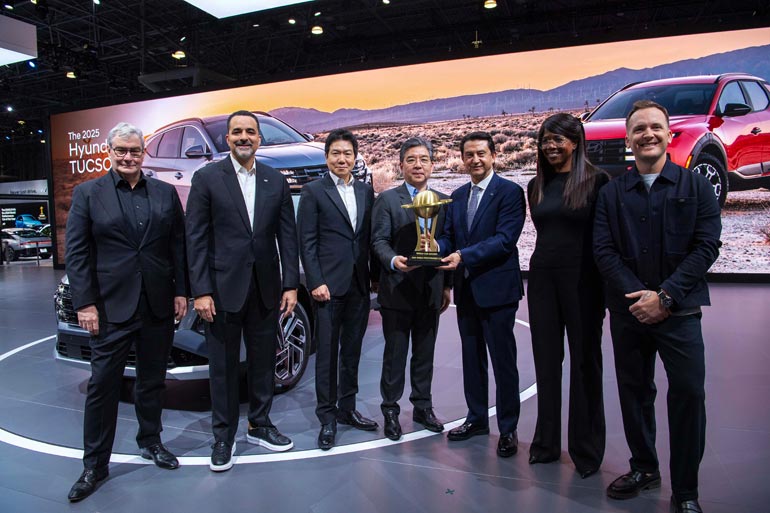
World Car Awards is an annual event that sees 100 international jurors across 29 countries test-drive and vote on a field of eligible vehicles.



Spotlight is BusinessWorld’s sponsored section that allows advertisers to amplify their brand and connect with BusinessWorld’s audience by publishing their stories on the BusinessWorld Web site. For more information, send an email to online@bworldonline.com.

Join us on Viber at https://bit.ly/3hv6bLA to get more updates and subscribe to BusinessWorld’s titles and get exclusive content through www.bworld-x.com.

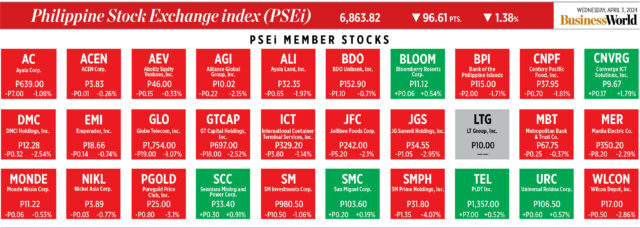
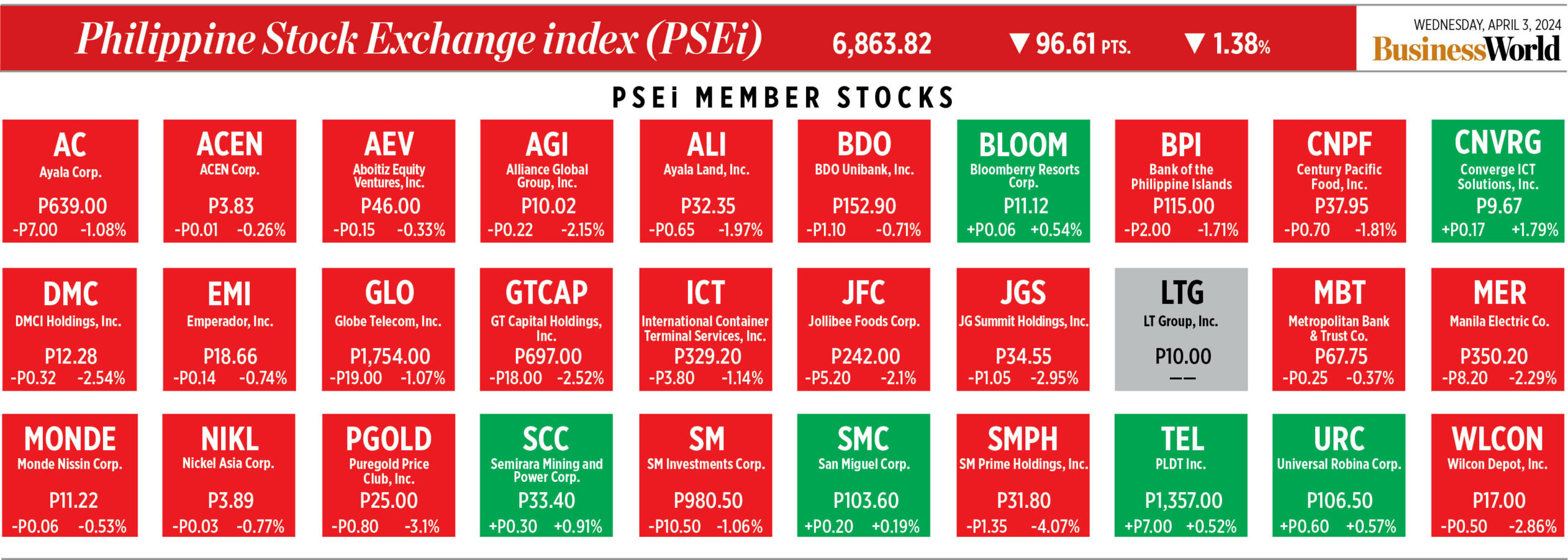
How PSEi member stocks performed — April 3, 2024

Here’s a quick glance at how PSEi stocks fared on Wednesday, April 3, 2024.


Philippines prepared to respond to China meddling in resupply missions

BRP SIERRA MADRE, a marooned transport ship which Philippine Marines live in as a military outpost, sits on the disputed Second Thomas Shoal, part of the Spratly Islands in the South China Sea. — REUTERS

THE PHILIPPINES is prepared to respond to China’s attempts to foil its resupply missions in the South China Sea, a top security official said on Wednesday, adding that the operations would be adjusted to counter Beijing’s conduct in the waterway.

Jonathan Malaya, the spokesman of the National Security Council, said the Philippines would keep its position at Second Thomas Shoal and there would be no letup in resupply missions to a handful of Filipino soldiers stationed on a grounded warship there.

“Our commitment to maintain BRP Sierra Madre will always be there, so any attempt by China to interfere with resupply missions will be met by the Philippines in a fashion that protects our troops,” he told a maritime forum.

Mr. Malaya reiterated that the countermeasures announced by Philippine President Ferdinand R. Marcos, Jr. last week against “aggressive” actions by China’s coast guard would be “multi-dimensional” and not solely military in nature.

These measures include making “changes and adjustments” to Philippine resupply missions and operations in the South China Sea, he said without elaborating, citing security concerns.

Echoing an earlier call by the Philippine Defense secretary for the public not to fall victim to Chinese propaganda, Mr. Malaya warned of “foreign malign influence” meant to weaken the Philippines.

“We have seen that they are working here through their surrogates or if we may call them amplifiers, because there are definitely Chinese narratives which run counter to the truth,” he added.

The Chinese Embassy in Manila did not immediately reply to a request for comment.

The Philippines and China have had a series of maritime run-ins, including water cannon use and heated verbal exchanges that has triggered concern about an escalation at sea.

China claims almost the entire South China Sea as its territory, policed by an armada of coastguard vessels, some more than 1,000 km (620 miles) from its mainland. China has maintained its responses have been appropriate in the face of Philippine encroachment.

In 2016, the Permanent Court of Arbitration in the Hague said China’s claims in the South China Sea had no legal basis, a decision Beijing has rejected.

The row comes at a time when the Philippines and United States are deepening military ties, frustrating China, which sees Washington as interfering in its back yard.

Mr. Marcos will meet his American and Japanese counterparts at a three-way summit in Washington on April 11, and Mr. Malaya said a “big aspect” of their discussions would be on security.

Also on Wednesday, a special Senate committee approved a bill that seeks to set up naval outposts in the South China Sea to assert Philippine sovereignty.

Under Senate Bill No. 654, the country will set up forward operating bases — small-scale naval and military facilities that can serve as potential sites for future upgrade and expansion “for national security purposes.”

It allots P1 billion for 12 possible outposts including in Busuanga in Palawan province, Subic Bay in Zambales and Mavulis Island in Batanes. At Wednesday’s hearing, the Philippine Navy sought 13 more bases to be built in the South China Sea.

The Senate special committee on Philippine Maritime and Admiralty Zones switched to a closed-door hearing to discuss the reason for the Navy’s proposal.

‘ACT OF TREASON’
Meanwhile, Senator Ana Theresia N. Hontiveros-Baraquel on April 2 filed a resolution seeking to investigate the so-called gentleman’s agreement with China under ex-President Rodrigo R. Duterte to keep the status quo at Second Thomas Shoal, including barring repairs to BRP Sierra Madre.

The agreement is “tantamount to a surrender of the Philippines’ sovereignty and an act of treason,” she said in Senate Resolution No. 982.

Ex- presidential spokesman Herminio L. Roque earlier said Mr. Duterte had made deal with China not to bring building and repair materials to troops stationed at the World War II-era ship at Second Thomas Shoal.

“While China, in any case, will most likely attack our resupply missions en route to Ayungin (Second Thomas Shoal), this sham of an agreement only gave Beijing more ammunition to assert her baseless claims,” she said in a statement.

China’s Foreign Ministry earlier said a March 23 Philippine resupply mission had tried to transport building materials to the grounded ship.

The Senate resolution called on Mr. Roque to give more details of the deal and how it was brokered.

Ms. Hontiveros-Baraquel has said the deal was not surprising given Mr. Duterte’s foreign policy pivot to China.

“Whatever foreign policy direction former President Rodrigo R. Duterte took in his administration is his exclusive prerogative as chief architect of foreign policy,” Mr. Roque said in a statement in response to the proposed probe.

He said describing the deal as “treasonous” showed the senator’s “obvious gross ignorance of the law.” Mr. Roque had said the deal would not bind the Marcos government because it is not a treaty. — John Victor D. Ordoñez with Reuters

ADVERTISEMENT
ADVERTISEMENT