Home Blog Page 3432

DoE considering AS charge for WESM members responsible for forced outages
BW FILE PHOTO

THE Department of Energy (DoE) is proposing to require members of the Wholesale Electricity Spot Market (WESM) to pay for ancillary services (AS) if their forced outages are found to have been their responsibility.

“The DoE deemed it necessary to provide price mitigating measures in the Reserve Market such as the causer pays mechanism (CPM) to ensure consumer protection and accountability of market participants in ensuring grid reliability,” the DoE said in a draft circular.

The proposed policy will apply to all WESM members forced to turn to ancillary services, a form of reserve that companies keep on contractual standby should supply prove inadequate. This includes generation companies, the transmission network service provider, and customers of the spot market.

The cost of ancillary reserves that will be recovered via CPM will depend on the generating capacity allocated to stabilize or restore the system.

Ancillary services are tapped by grid operators to support the transmission of power from generators to consumers to maintain reliable operations.

Despite significant improvement in the reliability of the grid operations with the launch of the reserve market, the market operator, however, observed a “high market clearing price” for ancillary services, the DoE said.

In the February billing period, this manifested in an increased transmission charge collected from consumers.

“(The CPM aims) to have a sharing of cost of reserve between generators and consumers, considering that reliability is affected by changes in supply and demand,” according to Luningning Baltazar, assistant director of the DoE’s Electric Power Industry Management Bureau.

She said that the CPM will enable generators who frequently report outages to pay for a bigger share of ancillary service costs, as determined by a formula for reserve responsibility sharing.

According to the DoE, reserve responsibility sharing will be calculated by the market operator through a “runway model” based on the real-time dispatch schedule and reliability performance of the generation companies.

Separately, in an advisory, the DoE directed the distribution utilities and the National Grid Corp. of the Philippines (NGCP) to be ready to implement the interruptible load program (ILP) during the dry months.

The DoE has requested updates on the registered ILP participants. It has also asked the entities to submit “any concerns and request for support for distribution utilities which are new to the implementation of the ILP.”

The ILP asks large power consumers to use their generators or shift their operations instead of sourcing power from the grid.

This is meant to spare households from power interruptions during red alerts — when supply is insufficient to meet demand. — Sheldeen Joy Talavera


Israel sees potential tie-ups with PHL in electronics, BPOs 

A worker uses a microscope at an electronics manufacturing assembly plant in Biñan, Laguna, April 20, 2016. — REUTERS

ISRAEL said it sees areas of collaboration with the Philippines in electronics, information technology and business process outsourcing (IT-BPO).

“The expectation (is for trade relations) to grow. We have to wait and see… But when you look at the investment from companies creating new business, that is an indicator,” Israel Ambassador Ilan Fluss told reporters on the sidelines of the Israel-Philippines Water Technology Innovations forum on Thursday.

Israel is “very optimistic” about the trade relationship, Mr. Fluss said, adding that two-way trade in 2022 topped $500 million.

Tradeline Philippines estimates two-way trade to have dropped 14.9% to $478.2 million in 2023.

“We are pushing as many as possible trade delegations and working on introductions and facilitating Israeli company visits to the Philippines,” Mr. Fluss said. 

“The Israeli private sector is very interested in the Philippine market. Companies in the BPO, electronic (electronics manufacturing services) are moving into the Philippines to do their processes here,” he said. 

The head of Israel’s Economic and Trade Mission to the Philippines Tomer Heyvi said the recently ratified IPPA will also spur investment in the Philippines.

“The IPPA… will also provide an avenue to increase bilateral trade and investment,” Mr. Heyvi said. — Ashley Erika O. Jose

Gen Z work preferences lean towards entrepreneurship, gig jobs —  PhilCare

COURTESY OF PAYONEER

GENERATION Z has expressed a preference for running their own business and participating in the gig economy, according to health maintenance organization PhilhealthCare, Inc. (PhilCare).

The 2024 PhilCare Wellness Index, said 70.3% of Gen Z listed entrepreneurship over employment as their top, compared to 80.5% for Gen X and and millennials, also known as Gen Y.

“The younger (generation) wants to be entrepreneurs but there are timelines. Previous research suggests that (people work) to save capital and then go into business,” Fernando dlC. Paragas, PhilCare Wellness Index lead researcher, said.

Gen Z’s work preferences include flexible schedules, independent work, taking on gigs, and working overseas.

“I guess that’s why there is some kind of a correlation between entrepreneurship and taking risks. The restrictions to being an employee are no longer there,” PhilCare Chairman Monico V. Jacob said.

The study noted that 53% of its Gen Z respondents prefer multiple part-time jobs over just one full-time job. This compares to 48% for Generation X and Y.

Some 58.1% of Gen Zs said they feel the double burden of earning for themselves and for family, including parents.%.

“Gen Z’s significant part of work life so far was during the pandemic, in comparison to the older generations, whose work experience was in the office,” he said. — Aubrey Rose A. Inosante

ESCAP calls on PHL to streamline VAT processes, enhance tax compliance

PHILIPPINE STAR/KRIZ JOHN ROSALES

THE Philippines needs to streamline its value-added tax (VAT) system and enhance tax compliance to reduce fiscal risks, according to the United Nations Economic and Social Commission for Asia and the Pacific (ESCAP).

“What the government can do is to close the tax collection gap, which not only mobilizes additional fiscal resources, but over time, helps to reduce fiscal risk,” Vatcharin Sirimaneetham, ESCAP’s macroeconomic policy and analysis chief, said at a briefing.

Taxes account for around 60% of total government revenue in Southeast Asia, according to ESCAP.

The Bureau of Internal Revenue failed to hit its P2.64-trillion revenue target last year, collecting only P2.53 trillion.

In its Economic and Social Survey of Asia and the Pacific report, ESCAP noted that countries like Philippines don’t need to raise tax rates to improve collections.

“While mobilizing fiscal resources for development purposes relies on adequate tax revenue collection, being able to tax more does not always mean taxing better, and tax policies often have to balance between different and sometimes conflicting policy objectives,” it said.

Findings of the report showed that VAT collection efficiency was “substantially below regional and global averages” in the Philippines, Armenia, Sri Lanka and Turkey.

Corrupt and inefficient governments were also advised not to rely on taxes from the private sector and households, citing taxpayers’ burden.

To encourage tax compliance, governments should be more transparent about where revenue is spent, Mr. Sirimaneetham said.

Higher income levels, more state spending on education, and reduced inequality and corruption help raise tax compliance, according to the ESCAP report. — Beatriz Marie D. Cruz

Top Philippine security adviser says Manila to fight for its maritime rights

AN AERIAL VIEW of the BRP Sierra Madre at the contested Second Thomas Shoal on March 9, 2023. — REUTERS

THE PHILIPPINES will stand up to China in defending its sovereign rights in the South China Sea, its top security adviser said on Thursday, as the diplomatic row intensifies between the two Asian neighbors.

“We will fight for our rights,” National Security Adviser Eduardo M. Año told reporters on the sidelines of a palace briefing. “We will make sure we are protecting our… maritime rights in our exclusive economic zone.”

Mr. Año also disputed the so-called gentleman’s agreement between China and the Philippines under ex-President Rodrigo R. Duterte for a status quo at Second Thomas Shoal. The deal supposedly barred repairs to BRP Sierra Madre, a World War II-era ship that Manila grounded there in 1999 to assert its sovereignty.

“The Chinese have always talked about the gentleman’s agreement, but they cannot show anything that there’s really one,” he said.

Jonathan Malaya, the spokesman of the National Security Council, on Wednesday said the Philippines is prepared to respond to China’s attempts to foil its resupply missions in the South China Sea.

The operations would be adjusted to counter Beijing’s conduct in the waterway, he added.

Mr. Malaya said the Philippines would keep its position at Second Thomas Shoal and there would be no letup in resupply missions to a handful of Filipino soldiers stationed on a grounded warship there.

“Our commitment to maintain BRP Sierra Madre will always be there, so any attempt by China to interfere with resupply missions will be met by the Philippines in a fashion that protects our troops,” he told a maritime forum.

Mr. Malaya reiterated that the countermeasures announced by Philippine President Ferdinand R. Marcos, Jr. last week against “aggressive” actions by China’s coast guard would be “multi-dimensional” and not solely military in nature.

These measures include making “changes and adjustments” to Philippine resupply missions and operations in the South China Sea, he said without elaborating, citing security concerns.

Echoing an earlier call by the Philippine Defense secretary for the public not to fall victim to Chinese propaganda, Mr. Malaya warned of “foreign malign influence” meant to weaken the Philippines.

Mr. Año and National Security Adviser Jake Sullivan earlier discussed by telephone “coercive, aggressive and deceptive actions” by Beijing in the South China Sea.

National Security Adviser Eduardo “expressed his appreciation for the United States’ continued assurances and reaffirmation of its ironclad commitment” to their alliance, the Philippines’ National Security Council said in a statement on Tuesday.

In a statement posted on its website, the White House said Mr. Jake Sullivan and Mr. Año discussed preparations for the visit of Philippine President Ferdinand R. Marcos, Jr. to the White House and the historic Japan-Philippines-US trilateral leaders’ summit this month.

“Mr. Sullivan also emphasized US support for the Philippines following the People’s Republic of China Coast Guard and maritime militia’s dangerous actions on March 23 obstructing a lawful Philippine resupply mission to Second Thomas Shoal,” it said.

The Philippines and China have had a series of maritime run-ins, including water cannon use and heated verbal exchanges that has triggered concern about an escalation at sea.

China claims almost the entire South China Sea as its territory, policed by an armada of coastguard vessels, some more than 1,000 km (620 miles) from its mainland. China has maintained its responses have been appropriate in the face of Philippine encroachment.

In 2016, the Permanent Court of Arbitration in the Hague said China’s claims in the South China Sea had no legal basis, a decision Beijing has rejected.

The row comes at a time when the Philippines and United States are deepening military ties, frustrating China, which sees Washington as interfering in its back yard.

Mr. Marcos will meet his American and Japanese counterparts at a three-way summit in Washington on April 11, and Mr. Malaya said a “big aspect” of their discussions would be on security.

Senator Ana Theresia N. Hontiveros-Baraquel on April 2 filed a resolution seeking to investigate the so-called gentleman’s agreement with China.

The agreement is “tantamount to a surrender of the Philippines’ sovereignty and an act of treason,” she said in Senate Resolution No. 982.

Ex-presidential spokesman Herminio L. Roque earlier said Mr. Duterte had made a deal with China not to bring building and repair materials to troops stationed at the grounded vessel.

China’s Foreign Ministry earlier said a March 23 Philippine resupply mission had tried to transport building materials to the grounded ship.

The Senate resolution called on Mr. Roque to give more details of the deal and how it was brokered. — NPA and KATA

Tribunal voids Duterte order revoking former rebel soldier’s amnesty

PHILSTAR FILE PHOTO

THE PHILIPPINE Supreme Court (SC) has upheld the validity of the amnesty given to a former senator and rebel soldier, nullifying ex-President Rodrigo R. Duterte’s order.

The President did not have the power to void Antonio F. Trillanes IV’s amnesty without congressional approval, the tribunal ruled in a decision written by Justice Ma. Filomena D. Singh.

“The court also grounded its ruling on the primacy of the Bill of Rights and reaffirmed that neither the government nor any of its officials, including the President, are above the law,” the court said in a statement on Wednesday night.

The High Court struck down Mr. Duterte’s Proclamation No. 572, which in 2018 revoked the 2010 amnesty given to the former senator by the late President Benigno S.C. Aquino III. Mr. Duterte also ordered government prosecutors to revive rebellion and other charges against him.

Mr. Duterte said the amnesty was void because Mr. Trillanes had failed to file the official amnesty application form and admit guilt for his crimes.

The top court said Mr. Duterte’s proclamation violated Mr. Trillanes’ constitutional rights against double jeopardy and ex post facto laws, which punish actions retroactively.

The tribunal also said there was “convincing evidence” that Mr. Trillanes had filed his amnesty request.

“The decision affirms that in balancing the exercise of presidential prerogatives and the protection of the citizens’ rights, the Constitution and the laws remain as the court’s anchor and rudder,” the Court said.

In 2003, Mr. Trillanes led more than 300 junior officers and enlisted men of the Armed Forces of the Philippines in a mutiny against the government of then President Gloria Macapagal Arroyo.

The rebels occupied the Oakwood Premier Ayala Center (now Ascott Makati), an apartment tower in Makati City, to protest rampant state corruption.

The mutiny lasted only 18 hours. Mr. Trillanes and his men were charged in a general court martial. He was detained for more than seven years.

Four years later, Mr. Trillanes, Brigadier General Danilo Lim and 25 others charged in the Oakwood mutiny walked out of their trial and marched toward the Manila Peninsula Hotel in Makati.

They seized control of the hotel and called for the ouster of Ms. Arroyo.

The coup was over by 5:10 p.m. after government troops broke through the hotel. Mr. Trillanes and Mr. Lim surrendered supposedly to avoid the loss of lives. — Chloe Mari A. Hufana

Marcos orders broad solution to Manila’s traffic problem

PHILIPPINE STAR/ MIGUEL DE GUZMAN

PHILIPPINE President Ferdinand R. Marcos, Jr. wants a comprehensive approach to the capital region’s traffic crisis, one of his economic managers said on Thursday.

Officials on Wednesday discussed traffic issues during a Cabinet meeting, where Mr. Marcos ordered agencies to submit recommendations, National Economic and Development Authority Secretary Arsenio M. Balisacan told a palace briefing.

“What the President really wants is a comprehensive, holistic approach to solving the traffic problem, not a piecemeal approach as has been the case all these years,” he said.

“In the planning of our transport system, we should be looking at the intermodal transport system and see how they operate efficiently as a whole… If there’s a chokepoint in one, it affects the whole system. That’s why we really look at it as a system — and that’s the direction of the President.”

The Management Association of the Philippines last month called for a state of calamity declaration in Metro Manila so the President can use his special powers to solve traffic congestion in Manila and nearby cities.

The group also urged the President to appoint a traffic czar.

Traffic congestion in Metro Manila is costing the Philippine economy at least P3.5 billion daily or P1.27 trillion annually, according to a Japan International Cooperation Agency study.

MAP Transportation and Infrastructure Committee Chairman Eduardo H. Yap said at a Mar. 21 House of Representatives hearing that events causing P1 billion in damage qualify as calamities. — Kyle Aristophere T. Atienza

DICT suspects domestic hackers, blames ‘outdated’ systems for DoST data breach

TOWFIQU BARBHUIYA-UNSPLASH

By Ashley Erika O. Jose, Reporter

STATE officials suspect domestic hackers behind the recent breaching of the Department of Science and Technology’s (DoST) network systems, compromising about two terabytes of data.

In a media briefing on Thursday, Department of Information and Communications Technology (DICT) Assistant Secretary Renato A. Paraiso downplayed the scale of the incident, but exposed the bigger challenge of updating network systems vulnerable to such attacks.

“Security protocols were actually in place,” said Mr. Paraiso as he revealed that 20 systems of the DoST were compromised. “It is not because there is no system in place. It is just that it might be outdated — outdated in terms of capabilities and the systems employed by the threat actors.”

While authorities were still working to gain full access to its compromised network systems and studying the extent of the attacks, the DICT downplayed the impact of this latest cyberattack on a state agency.

“[The compromised data] involves research, when you say research, this involves designs of proposed inventions or maybe even inventions that were completed. Information of their scientists and their members were also compromised and their login accesses,” he said.

“In terms of size, this is recently one of the biggest but comparatively, the impact is not that big, because some designs, files in the systems were already obsolete” he added.

What is more disturbing is that the threat actors were able to penetrate the system because the DoST’s network is likely outdated and the government’s procurement process is slow amid a rapidly evolving information communications and technology landscape.

“Our government’s procurement process is kind of slow. It takes at least 60 days to procure a system and systems you employ now might be obsolete in six months’ time,” said the DICT official.

With the recent hacking incident, the government is urged to prepare for similar attacks in the future, Ronald B. Gustilo, national campaigner for Digital Pinoys, said.

“The government should prepare for more of these attacks. Their contingency measures should be in place and the quick response teams always ready,” Mr. Gustilo said in a Viber message.

He said the government should allocate a higher budget to be able to update its technology realtime and hire more experts to monitor its systems.

“More than being either quick or slow with regard to their response, we find it appealing that in a span of a few months, DoST was attacked twice. This should not have happened in the first place,” Mr. Gustilo said.

“The recent DoST incident is an indicator that there is still a lot to be done for the Critical Information Infrastructure of the Philippines,” Sam Jacoba, founding president of the National Association of Data Protection Officers of the Philippines, said in a Viber message.

Critical information infrastructure is interconnected with information systems and networks.

“The challenge now is how to bring back the operations of the DoST that have been impacted by the hack, and recover or reconstruct the digital assets within those information systems,” Mr. Jacoba said.

DBM OK’s release of P5.8-B budget for new classrooms

PHILIPPINE STAR/KRIZ JOHN ROSALES

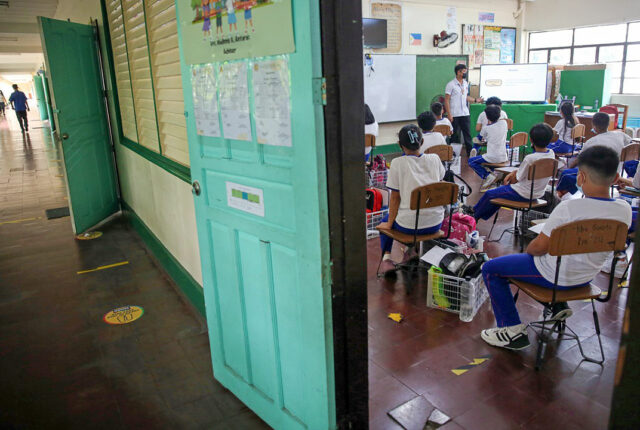
THE DEPARTMENT of Budget and Management (DBM) on Thursday said it approved the release of P5.83 billion to help build classrooms nationwide.

In a statement, the agency said the money would be given to the Department of Education (DepEd) and Department of Public Works and Highways.

The amount is enough to build 1,834 classrooms in 216 sites across the country, it said.

“The timely release of funds for the project signifies our dedication and commitment to help in building a brighter future for our young learners,” Budget Secretary Amenah F. Pangandaman, who approved fund release on March 18, said in the statement.

The budget is meant for the construction of school buildings for kindergarten, elementary and secondary education public schools. It will also be used to build technical and vocational schools.

It may also be used to install or upgrade facilities for persons with disabilities, in compliance with accessibility and universal design principles. The amount would also be used for water and sanitation facilities, as well as site improvements, the Budget department said.

The funding also supports the first batch of DepEd’s basic education facilities fund, which covers the maintenance of school facilities, repair and rehabilitation of classrooms and replacement of old buildings.

Last year, the Education department failed to meet its target of building 6,379 classrooms, having built only 3,600 classrooms.

An average classroom costs about P2.5 million each, Education Undersecretary Epimaco V. Densing III told a Senate hearing last year.

But DepEd needs about P105 billion yearly to address the Philippines’ classroom shortage by 2030, he said. — Beatriz Marie D. Cruz

Marcos: April 10 a holiday 

A BOY reads the Koran at the Golden Mosque in Quiapo, Manila on the eve of Ramadan. — PHILIPPINE STAR/ RUSSEL PALMA

PHILIPPINE President Ferdinand R. Marcos, Jr. has declared April 10, Wednesday a holiday in observance of Eid’l Fitr or the Feast of Ramadhan. 

The regular holiday would “bring the religious and cultural significance of Eid’l Fitr to the fore of national consciousness,” according to Proclamation 514 signed by Executive Secretary Lucas P. Bersamin on April 4.

It would also “allow the entire Filipino nation to join their Muslim brothers and sisters in peace and harmony.”

April 9 on Tuesday is also a holiday in observance of the Day of Valor. — KATA

Expanded Maoist amnesty eyed

THE MARCOS government seeks to expand the amnesty program for Maoist rebels to cover more members once a final peace agreement is reached, according to National Security Adviser Eduardo M. Año.

“Normally, amnesty is being [implemented] after peace talks,” he told a palace briefing.

He also said President Ferdinand R. Marcos, Jr. has ordered the “immediate implementation” of a presidential proclamation granting amnesty to 40,000 ex-members of the Communist Party of the Philippines and its armed and political wings.

This is given that Congress has already concurred with the proclamation, he added. — Kyle Aristophere T. Atienza

Peso climbs on Powell comments

BW FILE PHOTO

THE PESO recovered against the dollar on Thursday after US Federal Reserve Chair Jerome H. Powell affirmed that the US central bank will cut rates this year.

The local unit closed at P56.355 per dollar on Thursday, strengthening by nine centavos from its P56.445 finish on Wednesday, Bankers Association of the Philippines data showed.

The peso opened Thursday’s session at P56.35 against the dollar, which was also its intraday best. Its weakest showing was at P56.50 versus the greenback.

Dollars exchanged rose to $1.26 billion on Thursday from $1.19 billion on Wednesday.

The peso gained on Thursday as the dollar generally weakened after Mr. Powell said the Fed would still likely begin its easing cycle this year, Rizal Commercial Banking Corp. Chief Economist Michael L. Ricafort said in a Viber message.

Federal Reserve officials including Mr. Powell on Wednesday continued focusing on the need for more debate and data before interest rates are cut, a move financial markets expect to occur in June, Reuters reported.

“Recent readings on both job gains and inflation have come in higher than expected,” Mr. Powell said in a speech to the Stanford Graduate School of Business. While policy makers generally agree that rates can fall later this year, he said this will happen only when they “have greater confidence that inflation is moving sustainably down” to the Fed’s 2% target.

“The peso appreciated following the softer-than-expected US services report for March 2024,” a trader added in an e-mail.

For Friday, the trader sees the peso moving between P56.20 and P56.45 per dollar, while Mr. Ricafort expects it to range from P56.25 to P56.45. — A.M.C. Sy with Reuters

ADVERTISEMENT
ADVERTISEMENT