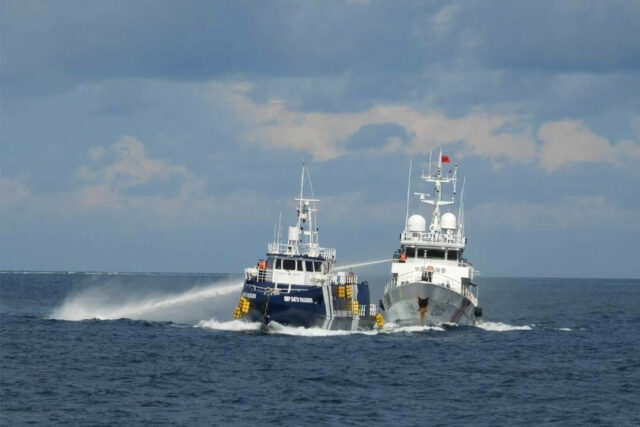
MANILA — Philippine Defense Secretary Gilberto Teodoro on Tuesday denounced what he described as “dangerous” and “inhumane” actions by Chinese maritime forces against Filipino fishermen in a contested South China Sea shoal last week.
Three Filipino fishermen were injured and two fishing vessels damaged when Chinese coast guard ships used water cannon and cut their anchor lines near Sabina Shoal on Friday, Manila’s coast guard said over the weekend.
“Water cannoning, aggressive maneuvering, and the cutting of anchor lines resulting in physical injuries of Filipino civilians are wholly inconsistent with the duty of all States to ensure the safety of human lives,” Mr. Teodoro said in a statement.
On Monday, China’s foreign ministry said the measures taken were necessary to safeguard its territorial sovereignty, saying the actions were “reasonable, lawful, professional and restrained.”
Mr. Teodoro urged nations aspiring for regional leadership to act responsibly, and dismissed as “blatant lies” China’s assertions that the fishermen brandished knives to threaten Chinese coast guard officers.
“We call on China to stop spreading false narratives and engaging in a state-orchestrated disinformation campaign,” Mr. Teodoro said.
The Philippine foreign ministry said it has issued a demarche, or formal reprimand, to the Chinese Embassy in Manila on Monday. The Chinese Embassy did not immediately respond to a request for comment on Mr. Teodoro’s remarks.
Sabina Shoal, which China refers to as Xianbin Reef and the Philippines as the Escoda Shoal, lies in the Philippines’ exclusive economic zone 150 kilometers (95 miles) west of Palawan province.
China claims almost the entire South China Sea, a waterway supporting more than $3 trillion of annual commerce. The areas Beijing claims cut into the exclusive economic zones of Brunei, Indonesia, Malaysia, the Philippines, and Vietnam.
An international arbitral tribunal ruled in 2016 that Beijing’s sweeping claims had no basis under international law, a decision China rejects.—Reuters
A China Coast Guard vessel fires a water cannon at the BRP Datu Pagbuaya near Thitu Island, in the latest flare-up between Manila and Beijing in the disputed South China Sea. — PCG
MANILA — The Philippines said on Monday it will protest the Chinese coast guard’s “harassment and endangerment” of Filipino fishermen in a South China Sea shoal last week.
Three Filipino fishermen were injured and two fishing vessels damaged when Chinese coast guard ships blasted water cannon and cut their anchor lines near Sabina Shoal on Friday, Manila’s coast guard said over the weekend.
The Philippines said it was alarmed by the actions of China’s coast guard, saying the use of water cannons and dangerous maneuvers that cause injury and damage “cannot be justified”.
“The Philippines will undertake the appropriate diplomatic response and register its strong objection to these actions and demand that China cease such aggressive acts,” the Philippines’ maritime council said in a statement.
Presidential press officer Claire Castro told reporters that the Philippines will file a demarche to the Chinese embassy on Monday, citing information from the foreign minister.
China said the Philippines had deployed a large number of ships on Friday to “create trouble”, adding the vessels ignored repeated dissuasion and warnings to stubbornly remain in the lagoon.
The Philippine vessels took dangerous actions such as malicious course changes and their personnel “even brandished knives to threaten Chinese coast guard officers” who were carrying out law-enforcement duties, foreign ministry spokesperson Guo Jiakun told reporters during a regular press conference on Monday.
On Friday, China’s coast guard said it had driven away multiple Philippine vessels and taken “control measures”. The Philippines said that the Chinese statement was “deeply troubling”.
“We call on the CCG, in particular, to act responsibly, adhere to international standards of conduct, and place the preservation of life at sea above actions that sow fear and endanger civilians,” the council said.
Treaty ally the United States has also condemned China’s use of water cannons and the cutting of anchor lines of Filipino fishermen.
“We stand with our Philippine allies as they confront China’s provocative actions and increasingly dangerous tactics against its neighbors, which undermine regional stability,” US State Department principal deputy spokesperson Tommy Pigott said in a statement.
Mr. Guo said on Monday that the US had no right to interfere in these maritime matters and China urges it to stop distorting facts and inciting confrontation.
Sabina Shoal, which China refers to as Xianbin Reef and the Philippines as the Escoda Shoal, lies in the Philippines’ exclusive economic zone 150 kilometers (95 miles) west of Palawan province.
China claims almost the entire South China Sea, a waterway supporting more than $3 trillion of annual commerce. The areas Beijing claims cut into the exclusive economic zones of Brunei, Indonesia, Malaysia, the Philippines, and Vietnam.
An international arbitral tribunal ruled in 2016 that Beijing’s sweeping claims had no basis under international law, a decision China rejects.— Reuters
Across industries that rely on service, clients and patrons now expect environments that feel adaptive, seamless, and personalized. Whether arriving at a lobby, settling into a room, or navigating shared facilities, today’s guests favor interactions that mirror the ease of connected living.
Anchored in its vision of “Powering Connected Innovation,” Samsung is positioning SmartThings as a unifying platform that makes these interactions possible. By integrating intelligence into displays, sensors, and devices, Samsung aims to create environments that anticipate needs, reduce friction, and enable staff to focus on higher-value service.
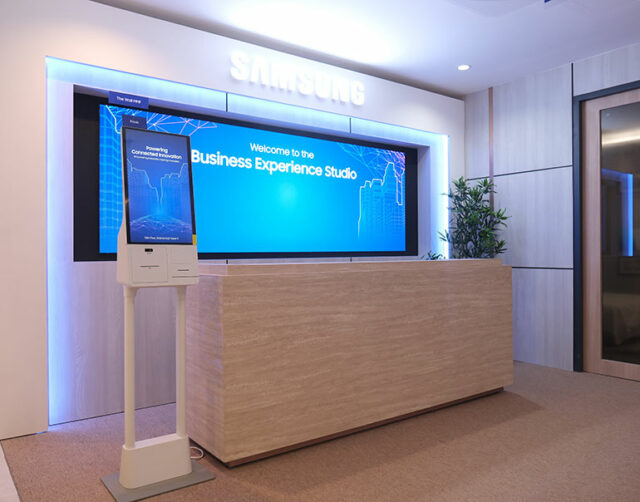
Samsung Philippines recently gave an exclusive, curated look at how digital ecosystems can enhance both the visible and behind-the-scenes flow of a space at the Samsung Business Experience Studio and SmartThings Home Showroom at the Science Hub Tower, McKinley Hill last Dec. 4.
Led by the head of Samsung Philippines’ One Samsung B2B Vertical, Anthony Atacador, the showcase demonstrated how Samsung’s connected ecosystem — spanning from professional displays, security solutions, to SmartThings-powered automation — can transform spaces into intuitive, responsive environments that elevate comfort, convenience, and overall experience of guests and clients.
“The goal of Samsung is really to empower and help business owners through our technology. And when I say technology, it’s not only our products but the solutions that Samsung has. What’s innovative about Samsung are the solutions we created,” Mr. Atacador said.
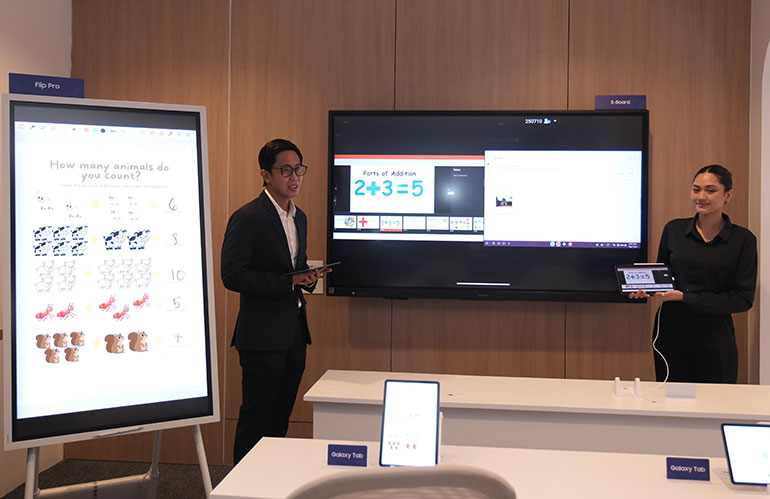
Anthony Atacador, One Samsung Philippines B2B Vertical Head, demonstrates how Samsung enhances learning environments through its displays, tablets and seamless ecosystem.
Responsive room controls
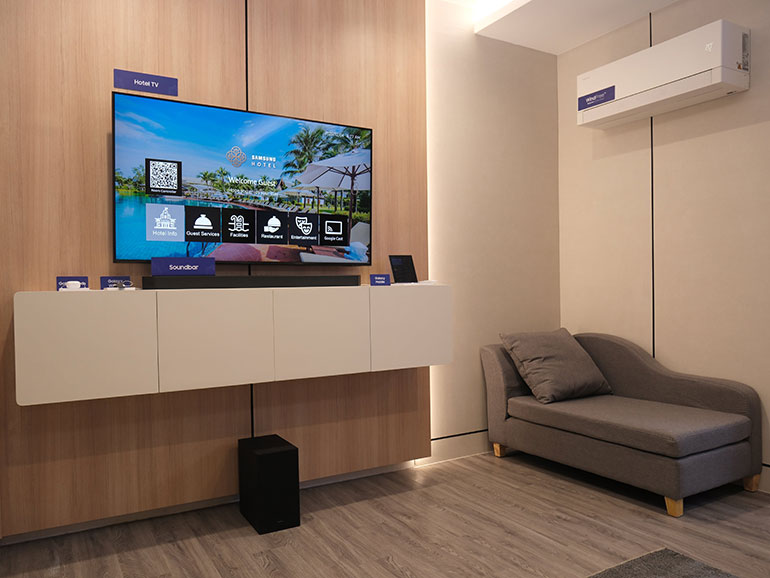
Despite the sophistication, Samsung has designed its interfaces so clients are able to navigate controls with minimal effort. At the core of this is SmartThings, which enables centralized and user-friendly control of a room’s key functions. By simply scanning a QR code, a visitor can adjust lighting, temperature, entertainment and more.
This approach allows spaces to adapt in real time. Lights can dim gradually in the evening, air-conditioning can adjust before arrival, and entertainment systems can sync with a visitor’s device within moments.
The ease of use is essential in environments that welcome diverse guests, ensuring that comfort and convenience are accessible regardless of a visitor’s age, tech fluency, or familiarity with connected spaces.
Dynamic ambiance
Samsung’s professional displays and hospitality TVs play a major role in creating visually unified environments. With advanced calibration, crisp resolution, and customizable interfaces, these displays can shift seamlessly between welcome messages, content streaming, and branded information.
This means lobbies, corridors, and rooms can maintain consistent visual quality. Businesses can tailor messaging, present information, or enhance ambiance with curated visuals, all managed through centralized content systems.
Another forward-looking element of the studio is the demonstration of automated routines. SmartThings allows spaces to react based on time, occupancy or specific triggers.
Motion sensors can activate gentle lighting during late hours, shades or curtains can adjust automatically at sunrise, and rooms can switch to energy-saving settings when unoccupied.
Efficiency and control for operations
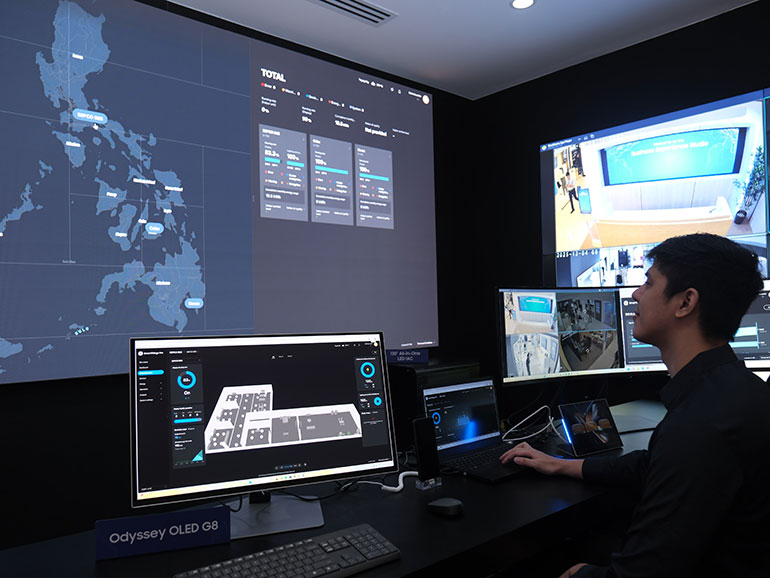
SmartThings and Samsung’s B2B solutions allow administrators to oversee multiple spaces from a single dashboard. This includes monitoring device status, adjusting room conditions, pushing broadcast messages, and scheduling routing automations.
Additionally, Samsung’s Knox security platform provides device-level protection across connected displays and mobile devices. In environments where visitors often use personal smartphones to interact with in-room or in-space systems, Knox ensures that data is protected and that device connections are automatically cleared after use.
Optimized energy efficiency
Samsung also eases energy management within hospitality spaces. Powered by artificial intelligence (AI) and through automated controls that respond to occupancy and time-of-day patterns, SmartThings helps reduce unnecessary consumption without compromising comfort. HVAC adjustments, lighting routines, and system-wide automations contribute to more sustainable operations.
“If I [manage] a building and I have SmartThings Pro, SmartThings Pro can study the activity inside the building. But of course, you can manually set it up,” Mr. Atacador shared.
Over time, these optimizations contribute to lower utility costs and more environmentally responsible operations—an increasingly important consideration for organizations that manage large facilities and aim to balance guest comfort with long-term sustainability commitments.
From spaces to cities
At a broader level, solutions offered by SmartThings not only can strengthen industries like hospitality but can also support the government’s long-term push toward building smarter, future-ready communities.
As government agencies and private sectors explore digitalization initiatives, connected ecosystems offer models for modernizing public facilities, boosting operational efficiency, and raising service standards across sectors.
“Samsung is very passionate in helping our country develop,” Mr. Atacador said. “Not only we’re trying to work with the government in terms of smart cities but also with businesses.”
By showcasing how intuitive automation and centralized management can improve comfort while reducing resource consumption, Samsung’s ecosystem aligns with national priorities on digital transformation.
“If our businesses are not digital, they will get challenged later on, even our country,” he emphasized. “Samsung will provide awareness and would provide the needed education for people to understand the importance of technology, specifically Samsung’s.”
As people increasingly experience connected living in their homes, their expectations carry over into the places they visit. Samsung’s preview underscored how thoughtfully designed connected environments can elevate the way people experience spaces and engage with them.
Spotlight is BusinessWorld’s sponsored section that allows advertisers to amplify their brand and connect with BusinessWorld’s audience by publishing their stories on the BusinessWorld Web site. For more information, send an email to online@bworldonline.com.
Join us on Viber at https://bit.ly/3hv6bLA to get more updates and subscribe to BusinessWorld’s titles and get exclusive content through www.bworld-x.com.
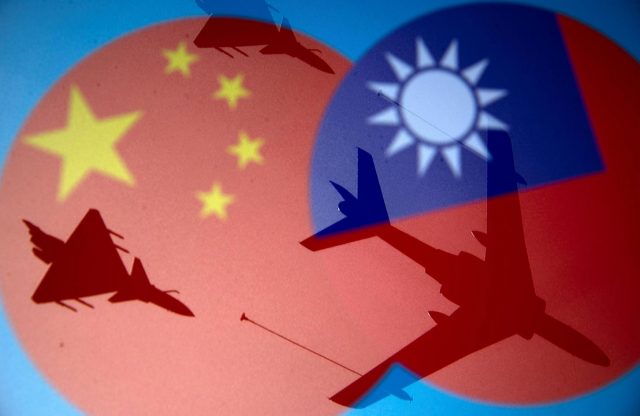
TAIPEI — Taiwan’s military can respond rapidly to any sudden Chinese attack with all units able to operate under a decentralized mode of command without awaiting orders from above, Taipei’s defense ministry said in a report to lawmakers.
Democratically-governed Taiwan, which Beijing views as its own territory, has repeatedly warned that China could try to suddenly shift its regular drills into active combat mode to catch Taiwan and its international supporters off guard.
China’s military operates around Taiwan on an almost daily basis, in what Taipei says is part of a “grey zone” harassment and pressure campaign that stops short of actual combat but is designed to wear out Taiwan’s armed forces by putting them constantly on alert.
The defense ministry said in its report that the frequency and scale of China’s military activities have increased year by year, including their regular “joint combat readiness patrols”.
The military has a standard operating practice on how to raise its combat alert level in case Chinese exercises move “from drill to war”, the ministry added.
“If the enemy suddenly launches an attack, all units are to implement ‘distributed control’ without waiting for orders and, under a ‘decentralized’ mode of command, carry out their combat missions,” it said, without giving details.
Defense Minister Wellington Koo is scheduled to take questions from lawmakers on the report on Wednesday.
PRACTICE ATTACKS China has also been practicing how to attack Taiwan, and sending its warships further and further out into the Pacific and down towards Australia and New Zealand, the ministry added.
“The Chinese communists have never renounced the use of force to annex Taiwan and continue to intensify joint training across services, shifting from purely military drills to routine, multi-service, real-combat-oriented exercises.”
Taiwan’s government rejects Beijing’s sovereignty claims, saying only the island’s people can decide their future.
On Monday, China’s defense ministry said Taiwan President Lai Ching-te was “hyping up” the threat from China and “peddling war anxiety”.
“We hope that the broad mass of Taiwan compatriots will clearly recognize the extreme danger and harmfulness of the Lai authorities’ frantic ‘preparing for war to seek independence’,” the ministry said in a statement.— Reuters
The BBC logo on The Forum, Norwich. — WIKIMEDIA COMMONS/SEBASTIAN DOE, VIA CC BY-SA 4.0
PRESIDENT Donald Trump sued the BBC on Monday for defamation over edited clips of a speech that made it appear he directed supporters to storm the US Capitol, opening an international front in his fight against media coverage he deems untrue or unfair.
Mr. Trump accused Britain’s publicly owned broadcaster of defaming him by splicing together parts of a January 6, 2021 speech, including one section where he told supporters to march on the Capitol and another where he said “fight like hell”. It omitted a section in which he called for peaceful protest.
Mr. Trump’s lawsuit alleges the BBC defamed him and violated a Florida law that bars deceptive and unfair trade practices. He is seeking $5 billion in damages for each of the lawsuit’s two counts.
The BBC has apologized to Mr. Trump, admitted an error of judgment and acknowledged that the edit gave the mistaken impression that he had made a direct call for violent action. But it has said there is no legal basis to sue.
Mr. Trump, in his lawsuit filed Monday in Miami federal court, said the BBC despite its apology “has made no showing of actual remorse for its wrongdoing nor meaningful institutional changes to prevent future journalistic abuses.”
The BBC is funded through a mandatory license fee on all TV viewers, which UK lawyers say could make any payout to Mr. Trump politically fraught.
A spokesman for Mr. Trump’s legal team said in a statement the BBC “has a long pattern of deceiving its audience in coverage of President Trump, all in service of its own leftist political agenda.”
A BBC spokesperson told Reuters earlier on Monday that it had “no further contact from President Trump’s lawyers at this point. Our position remains the same.” The broadcaster did not immediately respond to a request for comment after the lawsuit was filed.
CRISIS LED TO RESIGNATIONS Facing one of the biggest crises in its 103-year history, the BBC has said it has no plans to rebroadcast the documentary on any of its platforms.
The dispute over the clip, featured on the BBC’s “Panorama” documentary show shortly before the 2024 presidential election, sparked a public relations crisis for the broadcaster, leading to the resignations of its two most senior officials.
Mr. Trump’s lawyers say the BBC caused him overwhelming reputational and financial harm.
The documentary drew scrutiny after the leak of a BBC memo by an external standards adviser that raised concerns about how it was edited, part of a wider investigation of political bias at the publicly funded broadcaster.
The documentary was not broadcast in the United States.
Mr. Trump may have sued in the US because defamation claims in Britain must be brought within a year of publication, a window that has closed for the “Panorama” episode.
To overcome the US Constitution’s legal protections for free speech and the press, Mr. Trump will need to prove not only that the edit was false and defamatory but also that the BBC knowingly misled viewers or acted recklessly.
The broadcaster could argue that the documentary was substantially true and its editing decisions did not create a false impression, legal experts said. It could also claim the program did not damage Mr. Trump’s reputation.
Other media have settled with Mr. Trump, including CBS and ABC when Mr. Trump sued them following his comeback win in the November 2024 election.
Mr. Trump has filed lawsuits against the New York Times, the Wall Street Journal and a newspaper in Iowa, all three of which have denied wrongdoing.
The attack on the US Capitol in January 2021 was aimed at blocking Congress from certifying Joe Biden’s presidential win over Mr. Trump in the 2020 US election.— Reuters
STRASBOURG — The European Commission is set to backtrack on the EU’s ban on new combustion-engine cars from 2035 by allowing up to 10% of non-electric vehicles after intense pressure from Germany, Italy, and Europe’s auto sector.
The EU executive appears to have yielded to the call from carmakers to be allowed to keep selling plug-in hybrids and range extenders with CO2-neutral biofuel or synthetic fuel as they struggle to compete against Tesla and Chinese electric vehicles.
The move, which will need approval by EU governments and the European Parliament, would be the EU’s most significant climb-down from its green policies of the past five years.
Carmakers such as Volkswagen and Fiat owner Stellantis have pushed for an easing of targets and fines for missing them. European automotive lobby group ACEA called it “high noon” for the sector, adding that the Commission should ease intermediate 2030 targets as well.
However, the electric vehicle industry says this will undermine investment and result in the EU yielding even more ground to China in the shift to EVs.
“Moving from a clear 100% zero-emissions target to 90% may seem small, but if we backtrack now, we won’t just hurt the climate. We’ll hurt Europe’s ability to compete,” said Polestar CEO Michael Lohscheller.
William Todts, executive director of clean transport advocacy group T&E, said the EU was playing for time while China was racing ahead.
“Clinging to combustion engines won’t make European automakers great again,” he said.
The Commission will also detail plans to boost the share of EVs in corporate fleets, notably company cars, which account for about 60% of Europe’s new car sales. The precise measure is not clear, but there may be an insistence on some local content. The auto industry wants incentives rather than mandatory targets.
The EU executive is also likely to propose a new regulatory category for small EVs that would incur lower taxes and earn extra credits towards meeting CO2 targets.
Credits might also be earned through more sustainable production, such as vehicles made with low-carbon steel.— Reuters
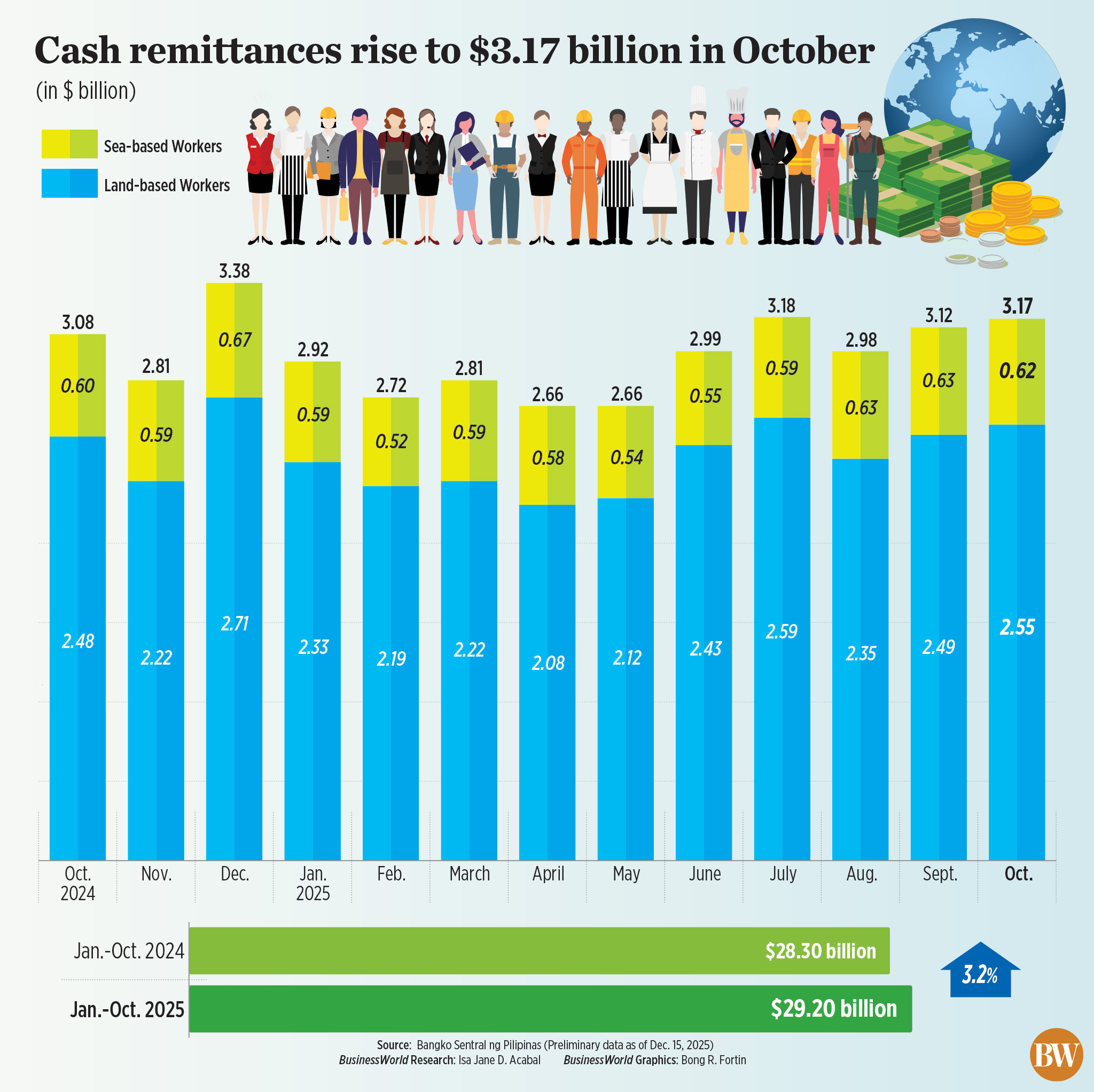
MONEY SENT HOME by Filipinos abroad grew by 3% year on year in October, the slowest pace in five months, the Bangko Sentral ng Pilipinas (BSP) said on Monday.
Cash remittances coursed through banks climbed to $3.171 billion from $3.079 billion in the same month last year, data from the central bank showed.
This was the slowest growth since May when remittances rose by 2.9%. It also matched the 3% growth in July.
In terms of amount, October had the highest monthly remittance level in three months or since the $3.179 billion logged in July.
“Cash remittances from overseas Filipinos totaled $3.17 billion in October 2025 and $29.2 billion in January-October 2025,” the central bank said in a statement.
Month on month, remittances grew by 1.6% from $3.121 billion in September.
“Growth was driven by steady overseas employment and seasonal transfers ahead of the holidays, with the US accounting for over 40% of inflows,” Union Bank of the Philippines Chief Economist Ruben Carlo O. Asuncion said in a Viber message.
“While October marked the slowest pace in five months, this reflects timing rather than a structural slowdown.”
Rizal Commercial Banking Corp. Chief Economist Michael L. Ricafort said the peso trading at the P58 to P59-per-dollar level benefited overseas Filipino workers (OFW) who sent remittances in October.
“The relatively higher US dollar-peso exchange rate at P58-P59 levels in recent months amid the political noises especially in September…, was an opportunity for some OFWs and their families or dependents to convert remittances to pesos to finance their various expenditures in the country,” he said in a Viber message.
In October, the peso performed weaker against the greenback at an average of P58.2984 per US dollar from the P57.2501 recorded in September.
Jonathan L. Ravelas, a senior adviser at Reyes Tacandong & Co., said high labor demand and pre-holiday preparations helped sustain the annual growth in remittances.
He also noted that the slowdown in October was a trend typically observed before remittances hit their highest level by yearend.
“The slower October pace isn’t alarming — it’s a typical lull before the year-end surge, and the weak peso actually gives OFWs more bang for their buck,” Mr. Ravelas said in a Viber message.
Money sent home by land-based workers went up by 2.98% to $2.55 billion in October from $2.476 billion in the same month in 2024.
On the other hand, remittances from sea-based migrant workers grew by 3.11% to $621.113 million in October from $602.35 million a year ago.
Meanwhile, personal remittances, which include both cash coursed through banks and informal channels and in-kind remittances, rose by 3% to $3.519 billion in October from $3.415 billion a year earlier.
10-MONTH REMITTANCES In the 10-month period, cash remittances reached $29.202 billion, up 3.2% from the $28.304 billion seen a year ago.
This is slightly faster than the BSP’s 3% full-year growth forecast. The BSP expects to end the year with $35.5 billion in total cash remittances.
However, Mr. Asuncion said remittance inflows will likely increase in the remaining two months of the year.
“It is important to note that OFW remittances and conversion to pesos seasonally accelerate, if not peak, in (the fourth quarter) especially during the Christmas holiday season towards the end of the year,” Mr. Ricafort said.
Personal remittances grew by 3.2% annually to $32.493 billion in the January-to-October period from $31.487 billion a year ago.
BSP data also showed that remittances from land-based OFWs edged up by 3.28% year on year to $23.36 billion from $22.618 billion in 2024.
Meanwhile, sea-based Filipinos have sent home a total of $5.841 billion at end-October, 2.73% higher than the $5.686 billion recorded in the comparable year-ago period.
As of October, OFWs in the United States sent the most money home, accounting for 40.3% of the total cash remittances during the period.
This was followed by Singapore (7.2%), Saudi Arabia (6.4%), Japan (4.9%), the United Kingdom (4.7%), the United Arab Emirates (4.5%), Canada (3.5%), Qatar (2.9%), Taiwan (2.8%) and South Korea (2.5%).
Most of the cash remittances from land-based OFWs at end-October came from the US, accounting for 42.3% of the total, while the rest were from Saudi Arabia (7.9%), Singapore (6.4%), the United Arab Emirates (5.5%) and the United Kingdom (4.5%).
The US was also the top source of sea-based remittances during the period with 32.3%, followed by Singapore (10.2%), Japan (7.2%), Germany (5.5%) and the United Kingdom (5.4%).
Residents line up to get water from a tanker. — PHILIPPINE STAR/EDD GUMBAN
RESIDENTIAL HOUSEHOLDS in Metro Manila will see higher water bills in the first quarter of 2026 as the regulator approved the rate adjustments sought by the two concessionaires.
The Metropolitan Waterworks and Sewerage System – Regulatory Office (MWSS RO) approved a rate hike of P8.39 per cubic meter (cu.m.) for Manila Water Co., Inc. and P2.15 per cu.m. for Maynilad Water Services, Inc.
The new rates will take effect on Jan. 1, 2026, MWSS RO Chief Regulator Patrick Lester N. Ty. told a press briefing on Monday.
Customers served by Manila Water in the east zone who consume 10 cu.m. or less will see their monthly bills go up by P29.86. Those who consume up to 20 cu.m. and 30 cu.m., will have to pay an additional P66.25 and P135.22, respectively.
Mr. Ty said the steep increase in Manila Water’s overall rate was due to the higher environmental charge as the company was able to increase its sewer coverage.
“Since Manila Water was able to increase their sewer coverage to 30%, they are allowed to increase the environmental charge to 30%,” he said.
The chief regulator said that allowing the increase in the environmental charge encourages the water concessionaires to fast-track their sewerage coverage programs.
Meanwhile, Maynilad customers who use 10 cu.m. or less will see an upward adjustment of P5.06 in their monthly bills. Those who consume up to 20 cu.m. and 30 cu.m. will see their bills increase by P19.06 and P39.04, respectively.
The tariff increase has less impact for low-income households who are beneficiaries of the enhanced lifeline program of Manila Water and Maynilad.
According to MWSS, the increases reflect changes in basic charge, tax rates, environmental charges, sewerage charge, and foreign currency differential adjustments.
The rate hike is the fourth tranche of the approved tariffs for the 2023-2027 rate rebasing period. Rate rebasing is a periodic performance review and general tariff adjustment that sets the maximum rates that the concessionaires may charge for their services.
Mr. Ty said that Manila Water and Maynilad are entitled to collect their fourth tranche as they were able to comply with the required capital expenditure (capex) spending.
Manila Water and Maynilad have spent P48.56 billion and P75.06 billion respectively, which are more than 70% of the target spending for the 2023-2025 period.
“The MWSS RO is here to protect their interest, and we actually double-check if Manila Water and Maynilad indeed spent their capex, rollout projects and they indeed did their projects,” he said.
“We are here to audit and do inspections to make sure that these are the programs that are required, and Maynilad and Manila Water are good and efficient in their capex spending,” he added.
Mr. Ty also assured the public that there will be “no water crisis” next year, with the infrastructure projects that the two water concessionaires are implementing.
Manila Water serves the east zone network of Metro Manila, covering parts of Marikina, Pasig, Makati, Taguig, Pateros, Mandaluyong, San Juan, portions of Quezon City and Manila, and several towns in Rizal province.
Maynilad serves parts of Manila, Quezon City, and Makati, as well as Caloocan, Pasay, Parañaque, Las Piñas, Muntinlupa, Valenzuela, Navotas, and Malabon. It also supplies water to the cities of Cavite, Bacoor, Imus, and the towns of Kawit, Noveleta, and Rosario in Cavite province.
Metro Pacific Investments Corp., which has a majority stake in Maynilad, is one of three Philippine units of First Pacific Co. Ltd., the others being Philex Mining Corp. and PLDT Inc.
Hastings Holdings, Inc., a unit of PLDT Beneficial Trust Fund subsidiary MediaQuest Holdings, Inc., has an interest in BusinessWorld through the Philippine Star Group, which it controls. — Sheldeen Joy Talavera
A participant stands near a logo of the International Monetary Fund at the annual meeting in Nusa Dua, Bali, Indonesia, Oct. 12, 2018. — REUTERS/JOHANNES P. CHRISTO/FILE PHOTO
THE PHILIPPINE ECONOMY is seen to grow below target until next year, as higher US tariffs dampened exports and investments, the International Monetary Fund (IMF) said on Monday.
In a statement for its Article IV Consultation with the Philippines, the IMF trimmed its economic growth forecast for the Philippines to 5.1% for 2025 from 5.4% previously.
If realized, this will be the fourth straight year that the Philippines will miss its gross domestic product (GDP) growth target.
The IMF also lowered its 2026 growth projection for the Philippines to 5.6% from 5.7% previously. This is also below the government’s 6%-7% target for 2026 until 2028.
“The Philippines’ growth is expected to slow to 5.1% in 2025 as increasing tariffs weigh on exports and investment, before picking up moderately to 5.6% in 2026, a downward revision relative to previous forecasts due to a sharper-than-expected slowdown in (the third quarter),” the IMF said.
The Philippine economy expanded by 4% in the third quarter, the weakest growth posted since the same quarter in 2011 excluding the pandemic slowdown, as the widening flood control scandal curtailed consumer and government spending.
The country’s GDP growth stood at 5% as of September.
Meanwhile, IMF Executive Director for the Philippines Idwan Hakim, alternate Executive Director Kaweevudh Sumawong and advisor to Executive Director Maria Cynthia Sison said the Marcos administration’s macroeconomic framework has allowed disinflation and resilient growth amid external headwinds.
“However, (IMF) directors concurred that the balance of risks to the growth outlook is tilted to the downside amid uncertainty from global trade policies, corruption allegations related to flood control projects, and extreme climate events,” they said.
Still, the IMF said the government could recover investor confidence and potentially lift economic growth if it fast-tracks structural and governance reforms.
The IMF noted that the main external risks stem from prolonged global trade policy uncertainty, geopolitical tensions, and disruptive financial market corrections.
On the domestic front, more frequent and intense climate shocks would cause notable macroeconomic losses.
On the upside, accelerated implementation of structural and governance reforms would support investor confidence and raise fiscal multipliers and potential growth.
The IMF also hiked its Philippine inflation estimate for this year to 1.7% from 1.6% previously. For 2026, it raised the inflation projection to 2.8% from 2.6%.
“Inflation declined amid a restrictive monetary policy stance and concerted efforts by the government to reduce food prices,” it said. “Inflation is projected to average 1.7% in 2025 then pick up to 2.8% in 2026 as negative base effects recede.”
This gives the Bangko Sentral ng Pilipinas (BSP) room for an accommodative monetary policy, the IMF said.
“The BSP shares the staff’s view that there is room for monetary policy to be accommodative, while remaining vigilant to risks that may undermine price stability,” it said. “The benign inflation outlook and moderating domestic demand provide room for monetary policy to support economic activity.”
The central bank’s key policy rate is now at an over three-year low of 4.5% following the Monetary Board’s fifth consecutive 25-bp cut last week. It has so far reduced borrowing costs by a total of 200 basis points (bps) since August 2024.
However, BSP Governor Eli M. Remolona, Jr. said they are approaching the end of the easing cycle, but noted that one more 25-bp reduction is possible next year depending on economic data.
The Monetary Board will hold its first meeting of the year in February. — Katherine K. Chan
A tour guide wearing Spanish-era civil guard uniforms leads tourists on a heritage tour around Intramuros, Manila, June 28. — PHILIPPINE STAR/NOEL B. PABALATE
By Justine Irish D. Tabile, Reporter
VISITOR ARRIVALS in the Philippines fell by 2.16% in the first 11 months, amid a decline in tourists from South Korea and China, Tourism department data showed.
Data from the Department of Tourism (DoT) showed international tourist arrivals dropped to 5.235 million in the January-to-November period from 5.35 million in the same period in 2024.
Of the tourist arrivals, the bulk or 4.918 million were foreign tourists, while the rest were overseas Filipinos.
South Korea remained the biggest source of tourists in the first 11 months, accounting for 21.66% of the total.
While 1.134 million South Koreans visited the Philippines as of November, this was a 21% decline from the 1.436 million Korean tourists a year ago.
The US was the second-biggest source of tourists, at 894,835 or 17.09% of the total as of end-November. This was 6.57% higher than last year’s 839,635 tourist arrivals from the US.
Japan was the third-biggest source of tourists, accounting for 406,794 or 7.77% of the total, 15.36% up from 352,630 a year ago.
Tourist arrivals from Australia increased by 16.17% to 268,892 in the 11-month period.
Meanwhile, tourists from China fell by 16.55% to 248,339 as of end-November.
The other top markets were Canada, Taiwan, the United Kingdom, Singapore, and Malaysia, which cumulatively accounted for 793,750 of the total arrivals.
“The weaker South Korean won amid a volatile political and economic situation over the past year and slower economic growth in China, which is the world’s second-biggest economy, on top of territorial disputes partly weighed on foreign tourism numbers,” Rizal Commercial Banking Corp. Chief Economist Michael L. Ricafort said in a Viber message.
Mr. Ricafort noted that the government should improve infrastructure to make it more convenient for tourists to travel around the country.
“Challenges include the need to further expand and develop tourism-related infrastructure such as airports, seaports, accommodation facilities, and train systems, including the Metro Manila subway and toll roads,” he added.
Despite the decline in the first 11 months, Mr. Ricafort said that it is still possible for the country to surpass the tourist arrivals last year, which reached 5.949 million.
“It is still possible, considering some seasonal increase in foreign tourists during the Christmas holiday season, especially overseas Filipino workers and balikbayans, to spend the most festive time of the year, while others escape winter,” he said.
“A higher US dollar-peso exchange rate would make it cheaper for foreign tourists to come to the Philippines,” he added.
Meanwhile, Mr. Ricafort noted the growth in tourist arrivals from India and other countries, which helped “offset the decline in major traditional sources such as South Korea and China.”
India was the 11th biggest source of tourist arrivals in the January-to-November period, accounting for 85,885 or 1.64% of the total. Tourists from India increased by 17.06% from 73,369 arrivals in the same period in the previous year.
Earlier this year, the Philippines and India signed the Implementation Program on Tourism Cooperation for the years 2025 to 2028.
For his part, Colliers Research Director Joey Roi H. Bondoc said that with only 5.235 million as of end-November, it will be difficult for the country to even surpass last year’s arrivals.
“I think it will be very difficult… We may not be able to beat that or even meet that, but of course we want to end the year stronger,” he said in a phone interview.
“We see a lot of foreign tourists still in December because of the holiday season. Definitely that optimism should spill over to next year,” he added.
As for the drop in arrivals from South Korea, Mr. Bondoc attributed this to the economic downturn and political crisis in the country.
“If you look at some integrated casinos, they were initially targeting Koreans… so they are experiencing the pinch of slower arrivals from South Korea,” he said.
Mr. Bondoc said the Philippines should try to attract tourists from other markets.
“I think the challenge here is we really need to diversify our markets because when the South Korean tourists plummeted in numbers, our arrival suffered substantially. Why? Because we have a very narrow bench in terms of international markets,” he said.
“If we broaden that and really promote diversification, meaning attract more tourists from other countries, then if there’s a slowdown in one market, there are other markets or several markets that can help fill that void,” he added.
In a market report released on Dec. 11, Leechiu Property Consultants (LPC) said that despite the decline in the 11-month period, the outlook for tourism remains positive.
“(The) projected recovery (is) supported by streamlined visa processing, particularly for the Chinese market, and expanded long-haul and regional flight routes,” the property consultant said.
“These improvements underpin expectations of stronger international demand by 2026, especially toward the latter part of the year when the full impact of these initiatives is anticipated to take effect,” it added.
LPC said that it expects international arrivals to strengthen by the third quarter of next year.
RAZON-LED International Container Terminal Services, Inc. (ICTSI) will invest R$948 million (around P10.3 billion) to expand and modernize its Rio Brasil Terminal at the Port of Rio de Janeiro, the company announced on Monday.
The project, which will run until 2029, is expected to increase the terminal’s annual container-handling capacity by 70.5%, from 440,000 twenty-foot equivalent units (TEUs) to 750,000 TEUs, ICTSI said in an e-mailed statement.
The expansion will position Rio de Janeiro as a key logistics hub for Brazil’s Southeast and Midwest regions, it added.
“This investment is essential for Rio to increase its efficiency, maintain its competitiveness, and absorb part of the demand currently concentrated in Santos,” Roberto Lopes, chief executive officer of Rio Brasil Terminal, was quoted as saying in the statement.
“The project benefits not only the terminal but also the broader economy of the Southeast and Midwest of Brazil,” he added.
ICTSI Rio offers maritime, road, and rail access and can handle the largest vessels calling the Brazilian coast.
The investment will fund R$414.4 million in infrastructure works and R$533.5 million in equipment acquisition, including expansion and unification of storage yards, rearrangement of buildings to optimize container flows, acquisition of modern container-handling equipment, upgrading utility systems and electrical infrastructure, and technology and automation improvements to enhance customer service efficiency.
The terminal will also implement advanced access control, cargo monitoring, and management systems to meet regulatory requirements, ICTSI said.
The expansion will allow the terminal to operate large Panamax and post-Panamax vessels up to 366 meters long with over 13,000 TEU capacity.
Two new cranes for the largest vessels are expected to arrive by mid-2026, the company said.
“This is a transformative project that reinforces our commitment to Brazil and the efficiency and competitiveness of the national logistics chain,” Mr. Lopes said.
ICTSI has already invested R$190 million in the Rio-Minas and Rio-Suzano logistics corridors, focusing on rail transport, according to the company.
“The expansion will also help reduce congestion at the Port of Santos, better distributing container traffic across the country,” Mr. Lopes added.
Toby Allan C. Arce, head of sales trading at Globalinks Securities and Stocks, Inc., said the investment strengthens ICTSI’s presence in a major South American port.
He noted that over the next two to five years, the project will gradually affect earnings, with initial capital expenditure and depreciation, followed by incremental revenue and earnings before interest, taxes, depreciation, and amortization (EBITDA) gains as the expanded terminal and modernized equipment increase throughput and services.
Established in 1988, ICTSI operates 34 terminals in 20 countries across six continents. ICTSI Rio Brasil Terminal serves import, export, and industrial hubs.
On Monday, ICTSI shares in the Philippines fell 4.75% to P581 apiece. — Sheldeen Joy Talavera
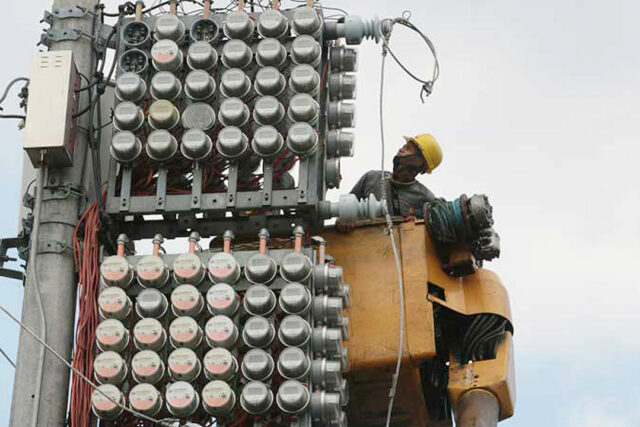
MANILA ELECTRIC CO. (Meralco) has launched a competitive selection process (CSP) to procure 200 megawatts (MW) of baseload renewable energy (RE) to comply with its renewable portfolio standards (RPS) obligations, the company said on Monday.
The CSP aims to secure a four-year power supply agreement (PSA) that will cover Meralco’s baseload requirement starting Jan. 26, subject to approval by the Energy Regulatory Commission (ERC), it said in a statement.
The launch follows the Department of Energy’s (DoE) issuance of a certificate of conformity on Dec. 4, confirming that the CSP aligns with Meralco’s latest DoE-approved power supply procurement plan.
Power generation companies can submit expressions of interest (EoI) to Meralco’s Bids and Awards Committee by Jan. 6. A pre-bid conference is scheduled on Jan. 15, and the bid submission deadline is Feb. 16.
“This CSP is consistent with Meralco’s ongoing efforts to expand its supply portfolio from renewable energy while ensuring RPS compliance through a competitive and transparent bidding process,” said Jose Ronald V. Valles, senior vice-president and head of regulatory management.
Distribution utilities conduct CSPs to procure power through a competitive process that results in a PSA at a least-cost basis.
Meralco has already contracted 1,536 MW of renewable energy from various suppliers, exceeding its initial target of 1,500 MW. Through these initiatives, renewable energy is expected to account for 22% of Meralco’s supply portfolio by 2030.
Earlier this year, the DoE approved Meralco’s 2025 power supply procurement plan, which aims to secure nearly 3 gigawatts of electricity supply from 2026 to 2052.
Meralco’s controlling stakeholder, Beacon Electric Asset Holdings, Inc., is partly owned by PLDT Inc.
Hastings Holdings, Inc., a unit of PLDT Beneficial Trust Fund subsidiary MediaQuest Holdings, Inc., has an interest in BusinessWorld through the Philippine Star Group, which it controls. — Sheldeen Joy Talavera



 Efficiency and control for operations
 From spaces to cities