Home Blog Page 3296

Meralco targets to energize more hyperscale data centers

MANILA Electric Co. (Meralco) said it aims to energize more hyperscale data centers to support the industry.

“Meralco can even provide data center facilities with power supply redundancy through a double feed from an equally reliable power source, resulting in even more outstanding service availability,” Meralco Executive Vice-President and Chief Operating Officer Ronnie L. Aperocho said in a statement on Monday.

“Hyperscale data centers will soon be energized by Meralco,” he added.

In 2023, Meralco energized hyperscale-ready data centers with an initial capacity of 22 megawatts (MW), which can ramp up to 180 MW, according to Meralco Senior Vice-President Ferdinand O. Geluz.

“We now have more than 30 service applications in the pipeline with a total capacity of 1,200 MW,” Mr. Geluz said.

Hyperscale data centers are massive business-critical facilities for companies with major data processing and storage needs.

Mr. Geluz said that Meralco has been providing packaged solutions that cater to hyperscalers and data centers’ needs, including master planning, value engineering, timely energization, energy and demand management, Retail Competition and Open Access day one switch, and renewable solutions.

“In our collective pursuit of advancing and elevating the hyperscale industry landscape of our nation, we pledge to continue providing innovative energy solutions and delivering efficient, value-added services that not only meet but exceed the evolving needs of our dynamic economic environment,” Mr. Aperocho said.

Meralco’s controlling stakeholder, Beacon Electric Asset Holdings, Inc., is partly owned by PLDT Inc.

Hastings Holdings, Inc., a unit of PLDT Beneficial Trust Fund subsidiary MediaQuest Holdings, Inc., has an interest in BusinessWorld through the Philippine Star Group, which it controls. — Sheldeen Joy Talavera

Inspired by The Crown, new series explores Gandhi’s early life

IMDB

LONDON — The years of Mahatma Gandhi when he was a shy young man who had yet to become the revered father of a nation are being brought back to life in a historic London pub and other British venues for a new television series.

The producers plan a three-season series based on historian Ramachandra Guha’s biographical books Gandhi Before India and Gandhi: The Years that Changed the World.

Sameer Nair, the managing director of Indian production company Applause Entertainment, says that the extended format “much in the vein of (Netflix series) The Crown” allows greater scope than, for instance, the films on Gandhi’s life.

“This is really a coming-of-age story. It’s a very rich story that few people know about. You know the man, you don’t know the story,” Mr. Nair told Reuters during a break from filming at London’s George Tavern.

The first season, made up of eight episodes, went into production in India at the start of the year and is being filmed in Mumbai and Gujarat as well as Britain.

Directed by filmmaker Hansal Mehta, actor Pratik Gandhi, 44, takes on the title role.

No relation of Mahatma, he has already played his namesake on stage for the last eight years in India.

“Unknowingly, I was prepping for this day,” he said.

Despite the preparation, Pratik Gandhi feels the pressure of conveying the great man. His response is to anchor his performance in Gandhi’s human qualities.

“He was not a born great person. He was not a superman or superhuman,” he said. “All these experiences of his life made him what he became. And those capabilities are there in each one of us.”

Director Mehta says the series seeks to engage younger audiences. They could be drawn by the decision to cast British actor Tom Felton, known for his performances in the film adaptations of the Harry Potter books.

Mr. Felton plays Josiah Oldfield, who became a friend of Gandhi when he studied law in London.

The actor, 36, said he could not resist the role.

“Clearly the world would look very different without him. To be part of realizing why he became the way he became and how his actions were, it was pretty much a no-brainer for me to say ‘yes, I’d love to be part of this’,” he said. — Reuters

Security Bank readies dollar bond issuance

SECURITY BANK/BW FILE PHOTO

SECURITY Bank Corp. on Monday began a series of fixed income investor meetings for a possible offering of Regulation S dollar-denominated senior unsecured notes, it said on Monday.

The lender has mandated MUFG and UBS as the joint global coordinators to arrange the meetings for the potential issue, along with Standard Chartered Bank and SB Capital as joint bookrunners, Security Bank said in a disclosure to the local bourse.

“A Regulation S offering of US dollar-denominated senior unsecured notes… may follow, subject to market conditions,” it said.

“The notes are expected to be rated Baa2 by Moody’s,” Security Bank added.

The bonds will be issued out of the bank’s $1-billion medium-term note program established on Aug. 29, 2018.

The bank’s most recent issuance under the program was made in September 2018, from which it raised $300 million from five-year notes.

Security Bank’s net income declined by 13.74% to P9.105 billion last year due to higher expenses and as it set aside more loan loss reserves.

Its shares closed unchanged at P70 each on Monday. — A.M.C. Sy

Philippines slips in Nomad Passport Index

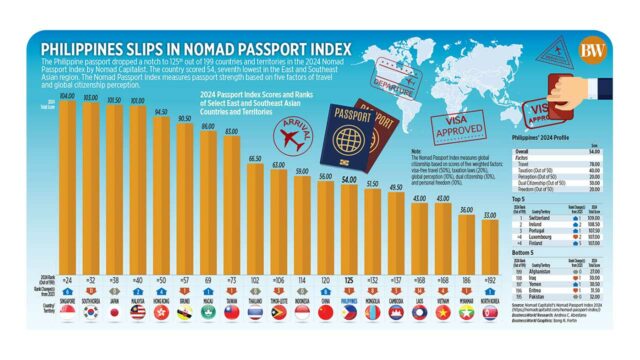
The Philippine passport dropped a notch to 125th out of 199 countries and territories in the 2024 Nomad Passport Index by Nomad Capitalist. The country scored 54, seventh lowest in the East and Southeast Asian region. The Nomad Passport Index measures passport strength based on five factors of travel and global citizenship perception.


Philippines slips in Nomad Passport Index

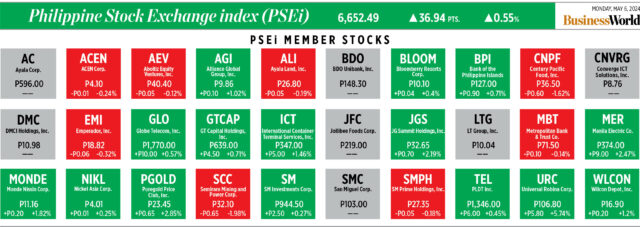
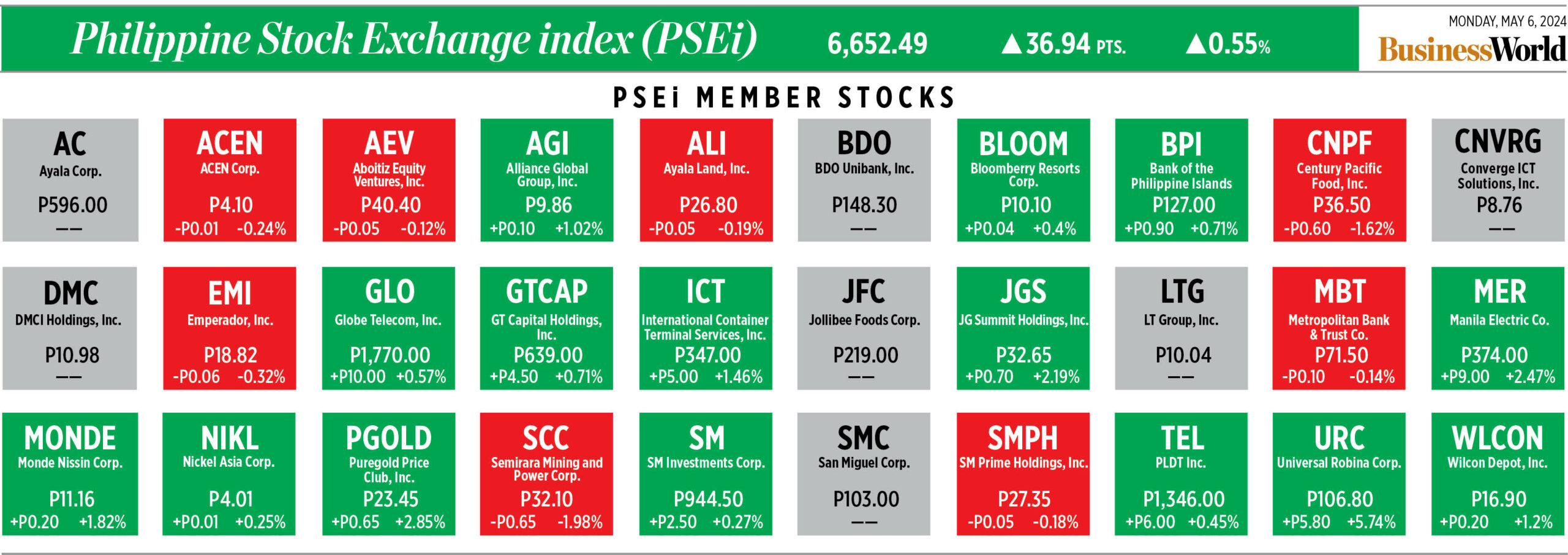
How PSEi member stocks performed — May 6, 2024

Here’s a quick glance at how PSEi stocks fared on Monday, May 6, 2024.


Peso strengthens on US data, weak dollar

BW FILE PHOTO

THE PESO rose on Monday amid a generally weaker dollar and softer-than-expected April US nonfarm payrolls data.

The local unit closed at P57.22 per dollar on Monday, strengthening by 12.5 centavos from its P57.345 finish on Friday, Bankers Association of the Philippines data showed.

The peso opened Monday’s session at P57.20 against the dollar. Its intraday best was at P57.10, while its weakest showing was at P57.28 versus the greenback.

Dollars exchanged dropped to $1.04 billion on Monday from $1.4 billion on Friday.

“The peso appreciated following the softer-than-expected US employment reports in April 2024,” a trader said in an e-mail.

Rizal Commercial Banking Corp. Chief Economist Michael L. Ricafort said in a Viber message that the peso rose amid a weaker dollar.

The dollar was a touch lower on Monday as a soft US jobs report boosted wagers that the Federal Reserve may still cut rates this year, Reuters reported.

Data on Friday showed US job growth slowed more than expected in April and the increase in annual wages fell below 4% for the first time in nearly three years, as signs of labor market cooling raised optimism that the US central bank could engineer a “soft landing” for the economy. 

Markets are now pricing in almost 50 basis points of cuts this year, with a rate cut in November fully priced in.

The Fed held interest rates steady at the conclusion of its two-day monetary policy meeting last week, as expected, but signaled it was still leaning towards eventual rate cuts, even if they may take longer to come than initially expected.

The dollar index, which measures the US currency against six others, was at 105.10, having touched a more than three-week low of 104.52 on Friday. The index is up nearly 4% this year but fell almost 1% last week.

For Tuesday, the trader said the peso could depreciate again due to an expected uptick in Philippine inflation last month.

The trader sees the peso moving between P57.05 and P57.30 per dollar, while Mr. Ricafort expects it to range from P57.10 to P57.30. — A.M.C. Sy with Reuters

PHL stocks climb as investors hunt for bargains

BW FILE PHOTO

By Revin Mikhael D. Ochave, Reporter

PHILIPPINE shares advanced on Monday as investors hunted for bargains ahead of April inflation data.

The bellwether Philippine Stock Exchange Index (PSEi) gained 0.55% or 36.94 points to close at 6,652.49. The broader all-share index added 0.52% or 18.34 points to 3,516.51.

“Ahead of the release of April inflation data, the local bourse rose as investors bought bargain stocks near the support level of 6,600 following three consecutive days of market decline,” Claire T. Alviar, research analyst at Philstocks Financial, Inc., said in a Viber message.

The local statistics agency will report April inflation data on May 7.

Inflation likely quickened to 4.1% last month, according to a median estimate of 16 analysts in a BusinessWorld poll last week. This is within the Philippine central bank’s 3.5-4.3% forecast.

“Positive cues from the United States markets last Friday lifted the sentiment at home amid growing optimism that the Federal Reserve will soon cut rates,” Ms. Alviar said.

On May 3, the Dow Jones Industrial Average Index rose by 1.18% or 450.02 points to 38,675.68; the S&P 500 Index gained 1.26% or 63.59 points to 5,127.79; and the Nasdaq Composite Index went up by 1.99% or 315.37 points to 16,156.33.

“Investors are monitoring the ongoing corporate earnings report releases here at home,” Luis A. Limlingan, head of sales at Regina Capital Development Corp., said in a Viber message.

Among sectoral indices, property was the lone decliner, down by 0.02% or 0.56 point to 2,427.62.

Industrials gained 1.3% or 115.17 points to 8,975.13; services climbed by 1.24% or 23.55 points to 1,910.34; and mining and oil added 1.14% or 100.90 points to 8,900.87.

Holding companies added 0.35% or 21.38 points to 6,090.68, while financials gained 0.32% or 6.76 points to 2,095.65.

“Universal Robina Corp. had the biggest gain, increasing by 5.74%, following good first-quarter earnings results,” Ms. Alviar said. “On the other hand, Semirara Mining and Power Corp. was at the bottom, dropping by 1.98%, amid weaker market coal prices, which translated to lower income.”

Value turnover fell to P4.13 billion, with 491.98 million stocks changing hands compared with 764.55 million worth P6.37 billion on Friday.

Winners beat losers 112 to 74, while 50 stocks were unchanged.

Net foreign selling fell to P279.75 million from P1.29 billion on Friday.

Marcos backs bill restoring NFA power to intervene in rice market

PHILSTAR FILE PHOTO

PRESIDENT Ferdinand R. Marcos, Jr. expressed support for a bill that would amend the Rice Tariffication Act of 2019 to restore the National Food Authority’s (NFA) power to stockpile rice and intervene in the market if needed.

Mr. Marcos said he would certify as urgent a proposed amendment to the Rice Tariffication Act, citing the need for government involvement in the market to check rising rice prices.

“The problem is, rice prices are rising because traders are competing with each other. Their bidding for palay (unmilled rice) is pushing up prices, and we have no control over this,” he told reporters on the sidelines of an event in Manila.

By amending the charter of the National Food Authority and the 2019 law, the government can influence the farmgate price of palay, and ultimately retail prices, he added.

Speaker Martin G. Romualdez last week said the House is targeting a reduction in rice prices of as much as P10 to P15 per kilo with an amendment that restores the NFA’s power to buy rice and sell it at a lower price — effectively committing the NFA to sell subsidized rice.

Under the Constitution, a President can only certify a bill as urgent if there is a public emergency or calamity that requires the immediate passage of a law.

Inflation accelerated for a second straight month in March — to 3.7% from 3.4% in February — as rice prices continued to surge, according to the Philippine Statistics Authority. Rice inflation hit 24.4% in March, the strongest reading since the 24.6% posted in February 2009.

The government and private economists expect El Niño, which has caused P5.9 billion in agricultural damage as of April 30, to worsen inflation and push food prices even higher.

Agriculture Assistant Secretary Arnel de Mesa on Sunday expressed support for the House proposal, citing the lack of tools at the government’s disposal to respond to high rice prices.

The price of regular-milled rice was P50 per kilo, while that of domestically grown well-milled rice was P48 to P55. Imported rice fetched P51 to P54 per kilo.

Mr. De Mesa said that should such a bill be signed into law, the NFA needs to be cautious about selling rice at low prices as it may once again incur losses, which prompted the passage of the Rice Tariffication Law in the first place. 

“This view of the President reflects a complete lack of understanding of the competition and the Rice Tariffication Law,” said Leonardo A. Lanzona, who teaches economics at the Ateneo de Manila.

It is unlikely for rice traders to raise prices because that will mean losing their consumers, he said via chat. “Collusion in the form of cartels and monopolies is the only way that the traders can unilaterally increase prices.”

“In which case, the solution is institutional in nature, not the government regulating prices,” he added, noting that the government should instead empower more traders to compete with alleged carters.

“Thus, the answer is really in strengthening the law, not amending it to allow for more government intervention,” Mr. Lanzona said. “Whatever the government can do will fail in comparison to what the markets can do.”

Reviewing the tariffication law for possible amendment was among the campaign promises of Mr. Marcos.

The 2019 law allowed private traders to bring in rice shipments without restriction, though they had to pay a 35% tariff on Southeast Asian grain, thereby generating revenue for the government instead of obligating the government to pay for rice imports in government-to-government deals with the source countries. The rules have since been modified to apply the 35% tariff to rice privately imported from any source country.

“I don’t think it is the role of the government to bring down palay prices just so that the government can buy enough palay for its buffer stocks. That would be unfair to farmers,” Raul Montemayor, national director of the Federation of Free Farmers, said in a Viber message.

He said the 2019 law should be amended to instead give the government other options to obtain rice to hold in reserve, including buying from importers, or even directly importing as a last resort.

“With respect to consumers, the cost of selling subsidized rice should be carefully studied, together with the manner of distribution to make sure only intended beneficiaries benefit and there are no leakages to middlemen,” he said.

“Overall, government intervention in both the palay and rice markets should be limited to extreme situations,” Mr. Montemayor noted, “and for as long as prices fall within a certain target range, the government must allow the private sector to operate without too much intervention.”

The Philippines imported 3.58 million metric tons (MT) of rice in 2023, according to the Bureau of Plant Industry.

In the same year, farmers produced 20 million MT of palay.

Jayson H. Cainglet, executive director of Samahang Industriya ng Agrikultura, said in a Viber message: “We’d rather that (the NFA’s function) be limited to buffer stocking, procuring palay directly from farmers.”

Mr. Cainglet, who was present at a House hearing on the bill on Monday, said his group is lobbying for a P20-billion increase in the annual P10-billion allotment for the Rice Competitiveness Enhancement Fund or Rice Fund. — Kyle Aristophere T. Atienza


Gov’t must also promote competition among infra partners, economist says

PHILIPPINE STAR/MIGUEL DE GUZMAN

THE GOVERNMENT must promote genuine competition among private-sector partners embarking on flagship infrastructure projects, going beyond its recent order to simplify the permit process for proponents of such projects, an economist said.

“EO 59 should include not just the implementation of these projects but also the rules governing the selection of private partners to promote more competition and local participation,” according to Leonardo A. Lanzona, who teaches economics at the Ateneo De Manila.

He was referring to Executive Order (EO) 59, issued last week, which streamlined the approval process for flagship infrastructure projects by bringing permit applications more in line with the norms set by the Ease of Doing Business law. The law deems complete permit applications to be approved if not acted upon within a prescribed period.

“The (priorities implied) by the EO can affect the criteria for evaluation or set preferences for certain private groups that may contradict the interests of society, including environmental and social safeguards,” Mr. Lanzona added.

“The government should strategize properly in order to obtain the true value of these projects to society,” he said.

The EO cut down the national or local permit requirements for flagship projects to the environmental compliance certificate or certificate of non-coverage from the Department of Environment and Natural Resources; building or occupancy permits issued by a municipal official; excavation permits from the local government unit, and clearances from the National Commission for Culture and Arts, Metropolitan Manila Development Authority, Department of Public Works and Highways, and the Bases Conversion and Development Authority, where applicable.

It also cited the need to comply with “other requirements as mandated by the Constitution and existing laws.”

Terry L. Ridon, a public investment analyst and convenor of think tank InfraWatch PH, said right-of-way issues should also be a priority to avoid major delays in infrastructure projects.

“Right of way is a perennial bottleneck for (infrastructure flagship projects), as it is difficult for government to immediately build resettlement communities for affected informal settler families,” Mr. Ridon said in a Viber message.

Last month, Mr. Marcos issued a separate EO to fast-track the implementation of national railway projects, which are also been hampered by right-of-way issues.

EO 59 is expected to reduce transaction costs when implementing infrastructure projects, University of Asia and the Pacific Senior Economist Cid L. Terosa said in an e-mail.

“It complements the development of ‘hard infrastructure’ with ‘soft infrastructure’ in the form of streamlined processes and procedures. EO 59 therefore has the potential to raise both efficiency and productivity of infrastructure project implementation,” he said.

Upon issuance of the EO, the government must incorporate feedback from communities, businesses and other stakeholders affected by the infrastructure projects, Mr. Lanzona said.

There are currently 185 infrastructure projects in the pipeline, valued at P9.4 trillion.

The government’s Build Better More program includes 197 projects including mass transit, railways, roads and bridges, airports, and seaports.

The government’s infrastructure program for this year is budgeted for P1.472 trillion, equivalent to 5.6% of gross domestic product, the Development Budget Coordination Committee said.

For 2025, the infrastructure program will spend P1.66 trillion, or about 5.7% of GDP. — Beatriz Marie D. Cruz

Contact centers see 2024 revenue of $32.16 billion

INDUSTRY.GOV.PH

THE Contact Center Association of the Philippines (CCAP) said it estimates a 9% increase in revenue for the contact center and business process outsourcing industries this year to $32.16 billion.

“The contact center and business process sector, along with the IT-BPM (Information Technology and Business Process Management) industry, remain optimistic and positive in terms of revenue growth through the years,” CCAP President Mickey Ocampo said in a statement on Monday.

The CCAP called the forecast conservative but in line with the industry yearly average revenue growth, citing an analysis by research firm Everest Group.

In 2023, the association’s members booked revenue of $29.5 billion, or 83% of the revenue posted by the IT-BPM industry of $35.5 billion.

In 2024, the IT-BPM industry projected revenue to increase by around 20% to $39 billion.

“The figures prove how resilient the sector has become, successfully overcoming the significant challenges that came its way, including stringent data privacy laws worldwide, the COVID-19 pandemic, recessions, and now, the rise of generative artificial intelligence (AI),” Mr. Ocampo said.

CCAP expects its members to post revenue of $49 billion by 2028, in line with the IT-BPM roadmap 2028, which projects industry revenue of $59 billion by that year.

CCAP said that according to industry studies, 28% of call center firms are planning to establish sites in Cavite, while 23% are planning to launch in San Fernando, Pampanga.

Other areas that are being considered for expansion by CCAP members include Rizal (21%), Batangas City (21%), Puerto Princesa (21%), Laguna (18%), Iloilo (18%), Tarlac (15%), Cebu (15%), Davao (15%), General Santos City (15%), and Bacolod City (10%). — Justine Irish D. Tabile

Exporters caught up in US restrictions on materials from Xinjiang

REUTERS

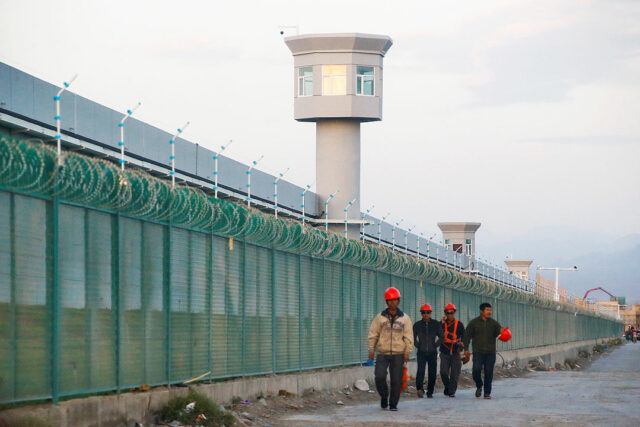
A US ban on materials made in a western Chinese region and soft demand for Philippine garments have caused exporters to lay off or place on forced leave more than 5,000 workers in the wearables industry, the Confederation of Wearable Exporters of the Philippines (CONWEP) said.

In a virtual briefing on Monday, CONWEP Executive Director Maritess Jocson-Agoncillo said the downsizings involve the country’s top cotton apparel exporter, L&T Clark, which is part of Hong Kong-based Luen Thai Group.

Ms. Jocson-Agoncillo said that industry’s performance has been declining for the past two years due to softened demand.

In 2023, exports of wearable apparel, textiles, travel goods, and footwear declined 19% to $1.36 billion, while exports in the first two months of 2024 declined 12% to $215.86 million.

“Over and above this, what really instigated this (the layoff) was the concerns of the industry related to the Uyghur Forced Labor Prevention Act (UFLPA),” she said, referring to a US law sanctioning China due to allegations that residents of Xinjiang, mainly from the Uyghur ethnic minority, have been placed in camps and made to perform forced labor.

UFLPA requires that exporters certify that their shipments contain no materials from Xinjiang, which is a major producer of cotton.

Ms. Jocson-Agoncillo said that the UFLPA has hindered the entry of L&T exports to the US, which cost the company around $5 million, with the cost to the export industry overall estimated at $6 million in losses.

Ms. Jocson said that L&T ended up retrenching around 2,000 employees in Clark, while nine other plants reported, citing various reasons, the retrenchment or forced leave of 3,077 workers in the four months to April.

In a statement on Monday, L&T Clark said the UFLPA presented unforeseeable difficulties for its operations.

“Despite our strict adherence to UFLPA-compliant sourcing practices, we are currently being required by CBP (the US Customs and Border Protection agency) to prove the origin and production practices of all elements of our supply chain,” the company said.

“(This) has led to prolonged delays in clearing recent US shipments, causing significant business interruption and order losses,” it added.

L&T Clark said that the delayed entry of the shipments led to the decision to place employees on forced leave.

“Given the extended and unanticipated time period for determinations on our shipments by CBP, it has become unsustainable to maintain full capacity without causing undue hardship to our employees,” it said.

“As a result, L&T Clark was compelled to implement a retrenchment program. This challenging decision is made with our employees’ well-being in mind, to spare them from uncertainty and prolonged forced leave,” it added.

On April 26, the company announced a retrenchment program for its 2,000 employees, which allowed affected employees to receive comprehensive severance packages that met legal standards.

“Looking to the future, we are hopeful for a rebound in business. Once these conditions improve and orders resume, our goal is to rehire our skilled workforce and restore normal operations,” the company said.

“It is crucial to recognize that these circumstances are the result of external policies beyond our control,” it added.

According to Ms. Jocson-Agoncillo, the industry saw the release of a few of the shipments a week and a half ago amid efforts by the Department of Trade and Industry to address the problem with the US government.

“However, at the end of the day, the damage is done because these shipments were due for November and December and were supposed to be in the stores in February, but since early November, they started getting detained,” she said.

As such, among CONWEP members, “close to about $6 million (worth of shipments) have been compromised,” she added.

Asked for an industry outlook, she said a rebound is possible by the end of the year.

“(The members) are very optimistic that, towards the end of the year until early next year, we can rebound,” she said. “The optimism is coming from the confidence of the buyers. For the Luen Thai Group, the partnership with its major counterpart buyers is there.” — Justine Irish D. Tabile

NGCP declares yellow alert over Luzon grid

PHILSTAR FILE PHOTO

THE National Grid Corp. of the Philippines (NGCP) declared a yellow alert over the Luzon power grid on Monday after more than 1,400 megawatts (MW) worth of plant capacity were reported inoperable.

In an advisory early Thursday, the NGCP said that the yellow alert was raised on Luzon between 3 p.m. and 4 p.m. with peak demand estimated at 13,714 MW for the period, against available capacity of 15,167 MW.

The grid operator said that four plants have been on forced outage since 2023. Three became inoperable between January and March, and nine have been out since April. One plant is running on derated capacity.

As a result of the plant shutdowns and capacity limitations, 1,406.09 MW were unavailable to the grid.

As of the 4:31 p.m., the yellow alert for Luzon had been lifted by the NGCP.

According to the NGCP, the Luzon grid went on red alert for five days and on yellow alert for 11 days in April. The Visayas grid was on red and yellow alerts for five and 10 days, respectively.

The Mindanao grid was on yellow alert for two days during the month.

In May, the NGCP has declared yellow alerts over the Luzon grid for three days.

The Energy Regulatory Commission (ERC) last week ordered the suspension of trading on the Wholesale Electricity Spot Market (WESM) during red alerts to prevent a spike in electricity prices.

Gerry C. Arances, convenor of consumer group Power for People Coalition, welcomed ERC’s decision, saying, “We’d gladly skip even higher electricity prices resulting from outages from burning holes in our pockets.”

“The WESM suspension provides some level of protection to keep that risk at bay,” he said in a statement on Monday.

WESM is the trading floor for non-contracted electricity. The ERC has the power to suspend its operations or declare a temporary WESM failure “in cases of national and international security emergencies or natural calamities” under Republic Act No. 9136 or the Electric Power Industry Reform Act of 2001. — Sheldeen Joy Talavera

ADVERTISEMENT
ADVERTISEMENT