Home Blog Page 3251

Century Pacific Food profit climbs 15% to P1.7 billion

LISTED Century Pacific Food, Inc. (CNPF) reported a 15% increase in its first-quarter net income to P1.7 billion, led by stronger exports and favorable commodity costs.

Consolidated revenue improved by 16% to P18.2 billion, driven by the 10% growth of the branded business composed of the marine, meat, milk, and other emerging segments, CNPF said in a statement to the stock exchange on Wednesday.

CNPF also benefited from the 49% sales increase of original equipment manufacturer (OEM) tuna and coconut exports.

CNPF Chief Financial Officer Richard Kristoffer S. Manapat said the company continues to operate with cautious optimism as it aims to grow the business in the low double-digit territory.

“We are thankful for the first quarter’s healthy momentum, which we expect to normalize and align with our full-year outlook as we move forward. Uncertainties remain, especially with inflation looming over our operating landscape and dampening consumer sentiment,” he said.

“On the branded side, our offerings come in different price tiers to serve varying consumer needs. We focused on providing our consumers with affordable sources of nutrition, keeping our brands relevant during this time. Meanwhile, the OEM exports business, which was challenged last year, is in recovery mode, given tailwinds in commodities,” he added.

CNPF previously committed $40 million to expand its coconut processing capacity, which will serve both its OEM and domestic coconut business with room for growth.

The commitment is part of an expanded agreement with US-based beverage firm The Vita Coco Company, Inc., which requires approximately 90 million liters of coconut water over the next five years.

On Wednesday, CNPF stocks declined by 2.14% or 80 centavos to P36.55 per share. — Revin Mikhael D. Ochave

Puregold income reaches P2.5 billion in Q1 on higher sales

LISTED retailer Puregold Price Club, Inc. posted a consolidated net income of P2.5 billion for the first quarter (Q1), a 4.1% increase from P2.4 billion a year ago, driven by higher sales for the period.

The company’s consolidated revenue for the first quarter increased to P47.3 billion, a 6.5% rise from the P44.4 billion in the corresponding period a year ago, the company told the stock exchange.

For the January to March period, the company recorded net sales of P47.32 billion, marking a 6.7% increase from last year’s P44.35 billion.

Puregold said its operating expenses increased by 10.9% to P6.33 billion from P5.71 billion in the same period last year.

The listed grocery retailer said it logged positive 1.5% same-store sales growth for the first quarter from Puregold stores and negative 1.2% from S&R Warehouse clubs.

Same-store sales measure revenue growth from store locations that have been in operation for at least a year.

“Same-Store Sales Growth trends continued to normalize starting in the second quarter of 2023 as consumer revenge spending has plateaued. The company continues to see a buoyant trajectory in top line growth for the year 2024,” Puregold said.

As of last year, Puregold has opened 37 new Puregold stores, four S&R membership shopping warehouses, and three S&R New York Style quick service restaurants.

To date, the company has a total of 568 stores nationwide; of which 488 are Puregold stores, 26 are S&R membership shopping warehouses, and 54 are S&R New York Style quick service restaurants.

At the local bourse on Wednesday, shares in the company closed 25 centavos or 1.04% higher at P24.20 apiece. — Ashley Erika O. Jose

Schneider Electric opens smart distribution center in Cavite

THE LOCAL unit of a French energy management and industrial automation company opened its smart distribution center in the Cavite Economic Zone on Wednesday.

“The growth that we’re seeing is more on the internal demand for our existing production, and since we’re one of the fastest growing across the region, our capacity can still sustain the growth projections globally,” said Ireen Catane, country president of Schneider Electric, at the inauguration of the new distribution center.

Spanning 4,200 square meters (sq.m.), the new distribution center is part of Schneider Electric Philippines, Inc.’s expansion plan to increase the total area of its distribution center in Cavite to 19,600 sq.m.

Ms. Catane said that the company’s investment in the expansion amounted to P86.5 million, covering the newly opened smart distribution center and its yet-to-open station to be used for consolidating containers.

“If you look at how much we have invested and automated the facility, the intent really is for us to strengthen our safety for our employees, as well as to automate our processes so that we become more efficient,” she said.

“In any logistics operation, efficiency is very important because when we are efficient, we are also fast, meaning we can deliver our items to the market faster than expected,” she added.

Schneider Electric Logistics Director Jordan Gansan said that the new facility will manage the distribution of UPS 3-phase equipment, mainly used in data centers, utilities, and power plants.

“We will also manage other hardware and accessories needed to accommodate and fulfill [our clients’] requests,” Mr. Gansan said.

He said that the 4,200-sq.m. distribution center will have over 2,000 pallet spaces and over 5,000 references to serve the local market, while the size of the container station will be around 2,200 sq.m.

“Pretty much, there’s just one more building that we’re finishing, which is our container station. That will go live at the end of May and will complete all our expansion,” he said.

“By the time we finish the P86.5-million investment… we will have increased and expanded our footprint by 55%,” he added.

The Cavite Smart Distribution Center is one of the French firm’s main distribution centers in the Asia Pacific and is one of its 17 smart distribution centers worldwide.

Aside from meeting the local requirements, the Cavite hub also manages the export and distribution of the company’s UPS 3 Phase equipment to Asia Pacific, North America, Europe, and South America. — Justine Irish D. Tabile

Upgrade to an iPhone and get up to P5,000 cashback from Smart and UnionBank

Mobile services provider Smart Communications, Inc. (Smart) is making it easier for subscribers to upgrade to a 5G device as it now offers the latest iPhones in an exclusive partnership with UnionBank that enables customers to get up to P5,000 cashback when they pay using UnionBank credit card.

Open to Smart Prepaid, Smart Postpaid, and Smart Infinity subscribers, customers can get their preferred iPhone at select Smart Stores via zero-interest installment for 12 or 24 months for new UnionBank credit card holders via PayEasy.

Subscribers who don’t have an active or existing credit card yet from UnionBank are eligible for this promo and are entitled to get their first monthly amortization cashback from April 26 to July 7, 2024 when they avail of an iPhone device. Cashback is computed based on the principal cost of the device and their chosen installment term.

The best iPhone deal from Smart

To avail of this promo, Prepaid and Postpaid subscribers must simply apply for a UnionBank Rewards Credit Card and for Infinity, they must apply for the UnionBank Miles+ Credit Card. For a minimum device purchase of P3,000, customers who used their new UnionBank credit card are qualified to avail of 0% installment for 12 or 24 months at select Smart Stores.

Prepaid and Postpaid subscribers may apply for a UnionBank Rewards Credit Card via smart.com.ph/Pages/UBWelcomeGift. On the other hand, Infinity members may apply for a UnionBankMiles+ Credit Card via smart.com.ph/Pages/InfinityUBWelcome.

Subscribers who avail of the promo will then receive up to P5,000 cashback depending on the total cost of their device.

As an added benefit, “No Annual Fees For Life” will also apply to Smart Prepaid and Postpaid subscribers with a new UnionBank Rewards Credit Card if they spend P20,000 within 60 days of card approval. Meanwhile, Infinity members get an additional 30,000 miles with a new UnionBankMiles+ Credit Card P40,000 accumulated spend in the first 60 days of card approval, which may be used to redeem airline miles and enjoy lounge access.

Get the iPhone 15 for as low as P2,033 per month
 
Under this exclusive offer, customers can get the iPhone 15 (128 GB) for only P2,033 per month for 24 months, or P4,067 per month for 12 months with zero interest rate with a UnionBank credit card.

Aside from the latest iPhone 15 series, Smart also offers other select iPhone models, including the iPhone 15 Plus; iPhone 15 Pro; iPhone 15 Pro Max; iPhone 14; iPhone 13; and iPhone 12; and iPhone 11 — also through affordable and flexible payment options.

For Prepaid customers, each iPhone is also bundled with a FREE Smart Prepaid eSIM and Magic Data 99, which comes with 2 GB non-expiry data, allowing customers to connect online and browse their favorite apps right away. On the other hand, Postpaid subscribers may get their dream iPhones via Smart Signature Plans+, which offer data-packed plans for uninterrupted connectivity, perfect for getaways this summer season.

To know more, visit smrt.ph/UBWelcomeGift for Prepaid and Postpaid, and smrt.ph/UBWelcomeGiftInfinity for Infinity.


Spotlight is BusinessWorld’s sponsored section that allows advertisers to amplify their brand and connect with BusinessWorld’s audience by publishing their stories on the BusinessWorld Web site. For more information, send an email to online@bworldonline.com.

Join us on Viber at https://bit.ly/3hv6bLA to get more updates and subscribe to BusinessWorld’s titles and get exclusive content through www.bworld-x.com.

Not all olive oils are the same

WHILE a large part of the Mediterranean makes and uses olive oil, some are just better than the others. In the case of Castillo de Canena from Jaen, Spain, it uses the power of heritage and harnessing time to join the game.

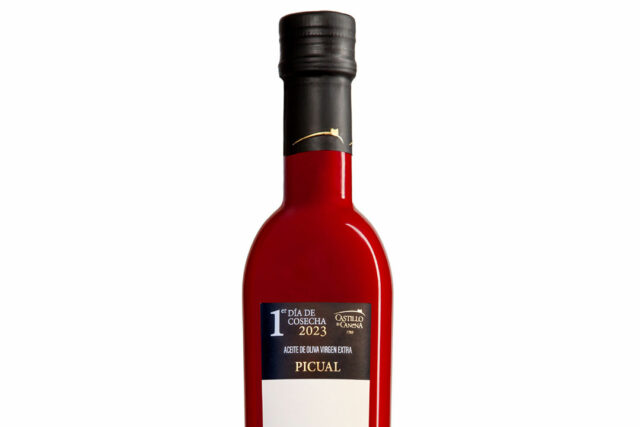
On April 18, BusinessWorld seemed to be transported to Spain, if only for all the olive oil and jamon present at the Spanish Ambassador’s residence in Forbes Park. Francisco Vañó and his sister Rosa were there to unveil new bottles of their limited edition First Day of Harvest olive oils, the bottles bearing two paintings by esteemed Filipino-Spanish artist Fernando Zóbel.

Mr. Zóbel hails from the prominent Zóbel de Ayala family – while known for the financial district they established in Makati, the family’s imprimatur on art is indelible thanks to their Ayala Museum. In their native Spain, the Zóbel scion left his own fingerprint through the founding of the Museo de Arte Abstracto Español in the town of Cuenca, and through his own artworks.

Mr. Vañó told BusinessWorld about their choice of art. Every year, for the special edition bottles, they choose an artist, an actor, a writer — famous people — for their images to adorn their bottles. “Everybody knows, in Spain, Fernando Zóbel is one of the best painters of the 20th century,” he said. “We think that it merged in a very rational way the two countries. He was Filipino, as well he was Spanish.”

The bottle of Picual (a variety of olive) oil bears the image of the painting Dos de Mayo IV, owned by the Juan March Foundation. The bottle of the Arbequina variety of olive oil uses the image of Luz Pálida, II, owned by the Ayala Foundation.

DIFFICULT HARVEST
In a statement, Mr. Vañó described the conditions under which the olive oils were made: “This new edition dedicated to Fernando Zóbel comes in a year in which the harvest has been particularly difficult and complicated. Although the trees were watered using a localized irrigation system, they began flowering three weeks earlier than usual: this was due to extreme heat coupled with a lack of rainfall throughout the early part of spring. Although flowering was expected to be very good, the persistent high temperatures in late April and the first fortnight in May scorched most of the buds, drastically reducing fruit quantity. Very few olives on the trees, very differing fruit production and a very rapid maturity: this was the scenario we faced. Finally, we managed to overcome this dire scenario thanks to the involvement of our team, by using high-tech machinery and integral refrigeration systems together with a scrupulous process of choosing the specific estates and fruit. The effort made was huge, but, once again, we are very happy with the obtained results.”

To BusinessWorld, he described the Picual variety as grassy, and the Arbequina variety as fruity. There are only 10,000 bottles made of the First Day of Harvest edition. But does it make a difference? “The fruit is very strong; it’s very robust… more personality,” he said. “It’s an homage to the producer.”

“A tree is a living creature. It’s like us. It doesn’t move, but it reacts.”

The harvest season of olives is short: Mr. Vañó said that it lasts from October until mid-November. That contrasts with the age of Mr. Vañó’s family: he is of the 9th generation; and the estate where the olives are planted has been productive since 1780.

“Each generation that joins the family company should add, should innovate, should do new things, should expand the business,” he said.

While his ancestors produced olive oil in bulk, it was he and his sister, upon joining the company in 2003, that had the idea to release premium varieties. “You have to continue working,” he said.

Castillo de Canena olive oil is available in Santi’s Delicatessen and The Bow Tie Duck Manila. — Joseph L. Garcia

PHL among most targeted by malicious URL attacks — report

MUHAMMAD RAUFAN YUSUP-UNSPLASH

THE PHILIPPINES placed fifth in a global ranking of economies that logged the highest number of accessed malicious Uniform Resource Locators (URLs) in 2023, cybersecurity software company Trend Micro said.

According to its latest annual cybersecurity report, Filipinos accessed 76.73 million malicious URLs.

Still, this was a 20% decline from 2022.

Ahead of the Philippines were Japan, which led the ranking with 823,06 million accessed URLs, followed by the United States with 382.88 million, Taiwan with 95.1 million, and China with 84.3 million.

“We’re blocking more threats than ever before for our customers. However, adversaries showed a variety and sophistication of tactics, techniques, and procedures (TTPs) in their attacks, especially in defense evasion,” Trend Micro Philippines Country Manager Ian Felipe said in a statement.

Mr. Felipe said network defenders should continue to proactively manage risks.

“Understanding the strategies favored by our adversaries is the foundation of effective defense.”

Meanwhile, Trend Micro also reported that among other threats detected in the Philippines, e-mail threats went down by 27% year on year, while URL hosted and URL victim threats fell 34% and 20%, respectively.

The firm also saw botnet victims go down by 27% and online banking malware drop by 46%.

Meanwhile, malware detections in the country rose by 12% year on year.

Southeast Asian countries including the Philippines recorded an overall increase in ransomware detections, making up more than half (52%) of the global number, largely attributed to significant detections within Thailand.

“Other markets such as Indonesia, Malaysia, Singapore, and the Philippines saw a decline in ransomware detections, similar to the overall global trend. In the Philippines, the number of ransomware detections fell by 93%,” Trend Micro said.

The report also showed that the Philippine government was mostly targeted in advanced persistent threat campaigns.

It said that threat actor Earth Estries, known to deploy cyber espionage campaigns, targeted government organizations and technology industries in the Philippines, Taiwan, Malaysia, South Africa, Germany, and the US.

Earth Estries uses public services such as GitHub, Gmail, AnonFiles, and file.io to exchange and transfer commands and stolen data.

In addition, it also identified China-based group Mustang Panda attacked government organizations in the country using “components of legitimate software commonly used in Southeast Asia for DLL (Dynamic Link Library) sideloading.”

Meanwhile, globally, Trend Micro said detected threats rose to 161 billion in 2023 from 146.4 billion in 2022.

It blocked 73.8 billion e-mail threats, 2.3 billion malicious URLs, 82.1 billion malicious files, 87.5 billion e-mail reputation queries, 4.1 trillion reputation queries, and 2.3 trillion file reputation queries. — Aubrey Rose A. Inosante

DigiPlus Q1 income rises to P2 billion on higher user traffic

LISTED digital entertainment company DigiPlus Interactive Corp. said its first-quarter (Q1) attributable net income rose by almost four times to P2 billion from P424.38 million last year, driven by better revenues and higher user traffic.

First-quarter revenues soared by more than two times to P13.6 billion from P4.18 billion in 2023, led by growing user traffic in its flagship platforms BingoPlus and ArenaPlus digital sportsbook, as well as fresh contributions from new game offerings, Digi-Plus said in a stock exchange filing on Wednesday.

Earnings before interest, taxes, depreciation, and amortization increased over three times to P2.1 billion.

Due to higher revenues, costs, and operating expenses during the period also increased by more than two times to P11.61 billion from P3.71 billion in 2023.

“We intend to sustain our growth momentum by continuing to invest in innovation and new technologies to enhance user experience and adding new digital offerings traditionally well-loved by Filipinos,” DigiPlus President Andy Tsui said.

“By delivering innovative, fun, and accessible digital offerings, we aim to continue revolutionizing the entertainment space in the Philippines,” he added.

DigiPlus previously launched the Perya Game, a local leisure and entertainment game platform with a nod to traditional Filipino carnival. The platform offers various online versions of popular games such as “Color Games,” “Pusoy,” “Lucky 9,” “Tongits,” and “Pa Pula, Pa Puti.”

“To diversify its digital entertainment portfolio, DigiPlus continues to introduce innovative and exciting product offerings that cater to a variety of demographics and lifestyle preferences,” the company said.

On Wednesday, DigiPlus shares declined by 4.63% or 62 centavos to P12.76 per share. — Revin Mikhael D. Ochave

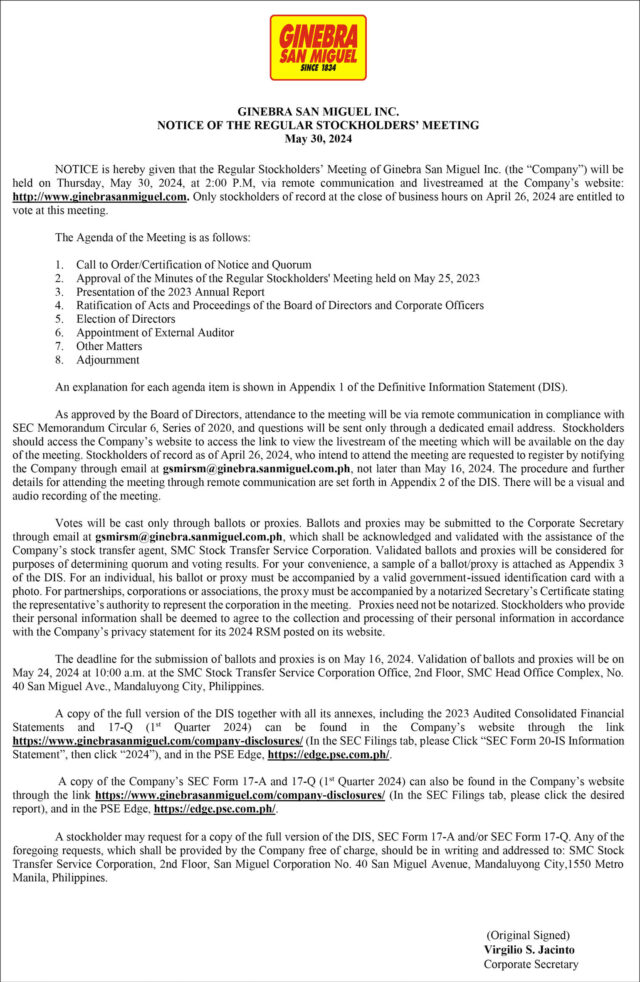
Ginebra San Miguel, Inc. sets Regular Stockholders’ Meeting via remote communication on May 30


Spotlight is BusinessWorld’s sponsored section that allows advertisers to amplify their brand and connect with BusinessWorld’s audience by publishing their stories on the BusinessWorld Web site. For more information, send an email to online@bworldonline.com.

Join us on Viber at https://bit.ly/3hv6bLA to get more updates and subscribe to BusinessWorld’s titles and get exclusive content through www.bworld-x.com.

Back to Investment: Is the World Bank running out of ideas?

TAWATCHAI07-FREEPIK

(Part 2)

WE ARGUED in the first part of this article (https://tinyurl.com/292e53k3) that the evidence indicates that investment is not the magic elixir that the World Bank study on investment accelerations (World Bank’s Global Economic Prospects publication of January 2024, entitled The Magic of Investment Accelerations (https://tinyurl.com/yxmeg4ve) claims, despite the many correlations that the authors documented.

We believe the analysis would have made more sense with manufacturing, on the grounds that aggregate growth is ultimately related to the rate of expansion of the sector with the most favorable growth characteristics. There is a lot of historical work and empirical evidence to suggest there is something special about industry, particularly manufacturing. Indeed, there appears to be a close empirical relationship between the level of per capita income today and the share of manufacturing in GDP in the past, as well as between industrial growth and the growth of overall GDP. It is through the growth of manufacturing that investment matters: a new plant is an investment.

Given the discussion in recent years about the importance of services, this could have been the other variable to analyze. Recent research seems to indicate that some modern services have the production characteristics, i.e., static and dynamic scale economies, to induce fast growth. The relationship between the growth of GDP and the growth of services is strong but there is reason to believe that the direction of causation may be the other way around, from the growth of GDP to service growth since the demand for many services is derived from the demand for manufacturing output itself.

We also believe there are good reasons to think that the magic variable could be exports, the only true component of autonomous demand in an economy, in the sense that their demand emanates outside the economy. On the other hand, the major part of consumption and investment demand depends on the growth of income itself. Exports are the only component of demand that can pay for the import requirements of growth. Surely an economy can experience consumption-led, investment-led, or government expenditure-led growth; but each of these components of demand has an import content. If an economy does not obtain sufficient export earnings to pay for its imports (more precisely, the import content of other components of expenditure), then demand will have to be constrained. For this reason, exports play a very significant role because experience shows that countries, especially developing countries, need to maintain balance-of-payments equilibrium in the long run. Otherwise, they run into a crisis. This implies that exports not only have a direct effect on demand, but also an indirect effect by allowing all other components of demand to rise faster than otherwise would be the case.

Finally, exports matter because recent work shows that the sophistication of a country’s export basket is a good predictor of its future growth. Asian firms moved up in the development ladder, and consequently produced more sophisticated products, by slowly accumulating productive capabilities. Exporting was a means of “testing” whether firms and sectors could compete in the global marketplace by subjecting them to global competition.

Once it has been established that the key drivers of growth are manufacturing and exports, one can then argue that investment matters, both at the firm (machinery and equipment) and at the aggregate (exports require infrastructure in the form of roads and ports) levels. Surely investment has to be part of the equation, but it is not the true underlying cause of growth.

Manufacturing and exports are what the Philippines desperately needs. The country never industrialized (hence its manufacturing employment share is very low) and it is not a powerhouse exporter. These two are the two magic variables that will trigger the investment that the country needs, be it specific equipment or large-scale infrastructure.

Is the Philippines on the right track on both manufacturing and exports? If we look at exports, definitely it is not. Exports of goods and services represented just 27% of GDP in 2023, whereas in the ASEAN peers this share is well above 50%: in Thailand 65%, and 94% in Vietnam. The level of sophistication of these exports is even more important, as this is what will ultimately play a critical role in securing higher returns — higher real wages — due to the high in-come-elasticity of demand of many manufactures. Although the Philippine export basket contains some relatively sophisticated products, it also contains many simple agricultural products and manufactures. Sure, it exports electronic components, but we know that it is just assembly, part of a value chain.

Let us do not forget that exports of goods are an indicator of what is happening in the manufacturing sector. In the Philippines, manufacturing gross value-added growth had been decelerating even prior to the pandemic (removing the statistical over-shooting effect caused by the year 2020). Whereas during 2010-2018 the sector enjoyed robust and sustained growth of 6% (year-on-year average), the growth rate during 2019-2023 was only 1.8% (year-on-year average).

Is the Philippine Government — the current and the previous administrations — aware of the importance of manufacturing and exports for the country’s short- and long-term growth? No doubt it is, but it falls into the mistake of thinking that other issues or sectors are equally important, and that these may produce similar gains in terms of development. Just read the Philippine Development Plan 2023-2028.

A major mistake — in our opinion — is the chosen set of actions/indicators to foster manufacturing and exports. As an example, the Philippine Development Plan 2023-2028 does recognize the need to revitalize industry (Chapter 3) and sets a wide number of “very ambitious” — rather aspirational — targets. In the case of manufacturing, the ambition is to sustain a yearly gross value-added growth rate of 8-9.5% until 2028. Just for reference, the figure for 2023 was 1.3%. There is definitely a lot to do until 2028.

In addition, the “obsession” with the country’s ranking in international qualitative indexes of Doing Business completely misses the focus on serious and effective industrial policy. Cutting red tape and accelerating companies’ registration process is definitely a relief, but no company decides to start manufacturing because the number of days to register has dropped.

A recent significant industrial policy milestone is the passing of the Tatak Pinoy Act. This law, proposed by Senator Sonny Angara and signed into law by President Ferdinand Marcos, Jr. on Feb. 26, aims to increase the diversity, sophistication, and quality of Filipino products leading ultimately to more and better exports. We cannot be more aligned with this leading policy. Now come the big challenges of implementing it and making this ambition a reality. We welcome the inclusion of four private sector representatives in the Tatak Pinoy Council, the body that shall draft and monitor the multi-year Tatak Pinoy Strategy. One of the characteristics of this Government is the belief in establishing partnerships with the private sector as a leverage for development. Whereas we may not be so thrilled with this overarching policy for the provision of certain public services, we firmly believe that this is the only way forward in the case of industrialization.

Without strong collaboration between the private and the public sectors, the Philippines will never truly industrialize. However, it is also important to define what kind of collaboration is established. Whereas private compa-nies are absolutely free and independent to invest in the businesses or sectors that they may find more financially interesting — they are in the good economic sense “profit maximizers” —, it is the Government that has to have a clear economic long-term vision about the sectors it wants private companies — domestic or foreign — to invest in. Leaving industrialization to “market dynamics” will not work, as development is a collective effort — among competitors — that needs public coordination and support.

Finally, another industrial policy misunderstanding is the “obsession” with Foreign Direct Investment (FDI) as the “magic wand” to spur exports. Being in favor of easing foreign investment in all sectors for private companies

(state-owned companies are a different story) for the benefits it entails through increased competition, industrialization will mostly be driven by domestic corporations. No country (with exceptions like Singapore due to size) has industrialized without developing a wide base of domestic industrial companies. Surely at the micro level, we will find certain foreign companies that have specific products or technologies that are critical for a certain sector to develop, at least in the short- to medium-term. We believe in the benefits of this company-targeted approach for FDI.

Summing up: We have argued that the magic recipe for the Philippines lies in developing a manufacturing sector and in exporting. Investment is an intermediate variable, and it is investment in these two areas that matters. The six-million-dollar question is: do we have the firms to do this?


Jesus Felipe is distinguished professor of Economics, De La Salle University while Pedro Pascual is a board-certified economist with Spain’s Ministry of Economy and a partner at MC Spencer (Philippines).


Philippines’ gross dollar reserves dip at end-April

UNSPLASH

By Luisa Maria Jacinta C. Jocson, Reporter

THE PHILIPPINES’ gross international reserves (GIR) slipped at end-April as the National Government (NG) paid back some of its debt, the central bank said.

Preliminary data from the Bangko Sentral ng Pilipinas (BSP) showed reserves inched down by 0.6% to $103.44 billion as of end-April from $104.07 billion at end-March.

“The month-on-month decrease in the GIR level reflected mainly the NG’s net foreign currency withdrawals from its deposits with the BSP to settle its foreign currency debt obligations and pay for its various expenditures,” the BSP said in a statement late on Tuesday.

Meanwhile, year on year, dollar reserves rose by 1.6% from $101.76 billion.

As of end-April, the level of dollar reserves was enough to cover about 5.9 times the country’s short-term external debt based on original maturity and 3.6 times based on residual maturity.

It was also equivalent to 7.7 months’ worth of imports of goods and payments of services and primary income.

The central bank expects the GIR level to settle at $103 billion by yearend.

Ample foreign exchange buffers protect an economy from market volatility and ensure the country can pay its debts in the event of an economic downturn.

Broken down, the central bank’s foreign investments slipped by 0.06% to $87.89 billion at end-April from $87.94 billion the previous month. Year on year, foreign investments went up by 2.5% from $85.77 billion.

Reserves in the form of gold were valued at $10.26 billion, down by 2.6% from $10.53 billion a month prior, but edging higher by 0.2% from $10.24 billion a year ago.

Meanwhile, foreign currency deposits fell by 26.9% to $791.7 million as of April from $1.08 billion in the previous month. The total was also 30.6% lower than $1.14 billion a year ago.

Net international reserves dipped by 0.6% to $103.4 billion from $104 billion a month earlier. Net international reserves are the difference between the BSP’s reserve assets or GIR and reserve liabilities, such as short-term foreign debt and credit and loans from the International Monetary Fund (IMF).

The country’s reserve position in the IMF inched down by 0.7% to $736.1 million at end-April from $741.3 million a month prior. It also dropped by 9% from $809.3 million year on year.

Special drawing rights, or the amount the country can tap from the IMF, was unchanged at $3.77 billion.

Rizal Commercial Banking Corp. Chief Economist Michael L. Ricafort said the drop in dollar reserves as of end-April was due to “lower foreign exchange holdings amid some foreign debt payments and other expenses by the National Government.”

There was a decrease in the value of gold holdings after world gold prices corrected lower during the month, Mr. Ricafort added.

Union Bank of the Philippines, Inc. Chief Economist Ruben Carlo O. Asuncion said the country’s reserves declined as they were likely used to support the peso, which recently hit 17-month lows against the dollar.

“I would like to think that the reserves were used to defend the peso in April. We know that there has been a lot of pressure on emerging markets currencies since last month,” Mr. Asuncion said in a Viber message.

BSP Governor Eli M. Remolona, Jr. this week said the central bank has only had to intervene in the foreign exchange market in “small amounts” despite the peso’s recent depreciation versus the greenback.

Can’t book a table in New York? It could be worse

WYRON A-UNSPLASH

IF YOU could hear handwringing, that was the noise that sounded around the world as people scrolled through The New Yorker’s piece on the cutthroat secondary market for bookings in Manhattan’s hottest restaurants. Adam Iscoe went through the many ways diners can get to eat at some of the toughest tables in town — almost all involved spending large amounts of money, sometimes just for the right to get in the front door. Think Ray Liotta at the Copacabana in Goodfellas, but handing off a lot more cash.

Still, it could be worse. I’m reminded of a cartoon caption — most likely from the same magazine — that portrayed someone on the phone negotiating a reservation with a would-be customer, saying, “Never. How about never?”

I’m thinking of the reservation system followed by some high-end establishments in Japan: ichigensan okotowari or, no first-time customers. These are probably the best restaurants you’ve never (or will never) hear of because they only let in regulars and their guests. These guests can become regulars if they pass muster. They are then allowed to book seats under their own names. If you want to go but don’t have a member of the restaurant’s faithful to vouch for or accompany you, you’re out of luck. It’s the kind of exclusivity that’s truly meant to exclude. And while it may not be the most democratic of business models, it may be a beneficial one in terms of sustainability and culinary integrity.

For chefs and restaurateurs, getting customers into the seats is one thing; attracting people who actually appreciate what you do is another. That point was made by a story about the great New York chef David Bouley that circulated after he died in February. As the tale went, Bouley — whose eponymous restaurants were central to Manhattan’s epicurean renaissance in the 1980s and 1990s — had just received a fresh supply of Copper River salmon of exquisite quality. He put it on the menu that evening and sent it out as a first course — tenderly baked and accompanied by creamy watercress rice and a puree of peas. But to his surprise (and his staff, as well, who had been oohing and aahing over the fish), the couple they served with the dish sent it back, complaining it was fishy and could they have the shrimp instead. The chef was furious. He tore up the order ticket for the couple’s table and commanded the flustered maitre d’ to tell them “their meal is over.” The kitchen erupted in applause. And the mystified (though apparently “surly”) couple scampered out, never to darken the portals of a Bouley restaurant ever again. Or so I assume.

I remember arriving at a favorite restaurant of mine too late to get the last order of a terrific pork chop. It went to the customer seated next to me at the bar. He was very carefully cutting away all the fat and only ate the lean meat. I was exasperated: The whole point of the dish was its unctuousness; the pig was raised for its fat. I wasn’t the only person outraged. The server who took away the not-quite-empty plate came back with a message from the kitchen: “Sir, the chef noticed that you didn’t finish your food. Was everything ok?” The diner was nonplussed and mumbled something. It was the restaurant’s polite way of putting him on notice: Never do that again.

A restaurant owner I know in Copenhagen says that he’d like nothing better than to have tried-and-true regulars as their customer base. That’s not really acceptable for restaurants indoctrinated in the Western ideal of perpetual growth and the magic escalator of scalability. But it may just work for cooks and purveyors of hospitality who want to retain the quality of their craft by remaining small and off-the-radar. In Japan, some of the restaurants that practice ichigensan okotowari have been handed down through generations of chefs. But then they very rarely have to jump through the hoops that almost all Western-style restaurants do: worrying about the latest food trends; or preparing substitutes for their non-vegan or non-vegetarian specialties. If you don’t like what the restaurant is good at, the cognoscenti won’t take you there.

The practice is certainly not universal even in Japan — and there are more popular and accessible spots that will give you alternatives to shellfish and skewered poultry. But in high-end restaurants that do take call-in or online reservations, first dibs still often go to the regulars — and their friends (and would-be future regulars). At the end of a meal, most of the customers book their next. I had the great good fortune to get into Sugita, one of the best sushi-yas in Tokyo today, through a friend who is a regular there. It wasn’t an inexpensive meal but I paid much less than the amounts that diners in New York are willing to throw at the apps and sites that offer entry to the trendiest dining rooms in town. I had one of the most memorable meals of my life at Sugita. My only regret: I wasn’t asked about a reservation for my next visit.

BLOOMBERG OPINION

MacBook Air M3 now available at Power Mac Center stores

POWER MAC Center (PMC) on Friday announced the availability of the MacBook Air equipped with the latest M3 chip at its stores.

“It’s 1.4 times faster than M2, it’s super fast. It could handle if my Final Cut Pro was open, Google Docs, my PDFs for all of my readings were open — the MacBook Air M3 can handle it,” content creator Janina Vela during a launch event on May 3 at PMC Greenbelt 3.

PMC Partner Trainer Eiron Valdez said among the new MacBook Air’s notable specifications are “all-day battery life, which lasts up to 18 hours, its 13 times faster performance compared to an Intel-based model, seamless files migration even from a Windows computer, and portability.”

The new laptop has 13-inch and 15-inch models. Available colorways are space gray, silver, starlight, and midnight.

The prices of the 13-inch MacBook Air M3 range from P79,990 to P102,990, depending on memory and storage options, while the 15-inch model will cost from P89,990 to P115,990.

The new laptop has a 13.6 Liquid Retina display with 500 nits brightness. The device also has one MagSafe 3 and two Thunderbolt ports and is fanless.

Power Mac Center rolled out promos for the launch of the new MacBook Air, with details available on its social media platforms. Customers can purchase the new laptop in PMC stores or online via The Loop.

“PMC always tries to come up with offers that would make it a little easier for average Filipinos to own one because that is what the Mac&Me campaign stands for, whether you’re a student, entrepreneur, technical, creative, or professional,” PMC Brand Manager Gio Ignacio said.

Power Mac Center has 100 locations nationwide. It is an Apple Premium Reseller, Apple Authorized Education Reseller, Apple Authorized Training Provider, and Apple Authorized Service Provider in the Philippines. — A.R.A. Inosante