Home Blog Page 3238

BSP says less hawkish stance may put pressure on peso

STOCK PHOTO | Image by iiijaoyingiii from Pixabay

MANILA – The Philippine central bank’s less hawkish stance may put pressure on the peso but ithas not affected the local currency yet, its governor said on Friday.

Bangko Sentral ng Pilipinas (BSP) Governor Eli Remolona told Bloomberg TV on Friday the central bank is “happy” with the movement of the currency, but it has been intervening in small amounts to keep markets orderly.

The BSP kept rates steady for a fifth straight meeting on Thursday, but signalled it could cut interest rates as early as August given recent inflation and economic growth numbers.

Mr. Remolona said he would like to reduce reserve requirements for banks “by quite a bit”, but it would not necessarily be in tandem with a rate cut. He said the BSP could reduce the requirement to 5% from 9.5%, one of the highest in the region.

“The timing is important. We don’t want to do it while we’re still hawkish,” Remolona said.

Mr. Remolona added the country’s ongoing maritime tensions with China in the South China Sea has not affected the peso.

Annual inflation quickened for a third straight month in April to 3.8%, bringing the average to 3.4% in the first four months, within the central bank’s 2% to 4% target for 2024. — Reuters

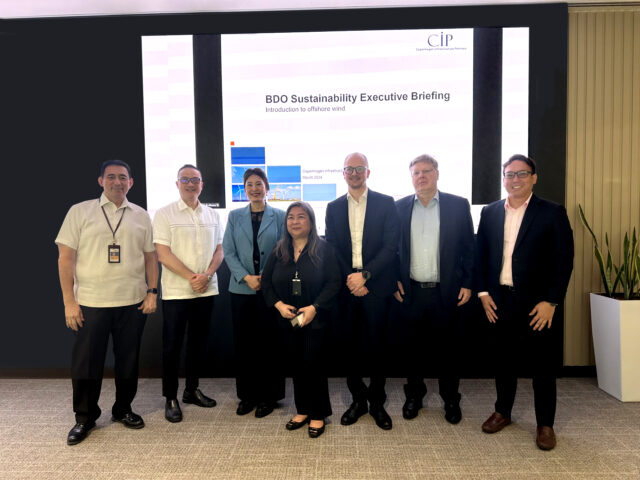
BDO holds sustainability briefing series for its top executives

In Photo: Atty. Federico Tancongco (left), Senior Vice President and Chief Compliance Officer of BDO Unibank Inc. and Marla Garin-Alvarez (center), Vice President and Head of Sustainability Office of BDO Unibank Inc. organized BDO’s Sustainability Executive Briefing on offshore wind. Joining them are (From L-R) Joseph Albert Gotuaco, Senior Executive Vice President and Head of Central Operations Group of BDO Unibank Inc.; Copenhagen Infrastructure Partners (CIP) speakers Marina Hsu, CISC Regional Managing Director for Taiwan, Vietnam and the Philippines; Jesper Krarup Holst, CIP Senior Vice President and Co-CEO for COP Philippines; Pierre Martignoli, CIP Head of Capital Markets and Francis Daba, CIP Business Development Director for the Philippines.

BDO Unibank Inc. (BDO) has launched its Sustainability Executive Briefing Series to enable senior leaders to gain a broad understanding of sustainability at a strategic level specifically on risks and opportunities in environment, social, and governance (ESG) that impact their decisions on credit, investments, underwriting, insurance, and administrative operations.

The briefings support BDO’s sustainability philosophy, incorporating sustainability in the way the Bank conducts business, aimed at embedding sustainability principles in everything it does – from making decisions to assessing relationships to creating products.

The Executive Series has so far covered diverse topics such as nature and biodiversity loss and conservation, responsible investing, offshore wind energy, and current nuclear power technology. Featured external speakers are experts on emerging sustainability issues designed to provide the leadership team with valuable insights, best practices and a platform for meaningful exchange of ideas to identify business opportunities.

BDO’s Sustainability Executive Briefing Series aligns with the mandate set forth by the Bangko Sentral ng Pilipinas (BSP), to bolster the financial institutions’ leadership capability in effectively assessing and managing environmental and social (E&S) risks. Furthermore, the sessions intend to reinforce BDO’s financial performance in a global low carbon economy that is environmentally responsible, and socially inclusive.


Spotlight is BusinessWorld’s sponsored section that allows advertisers to amplify their brand and connect with BusinessWorld’s audience by publishing their stories on the BusinessWorld Web site. For more information, send an email to online@bworldonline.com.

Join us on Viber at https://bit.ly/3hv6bLA to get more updates and subscribe to BusinessWorld’s titles and get exclusive content through www.bworld-x.com.

BSP signals possible rate cut in Aug.

THE CENTRAL BANK trimmed its risk-adjusted inflation forecast for this year to 3.8% from 4% previously. — PHILIPPINE STAR/WALTER BOLLOZOS

By Luisa Maria Jacinta C. Jocson, Reporter

THE BANGKO ng Pilipinas (BSP) stood pat for a fifth straight meeting but signaled a “less hawkish” tone amid lower-than-expected inflation.

This as the central bank now sees the possibility of monetary easing as early as August.

The Monetary Board on Thursday left its target reverse repurchase rate unchanged at a 17-year high of 6.5%, as expected by 17 out of 19 analysts in a BusinessWorld poll last week.

Interest rates on the overnight deposit and lending facilities were left unchanged at 6% and 7%, respectively.

“We are actually somewhat less hawkish than before, which means we could ease (or) cut rates by the third or fourth quarter this year,” BSP Governor Eli M. Remolona, Jr. said at a press briefing.

Mr. Remolona said that they may reduce rates “possibly by August of this year.”

At an event late on Thursday, Mr. Remolona told reporters that the BSP could deliver a 25-basis-point (bp) rate cut at its Aug. 15 meeting. 

He said there could be one or two rate cuts within the second semester. “It’s a range between 25 bps and 50 bps for the rest of the year,” he added.

Mr. Remolona noted the BSP might start easing ahead of the US Federal Reserve, which he expects to start cutting rates by September.

The BSP chief said he is not worried about the potential impact on the peso, noting that there would only be a “bit” of pressure on the currency if the BSP cuts before the Fed.

However, Mr. Remolona said that it still sees the need for “sufficiently tight monetary policy settings” until inflation can settle firmly within the 2-4% target band.

“A restrictive policy stance will also help keep inflation expectations anchored amid a possible buildup in upside risks to future inflation,” he added.

The BSP lowered its risk-adjusted inflation forecast for this year to 3.8% from 4% previously. However, it raised its risk-adjusted forecast for 2025 to 3.7% from 3.5% previously.

Meanwhile, the central bank also adjusted its average baseline inflation forecast to 3.5% from 3.8% previously. It also hiked its baseline forecast to 3.3% for 2025 from 3.2%.

Mr. Remolona noted that their less hawkish stance was due to the “better-than-expected” April inflation figure.

Headline inflation quickened for a third straight month to 3.8% in April from 3.7% in March. It also marked the fifth straight month that inflation fell within the 2-4% target range.

For the first four months of 2023, inflation averaged 3.4%.

However, the BSP chief warned that risks to the inflation outlook “continue to lean toward the upside.”

“Potential price pressures are linked mainly to higher transport charges, food prices, electricity rates, and global oil prices,” Mr. Remolona said.

BSP Deputy Governor Francisco G. Dakila, Jr. said the BSP still anticipates inflation could potentially overshoot the 2-4% target band from May until July amid positive base effects.

“But even if there were to be some breach of the inflation target band, the expectation is that this will be temporary and there will be a reversion to the target band,” Mr. Dakila added.

LESS HAWKISH
Meanwhile, Capital Economics Senior Asia Economist Gareth Leather noted the BSP’s less hawkish tone at Thursday’s meeting compared with its meeting in April.

“Not only did the central bank cut its inflation forecast for this year, but clearly hinted that rates would be cut in the third or fourth quarter. This supports our forecast that the easing cycle will begin in August,” he said in a note.

ING Bank N.V. Manila Senior Economist Nicholas Antonio T. Mapa said that Mr. Remolona took on a “more dovish tilt” at Thursday’s meeting.

“Despite this recent shift in tone from the previously hawkish Remolona, we hold on to our previous expectation that the BSP can only cut policy rates ‘as soon as the Fed does,’” he said in an e-mail note.

Markets were initially anticipating the US Federal Reserve to cut rates as early as June, but this has been pushed back to the fourth quarter amid persistent inflation in the United States.

Mr. Leather said that Philippine inflation should continue to decelerate in the coming months.

“However, while inflation is likely to remain elevated over the next few months, it should fall in the second half of the year on the back of an increase in the supply of agricultural products, slower economic growth and more beneficial base effects,” he added.

Pantheon Chief Emerging Asia Economist Miguel Chanco said that inflation could possibly overshoot the target band in May.

“A minor breach of the upper bound remains likely this month, given the still-unfavorable food price base effects in play,” he said in a note.

“But the May print should be the peak, with a sustained period of disinflation set to take hold from June — with food-price base effects U-turning to sharply favorable — opening the door in August for the first of three 25-bp rate cuts we expect this year,” he added.

Mr. Leather also sees the BSP cutting rates by 25 bps in August, with further rate cuts late this year.

For his part, Mr. Mapa expects the first rate cut to be delivered in October.

Zero tariff policy now extended to two-wheeled EVs, hybrid vehicles

The Philippine government granted tax breaks to two-wheeled electric vehicles and hybrid vehicles as it seeks to promote green transport. — PHILIPPINE STAR/EDD GUMBAN

By Beatriz Marie D. Cruz, Reporter

THE NATIONAL Economic and Development Authority (NEDA) Board on Wednesday granted tax breaks for electric motorcycles (e-motorcycles), electric bicycles (e-bicycles) and hybrid electric vehicles (EVs), as the government seeks to further promote green transport and cut carbon emissions.

The NEDA Board, chaired by President Ferdinand R. Marcos, Jr., on Wednesday approved to expand the coverage of Executive Order (EO) No. 12 which temporarily reduced tariffs on electric vehicles to zero until 2028.

The zero tariff policy will now cover e-motorcycles, e-bicycles, nickel metal hydride accumulator batteries, e-tricycles and quadricycles, hybrid EVs and plug-in hybrid EV (PHEV) jeepneys or buses.

The NEDA Board also agreed to keep the zero tariff policy on 34 lines of battery EVs currently covered by EO 12.

In February 2023, Mr. Marcos signed EO 12, which temporarily removed the tariffs for EVs and their parts and components for five years. However, the EO did not include two-wheeled EVs and hybrid vehicles.

Prior to the order, tariff rates for some EVs ranged from 5-30%.

“EO 12 is designed to stimulate the EV market in the country, support the transition to emerging technologies, reduce our transport system’s reliance on fossil fuels, and reduce greenhouse gas emissions attributed to road transport,” NEDA Secretary Arsenio M. Balisacan said in a statement on Thursday.

The Philippine government is now promoting more environment-friendly means of transport as it committed to reduce greenhouse gas emissions by 75% by 2030 under the Paris Agreement.

“By encouraging consumers to adopt EVs, we are promoting a cleaner, more resilient, and more environmentally friendly transportation alternative,” Mr. Balisacan, who also serves as the vice chairperson of the NEDA Board, said.

The recommendation to expand EO 12’s coverage was made by the Committee on Tariff and Related Matters (CTRM) after a series of industry consultations.

The Department of Trade and Industry said the expansion of the EO aligns with the country’s commitment to green transition and promotes the adoption of eco-friendly transportation.

“By making EVs and hybrid EVs more accessible and affordable, the government not only fosters sustainable mobility but also contributes to cleaner air and a healthier environment,” Trade Secretary Alfredo E. Pascual said in a statement.

European Chamber of Commerce of the Philippines (ECCP) President Paulo Duarte welcomed the expansion of EO 12, saying that this would aid the industry in achieving the targets set under the Comprehensive Roadmap for the Electric Vehicle Industry.

“The extended elimination of EV tariffs will also prompt a positive push for the development of EV infrastructure. We also laud the incorporation of hybrid EVs and PHEVs in the zero tariffs program as this will greatly enhance their affordability and serve as a driving force for the eventual market penetration of (battery EVs), thereby encouraging their widespread adoption and accelerating the transition towards cleaner mobility solutions,” Mr. Duarte said in a Viber message.

Philippine Chamber of Commerce and Industry Chairman George T. Barcelon said EO 12 would help the Philippines develop its own EV manufacturing hub.

“The upside is that this might spur the manufacturing or assembling of such EV vehicles. Other countries have already embarked on the manufacturing side, and we can also catch up,” he said via telephone.

Rene S. Santiago, founding member of the Transportation Science Society of the Philippines, said improving the road traffic flow would be a better way to cut greenhouse gas emissions.

“Lower taxes can induce more buyers, but the percentage of Filipino households who can afford those EVs is small,” Mr. Santiago said via Viber.

Eleanor L. Roque, tax principal of P&A Grant Thornton, noted that while the order would lessen revenue collection, the government’s top priority should be sustainability and environmental protection.

“We are already at the 11th hour and government cannot just rely on market forces or societal changes. Otherwise, we are setting up for failure. Government must step up and drive the change,” she said in a Viber message.

PROJECT APPROVALS
Meanwhile, the NEDA Board approved a P2.75-billion Facility for Accelerating Studies for Infrastructure (FAST-Infra) project.

“FAST-Infra will initially focus on the transportation sector by providing fund support in formulating high-quality transportation master plans and develop a robust pipeline of big-ticket transportation projects that would strengthen both national and regional connectivity,” it said.

The board also greenlit the Infrastructure for Safer and Resilient Schools (ISRS) project, which involves the repair, rehabilitation and reconstruction of school facilities damaged by natural disasters.

The project will be implemented starting this year until 2029. It will cover 13,101 classrooms across 1,282 schools nationwide.

The NEDA Board also extended the implementation period of the P8.41-billion Light Rail Transit (LRT) Line 2 East Extension project to give way for the “full disbursement to project contractors and consultants and ensure the quality of the project until the end of its defects liability period in December 2024.”

The project, which added railway stations in Marikina City and Antipolo, east of Metro Manila, was completed in 2021.

The NEDA Board also approved the extension of the Department of Agrarian Reform’s land titling project to Dec. 31, 2027 from Jan. 1, 2024. The loan validity was also extended to Dec. 31, 2027 from Jan. 1, 2025.

The P24.62-billion Support to Parcelization of Lands for Individual Titling project aims to improve land tenure security and stabilize the property rights of agrarian reform beneficiaries.

Foreign investment pledges fall 64% in Q1

Philippine flags line the road in the City of Dasmariñas in Cavite, June 2, 2023. — PHILIPPINE STAR/EDD GUMBAN

By Abigail Marie P. Yraola, Deputy Research Head

FOREIGN INVESTMENT pledges slumped by 63.6% in the first quarter as global economic challenges prompted investors to be more wary of investing in emerging markets like the Philippines, analysts said.   

Preliminary data from the Philippine Statistics Authority (PSA) showed that the value of foreign commitments approved by investment promotion agencies dropped to P148.43 billion in the January-to-March period from P408.22 billion a year earlier.

This was also 63.4% lower than P394.45 billion in the final three months of 2023, and the lowest since the P27.3 billion logged in the third quarter of 2023.

Total Approved Foreign Investment Pledges

Singapore was the biggest source of approved investment pledges at P70.06 billion (47.2% share), followed by the Netherlands and South Korea with commitments worth P38.89 billion (26.2%) and P20.23 billion (13.6%), respectively.

The steep decline seen in the foreign investment approvals raises concerns about the health of the Philippines’ investment climate, Robert Dan J. Roces, chief economist at Security Bank Corp., said.

“It may very well be due to several factors, namely, global economic headwinds, like elevated interest rates in major economies, which might be making investors wary of riskier emerging markets like the Philippines,” he said in a Viber message.

Mr. Roces also noted that the “high figures” from a year ago were inflated by exceptionally large projects, making the latest figures seem lower.

For Nicholas Antonio T. Mapa, senior economist at ING Bank N.V. Manila, the drop in the first quarter could be attributed to the normalization of pledges following the initial surge of pledges at the beginning of the Marcos administration.

“Despite the decline, we note an improvement in actual foreign direct investment (FDI) flows as pledges are converted into actual FDI flows,” Mr. Mapa said in e-mail.

The latest Bangko Sentral ng Pilipinas’ (BSP) data showed that FDI net inflows rose by 29.3% to $1.364 billion in February, the highest level in 26 months.

For the first three months, investment commitments were approved by five investment promotion agencies (IPAs) — Board of Investments (BoI), Clark Development Corp., (CDC), Cagayan Economic Zone Authority (CEZA), Philippine Economic Zone Authority (PEZA), and Subic Bay Metropolitan Authority (SBMA).

The BoI contributed the largest bulk or 75.6% of foreign investment pledges with P122.22 billion.

The CDC approved P20.24 billion worth of commitments followed by PEZA with P13.93 billion. SBMA and CEZA approved P2.04 billion and P40 million worth of pledges, respectively.

The Authority of the Freeport Area of Bataan, Bases Conversion and Development Authority (BCDA), BoI-Bangsamoro Autonomous Region in Muslim Mindanao, Clark International Airport Corp., John Hay Management Corp., (JHMC), Poro Point Management Corp., Tourism Infrastructure and Enterprise Zone Authority, and Zamboanga City Special Economic Zone Authority (ZCSEZA) did not approve any investment pledges during the period.   

About 73.6% or P109.19 billion of the approved foreign investments will go into the energy industry, while 13.5% or P20.09 billion worth of pledges will be invested in the accommodation and food service sector.

The manufacturing sector cornered P12.62 billion, about 8.5% of the total pledges.

For the first three months, about 79.1% of these foreign investment commitments worth P117.39 billion will be for projects in Calabarzon (Cavite, Laguna, Batangas, Rizal, and Quezon).

Meanwhile, Central Luzon cornered P23.83 billion worth of these investment commitments, while the Bicol Region will get P2.86 billion worth of investment commitments.

Should these foreign commitments materialize, these projects are expected to generate 23,378 jobs, 20.3% higher than the 19,429 projected jobs a year earlier.

From January to March, total investment commitments from foreign and Filipino nationals fell by 35.6% to P309.45 billion, lower than P480.48 billion a year ago.

Investment pledges by Filipinos reached P161.03 billion in the first quarter, accounting for 52% of the total.

“Looking ahead, the future of foreign investment in the Philippines hinges on several factors, such as stability in global economic conditions and the current administration’s policies that foster economic growth and investor confidence,” Mr. Roces said.

He added that a potential policy rate cut in the future will help attract investors. The Monetary Board has kept its key rate to a 17-year high of 6.5% after hiking benchmark interest rates by 450 basis points (bps) from May 2022 to October 2023.     

Mr. Roces noted the continued strong performance of specific sectors within the economic zones, such as renewable energy or business process outsourcing/information technology, could attract investors seeking targeted opportunities.

“We can expect pledges to continue to increase in the coming months with the economy posting solid growth numbers,” Mr. Mapa said.

In the first quarter, the Philippine economy expanded by 5.7%, faster than 5.5% in the previous quarter but slower than a year earlier.    

PSA data on foreign investment commitments, which may materialize in the near future, differ from actual FDI tracked by the Bangko Sentral ng Pilipinas for the balance of payments. The central bank’s monitoring goes beyond the projects and includes other items such as reinvested earnings and lending to Philippine units via their debt instruments.


Gov’t mulls sale of stake in SCTEx

NLEX.COM.PH

THE DEPARTMENT of Finance (DoF) is looking to sell the government’s stake in the Subic-Clark-Tarlac Expressway (SCTEx), possibly to state pension funds, in order to boost revenues, Finance Secretary Ralph G. Recto said.

“We’re looking at selling those shares. Maybe the Social Security System (SSS) and Government Service Insurance System (GSIS) can buy them. So that these pension funds can earn,” he told reporters in mixed English and Filipino.

He said the revenue generated from this sale will be “fairly significant.”

The Finance department is exploring ways to raise more revenue without imposing new taxes.

“I think it’s better off that we sell those shares to raise nontax revenues, and better that the pension funds buy (it) from us,” Mr. Recto said.

The DoF will also be meeting with both pension funds soon to discuss the proposal, he added.

The Bases Conversion and Development Authority (BCDA) recently announced its plan to sell its 50% stake in SCTEx to the tollways unit of Metro Pacific Investments Corp. (MPIC) for at least P20 billion.

“Assuming BCDA agrees to sell it, we prefer it be offered to the pension funds first,” Finance Undersecretary Catherine L. Fong said in a Viber message.

“Because if they can afford to buy and hold it, they will reap the dividends and the value for the benefit of the pensioners. They may choose to flip it later on,” she added.

China Bank Capital Corp. Managing Director Juan Paolo E. Colet said that the proposed sale can be conducted through a competitive bidding process.

“If the sole objective is to maximize the upfront revenue of the government, then a competitive bidding for the stake may yield the best results,” he said in a Viber message.

“However, a sale to the SSS and GSIS appears to be geared towards both fundraising as well as enabling the state pension funds to benefit from the reliable cash flows of SCTEx. In other words, under the (DoF) proposal, the government gets a fair amount of cash while the pension funds get an important revenue-generating asset,” he added.

Mr. Recto has said that the Finance department is also seeking to dispose of its other assets.

Last year, the department announced its plan to dispose of its 3.46% stake in NLEX Corp.

NLEX Corp. is part of Metro Pacific Tollways Corp., the tollway unit of MPIC.

MPIC is one of three key Philippine units of Hong Kong-based First Pacific Co. Ltd., the others being Philex Mining Corp. and PLDT Inc.

Hastings Holdings, Inc., a unit of PLDT Beneficial Trust Fund subsidiary MediaQuest Holdings, Inc., has a majority stake in BusinessWorld through the Philippine Star Group, which it controls. — Luisa Maria Jacinta C. Jocson

REIT listing for PLDT’s data center arm may draw investor interest — analysts

BW FILE PHOTO

By Ashley Erika O. Jose, Reporter

A REAL ESTATE investment trust (REIT) listing for the data center arm of PLDT Inc. is expected to draw interest from investors, according to analysts.

PLDT is in talks to sell up to 49% of its data center business to Japan’s Nippon Telegraph and Telephone (NTT), but it is also open to a REIT listing  if the valuation targets are not achieved.

“Business is business. If they cannot meet the target objective of valuation for PLDT, we have to talk to others who offer high valuation. If we cannot get the values from equity investors, let’s say we decided to keep control, we might get a REIT listing for the data centers,” PLDT Chairman and Chief Executive Officer Manuel V. Pangilinan said during the company’s financial briefing on May 9.

Sought for comment, Chinabank Capital Corp. Managing Director Juan Paolo E. Colet said in a Viber message: “A data center REIT listing on the PSE would be the first of its kind in the local market, so that novelty factor alone will draw the attention of investors.”

“There’s also a potentially good investment story given the secular tailwinds for the digital infrastructure industry, foremost of which are the growth of artificial intelligence and the expansion of the digital ecosystem,” he added. 

To date, PLDT, through its subsidiary ePLDT, has 11 data centers, including the 50-megawatt hyperscale data center in Sta. Rosa, Laguna, which is expected to be completed by July.

REITs are companies that own real estate-related assets, generating income from properties like land, buildings, and real estate securities. They are created to provide an alternative to illiquid real estate investments, offering a liquid asset class. Publicly traded property stocks, such as REITs, enable investors to access real assets.

“PLDT’s data center REIT could be a good option for investors seeking exposure to the growing data center market,” First Grade Finance, Inc. Managing Director Astro C. del Castillo said in a Viber message.

The Philippines is seen as an attractive location for hyperscalers as the country is strategically positioned to take advantage of the transitions in the Southeast Asian region.

For Mr. Del Castillo, a possible REIT listing is expected to generate interest due to the growing data center demand.

“The data center demand is growing and this bodes well for stable and potentially growing income for investors. Another reason would be PLDT estimates the data center business to be worth over $1 billion. REITs are known for offering good dividends, so investors could benefit from a share of that value,” he said. 

However, he also said, since this would be the first REIT listing of its kind in the Philippines, investors might be cautious about the track record and stability of payments to investors.

High interest rates are also a factor to consider and may sway investors due to the current conditions, Mr. Colet said.

“At the end of the day, investors will focus primarily on the total return, especially the dividend yield, that a REIT can deliver to shareholders. Since we are in an elevated interest rate environment, investors will demand premium dividend yields, which will lower the IPO (initial public offering)  valuation of a REIT,” he said.

Last year, PLDT said it was targeting to grow its data centers by up to 25% with a planned expansion in Luzon.

Hastings Holdings, Inc., a unit of PLDT Beneficial Trust Fund subsidiary MediaQuest Holdings, Inc., has a majority stake in BusinessWorld through the Philippine Star Group, which it controls.

Opportunities in digitalized and tech-powered healthcare industry

PHOTO FROM UNSPLASH/IRWAN

The integration of healthcare and technology has led to significant improvements in the medical field. Such innovations have reinvented how healthcare professionals approach patient treatment, leading to improved outcomes and efficient healthcare delivery systems.

According to an article published by McKinsey & Company, healthcare has seen significant improvements through technology such as interoperability, advanced analytics, machine learning, digitization, and the Internet of Things. These technological advancements present a significant opportunity to address the annual spending of half-a-trillion dollars that arises from low productivity and waste.

Coronavirus disease 2019 (COVID-19) has also accelerated the adoption of digital health technologies, which have played a crucial role in managing the crisis and reshaping the future of healthcare.

For instance, interventions, such as telemedicine, mobile health (mHealth), electronic health records, and computerized clinical decision support systems, have enabled remote patient monitoring, facilitated the diagnosis and treatment of COVID-19 patients, and supported the tracking of the outbreak.

According to Ernst & Young (EY), telemedicine, in particular, has seen a massive surge in adoption, with countries experiencing the shift to virtual care. This healthcare approach has reduced the risk of in-person transmission and increased access to healthcare services, especially for vulnerable populations, during the pandemic.

Studies have shown that a substantial proportion of patients strongly support the integration of telemedicine into routine medical appointments post-COVID because of its convenience and accessibility. In fact, a significant number of respondents in a study published in the Journal of Clinical Neuroscience strongly agreed that telemedicine should continue to be an option for medical appointments post-pandemic.

A study published in an open-access journal Clinical eHealth also found high patient satisfaction ratings have been reported for telemedicine services, highlighting the safety, convenience, and privacy benefits that telemedicine offers to individuals.

On the other hand, technology enables healthcare workers to access patient information quickly, make more accurate diagnoses, and provide personalized treatment plans.

One of the key technologies enabling quick access to patient data is the Electronic Health Record (EHR) system. According to the Office of the National Coordinator for Health Information Technology in the United States, EHRs provide accurate, up-to-date, and complete information about patients at the point of care, allowing for quick access to vital patient records. A study by the Deloitte Center for Health Solutions also found that most doctors believe the meaningful adoption of EHRs can improve the efficiency of clinical practice.

The integration of technology into healthcare has also led to a reduction in paperwork, automation of processes, and ultimately, a shift in focus for healthcare workers towards providing better patient care.

Digital documentation and communication tools have streamlined healthcare processes, such as scheduling appointments, billing, and insurance claims. A study published in BioMed Research International found that around 66.8% of participants agreed that storing personal healthcare information in a database could be used for research, and 65.3% believed that e-prescribing could reduce healthcare system costs.

Healthcare workers can also leverage data analytics tools to analyze trends, track outcomes, and make informed decisions to improve healthcare delivery.

By leveraging historical data and statistical modeling techniques, hospitals can now anticipate demand trends more accurately, optimize staffing levels, and improve operational capacities. For instance, the Assistance Publique-Hôpitaux de Paris (AP-HP) collaborated with Intel to develop a cloud-based data analytics system for predicting patient visits and admissions.

The application of data analytics in healthcare extends beyond predicting hospital admissions as this technology can also improve procurement and supply chain optimization. Furthermore, artificial intelligence (AI) is proving to be a powerful tool for early disease detection.

Meanwhile, the Philippine Council for Health Research and Development emphasizes the importance of embracing these new technologies to empower Filipinos and address the challenges faced by the healthcare sector, such as the shortage of healthcare personnel and outdated technology. Mhicole A. Moral

The Medical City offers innovative SPOT MAS for cancer risk detection

The Medical City (TMC) has introduced an innovative program called SPOT MAS (Screening Program for Oncologic Targets: Molecular and Serologic). This program aims to help patients determine their predisposition to various types of cancer through advanced molecular and serologic testing.

SPOT MAS offers a comprehensive approach, integrating the latest advancements in genetic and biomarker testing. By analyzing a patient’s genetic profile and blood markers, the program can identify potential cancer risks before symptoms appear. This proactive measure enables early intervention and personalized preventive strategies, significantly improving patient outcomes.

This test works by drawing a blood sample from a patient. The collected blood then undergoes next-generation sequencing to find cancer signals or circulating tumor DNA (ctDNA). If ctDNA is found, the sample will be analyzed to identify the tumor’s origin.  SPOT MAS will be able to detect a patient’s risk for cancers in the lung, liver, breast, stomach, and colon. The results are then reviewed by a team of expert oncologists and genetic counselors at TMC, ensuring personalized and accurate assessments.

Patients who are 40 years old and above, have a family history of cancer, or have an elevated risk for the disease due to factors such as an unhealthy lifestyle are potential candidates for SPOT MAS. However, this test is not an alternative to regular cancer screening.

By incorporating SPOT MAS into its healthcare offerings, TMC reaffirms its commitment to pioneering preventive medicine and empowering patients with the knowledge to take control of their health.

For more information, interested individuals may contact The Medical City’s Facebook Page or call (02) 8988-1000 local 6386 or 6579.

Disclaimer: SPOT MAS is not a substitute for regular cancer screening.


Spotlight is BusinessWorld’s sponsored section that allows advertisers to amplify their brand and connect with BusinessWorld’s audience by publishing their stories on the BusinessWorld Web site. For more information, send an email to online@bworldonline.com.

Join us on Viber at https://bit.ly/3hv6bLA to get more updates and subscribe to BusinessWorld’s titles and get exclusive content through www.bworld-x.com.

Maynilad receives SEC approval for blue bond issuance

MAYNILAD Water Services, Inc. said the Securities and Exchange Commission (SEC) has approved its proposed blue bond issuance.

The SEC confirmed Maynilad’s proposal to issue Series A Blue Bonds due 2029 and Series B Blue Bonds due 2034, the company said in a statement on Thursday.

This complies with the ASEAN Green Bond Standards, as well as SEC Memorandum Circular No. 12 from 2018 and SEC Memorandum Circular No. 15 from 2023.

“This is the first Blue Bond public offering in the Philippines,” the company said.

Maynilad is proposing to offer up to P12 billion of fixed rate with an oversubscription option of up to P3 billion, subject to the company’s compliance with certain remaining requirements.

The company is targeting to offer the blue bonds from May 27 to May 31 and issue and list on the Philippine Dealing & Exchange Corp. on June 7.

Net proceeds from the offer are intended to finance sustainable water and wastewater management projects, according to the company.

The SEC said blue bonds refer to “a subset of green bonds and sukuk whose proceeds will exclusively be used to finance or refinance new and/or existing eligible blue projects and activities.”

Eligible blue projects are classified into several categories, including sustainable fisheries management, sustainable aquaculture, wastewater management, and marine and offshore renewable energy that do not harm marine ecosystems, among others.

Maynilad’s blue bonds have been rated “PRS Aaa” with a stable outlook by the Philippine Rating Services Corp.

The company has tapped BPI Capital Corp. as the sole issue manager for the offer. BPI Capital will also act as joint lead underwriter and joint bookrunner, together with BDO Capital & Investment Corp., First Metro Investment Corp., and East West Banking Corp.

Maynilad serves the cities of Manila, except San Andres and Sta. Ana. It also operates in Quezon City, Makati, Caloocan, Pasay, Parañaque, Las Piñas, Muntinlupa, Valenzuela, Navotas, and Malabon. It also supplies the cities of Cavite, Bacoor, and Imus, and the towns of Kawit, Noveleta, and Rosario, all in Cavite province.

Metro Pacific Investments Corp., which has a majority stake in Maynilad, is one of three Philippine units of Hong Kong-based First Pacific Co. Ltd., the others being Philex Mining Corp. and PLDT Inc.

Hastings Holdings, Inc., a unit of PLDT Beneficial Trust Fund subsidiary MediaQuest Holdings, Inc., has an interest in BusinessWorld through the Philippine Star Group, which it controls. — Sheldeen Joy Talavera

GT Capital attributes Q1 growth to Metrobank, TMP, AXA Philippines

LISTED conglomerate GT Capital Holdings, Inc. saw its first-quarter (q1) attributable net income grow by 7.1% to P7.11 billion, led by its banking, automotive, and insurance businesses.

“This was driven by the record performance of Metropolitan Bank & Trust Co. (Metrobank), the net income of which is at P12 billion, Toyota Motor Philippines (TMP), which realized a net income of P4 billion, and AXA Philippines Life and General Insurance Corporation (AXA Philippines) with a net income of P 728 million,” the company said in a statement on Thursday.

“Federal Land, Inc. (Federal Land) recorded a net income of P291 million, while associate Metro Pacific Investments Corp. (MPIC) also contributed to GT Capital’s robust performance during the period,” it added.

Combined revenues for the first-quarter period rose 6.2% to P74.1 billion from P69.8 billion in the corresponding period a year ago. 

“We are encouraged by the quality and persistence of our core earnings growth on top of the prior year’s historical high levels,” GT Capital President Carmelo Maria Luza Bautista said.

“These demonstrate the strength in the underlying fundamentals of GT Capital and the resiliency of the domestic economy,” he added.

At the same time, he expressed confidence that the group will sustain its early gains throughout the remainder of the year.

GT Capital has interests in banking, automotive assembly, importation, dealership, and financing, property development, life and general insurance, and infrastructure.

Its operating companies also include Toyota Financial Services Philippines Corp., Sumisho Motor Finance Corp., GT Capital Auto and Mobility Holdings, Inc., JBA Philippines, Inc., and Premium Warranty Services Philippines, Inc.

MPIC is one of the three key Philippine units of Hong Kong-based First Pacific Co. Ltd., the others being Philex Mining Corp. and PLDT Inc.

Hastings Holdings, Inc., a unit of PLDT Beneficial Trust Fund subsidiary MediaQuest Holdings, Inc., has a majority share in BusinessWorld through the Philippine Star Group, which it controls. — Ashley Erika O. Jose

Manila Water divests from Bulacan water companies

MANILA Water Co., Inc. announced on Thursday its subsidiary’s divestment from Bulakan Water Co., Inc. (BWCI) and Obando Water Co., Inc. (OWCI) for a total of P1.02 billion to fund other initiatives.

Filipinas Water Holdings Corp. (FWHC) has signed a share purchase agreement with SMC Bulacan Water Services Corp. for the sale of all of FWHC’s interests, Manila Water said in a regulatory filing.

The interests constituted a 90% stake in BWCI, amounting to 135 million shares, and a 90% stake in OWCI, amounting to 88.2 million shares.

BWCI is a joint venture corporation with Bulacan Water District to operate the concession for the provision of water and sanitation services in Bulacan town.

Meanwhile, OWCI is a joint venture corporation with Obando Water District to operate the concession in the Municipality of Obando, both in the province of Bulacan.

Manila Water serves the east zone network of Metro Manila, covering parts of Marikina, Pasig, Makati, Taguig, Pateros, Mandaluyong, San Juan, portions of Quezon City and Manila, and several towns in Rizal province. — Sheldeen Joy Talavera

ADVERTISEMENT
ADVERTISEMENT