Home Blog Page 3184

Illegal tobacco trade eating government revenues away — BIR

Counterfeit cigarette products are seen in this file photo. — PHILIPPINE STAR/MIGUEL DE GUZMAN

By Kenneth Christiane L. Basilio

THE Philippine government lost P25.5 billion in taxes from tobacco smuggling last year, according to the Bureau of Internal Revenue (BIR), as it sought to intensify its enforcement of tax compliance on the tobacco industry.

While the preferential shift of Filipinos to vape products increased “by a hundred percent,” it is not enough to compensate excise tax revenue losses from illicit tobacco trade, the BIR said.

“[Illegal tobacco] trade has greatly affected our collection on excise taxes on tobacco products,” Venus T. Gaticales, BIR Excise Large Taxpayers Field Operations Division chief, told reporters on the sidelines of a forum. “For last year, [the] collection [for] 2023, compared to 2022 collection, there is a decrease of about P25.5 billion or 15.91%.”

“The contributions of the excise tax on vapor products, although it almost increased by 100%, it is not enough to compensate the decrease as far as the cigarette excise tax collection is concerned,” she added.

The Philippines applies an excise tax rate of P60 per pack of 20 cigarettes while vape products are levied with a P54.60 per milliliter (mL) tax for salt nicotine and P63 per 10 mL tax for classic nicotine products, according to the excise tax rates prescribed by the Bureau of Customs for 2024.

While the government also incurs losses in vapor products, its foregone revenues do not “run in a billion compared to cigarettes,” Ms. Gaticales said.

The illicit trade of tobacco products not only harms government revenues but also public health as 50% of excise tax collections from tobacco products are allocated to fund the country’s universal healthcare program as well as support the local tobacco industry.

Illicit tobacco trade refers to the counterfeit production or smuggling of cigarette or vapor products into the country without undergoing proper trade avenues. 

For 2024, the BIR is targeting to collect P324.56 billion in excise tax collections, with tobacco products pegged to contribute P152.4 billion this year, according to a memorandum by the tax collection department.

The tobacco industry has contributed around P46.69 billion to the country’s total excise tax collections as of April 2024, said Ms. Gaticales during her presentation. 

To combat illicit tobacco trade, she said the BIR and Department of Trade and Industry (DTI) affix trade revenue stamps on tobacco products, allowing the government to distinguish between legitimate and smuggled cigarette and vapor products.

The government is also looking at addressing smuggled and unregistered vapor products, DTI Assistant Secretary Amanda Marie F. Nograles said.

“By June 2024, we will have the mandatory product registration that immediately plugs the faucet,” she said during the forum.

“We’ll be able to check whoever is not registered, whoever is not certified, then they can no longer enter our market. By January 2025, we’ll have a market clearing process. Then we will remove all vape [products] that’s not registered.”

The BIR seeks to strengthen its monitoring of the tobacco supply chain to reduce illegal cigarettes in the market, said Ms. Gaticales.

“These requirements include submission of a sworn statement of the volume of sales and removals as well as information on, among others, the product brand names, price, and the regions where the brands are distributed,” she said. 

Meanwhile, the BIR in a separate statement said it seized 347,869 packs of illicit cigarettes worth P219.2 million in tax liabilities after conducting raids in several areas in Agusan del Sur and Surigao del Sur last April.

“Residential houses are now being used as warehouses by traders of illicit cigarettes. If you see any signs of illicit cigarettes or vape products in your neighborhood, report the same to the BIR. Illicit trade destroys legitimate businesses,” Commissioner Romeo D. Lumagui, Jr. said.

The government should leverage its existing tax regulations and anti-smuggling laws to mitigate losses due to illicit tobacco trade before increasing excise taxes on these products, Rizal Commercial Banking Corp. Chief Economist Michael L. Ricafort said in a Viber message.

“(The government should) run after tax evaders, anti-smuggling campaign, alongside more disciplined spending to prevent leakages, wastage, and anti-corruption,” he said.

Ms. Gaticales urged the government to strengthen its border control operations to prevent the entry of smuggled tobacco goods into the country.

“Being an archipelagic country, with approximately 7,641 islands and a coastline that is fifth longest in the world… makes it difficult to monitor or control the transportation of illicit [tobacco products],” she said. “For this reason, the Philippine government needs to improve border defenses and tax administration to control the illegal trade of cigarettes.”

Policing the country’s borders to prevent tobacco smuggling “is a question of good governance,” Ser Percival K. Peña-Reyes, director of the Ateneo Center for Economic Research and Development, said in a Viber message.

The government should properly incentivize authorities tasked to monitor the country’s borders, he added. “Those who are tasked to police these activities, are they incentivized enough to carry out their job faithfully?”

Filomeno S. Sta. Ana, III, coordinator of Action for Economic Reforms, said deterring illicit tobacco trade requires a “whole-of-society approach.”

Congress should also strengthen House Bill No. 10329, a proposed measure seeking to strengthen regulation and penalties for the tobacco industry.

“The substitute bill, however, needs to be strengthened. The substitute bill omits citizens’ participation in monitoring illicit trade and is silent on conflict of interest issues,” he said. — with inputs from L.M.J.C.Jocson


Semiconductors, renewables to drive PHL growth — Go

Semiconductor chips are seen on a circuit board of a computer in this illustration picture taken on Feb. 25, 2022. — REUTERS

By Beatriz Marie D. Cruz, Reporter

THE PHILIPPINE government is banking on the semiconductor and renewable energy (RE) sectors to drive economic growth, according to the Palace’s chief investment adviser.

“[Some of our priority sectors are] semiconductors, electronics, simply because that is our largest export now in the country. So that’s the sector that we really want to grow,” Secretary Frederick D. Go, who heads the Office of the Special Assistant to the President for Investment and Economic Affairs, told reporters on the sidelines of the Philippine Economic Briefing late on Monday.

Mr. Go cited the potential growth of the electronics sector if the country increases capacity in the assembly, testing and packaging of semiconductors and other electronics.

He said the RE sector is also seen to be a major contributor to overall growth. This comes after the country allowed full foreign ownership of RE projects in 2023.

“Renewable energy now comprises of about a majority, maybe 70% of all the applicants in the green lane for strategic investments,” Mr. Go said.

As of April 1, 51 RE projects worth P1.57 trillion have been approved to go through the “green lane” in all government agencies to fast-track its approval and registration.

“It really tells you that the interest of global foreign direct investors is in that field,” Mr. Go said.

At present, renewables account for 22% of the country’s energy mix. The Philippines is aiming to increase the share of RE to 35% by 2030 and 50% by 2040.

“The main binding constraints to expanded foreign investments in the country remain to be red tape and corruption,” Terry L. Ridon, a public investment analyst and convenor of think tank InfraWatch PH, said in a Viber message.

Leonardo A. Lanzona, who teaches economics at the Ateneo de Manila University, said the semiconductor industry is profitable but still stuck in low value-added production.

“It is necessary to move to a higher value chain that utilizes more domestic resources especially labor. For this, a comprehensive and strategic industrial policy is necessary, especially one that incorporates all the experiences accumulated from the existing semiconductor industry,” he said in a Facebook Messenger chat.

In the first quarter, electronics remained the country’s top export with $10.47 billion, up 13.43% from $9.23 billion in the same period a year ago.

Semiconductor exports rose by 15.3% to $8.14 billion in the January-to-March period from $7.06 billion last year.

The Philippines is seeking to benefit from the United States’ CHIPS (Creating Helpful Incentives to Produce Semiconductors) and Science Act, which seeks to allocate $52.7 billion in federal subsidies to support chip manufacturing in several countries.

Meanwhile, Jose M. Layug, Jr., president of the Developers of Renewable Energy for Advancement, Inc., said that simplifying permits for energy projects, including renewables, will shorten the construction period to less than a year.

“The greatest hurdle in developing any power plant in the Philippines, including renewables, is the number of permits/signatures that need to be secured by the developer and the long period required to get approvals,” Mr. Layug said in a Viber message.

Government agencies must streamline their requirements and consolidate them under the Department of Energy’s energy virtual one-stop shop, he added.

“If we fast-track all these permits, we can easily build renewable energy plants which have shorter construction periods (solar can be built in nine months; wind can be built in 18 months; biomass/hydro can be built in 24 months) compared to the conventional power plants,” Mr. Layug said.

Megaworld eyes increased hotel exposure through Trip.com deal

Pebbles Caramat, Assistant Head of Distribution, Megaworld Hotels and Resorts (left) shaking hands with Boon Sian Chai, Managing Director and Vice President for International Markets, Trip.com Group(right) Photo by Justine Irish DP. Tabile, BusinessWorld

By Justine Irish D. Tabile, Reporter

SHANGHAI — Megaworld Corp.’s hospitality arm expects increased visibility in international markets after signing a partnership with Singapore-based Trip.com Group.

Megaworld Hotels & Resorts expects to get promoted in the campaigns of the international one-stop travel service provider.

Trip.com, which is listed in Hong Kong and the US, is available in 24 languages across 39 countries and regions, according to the Trip.com website.

It has an extensive network consisting of 1.4 million hotels in 200 countries and regions, as well as flights from more than 510 airlines covering 3,400 airports.

“All our hotels and resorts will now be participating in most, if not all, of Trip.com’s engagement and campaigns,” Pebbles S. Caramat, assistant head of distribution at Megaworld Hotels and Resorts, said at the signing ceremony here on Tuesday.

“We are the largest in the Philippines, but very local, so we would like to be known globally, and the platform of Trip.com will be able to do that for us given their global reach, tools and technology,” she added.

Photo by Justine Irish DP. Tabile

Under the partnership, Trip.com Group will designate the hotel operator as its preferred partner hotel and will feature it on its platforms.

Megaworld could also leverage Trip.com’s platform, technology and artificial intelligence tools to get more data on consumer behavior, said Trip.com Managing Director and Vice-President Boon Sian Chai.

“We’re going to be able to use our consumer behavior to showcase Megaworld properties to our wide array of customers, both in mainland China as well as internationally,” he added.

He also said they have a sophisticated and extensive marketing machine that can feature different aspects and offerings that Megaworld Hotels & Resorts could give to Chinese and global customers.

Aside from helping in the hotel brand’s marketing, the partnership allows Trip.com and Megaworld Hotels to collaborate on pricing and inventory management across Megaworld’s 13 hotels or more than 8,500 room keys, including those in the pipeline.

“This aims to optimize availability and pricing, ensuring competitive rates and seamless booking experiences for travelers,” Trip.com said in a separate statement.

Next month, the Megaworld Hotels expects to open its largest hotel to date, the Grand Westside Hotel in Entertainment City, Parañaque City in the Philippines. The hotel will be part of the partnership and will be promoted by Trip.com through a pre-opening sale.

Trip.com said the partnership comes on the back of strong growth after Philippine hotel bookings and searches more than doubled in April.

Megaworld shares lost 0.53% or a centavo to close at P1.89 each.

Vertiv opens office in Ortigas business area

By Aubrey Rose A. Inosante

VERTIV on Tuesday opened its main office in the Philippines’ Ortigas business district within the boundary of the cities of Pasig and Mandaluyong, banking on the growing demand for business centers.

“We are seeing a very big opportunity in the data center investments coming into the country,” Vertiv Sales Director Pamela May Lagra Albar told a news briefing.

She said Vertiv’s “business” grew by 30% from last year due to the influx of business centers.

The digital infrastructure provider serves more than 2,000 clients in telecommunications, and business processing outsourcing in the Philippines.

Vertiv’s 8,000-square-foot office across four floors is located at the SM Mega Tower building in Mandaluyong.

Ortigas Center is a central business district within the boundaries of the cities of Pasig, Mandaluyong and Quezon in Metro Manila.

Vertiv’s new office will cater to the growing demand locally and globally, adding to its smaller offices in Cebu and Davao in central and southern Philippines.

Vertiv sees talent movement across its operations in Manila. “We’ve been focused on being a talent export hub, bringing talent into the broader global operations,” Chief Human Resource Officer Cheryl Lim said.

Vertiv Philippines’ workforce has ballooned to 1,200 employees at its Mandaluyong office.

Ms. Lim said they have experienced the biggest growth in the Philippines among countries in Southeast Asia.

In the Asia-Pacific region, Vertiv operates in India, China, Korea, Japan, and Australia.

Vertiv is a listed company on the New York Stock Exchange with projected sales of $7.6 billion (P441 billion) this year or 12% growth from last year, Chief Financial Officer David Fallon said at the briefing.

He said artificial intelligence is enabled by high-powered semiconductors and chips that need a ton of power.

“Those chips need a ton of power and power that translates into heat,” he said. “These chips and the equipment that is needed to have them operate need a lot of service. Those three components — power, heat and service — that’s exactly what we do.”

He added that Vertiv services include cleaning and providing power and backup to data centers.

“We are known as the kings of thermal in the data center space. We provide products that cool the data hall,” Mr. Fallon said.

Vertiv operates in more than 130 countries and has 3,000 service engineers worldwide.

Alternergy gets P8B in loans for wind project

ALTERNERGY.COM

ALTERNERGY Holdings Corp. through its unit has obtained an P8-billion loan from two local banks for the development of its 112-megawatt (MW) wind project in Rizal province.

Alternergy Tanay Wind Corp. got loans from Bank of the Philippine Islands (BPI) and Security Bank Corp., the publicly listed local renewable energy developer said.

The company said the two banks lent P4 billion each, acting as co-lenders for the transaction, while BPI Capital Corp. and SB Capital Investment Corp. acted as joint lead arrangers.

“Their support comes at a critical time as we push forward with accelerated construction to bring our Tanay Wind Power Project into commercial operations by end 2025,” Gerry P. Magbanua, president of Alternergy, said in a statement.

The development of the Tanay wind power project would start in June, Alternergy said, adding that the turbine supply contract had been awarded to Envision Energy. The engineering, procurement, and construction contracts were awarded to China Energy Engineering Group Guangdong Electric Power Design Institute Co. Ltd.

The energy company seeks to develop up to 1,370 MW of renewable energy sources such as onshore and offshore wind, solar and run-of-river hydropower projects.

For the next three years, the company aims to develop up to 474 MW of additional wind, solar and run-of-river hydropower projects.

Alternergy shares closed unchanged at 69 centavos each. — Ashley Erika O. Jose

PT&T announces leadership changes

PHILIPPINE Telegraph and Telephone Corp. (PT&T) on Tuesday announced leadership  changes, including the resignation of its chief operating officer.

In a stock exchange filing, the company said Chief Operating Officer Miguel Marco A.  Bitanga and Chief Information Officer Alberto P. Ambuyo were stepping down effective immediately.

Both are moving to its parent company, Menlo Capital group and listed MRC Allied, Inc., the telecommunication company said. Mr. Bitanga had also resigned as PT&T director, it added.

“This transition presents a significant opportunity for both PT&T and Menlo Capital as the entire group embarks on its strategic initiatives for the next 10 years,” PT&T said.

It had yet to name their replacements.

“We have a robust succession plan in place and are confident that our strong management team will continue to lead the company toward achieving our goals,” the company said. “PT&T is well-prepared for this transition and remains focused on our mission.”

In April, MRC Allied further diversified its business after its board approved the purchase of a 31.2% stake in Rappler Holdings Corp, becoming its biggest stockholder.

Listed property developer MRC Allied also has shares in PT&T.

PT&T seeks to resume trading on the Philippine Stock Exchange after its suspension in 2004 due to issues with the bourse’s reportorial requirements. — Ashley Erika O. Jose

Benilde Open Design and Art lets the curious mind run free

UNRAVELING BAGUIO’S INNER TAPESTRY: A Psychogeographical Exploration Through Sensory Encounters by Gabe Mercado

VIBRANT in color and reminiscent of scenes from the everyday, Nice Buenaventura and Constantino Zicarelli’s Tropikalye took shape from an online index of photographs to a public display of items and visual excerpts as part of the first Benilde Open Design and Art grants. The collection of examples of contemporary Filipino aesthetics combines that which is tropical and that which is found on the street, referred to in the title by the Tagalized Spanish word kalye.

The installation at Benilde, Polymer and Palm, takes from the index to showcase prints of peculiarities like mint green-painted cement houses and plastic tablecloths wrapped around coconut trees (a rat dissuader). They’re complemented by actual objects, from pieces of commonly used floral bedsheets to striped poles topped with leaves (a street parking deterrent).

“Once you set out on the streets and look for these aesthetics, you’ll find that there is a lot. These are strange, humorous, and clever ways in which Filipinos adapt to tropical and postcolonial life and conditions,” Nice Buenaventura told the media at the launch of the Benilde Open on May 22.

“The images tend to seem abstract, but if you scan the QR code, you can read the text that explains why these images are interesting. They are also accessible via the @tropikalye Instagram,” she added.

The duo is one of 27 grantees chosen to receive P300,000 to realize design and art projects encompassing various fields. The two hope to use a chunk of the grant money to publish a Tropikalye book.

Meanwhile, Michael Vea puts a spotlight on the lively landscape of Filipino Sign Language (FSL) literature with CURIOUS, a video exhibition of literary works as performed by five deaf fellows. Displayed on screens are short stories told with expressive and creative hand signs, translated with subtitles, a blending of introductory FSL with innovative storytelling.

“Those who can hear have their own art forms. For us who are deaf, we have our hands and expressions,” said Mr. Vea in FSL. He indicated one of the screens, where the narrator signs a story by going through the ABCs, each letter representing an action that furthers the narrative.

“Visual vernacular uses deaf signs in a creative way. This project shows our literary tradition because it emphasizes how we tell stories and deepen our own culture,” he added.

GIVING MORE OPPORTUNITIES TO ARTISTS
The Benilde Open Design and Art is a grant-giving body organized by De La Salle College of Saint Benilde (CSB) and the Embassy of Switzerland. For its first edition, the showcase is installed across multiple floors of the CSB campus, where students and visitors can browse through the works.

It invited creatives from all fields of design and art, like video, textiles, puppetry, visual art, apps, augmented reality, sculpture, photography, and software. Out of 324 proposals, 10 from professionals and 17 from students each received the P300,000 grant to fulfill their projects.

Rita Nazareno, one of the Benilde Open convenors, told BusinessWorld that there is a “big need for grants for artists and designers.”

“The existence of grant-giving bodies is important because they enrich the practice and the process of those in need of funds. Residencies are great, but this provides more help, and it allows budding works to be seen by so many more people,” she said at the launch.

PUPPETRY
Developing Puppetry in the Philippines by Mikayla Teodoro, a selection of intricate puppets that made Benilde Open’s final cut, greets visitors with a life-sized hyena that the puppet master can operate to lift a paw or open a jaw. Advanced 3D-printed mechanisms allow for functional anatomical joints in the head, the tail, and the legs, a wonder to behold for casual passersby.

Ms. Teodoro, who finished her master’s degree in puppetry in the United Kingdom, hopes to use the grant to bring all that she’s learned to establish advanced puppetry in the Philippines. In the West End in London, her works have been part of theater productions like My Neighbor Totoro, Spirited Away, Life of Pi, Doctor Who, 101 Dalmatians, and Lion King (hence the hyena).

“It’s really baby steps, but it’s exciting because it’s so small,” she said in a statement. “And because the Philippines is so rich in indigenous materials and craftsmen, you can get everyone involved when it comes to telling stories through puppetry.”

EXPLORING UNFAMILIAR CONCEPTS
For Gabe Mercado, whose project Unraveling Baguio’s Inner Tapestry: A Psychogeographical Exploration Through Sensory Encounters entails literal exploring, Benilde Open has the potential to become an important part of the country’s creative landscape.

“I love how they’re pushing the envelope in art and design and being open to new ideas. For example, my work is something you can’t place squarely in art or design,” he told BusinessWorld.

The project is a collaborative intervention that deconstructs dominant tourist narratives. Using an online guide to create an unscripted walk, it encourages participants to explore a city’s (in this case, Baguio’s) multifaceted identity. The guide was put together with the help of literary, sound, and performance artists, photographers, designers, and architects.

“We curate the starting point, but we veer away from specific areas and tourist spots. There are prompts that help one get lost further and also a record of past journeys of others,” Mr. Mercado explained.

Psychogeography, meant for urban settings, is more or less the practice of getting lost without an agenda. “It’s a thing people can naturally do. It’s not a curated experience and has no involvement with LGUs or local establishments, because there’s no motivation to show the good parts. The steps are to find a starting point, get lost, and make something of it,” he said.

EXPLORING The GRANTEES
Walking through CSB’s floors of unique concepts presented by grantees is a fulfilling exploration of creativity in itself, as emphasized by Mr. Mercado.

There’s RJ Fernandez’s Nightingales, a short film that centers on the daily life of three Filipino nurses working in the United Kingdom’s National Health Service.

There’s Rambie Lim’s Exploring the Use of Philippine Silk in Tausug Pisyabit Weaving that bridges the gap between suppliers and Sulu weavers to continue producing traditional Tausug textiles, even as imported silk thread is now being replaced by more accessible acrylic and polyester.

Lala Monserrat’s Maria, Maria, in collaboration with Russ Ligtas, Geric Cruz, and Jazel Kristin, puts the spotlight on collaborative performance, photography, film, and sculpture work among LGBTQ+ (lesbian, gay, bisexual, trans, queer plus) locals of the coastal town of San Antonio, Zambales.

“There’s so much creativity and culture to explore all over the Philippines, and even beyond, and I’m sure efforts like ours have barely even scratched the surface,” convenor Ms. Nazareno said of the variety of works and sheer talent on display at the Benilde Open.

The “Benilde Open Design and Art 2024” exhibition is on view until June 30 on several floors of the CSB’s School of Design and Arts campus in Pablo Ocampo St., Malate, Manila. Free tours for the public and a lineup of talks and activities on the works will be held throughout the run. — Brontë H. Lacsamana

PH1 to finish P2-B housing project in Imus in two years

PH1 World Developers, Inc. seeks to finish a P2-billion mid-rise residential housing project in Imus, Cavite by 2026, according to its top official.

The project will cater to government employees, policemen and teachers, PH1 Chairman and Chief Executive Officer Edgar B. Saavedra said on the sidelines of the project’s groundbreaking ceremony on Tuesday.

“This is a tripartite agreement involving the Imus City local government, Department of Human Settlements and Urban Development and the developer,” PH1 General Manager Eric Gregor G. Tan said in a separate interview.

On Tuesday, PH1, the Imus City local government and Human Settlements department launched the Imus-PH1 Pambansang Pabahay Para sa Pilipino (4PH) housing project.

Situated on a 1.3-hectare lot, the project will have 1,100 units across five buildings.

Each unit, spanning 27 square meters, will cost P1.8 million to more than P2 million. The project will have amenities such as a clubhouse and a basketball court.

The 4PH project is an initiative of the Human Settlements department that seeks to address the country’s 6.5-million housing backlog by building a million housing units yearly until 2028.

Under the project, the Human Settlements department lowered the preferential interest rate on loans to 1% from 6% to address the housing shortage.

PH1 is the real estate unit of listed Megawide Construction Corp. — Revin Mikhael D. Ochave

‘And pull yesterday into today’: Heidi Bucher exhibition at MCAD Manila

HEIDI BUCHER'S BODYSHELLS and Bodywrappings on display at MCAD — BRONTË H. LACSAMANA

IN HER writings, Swiss artist Heidi Bucher would talk about looking at the interiors of a room, touching the items and observing them and wrapping them in gauze, all an act of “listening carefully.”

Human interiority as seen in fabric, clothing, and physical space is the crux of “And pull yesterday into today,” a selection of Ms. Bucher’s oeuvre on display at the Museum of Contemporary Art and Design (MCAD) in Manila. In collaboration with the Estate of Heidi Bucher, her textiles, “skinnings,” sketches, and wearable body sculptures were either flown in or reproduced by MCAD for the exhibition.

“She was trained as a dressmaker and went to an arts and crafts school in Zurich that was much like Benilde, where she learned textile design and fashion. She worked with fabric and the human body at a point when minimalism and conceptualism were at their height, so she was a late discovery because her work was so female and so outside of what was happening at that moment that she was never looked at properly,” said Joselina Cruz, director and curator of MCAD.

Ms. Bucher’s practice, spanning the 1960s to the ’80s, encompassed drawings, sculptures, installations, architecture, and collaborative performances, resisting the categorization of artistic disciplines. “It’s a perfect anchor for the Benilde Open Design and Art (grants exhibit), which thematically explores the curious mindset in celebration of the college’s 35th anniversary,” Ms. Cruz said.

“There’s liquid latex, silk collages, repurposing of her own clothes. It’s astonishing for Heidi to have this body of work for that time and important for students of an arts school to see,” she added.

INTERPLAY OF ART, CLOTHING, PERFORMANCE
Heidi Bucher’s many artistic intersections range from textiles used as architecture, to interiors displayed in the air, to sculptures be coming performances — all now in Manila for the last stop of the Asian tour of her oeuvre before going back to Zurich.

One of the most notable are the genderless body sculptures Bodyshells and Bodywrappings, which emerged in California in the early 1970s.

Both on display and free to touch — and even wear — by the public, they come to life thanks to students from the Benilde Dance Program, who occasionally put on the peculiar objects in a performance. As pale as the moon and as overwhelming to wear as they are to look at, they appear like bells or even vases, with the people inside tentatively and slowly stepping to balance and express themselves through movement.

Indigo and Mayo Bucher, Heidi Bucher’s sons who were in Manila to give a talk on their mother’s work, explained that her experience and experimentation with textiles and art naturally led her to these designs.

“People ask us how she must have thought of these things. She didn’t think of it; she just did it,” Indigo Bucher told BusinessWorld. “These figures she designed came about because she was a tailor [who was] also passionate about art, so it was a natural development for her.”

Perhaps the most fascinating example of Ms. Bucher’s exploration of the human body’s tension with its surrounding space are her “skinnings,” made from the mid-1970s to the early 1990s. The ceiling of MCAD’s spacious gallery is now home to one such cast of a room’s interior, namely the office of Dr. Binswanger at the Bellevue Sanatorium in Kreuzlingen, “skinned” in 1988.

Ms. Cruz explained Ms. Bucher’s elaborate process: “She put gauze on the walls, applied liquid latex, then pulled them out, which would then be documented on video. It’s fantastic to think of how she achieved materiality, performance, and video documentation in one fell swoop.”

The result, now hanging from the museum’s ceiling like a decayed ghost, is a display of how fleeting physical architecture can be, while also preserving the architecture of the memory of the space. The video projected on the wall shows how Ms. Bucher struggled to figure out the great fabric skinned from the room, akin to her own struggle against the artistic movements of the time.

“It’s an interesting piece because it’s the room where the first psychotherapy session happened, a space hidden from the public. Often her ‘skinnings’ are of domestic rooms, prisons, her father’s ‘gentleman’s study’ where women were not allowed. It’s a body of work emblematic of the human interiority Heidi sought to capture,” Ms. Cruz said.

She added that bringing the work to a school of art and design is a great way to show how one can experiment and cut across disciplines. Indigo Bucher said the same thing, of how the estate bringing the works all over the world is an act of “passing information and giving opportunities to students of today.”

The title of Ms. Bucher’s exhibition says it all, taken from her writings about how looking at the surface of rooms and covering them, coating them, can reveal so much: “What has been lived, what has passed, gets caught in the cloth and remains hanging. We slowly loosen the layers of rubber, the skin, and pull yesterday into today.”

“And pull yesterday into today” is on view at MCAD Manila, at the ground floor of the Benilde Design + Arts Campus, until Aug. 18. It is free and available to the public. — Brontë H. Lacsamana

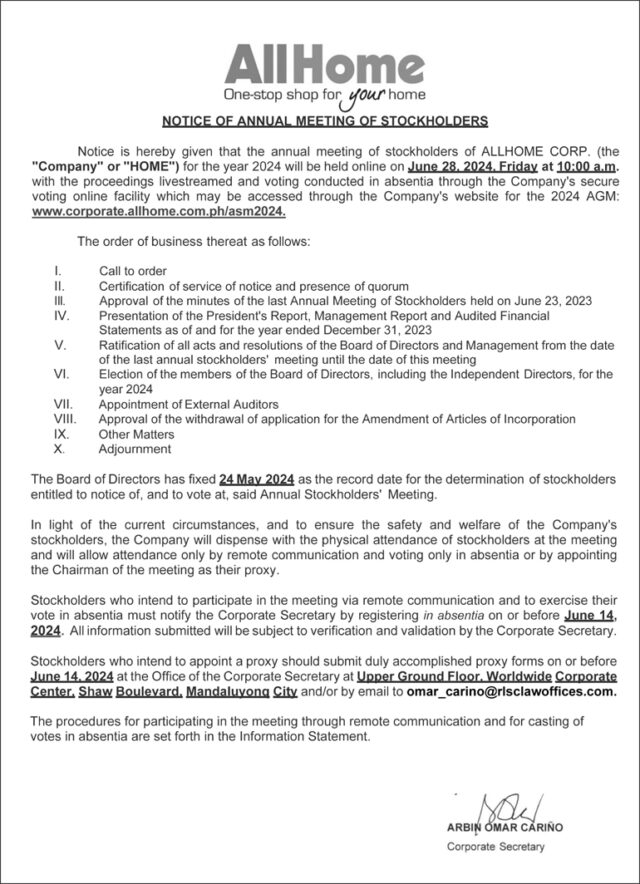
AllHome Corp. to hold online annual meeting of stockholders on June 28


Spotlight is BusinessWorld’s sponsored section that allows advertisers to amplify their brand and connect with BusinessWorld’s audience by publishing their stories on the BusinessWorld Web site. For more information, send an email to online@bworldonline.com.

Join us on Viber at https://bit.ly/3hv6bLA to get more updates and subscribe to BusinessWorld’s titles and get exclusive content through www.bworld-x.com.

Gov’t fully awards reissued three-year T-bonds

BW FILE PHOTO

THE GOVERNMENT made a full award of the reissued Treasury bonds (T-bonds) it offered on Tuesday even as the average rate rose from the previous auction amid dovish signals from the central bank and the peso’s recent weakness.

The Bureau of the Treasury (BTr) raised P30 billion as planned via the reissued three-year bonds it auctioned off on Tuesday as total bids reached P71.399 billion, or more than twice the amount on the auction block.

The bonds, which have a remaining life of two years and seven months, were awarded at an average rate of 6.347%. Accepted yields were 6.3% to 6.375%.

The average rate of the reissued bonds rose by 34 basis points (bps) from the 6.007% fetched for the series’ last award on Jan. 30. This was also 34.7 bps above the 6% coupon for the series.

Still, this was 3.8 bps lower than 6.385% quoted for the three-year bond and 2.6 bps below 6.373% seen for the same bond series at the secondary market before Tuesday’s auction, based on PHP Bloomberg Valuation Service Reference Rates data provided by the Treasury.

The BTr made a full award of its T-bond offer as the average rate was “lower than the prevailing secondary market rates,” it said in a statement.

“With its decision, the committee raised the full program of P30 billion, bringing the total outstanding volume for the series to P90 billion,” the Treasury said.

The T-bonds fetched rates lower than secondary market levels amid dovish signals from the Bangko Sentral ng Pilipinas (BSP), Rizal Commercial Banking Corp. Chief Economist Michael L. Ricafort said in a Viber message.

BSP Governor Eli M. Remolona, Jr. this month said the Monetary Board may kick off its easing cycle by the second semester, with a 25-bp cut possible as early as their Aug. 15 meeting and one or two rate cuts expected this year.

This would mean that they could ease ahead of the US Federal Reserve, which they expect to begin cutting rates by September, Mr. Remolona said.

The Monetary Board this month kept its policy rate at a 17-year high of 6.5% for a fifth straight meeting following cumulative hikes worth 450 bps from May 2022 to October 2023 to help bring down elevated inflation.

Meanwhile, Finance Secretary and Monetary Board member Ralph G. Recto on Monday said they may cut benchmark interest rates by 150 bps in the next two years.

“The awarded rate today reflected investors’ demand for higher fixed returns emanating from the recent weakness of the local currency,” a trader added in an e-mail on Tuesday.

The peso closed at the P58-per-dollar level for the first time in over 18 months last week amid the greenback’s strength as US Federal Reserve kept their “higher for longer” policy stance following recent data showing that inflation remained sticky and a robust economy.

On Monday, the local unit ended at P58.11 versus the greenback, strengthening by eight centavos from its P58.19 finish on Friday. This was down by P2.74 from the peso’s end-2023 close of P55.37.

Tuesday’s T-bond auction was the last for the month. The BTr raised P121.721 billion via T-bonds out of the P150-billion program for May as made partial awards of three out of its five offerings this month.

Overall, the Treasury raised a total of P183.721 billion out of its P210-billion domestic borrowing program for May.

For June, the BTr is looking to borrow a total of P180 billion from the domestic market, or P60 billion from Treasury bills and P120 billion via T-bonds.

The government borrows from local and foreign sources to help fund its budget deficit, which is capped at P1.48 trillion or 5.6% of gross domestic product for 2024. — A.M.C. Sy

Meralco about to complete feasibility study on micro-modular reactors

By Sheldeen Joy Talavera, Reporter

MANILA Electric Co. (Meralco) on Tuesday said its full feasibility study with a United States company is about to be completed as it targets to build micro-modular nuclear power plants.

“We are already wrapping up the feasibility study for the development of a micro-modular reactor with the US-based Ultra Safe Nuclear Corp.,” Meralco Executive Vice-President and Chief Operating Officer Ronnie L. Aperocho said at the company’s annual stockholder’s meeting.

Meralco plans to build micro-nuclear power plants to energize remote areas in the Philippines in the next four years.

“As we deep dive into this safety, financial and selection parameters, our goal is to build a micro-modular reactor with a capacity of 5-15 megawatts (MW) and have some sort of proof of concept that will help us convince the Filipino people that nuclear energy is safe, reliable, cheap and a clean source of baseload power which our country badly needs,” Mr. Aperocho said.

The power distributor has said it has completed the pre-feasibility study. It is now studying the safety, financial, and selection parameters of deploying the technology.

In November, Meralco and Ultra Safe signed a deal to study the potential deployment of one or more micro-modular reactor energy systems in the country.

The nuclear initiative is part of the power distributor’s commitment to adopt next-generation clean technologies. It is also in line with the goal of the Department of Energy of incorporating at least 1,200 MW of nuclear energy in the energy mix by 2032.

Mr. Aperocho said the company would send five to seven scholars overseas this year as part of its nuclear engineering program.

“It’s important… that we are able to prepare nuclear engineers by the time that we start building or operating these micro-modular nuclear plants,” Meralco Chairman and Chief Executive Officer Manuel V. Pangilinan said at the meeting.

Meralco’s controlling stakeholder, Beacon Electric Asset Holdings, Inc., is partly owned by PLDT, Inc.

Hastings Holdings, Inc., a unit of PLDT Beneficial Trust Fund subsidiary MediaQuest Holdings, Inc., has an interest in BusinessWorld through the Philippine Star Group, which it controls.

ADVERTISEMENT
ADVERTISEMENT