Home Blog Page 3171

PSE stock market accounts up by 11.3% last year
REUTERS

By Revin Mikhael D. Ochave, Reporter

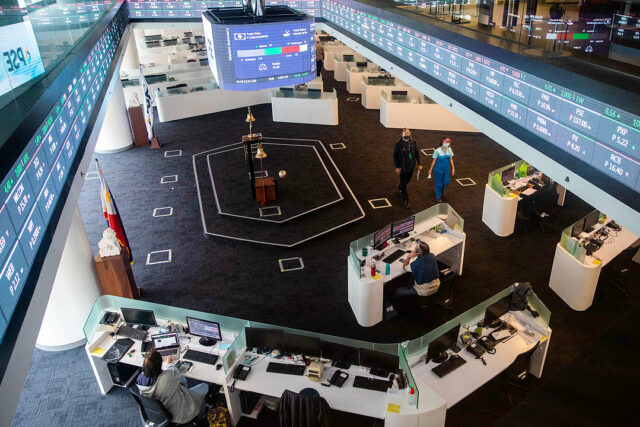
THE PHILIPPINE Stock Exchange, Inc. (PSE) on Wednesday said stock market accounts rose by 11.3% to 1.91 million last year from 2022, showing higher investor participation.

The growth came from new accounts opened via the GStocks PH platform of electronic wallet GCash, the PSE said in a statement, citing data from its annual investor profile report.

GStocks PH helped increase the number of online accounts by 21.2% to 1.53 million in 2023, accounting for 80% of total stock market accounts, the local bourse said.

“Giving e-wallet holders direct access to the stock market is instrumental in our drive to increase retail investor participation in the market,” PSE President and Chief Executive Officer Ramon S. Monzon said in the statement.

But the number of accounts was muted after the cleanup of dormant accounts done by trading participants pursuant to the Anti-Money Laundering Act, the PSE said.

Retail investors accounted for 98.5% of total accounts, while institutional investors took up 1.5%. Local investors made up 98.5% of total accounts, and the rest were foreigners.

Retail accounts accounted for 99.9% of total online accounts, 98.8% of which were owned by local investors. Foreign online accounts accounted for the rest.

A partnership with the Department of Migrant Workers to hold financial literacy and stock investing sessions for overseas Filipino workers and their families is expected to boost the number of retail investors in the stock market, Mr. Monzon said.

The average value per online trade increased by 1.8% to P47,050.48. The average value per trade grew by 9.6% to P85,385.54.

Male investors took up 50.6% of the stock market accounts, female investors accounted for the rest. Female investors accounted for 51% of online accounts while male investors took up the rest.

Investors aged 30 to 44 had the biggest share in online and total accounts at 49% and 45.6%.

For online accounts, investors aged 18 to 29 took up 21.5%, followed by the 45-59 bracket at 18.4% and 60 and above at 10.9%.

For total accounts, investors aged 45 to 59 accounted for 20.2%, followed by people aged 18 to 29 at 19.5% and those aged 60 and above at 14.8%.

The PSE said investors earning less than P500,000 accounted for 76.7% of online investors and 70.9% of the total investors.

Investors earning between P500,000 to P1 million took up 11.9% of online accounts and 14.4% of the total accounts.

Those earning above P1 million made up 11.4% of online accounts and 14.7% of the total accounts.

Metro Manila-based investors took up 68% of online accounts and 68.2% of the total accounts.

“Aside from e-wallets serving as access points to stock investing, the PSE’s programs such as PSE EASy paved the way for investors based outside Metro Manila to invest in the stock market,” Mr. Monzon said.

“I hope this growth in non-Metro Manila investors will be sustained over the years so that the geographical aspect of financial inclusion is addressed,” he added.

Overseas accounts took up 1% of online accounts and 1.1% of the total accounts.

Among foreigners, the top three investors were Japanese, Chinese and American, the PSE said.

Mr. Monzon said investor education remains a priority of the PSE, citing the operator’s revamped PSE Academy website that can be accessed for investment literacy.

“Alongside encouraging retail investors to invest in the stock market, the PSE pursues initiatives beneficial to them,” the PSE chief said.

For one, it has proposed to the regulator to lower the minimum investment requirement. “We are also fine-tuning the PSE EQUIP platform to provide more comprehensive data access to retail investors.”
Yields on term deposits decline amid BSP’s policy easing hints

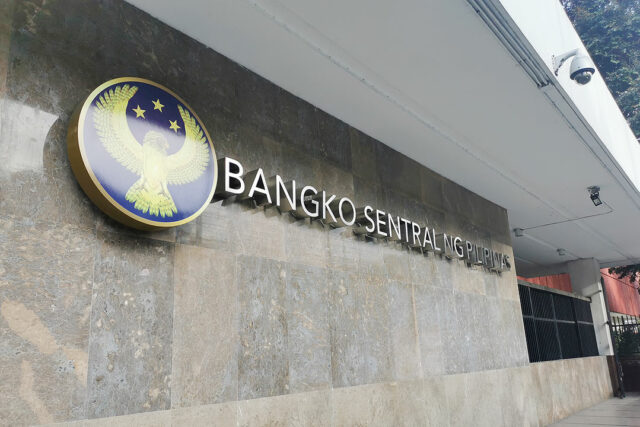
Bangko Sentral ng Pilipinas main office in Manila. — BW FILE PHOTO

YIELDS on term deposits dropped on Wednesday amid signals that the Bangko Sentral ng Pilipinas (BSP) would soon begin its easing cycle.

The term deposit facility (TDF) of the BSP fetched bids amounting to P226.658 billion on Wednesday, well above the P210 billion on the auction block and the P217.774 billion for a P230-billion offer seen a week ago.

Broken down, tenders for the seven-day papers reached P110.47 billion, higher than the P100 billion auctioned off by the central bank but lower than the P113.383 billion in bids for the P110-billion offering seen the previous week.

Banks asked for yields ranging from 6.51% to 6.5412%, narrower than the 6.51% to 6.55% band seen a week ago. This caused the average rate of the one-week deposits to decrease by 0.16 basis point (bp) to 6.5336% from 6.5352% previously.

Meanwhile, bids for the 15-day term deposits amounted to P116.188 billion on Wednesday, higher than the P110-billion offering and as well as the P104.391 billion in tenders for a P120-billion offer seen on May 22.

Accepted rates for the two-week tenor were from 6.56% to 6.59%, also lower than the 6.56% to 6.6% margin seen a week ago. With this, the average rate for the term deposits slipped to 6.5761% from 6.5762% logged in the prior auction.

The two-week tenor was adjusted from the usual 14-day maturity as its settlement date was moved to June 13 due to the Independence Day holiday on June 12, the BSP said.

The BSP has not auctioned off 28-day term deposits for more than three years to give way to its weekly offerings of securities with the same tenor.

The term deposits and the 28-day bills are used by the central bank to mop up excess liquidity in the financial system and to better guide market rates.

Term deposit yields went down amid rate cut signals from Monetary Board policy makers, Rizal Commercial Banking Corp. Chief Economist Michael L. Ricafort said in a Viber message.

BSP Governor Eli M. Remolona, Jr. this month said the Monetary Board may kick off its easing cycle by the second semester, with a 25-bp cut possible as early as their Aug. 15 meeting and one or two rate cuts expected this year.

This would mean that they could ease ahead of the US Federal Reserve, which they expect to begin cutting rates by September, Mr. Remolona said.

The Monetary Board this month kept its policy rate at a 17-year high of 6.5% for a fifth straight meeting following cumulative hikes worth 450 bps from May 2022 to October 2023 to help bring down elevated inflation.

Finance Secretary and Monetary Board member Ralph G. Recto on Monday said the central bank could reduce the policy rate by as much as 150 bps in the next two years, adding that the BSP has room to cut starting next quarter.

A survey of private sector analysts in the BSP’s latest Monetary Policy Report also showed that the analysts expect the central bank to reduce the policy rate by 25 bps to 150 bps by the end of the year. — Luisa Maria Jacinta C. Jocson

Prime Infra’s $7.6-B projects get faster permit processing

BW FILE PHOTO

By Sheldeen Joy Talavera, Reporter

PRIME Infrastructure Capital, Inc. on Wednesday said its two pumped storage projects worth $7.6 billion (P444 billion) have received certificates from the government that qualify them for expedited permit processing.

In a statement, the company said its Wawa Pumped Storage Project in Rizal and Pakil Pumped Storage Project in Laguna have been certified as “energy projects of national significance.”

The certification is authorized by Executive Order No. 30, signed by former President Rodrigo R. Duterte in 2017. It expedited the issuance of regulatory and documentary requirements from local and national government agencies.

Former Energy Secretary Alfonso G. Cusi halted the issuance of the certification in 2020 to “evaluate the department’s effectiveness in securing regulatory requirements of energy projects.”

The Energy department last year lifted the suspension to “rationalize and streamline the process of permitting and licensing of energy projects and thereby ensure their timely implementation.”

Under an order issued in April, the agency must certify an energy project as nationally significant if it has a capital investment of at least P3.5 billion and has a “significant contribution to the country’s economic development.”

The Pakil Pumped Storage Power Project is under Ahunan Power, Inc., a wholly owned unit of Prime Infra.

It will have a storage capacity of 14,000 megawatt-hours (MWh) daily and a generating output capacity of 1,400 megawatts (MW).

“The project investment amounts to $5.03 billion and is expected to be among the largest pumped storage power plants in Asia once completed,” Prime Infra said.

The Wawa Pumped Storage Project is being developed by Olympia Violago Water Power, Inc., another Prime Infra unit.

The project has an investment worth $2.57 billion and will have a storage capacity of 6,000 MWh per day and a generating unit capacity of 600 MW.

Both projects, which received “green lane” endorsement from the Department of Trade and Industry and the Board of Investments last month, will start operating by 2030.

“These are critical projects, essential to enable the energy transition and to enhance grid security through flexible energy generation,” Prime Infra President and Chief Executive Officer Guillaume Lucci said in a statement.

Vistamalls, Inc. to hold annual meeting of stockholders online on June 24


Spotlight is BusinessWorld’s sponsored section that allows advertisers to amplify their brand and connect with BusinessWorld’s audience by publishing their stories on the BusinessWorld Web site. For more information, send an email to online@bworldonline.com.

Join us on Viber at https://bit.ly/3hv6bLA to get more updates and subscribe to BusinessWorld’s titles and get exclusive content through www.bworld-x.com.

CIC looks to increase platforms to access credit scores, reports

CREDIT Information Corp. (CIC) is targeting to expand the number of platforms where borrowers and firms can access credit reports to assess creditworthiness.

“Our aim is to increase the channels that provide this and hopefully, you can access your credit report online,” CIC President and Chief Executive Officer Ben Joshua A. Baltazar told reporters on the sidelines of the FinScore Credit Risk Academy launch.

This initiative is part of the CIC’s Direct to Consumer Program, which seeks to allow borrowers to conveniently get their credit reports directly from lenders.

Mr. Baltazar said it is difficult to measure the creditworthiness of Filipino borrowers as most of them rely on informal lenders to get cash.

“So, we’ve been talking to the banks, online lenders, to offer this service so that if you need to check the status of your credit information, you can access it through the convenience of your phone,” he said.

Part of a borrower’s credit information is their credit score, which aims to assess whether a client is able to repay their loans on time.

Credit score provider FinScore on Wednesday launched Credit Risk Academy, which is an online course that aims to provide institutions with information on credit scoring and risks.

FinScore Chief Operations Officer Christo Georgiev said the course aims to serve at least 50 financial institutions this year to help firms assess credit risks.

“This would mean 50 financial institutions having better understanding about credit risk, both based on their internal data as well as based on alternative data, which is going to have a ripple effect around the rest of the industry,” Mr. Georgiev told reporters after the launch.

Credit Risk Academy is a seven-week course that provides an introduction to traditional and alternative credit scoring, data collection and pre-processing, and machine learning models for credit scoring. It will also discuss how alternative credit scoring could be integrated into the traditional model.

The course will be available starting June 10.

Mr. Georgiev said target participants include credit risk professionals, including traditional financial institutions, rural banks, cooperatives, and brick and mortar lenders.

It will also target C-level executives, decision makers and the broader population.

“Anyone that is interested to know how financial institutions should be evaluating credit risk based on their information will definitely benefit from the course,” he said.

Micro, small, and medium enterprises (MSME) may also assess their credit scores and risks through FinScore’s platforms, Mr. Georgiev added.

“Whenever they loan as a business, FinScore solutions can be used to score the individual behind the business. So to a very big degree, anything that is related to consumer lending within the Credit Risk Academy can be quite applicable to most of the MSMEs in the country.”

Lito M. Villanueva, chairman of Fintech Alliance.PH, said Credit Risk Academy will help democratize credit scoring.

“For lenders, this signifies informed decision making and risk mitigation, while borrowers gain increased credit accessibility and favorable terms that enhance their financial well-being,” he said at the launch.

Citing Republic Act No. 11765 or the Financial Products and Services Consumer Protection Act, CIC’s Mr. Baltazar emphasized the need to educate the public on their rights as well as information on financial products.

“Even at the level of, let’s say, the lender, bank, cooperative, or microfinance, we encourage all participants even down to the level of customer relations personnel to have what I would call an educated conversation with borrowers,” he said. — Beatriz Marie D. Cruz

A Tale of Two Sedas

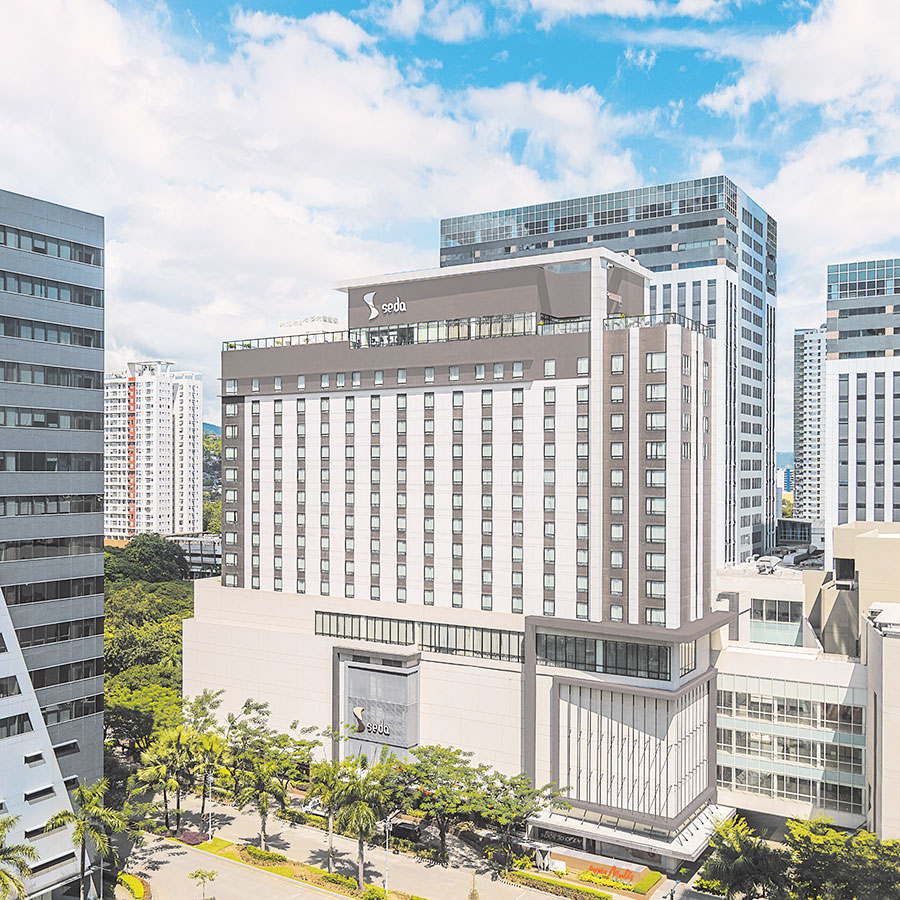
SEDA AYALA CENTER CEBU

IT MIGHT not make sense for sister hotels to be within a 15-minute drive of each other, but the two Seda Hotels in Cebu, by Ayala Land Hotels and Resorts, are making it work.

There are subtle differences. While all Seda hotels around the nation (from Quezon City to Cagayan de Oro) have a Misto all-day dining outlet and buffet, we noted that the Misto in Seda Central Bloc has a roasting station where you can see a whole lechon Cebu spin on a spit, the older Seda Ayala Center Cebu, does not have one (we were served lechon belly instead; no complaints here).

Furthermore, Seda Central Bloc, which opened just a month before the COVID-19 lockdowns of March 2020, has a hybrid format. There are 214 rooms, 108 of which are deluxe rooms measuring 28 sqm. One can choose a king-sized bed or two twin beds, and the room has a desk, a chaise longue, and a swivel chair. The rest of the hotel is devoted to serviced apartments: studio (30 sqm.), one bedroom (55-58 sqm.), two bedroom (63-67 sqm.), and a three-bedroom (there are only two, at 90 sqm.). These are meant for long-haulers, with a working kitchenette and a washer-dryer combination.

“We feel that there’s a demand (for serviced apartments) in terms of leisure, staycations, and the corporate market,” said Ron Manalang, General Manager of Seda Central Bloc Cebu, during a media trip to both Cebu Sedas on May 24 to 26.

Meanwhile, the older Seda, Ayala Center Cebu, opened in 2018, rebranding from the building’s previous occupant, the Cebu City Marriott Hotel. “The shift was very smooth,” noted Gwen Dela Cruz, Seda Ayala Center Cebu General Manager. The older Seda has 301 rooms, ranging in size from Deluxe Rooms (30-32 sqm.) to the Club and Seda Suites (66-88 sqm.), meaning it has a more conventional layout than its younger sibling property.

Both have access to nearby Ayala malls.

LOCATION, LOCATION, LOCATION
Still, just like every real estate pro will tell you, their differences lie in location, location, location.

The younger vibe of Seda Central Bloc Cebu can be credited to its newer inception (2020; though the Cebu I.T. Park where its located opened in 2000). “All the BPO companies are just surrounding us. This is what’s making it for us,” said Mr. Manalang. Meanwhile, Seda Ayala Center Cebu occupies a well-loved and familiar space at the Cebu Business Park.

“The two Sedas are not there to compete, but to uplift each other,” said Ms. Dela Cruz. “If you take a look at the businesses, here (at Seda Ayala Center), it’s really more of corporations,” she said, noting that the main Cebu offices of Ayala-controlled Bank of the Philippine Islands and Globe Telecom are located nearby. “While there, it’s BPOs.”

This means that the clientele of each hotel is different: the Seda Ayala Center Cebu has an older, more genteel clientele, thanks to its familiar location and the businesses around it; while Seda Central Bloc Cebu has younger customers (which might explain why the party was hopping at the younger property’s Straight Up bar, while we went straight to bed at the Seda Ayala Center Cebu; some of our colleagues though took advantage of the sauna and the spa services).

UNITED IN SUSTAINABILITY
What does unite them are their sustainability measures: Seda Central Bloc Cebu might be a bit ahead, having equipped its roofdeck with a 53 KWP (kilowatt peak) solar panel system, which, according to Mr. Manalang, has saved them P700,000 in power consumption costs. Its rooms are also equipped with dispenser-type toiletries (no more tiny bottles). However, Seda Ayala Center Cebu still has a few green tricks up its sleeve: it sources some of its food from local farmers and fisherfolk, and a reverse osmosis system helps them produce their own purified water (stored in glass, not plastic bottles; they do the same in Central Bloc).

“Seda Ayala Center Cebu was able to provide clean water to our neighbors and the environment,” said Ms. Dela Cruz, about what it faced, and what it was able to do, during Supertyphoon Rai (local name: Odette) in December 2021.

According to Ms. Dela Cruz, both properties hand over their plastics to GUUN Co., Ltd., a Japanese waste treatment business that converts plastics into “fluff fuel” (an alternative to solid fossil fuels like coal).

All Seda properties also allocate funds towards the care of Mayumi, a Philippine Eagle they adopted through the Philippine Eagle Foundation.

“It’s really helping from the heart,” said Ms. Dela Cruz about the importance of sustainability for their brand. “Every act we do, there has to be a repercussion: how we need to help the environment.”

The Seda Central Bloc Cebu is at Cebu’s I.T. Park, while Seda Ayala Cebu is at Cebu Business Park. See their amenities at https://www.sedahotels.com/location/hotels/cebu-city. — Joseph L. Garcia

Rockwell eyes sales until 2028 using 500-ha land bank

By Revin Mikhael D. Ochave, Reporter

ROCKWELL LAND Corp.’s land bank has reached 500 hectares (has) worth more than P10 billion, which it said could generate revenue until 2028.

This is five times more than five years ago, Rockwell Land Chairman and Chief Executive Officer Nestor J. Padilla said in the company’s annual report presented at its annual stockholders’ meeting on Wednesday.

More than 90% of the property developer’s land is in the key cities of Pampanga, Laguna, Batangas, and Bulacan.

“Our current presence in these strategic sites has given us the optimism to develop more products, allowing us to excite our core market with new offerings to complement their lifestyle,” he added.

Rockwell Land will launch three horizontal developments this year. One of these is the 100-hectare The Samanean at Paradise Farms in San Jose Del Monte, Bulacan, which will be designed as a hillside escape and wellness retreat.

The project will be launched in the third quarter. Its first phase will offer 250- to 300-square-meter lots.

Rockwell Land will also launch a 63-hectare mixed-use development in partnership with General Milling Corp., initially offering 250– to 400-square-meter lots. It will also launch the 38-hectare Lauan Ridges residential development with a hotel that will have views of Taal Lake. Both are in Lipa, Batangas province south of Manila.

“We want our next five years to be the best,” Mr. Padilla said. “We hit the ground rolling with our geographic expansion and land banking, projected to give us revenue growth until 2028.”

“Our new projects, though in new territories, keep us hopeful with its positive initial market reception,” he added.

Rockwell Land President and Chief Operating Officer Valerie Jane L. Soliven told stockholders the company is optimistic despite risks.

“We’re seeing risks like inventory buildup and with rising interest rates and inflation, there’s always that risk that discretionary spending will be hampered,” she said. “However, we are optimistic in the markets that we are serving.”

“In particular, we are confident in the resilience of our core luxury segment and the growth of regional and horizontal markets,” she added.

Ms. Soliven said Rockwell Land expects “significant progress” in its projects in Bulacan, Batangas, and the Visayas region in central Philippines.

“Our commitment to provincial development remains steadfast, as evidenced by our ongoing expansion and development efforts in provincial areas,” Ms. Soliven said.

Rockwell Workspaces, the company’s office brand, will have its first venture outside Metro Manila with the launch of 1 Rockwell in July.

It will be the first office building in the 2.8-hectare IPI Center community, presenting new investment opportunities in Cebu City.

Last year, Rockwell Land’s attributable net income rose by 35% to P3.1 billion, while revenue increased by 12.1% to P18.5 billion.

Rockwell Land shares gained 0.64% or a centavo to P1.58 each.

Online platform aims to improve materials procurement process

JCOMP-FREEPIK

ONLINE construction marketplace BuildHub.ph aims to help ease the materials procurement process, delivery time, and boost linkages between suppliers and builders through its platform, a senior official said.

“BuildHub.ph offers a strong alternative to procure materials, securing financing, and deliver products faster, leading to increased sales and improved supply chain management for suppliers and developers,” BuildHub.ph Chief Business Officer Marika Laciste told BusinessWorld in an e-mail interview this month.

Ms. Laciste said buyers have become increasingly curious about how digital tools can make their existing operations and transactions more efficient.

“BuildHub aims to make physical hardware stores long-term partner sellers, enabling them to go digital and be part of a more efficient construction process,” she said.

After its April launch, Ms. Laciste said it saw increased interest from brands selling steel, lighting, and electronics.

“Many known hardware stores are also in the process of onboarding, especially in the Visayas region,” she said.

BuildHub.ph currently carries 33 brand partners and 100 registered hardware stores, including Republic Cement & Building Materials, Inc., TKL Steel Corp., Union Cement by Philcement Corp., Saint-Gobain Philippines Co. Ltd., Inc., and Vicem Cement.

“The online platform has facilitated smoother transactions between brands, construction suppliers, and builders by providing a centralized platform for sourcing construction materials and supplies,” she added.

The online platform aims to help address issues in the manual materials procurement process, such as long delivery lead time and dependence on cash for high-value items, it said.

For one, its BuildCredit initiative provides financing facilities to hardware stores and buildings, with 1-3% competitive interest rates for terms of 30-60 days. This provides capital for inventory management, expansion, and other business needs of hardware stores and builders.

“To further support the financing offers of BuildHub, the company has partnered with the Bank of the Philippines to extend competitive interest rates for business loans below P30,000,000. This feature will soon be available on the platform,” Ms. Laciste said.

Meanwhile, the company said it plans to increase its fleet of trucks and cargo to boost the current 22,000-bag capacity of BuildmartShipping.

This will address growing demand for timely delivery of construction materials and supplies across the Philippines, it said.

Ms. Laciste is also bullish on achieving their P1-billion gross merchandise value (GMV) target in 2025.

To date, BuildHub.ph said it generated an “eight-digit figure” GMV, mainly driven by the cement category, while initial sales came from its network of existing supplies and sellers. — Aubrey Rose A. Inosante

First PHL takaful insurance offering may be launched within the year — IC

THE COUNTRY’S first takaful insurance product may be sold within the year, with two insurers already prepared to roll out their offerings, the Insurance Commission (IC) chief said.

The pilot or sandbox initiative was pushed back from the initial plan to offer takaful insurance by the first quarter, Insurance Commissioner Reynaldo A. Regalado told BusinessWorld on the sidelines of an event on Wednesday.

“But it’s important we’re having it. It’s sure to follow through this year. They’re already submitting the requirements and the products to be offered, which will be approved by us,” Mr. Regalado added.

Takaful is a type of Islamic insurance where members contribute a certain sum of money to a common pool. Takaful insurance needs to be compliant with Shari’ah law, which prohibits riba (interest), al-maisir (gambling), and al-gharar (uncertainty) principles.

Mr. Regalado said the two companies that have takaful insurance products ready for rollout are Pru Life Insurance Corp. of UK Philippines (Pru Life UK Philippines) and Etiqa Life & General Assurance Philippines, Inc.

He added that one of the companies already submitted a product for review, but the IC cannot approve it yet as it still has to set official regulations for this kind of product offering.

The IC also still needs to send correspondents to countries that already offer takaful insurance to help it create a framework for selling these, Mr. Regalado said.

The IC already sent people to Malaysia and will send people to Indonesia in June, he added.

The regulator will also be going to Thailand to study how takaful insurance is being distributed there, Mr. Regalado said.

“You know, in Thailand, the Muslim population is small, but they already have takaful insurance. We need to get the other countries’ [inputs] on how they’re doing it,” he said.

The IC will also conduct discussions with Shari’ah groups to help certify the takaful products that will be offered, he added.

It has talked with mutual benefit association groups and cooperatives to clarify Shari’ah law principles, he said.

Takaful or Islamic insurance can improve financial inclusion and expand insurance penetration in underserved areas, the Philippine Insurers and Reinsurers Association (PIRA) earlier said.

“There is a move for financial inclusivity in our country and around the world,” PIRA Executive Director Michael F. Rellosa said in an e-mail. “Parts of our population remain unserved or are underserved and they are the ones who need the protection that takaful or traditional insurance can bring. Any move towards this should be welcome.”

Insurance penetration, or premium volume as a share of gross domestic product or the sector’s contribution to the economy, inched up to 1.78% in the first quarter from 1.75% a year prior, latest IC data showed.

Insurance density, or the amount of premium per capita or average spending of each individual on insurance, rose by 10.66% to P965.56 in the first quarter from P872.56.

The Bangko Sentral ng Pilipinas’ (BSP) Financial Inclusion Survey also showed that fewer Filipinos had savings and insurance in 2021. The share of adults with insurance fell to 17% in 2021 from 23% in 2019.

“There are multinational companies with offices in Muslim-majority countries where takaful originated. They already have takaful experience in these jurisdictions and it would just be a matter of replicating the program here with perhaps minor changes,” Mr. Rellosa said.

“The IC can replicate its successes in the microinsurance field where the Philippines is considered a global leader, as we are the first country to come up with a legal framework for microinsurance. The same is needed for takaful.”

He said the IC must develop a legal framework to ensure an “orderly rollout.”

Micro-takaful products can also be explored, Mr. Rellosa said. “(This) is popular as it allows certain sections of the population who may not be able to afford traditional insurance or traditional takaful to be protected via micro-insurance.’

“A huge portion of the population belongs to this sector, so micro plays a major role and fills the protection gap,” he added.

On the other hand, Liberty Insurance Corp. Vice-President for Corporate Strategy Antonio Roderick B. Cabusao warned that takaful may not be well-received by the market.

“Regarding takaful insurance, the premiums collected are managed by an investment company (a third party) and that only a portion of it is given to the insurance company,” he said in a Viber message.

“Whereas in general insurance (nonlife) premiums are collected and managed by the insurance company. The insurance company invests portions of the premium and some portions are passed on to a reinsurer which assumes a portion of the risk in the event of a loss. So that being the case, it may not be attractive to the Philippine insurance market,” he added.

FINANCIAL INCLUSION
Meanwhile, aside from takaful insurance, Mr. Regalado said the IC is in talks with the BSP regarding other ways to boost financial inclusion, such as allowing banks to have more than one partnered insurance company.

“Right now it may not be required, but we’re reviewing the rules in our manual and the BSP’s. Hopefully, it will now be an option for the banks so they can have more than one insurance company as a partner,” he said.

However, he noted customers might be confused when presented with a variety of available products.

The IC will also be talking to rural banks and other financial institutions to increase bancassurance distribution channels, Mr. Regalado added.

The Philippine Life Insurance Association and the Committee on Bancassurance were onboard with the idea, but noted that banks are not keen on offering insurance products digitally, he said.

“Insurance companies can market their digital products on their own… I think we really have to make it open,” he said. — Aaron Michael C. Sy and Luisa Maria Jacinta C. Jocson

The end of greenwashing is in sight

FREEPIK

THE PROBLEM of climate change cannot be solved without capitalism. Governments have tried for more than three decades with little to show for it. And while more of them are now engaging partners in the private sector, the world is still lagging in deploying the full power of the market. An announcement by the Biden administration this week can help to change that, by beginning a much-needed overhaul of the market for carbon credits.

Global investment in clean energy has accelerated but is far below what is required to restrain rising temperatures, and governments will not make up that difference on their own. Much of the capital will need to come from the private sector. And while businesses and investors are eager to provide it, in one crucial area — carbon credits — a market failure is keeping them on the sidelines.

Carbon credits, which are bought and sold in what’s called the voluntary carbon market, offer companies and investors many ways to reduce greenhouse-gas emissions. In addition to helping finance new clean-energy installations, these credits can drive capital toward projects with high upfront costs but high potential rewards, such as scaling up new technologies like green hydrogen. They can also play an important role in funding reforestation and ecological preservation, as well as financing the early retirement of coal plants.

There is enormous potential demand for carbon credits. Many business leaders recognize that the costs of inaction are enormous — and that tackling climate change is in their companies’ self-interest — and so they are setting ambitious decarbonization goals. That is not altruism. It’s capitalism.

Companies have far less control, however, of their so-called Scope 3 emissions, those generated by suppliers and customers. Allowing companies to purchase credits against these emissions — but only after they disclose and begin implementing robust plans aligned with the Paris Agreement — could dramatically increase the demand for them.

For the demand side of the market to function, however, the problems on the supply side must be fixed.

Right now, the market for credits is opaque and riddled with inefficiency. Buyers can’t be sure which credits are credible, projects often don’t deliver what they promise and sellers can’t be held accountable. This lack of transparency also opens the door for greenwashing, where companies claim to be making a much bigger difference than they are, which fuels public skepticism about the potential for private-sector leadership.

As a result, the market for carbon credits is much smaller — and far less productive — than it should be. Many of us have long been skeptical of it, and for good reason. As with any market, opacity breeds not only inefficacy but also corruption.

This is a market failure we can fix, and we should treat it like any other market failure. For instance: When banks collapsed and the stock market melted down in 2007, the world didn’t walk away from markets and banking. Governments worked to address some of the causes of the crisis, including requiring more transparency of opaque securities like credit default swaps and collateralized debt obligations.

A similar remedy is needed for carbon credits, because transparency does for markets what spinach does for Popeye. The story of Bloomberg is a testament to that.

When we created Bloomberg in 1981, there was virtually no way for firms (especially smaller ones) to negotiate bond prices with sellers, because sellers had all the information. As a result, prices were inflated, commissions were enormous, and the market was inefficient. By creating real-time bond pricing and making it available to buyers as well as sellers, we helped level the playing field and allowed more capital to flow to productive assets, benefiting investors — no matter how small their portfolios — and driving economic growth.

For markets to work well, they must be transparent, trusted, and standardized — three qualities that have largely eluded the market for carbon credits. But change is coming.

Today, the Biden administration released a policy statement and set of principles for building more transparent, responsible, and effective voluntary carbon markets. It’s an important step forward that builds on work led by the Integrity Council for the Voluntary Carbon Market and the Voluntary Carbon Markets Integrity Initiative.

Together these efforts have the potential to do for the carbon market what the Bloomberg Terminal helped do for the bond market in the 1980s. Through transparency and standardization, we can generate more trust that these investments are sound, turning a relatively small market into an enormous one, and a relatively inefficient one into a powerhouse. And in the process, we can unleash the market power that we desperately need on our side in this fight.

Tuesday’s announcement begins a new phase in this effort. Encouraging other nations to join it should be a priority for the Biden administration, including at November’s G20 summit in Rio de Janeiro.

Fixing the carbon-credit market won’t solve the climate crisis on its own, but it will go a long way toward enlisting the market in the fight.

BLOOMBERG OPINION

Featr nominated for 3 James Beard Awards

YOUTUBE.COM/@FEATRMEDIA

LOCAL digital channel Featr (under celebrity Erwan Heussaff’s Fat Kid Inside Studios) has been nominated for three James Beard Foundation Awards.

The nominees were announced last month, and the James Beard Restaurant and Chef Awards ceremony itself will be held on June 10 at the Lyric Opera of Chicago.

Mr. Heusaff, a sibling of former it-girl Solenn Heusaff, and the husband of actress-host Anne Curtis, already won a James Beard Foundation Award last year for his Instagram account under the James Beard Foundation Broadcast Media Award Social Media category.

The Featr channel was nominated in two categories: Visual Media – Long Form (with two entries: Most Expensive Chocolate in the World: Heirloom Ingredients of Negros Occidental Philippines and Why is the Filipino Calamansi Being Left Behind?) and Docuseries Visual Media (Philippine Salt Series).

The James Beard Foundation Awards, founded in 1990, are said to serve like the Oscars of the culinary world. “The James Beard Foundation is a nonprofit organization whose mission is to celebrate, support, and elevate the people behind America’s food culture and champion a standard of good food anchored in talent, equity, and sustainability,” said the foundation’s website. “Established over 30 years ago, the Foundation has highlighted the centrality of food culture in our daily lives and is committed to supporting a resilient and flourishing industry that honors its diverse communities.”

Winners in the past have included Emeril Lagasse, Wolfgang Puck, and Joël Robuchon. The awards not only honor chefs, but also restaurateurs, authors, and food journalists.

“Thanks to everyone who worked with us on these stories — the people who shared their knowledge with us and the great storytellers who made these documentaries come to life,” said Featr on its Instagram account, @featrmedia. “It’s been truly a humbling experience to collaborate with the country’s best artisans and the hardworking Filipinos around the globe who continue to push the boundaries of Pinoy food and heritage.” — JLG

Kaspersky says skill gap a key PHL cybersecurity challenge

PIXABAY

KASPERSKY Security Network on Wednesday said a dearth of cyber-security workers, skill gap, and evolving threats are key challenges for the Philippines.

“The primary reason is the increase in threats, the security gap [and] skill gap in cyber-security staff and the complexity of the things we have in the environment,” Kaspersky Presales Manager Eden M. Carreon told a Management Association of the Philippines summit.

Kaspersky on Monday said online attacks targeting Philippine companies more than tripled last year from 2022, highlighting the urgency of boosting cyber defenses against web threats that can reverse the benefits of digitalization.

The global cybersecurity company said the number of web threats on local companies jumped to 1.69 million in 2023 from almost 500,000 a year earlier. Web threats detected and blocked among Southeast Asian companies only increased by 0.03% to 13.34 million.

These were calculated using Kaspersky’s business-to-business products installed in companies of various sizes, it said.

Ms. Carreon said it recorded 163,279 financial phishing scams and 4.62 million brute force attacks against Philippine businesses and blocked 1.5 million threats last year.

Ransomware attacks blocked by Kaspersky in the Philippines in 2023 reached 15,312.

Ms. Carreon said Kaspersky found that most companies have been using automated security solutions given the long hiring process and the lack of cybersecurity professionals.

She said 71% of companies in the Asia-Pacific region need as long as nine months to find qualified cybersecurity personnel, while 46% said their teams were understaffed.

Based on Kaspersky’s survey, 59% of information security professionals are leaving their jobs given the huge volume of monotonous manual tasks.

Ms. Carreon said launching a low-level attack is cheap and only costs about $34, but the return on investment is more than $300. — Aubrey Rose A. Inosante

ADVERTISEMENT
ADVERTISEMENT