Spotlight is BusinessWorld’s sponsored section that allows advertisers to amplify their brand and connect with BusinessWorld’s audience by publishing their stories on the BusinessWorld Web site. For more information, send an email to online@bworldonline.com.
Join us on Viber at https://bit.ly/3hv6bLA to get more updates and subscribe to BusinessWorld’s titles and get exclusive content through www.bworld-x.com.
Marketing is a tool that businesses can employ to increase brand awareness, acquire customers, and improve engagement. But is there a right way to do marketing? In this B-Side episode, BusinessWorld asks what businesses should prioritize in their marketing campaigns with Ashish Goel, product marketing manager of Zoho Corporation’s Campaigns, Marketing Automation, and Sites divisions.
GCash unveiled a float at the PIDCI’s Independence Day Parade, the biggest Independence Day Parade outside of the Philippines, which highlights GCash's main features that help connect Filipinos all around the world, especially with their loved ones back home.
GCash highlights new features and latest partnership with Meridian allowing transfers from over 12,000 US banks to GCash accounts
GCash, the Philippines’ leading finance app and largest cashless ecosystem, took part in Independence Day commemorations in New York City, hosted by the Philippine Independence Day Council, Inc. (PIDCI), a non-profit umbrella organization of Filipino-American associations along the East Coast. The PIDCI’s Independence Day Parade, the biggest Independence Day Parade outside of the Philippines and now on its 34th year, is an annual celebration of Filipino culture, the strengthening of familial and community ties, and a joyful display of Filipino pride.
At the event, Paul Albano, General Manager of GCash International, shared important new features that make digital financial services better for Filipinos living outside of the Philippines. GCash has made strides in its international expansion, with its app now available for download in the US using a US mobile phone number, and cashing in and sending money is easier from over 12,000 US banks to GCash accounts.
Highlighting its role as a seamless fintech solution for Filipinos overseas, GCash featured partnerships with financial institutions like Meridian, thus bridging US-based fintech services and the app that has become a staple for financial services across the Philippines.
“At GCash, when we say that ‘Finance for All’ is our vision, it means we are driven to go beyond the Philippines and reach as many Filipinos as we can around the globe,” said Albano. “We are honored to join our community in this distinctly Filipino celebration, and we’re eager to share all the ways GCash has been continuously innovating and enhancing our services to meet the needs of our kababayan overseas.”
The celebration of heritage and intergenerational community was held through a full-day cultural festival on June 2, 2024. GCash unveiled a float at its main event, an Independence Day Parade traversing Madison Avenue, that highlights GCash’s main features that help connect Filipinos all around the world, especially with their loved ones back home.
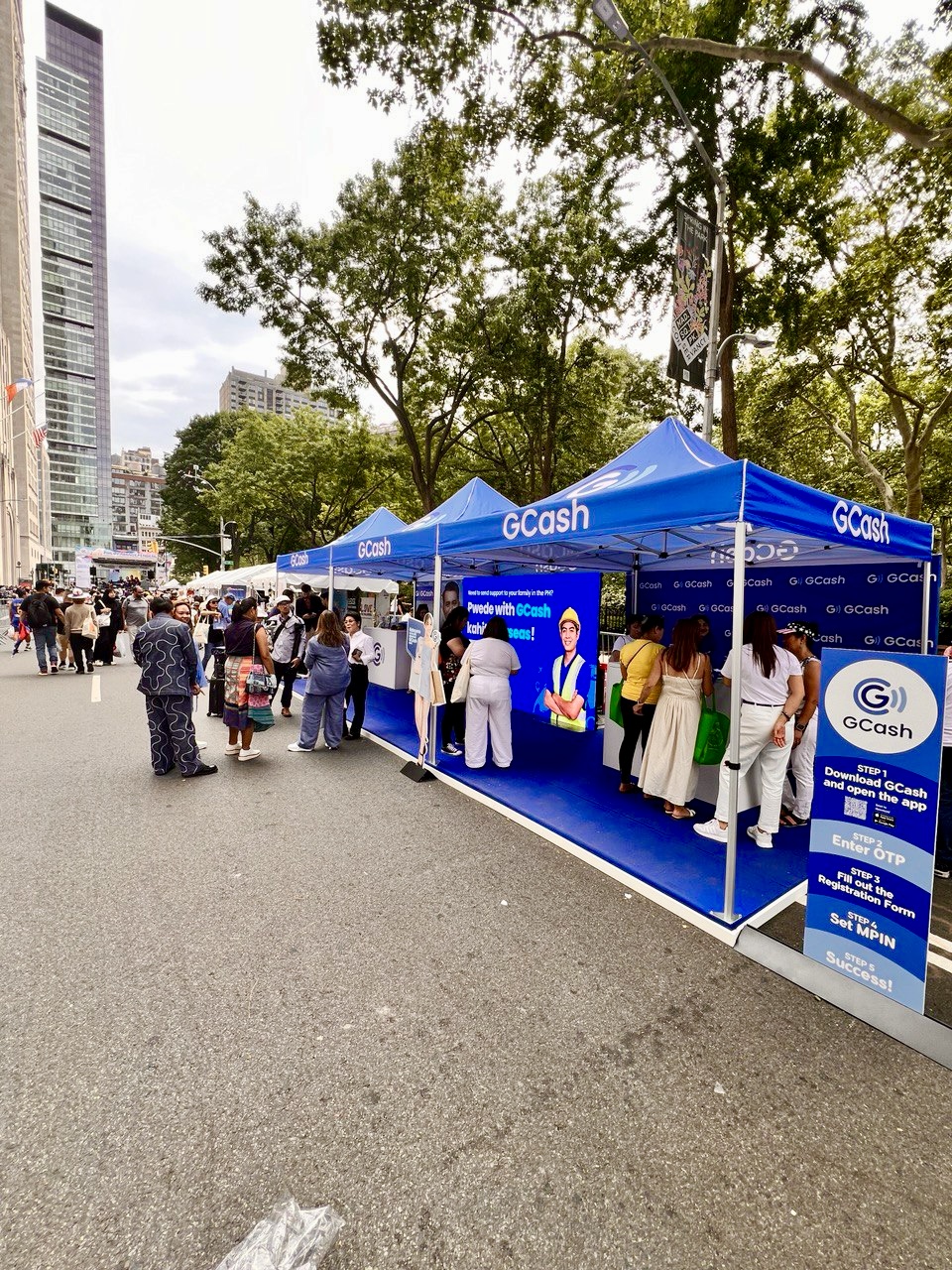
GCash booths were also set up during a parallel street fair between Madison and Park Avenues that featured trade and travel merchants. Highlighting its role as a seamless fintech solution for Filipinos overseas, the GCash booth featured partnerships with financial institutions like Meridian, thus bridging US-based fintech services and the mobile wallet that has become a staple for financial services across the Philippines.
GCash and Meridian enable transfers from US banks to GCash peso accounts
GCash’s partnership with Meridian, an instant payments technology company headquartered in New York City, has enabled the direct transfer of US-based user funds within the GCash app from a selection of 12,000 US banks to GCash accounts. Upon transfer, the service automatically converts dollar amounts into Philippine pesos, offering competitive ForEx rates and a nominal $1 fee per transaction.
Albano added, “At GCash, we want to help with the most important thing for our countrymen abroad: how they can care for their families and maintain connections with their loved ones despite the distance. With GCash’s international expansion, this is exactly what we are doing. We’re making it possible for Filipinos overseas to take better control of their finances, and sending money to the Philippines is more convenient with our competitive rates.”
Filipinos abroad visit GCash booths which feature trade and travel merchants set up during a parallel street fair between Madison and Park Avenues.
GCash International expansion to reach millions of overseas Filipinos
GCash announced in March that it has expanded its international reach and fully launched its global push following approval from the Bangko Sentral ng Pilipinas. Filipinos in 14 territories—the US, Canada, Italy, the UK, Australia, Japan, the United Arab Emirates, Qatar, South Korea, Taiwan, Hong Kong, Spain, Germany, and Singapore—can now use international mobile numbers to sign up and use the GCash app. Kuwait and Saudi Arabia will follow suit in the next half of 2024.
With its expansion outside of the Philippines, GCash is able to serve and empower more Filipinos, wherever they may be based. In addition to free real-time money transfers among GCash wallets for convenient access to funds and the ability to buy load for loved ones back home, GCash users abroad can now directly pay their bills—ranging from utilities and tuition fees to government payables like taxes and contributions—from more than 1,900 Philippine billers.
To access GCash outside the Philippines, simply download the GCash app on Google Play, App Store, or Huawei AppGallery with an active international SIM card. On the app, select the country, type in your mobile number, and fill out important personal information to register– residency requirements may apply. Next, set your MPIN then proceed to log in. Ready your valid ID, like your Philippine passport, for scanning to verify your account. Afterward, complete the facial verification via a selfie and provide additional information, then wait for the SMS confirmation. Upon receiving the confirmation, you may now enter your MPIN and use the app.
GCash is also expected to meet with the Filipino communities in Carson City, California and Dubai, UAE within the coming weeks to share its GCash Overseas innovations.
Spotlight is BusinessWorld’s sponsored section that allows advertisers to amplify their brand and connect with BusinessWorld’s audience by publishing their stories on the BusinessWorld Web site. For more information, send an email to online@bworldonline.com.
Join us on Viber at https://bit.ly/3hv6bLA to get more updates and subscribe to BusinessWorld’s titles and get exclusive content through www.bworld-x.com.
Spotlight is BusinessWorld’s sponsored section that allows advertisers to amplify their brand and connect with BusinessWorld’s audience by publishing their stories on the BusinessWorld Web site. For more information, send an email to online@bworldonline.com.
Join us on Viber at https://bit.ly/3hv6bLA to get more updates and subscribe to BusinessWorld’s titles and get exclusive content through www.bworld-x.com.
HealthFirst, a multi-specialty clinic network under the RelianceUnited portfolio, launched its healthcare hub in Williams Center, Mandaluyong, on June 7.
The hub has three levels of multi-specialty clinics that provide services such as primary and specialty consultations, diagnostics, ambulatory surgeries, and physical rehabilitation.
From being a clinic facility fifteen years ago, HealthFirst is now a consolidated platform “aligned with what a hospital can do in an outpatient facility,” according to Karl Aaron G. Dimaano, HealthFirst’s general manager and chief operating officer.
Its aim is to offer streamlined care from consultation to diagnostics to treatment, he said.
“We want to simplify the patient journey,” he said in a media tour of the hub during the launch. “After patient consult, the common dilemma is, ‘Where do I go to next?’ You don’t have to [go elsewhere], because everything’s here.”
The hub’s centralization of data, he added, “is also important in healthcare management…when assessing the patient.”
HealthFirst Williams Center has 33 multi-specialty rooms, specialized healthcare centers, and an imaging and central laboratory. It offers over 21 specializations, including allergology, dermatology, surgery, pediatrics, neurology, and gynecology.
In addition to its mental healthcare service, the hub is planning to develop a neurodevelopmental facility for children, Robert T. Castro, medical director at HealthFirst, said.
“We’re also looking into expanding our ambulatory surgical procedures,” he said during the launch. “Anything that can be safely done in an outpatient facility, like arthroscopy [a surgical procedure that allows a surgeon to examine and treat joint problems], we plan to bring here.”
HealthFirst has clinics in Alabang, BGC, Cubao, and Cebu, with more sites scheduled to open.
“We’re doing a hub-and-spoke model, where Williams Center is the hub and the other clinics are the spokes,” Mr. Dimaano told BusinessWorld. “We are planning to put up more hubs in the future.” – Patricia B. Mirasol
A month after the consolidation deadline, public utility vehicles (PUV) nationwide are sufficient to cater to passengers, Transportation Secretary Jaime J. Bautista said during the Maritime Industry Authority’s (MARINA) 50th anniversary.
“Overall, we have enough capacity. Yung mga nagconsolidate are offering required seats here in Metro Manila [Overall, we have enough capacity. Those who consolidated were enough to transport commuters in Metro Manila],” he expressed.
He added that 80% of operators and drivers who consolidated in the PUV Modernization Program (PUVMP) were already enough to transit the commuters in Metro Manila and other cities.
In contrast with Mr. Bautista’s statements, the Passenger Forum’s Convenor Primo Morillo claimed in an interview last May 29 that there is an evident shortage of operating PUVs.
“The government should allow more public utility vehicles on road kasi kulang yung masasakyan ng mga commuters [The government should allow more public utility vehicles on the road because it cannot cover the number of commuters],” he stated.
Aside from this, he also raised his concern about the government’s modernization program and how it added to the burden not only on the livelihood of drivers and operators but also on commuters.
“Hindi nakakatulong itong pagpilit dun sa PUV modernization program nang hindi nasasaalang alang yung livelihood ng mga drivers and ng mga operators…even sa commuters kasi kulang na nga ang masasakyan [Without consideration to the people’s livelihood, the PUVMP did not help drivers, operators, and even commuters. We already have a shortage of PUVs],” Mr. Morillo said.
According to Land Transportation Franchising and Regulatory Board (LTFRB) Chairman Teofilo E. Guadiz, 160,000 units have met the PUVMP’s consolidation requirement. Meanwhile, 10,000 unconsolidated jeepney units nationwide are now considered colorum.
Apprehended colorum jeepneys could face different penalties such as a P50,000 fine for the operator, one-year suspension for the driver, and 30 days vehicle impound in Pampanga, the LTFRB elaborated in their official statement last May 16.
Rationalizing routes through LPTRP
Mr. Bautista further emphasized the need for the DoTr and LTFRB to work with local government units (LGUs) to rationalize routes through the Local Public Transport Route Plan (LPTRP).
“With the finalization of this LPTRP, talagang masisiguro natin na magiging profitable at sustainable yung mga ruta and that would mean pwede silang maginvest sa modern vehicles [With the finalization of LPTRP, we can ensure that the routes would be profitable and sustainable for our PUV drivers and operators to help them invest in modern vehicles,”] he explained.
As defined in the LPTRP Manual Volume 1 in 2017, LPTRP is a plan that details the route network, mode, and required number of units per mode of delivering public land transport services. – Almira Louise S. Martinez
Okada Manila engages in reforestation efforts with partners like Nuvali, ABS-CBN Bantay Kalikasan, and the Motolite-PBSP Balik Baterya Program.
In support of the United Nations’ call to restore ecosystems, Okada Manila proudly joins the global community in celebrating World Environment Day 2024, reinforcing its commitment to environmental sustainability with this year’s theme, “Generation Restoration.” The focus is on land restoration, desertification, and drought resilience, highlighting the urgent need to revive natural spaces for a sustainable future.
Global Threat to Ecosystems
Ecosystems worldwide, including forests, drylands, farmlands, and lakes, are threatened and reaching a tipping point. This year’s World Environment Day focuses on land restoration, desertification, and building drought resilience under the slogan, “Our Land. Our Future. We are #GenerationRestoration.” The current generation is the first to witness severe environmental degradation and the last with the chance to counter it and achieve global climate and biodiversity goals.
Key Environment-friendly Initiatives
In alignment with “Generation Restoration,” Okada Manila has implemented several key initiatives that underscore its dedication to environmental stewardship, categorized as follows:
Land Restoration
Tree-Planting Activities: In partnership with organizations like Nuvali, ABS-CBN Bantay Kalikasan, and the Motolite-PBSP Balik Baterya program, Okada Manila has engaged in tree-planting activities that contribute to reforestation efforts in critical areas such as the Marikina Watershed and La Mesa Dam.
Plant Propagation: The Nursery at Okada Manila propagates, stocks, and grows plants for internal and external landscapes, replacing existing plants due to damage or senescence, and serves as a recuperation area for indoor plants displayed around the property.
Marine Restoration
Okada Manila conducts coastal clean-ups of Manila Bay to preserve marine ecosystems, with significant drives in 2018 and 2023.
Coastal Cleanups: The resort organized coastal cleanups of Manila Bay in 2018 and conducted another cleanup drive in September 2023. These efforts demonstrate the resort’s ongoing commitment to the environment and the preservation of marine life.
Okada Manila achieves zero waste discharge through advanced sewage treatment and ultra-filtration technology.
Zero Water Waste: Okada Manila utilizes state-of-the-art sewage treatment plants and ultra-filtration system technology to achieve zero water waste discharge, ensuring that water used in operations is treated and recycled, thereby minimizing environmental impact.
Sustainable Practices and Green Spaces
The Garden: Adjacent to the Asian cuisine restaurants, The Garden features Japanese pocket gardens and a gazebo with flowering vines overlooking Manila Bay, enhancing guests’ dining and strolling experiences.
The Zen Garden: Designed for relaxation, meditation, and contemplation, The Zen Garden places special emphasis on creating harmony, tranquility, and balance with every plant and rock.
The Herb Garden: A dedicated space for growing herbs used by The Retreat Spa, located in the Secret Garden and maintained organically to avoid contamination and insects.
Okada Manila cultivates the threatened Philippine plant, the King Fern, Angiospteris evecta.
The Winter Garden: Featuring the Giant Fern (Angiospteris evecta), a threatened Philippine plant, adding to the forest-like atmosphere of the property.
The Tropics at Cove Manila: Creates a tropical atmosphere with lush plants, pebbles, and white sand, enhancing the overall experience for guests enjoying the indoor pool.
“At Okada Manila, we are committed to building and designing an integrated resort that balances economic, environmental, and social considerations to ensure long-term viability and positive impacts,” said Byron Yip, President and Chief Operating Officer of Okada Manila. “This means adopting environmentally friendly practices, managing resources efficiently, and reducing waste and carbon footprints to combat pollution and climate change. We have the power and the knowledge to reverse the harm and restore the environment — if we act now.”
Okada Manila invites everyone to join in celebrating World Environment Day 2024 and to participate in ongoing efforts to restore and protect the environment. Together, a significant impact can be made, paving the way for a sustainable future.
Spotlight is BusinessWorld’s sponsored section that allows advertisers to amplify their brand and connect with BusinessWorld’s audience by publishing their stories on the BusinessWorld Web site. For more information, send an email to online@bworldonline.com.
Join us on Viber at https://bit.ly/3hv6bLA to get more updates and subscribe to BusinessWorld’s titles and get exclusive content through www.bworld-x.com.
The Philippines’ IT and Business Process Management (IT-BPM) industry has been expanding in recent years. It aims to grow its workforce to 2.5 million by 2028. This underscores the need for innovative HR strategies to ensure the acquisition and retention of quality talent.
With a firm commitment to be the trusted digitalization partner of businesses, Globe Business is ready to provide comprehensive support to IT-BPM companies. Globe’s enterprise arm aims to harness technology to optimize recruitment processes and enhance employee experience.
“We understand the critical role of HR in every organization. Our collaboration with IT-BPM companies ensures they have the right tools to recruit effectively, boost productivity, and foster a positive work environment,” said KD Dizon, Head of Globe Business.
“As your trusted partner in digitalization, we are dedicated to helping your organization thrive and succeed by uplifting employee experiences that mirror customer satisfaction,” she added.
Utilizing the diverse capabilities of Globe’s portfolio companies, Globe Business presents a comprehensive suite of HR solutions curated specifically for the unique needs of the IT-BPM industry. These offerings encompass:
Recruitment
Give HR teams access to a powerful combination of data analytics and digital marketing prowess through Inquiro. This platform enables quick actionable insights and data-driven business decisions, allowing IT-BPM companies to find and engage with potential talent through data-driven and compelling digital campaigns.
Interview Process
Maximize automation to enhance communication with candidates through IVES. This web-based application helps create call flows for automated individual or bulk callouts for more efficient screening, response, and scheduling of applicants.
Hiring and Onboarding
Make recruitment management more efficient and streamline applicant tracking and onboarding using customized applications through Yondu, a top-notch Information Technology (IT)-solutions provider.
Employee Engagement
Power up communication allowance and salary disbursements through Load Up and GCash. Load Up is a platform used to seed internet data and load credits to employees, while Gcash is widely utilized to disburse payroll, incentives, and allowances.
Reward and incentivize employees by providing exclusive digital vouchers as part of the employee engagement programs with the Spark Rewards platform. Employers can then drive talent development, upskilling, and reskilling in the workplace through Training Vouchers.
By providing access to tested technologies, Globe Business equips IT-BPM companies with essential resources to remain competitive locally and globally. These tools are crucial in fostering an efficient and engaged workforce, which is key to the industry’s ongoing success.
IT-BPM companies looking to overcome HR challenges are encouraged to explore Globe Business’ suite of digital solutions and set up a business consultation. To learn more about Globe Business’ HR Solutions, visit https://bit.ly/globeitbpm2024.
Spotlight is BusinessWorld’s sponsored section that allows advertisers to amplify their brand and connect with BusinessWorld’s audience by publishing their stories on the BusinessWorld Web site. For more information, send an email to online@bworldonline.com.
Join us on Viber at https://bit.ly/3hv6bLA to get more updates and subscribe to BusinessWorld’s titles and get exclusive content through www.bworld-x.com.
Acumen Strategy Consultants (acumen.com.ph) has been helping in the transformation of companies among the Philippines’ Top 100 and multinationals in the last 22 years.
Acumen’s consultancy services are customized and data-driven
“I am not afraid of asking tough questions.”
This is one of the guiding principles of Pauline Fermin, President & Chief Executive Officer of Acumen Strategy Consultants, which has been a trusted advisor of companies among the Philippines’ Top 100 and multinationals over the last 22 years.
What it means, Ms. Fermin said in an online roundtable discussion, is addressing the elephant in the room when corporate leaders sit down to assess their operations and organization in order to map out a new or renewed direction.
The business evaluation and the consequent tough questions, she stressed, are always anchored on data and other observable factors.
“What we bring is objectivity… because when leaders in a company have to make a certain decision, there are a lot of biases, perhaps history, paradigms that they have that stop them from really stepping back and thinking about what the right long term plan is for them,” said Ms. Fermin, who also heads Acumen’s Corporate Strategy Practice.
Having clear goals and a strategic plan to achieve those targets have become more crucial now than ever as industries and businesses — whether big, medium or small — are constantly challenged by a variety of disruptions, both good and bad, such as technological innovations, regulatory changes, geopolitical developments, and even natural threats like the global climate crisis.
Tom Valderrama, Client Director at Acumen, recalls how he dished out the “candid truth” to the CEO of one of Acumen’s largest clients regarding what he saw as likely problems in putting the firm’s strategic plan into action.
“So I brought it up to the CEO and I just said, ‘Our teams worked well together to deliver a solid strategic plan, but we’ve uncovered significant operational gaps during the process that need to be addressed.” said Mr. Valderrama who, before joining Acumen, worked in the telecommunications industry in the Philippines and abroad for two decades, with the last 12 years in various C-level executive positions.
He said a more common consulting engagement would have simply ended with drawing up the company’s strategic plan. But he took it further — a demonstration of Acumen’s commitment to delivering relevant, value-adding, and actionable plans.
TAILORED
Acumen Vice-President Tonton Mapa said their consultancy process starts with gaining a deep understanding of the client’s business needs, followed by tailored strategies that address those specific requirements.
“It’s very customized for the client, starting with what their business needs are,” said Mr. Mapa, who leads the Capability Building Practice, which involves training programs under Acumen’s Business Insights Academy™ and Marketing Leaders’ Academy™.
Benjie Jimenez, Program Director for Business Analysis, said Acumen’s process and outputs are always operative, measurable, and firmly rooted in data.
“We have a framework where we customize and connect all of the metrics that our client monitors,” Mr. Jimenez said.
This framework and the data-driven insights that come out from the evaluation process provides Acumen’s client companies a clear and solid foundation for making crucial business choices.
“We filter what the client really needs to look at – the critical drivers or success factors – that they must assess and consider before making decisions,” Ms. Fermin said, noting how easily businesses can get carried away by what’s trendy in the market and new developments in their industry.
She narrates how a previous client, one that was a market leader in its product category, enthusiastically expanded their line to a point of having thousands of brands and SKUs (stock keeping unit), many of which later ended up unsold.
“Without the discipline of zeroing in on who you truly are, what your business model is, what your strategies are, it’s so easy to get swayed by all of the latest and greatest that’s happening globally,” she said.
Mr. Valderrama, going back to the telecommunications sector as another example, noted how Acumen’s planning frameworks and methodologies help simplify and provide clarity to players in an industry driven by swift technological evolutions.
“Particularly in industries with that type of rapid change from 2G to 3G to 4G to 5G, it’s really important to be grounded in fundamentals… it all goes back to fundamentals like what is the value proposition of each technology and how does it support the unique selling proposition of your business?” he said.
COLLABORATION
Acumen’s approach also involves close collaboration with clients.
Acumen respects the expertise of their clients, said Zinnia Rivera, another Client Director who was president of a multinational company’s Philippine operations as well as a subsidiary of one of the biggest local restaurant conglomerates prior to joining Acumen.
“We don’t impose anything on them, and we don’t want to act as if we know more than them,” Ms. Rivera said. “Being the best in their field is their role. Ours is to make them think about their situations better through the frameworks, processes and tools that we bring in.”
This emphasis on meeting clients on an equal level is key to that collaboration.
Barbara Young, Vice-President for the Commercial Strategy Practice, said they make sure that clients never feel that the Acumen consulting team thinks they are more knowledgeable on everything.
“We want to meet them at their pain points, and we want to rise up together with them,” Ms. Young said.
Acumen’s president also emphasized that they take great pride in having a 100% Filipino team of consultants and affiliates who bring with them years of experience in the local, regional and global corporate sectors.
“Many of our senior consultants have that balance of multinational and local experience,” Ms. Fermin said.
Ms. Rivera added that what they bring to the table is “that general management mindset… a good understanding of the business side and the people side, how to build a business and at the same time, how to build your organization because at the end of the day it’s always these two dancing together.”
Building local capabilities using global standards
Acumen delivers customized training programs on enhancing business assessment skills and marketing excellence.
When Acumen Strategy Consultants deliver a training program under their Capability Building Practice, they do not simply pull out modules from the shelf then conduct the lectures and exercises to a corporate audience they barely know.
“It starts with what the business needs,” said Acumen Vice President Tonton Mapa, who heads the practice. “Each client will have its own unique situation, it’s not one size fits all.”
The Capability Building Practice, carried out through Acumen’s Business Insights Academy™ and Marketing Leaders’ Academy™, applies a comprehensive and involved process wherein the company’s data and actual business cases are used in the training sessions.
“We work with the client. We make sure that whatever that program is, it’s relevant to the client and is really going to add value, and it’s practical, it’s actionable,” Mr. Mapa said.
Acumen President Pauline Fermin said they consider Capability Building — one of the consulting firm’s four practice areas — the “apple of our eyes” because it is where the company traces its roots and it provides an opportunity to transfer knowledge to local companies.
The other three practice areas are Corporate Strategy, which involves strategic business planning; Commercial Strategy, for mapping out sustainable business growth; and Organization Transformation for calibrating team structure, culture, and leadership approach.
“We’re passionate about building capabilities through consulting… and helping local companies. That’s why actually most of our clients are not multinationals, they’re local companies,” Ms. Fermin said. “And a lot of the discipline that we have learned from our multinational experience is what we’re now sharing and teaching.”
Mr. Mapa noted that Acumen’s pool of consultants come from different industries, worked in big local companies and multinationals, and most with C-level experience.
“We’ve been in different roles, most in marketing, but some in finance and operations, general management, all at different levels and different positions,” he said. “And I think what we’ve picked up from that is the importance of really holding ourselves to a very high standard,” which is what they bring into the training programs.
At the same time, Acumen’s team members do not rest on their laurels.
Many on the faculty remain engaged in other endeavors, keeping them grounded and in touch with local and international developments in various industries.
Acumen also regularly conducts research, “which is part of making sure that our own organization’s capability remains fresh and remains strong,” according to Mr. Mapa.
“Aside from market research, we have our own learning sessions internally, so that the whole organization keeps abreast of what’s happening,” he added.
It’s a privilege, Mr. Mapa said, to be able to apply Acumen’s collective knowledge and expertise to help transform local companies by sharpening their strategies and building up their organization’s capabilities.
“The ability to bring all of our knowledge and experience to bear, to help companies, Philippine companies, transform themselves, level up, compete better not just here but on the world stage, I think that’s a very important and very meaningful purpose for us.”
Getting a grip on the Philippine market
Acumen’s leadership team and senior consultants bring in C-suite level experience from large local companies and multinationals.
What do Filipino shoppers want? And what are the different consumer portraits that make up the Philippine market?
Acumen Strategy Consultants got the answers.
“We’re quite big on data,” said Barbara Young, Vice-President for Commercial Strategy Practice, the Acumen business unit that helps companies draw up plans for sustainable revenue and market share growth.
For each engagement, Acumen starts with a discovery phase wherein a dedicated team looks at the client’s entire operations and organization. At this stage, Acumen takes a deep dive into the business — using proven business analysis frameworks, bringing in the expertise of senior consultants who have local and international experience across different industries, and tapping into existing data as well as additional primary market research in most cases.
“We look at what are the key drivers. And when I say key drivers, what are the pockets or business parts, including consumers, that will affect the performance of the business, the revenue or market share,” Ms. Young said.
Client Director Zinnia Rivera said Acumen uses its understanding of the Philippine market and culture to help companies develop plans and strategies that are relevant, value-adding and actionable. “Our programs are always designed with the proper perspective and context,” she said.
One of Acumen’s major research initiatives on the local market involve the profile, life needs, values and attitudes of the different generations of Filipinos — Gen Z, Gen Y, Gen X and Boomers.
“We have been thought leaders in this space,” said Acumen President & Chief Executive Officer Pauline Fermin.
Acumen’s Growth Accelerator™ service for sustainable commercial success also puts emphasis on being customer-focused with data-backed knowledge of the market base.
“We also teach customer-centricity, or how do you make the organization more customer-centric, because a lot of times companies are just planning based on what they know versus what the customers or consumers want,” Ms. Young said.
It is of equal importance, she said, for clients to understand the Philippine market and for them to be aware and appreciate how consumers actually perceive their brands and business.
Spotlight is BusinessWorld’s sponsored section that allows advertisers to amplify their brand and connect with BusinessWorld’s audience by publishing their stories on the BusinessWorld Web site. For more information, send an email to online@bworldonline.com.
Join us on Viber at https://bit.ly/3hv6bLA to get more updates and subscribe to BusinessWorld’s titles and get exclusive content through www.bworld-x.com.
The Pag-IBIG Fund has approved an P815-million developmental loan to construct a total of 17 medium- to high-rise condominium buildings in San Mateo, Rizal under the government’s Pambansang Pabahay para sa Pilipino Housing (4PH) Program. Once completed, the Juan Tahanan project will provide a total of 4,670 units for Pag-IBIG members living in the area, officials announced on June 4.
“I am pleased to report that there is a consistent growth of proponents partnering with Pag-IBIG Fund in building sustainable and self-sufficient communities through the 4PH Program. Buyer-beneficiaries of the 4PH will now have access to more affordable and decent homes, in line with President Marcos’ vision to address the housing needs of Filipino workers, especially the underserved,” said Secretary Jose Rizalino L. Acuzar, who heads the Department of Human Settlements and Urban Development (DHSUD) and the 11-member Pag-IBIG Fund Board of Trustees.
Located in Brgy. Guitnang Bayan I, San Mateo, Rizal, the Juan Tahanan — San Mateo, Rizal project has already made significant progress through the construction of buildings 1 to 6 with a total of 1,080 condo units, within just seven months from the signing of the contract between the developer and the Municipality of San Mateo.
Aligned with Pag-IBIG’s commitment to integrity and proper fiscal management, safeguards are implemented including the developer-contractor’s compliance with required permits and accreditations, application of a maximum payment term of three (3) years for the developmental loan, and provisions ensuring the release of funds only for the intended projects.
Pag-IBIG Fund Chief Executive Officer Marilene C. Acosta highlighted the benefits for Pambansang Pabahay (4PH) buyer-borrowers, including lower payment terms through subsidies and acquiring properties in a sustainable community with access to essential infrastructure and services.
“Pag-IBIG Fund members will greatly benefit from availing of projects under the Pambansang Pabahay (4PH) program, which include affordable monthly payments due to interest and price subsidies as package price is regulated. This will ensure affordability while enjoying quality living in a well-designed township with vertical infrastructure in proximity to commerce centers, educational institutions, and healthcare centers. These buildings ensure that residents will have comfortable and improved living conditions through green features, communal open spaces and gardens, as well as amenities such as swimming pools and basketball courts. Our aim is to elevate the quality of life for Filipino workers through the opportunity of homeownership,” Acosta said.
Spotlight is BusinessWorld’s sponsored section that allows advertisers to amplify their brand and connect with BusinessWorld’s audience by publishing their stories on the BusinessWorld Web site. For more information, send an email to online@bworldonline.com.
Join us on Viber at https://bit.ly/3hv6bLA to get more updates and subscribe to BusinessWorld’s titles and get exclusive content through www.bworld-x.com.
Workers are seen inside a manufacturing facility in Sto. Tomas, Batangas in this file photo taken on March 1, 2023 — PHILIPPINE STAR/KJ ROSALES
Manufacturing output climbed in April, fueled by seasonal demand rise and the growth in the production of food products, the Philippine Statistics Authority (PSA) reported on Friday.
Preliminary results of the Monthly Integrated Survey of Selected Industries showed that April factory output — as measured by volume of production index (VoPI) — rose by 6.7% year on year, a reversal from the revised 5.8% contraction in March but still slower than the 8% growth last year.
On a monthly basis, the April VoPI fell by 0.5% from the revised 0.7% growth in March. Stripping out seasonality factors, output grew by 1.8%, a turnaround from the 4.7% decline the previous month.
For the January to April period, VoPI growth averaged 0.5%, slower than 5.9% in the same period a year ago.
Analysts said that the faster April manufacturing output growth was due to the seasonal demand.
“It’s the cyclical pattern,” Philippine Exporters Confederation, Inc. (Philexport) President Sergio R. Ortiz-Luis, Jr. said in a phone call interview. “Demand falls in the first quarter as orders at yearend were met, and it rebounds after. This led to the higher April manufacturing output.”
Similarly, Cristina S. Ulang, research head at First Metro Investment Corp., said in a Viber message that the growth was due to factory production picking up during the April season.
“April is the start of the summer vacation. [It is a] positive backdrop for travel, driving and tourism, leisure, construction, and a notable catch up in [infrastructure] spending and the start of the seasonal second quarter mining shipments,” she added.
In comparison, the country’s April manufacturing purchasing managers’ index (PMI) by S&P Global that month also grew, reaching 52.2 from 50.9 in March. However, it eased to 51.9 in May.
A PMI reading below 50 marks a contraction in the manufacturing sector, while 50 marks an expansion.
The PSA attributed the leap in April’s factory output to the growth in the industry division of food products which rose by 6.8% from a 13.2% decline in March. Food products account for the the bulk (18.7%) of total manufacturing.
Also contributing to the rise in April’s factory output growth was the production of transport equipment, which grew by 5.1% from -12.0 %, and fabricated metal products, except machinery and equipment (up by 32.3% from -3.1%).
Out of the remaining 19 industry divisions,12 posted annual growth, while seven declined.
The capacity utilization rate in April eased to 75.2%, higher than the 72.5% rate last year but a tad slower than March’s 75.3%.
All 22 sectors had rates higher than 60% capacity utilization rate in April, surpassing the minimum 50% threshold.
Ms. Ulang expects expansion to continue in the coming months, albeit in slight moderation, due to the volatility of the peso.
The peso finished at P58.61 per dollar on Thursday, strengthening by 16.9 centavos from its Wednesday close. The Wednesday finish of P58.78 of the local unit was its lowest in 19 months.
“Inflation further accelerating in May and interest rates yet to adjust lower [are also factors to consider],” she said.
May inflation accelerated to a six-month high of 3.9%, faster than the 3.8% recorded in April.
The Bangko Sentral ng Pilipinas kept its benchmark rate at 6.5% in the May policy meeting. The central bank raised borrowing costs by a cumulative 450 bps from May 2022 to October 2023 to combat inflation.
Meanwhile, Mr. Ortiz-Luis expects continued growth in the manufacturing sector in spite of the weakening peso and given that no disruption occurs in the supply chain. — Andrea C. Abestano
Shares in Citicore Renewable Energy Corp. (CREC), one of the Philippines’ biggest solar power producers, opened at a price of P2.75 ($0.047) each in their market debut on Friday, slightly above their initial public offer price of P2.70.
Citicore raised P5.3 billion ($90.58 million) in what was only the Philippines’ second listing this year, to finance new solar power plants and a battery energy storage system.
The firm has a market value of $412 million and plans to build and commission 1,000 megawattts (MW) of solar power capacity every year for the next five years, company CEO Oliver Y. Tan told a press conference.
Citicore shares opened 1.85% higher and never went below the initial public offer price of P2.70 each, which was also the closing price.
The Philippines’ broader stock market index ended 0.14% higher.
Citicore, which has a current gross installed capacity of 285 MW, is targeting issuance of green bonds and to tap banks to fund future projects that will include hydro and wind projects, Mr. Tan said.
The Philippines, an archipelago of more than 7,600 islands that is among the most vulnerable to climate change, aims to increase renewables in its power mix from 22% in 2022 to 35% by 2030 and to 50% by 2040.
Coal accounted for nearly 60% in 2020 and 43.9% in 2023. — Reuters