Home Blog Page 303

Following the blazing trail of the Fire Horse this 2026

Chiplanay | Pixabay

The horse is one of mankind’s most ancient companions and most illustrious of inspirations. A horse symbolizes power and majesty, speed and independence, energy and relentless ambition. It features in our oldest epics and myths, and in countless legends from King Arthur to the Romance of the Three Kingdoms, the horse is a prominent agent of motion and change.

Fire is an even more ancient and evocative muse. Prometheus was cast down and punished for bringing fire down from the heavens, because fire represents manifold curses as well as blessings. It is light and warmth. The spark of ingenuity and innovation, clarity and vision, passion and desire. Yet, it also comes in the wake of war and vengeance, an entity that is wild and uncontrollable, and in many stories, a symbol of divine judgment. Fire is both progress and destruction.

In 2026, the Chinese calendar turns to one of its most kinetic archetypes: the Year of the Horse, or more specifically, the Fire Horse, in the 60-year elemental cycle. It begins with Chinese New Year on Feb. 17 and runs until Feb. 5, 2027.

In the Chinese zodiac, the Horse when paired with the Fire element heralds a year that favors speed, boldness, and reinvention. The year 2026 then is for progress, new start, bold decision and a year of action and dramatic shifts.

In the traditional sexagenary cycle, which combines 12 animal signs with five elements (Wood, Fire, Earth, Metal, and Water), each animal-element pairing returns only once every six decades. The last Fire Horse year occurred in 1966, a very important period in the history of China and various parts of East Asia, for Chairman Mao Zedong formally launched the Great Proletarian Cultural Revolution in May 1966.

Whether one attributes meaning to astrology or simple coincidence, the symbolic language is clear: Fire Horse years are culturally associated with heightened energy and extremes.

A year of acceleration

The Horse is one of the most dynamic signs in the zodiac. Unlike the Ox, which represents steady accumulation, or the Rabbit, known for diplomacy and caution, the Horse thrives on momentum. It prefers decisive movement over prolonged deliberation.

In 2026, that archetype suggests acceleration across multiple spheres of life. Career trajectories may feel fast-moving. Opportunities could arise suddenly, requiring quick judgment. Public-facing roles in business, politics, media, and creative industries may find the year particularly conducive to visibility and expansion.

This is a year that symbolically rewards initiative like launching new ventures, pursuing promotions, pivoting into new industries, or taking calculated professional risks. Entrepreneurs and leaders may feel an unusual drive to expand. Creative projects long delayed could finally gain traction.

Motion in business is always good. Economics is the motion of money, after all. But even as energy and momentum drives individual forward, it is prudent to maintain control.

Fire amplifies both strengths and weaknesses. Visibility can elevate success, but it can also magnify missteps. The same momentum that propels a venture forward can expose weaknesses if discipline is lacking.

Fire burns indiscriminately, after all. Burnout is a recurring theme in Horse years, particularly when Fire intensifies workloads and expectations.

This means that the secret to taking advantage of 2026 is decisive, but controlled boldness. Momentum must be paired with preparation and foresight.

Financially, the Horse is associated with active cycles: buying, selling, investing, reallocating. As mentioned before, it is not traditionally a symbol of slow wealth-building like the Ox; it leans toward movement, but it pays to recognize which movement could be opportunity and which could be risk.

With Fire in play, volatility becomes part of the symbolic landscape. Markets may feel energetic and responsive, but also reactive. The archetype favors calculated risk-taking, not impulsive speculation. Gains may come quickly but so can losses if decisions are made purely on emotion. 2026 can be framed as a year to stay alert, adaptive and nimble, rather than complacent and wary.

In terms of relationships, the Horse is not typically a strong symbol. It is fiercely independent. It values freedom and self-direction, sometimes at the expense of stability. When influenced by Fire, emotional intensity increases.

Romantic connections formed during a Fire Horse year may feel immediate and passionate. Bonds can deepen rapidly, but conflicts can escalate just as quickly. Maintaining balance requires conscious effort, particularly around communication and autonomy.

For established relationships, the year may bring renewed energy and excitement provided that both partners respect each other’s space. Fire energizes, but only if tamed within boundaries.

At its core, the Fire Horse year is a year of energy. What one does will either direct that energy towards productive ends, or allow that energy to direct them.

Symbolically, 2026 favors reinvention. It is well-suited to breaking stagnation, starting new routines, changing environments, or pursuing long-delayed ambitions. Yet, the same energy can also manifest as impatience or scattered focus.

Discipline becomes the stabilizing force. In Chinese elemental philosophy, Fire must be managed lest it consume what it seeks to illuminate.

Whether viewed as cultural tradition or symbolic framework, the Year of the Fire Horse suggests a period defined by movement. It is not a year that favors passivity. It invites action, initiative, and visibility.

But the Horse’s strength lies not only in its speed. It lies in its endurance. In 2026, fortune may favor those willing to move but wisdom will favor those who know when to tighten the reins. — Bjorn Biel M. Beltran


Arundhati Roy pulls out of Berlin film festival over jury comments on political films

REUTERS

BERLIN — Indian novelist Arundhati Roy announced on Friday she was pulling out of the Berlin Film Festival after the head of the festival jury said filmmakers should avoid overtly political films.

Ms. Roy, winner of the Booker Prize in 1997 for her novel The God of Small Things, said in a statement she was “shocked and disgusted” by the comments from jury members including German director Wim Wenders.

Asked on Thursday for his view on the German government’s position on Gaza, Mr. Wenders, who is head of this year’s seven-member international jury, said: “We have to stay out of politics because if we made movies that are dedicatedly political, we enter the field of politics, but we are the counterweight to politics.

“We have to do the work of people and not the work of politicians,” he said.

Polish film producer Ewa Puszczynska, another jury member, said it was “not fair” to ask the judges, as a body, about government positions on the Gaza war.

Ms. Roy described the comments as “unconscionable.” “To hear them say that art should not be political is jaw-dropping,” she said in a statement published in the Indian journal The Wire.

“It is a way of shutting down a conversation about a crime against humanity even as it unfolds before us in real time — when artists, writers and filmmakers should be doing everything in their power to stop it,” she said.

“The Berlinale respects this decision. We regret that we will not welcome her as her presence would have enriched the festival discourse,” the festival’s organizers said in an e-mailed statement.

Ms. Roy had been due to present In Which Annie Gives It Those Ones, a 1989 film which she wrote, in the Berlinale’s Classics section. She said in her statement she would not be attending.

Ms. Roy’s withdrawal from the festival is the latest mark of the bitter rifts across the world caused by the Gaza war.

Considered more politically minded than its counterparts in Venice and Cannes, the festival has been repeatedly criticized by pro-Palestinian activists for not taking an overt stance on Gaza, in contrast to the war in Ukraine and the situation in Iran, where thousands of anti-government protesters have been reported killed by security forces.

Hamas carried out a cross-border raid into southern Israel on Oct. 7, 2023, triggering a devastating Israeli campaign in the Gaza Strip that has killed more than 70,000 Palestinians, according to Gaza health officials. Hamas militants killed 1,200 people and took 251 hostages in the Oct. 7 attack, according to Israeli tallies.

Israeli Prime Minister Benjamin Netanyahu and senior Hamas leader Ibrahim Al-Masri have both been issued arrest warrants by the International Criminal Court on charges including crimes against humanity, which Israel denies. — Reuters

T-bill yields decline further on expected BSP cut

THE GOVERNMENT increased the amount of Treasury bills (T-bills) it awarded on Monday as yields continued to ease ahead of an expected rate cut by the Bangko Sentral ng Pilipinas (BSP) this week.

The Bureau of the Treasury (BTr) raised P37.8 billion via the T-bills it auctioned off, higher than the P27-billion plan as the offer was over five times oversubscribed, with total tenders reaching P142.15 billion. However, this was below the P158.173 billion in bids recorded last week.

Broken down, the government awarded P12.6 billion in 91-day T-bills, above the P9-billion plan, as demand for the tenor reached P49.75 billion. The three-month paper fetched an average rate of 4.35%, down by 14.2 basis points (bps) from 4.492% last week. Bids accepted had yields ranging from 4.332% to 4.363%.

The Treasury also borrowed P12.6 billion via the 182-day debt versus the P9-billion program as tenders hit P55.65 billion. The average rate of the six-month T-bill was at 4.433%, easing by 14.5 bps from 4.578% previously. Tenders awarded carried rates from 4.41% to 4.453%.

Lastly, the BTr raised P12.6 billion from the 364-day securities, more than the P9-billion plan as bids totaled P36.75 billion. The one-year paper’s average yield was at 4.512%, falling by 10.3 bps from 4.615% last week. Accepted bids had rates from 4.496% to 4.56%.

At the secondary market before Monday’s auction, the 91-, 182-, and 364-day T-bills were quoted at 4.5498%, 4.6354%, and 4.6781%, respectively, based on PHP Bloomberg Valuation Service Reference Rates data provided by the Treasury.

“The auction saw very aggressive bids, driving yields to levels below the secondaries. Total tenders reached P142.2 billion or 5.3 times the offered amount, amid expectations of another rate cut in the BSP meeting later in the week and on the backdrop of the announced P1.4-trillion primary expenditure program of the NG (National Government) to support economic growth,” the Treasury said in a statement.

“The overwhelming demand prompted the committee to exercise the doubling of noncompetitive bids acceptance, adding another P10.8 billion to the auction award total.”

The government fully awarded its offering as T-bill rates dropped for a sixth straight week to their lowest in at least three years on strong demand as market players likely wanted to lock in current yield levels as they see the BSP delivering a sixth straight cut on Thursday, Rizal Commercial Banking Corp. Chief Economist Michael L. Ricafort likewise said in a Viber message.

All 16 analysts in a BusinessWorld poll conducted last week expect the Monetary Board to deliver a sixth straight 25-bp cut at its first meeting for the year on Thursday (Feb. 19) to bring the policy rate to 4.25%.

The BSP has lowered benchmark borrowing costs by a cumulative 200 bps since its easing cycle began in August 2024.

BSP Governor Eli M. Remolona, Jr. last week said that a rate cut is possible at this week’s review amid weak economic growth, but reiterated that price stability remains their primary mandate and that their easing cycle is nearing its end.

Meanwhile, Finance Secretary Frederick D. Go said last month that the government plans to spend P1.44 trillion this quarter as part of catch-up efforts to support the economy after last year’s growth slowdown.

A bond trader said that the BTr increased its T-bill award via the acceptance of more noncompetitive bids for all tenors as yields continued their downward trend.

However, the trader noted that total demand was slightly lower week on week in anticipation of a jumbo bond issuance later this week.

On Wednesday, the BTr will hold the rate-setting auction for its new 10-year fixed-rate benchmark Treasury bonds (T-bonds), through which it plans to raise at least P30 billion, with the public offer scheduled to end on Friday. The offering also includes an exchange program for holders of bonds maturing over the next year.

The Treasury aims to raise P308 billion from the domestic market this month, or P108 billion via T-bills and up to P200 billion through T-bonds.

The government borrows from local and foreign sources to help fund its budget deficit, which is capped at P1.647 trillion or 5.3% of gross domestic product this year. — Aaron Michael C. Sy

Filinvest Land eyes P11.57B from retail bond offer

Filinvest City, Alabang, Muntinlupa — FILINVESTLAND.COM

GOTIANUN-LED property developer Filinvest Land, Inc. (FLI) said it plans to raise P11.57 billion through a retail bond offer as the company seeks to support expansion outside Metro Manila.

In a stock exchange disclosure, the company said the fixed-rate, peso-denominated bonds will have maturities of up to 10 years.

The bond offer was approved during FLI’s board meeting on Monday.

The issuance represents the third tranche of FLI’s P35-billion shelf-registered bond program approved by the Securities and Exchange Commission.

In March last year, the company raised P12 billion from the second tranche of its shelf-registered bonds, which supported its retail and industrial expansions.

FLI’s board of directors authorized its executive committee to evaluate all aspects of the proposed bond offer, including timing and interest rates, the company said.

FLI’s portfolio includes office towers, mid-rise and high-rise residential developments, townships, mixed-use projects, malls, and leisure developments.

The company is also developing two townships in Clark, Pampanga — the 288-hectare Filinvest New Clark City within the Clark Freeport Zone and the 201-hectare Filinvest Mimosa+ Leisure City, which it is developing in partnership with its sister firm, Filinvest Development Corp.

The board also reappointed SyCip Gorres Velayo & Co. as the company’s independent external auditor for 2026.

It likewise approved the appointment of Heherson M. Ibardaloza as FLI’s data protection officer and D’Artagnan M. Aguilar as chief marketing officer (senior vice-president).

On Monday, FLI shares rose by 1.22% or one centavo to close at 83 centavos each. — Beatriz Marie D. Cruz

North Luzon’s Romantic Road

IMAGE PROVIDED BY THE AUTHOR

There’s something timeless and soul-stirring about taking a road trip through scenic, storied landscapes.

In Germany, the famous Romantic Road, stretching 460 kilometers from the Baroque city of Würzburg to the Alpine village of Füssen, meanders through a fairytale-like vista of rolling hills and vineyards, walled towns with half-timbered houses, Gothic cathedrals and medieval castles, and thick forests and towering mountains, their peaks crowned with snow.

Launched in 1950 to rebuild tourism in the country’s Bavarian and Baden-Württemberg regions, this picturesque route now draws 24 million visitors a year.

Inspired by Germany’s success, other countries like Japan, South Korea, and Mexico have created their own versions of the “Romantic Road” — routes designed not only for sightseeing, but also for deep emotional immersion into their national heritage, natural wonders, and enchanting local life.

What about the Philippines?

Often celebrated for its dazzling beaches, the Philippines holds inland gems equally breathtaking and fascinating — none more so than North Luzon’s highland corridor.

One oft-overlooked but unforgettable route winds around the mystical Cordillera and the Carballo mountains peopled by the Igorot groups.

It spans 396 kilometers of surface roads, from the misty ridges of Malico in Nueva Vizcaya to the terraced heights of Banaue, the mystical caves of Sagada, and the pine-fringed hills of Baguio City in Benguet.

Driving down this route, you would catch sight of rugged mountains and terraced hills planted to rice and vegetables, rainforests and river systems, and traditional villages.

What makes traveling in these parts all the more pleasant is that all four major stops are nestled in high elevations, allowing you to observe and soak in the native culture up close in cool, inviting temperatures all year round.

This North Luzon route could be our very own Romantic Road — a ribbon of adventure, serenity, and indigenous heritage, ensconced in the cloud-kissed heart of Luzon.

Some of the must-see, “Instagrammable” attractions along the way are:

• The Banaue Rice terraces, a UNESCO World Heritage Site renowned as the world’s eighth wonder;

• The Bontoc Museum, a repository of Cordilleran tribal artifacts and antiques that also showcases a replica of a traditional Cordilleran ancestral village;

• The Chico River, a 233-kilometer-long waterway in the Mountain Province considered the “river of life” by the surrounding indigenous communities that has become a popular white water rafting venue during the summer months;

• Mt. Data Hotel – an inviting, dreamy hideaway atop a hill, built in 1960, that hosted the signing of the historic peace pact between the Philippine Government and the Cordillera People’s Liberation Army;

• The Halsema Highpoint Road marker in Benguet, with a view deck 2,255 meters above sea level offering a sweeping view of valley below and the majestic Mt. Pulag in the far horizon.

A minimum of four days would suffice to navigate the whole route and to sightsee. Ideally though, you should allot seven or more days to your itinerary to allow for exploration and immersion.

Each of the four major stops — Malico, Banaue, Sagada, and Baguio — feels like a world unto itself. Let’s explore them, one by one.

MALICO, NUEVA VIZCAYA A HIGHLAND EDEN
Tucked into the boundary of Nueva Vizcaya and Pangasinan, the idyllic mountain village of Malico sits on a rise 1,675 meters above sea level. Its many vantage points offer a panoramic view of the sprawling Pangasinan plains and ruggedly beautiful Caraballo Mountains.

This remote, unspoiled hamlet is home to the Kalanguyas, whose quiet way of life is steeped in tradition. Here, mornings are cloaked in mist, and the silence is broken only by winds whispering through pine forests.

Malico was a major battleground between the American and Filipino Allied forces and the Japanese Imperial Army during World War II. The remains of a Sherman tank, foxholes, trenches, and caves bear witness to the vicious battle that raged for four months and speak of valor on all sides.

BANAUE, IFUGAO: STAIRWAY TO HEAVEN
Banaue is world-renowned for its rice terraces which are spread out in five clusters: Batad, Bangaan, Hungduan, Mayoyao Central, and Nagacadan. Stretching 10,360 square kilometers, these giant steps, hand-carved by the Ifugaos with only primitive tools 2,000 years ago, stand out today as an enduring feat of engineering and communal enterprise.

The Batad rice terraces, curved and soaring to the heavens in semi-cylindrical shape along the mountain slopes, their walls protected and embellished by huge boulders, are arguably the most spectacular. Their stunning features have earned for Batad a place in many lists of the world’s most beautiful villages.

SAGADA, MOUNTAIN PROVINCE: A MYSTIC HIDEAWAY
Foreign backpackers had already been flocking to Sagada long before local tourists even heard of it. Its rich natural features, mystic traditions, and remoteness molded this far-off destination into an irresistible magnet for nature lovers and adventurers.

Limestone cliffs cradle the town, where underground rivers run through caves, like Sumaguing and Lumiang. Waterfalls, such as the 200-foot high Bomod-ok, spill down steep green ravines. Ancient hanging coffins, lashed high on cliff faces, speak of ancestral beliefs and rites unique to these mountains.

BAGUIO CITY, BENGUET: A HILLTOP SANCTUARY
Acknowledged as the country’s summer capital, Baguio has always been a top-of-mind vacation destination for city dwellers. With its cool climate, pine-scented air, and vibrant blend of old and new, Baguio is both a nostalgic retreat and a cultural hub.

Stroll through Burnham Park or take in sweeping vistas from Mines View Park. Visit heritage landmarks, like The Mansion and the Baguio Cathedral, or explore local artistry at the BenCab Museum.

In between, there’s strawberry taho (silken tofu snack), ukay-ukay (second hand clothes) hunting, horseback riding, and freshly brewed coffee in mountain cafés with breathtaking views.

UNLOCKING NORTH LUZON’S TOURISM POTENTIALS
North Luzon’s Romantic Road has a huge potential to draw in hordes of domestic and international travelers looking for distinct and authentic rural getaways. It’s just waiting to be unlocked. For hikers, bikers, trekkers, or just plain adventurers, it is the ideal slow-travel destination that prioritizes mental tranquility and deep connection with nature and culture.

To reach its full potential, however, the government, through the Department of Tourism, must upgrade the existing public facilities and offerings along the route. Some of the immediate improvements needed are:

1. Construction of world-class rest areas with clean toilets at regular intervals;

2. Upgrading the local delicacies’ standards, like pinikpikan (beaten chicken), binakle (a steamed rice cake), inlagim (chicken stew with ginger), binungor (stir-fried snails with bamboo shoots), etc.;

3. Clearing of the towns’ main roads of traffic obstructions to improve the travel experience or converting certain areas into strictly walkable zones;

4. Opening up or making available first-class public transport dedicated to this route;

5. Putting in place an efficient garbage disposal system;

6. Full-blast promotion of the area as our Romantic Road.

Understandably, the current focus of our tourism promotions is on our beaches — having some of the best in the world. But it is to our advantage to showcase the diversity of our country’s allures to attract more visitors.

Our version of the Romantic Road is out there, ready and waiting to be discovered. It conforms to the current tourism trend towards offbeat peaceful retreats, instead of commercial spaces.

In the final reckoning, our country is the “Pearl of the Orient” not only because of the attractiveness of our peripheries but the beauty that lies at the core of our boundaries. Romantic Roads could even pave the way for a cultural reawakening that could reinforce national pride.


Edgardo “Ed” C. Amistad is member of the Agribusiness Committee of the Management Association of the Philippines or MAP. He is also the adviser of the Philippine Disaster Resilience Foundation and is a former president of UCPB-CIIF Finance and Development Corp., and UCPB-CIIF Foundation.

map@map.org.ph

edgardo.amistad@yahoo.com

Stabilizing fundamentals set the stage for office sector growth — Colliers

STOCK PHOTO | Image by Dit26978 from Freepik

THE PHILIPPINE office sector ended 2025 with a stronger-than-expected performance, signaling a clear shift from post-pandemic recovery toward a new phase of stable, sustainable growth. Despite persistent global and local headwinds, the office sector outpaced initial projections supported by reliable and long-term demand drivers. With key market fundamentals steadily returning to normal levels, the sector enters 2026 with a more positive outlook, guided by improving stability and emerging growth opportunities.

RETURN OF PRE-POGO DEMAND
Demand rebounded significantly in 2025, with Metro Manila recording 847,000 square meters (sq.m.) of office transactions — a 37% increase year on year (YoY). This level of transactions has already surpassed the annual demand recorded from 2015 to 2017, a period that predated Philippine Offshore Gaming Operators (POGOs).

Traditional occupiers and government agencies remained the primary demand drivers, accounting for 65% of total take‑up, while information technology and business process management (IT-BPM) firms accounted for 35%. Despite proposed anti‑outsourcing measures in the US, both third‑party outsourcing (3PO) firms and shared services continued to expand, reaffirming the industry’s long‑term commitment to the Philippines.

While overall IT‑BPM demand has not fully returned to pre‑pandemic highs, global capability centers (GCCs) stood out as a key growth segment. GCCs posted a 67% YoY increase, driven by expansions from existing players. The IT & Business Process Association of the Philippines (IBPAP) likewise expects the GCC segment to sustain this trajectory in 2026 and potentially outpace overall industry growth — an outlook that is likely to translate into continued demand for office space.

FORT BONIFACIO AND CEBU EMERGE AS TOP SUBMARKETS
At a submarket level, Fort Bonifacio emerges as the top location in Metro Manila, with expansion from multinational companies and outsourcing firms driving office take‑up. Colliers recorded a total of 232,000 sq.m. of office transactions in the submarket in 2025, a 57% growth YoY.

In our view, Fort Bonifacio will continue to be a relevant submarket in the years ahead, as it continues to draw in multinational firms. We believe that the upcoming infrastructure developments such as the MRT-7 subway stations in Uptown and Market! Market! areas along with the redevelopment of notable prime properties should further position Fort Bonifacio as a key growth area in Metro Manila.

Outside Metro Manila, Cebu remains a major office market hotspot, posting 121,000 sq.m. of office deals in 2025, nearly double the volume recorded in 2024. Expansions by existing IT-BPM firms fueled demand for office space in the area, further reinforcing Cebu’s reputation as the country’s leading provincial outsourcing hub.

While demand in Cebu IT Park and Cebu Business Park remains strong, availability in these locations may become challenging as no substantial office projects are slated for completion over the next three years. New supply will come mainly from areas outside the core districts, particularly in Mandaue and the Reclamation Area, which may become viable alternatives for occupiers seeking sizable, modern, and cost‑efficient spaces.

VACANCY AND RENTAL RATES REMAIN MIXED
Metro Manila’s vacancy rate eased to 19.4% by end-2025, supported by sustained demand, lower space surrenders and tempered completions. While demand and net take‑up have returned to pre‑pandemic ranges, overall vacancy remains in the double-digit territory, underscoring the lingering impact of earlier supply surges and space rationalization during the pandemic years.

Performance across submarkets remained uneven, with Makati Central Business District (CBD), Fort Bonifacio and Ortigas CBD posting below-market vacancies while secondary markets such as the Bay Area, Alabang and Makati Fringe continued to experience higher vacancies.

Rental movements also reflected this divergence. Overall rents remained subdued, but marginal increases were recorded in Fort Bonifacio and Makati CBD as vacancies tightened. While this may encourage landlords to raise rents, pricing strategies must remain value-driven, as occupiers continue to seek “well‑justified” deals. Any upward price adjustments should be supported by enhancements, including green and sustainability certifications, targeted refurbishments, improved building systems, and enhanced amenities.

Notably, major deals were concentrated in newer office buildings (i.e., completed within the past 5-10 years), underscoring a clear preference for newer, high‑quality assets. In districts with higher vacancies, landlords are encouraged to remain flexible with lease terms and do timely refurbishments of older properties to stay competitive.

OUTLOOK FOR 2026
With key market metrics returning to normal levels, we take an optimistic view of the office sector’s performance in 2026. The market has proven resilient despite continued headwinds both internationally and domestically, and we expect to see this resilience to carry through in 2026.

Emerging opportunities across Metro Manila and provincial markets provide a meaningful window for both occupiers and landlords to revisit their long‑term real estate plans. For developers, now is an opportune time to plan their long‑term office portfolios, particularly in locations such as Makati CBD, Ortigas CBD, Cebu IT Park, Cebu Business Park, Davao and Dumaguete where vacancies are tightening and occupier interest remain strong. Meanwhile, occupiers should also reassess their space strategies as they prepare for expansion and align their footprints with evolving organizational needs. With stability strengthening and demand drivers becoming more defined, 2026 is shaping up to be a year where both landlords and occupiers can position themselves more confidently for future growth.


Kevin Jara is director, while Kath Taburada is research manager, Office Services–Tenant Representation, at Colliers Philippines.

Berlin Film Festival: Charli xcx closes ‘brat summer’ chapter with new mockumentary

BERLIN — British pop star Charli xcx was everywhere in 2024, when the “brat summer” cultural phenomenon her album unleashed even made its way into US presidential candidate Kamala Harris’ campaign.

Some two years since the neon-green party album Brat vaulted her into stardom, Charli xcx is characteristically closing that chapter on her own terms with mockumentary The Moment.

“It’s up to the world, but for me it’s over,” she told journalists at the Berlin Film Festival on Saturday when asked whether the “brat summer” cultural blend of music and carefree fashion was over.

“You can’t dread the end when it’s over, to quote the film.”

Charli xcx plays a version of herself in the film, which divided critics when it premiered at the Sundance Film Festival last month.

The film celebrated its Berlin premiere on Saturday night at the luxurious Zoo Palast theater, where fans had lined up for hours, despite low temperatures, for a glimpse.

Films seem to be Charli xcx’s focus for now, with roles in two other films at Sundance, The Gallerist and I Want Your Sex, as well as in the upcoming horror remake Faces of Death.

SCENARIOS THAT ARE NOT TRUE
The other version of Charli xcx has also shot to stardom from a niche fan base and must navigate the next steps, even if they are at odds with what her studio envisions for her career.

“The scenarios that we show in the film are not true,” she said. “But given a different set of circumstances, they might, and I think I have definitely come close to those circumstances, especially having been in the music industry for so long.”

Alexander Skarsgard has a role as an off-putting director sent by the studio to film her concert, while Kylie Jenner, of Kardashian fame, model Julia Fox, and comedian Rachel Sennott have cameos in the film as fictional versions of themselves.

The popstar said making the film with director Aidan Zamiri was cathartic in that it allowed her to channel many of the same frustrations she has felt in the real world.

“We’ve always been very interested in the lifespan of art, the idea of the tension of sort of staying too long, overstaying your welcome in a cultural space,” said Charli xcx. — Reuters

Peso returns to P57 level as data back Fed easing bets

PHILIPPINE STAR/ MIGUEL DE GUZMAN

THE PESO returned to P57-per-dollar level on Monday as softer-than-expected US inflation data supported expectations of more rate cuts by the US Federal Reserve.

The local unit rose by 3.4 centavos to close at P57.986 versus the greenback from its P58.02 finish on Friday, data from the Bankers Association of the Philippines showed.

This was the peso’s best finish in more than four months or since it closed at P57.95 on Oct. 8, 2025, which was also the last time it closed at the P57 level.

The local currency opened Monday’s trading session stronger at P57.95 against the dollar. Its intraday low was at P58.02, while its best showing was at P57.91 against the greenback.

Dollars traded fell to $896.5 million from $1.338 billion on Friday.

“The dollar-peso traded lower on broad dollar weakness amid renewed Fed cut bets after the release of cooler than expected US inflation,” a trader said in a phone interview.

Data on Friday showed US consumer prices increased less than expected in January, giving the Fed additional leeway for policy easing, Reuters reported. Futures imply 62 basis points of easing over the rest of this year. The next cut is likely in June, with markets assigning 68% odds to a reduction.

The US dollar index, which measures the currency against six major peers, was steady at 96.973 after dropping 0.8% last week.

The peso strengthened along with other regional currencies, Rizal Commercial Banking Corp. Chief Economist Michael L. Ricafort said in a Viber message. 

Philippine financial markets are closed on Tuesday (Feb. 17) for the Lunar New Year holiday.

For Wednesday, the trader sees the peso moving between P57.80 and P58.10 per dollar, while Mr. Ricafort expects it to range from P57.05 to P58.05. — Aaron Michael C. Sy

Megawide plans additional precast plants

MEGAWIDE.COM.PH

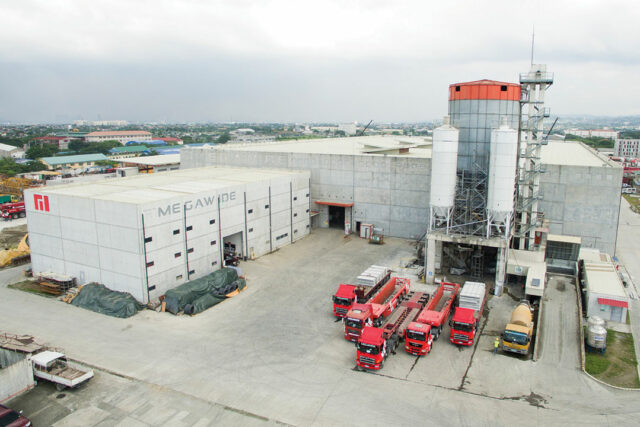
MEGAWIDE CONSTRUCTION CORP. plans to build additional precast facilities to support the government’s expanded Pambansang Pabahay para sa Pilipino (4PH) Program, aiming to sustain employment and help meet housing targets.

“We, here in the private sector, in construction, real estate and in the field are happy because this will bring great prosperity to the economy and give jobs to our workers,” Megawide President and Chief Executive Officer Edgar B. Saavedra said in a speech during the Department of Human Settlements and Urban Development’s (DHSUD) seventh anniversary on Monday.

“In this [Megawide Precast in Taytay] facility alone, we employ around 5,000 jobs, 1,500 direct and around 3,500 indirect. Because of the 4PH program, our company will be expanding another facility, bigger and more sophisticated to support our commitment in delivering 100,000 units of houses within 5 years,” he added.

In December last year, Megawide and the Home Development Mutual Fund (HDMF or Pag-IBIG Fund) signed an Investment and Partnership Agreement to advance the government’s 4PH housing program.

Under the agreement, HDMF will invest P10 billion in Megawide Dreamrise Residences, Inc., a wholly owned subsidiary, through subscription to perpetual preferred shares in three tranches to fund 4PH housing projects.

The investment is expected to deliver at least 7,000 affordable housing units over the next two to three years.

On the sidelines of the event, Mr. Saavedra told reporters the company is still identifying a site for a second precast plant but is targeting an area in Cavite.

“That’s the one closest to Manila, right? Because we already have one in the east in Taytay, we need one in the South as there are a lot of houses in the South and North now,” he said.

Mr. Saavedra added that construction of the new facility is targeted to begin this year so it can become operational next year, subject to land acquisition.

Megawide earlier expressed interest in participating in the government’s 4PH program and plans to launch 100,000 housing units over the long term.

The company has identified the first 50,000 units for development over the next five years, with launches and groundbreakings planned across five sites in Cavite — one in Imus and two each in Dasmariñas and Bacoor.

Also present during the DHSUD’s seventh anniversary celebration at the Megawide Precast Plant was President Ferdinand R. Marcos, Jr., who visited the facility to inspect the construction systems that will be used in the company’s nationwide 4PH projects.

He also led the ceremonial turnover and awarding of housing assistance to beneficiaries under different 4PH modalities.

At the local bourse on Monday, Megawide shares rose by 0.63% to close at P3.19 apiece. — Alexandria Grace C. Magno

Small modular nuclear reactors: What are the issues?

STOCK PHOTO | Image by User6702303 from Freepik

By Dianne Araral

THE PHILIPPINES is seriously considering the introduction of small modular nuclear reactors (SMRs) as part of its long-term energy strategy.

The policy groundwork began with Executive Order (EO) No. 116 (2020) and EO No. 164 (2022), which together directed the government to adopt a national position on nuclear energy and integrate it into energy planning. More recently, Congress enacted the Philippine National Nuclear Energy Safety Act, establishing an independent nuclear safety regulator. The Philippines has also secured United States approval for the export of nuclear technology, including SMRs, following the entry into force of a civil nuclear cooperation agreement. President Ferdinand Marcos, Jr. has also met with SMR executives during visits to the US, signaling high-level interest in the technology. Domestically, government agencies have begun preliminary discussions on potential siting criteria, emergency preparedness, and grid integration.

What can SMR technology realistically deliver? How mature is it? How is safety ensured? And what regulatory and legal framework must be in place before any deployment can be responsibly considered in the Philippine context?

WHAT ARE SMRS?
SMRs are generally defined as nuclear reactors with capacities of up to 300 megawatts (MW) per unit, compared with conventional nuclear plants that often exceed 1,000 MW. The “modular” aspect refers to factory fabrication of major components and on-site assembly.

For the Philippines, this matters for three reasons. Smaller units are easier to integrate into a grid with uneven demand centers. Incremental deployment allows capacity to be added over time rather than all at once. And modular construction is intended to reduce construction risk compared with bespoke, site-built megaprojects like the one in Bataan.

However, these advantages are conditional. On the first unit, SMRs behave less like standardized infrastructure and more like prototype nuclear plants. Modularity delivers benefits only after repetition and this lesson is crucial for a first-time adopter like the Philippines.

A single 300-MW SMR operating at a high-capacity factor can produce roughly 2-2.5 terawatt-hours (TWh) of electricity per year, enough to power a large city or several industrial zones, but it is not transformative on its own. Any serious impact on the national power mix would require multiple units deployed over time.

This has implications for planning. SMR adoption is not a one-off procurement decision but a programmatic commitment. Grid upgrades, transmission planning, and workforce development must assume a pipeline, not a pilot.

STATUS OF SMR TECHNOLOGY
Globally, SMRs are at uneven stages of readiness. For example, in the United States, NuScale’s VOYGR SMR became the first design to receive certification from the Nuclear Regulatory Commission, yet its flagship Idaho project was canceled in 2023 after costs escalated, showing that regulatory approval does not eliminate first-of-a-kind risk. In China, the HTR-PM reactor has entered operation, but only as a state-led demonstration embedded in sovereign finance. Russia operates floating SMRs, though entirely under state ownership. Canada and the United Kingdom are advancing SMR licensing with public backing but have yet to deliver commercial fleets.

Taken together, SMRs are technically real but commercially immature, operating today only where governments absorb early risk and uncertainty. This matters because nuclear risk is front-loaded. The first unit carries the burden of design finalization, licensing interpretation, supply-chain qualification, and workforce training. These are precisely the risks that drive delays and cost escalation.

In practice, countries mitigate this by importing experience. The United States relies on a strong, technically independent regulator to license new designs. Canada has paired SMR development with a public utility that can absorb early risk and learning. The United Kingdom has had to revisit its regulatory and financing approach after early projects exposed the cost of uncertainty.

SAFETY: WHAT IS DIFFERENT, AND WHAT IS NOT
SMRs are often described as “safer by design.” There is substance behind this, but it needs to be understood carefully.

Many SMR designs emphasize passive safety systems that rely on natural forces — gravity, convection, pressure differences — rather than active pumps or operator intervention. Some place the reactor underground, adding physical protection. Others integrate major components into a compact vessel, reducing potential leak points.

These features can reduce certain risks, particularly those associated with loss of power or cooling. But they do not eliminate risk. Nuclear safety ultimately depends on regulation, operations, maintenance, emergency planning, and institutional culture.

This is where geography matters. For the Philippines, seismic risk, typhoons, flooding, and evacuation logistics must shape siting decisions and emergency planning. Passive safety helps, but it does not substitute for conservative siting and a regulator empowered to enforce stringent standards.

LICENSING AND TESTING: THE REAL BOTTLENECK
One common misconception is that reactors are “tested” like other technologies, but nuclear plants are licensed — a comprehensive process covering design, site characteristics, construction methods, operations, and emergency response.

In countries with mature regulators, licensing still takes years. For SMRs, it can be more complex because many rules were written for large reactors. Regulators must decide how existing standards apply to new designs.

This is why the creation of an independent nuclear regulator in the Philippines is so important — and why it must be resourced, staffed, and protected from political pressure. Without regulatory credibility, licensing delays are inevitable, and financing costs rise sharply.

THE LEGAL FRAMEWORK: BEYOND SAFETY REGULATION
Adopting SMRs requires a complete legal architecture, not just a safety regulator. First, nuclear liability and compensation rules must be clear. Investors, insurers, and host communities need certainty about who pays, how much, and under what conditions in the event of an accident.

Second, radioactive waste management and decommissioning obligations must be specified upfront, with funding mechanisms that cannot be deferred. Countries that postponed these questions have paid for it later.

Third, siting authority and local consent processes must be transparent. International experience shows that nuclear projects fail politically when communities feel decisions are imposed rather than governed by clear rules.

Fourth, alignment with energy, tariff, and PPP laws is essential. SMRs do not fit neatly into merchant power models. Legal clarity on offtake, government support, and consumer protection is necessary to avoid disputes and renegotiation.

LESSONS FROM ABROAD, IMPLICATIONS FOR PHL
International experience offers consistent lessons.

The United Arab Emirates (UAE) anchored its first nuclear project in a state-owned entity, imported an experienced operator, and built regulatory capacity in parallel. The result was disciplined execution. The lesson is not to copy the UAE’s model wholesale, but to recognize that early nuclear projects work best when the state anchors capability and risk.

The United Kingdom learned the hard way that pushing uncertainty onto private investors raises costs. Its later shift toward regulated approaches reflects an effort to lower financing costs by reducing risk upfront.

France demonstrates the benefits of treating nuclear as strategic infrastructure with regulated economics, while also highlighting the importance of managing long-term liabilities transparently.

In China, rapid deployment and lower costs stem from risk reduction through standardization and repetition — conditions that cannot be replicated in the Philippines, but which underscore the value of learning and scale.

For the Philippines, the promise of SMRs depend on conservative technology choices, credible regulation, and complete legal foundations on safety, liability, waste, and siting.


Dianne Araral is a green finance and energy policy researcher based in Singapore.

Federal Land to launch new phases of Laguna, Cavite projects

LIFE AT YUME at Riverpark.

By Beatriz Marie D. Cruz, Reporter

TY-LED property developer Federal Land, Inc. (FLI) plans to launch expansions of two residential projects this year, citing sustained demand for horizontal developments in key locations outside Metro Manila.

“The Biñan and General Trias projects are sequels to our existing horizontal projects in these areas,” Federal Land President Jose Mari H. Banzon told BusinessWorld in a Viber message.

“Based on the existing sales velocity of these projects, we expect to launch the succeeding phases in the second half of 2026,” he added.

Federal Land’s project pipeline includes a 21-hectare (ha) expansion of Hartwood Village in Barangay Malamig, Biñan City, Laguna.

The first phase spans 11 ha with 110 lots, while the second phase will offer 55 lots.

Hartwood Village features amenities such as a parking area, multi-purpose court, multi-purpose gym, children’s pool, lap pool, pet park, garden, and clubhouse.

Also scheduled for launch this year is phase two of Yume at Riverpark in General Trias, Cavite. The Japanese-inspired village is being developed by the company’s subsidiary, Federal Land NRE Global, Inc.

“Yume phase one is 18 ha, while phase two, to be launched in 2026, is about the same,” Mr. Banzon said.

Lot prices at Yume at Riverpark range from P16 million to P33 million, while pre-selling lots at Hartwood Village start at P12 million, Federal Land said.

Amenities at Yume at Riverpark include a swimming pool, pocket parks, play area, outdoor fitness areas, multi-purpose court, Japanese-inspired garden, clubhouse, function room, and spa.

Mr. Banzon earlier told BusinessWorld that the horizontal residential market remains a “safe investment” amid economic uncertainties and a cautious buyer environment.-

Federal Land has residential projects in Makati, Manila, Marikina, San Juan, Pasig, Pasay, Taguig, and Quezon City. The company also operates commercial and hotel developments in Makati, Taguig, and Pasay.

AUB books record income in 2025

BW FILE PHOTO

ASIA UNITED BANK Corp.’s (AUB) net income climbed by 12% year on year to a record high in 2025, driven by strong growth in its commercial loans.

The bank’s unaudited consolidated net income reached P12.7 billion last year, rising from P11.4 billion in 2024, it said in a disclosure to the stock exchange on Monday.

AUB’s full-year financial performance translated to a return on equity of 20% and a return on assets of 3.1%.

“A more robust commercial lending portfolio combined with improved operational efficiency enabled AUB and its subsidiaries to post a record double-digit growth in profitability in 2025,” it said.

AUB’s financial statement was unavailable as of press time.

Net interest income rose by 10% to P18.4 billion in 2025, backed by the 13% growth in its loan portfolio to P276 billion.

“The bank saw a surge in loan availments as business confidence returned to pre-pandemic levels in 2025,” it said.

Despite the increase, AUB said its credit costs were “well-contained,” as its nonperforming loan (NPL) ratio was at just 0.38% and its NPL coverage ratio was at 115%.

“This reflects the bank’s disciplined underwriting and high-quality asset base, which further bolstered its strong income performance. This also ensures the bank is fully prepared to absorb potential volatility, even as provisioning requirements normalize due to improved borrower behavior.”

Net interest margin stood at 4.8%, the bank added.

With this, its total operating income increased by 9% year on year to P23.3 billion.

Other income went up by 8% to P4.8 billion, supported by higher fee-based income from its payment acceptance solution AUB PayMate, its e-wallet HelloMoney, and its remittance, trust, and credit cards businesses.

Meanwhile, on the funding side, total deposits with the bank rose by 12% year on year to P349 billion at end-2025.

“Low-cost current account/savings account (CASA) deposits grew 25% to P279 billion, cushioning the bank from higher funding costs and enabling it to keep its net interest margin steady at 4.8%. CASA deposits comprised 71% of AUB’s total deposits…,” it added.

AUB’s assets expanded by 13% year on year at P435 billion at end-2025.

Its common equity Tier 1 ratio was at 18.4% last year, while its total capital adequacy ratio stood at 19.1%.

“Even as we continue to post record growth, we remain cautiously optimistic as the entire banking industry faces more intense competition from fintechs, AI (artificial intelligence) adoption, and more complex cyberthreats. In addition, there are still mounting cost pressures and continuing geopolitical instability,” AUB President Manuel A. Gomez said in a statement.

“However, growth opportunities abound for AUB, particularly in digital partnerships. It is through this that we can stay ahead of the curve by revolutionizing cross-border digital payment solutions through our HelloMoney, among others,” he said.

AUB shares gained 20 centavos or 0.46% to close at P43.90 each on Monday. — Aaron Michael C. Sy