Home Blog Page 2953

St. Luke’s to invest P18B in Parañaque hospital, opening in 2029

ST. LUKE’S Medical Center (SLMC) announced on Monday an P18-billion investment in its Parañaque hospital, with groundbreaking scheduled for October.

This expansion reinforces SLMC’s position as the Philippines’ premier destination for medical tourism, SLMC President and Chief Executive Officer Dennis P. Serrano said during a briefing.

“The Parañaque facility is going to be a 450-bed hospital, as big and modern as the Global City unit, and the cost is P18 billion,” he added.

He said that medical tourism will be a key component of SLMC’s third hospital, slated to commence operations in 2029.

The Department of Tourism (DoT) has recognized SLMC as the country’s foremost facility for medical tourism.

Mr. Serrano said referring to the gross revenue of its two hospitals in Quezon City and Global City.

SLMC anticipates that revenue from international patients will constitute approximately 7% to 10% of its total gross revenue, translating to a figure in the billions, as noted by Mr. Serrano. This pertains to the aggregate revenue generated by SLMC’s two hospitals located in Quezon City and Bonifacio Global City, Taguig City.

Tourism Secretary Maria Esperanza Christina G. Frasco said the government aims to position the Philippines as a leading health and wellness tourism destination in Asia and beyond.

“We aim to secure our place in the global medical tourism market, which is currently valued at over $63.89 billion and expected to reach over $207 billion by 2030,” she said during an event on July 15.

In 2023, the Tourism department recorded over 30,000 arrivals for medical tourism, contributing an estimated $15 billion to $25 billion in receipts.

Meanwhile, SLMC Quezon City is undergoing renovation, according to Mr. Serrano. — Aubrey Rose A. Inosante

Private initiatives fostering marriage inviolability: The Defending Family Values Foundation, Couples for Christ, Mother of Life Catechetical Center, and the Christian Family Movement

SANDY MILLAR-UNSPLASH

(Part 2)

Especially focused on the poorest of the poor, Defending Family Values Foundation, Inc. is an initiative of the Madrigal family.

The Foundation fosters the strengthening of family values by involving the various sectors of a depressed community in Quezon City — Payatas.  It sponsors, among the key members of this human settlement area, varied activities in favor of strong family ties.  It supports college scholars who are provided with a sound background on the catechesis of the sanctity of the family, including the principles of good parenting. It organizes development seminars and workshop forums on issues related to family life among the households in the community.

These activities are held within the Consuelo “Chito” Madrigal Foundation, Inc., a hub that provides a wide variety of educational services for educators, civic leaders, college students, and surrounding poor communities.  The contents of these educational services include foundational notions of husband-wife relations; family finances; parent-child and sibling relationships; and principles and practices of the upbringing of children in a wholesome family environment.

COUPLES FOR CHRIST
The most organized lay movement to protect the inviolability of marriage and the sanctity of family life is Couples for Christ (CFC), which is already global in its reach. In fact, its leaders have already announced that they will lead a People Initiative that, under the provisions of the Philippine Constitution of 1987, can repeal the Divorce Law if and when it is passed by the Senate and certified by the President. 

This is not an empty threat. The CFC has tremendous political clout.

Today, it is an international Catholic lay ecclesiastical movement whose goal is to renew and strengthen Christian values especially as regards the institution of marriage and the Christian family. It was established in 1981 by the charismatic community Ang Ligaya ng Panginoon as its outreach program to evangelize married couples at all the social levels of Philippine society as well as the world.

Its varied activities in the Philippines and all over the world are motivated by its mission which is “to live in God’s righteousness and holiness,” evangelizing people through a life of love and service. Its members work for the renewal of families that will serve God and build generations of Christian leaders. The organization intends to strategically locate in the world to evangelize peoples and inculcate a way of life based on Gospel values. It is strongly committed to family renewal, strengthening and defending the family as a basic unit of society and of the Church in accordance with the plan of God.

Members of Couples for Christ live and spread the Catholic doctrine about marriage and the family: that God designed marriage so that man and woman could come together and be saved from their sins. When husband and wife come together in holy matrimony, they commit to God’s plan for their lives. This plan includes raising children in a God-fearing home and helping each other stay on the path of salvation.

Those Catholics who support the Absolute Divorce law on the ground that the Catholic Church is not doing enough to help the faithful who are married, especially among the lower-income households, are either completely ignorant of or are blind to the very active role of the Couples for Christ in the evangelization of Christian couples. All over the Philippines and in many parts of the world, especially where there are Overseas Filipinos Workers (OFWs) like in the Middle East, the Couples for Christ is actively teaching in words and in deeds that God designed marriage for three primary purposes: companionship, procreation, and redemption. They are proclaiming to the four winds that these purposes, despite all the scientific and technological advances associated with the so-called Industrial Revolution 4.0 (Artificial Intelligence, Internet of Things, Robotization and Data Analytics) are as relevant today as they have ever been and are essential for a healthy society.

Through myriad classes, workshops, sessions, and other means of communication in today’s social media, the CFC evangelists are spreading the truth that the purposes of marriage are still relevant today.

Companionship is important because it provides a close relationship between husband and wife. They are enabled to share their lives and experiences. Procreation is important because God designed marriage so that couples have children.  Children are a blessing from God, and it is important that they be raised in a God-fearing home. Redemption is important because when husband and wife come together in holy matrimony, they commit to God’s plan for their lives.  It is part of God’s plan that their union in a valid marriage be indissoluble.

MOTHER OF LIFE CATECHETICAL CENTER
Another institution of the Catholic Church that is very active in helping to spread among the Catholic faithful, especially those in the lower-income households, is the Mother of Life Catechetical Center (MOL), an undertaking of Notre Dame de Vie, a secular institute of the Church.

It’s main activity is the training of catechists nationwide who are recommended by the bishops of various dioceses by providing a master’s program in  Religious Education, which includes a one-year residence in MOL facilities in Novaliches, Quezon City for academic classes; followed by one year of pastoral work in diocesan communities or schools; and, finally, a one summer wrap-up program that includes a comprehensive examination on seven aspects of religious education and a thesis defense.

A good number of the courses taken by the students involve the catechesis on family and the psychology of men and women influencing marital situations that can prepare them to be effective marriage counsellors. With timely and expert counselling, most marital conflicts can be resolved without having to end in the dissolution of the marriage.  Now on its 56th year, MOL has graduated hundreds of professionally trained catechists, all at the level of college graduates, who can provide sound doctrinal and church cultural education nationwide, taught with the appropriate pedagogy and andragogy.

CHRISTIAN FAMILY MOVEMENT
Another very active apostolic movement fostering the inviolability of marriage and the sanctity of family life is the Christian Family Movement (CFM) that had its origins in the early 1940s in South Bend, Indiana and Chicago, Illinois.  The Mission Statement of CFM, taken directly from its website, was adopted by its board of directors on March 10, 2002: “The mission of the Christian Family Movement is to promote Christ-centered marriage and family life; to help individuals and their families to live the Christian faith in everyday life and to improve society through actions of love, service, education and example.”

CFM Philippines was established in 1976. Its local website describes it as “an international movement of families called to witness to Christ, to be evangelized and to evangelize families and communities through its family and life programs.” In practical terms, evangelization in the context of the CFM program transforms the Filipino from being just “religious” to being “catechized,” that is, aware of and striving to live by the teachings of Christ concerning creed, sacraments, morals, and family via study groups, regular meetings, counselling, and other means of reaching out to families.

(To be continued.)


Bernardo M. Villegas has a Ph.D. in Economics from Harvard, is professor emeritus at the University of Asia and the Pacific, and a visiting professor at the IESE Business School in Barcelona, Spain. He was a member of the 1986 Constitutional Commission.

bernardo.villegas@uap.asia

PHL financial system’s resources expand by 10.69% as of end-May

BW FILE PHOTO

THE TOTAL RESOURCES of the Philippine financial system expanded by 10.69% as of May, mainly driven by big banks, preliminary data from the Bangko Sentral ng Pilipinas (BSP) showed.

Based on central bank data, the resources of banks and nonbank financial institutions stood at P31.787 trillion as of May from P28.716 trillion in the same month last year.

These resources include funds and assets such as deposits, capital, as well as bonds or debt securities.

Broken down, banks’ resources rose by 12.3% to P26.463 trillion at end-May from P23.565 trillion in the comparable year-ago period, BSP data showed.

Total resources held by universal and commercial banks increased by 12.32% year on year to P24.799 trillion from P22.078 trillion.

Meanwhile, resources of thrift banks reached P1.102 trillion as of May, 9.76% higher than the P1.004 trillion recorded in the same period a year prior.

Resources held by digital banks stood at P105 billion in the period, surging by 32.91% from P79 billion the previous year.

Lastly, rural and cooperative banks’ resources stood at P458 billion as of end-May, increasing by 13.33% year on year from P404 billion.

On the other hand, nonbanks’ resources also grew by 3.34% year on year to P5.323 trillion as of May from P5.151 trillion.

Nonbanks include investment houses, finance companies, security dealers, pawnshops and lending companies.

Institutions such as nonstock savings and loan associations, credit card companies, private insurance firms, the Social Security System and the Government Service Insurance System are also considered nonbank financial institutions.

The expansion of the financial system’s resources as of May reflected the banking industry’s growth in terms of income, loans and deposits, Rizal Commercial Banking Corp. Chief Economist Michael L. Ricafort said in a Viber message.

The Philippine banking system’s net income grew by 2.95% year on year to P92.11 billion in the first quarter this year, latest data from the BSP showed.

​​Meanwhile, banks’ net loan portfolio increased by 10.39% year on year to P13.419 trillion as of end May, separate central bank data showed. Total deposits likewise rose by 9.03% to P19.11 trillion.

“Rate cuts from the US Federal Reserve and the BSP in the coming months would lead to more trading income by banks and faster growth in the demand for credit moving forward,” Mr. Ricafort added.

BSP Governor Eli M. Remolona, Jr. last month said the Monetary Board may deliver its first rate cut in over three years at its Aug. 15 review as they expect inflation to continue easing this semester.

He said the central bank may slash borrowing costs by 25 basis points in the third quarter and by another 25 basis points (bps) in the fourth quarter.

The BSP last month kept its policy rate at a 17-year high of 6.5% for a sixth straight meeting. — A.M.C. Sy

Booking app NarsToday eyes more handy care

NARS.TODAY APP

By Aubrey Rose A. Inosante

STARTUP booking platform NarsToday wants to make nursing and caregiving services more accessible, while creating jobs for healthcare providers including those who have stopped practicing their profession.

About 47% of registered Filipino nurses are not practicing their profession, Chief Executive Officer and co-founder Suzette Q. Rosario told BusinessWorld.

“They opted not to because they did not want to work abroad,” she said in an interview. “They have established their businesses, or they are employed elsewhere in a different industry.”

Ms. Rosario said NarsToday wants to contribute to the government’s Private-Public Partnership and efforts to decentralize the healthcare industry to ease the burden on local hospitals.

The NarsToday app allows one to book a nurse to provide duty at their home or at a healthcare facility.

It offers homecare services through its pool of nurses and caregivers for the elderly, mothers and newborns, and even specialized care in post-operation, radiotherapy and dialysis.

For now, the company focus is on new mommies with newborns who need help, said Ms. Rosario, who was inspired to start the platform in December after her family had a hard time trying to get nurses for their two grandmothers.

“I thought if we have a booking [platform] for food, for transportation or cars like Grab and Uber, why not for healthcare?” she said, citing the telemedicine boom at the height of the coronavirus pandemic.

Ms. Rosario, who earlier joined season 9 of the business reality TV program The Final Pitch and became one of the finalists, said she also created a website where nurses could sign up to join the platform.

More than 60 signed up in the first month, she said.

She noted that clients are keener to book their appointments on their Facebook page than on their app because their services are advertised by word-of-mouth. Customers prefer to talk to a real person first.

“We are not running any Facebook or Google ads,” she said. “We rely mostly on people who share posts or people who have experienced our service,” she said.

Ms. Rosario said mothers particularly appreciate their advice on swaddling and proper baby handling. She also said clients sometimes need specialized care, which NarsToday can provide.

NarsToday prices range from P1,440 for caregivers to P3,600 for registered nurses for mother and baby care for 12 hours.

The company also sells gift cards that can be given to expectant mothers in baby showers.

Ms. Rosario said NarsToday’s pool of nurses and caregivers is big enough. She declined to say the exact number.

The app on Google Play has had about 50 downloads.

She said the company employs nurses and caregivers “on demand,” though they are looking at a monthly setup with a competitive salary that is not lower than the prevailing rate of P800 to P900 per service.

Study firms up date of famous ancient shipwreck off Cyprus

ARCHAEOLOGY.ORG
ARCHAEOLOGY.ORG

WASHINGTON — When scientists in the 1960s excavated the wreck of an ancient Greek merchant ship off the northern coast of Cyprus, what they found was an amazing time capsule from a pivotal period in the Mediterranean world following the death of Alexander the Great.

But determining the date of the Kyrenia shipwreck with any sort of precision has proven difficult, and some previous scientific dating yielded conclusions that conflicted with the archeological evidence. Researchers have now calculated this timeline with new precision using improved techniques that they said can be applied to date other ancient shipwrecks as well.

By analyzing organic material from the wreck, including the vessel’s wooden timbers, almonds from its cargo, and a gaming piece called an astragalus made from animal bone and used like dice, they concluded that the ship went down around 280 BC. That is a bit later than prior scientific dating estimates but a better match for the archeological evidence.

Sturt Manning, a Cornell University professor of classical archaeology, called the Kyrenia vessel an “iconic ship from the early Hellenistic period, central to the history of ancient maritime technology.”

The ship, about 46 feet (14 meters) long, was built of wood with lead sheathing, with one mast bearing a square sail, and likely carrying a crew of four. It sank about a mile (1.6 km) off the coast. Aboard were nearly 400 amphoras — large two-handled pottery storage jars — some filled with almonds and others apparently with wine, along with heavy millstones as ballast.

“Likely it was going to or from Cyprus, and the cargo — amphora types — suggest it was trading in the Aegean and east Mediterranean area. The main cargo comprised amphora of a type associated with the island of Rhodes in the southeast Aegean,” said Manning, lead author of the study published in the journal PLOS ONE.

Using various lines of evidence, the researchers determined that the ship had been constructed between about 345-313 BC and sank between about 286-272 BC.

The death in 323 BC of Alexander, who had conquered wide swathes of the Mediterranean region and beyond, led to regional scrambles for power. Cyprus became a contested area pitting successors of Alexander ruling in the Aegean region versus those in Egypt, with the latter winning control of the island.

The Kyrenia ship’s remains are displayed at a museum in Cyprus.

“Ancient shipwrecks hold several unique sources of information for archaeologists to reconstruct the human past. In underwater sites like where the Kyrenia was buried, archaeological materials decay much more slowly. As a result, organic materials like wood, seeds or rope can be much better preserved than on land,” said University of Georgia anthropology professor and study co-author Brita Lorentzen.

The discovery of a deepwater shipwreck off the coast of Israel, dating to roughly 1300 BC, was announced just last week.

“Ships were a critical source of transportation in the ancient world, which allowed people to move from one place to another, create social networks, and exchange trade goods and ideas. A shipwreck’s contents can tell us specifically which items were being traded or exchanged, where and how people were moving around by sea, which groups of people were in contact with one another, and how they were impacted by these early social and economic networks,” Ms. Lorentzen said.

This ship’s timbers were embalmed decades ago using the chemical compound polyethylene glycol (PEG) to preserve the wood on land. This complicated the use of radiocarbon dating, a technique for determining an object’s age based on the decay over time of a radioactive form of carbon.

“Adding PEG prevents ship timbers from drying out, shrinking and turning to dust out of the water. But it also contains petroleum, with lots of carbon from long-dead organic remains,” Ms. Lorentzen said.

The researchers devised improved methods to remove PEG so radiocarbon dating could be used for the timbers. They also used radiocarbon dating on the almonds and astragalus.

Analysis of annual growth rings in trees also helps govern the dating of ancient wooden artifacts. The researchers found a discrepancy in a scientific standard used in analyzing wood from this time period to convert radiocarbon measurements into calendar dates for the northern hemisphere, and updated it.

“The work here is relevant to ancient shipwrecks generally,” Manning said. — Reuters

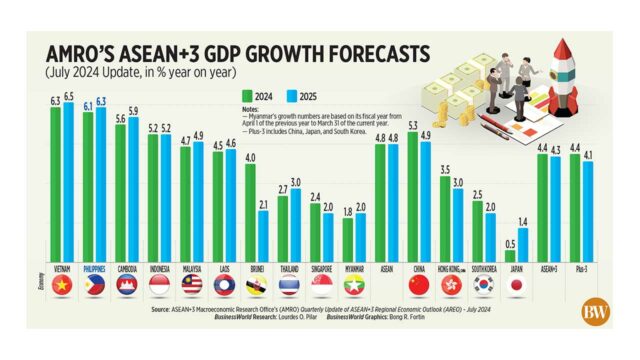
AMRO’S ASEAN+3 GDP growth forecasts

THE ASEAN+3 Macroeconomic Research Office (AMRO) trimmed its Philippine economic growth forecast for this year and in 2025, amid slowing external demand. Read the full story.

AMRO'S ASEAN+3 GDP growth forecasts

Using the 2016 UNCLOS Award as the basis of the Philippines’ Archipelagic Defense Doctrine

PHOTOS FROM VECTEEZY AND SANJITBAKSHI-FLICKR

The South China Sea is the site for China’s integrated maritime campaign for expansion against its smaller and weaker Southeast Asian neighbors. China aims to gain legitimacy for its unilateral territorial claims over the vast marine terrain, several surface and subsurface land features, and natural resources above and below the seabed. China deploys its three services in its campaign against the coastal Southeast Asia states. The first layer is the People’s Liberation Army Navy (PLAN), with its numerous and advanced naval vessels to provide it with the escalatory option of the threat or actual use of force. The second layer is the Chinese Coast Guard (CCG), which ensures the occasional presence of Chinese maritime forces in the disputed waters. Finally, the People’s Armed Forces Maritime Militia (PAFMM) is tasked with maintaining a persistent presence in the contested maritime terrain of the South China Sea.

The PLAN and the CCG operate to normalize patrol activities to maintain China’s rights and interests in the South China Sea and, if necessary, respond to sudden maritime incidents involving the navies and coast guards of the smaller Southeast Asian states. The PLAN, the CCG, and maritime militias are tasked to promote China’s economic activities in the disputed waters while obstructing the economic activities of its smaller neighboring states. China’s integrated maritime campaign for expansion seeks two objectives: a.) de facto — or the imposition of a state of affairs based on raw power and use of force; and, b.) de jure — earning the legal recognition of China’s sovereignty over the South China Sea through international law.

In 2013, the Philippines filed a case in the Permanent Court of Arbitration (PCA) to deny China the possibility that it could accomplish the second goal of its integrated maritime expansion — the legitimacy of its expansive naval claim in the South China Sea. In 2016, the Arbitral Tribunal on the United Nations Convention on the Law of the Sea (UNCLOS) decided that China’s legal basis for its expansive claim — the nine-dash-line — is a completely untenable claim because it has no basis in international law. The tribunal ruled that since China became a party to the UNCLOS, it could not legally claim to have historic rights in areas beyond 12 nautical miles from its coast. The tribunal further pointed out that there was no evidence to support China’s landmark claim in the South China Sea. By ruling that China’s nine-dash line claim has no legal basis and is groundless, the arbitral court effectively deprived China of any chance to gain de jure control of the South China Sea.

THE UNCLOS AWARD AS THE BASIS OF AN ARCHIPELAGIC DEFENSE DOCTRINE
President Ferdinand Marcos, Jr. said in an interview before his inauguration as president on June 30, 2022 that he would assert the Philippines’ territorial rights over the West Philippine Sea. He said he would talk with China consistently with a firm voice about the two countries’ territorial dispute. He also declared that he would use the July 2016 arbitral awards against China’s expansive and sweeping claims in the South China Sea to assert his country’s territorial rights.

On July 12, 2022, Philippine Foreign Affairs Secretary Enrique Manalo announced that the Philippines would uphold the July 12, 2016, arbitral ruling as it is one of the twin anchors of the country’s policy and actions on the West Philippine Sea. He added that the award affirmed to the community of nations that the rule of law prevails. That stability, peace, and progress can only be attained when founded on a rules-based legal order on the oceans, as it should be everywhere else. In the Department of Foreign Affairs’ (DFA) July 12, 2022 statement commemorating the 6th anniversary of the arbitral award and the 40th anniversary of the United Nations Convention on the Law of the Sea, Secretary Manalo declared that compliance with UNCLOS in its entirety is critical to ensuring global and regional peace and the fair and sustainable use of the oceans.

Since 2023, President Marcos Jr. has pursued a vigorous balancing policy based on the July 12 arbitral ruling to challenge China’s maritime expansion in the South China Sea. Specifically, this balancing policy entails building up the Philippine military’s external defense capabilities, enhancing its alliance with the US by increasing American strategic presence in the Philippines and fostering security arrangements with other American allies like South Korea, Japan, and Australia, and, more recently, adopting the Comprehensive Archipelagic Defense Concept (CADC).

Secretary of National Defense Gilberto Teodoro announced the gist of CADC in January 2024. CADC incorporates President Marcos Jr.’s view that China’s activities aimed to implement its 10-dash line claim (Recently expanded from nine dashes. — Ed.) in the South China Sea is not only a blatant disregard of UNCLOS and of the July 12, 2016, arbitral tribunal ruling, China’s actions are a major strategic threat to Philippine national security. The CADC directs the Armed Forces of the Philippines (AFP) to develop and project its capabilities up to the Philippines’ exclusive economic zone (EEZ) and expand the country’s strategic depth to enhance the defense of its entire archipelagic territory. CADC’s long-term goal is to guarantee the unimpeded and peaceful exploration and exploitation of all the natural resources with the country’s EEZ for Philippine nationals, corporations, and others authorized by the Philippine government. This implies a more comprehensive and defiant strategy against Chinese maritime expansion grounded on the July 12, 2016, UNCLOS award to the Philippines.


Dr. Renato De Castro is a trustee, convenor, and non-resident fellow of the think tank Stratbase ADR Institute. He is also a distinguished full professor at the Department of International Studies at De La Salle University-Manila.

UnionDigital CEO to step down by August

THE PRESIDENT and chief executive officer (CEO) of the digital banking arm of Union Bank of the Philippines, Inc. (UnionBank) will step down by August, its listed parent said on Tuesday.

UnionDigital Bank President and CEO Henry R. Aguda will leave his post effective Aug. 1 after the online lender’s board of directors accepted his resignation, UnionBank said in a disclosure to the stock exchange.

Mr. Aguda will be replaced by Danilo “Bong” J. Mojica II, who is currently a director at UnionDigital.

“Mojica brings with him over 35 years of local and international C-level corporate and consulting experience in various fields and industries, like FMCG (fast-moving consumer goods), airline, telecommunications, financial services and in financial technologies,” the bank said.

“We respect Henry’s decision to pursue opportunities that are more aligned to his personal development goals, and we wish him the best. Our appointment of Bong, who is close to UnionDigital’s business and operations as a board director, will ensure continuity and the uninterrupted execution of the bank’s plans for growth and its strategic initiatives,” UnionDigital Board of Directors Chairman Justo A. Ortiz said.

Mr. Aguda will also leave his post as UnionBank senior executive vice-president, the listed lender added.

“This was also accepted by the UnionBank Board and will be effective Oct. 01, 2024, to allow Aguda to have enough time for an effective turnover and transition to Bong Mojica as UnionDigital President and CEO successor,” it said.

UnionDigital is one of the six licensed digital banks in the country.

Its parent UnionBank saw its net income decrease by 78.06% to P1.98 billion in the first quarter due to one-time integration costs related to its acquisition of Citigroup, Inc.’s consumer business in the Philippines.

The listed lender’s shares went up by 30 centavos or 0.87% to close at P34.80 apiece on Tuesday. — AMCS

SMIC holds fixed-income investor meetings in Asia, Europe for possible dollar note issuance

SY-LED holding company SM Investments Corp. (SMIC) has started a series of fixed-income investor meetings in Asia and Europe on Tuesday for a possible dollar note issuance.

SMIC mandated HSBC, J.P. Morgan, Standard Chartered Bank, and UBS as joint lead managers and joint bookrunners, alongside BDO Capital and Chinabank Capital as joint lead managers, to arrange the meetings, the listed holding company said in a regulatory filing.

“A US dollar-denominated benchmark-sized Regulation S offering of five-year senior notes by SMIC SG Holdings Pte. Ltd. guaranteed by SMIC may follow, subject to market conditions,” SMIC said.

“The notes are expected to be drawn from (SMIC SG Holdings’) $3-billion euro medium-term note programme (EMTN),” it added.

SMIC SG Holdings and SMIC’s legal advisers include SyCip Salazar Hernandez & Gatmaitan for Philippine law, and Latham & Watkins LLP for English law.

The legal advisors of the joint lead managers and joint bookrunners are Picazo Buyco Tan Fider & Santos Offices for Philippine law, and Linklaters Singapore Pte. Ltd. for English law.

SMIC and its listed property developer, SM Prime Holdings, Inc., previously announced the maiden $3-billion multi-issuer EMTN program. It seeks to finance expansion and debt payments. EMTNs are a type of debt security that is issued and traded overseas.

For the first quarter, SMIC logged a 6% increase in its consolidated net income to P18.4 billion as consolidated revenues surged by 4% to P144 billion.

The holding company’s core businesses are in the retail, banking, and property sectors.

SMIC shares closed unchanged at P900 per share on Tuesday. — Revin Mikhael D. Ochave

SoftBank buys troubled UK semicon startup in AI race

GRAPHCORE.AI

SOFTBANK GROUP CORP. has acquired British semiconductor startup Graphcore Ltd., as the Japanese firm seeks to strengthen its investments in chips and artificial intelligence (AI).

The companies announced the deal on Friday without disclosing financial terms. Bristol-based Graphcore will operate as a SoftBank subsidiary and keep its management team, Nigel Toon, Graphcore’s chief executive officer, told reporters in a briefing.

It’s the second UK semiconductor company that SoftBank’s snapped up, and follows its 2016 takeover of Cambridge-based Arm Holdings Plc, the chip designer whose technology is found in almost all of the world’s smartphones. Graphcore was frequently held up as a champion of the UK tech industry — it participated in the country’s inaugural AI safety summit last year. But Mr. Toon has been openly critical of the government’s lack of support for the industry.

Based in Bristol, Graphcore designed a new type of chip, called an IPU, meant to enable AI applications. Financing from marquee investors, including Sequoia Capital, gave the company a $2.8-billion valuation in 2020 on the hopes that it would rival Nvidia Corp. But the British upstart struggled to gain customers, even as the frenzy around AI sent the demand for silicon sky high.

Graphcore brought in $2.7 million in sales on $204.6 million in losses in 2022, according to its most recent filings. The company disclosed that it needed more money to survive. Last year, Graphcore left China, a market Mr. Toon had cited as promising.

Mr. Toon, a semiconductor veteran, cited the unmanageable costs of competing with Nvidia and others developing customized AI chips. “The scale here is just enormous,” he said. “The right outcome for the company is to work closely with a partner that is willing to make these levels of investment to succeed.” He said the plan under SoftBank was to “invest and add” to his employee base in the UK.

“This acquisition is a welcome end to the uncertainty that has faced Graphcore,” UK Science Secretary Peter Kyle said in a statement on Friday. “It must, however, serve as a reminder of the important work that needs to be done.”

Vikas Parekh, a managing partner with SoftBank’s investment fund, said in a statement that SoftBank was “pleased to collaborate” with Graphcore on moving toward AGI, an industry term for a machine that outperforms humans in a range of tasks. The company didn’t comment further. Bloomberg News reported on the companies’ talks in May.

Masayoshi Son, SoftBank’s founder, has shifted his strategy from splashy venture deals to strategic investments in AI and semiconductors, riding the successful public listing of Arm. Mr. Toon said Graphcore will work “across the whole SoftBank family,” without specifying how it would collaborate with Arm.

Before the deal was announced, Graphcore sent former employees letters indicating that their company shares were worthless, according to a report in Sifted and documents seen by Bloomberg News. The letter explained that the offer price was less than the amount it had raised in investment capital. 

Mr. Toon confirmed that former employees wouldn’t profit from the sale but declined to comment on the financial terms. He said Graphcore had raised “in the order of $700 million” before being acquired. — Bloomberg News

K-pop group NMIXX breaks fresh ground, teases new music

INSTAGRAM.COM/NMIXX_OFFICIAL

LONDON — Performing with a live band gave South Korean girl group NMIXX new means to connect with audiences as they brought their “mix pop” sound to the British Summer Time (BST) Hyde Park Festival in London on Sunday.

The main stage performance marked a first for the six-piece, which is made up of members Haewon, Lily, Sullyoon, BAE, Jiwoo and Kyujin.

“When I heard that we were performing in this historical park, like, even just visiting here would have been fun but performing here is so crazy,” Australia-born vocalist Lily said in a post-show backstage interview.

“We honestly don’t have a lot of experience with festivals but this time we were lucky enough to perform with a band,” the 21-year-old singer, said.

“When you’re doing it with a backtrack, you can’t manipulate it as you go. But with a band you can work together and have good synergy and you can kind of slow it down if you want to or make it faster. I think that was an interesting thing that we were kind of all getting used to while preparing for the festival.”

NMIXX made their debut in early 2022 and have since released two extended play records, three single albums, and toured across Asia and the United States.

The group’s track “Love Me Like This” recently surpassed 100 million streams on Spotify, with songs “O.O” and “DASH” closing in on 200 million streams on the digital music service.

The members have also attended European catwalk shows for a Spanish luxury brand, as an increasing number of fashion houses hire Asian stars for their highest-profile global promotional gigs.

Fans will not have to wait long for new music, said the group, who gave audiences at BST a taster of their as-yet-unreleased song “Moving On.”

“We’re working hard to bring out music that’s new and different,” Kyujin said.

“I think you’re going to get a hip mix that we haven’t shown you yet. It’s a little bit more free,” added Sullyoon. — Reuters

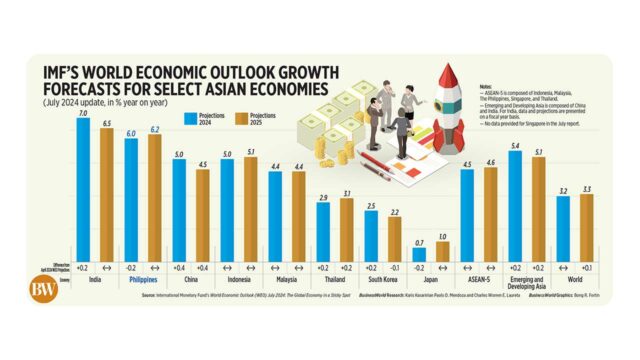
IMF’s World Economic Outlook growth forecasts for select Asian economies

THE PHILIPPINES will likely post the second-fastest growth in Asia this year and in 2025, the International Monetary Fund (IMF) said. Read the full story.

IMF's World Economic Outlook growth forecasts for select Asian economies

ADVERTISEMENT
ADVERTISEMENT