Home Blog Page 293

Metro Retail expands urban retail strategy with Metro Corner launch in Mandaue City

THE METRO STORES FACEBOOK PAGE

METRO RETAIL STORES Group, Inc. (MRSGI) has opened its first Metro Corner at Mandani Bay Suites in Mandaue City, a store concept intended to provide convenient access to goods for condominium residents and nearby workers.

“Metro Corner represents the next chapter of Metro Retail’s innovation in serving our customers,” MRSGI President and Chief Operating Officer Joel Orense said in a statement on Tuesday.

He said the new store format reflects the changing nature of shopping in urban communities — “compact and closer, designed around convenience without losing the warmth and quality Metro is known for.”

The new store features everyday essentials, artisan items, organic products, and international specialties in a modern layout that highlights fresh goods, friendly service, and quick checkout.

Located on the ground floor of Tower 1, Mandani Bay Suites, Metro Corner caters to residents, workers, and property owners seeking easy access to quality products within their community.

The company said the launch marks its first Metro Corner store within Mandani Bay, a developing mixed-use community in Mandaue City with a growing residential and business population.

“As more communities embrace urban living, we see an opportunity to reimagine convenience through well-designed, right-sized stores that bring essentials and lifestyle selections closer to home,” Mr. Orense said. “Metro Corner allows us to serve residents more efficiently while maintaining the same quality, service, and trust that define the Metro brand.”

Metro Retail operates 79 stores across Luzon and the Visayas, including Metro Supermarket, Metro Department Store, Super Metro Hypermarket, Metro Value Mart, and Metro Home Improvement and Lifestyle formats.

Shares of MRSGI rose by 0.88% or one centavo to close at P1.14 each on Tuesday. — Alexandria Grace C. Magno

Raising digitally mature children: Data privacy for the next generation

STOCK PHOTO | Image by Pressfoto from Freepik

The toothpaste is out of the tube. Once personal data hits the internet, there is no going back. Children today grow up leaving permanent traces with every like, post, and DM, often unaware of how much of themselves they have exposed. To shield children, lawmakers have taken decision-making out of their hands and placed them in the care of adults. The assumption is that children lack the understanding to have a say.

However, we often underestimate them. Children’s abilities are constantly evolving, and today’s average 10-year-old knows Instagram and TikTok like the palm of their hand. Children nowadays possess the knowledge and more; what they need is guidance so that they can develop the judgment to make informed decisions about data privacy matters.

The foundation of these protections is the principle of transparency. As data subjects and rights holders, children are entitled to information on how their personal data is collected, processed, and used.1

PHL DATA PRIVACY LAWS FOR CHILDREN
In December 2024, the National Privacy Commission took a leap forward by issuing Advisory No. 2024-03, also known as Guidelines on Child-Oriented Transparency.

The Guidelines emphasize the vulnerability of children, while also acknowledging their rights as primary data subjects and their increasing ability to understand how their personal data is used. They require children to be informed, through age-appropriate privacy notices, regarding the nature, purpose and extent of the processing of their personal data, even in cases where the product or service is intended for adults.2 They also require that children must be notified if their personal information is affected by a data breach.3

However, transparency does not necessarily equate to autonomy. While the Guidelines call for data processors to be open towards children, the accountability and responsibility of providing consent still rests on those exercising parental authority.4

The Guidelines themselves require data processors to conduct Child Privacy Impact Assessments before launching products or services, and, whenever necessary, secure the involvement of parents or guardians in deciding whether children should participate in a specific processing activity.5

GLOBAL APPROACHES TO PARENTAL CONSENT
This crucial role of parents and guardians is reflected in international laws, although the age threshold for parental consent varies across jurisdictions.

In the United States, consent must be obtained before processing data of children under 13.6 South Korea sets this age at 14,7 whereas India enforces a stricter rule, requiring verifiable parental consent for individuals younger than 18.8

In Europe, countries find guidance in the General Data Protection Regulation (GDPR).9 which requires parental consent for children below 16. However, the GDPR allows Member States to set a lower age limit by law, provided it is not below 13.10 In Italy, parental consent is required for processing the personal data of children under 14.11

Certain jurisdictions are more progressive in terms of giving children decision-making rights once they reach a certain age. For instance, in Vietnam12 and Thailand13, as young as the ages of seven and 10, respectively, a child must give their consent alongside that of their parents.

In the Philippines, parental consent is required for children who are below 18 or those over 18 with disabilities.14 Currently, there is a pending house bill proposing to lower this age to 15.15

EMPOWERING THE NEXT GENERATION
There is no doubt that today’s children are adept with technology and the internet. However, they have yet to fully grasp the long-term impact of sharing their personal information. The onus, therefore, also falls on data processors, especially social media platforms, to inform them about all matters affecting their data.

In fact, the Guidelines recommend specific strategies in crafting child-specific and age-appropriate privacy notices that consider the readability, comprehension, and granularity of the information while keeping in mind the best interests and evolving capacities of children. In any case, the information must be presented in a manner that is simple and easily understandable for children using videos, infographics, animation, and audio recordings.16

The growing digital maturity of children highlights not only their adaptability but also their potential as informed digital citizens. By empowering them through education, transparent policies, and supportive parental guidance, we can shift the narrative — from seeing them as mere vulnerable subjects to recognizing them as active participants in protecting their own personal data.

Ultimately, protecting children’s data privacy implores us to “prepare the child for the road, not the road for the child.” In this age of open information, keeping children safe requires more than shielding them from the digital world. It entails empowering them to thrive within it.

(This article is for general informational and educational purposes only and not offered as, and does not constitute, legal advice or legal opinion.)

1UN Committee on the Rights of the Child, General Comment No. 25 (2021) on Children’s Rights in Relation to the Digital Environment, CRC/C/GC/25 (March 2, 2021).

2Section 3, NPC Advisory No. 2024-03 entitled “Guidelines on Child-Oriented Transparency.”

3Section 4, NPC Advisory No. 2024-03 entitled “Guidelines on Child-Oriented Transparency.”

4Title IX, New Civil Code.

5Section 2(A), NPC Advisory No. 2024-03 entitled “Guidelines on Child-Oriented Transparency.”

6Section 312.4(a), Children’s Online Privacy Protection Rule.

7Article 22(6), Personal Information Protection Act 2011.

8Section 9, Chapter 2, Digital Personal Data Protection Act (2023).

9Regulation (EU) 2016/679 of the European Parliament and of the Council of April 27, 2016.

10Article 8, Regulation (EU) 2016/679 of the European Parliament and of the Council of April 27, 2016.

11Section 2-d, Personal Data Protection Code containing provisions to adapt the national legislation to Regulation (EU) 2016/679 of the European Parliament and of the Council of April 27, 2016 on the protection of natural persons with regard to the processing of personal data and on the free movement of such data, and repealing Directive 95/46/EC.

12Clause 2, Article 20(2), Vietnam’s Decree on Personal Data Protection (Decree No. 13/2023/ND-CP).

13Section 20, Part I, Chapter II, Thailand’s Personal Data Protection Act 2019.

14Section 3(a), Republic Act No. 7610 (1992). An Act Providing for Stronger Deterrence and Special Protection Against Child Abuse, Exploitation and Discrimination, and for Other Purposes [Special Protection of Children Against Abuse, Exploitation and Discrimination Act of 1992].

15HB 898

16Section 3, NPC Advisory No. 2024-03 entitled “Guidelines on Child-Oriented Transparency” (Guidelines).


Clarisse Paulina M. Valdecantos-Javelosa is a senior associate of the Intellectual Property Department and a member of the Data Privacy and Security Group of the Angara Abello Concepcion Regala & Cruz Law Offices (ACCRALAW).

cmvaldecantos@accralaw.com

+632-8830-8000

Philippines edges up in rule of law, still behind region

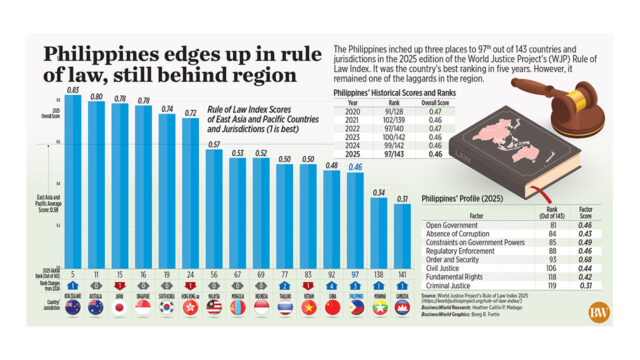
The Philippines inched up three places to 97th out of 143 countries and jurisdictions in the 2025 edition of the World Justice Project’s (WJP) Rule of Law Index. It was the country’s best ranking in five years. However, it remained one of the laggards in the region.

Philippines edges up in rule of law, still behind region

How PSEi member stocks performed — October 28, 2025

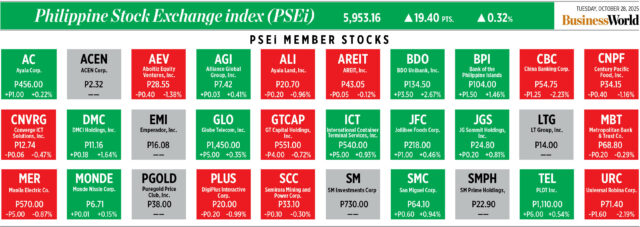
Here’s a quick glance at how PSEi stocks fared on Tuesday, October 28, 2025.


Shares rise on bargain-hunting before Fed move

REUTERS

PHILIPPINE STOCKS closed higher on Tuesday as players picked up cheap stocks following the market’s two-day slide, but sentiment remained cautious before the US Federal Reserve’s policy decision.

The benchmark Philippine Stock Exchange index (PSEi) went up by 0.32% or 19.40 points to close at 5,953.16, while the broader all shares index rose by 0.21% or 7.78 points to 3,589.51.

“The Philippine market ended higher, driven by bargain-hunting after two consecutive days of strong selling. Investors remained cautious, closely monitoring upcoming earnings reports and the anticipated next move by the US Federal Reserve, which could influence market direction,” Regina Capital Development Corp. Head of Sales Luis A. Limlingan said in a Viber message.

“The market snapped its losing streak, but the rebound of a third of a percent was unconvincing as investors await the Fed’s rate cut decision,” AP Securities, Inc. Research Head Alfred Benjamin R. Garcia said in a Viber message.

Fed policymakers are widely expected to reduce US short-term borrowing costs this week by a quarter of a percentage point for the second time this year as they look to prevent further slowing in the labor market, Reuters reported.

Odds are it won’t be the last of the series.

Climbing unemployment insurance claims suggest that labor market demand continues to cool, even as the government shutdown delays publication of most official economic statistics, including the unemployment rate, last estimated at 4.3% in August.

Milder-than-expected inflation readings, including last week’s report that the consumer price index rose 3% in the 12 months through September, have put worries of tariff-driven price pressures on the back burner.

A quarter-point rate cut on Wednesday at the close of the Fed’s two-day meeting would put the policy rate in the 3.75%-4% range. Financial markets are betting heavily on further rate cuts in both December and January.

Back home, sectoral indices closed mixed on Tuesday. Mining and oil slumped by 4.42% or 565.68 points to 12,230.69; industrials dropped by 0.27% or 24.08 points to 8,772.47; and property slipped by 0.01% or 0.39 point to 2,198.54.

“The mining sector counter was the biggest loser with a decline of 4.4% as gold prices continue to slump,” Mr. Garcia said.

Meanwhile, financials rose by 1.15% or 22.44 points to 1,970.64; services increased by 0.42% or 9.76 points to 2,282.42; and holding firms edged up by 0.05% or 2.43 points to 4,807.25.

Advancers narrowly beat decliners, 95 to 94, while 62 names closed unchanged.

Value turnover went down to P4.64 billion on Tuesday with 1.18 billion shares changing hands from Monday’s P18.77 billion with 11.82 billion issues traded.

Net foreign selling increased to P432.57 million from P313.66 million. — Alexandria Grace C. Magno with Reuters

Marcos to push Philippine trade, tech agenda at APEC Summit in South Korea

MALAYSIAN Prime Minister Anwar Ibrahim handed over the gavel to Philippine President Ferdinand R. Marcos, Jr., symbolizing the turnover of the Association of Southeast Asian Nations (ASEAN) chairmanship at the closing ceremony of the 47th ASEAN Summit and Related Summits in Kuala Lumpur on Oct. 28. — PPA POOL/MARK BALMORES

By Erika Mae P. Sinaking and Chloe Mari A. Hufana, Reporter

PHILIPPINE President Ferdinand R. Marcos, Jr. will promote Philippine economic interests and push deeper regional cooperation at the 32nd Asia-Pacific Economic Cooperation (APEC) Economic Leaders’ Meeting in Gyeongju, South Korea later this month, the Department of Foreign Affairs (DFA) said on Tuesday.

Mr. Marcos will attend the summit from Oct. 30 to Nov. 2 at the invitation of South Korean President Lee Jae Myung, joining leaders from all 21 APEC member economies, DFA spokesperson Angelica C. Escalona told a livestreamed news briefing in Malacañang.

“The President’s participation is centered on advancing the Philippines’ economic interests, forging deeper ties with APEC members, and reaffirming our commitment to APEC’s vision of a more open, prosperous, and dynamic Asia-Pacific,” she added.

The two-day leaders’ meeting is expected to produce four key outcome documents — a Leaders’ Declaration and three statements focusing on artificial intelligence, demographic change and the cultural and creative industries.

“These topics reflect the priorities set by Korea as this year’s APEC host and tackle trends that impact economic growth across the region,” Ms. Escalona said.

Mr. Marcos will also join a leaders’ dialogue with the APEC Business Advisory Council (ABAC) and deliver remarks at the APEC Chief Executive Officer Summit, where he is expected to discuss technology, innovation and regional economic integration with top business executives.

“The President is expected to highlight new technologies and economic integration,” Ms. Escalona added.

The DFA said Mr. Marcos’ visit aims to attract investments and strengthen trade cooperation, particularly with South Korea, one of the Philippines’ major economic partners.

The President is scheduled to meet with business leaders from key sectors and the Filipino community in Busan, home to more than 70,000 Filipinos, including more than 42,000 overseas workers employed in manufacturing, agriculture, fishing, professional services, entertainment and domestic work.

The trip follows clarification from the Department of Finance (DoF) that a previously reported P28-billion official development assistance (ODA) loan from South Korea “does not exist.”

Ms. Escalona said the matter is “considered closed,” adding that “the Korean government has already reassured us of its continued support for advancing development cooperation with the Philippines.”

Asked whether Mr. Marcos would bring up the South China Sea dispute amid tensions with China, Ms. Escalona said the issue falls outside APEC’s mandate, which is to “facilitate trade and investments and promotes sustainable development.”

Bilateral meetings with other leaders were still being finalized, she added.

Mr. Marcos was in Kuala Lumpur for the 47th Association of Southeast Asian Nations (ASEAN) Summit and Related Summits from Oct. 26 to 28. He will be accompanied to APEC by Foreign Affairs Secretary Maria Theresa P. Lazaro, Trade Secretary Maria Cristina A. Roque, Migrant Workers Secretary Hans Leo J. Cacdac, Acting Communications Secretary Dave M. Gomez and Special Assistant for Investment and Economic Affairs Frederick D. Go.

The 32nd APEC Summit will serve as a key platform for Manila to emphasize its innovation agenda, expand trade opportunities, and align with regional efforts toward sustainable, technology-driven growth.

ASEAN CHAIRMANSIP
Meanwhile, the Philippines has officially assumed the chairmanship of the ASEAN. Manila’s term will begin on Jan. 1, 2026. It last hosted the regional bloc in 2017.

“We are committed to carrying forward [Malaysia’s] momentum and to implement in its first year the ASEAN Community Vision 2045 with purpose and resolve,” Mr. Marcos said during the turnover ceremony. “We likewise remain dedicated to facilitating the further integration of Timor-Leste into the ASEAN family.”

“The Philippines will continue to fortify our peace and security anchors, strengthen our prosperity corridors and advance people empowerment,” he added.

The regional bloc is composed of 11 member states, making up the world’s fifth-largest economy. It welcomed Timor-Leste as the newest member on Sunday.

The ASEAN chairman acts as the facilitator and spokesperson of the bloc, sets the agenda and leads the discussions on regional priorities. The chairmanship has a one-year tenure and goes by alphabetically each year.

Mr. Marcos earlier said one of the Philippines’ priorities for its chairmanship is the enactment of a legally binding Code of Conduct in the South China Sea as tensions with Beijing continue.

Meanwhile, in separate meetings with Australia and New Zealand, Mr. Marcos called for stronger cooperation in the areas of peace, prosperity, people-to-people exchange and environmental protection.

At the ASEAN-New Zealand Commemorative Summit, he lauded New Zealand’s “consistent recognition of ASEAN centrality” over the past 50 years and said the elevation of their relationship to a comprehensive strategic partnership would open new avenues for cooperation under peace, prosperity, people and planet.

The President highlighted in his intervention speech maritime cooperation initiatives, including New Zealand’s involvement in the ASEAN Regional Forum Workshops on Implementing United Nations Convention of the Law of the Sea (UNCLOS) and the ASEAN Indo-Pacific Marine Debris Workshop, which he said helped build regional capacity to tackle maritime challenges.

He also welcomed the entry into force of the Second Protocol to Amend the ASEAN-Australia-New Zealand Free Trade Area, expressing optimism that it would expand market access and promote e-commerce and sustainable trade and empower micro, small and medium enterprises.

Mr. Marcos urged closer collaboration on sustainable agriculture and fisheries, citing New Zealand’s expertise in agritech and value-chain integration.

During the 5th ASEAN-Australian Summit, he reaffirmed the Philippines’ commitment to fully implement the ASEAN-Australia Plan of Action 2025-2029, calling it “a roadmap that embodies the trust and shared resolve that underpin our comprehensive strategic partnership.”

Philippine troops sent as clan clash sparks firefight in restive south

@BANGSAMOROGOVT

By Kenneth Christiane L. Basilio, Reporter

GOVERNMENT troops were deployed to a southern Philippine town on Tuesday after a family clan stormed the area in pursuit of a suspected killer of one of their members, leading to exchanges of gunfire in the latest flare-up of violence in Mindanao, authorities said.

A firefight broke out in Tipo-Tipo after a clan seeking to avenge a slain relative sought to search for the suspected assailant, according to Basilan province’s police office.

“The tension in Tipo-Tipo is directly linked to the shooting and death of… an Islamic teacher and barangay official,” it said in a statement posted on Facebook. “Reports indicate that the followers… are seeking revenge and have allegedly identified those responsible for the killing.”

Basilan Governor Mujiv S. Hataman said the slain person was affiliated with the Moro Islamic Liberation Front (MILF) — once the largest armed group in the region advocating for Mindanao’s autonomy — and that the victim’s clan believed the suspect was in the municipality.

“They entered the municipal town because their suspect is a municipal guard… and they wanted him turned over to them,” he told One PH on Cignal TV.

About 26.2 million people live in Mindanao, recognized as one of the Southeast Asian nation’s most volatile regions long plagued by militant groups advocating for the major Philippine island’s separation.

But violence has largely subsided in recent years after the establishment of the Bangsamoro Autonomous Region in Muslim Mindanao, a result of peace efforts between the government and former rebel groups.

The local government of Tipo-Tipo earlier said in a Facebook post that the town was “under siege” by “lawless elements” allegedly backed by the MILF, raising fears of renewed violence reminiscent of the siege of Marawi, one of the deadliest urban conflicts to hit Mindanao in the past decade.

“The Armed Forces of the Philippines (AFP) and the Philippine National Police (PNP) are working jointly to prevent further escalation, protect civilians and restore peace and order in the affected communities,” Basilan’s provincial police said.

A joint military task force took up defensive positions and “held their ground, preventing any armed group from advancing toward key facilities,” including the government hall of Tipo-Tipo, the armed forces command in Western Mindanao said.

“Government troops continue to exercise tactical restraint to avoid the further escalation of hostilities while ensuring the safety of the civilian populace,” it said in a separate statement.

About 2,500 families fled the town, Mr. Hataman said. “They voluntarily left and went to nearby villages.” He added that there were four civilians wounded in the firefight.

“It affected nearly 90% of the population in Tipo-Tipo,” he said. “Even before the incident, they were already aware of it [possible conflict] because some of those who entered the town were also their relatives.”

Tipo-Tipo’s local government had indefinitely suspended classes and government work after the firefight, it said in a Facebook post.

The armed forces’ Western Mindanao command assured the public that they remained in control of the situation and were taking “all necessary measures” to restore peace.

“The incident is now under control, with the Coordinating Committee on the Cessation of Hostilities and the provincial government of Basilan facilitating dialogue and de-escalation,” the AFP said in a separate statement.

Lacson eyes wider DPWH probe when sessions resume

SENATE PRIB

SENATOR Panfilo “Ping” M. Lacson on Tuesday said he plans to widen the Senate Blue Ribbon Committee’s investigation of anomalies in the Department of Public Works and Highways (DPWH) projects once he is reinstated as its chairman.

“Over time, the DPWH allowed such abuses because they went undetected or unpunished,” he said in a statement. “In the course of time, this became a lucrative practice.”

The senator said the probe could expand beyond flood control projects to include other DPWH undertakings, such as farm-to-market roads, which have also been flagged for irregularities.

Earlier, Senator Sherwin T. Gatchalian, who heads the Senate finance committee, raised concerns over P10 billion worth of allegedly overpriced farm-to-market road projects implemented by the agency.

The Blue Ribbon Committee has been investigating kickbacks involving multibillion-peso flood control projects, following reports that lawmakers and public officials benefited from infrastructure funds allocated since 2022.

Senate President Vicente “Tito” C. Sotto III confirmed last week that Mr. Lacson is set to return as committee chairman when Congress resumes session next month. Mr. Lacson resigned from the post earlier this year after being criticized by his peers over his handling of the probe.

If reappointed, the senator said he plans to convene another hearing on Nov. 14 and call a “very important witness” who could identify more officials linked to the corruption scheme. He declined to name the person.

Mr. Lacson said the committee would also summon the former security aide of Party-list Rep. Elizaldy S. Co to testify at the next hearing.

The aide earlier claimed he was part of a group that delivered bags of money to Mr. Co and Leyte Rep. and former Speaker Ferdinand Martin G. Romualdez at their homes from December 2024 to August 2025. Both lawmakers have denied the allegations.

The senator added that the committee also intends to summon the contractor allegedly responsible for building Mr. Romualdez’s residence, as well as secure the project logbook to verify the aide’s statements.

Mr. Lacson said expanding the investigation would expose systemic irregularities in public infrastructure projects and ensure accountability in the disbursement of government funds.

The Blue Ribbon Committee, one of the Senate’s most powerful investigative bodies, has historically handled high-profile corruption cases involving public funds and government contracts. Its findings often lead to administrative or criminal recommendations against public officials. — Adrian H. Halili

Congressmen urge reforms to rice industry

PHILSTAR FILE PHOTO

OPPOSITION congressmen on Tuesday criticized President Ferdinand R. Marcos, Jr.’s executive orders (EO) aimed at supporting rice farmers, calling them short-sighted and urging broader reforms to strengthen the country’s agriculture and food sector.

The Marcos administration’s EO No. 100 and No. 101 lack teeth and fall short of empowering the government to meaningfully support the rice industry, Deputy Minority Leader and Party-list Rep. Antonio L. Tinio said.

“[They are] nothing but empty rhetoric that fails to address the root cause of our agricultural crisis,” he told a news briefing in Filipino.

EO No. 100 will set a yet-to-be-determined regional floor price for unmilled rice, while EO No. 101 directs all government agencies, state universities and local governments to buy food directly from accredited farm and fisherfolk cooperatives.

In mid-October, the Department of Agriculture reported an average price for locally well-milled rice of P42.72 per kilo, with regular-milled rice fetching P37.30. The average per kilo of local special rice stood at P56.92.

“If the government truly wants to lower the price of rice, it should strengthen local production and directly purchase palay at a fair price of at least P20 per kilo,” Mr. Tinio said.

He said the executive orders won’t be implemented effectively, citing the government’s lack of rice mills and storage facilities. Local government units also “have no clear mandate to purchase palay” under the order, he added.

The Marcos administration should instead focus on reinstating the government’s ability to buy rice directly from producers, an authority that was revoked under a 2019 law that liberalized the rice industry, Mr. Tinio said.

“The real and immediate solution is to scrap the rice liberalization law and bring back the regulatory powers of the National Food Authority, its mandate and budget to directly purchase palay from farmers at living and just prices,” he said.

Party-list Rep. Sarah Jane Elago said the government should also look at mandating local governments to buy at least 20% of local palay production from farmers directly, while also allotting state funding for agricultural subsidies aimed at supporting industry growth.

“Those are what we look forward to,” she told the same briefing. — Kenneth Christiane L. Basilio

Toll operators gear up for traffic

PHILIPPINE STAR/ MICHAEL VARCAS

TOLLWAY operators are preparing for the expected surge of motorists across their toll network at the weekend, during All Saints’ Day and All Souls’ Day.

San Miguel Corp.’s (SMC) infrastructure arm SMC Infrastructure is anticipating a 10% increase in vehicle volume across its expressways during the Undas period.

With this, SMC is deploying 24/7 operations of its response teams to manage the expected high number of motorists.

Further, SMC Infrastructure said it is also implementing the One-RFID interoperability program, allowing motorists to use a single RFID-tag across SMC and Pangilinan-led Metro Pacific Tollways Corp. (MPTC) expressways.

This program allows SMC’s Autosweep and MPTC’s Easytrip systems to be readable on each other’s tollways.

“We want to make it clear that interoperability has been launched, but activation still requires a simple one-time registration… Once enrolled, motorists can enjoy seamless travel across all major expressways,” SMC Infrastructure.

Separately, MPTC said that it is also intensifying operations by the deployment of additional personnel and round-the-clock traffic monitoring and quick response team.

It said that about 2,000 traffic, toll, and emergency personnel will be on duty across its network.

“MPTC encourages motorists to ensure their vehicles are in good condition, and RFID accounts are sufficiently loaded before traveling,” MPTC said.

MPTC is the tollways unit of Metro Pacific Investments Corp., one of the three key Philippine subsidiaries of Hong Kong-based First Pacific Co. Ltd., along with Philex Mining Corp. and PLDT Inc.

Hastings Holdings, Inc., a unit of the PLDT Beneficial Trust Fund’s MediaQuest Holdings, Inc., has a majority stake in BusinessWorld through the Philippine Star Group, which it controls. — Ashley Erika O. Jose

PHL yields P600M in tourism leads

The Philippines’ 171-square-meter booth at the Internationale Tourismus Börse (ITB) Asia 2025 featured capiz shells and visuals of famous tourist destinations in the country.

TWENTY-THREE accredited Philippine sellers secured 842 business appointments, generating P600 million in sales leads during a three-day trade event in Singapore, the Tourism Promotions Board (TPB) said.

The Internationale Tourismus Börse (ITB) Asia 2025, held from Oct. 15-17, gathered more than 18,000 attendees and more than 1,500 quality buyers, the TPB said in a media release on Tuesday.

The board said the Philippine delegation, which included destination management companies, hotels, resorts, airlines, and travel & tours operators, forged partnerships and drew steady traffic from buyers in the leisure, corporate, and meetings, incentives, conventions and exhibitions (MICE) sectors.

“The continued interest in Philippine tourism’s offerings at ITB Asia 2025 is a reflection of the growing demand for authentic and unique experiences that meet travel expectations,” TPB Chief Operating Officer Maria Margarita Montemayor Nograles said.

“By engaging with highly diverse tourism players, TPB continues to build momentum and strengthen partnerships across global markets.” — CAT

Reforms vs patronage politics urged

PHILIPPINE STAR /KJ ROSALES

A CIVIL SOCIETY organization on Tuesday called on Congress to remove government programs that strengthen patronage politics and corruption.

“What we are saying is we have to remove the tendency, the system, the incentives for lawmakers to use these to foster dependent patron-client relationship,” Adolfo Jose Montesa, the co-convener of the Roundtable for Inclusive Development told a senate hearing.

“Instead imagine a… rules-based, rights-based systems of providing these services to the people,” he added.

He said that Congress should remove about P256 billion allocated for “patronage-based programs” and divert them towards better social protection and socioeconomic development programs.

Among the government programs that enforce patronage politics, according to Mr. Montesa, are the Assistance to Individuals in Crisis Situation (AICS), Medical Assistance to Indigent and Financially Incapacitated Patients Program (MAIFIP), Tulong Panghanapbuhay sa Ating Disadvantaged/Displaced Workers (TUPAD), and Tulong Dunong.

“These are pork, because instead of guaranteeing people’s rights these programs have turned citizen into clients and politicians into gatekeepers,” he added.

He said that the programs have “rob people of their dignity by forcing them to beg for assistance from politicians.”

This year’s budget deliberations have been under heightened public scrutiny after the 2025 budget was found to have numerous unprogrammed funding and line-item insertions. — Adrian H. Halili