Home Blog Page 288

From anti-hero to protagonist? The BIR’s lyrical shift toward audit reform

For years, the relationship between the Bureau of Internal Revenue (BIR) and the taxpayer has been fraught with stress, uncertainty, and administrative friction. Many business owners start their day not with coffee, but with the familiar unease brought by BIR notices of overlapping Letters of Authority (LoA), simultaneous audits, and multiple Revenue Officers (ROs) looking into the books the exact same taxable year. To taxpayers, it feels like being pierced through the heart, but never (quite) killed. We survive the audit only to dread the next one.

Anyone who has dealt with an LoA knows that the BIR’s previous audit system often felt stuck in a loop of “I have this thing where I get older, but just never wiser.” The fragmented examinations, parallel case handling, and redundant investigations became part of the status quo. Under earlier rules, a single company could be pursued by different divisions all at once, e.g., all Internal Revenue Taxes except Value-Added Tax (VAT) cases are handled by the Revenue District Office (RDO) while VAT-specific cases are overseen by the VAT Audit Section (VATAS). This created a multiverse of cases that strained corporate resources, heightened uncertainty and perhaps more concerningly, opened a space for inconsistencies and unintended administrative overreach.

With the recent issuance of Revenue Memorandum Order (RMO) No. 1-2026, however, the BIR appears ready for a new era, almost echoing a familiar line: “It’s me, hi, I’m the problem, it’s me.” Yet this isn’t just a self-deprecating lyric, but more like an earnest step toward a more systematized, transparent, and taxpayer-friendly deficiency assessment procedure.

SINGLE-INSTANCE AUDIT FRAMEWORK
The new directive from the Commissioner, which lifted a two-month suspension on the issuance of LoAs, among others, signals a significant shift. The Bureau’s intention is clear: to streamline the audit process and put an end to the overlapping cases and duplication of audits that have burdened businesses. A key strength of the framework lies in the finality and certainty it seeks to introduce. Once an audit for a particular taxable year is completed, taxpayers can reasonably expect that all tax issues for that year have been examined and resolved, subject only to the narrowly defined fraud exception. This reduces the risk of successive or piecemeal examinations for the same year under different tax categories and reinforces the principle that audits should be comprehensive, conclusive, and time-bound.

On the surface, this is a welcome development that promotes clarity and supports the government’s Ease of Doing Business (EoDB) initiative. However, the issuance does not directly address situations where a taxpayer may be audited for different taxable years at the same time — an experience familiar to taxpayers who are subject to consecutive or multiyear audits. In practice, a company may still find itself undergoing audits for open years such as 2023 to 2025, since the single-instance rule is applied on a per-year basis. As a result, taxpayers may still need to manage separate audit teams, checklists, and timelines for each year, requiring careful coordination and sustained internal resources.

Tax audits are generally intended to be corrective, serving as a means to identify gaps and guide taxpayers toward improved compliance rather than to impose punitive measures. When deficiencies or non-compliances are identified during an assessment, it may be helpful for taxpayers to be given reasonable window to implement corrective and systemic improvements. Allowing such adjustments to take effect before the issuance of a new LoA immediately for the same recurring issues can better support the spirit of voluntary compliance and help avoid an inefficient cycle of repetitive assessments.

CONSOLIDATION, A HELP OR HIDDEN RISK
The implementation of the single-instance audit framework comes with automatic consolidation without any action required from the taxpayer. However, it also comes with incredibly tight deadline to opt out which is Feb. 16, 2026, feels like a tale as old as time, where the taxpayer is left scrambling while the Bureau sets the clock. This raises practical concerns: Can the Bureau realistically implement and operationalize this framework within the timeframe? Will extensions be considered?

While the consolidation of multiple audits is presented as a measure intended to ease the burden on taxpayers, it may also carry certain implementation risks if not carefully managed. If a taxpayer’s All Internal Revenue Taxes except VAT audit was at the Final Assessment Notice (FAN) stage, meaning they were inches away from resolution and settlement, consolidating it with a newly opened VAT audit may effectively be hitting the reset button.

Alternatively, this can also be interpreted as fast forwarding the audit procedure to match the advanced stage of the All-Internal Revenue taxes except VAT audit, it risks violating the taxpayer’s constitutional right to due process. Taxpayers will be unable to adequately defend themselves against VAT findings that haven’t even been properly ventilated at the initial stages of the audit procedure.

This tension between speed and fairness suggests that the Bureau might still be staring directly at the sun but never in the mirror regarding the logistical challenges these tight timeline and consolidations create.

SYSTEM VS HUMAN JUDGMENT
The RMO also introduced a system-assisted, risk-based selection model for audits. The criteria for mandatory and priority cases are outlined in Annex A of the RMO, aim to eliminate the weaponization of audits by removing human discretion and influence. The anonymization of examiners and supervisors also aligns with the Bureau’s digital transformation efforts.

Still, essential questions remain:

Who oversees the algorithm?

Who defines the risk parameters?

To what extent can backend adjustments still be made?

Even with increased automation, human intervention and judgment will continue to play a meaningful role, raising the need for strong controls and oversight.

BALANCING UNIFORMITY AND PRACTICALITY
Furthermore, Annex B of the RMO provides for the standardized Checklist of Requirements for Presentation/Submission of Documents/Record remains a significant burden. While it aims for uniformity, it still requires exhaustive documentation.

For instance, Item 2 – Securities and Exchange Commission (SEC) registration documents are public records held by the SEC. In the spirit of a truly integrated EoDB, there is a golden opportunity here to relieve the taxpayer of their role as the middleman. Similarly, Item 4 – Proof of tax credits is a quarterly and annual submission of taxpayers via the electronic Audited Financial Statements (eAFS) system and should be readily available to the BIR.

To truly embrace streamlined audit procedures and assist taxpayers, the BIR may consider removing the monster on the hill by developing industry‑specific sub-checklists to reduce unnecessary document demands and improve audit efficiency.

FINAL THOUGHTS: ROOTING FOR THE ANTI-HERO
RMO No. 1-2026 marks a meaningful lyrical shift, a recognition that the BIR audit system needed calibration. The Bureau may have played the anti-hero in the taxpayer’s story for too long. The story of the one we “agree with” in principle that is, taxes must be collected, but the one we “disagree with” in practice that is, the procedure is always painful.

But as we navigate the opt-out and mandatory consolidation deadlines of Feb. 16 and March 4, respectively, the business community remains cautiously hopeful. For the BIR to fully remove its anti-hero persona, consolidation must not become a tool for delay, and the promise of single-instance auditing must eventually extend to multi-year audit management.

We are beginning to believe the Bureau is changing. We are slowly letting go of the feeling that the Bureau is the antagonist. But until these reforms function smoothly and consistently, without infringing on due process, taxpayers will continue to root for the Bureau’s reform, even if it is exhausting to always root for the anti-hero.

Let’s Talk Tax is a weekly newspaper column of P&A Grant Thornton that aims to keep the public informed of various developments in taxation. This article is not intended to be a substitute for competent professional advice.


Charisse A. Datiles is a manager from the Tax Advisory & Compliance practice area of P&A Grant Thornton, the Philippine member firm of Grant Thornton International Ltd.


pagrantthornton@ph.gt.com

Stocks down on BSP watch, Semirara’s plunge

BW FILE PHOTO

PHILIPPINE STOCKS closed lower on Monday as investors looked ahead to the Bangko Sentral ng Pilipinas’ (BSP) policy meeting, with declines in share prices of Semirara Mining and Power Corp. (SMPC) and its parent DMCI Holdings, Inc. (DMCI) due to the reported non-renewal of the former’s coal contract also weighing on sentiment.

The benchmark Philippine Stock Exchange index (PSEi) dropped by 0.25% or 16.03 points to close at 6,368.55, while the broader all-share index decreased 0.92% or 32.97 points to end at 3,527.29.

“Investors took a cautious stance while waiting for the Bangko Sentral ng Pilipinas’ policy decision, which will be up this week,” Philstocks Financial, Inc. Research Manager Japhet Louis O. Tantiangco said in a Viber message.

“Trading was tepid with net value turnover at P4.22 billion, lower than the year-to-date average of P6.35 billion. This comes as many investors choose to stay on the sidelines while waiting for catalysts,” he said.

All 16 analysts in a BusinessWorld poll expect the Monetary Board to deliver a sixth straight 25-basis-point (bp) cut at its first meeting for the year on Thursday (Feb. 19) to bring the policy rate to 4.25%.

The BSP has lowered benchmark borrowing costs by a total of 200 bps since its easing cycle began in August 2024.

“The local market was dragged by the steep losses from SCC and DMC after the Department of Justice denied SCC’s plea to extend its mine operating contract in Semirara Island beyond the 50-year legal limit. Although, SCC could still join Department of Energy’s contract auctioning alongside other interested parties,” AP Securities, Inc. said in a market note, referring to the ticker symbols of SMPC and DMCI.

Energy Secretary Sharon S. Garin said the contract to mine on Semirara Island will be auctioned off as SMPC’s bid to extend its term by 13 years beyond the 2027 expiration was thumbed down.

SMPC was the day’s worst index performer as its shares plunged by P7.10 or 21.39% to P26.10 each. DMCI shares also dropped by P1.58 or 14.66% to P9.20 apiece.

Most sectoral indices ended lower. Industrials dropped by 0.89% or 81.80 points to 9,088.76; mining and oil retreated by 0.8% or 144.63 points to 17,854.77; property went down by 0.65% or 14.28 points to 2,171.41; holding firms decreased by 0.20% or 10.52 points to 5,051.61; and services declined by 0.15% or 4.23 points to 2,648.36.

Financials was the lone gainer, rising by 0.13% or 2.78 points to 2,137.59.

Market breadth was negative, with 140 decliners against 79 advancers, while 51 names closed unchanged.

Value turnover went down to P5.28 billion with 1.04 billion shares traded from the P8.37 billion with 984.77 million issues that changed hands on Friday.

Net foreign selling decreased to P90.80 million from P451.64 million.

Philippine financial markets are closed on Tuesday (Feb. 17) for the Lunar New Year holiday. — A.G.C. Magno

Driving sustainable energy solutions in the Philippines: From vision to action

(Second of two parts)

In brief:

• Energy providers must evolve from traditional utility roles to offer customized, flexible solutions that meet the specific needs of businesses, particularly in the context of sustainability and digital transformation.

• The Philippine energy market is seeing increased competition and innovation, with companies seeking energy-as-a-service contracts and advanced digital tools to enhance efficiency and support sustainability goals.

• Strategic partnerships and a deep understanding of diverse business energy needs are essential for energy providers to create value, drive economic prosperity, and support the transition to renewable energy sources in the Philippines.

Businesses are increasingly recognizing the critical role that energy plays in their operations, prompting a shift away from traditional utility services towards more flexible and customized solutions. As sectors such as technology and automotive innovate within the energy market, energy providers must adapt to meet the diverse and complex needs of their clients.

With the government and private sector committed to a greener future, energy providers have a unique opportunity to redefine their services, enhance their offerings, and support businesses in achieving their energy objectives while navigating the challenges of a changing energy climate.

In the first part of this article, we discussed the significant transformation of the energy landscape driven by rising electricity demand from businesses, highlighting the need for energy providers to adapt their strategies to meet complex client needs and capitalize on opportunities for sustainable and reliable energy solutions.

In this second part, we discuss the evolving role of energy providers as they seek to enhance their offerings and better serve business clients by focusing on customized solutions, digital innovation, and strategic partnerships that align with the growing demand for clean energy and operational flexibility.

THE EVOLVING ROLE OF ENERGY PROVIDERS
As businesses recognize the importance of energy in their operations, they are seeking more than just traditional utility services that could provide flexibility and customization based on their specific needs. Energy providers must adapt to this changing landscape by broadening their definitions of service. Companies from various sectors, including technology and automotive, are entering the energy market with innovative solutions. For instance, a Swedish EV manufacturer has implemented an app that streamlines EV charging management for customers across Europe.

In the Philippines, developers will need to develop cutting-edge solutions that fit the current advancements of the country. Addressing the need for automation and streamlining of energy-related processes would give businesses the ability to modify their chosen solutions not only to fit their unique energy needs but also to the energy climate of the country. Aside from revamping and adding offerings, the upskilling of the workforce will also be required.

Many organizations plan to upskill existing employees, hire new specialists, and partner with external experts to navigate the complexities of energy management. This shift presents a significant opportunity for energy providers to demonstrate their value and support businesses in achieving their energy objectives.

Findings from the EY Navigating the Energy Transition research program, which surveyed economies at different stages of energy transition, underscores the need for energy providers to focus on consumer-centric strategies such as customized energy solutions, energy efficiency consulting, and digital tools and analytics.

For the Philippines, a consumer-centric energy provider fulfills the following roles:

• Choice provider: Some of the conglomerates or prominent energy producers are already in the retail market. The country’s Retail Competition and Open Access (RCOA) mandate provides competition and options for the contestable customers. They have the power to choose a tariff that aligns with their preferences whether on cost, risk, or sustainability objectives.

• Efficiency partner: Aside from conglomerates and energy producers venturing into retail electricity supply, some of them are also in the energy efficiency space. Usually, they provide consultancy services to businesses for energy savings, but to fully embody the evolving landscape, they can offer Energy-as-a-Service contracts that bundle lighting, HVAC optimization, high‑efficiency motors, and ISO 50001-compliant energy management systems.

• Digital optimizer: Advanced metering infrastructure and other digital tools could be part of the consumer-centric initiatives that the energy providers may offer. It will support the retail aggregation program of the Department of Energy (DoE).

More than the savings and digitization, sustainability is also a top priority for businesses, with nearly all surveyed organizations setting goals to increase their use of carbon-free energy. However, companies may be unwilling to compromise growth in pursuit of sustainability. They expect customized energy solutions that align with their specific needs and are willing to invest in on-site power generation and battery storage.

Philippine companies are no longer treating sustainability as a “nice‑to‑have.” It now sits alongside cost efficiency and digital transformation as a board‑level priority. The government, together with private companies, is making significant strides in the sustainability space through renewable energy generation, with projections indicating that over 11,000 megawatts (MW) of clean energy capacity will be operational by 2030. According to the DoE, solar photovoltaics are expected to contribute the largest share, with approximately 8,431 MW planned, and around 7,399 MW anticipated to be operational by 2026. Moreover, distributed solar and storage are moving from pilots to portfolio strategies. The DoE reports cumulative net‑metered solar at approximately 141 MW from the past 10 years and at least 252 MW of own‑use projects, which clearly signals a steady shift behind the meter.

On the storage side, policy and market design are catching up: DoE Circular 2023‑04‑0008 established Battery Energy Storage System (BESS) policy for the power industry, commitments of about 1,850 MW by 2030, and major integrated solar‑plus‑BESS or integrated renewable energy storage system (IRESS) deals by leading developers. With these continued efforts from both public and private sectors, energy providers must recognize the growing demand from businesses in the Philippines for sustainable solutions and collaborate with them to create innovative offerings that harmonizes growth and sustainability.

STRATEGIC ACTIONS FOR ENERGY PROVIDERS
EY’s latest research on business energy demand reinforces the urgency: commercial and industrial loads will drive the next wave of electricity growth, so winning providers will be those that reimagine the business energy experience end‑to‑end.

Enhancing digital offerings is essential for meeting the evolving expectations of business customers. Providers should focus on developing advanced digital tools that deliver proactive insights and facilitate AI-enabled interactions, allowing customers to self-serve and analyze their energy consumption patterns. Even though the Philippines differs in terms of level of advancement in digital infrastructure to other countries, developers could learn from the experience of others in integrating technology into their energy processes and services and tailor them to the country’s own landscape.

To drive energy prosperity, energy providers should deepen their understanding of business customers by moving beyond traditional categorizations and grasping the diverse drivers of energy needs. This tailored approach will enable providers to align their services more effectively with the specific requirements of different organizations. Empowering account managers to become energy success managers through internal upskilling is also crucial, as this transformation will yield strategic partnership, equipping them to offer personalized and data-driven recommendations and insights that help businesses navigate their energy challenges.

Additionally, energy providers must prioritize support for mid-sized businesses, which often face barriers in achieving their energy goals. Offering scalable solutions and flexible financing options could create significant value for this segment and contribute to broader economic prosperity.

Finally, clarifying their roles within the energy ecosystem will be vital for providers. They should define a clear strategy that aligns with the needs of businesses and captures new value opportunities. Fostering collaboration with other organizations will be key to creating innovative solutions that meet the diverse needs of business customers, ultimately enhancing the energy experience and supporting businesses in achieving their energy ambitions.

FROM A GLOBAL PERSPECTIVE TO A LOCALIZED LENS
The path to sustainable energy in the Philippines goes beyond by just adding renewables — it envisions recasting the way energy solutions are conceived, commercialized, and experienced. The drive for sustainability is about moving from transactional supply to strategic partnerships that align with business requirements, using digital platforms suitable for local infrastructure, and creating financing frameworks that bring adoption to the whole range of businesses. It is also about defining clear roles in the energy system and fostering partnerships to accelerate grid modernization and innovation.

By embracing customer-centric design, leveraging advisory knowledge, and implementing frontline digitalization, energy providers can transition from being commodity traders to enablers of resilience and growth, acting as accelerators of the green energy transition. This approach will not only facilitate cost savings for enterprises and help achieve environmental, social, and governance (ESG) targets, but also contribute to national targets of 35% renewable energy share in 2030 and 50% in 2040, making sustainability not just an environmental objective but also an economic advantage.

This article is for general information only and is not a substitute for professional advice where the facts and circumstances warrant. The views and opinions expressed above are those of the authors and do not necessarily represent the views of SGV & Co.


Smith C. Lim is the energy sector leader and a strategy and transactions partner, and Chip A. Maalihan is a strategy and transactions associate director, both of SGV & Co.

Eala advances; Baptiste retires

ALEX EALA — DUBAIDUTYFREETENNISCHAMPIONSHIPS.COM

Next for Eala is world No. 8 Jasmine Paolini of Italy

ALEXANDRA “ALEX” EALA earned a shot at world No. 8 Jasmine Paolini of Italy, taking a 6-4, 0-1 win via retirement after the injury of American foe Hailey Baptiste in Round 1 of the WTA 1000 Dubai Duty Free Tennis Championships early on Monday morning.

Ms. Eala, who slid down to No. 47 in this week’s Women’s Tennis Association (WTA) rankings, ran away with the Round of 64 win as Ms. Baptiste did not push through to the rest of the match due to an abdomen pain early in the second set.

The 20-year-old Filipina sensation broke free from a 3-all score in the first set behind a 4-1 finishing kick that set the tone in her triumph.

Ms. Baptiste broke serve in the second for what was seen as a retaliation in a bid to force a decider only to pull out as Ms. Eala took the win in 57 minutes.

Albeit in no way Ms. Eala wanted, it became a repeat win for her after a 6(1)-7, 7-6(4), 6-1 comeback win against then top-ranked Ms. Baptiste in the qualifiers of the Eastbourne Open, where she earned her first WTA Finals appearance only to bow to Australia’s Maya Joint, 4-6, 6-1, 6-7 (10-12), in the epic marathon finale.

Ms. Baptiste, 24, once again was the No. 1 seed in the Dubai qualifiers and scored a 6-4, 6-4 win against Chinese Shuai Zhang (WTA No. 86) to get a shot at Ms. Eala in the main draw but to no avail.

“Obviously, no one likes advancing this way, being on tour I’m starting to discover really at this level how different it is to maintain your health physically. I really hope Hailey is okay and will bounce back soon,” said Ms. Eala.

Up next for Ms. Eala in the Round of 32 is the multititled Ms. Paolini, who gained a bye in the first round as the No. 6 seed in the 1000-level tourney next only to the four majors.

The 30-year-old Ms. Paolini, a gold medalist in the 2024 Paris Olympics with compatriot Sara Errani, boasts a bevy of milestones compared to the youthful Filipina pride to make herself the heavy favorite in the duel for a seat in the final four. Aside from reaching a career-best of No. 3 in both the singles and doubles, Ms. Paolini was a two-time Grand Slam singles finalist laced by a doubles championship in the 2025 French Open.

That should be enough warning on how steep of a mountain Ms. Eala has to climb to book a Round of 16 ticket against either WTA No. 14 Linda Noskova of Czechia or the winner between Romania’s Sorana Cirstea (No. 32) and Belarus’ Aliaksandra Sasnovich (No. 113).

Ms. Eala, who’s assured of $26,000 and 65 points, is out to garner more ranking points to hold fort inside the Top 50 after a seven-spot slide this week.

The lefty ace went free fall after a first-round exit in the WTA 1000 Qatar Open last week.

Before that, Ms. Eala made the semifinals in the WTA 250 ASB Classic in New Zealand on top of a pair of quarterfinals finishes in the WTA 125 Philippine Women’s Open for her first home tourney and the WTA 500 Abu Dhabi Open, where she also reached the doubles final four with Indonesian partner Janice Tjen.

She also completed an appearance in all four major main draws after a debut in the Australian Open last month in Melbourne, where she netted an exhibition crown in the Kooyong Classic as well. — John Bryan Ulanday

Creamline Cool Smashers battle ZUS Coffee in PVL All-Filipino Conference

CREAMLINE COOL SMASHERS — FACEBOOK.COM/PREMIERVOLLEYBALLLEAGUE

Games on Wednesday
(FilOil Arena)
4 p.m. – Choco Mucho vs Capital1
6:30 p.m. – Creamline vs ZUS Coffee

CREAMLINE hopes to start something big out of its breakthrough PVL All-Filipino Conference win over sibling rival Choco Mucho as it clashes with ZUS Coffee on Wednesday at the FilOil Arena.

The Creamline Cool Smashers summoned the championship form that won them 10 championships and crushed the Choco Mucho Flying Titans, 27-15, 17-25, 25-21, 25-15, last week at the MOA Arena to improve to 1-1.

That same aura of invincibility was absent when Creamline was ambushed by PLDT in a humiliating straight-set defeat five days before.

“This is a good win for us and we hope to get our rhythm from this,” said Creamline coach Sherwin Meneses.

For their returning beloved setter Jia de Guzman, she had tempered expectations saying the tournament had just started.

“We don’t want to get too far ahead of us because we admittedly at this point are still familiarizing ourselves with one another,” said the Alas Pilipinas standout and Japanese league veteran.

The ice cream-making franchise will be up against a ZUS squad that had also claimed its first win in three starts at the expense of Akari, 16-25, 25-18, 18-25, 25-23, 15-12, on Thursday at the same San Juan venue.

Game time is at 6:30 p.m.

Also seeking a second win are Choco Mucho (1-2) and Capital1 (1-2) at 4 p.m. — Joey Villar

WGAP tees off with 2026 Philippine Ladies Open

BIANCA PAGDANGANAN — SCREENSHOT FROM INSTAGRAM.COM/BIANCAPAGDA

THE ROAD to golfing greatness in the Philippines will once again pass through the manicured fairways of The Manila Golf & Country Club as the 2026 Philippine Ladies Open (PLO) takes center stage from Feb. 24 to 26, with the backing of the Philippine Sports Commission (PSC).

Organized by the Women’s Golf Association of the Philippines (WGAP), the prestigious annual tournament is set to draw up to 100 of the country’s top amateur talents alongside international standouts, reinforcing its reputation as the premier proving ground for the next generation of champions.

PSC Chairman Patrick C. Gregorio praised the impact of women’s golf in the country, noting its proven ability to produce global winners.

“The success of Bianca Pagdanganan and Yuka Saso shows that Filipino women can compete and win against the very best in the world. The Philippine Ladies Open is where those journeys begin,” Mr. Gregorio said.

The Philippine Ladies Open has long been a springboard to global success with Mses. Pagdanganan and Saso among its distinguished alumnae.

Ms. Pagdanganan ruled the 2017 edition and was an Asian Games dual medalist who now competes on the LPGA Tour.

Back-to-back champion in 2018 and 2019, Ms. Saso went on to become a two-time US Women’s Open titlist and an Asian Games dual gold medalist, cementing her status as one of Asia’s brightest stars.

Also gracing the PLO fairways in 2017 and 2018 was Thailand’s Atthaya Thitikul, fondly known as “Jeeno,” who has since risen to world No. 1.

“These champions sharpened their competitive edge here,” said WGAP Secretary Greely R. Oposa, underscoring the tournament’s role in nurturing young golfers for international competition.

Mr. Gregorio pointed out that the future remains bright with continued support for grassroots programs.

“We believe the next generation of Filipina golfers will not only follow in their footsteps but surpass them. With the right training, exposure, and opportunities, more Filipinas will stand on global podiums and bring pride to the nation,” Mr. Gregorio emphasized.

Beyond its flagship event, WGAP is expanding its impact in 2026 through three cornerstone competitions aimed at deepening the country’s women’s golf pipeline.

The PLO remains the association’s crown jewel, while the 30th Luzvimin Invitational heads north to the scenic John Hay Golf Course in Baguio City.

Running from April to October, the six-leg WGAP Circuit and WGAP Cup will feature more than 220 women golfers from 15 member clubs, culminating in a high-stakes match play showdown.

With a membership base now at 555 and still rising, WGAP continues to champion grassroots and elite-level development for women golfers nationwide.

Its programs reflect a clear mission: cultivate talent, build competitive experience, and create pathways to international success.

Gregorio says no plan to move on from PSC post

PATRICK C. GREGORIO — PSC

PHILIPPINE Sports Commission (PSC) Chairman Patrick C. Gregorio said he has no plan to move on from his current position, amid speculation he could be elevated to the Cabinet.

“Seriously, I studied Tourism in college, I have been a hotelier for 20 years and ever since I have been a believer of sports tourism. And I’m bound to honor that commitment (to advance sports tourism),” he said at a Monday symposium with Resto PH, a group of restaurant owners in the country, at the Wolfgang Steakhouse in Gateway 2, Cubao.

Also appearing at the symposium were Resto PH’s Eric Teng, Alberto Agra of obstacle sports, Francis Diaz, the University of the Philippines Human Kinetics dean and incoming National Academy of Sports executive director, Karen Caballero of sepak takraw and Passi, Iloilo Mayor Stephen Palmares. — Joey Villar

Converge’s Justine Baltazar beefs up Gilas Pilipinas frontline ahead of FIBA World Cup Asian Qualifiers

GILAS PILIPINAS has called up Converge’s Justine Baltazar as the Nationals deal with frontline issues ahead of the second window of the FIBA World Cup Asian Qualifiers.

The Philippine quintet brought in the 6-foot-9 Mr. Baltazar to help regulars June Mar Fajardo and AJ Edu man the paint with Kai Sotto and Quentin Millora-Brown (QMB) unlikely to play in the tough Group A matches against New Zealand on Feb. 26 and Australia on March 1.

Mr. Baltazar, who averaged 14.8 points and 14.2 rebounds and finished fourth in the race for the Best Player of the Conference award in the last PBA Philippine Cup, attended Gilas’ first training at the Upper Deck on Monday.

His length and inside presence should help fill some gap in the absence of the 7-foot-3 Mr. Sotto and the 6-foot-10 Mr. Millora-Brown, whom coach Tim Cone has virtually ruled out of the two home gigs.

Mr. Cone, in a report by Spin.ph, said QMB “chose not to join Gilas” for the window while Mr. Sotto, who just returned from a year-long recovery from ACL, is “reluctant because of the injury factor.”

Mr. Baltazar is the only new face in Mr. Cone’s pool for Window 2 with his Converge teammate Juan Gomez de Liaño back after previously serving pool duties last November.

They joined Justin Brownlee, Mr. Fajardo, Scottie Thompson, Calvin Oftana, CJ Perez, Chris Newsome, RJ Abarrientos, and Troy Rosario in the first sessions of the scheduled 10-day camp.

Mr. Edu, along with fellow overseas-based players Dwight Ramos, Kevin Quiambao, and Carl Tamayo are expected to be on board in the next few days.

Gilas holds pole position in Group A with four points and +65 points difference (PD) on account of its two-game sweep of Guam, 87-46 and 95-71. Powerhouse Australia also posted a perfect 2-0 (+7 PD) in the opening window at the expense of New Zealand, 84-79, and 79-77.

This makes the winless Tall Blacks even more determined to bounce back and beat the Filipinos in the duel set at the MOA Arena. — Olmin Leyba

Anthony Edwards, USA Stars prevail in new All-Star Game format

INGLEWOOD, California — With youth on its side, USA Stars outlasted all challengers to come out on top during the new-look NBA All-Star Game on Sunday.

Tyrese Maxey scored nine points and Anthony Edwards added eight as USA Stars earned an easy 47-21 championship victory over USA Stripes.

The three-team round-robin tournament of short 12-minute games also included Team World, made up of international stars, and was the latest incarnation of the ever-changing All-Star Game format that went with four teams in a tournament-style bracket last year.

Chet Holmgren of the Oklahoma City Thunder also scored eight points and Jalen Duren of the Detroit Pistons added six as the younger USA Stars avenged an earlier 42-40 defeat to the veteran USA Stripes in the three-game round robin.

The Philadelphia 76ers’ standout went 4 of 8 from the floor in the 12-minute title game and the Minnesota Timberwolves’ Edwards went 3 of 5 with a pair of 3-pointers. Edwards scored 32 total points in his teams’ three games.

The Cleveland Cavaliers’ Donovan Mitchell scored six points and the Los Angeles Lakers’ LeBron James added five for USA Stripes. In his record 23rd NBA season James was making his 22nd All-Star Game appearance. — Reuters

Amihan surge seen to bring rains across the country — PAGASA

DOST-PAGASA FB PAGE

The northeast monsoon, locally known as Amihan, is projected to surge in the next few days and is likely to bring rains and cloudy skies over the majority of the country, according to the Philippine Atmospheric, Geophysical, and Astronomical Services Administration (PAGASA) on Monday.

“Nakikita natin ang muling pagbugso ng Northeast Monsoon, simula Miyerkules hanggang Biyernes sa malaking bahagi ng bansa [We are seeing a renewed surge of the northeast monsoon from Wednesday to Friday across a large part of the country],” Charmagne Marie Varilla, PAGASA’s weather specialist, said during the agency’s 5:00 p.m. weather advisory.

She said the northeast monsoon will bring cloudy skies with occasional rains over the whole of Luzon, especially the eastern portions of Northern, Central, and Southern Luzon.

Areas affected include Metro Manila, the Bicol Region, and Legazpi City.

Meanwhile, in large parts of the Visayas, the same weather conditions are expected from Wednesday to Thursday.

However, on Friday, Ms. Varilla said the shear line — the convergence of colder winds from the northeast and warmer winds from the easterlies — is forecast to resurge, especially over the eastern parts of the Visayas.

“Magdadala yan ng mga katamtaman hanggang sa malalakas na pag-ulan [This will bring moderate to heavy rains],” she said.
The same weather conditions due to the shear line are expected over parts of Mindanao, such as Metro Davao, the Davao Region, Caraga, and Cagayan de Oro City.

In the rest of Mindanao, including Zamboanga, short-lived and scattered rains are expected.

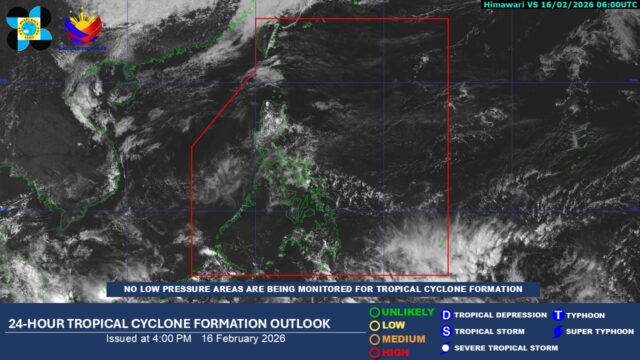
No low-pressure area (LPA) is being monitored by PAGASA during the forecast period and this is expected to remain the case until Feb. 22, the agency’s Tropical Cyclone Threat Potential bulletin said.

However, between Feb. 23 and March 1, a tropical cyclone-like vortex may form offshore east of the Visayas and Mindanao.

PAGASA said it will monitor the projected weather disturbance to determine whether it will develop into a tropical cyclone. — Edg Adrian A. Eva

Valentine’s season seen boosting demand for local craft chocolates

A couple celebrating a rainy Valentine's Day at Luneta Park in Manila, Feb. 14, 2026. — PHILIPPINE STAR/NOEL PABALATE

Craft chocolates in the Philippines have gained popularity as more Filipinos explore distinct flavors of the sweet treat, in time for the love season, according to an expert.

“More consumers are becoming more curious about origin, sustainability, flavor,” Treena C. Tecson, certified chocolate taster with a cacao evaluation and sensory evaluation certificate, told BusinessWorld in an interview.

“If you’re going to be preparing for Valentine’s and you’re a craft chocolate maker, the preparation goes way before Valentine’s Day,” she added.

Ms. Tecson noted that locally crafted chocolates before were often overlooked in the market due to low consumer awareness. “People weren’t really eating local chocolates because maybe at that time there was no awareness.”

With more advanced machinery and buyers’ sustainable shopping habits, the industry has seen higher demand, especially during the Valentine’s season.

“There’s a big shift from international to local interest and I think that’s what really makes the craft chocolate movement in the Philippines really move forward,” she said.

“The local chocolate makers have leveled up how they process craft chocolate… and the consumers have become more aware of this and are choosing to support local, and that’s a big movement also,” she added.

The popular tradition of giving chocolates during Valentine’s dates back to the 19th century, with a heart-shaped box filled with chocolates.

“It became an iconic Valentine’s representation of love, thoughtfulness, and gift-giving,” said Ms. Tecson.

“The heart shape is really the symbol of love, so I guess chocolate makers would want to capitalize on that during that time to make it available for everybody who’s celebrating,” she added.

Cacao, the crop used to make chocolate, is a perennial crop that grows in the cacao belt or countries located 20 degrees above or below the equator. The Philippines is among the “origin countries” that could grow and produce their own cacao.

“We are believed to be the first country in Asia, the Philippines, to grow cacao because we were growing it for Spain at that time as a colony of Spain,” Ms. Tecson said. “That would be exported back to Spain, where at that time the Spaniards were already consuming cacao in the form of a drink.”

Three major cultivar groups in the country – Criollo, Forastero, and Trinitario- are available in the country, according to the Department of Agriculture (DA). Of the three, Forastero is the most commonly grown cocoa, amounting to 80% of the world’s supply.

Within the country, the majority of the crop comes from Mindanao, with Davao Region contributing 78% of national cacao production. Meanwhile, the other 12% and 10% comes from other regions in Mindanao and Luzon, respectively.

“It’s a very special thing to be a country that grows your own cacao,” said Ms. Tecson. “Whether it’s bean-to-bar or tree-to-bar, the beans that are used are Philippine beans, that’s the more important factor.”

“People are choosing to give locally-made, locally-sourced beans a try because the Philippines is an origin country,” she added. — Almira Louise S. Martinez

Japan’s fragile Q4 economic recovery poses early test for Takaichi

STOCK PHOTO | Image from Freepik

TOKYO — Japan’s economy limped back to meager growth in the fourth quarter, significantly missing market expectations in a key test for Prime Minister (PM) Sanae Takaichi’s government as cost-of-living pressures drag on confidence and domestic demand.

Fresh off a sweeping election victory, Ms. Takaichi’s administration is preparing to ramp up investment through targeted public spending to shore up consumption and revitalize economic growth.

Monday’s data bring sharp focus to the challenge at hand for policymakers at a time when the Bank of Japan (BoJ) has reiterated its pledge to keep raising interest rates and normalize monetary settings from years of ultra-low borrowing costs amid persistent inflation and a weak yen.

“PM Takaichi’s efforts to reflate the economy via looser fiscal policy look prescient,” said Marcel Thieliant, head of Asia-Pacific at Capital Economics.

Gross domestic product (GDP) in the world’s fourth-largest economy increased an annualized 0.2% in the October-December quarter, government data showed, well short of a median estimate of a 1.6% gain in a Reuters poll. It barely scraped back to growth from a larger revised 2.6% contraction in the previous quarter.

The reading translates into a quarterly rise of 0.1%, also weaker than the median estimate of a 0.4% uptick.

“It shows that the economy’s recovery momentum is not very strong,” Meiji Yasuda Research Institute economist Kazutaka Maeda said. “Consumption, capital expenditure (capex) and exports — areas we hoped would drive the economy — just haven’t been as strong as we expected.”

The surprisingly soft momentum will keep investors on alert for Ms. Takaichi’s campaign pledge to suspend a consumption tax, an issue that sparked turmoil in Japanese markets worried about fiscal slippage in a nation with the heaviest debt burden in the developed world.

“In fact, sluggish economic activity increases the chances that Takaichi will not only press ahead with suspending the sales tax on food but enact a supplementary budget during the first half of the fiscal year that starts in April already rather than wait until the end of this year,” Capital Economics’ Mr. Thieliant said.

Japanese stocks stuttered in the wake of the GDP data, while bonds were subdued.

SLOWER RATE HIKES?
Analysts project Japan will continue to expand at a gradual pace this year, though the fourth quarter’s weak outcome suggests the economy might struggle to fire on all cylinders.

“Whether the economy can achieve sustainable growth really depends on whether real wages can firmly return to positive growth,” Shinichiro Kobayashi, principal economist at Mitsubishi UFJ Research and Consulting, said.

A survey this month by the Japan Center for Economic Research showed 38 economists forecast an average annualized GDP growth of 1.04% in the first quarter and 1.12% in the second quarter.

Economists say the latest GDP report is unlikely to affect the Bank of Japan’s policy decisions, but Ms. Takaichi’s historic election win has heightened market attention to whether the dovish premier will renew her calls for interest rates to be kept low.

“Although GDP posted positive growth this time, the momentum was weak, and with the need to assess the impact of the December rate hike, the likelihood of an additional hike in the near term appears to have receded,” said Takeshi Minami, chief economist at Norinchukin Research Institute.

The country’s inflation dynamic underscored the policy tensions between the government and central bank.

Mitsubishi UFJ’s Mr. Kobayashi, for instance, expects the central bank to prioritize bringing inflation to heel.

“Rather than this rate hike causing the economy to stall, the BoJ’s focus is likely to be on how to contain inflation,” he said.

Private consumption, which accounts for more than half of economic output, rose 0.1% in October-December, matching market estimates.

It cooled from the 0.4% rise in the previous quarter, indicating that persistently high food costs remain a drag on household spending.

TRUMP FACTOR
Capital spending, a key driver of private demand-led growth, also rose at a slow pace of 0.2% in the fourth quarter, versus a rise of 0.8% in the Reuters poll.

To be sure, historically capex has been a volatile data set, and future revisions could point to the economy carrying more momentum into 2026 than initial estimates suggest.

That still leaves the economy with a lot of catching up to do, especially as its key manufacturing industry struggles to adapt to a protectionist US administration under President Donald J. Trump.

Indeed, net external demand, or exports minus imports, contributed nothing to fourth-quarter growth, versus a 0.3-point drag in the July-September period.

Exports did post a milder drop after the US formalized a baseline 15% tariff on nearly all Japanese imports, down from 27.5% on autos and initially threatened 25% on most other goods.

“The impact of tariffs appears to have peaked in July-September, but judging from the latest results, there is at least some possibility that firms will continue to take a somewhat cautious stance going forward,” Meiji Yasuda’s Mr. Maeda said. — Reuters

ADVERTISEMENT
ADVERTISEMENT