
Performance of Philippine Agriculture

THE PHILIPPINES’ agricultural output fell in the second quarter, as the crops and livestock sector continued to bear the brunt of the El Niño weather phenomenon. Read the full story.

THE PHILIPPINES’ agricultural output fell in the second quarter, as the crops and livestock sector continued to bear the brunt of the El Niño weather phenomenon. Read the full story.
YIELDS on the central bank’s term deposit facility (TDF) ended mixed on Wednesday amid hawkish policy bets following faster-than-expected July inflation.
The Bangko Sentral ng Pilipinas’ (BSP) offering of term deposits fetched bids amounting to P179.018 billion on Wednesday, just short of the P180 billion on the auction block but higher than the P121.893 billion in tenders for the P250-billion offer a week ago.
Broken down, tenders for the seven-day papers reached P90.542 billion, higher than the P80 billion auctioned off by the central bank and the P51.047 billion in bids for a P120-billion offering seen the previous week.
Banks asked for yields ranging from 6.495% to 6.52%, narrower than the 6.4925% to 6.525% band seen a week ago. This caused the average rate of the one-week deposits to slip to 6.5155% from 6.5161% previously.
Meanwhile, bids for the 14-day term deposits amounted to P88.476 billion, below the P100-billion offering but higher than the P70.846 billion in tenders seen on July 31 for the P130 billion on the auction block.
Accepted rates for the tenor were from 6.53% to 6.57%, narrower than the 6.52% to 6.575% margin seen a week ago. With this, the average rate for the two-week deposits rose by 0.29 basis point (bp) to 6.5523% from 6.5494% logged in the prior auction.
The BSP has not auctioned off 28-day term deposits for more than three years to give way to its weekly offerings of securities with the same tenor.
The term deposits and the 28-day bills are used by the BSP to mop up excess liquidity in the financial system and to better guide market rates.
Term deposit yields were mixed following the release of July inflation data, which prompted slightly hawkish signals from BSP Governor Eli M. Remolona, Jr., Rizal Commercial Banking Corp. Chief Economist Michael L. Ricafort said in a Viber message.
Headline inflation accelerated to a nine-month high of 4.4% in July from 3.7% in June.
This was slower than the 4.7% print in the same month a year ago and was within the BSP’s 4%-4.8% forecast for the month. However, this was higher than the 4% median estimate in a BusinessWorld poll of 15 analysts and was the fastest in nine months or since the 4.9% clip in October 2023.
The July print marked the first time since November that headline inflation exceeded the central bank’s 2-4% annual target.
The central bank is now “less likely” to cut rates at its Aug. 15 policy meeting next week following the worse-than-expected July inflation print, Mr. Remolona said on Tuesday.
The BSP chief earlier signaled that they were on track to cut rates for the first time in over three years this month, possibly by 25 bps, adding that another 25-bp cut is likely next quarter.
After next week’s review, the central bank’s remaining policy-setting meetings this year are scheduled for Oct. 17 and Dec. 19. — Luisa Maria Jacinta C. Jocson
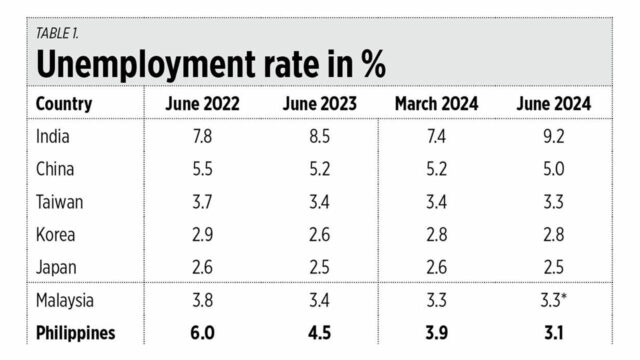
Yesterday the Philippine Statistics Authority (PSA) released the labor force data for June 2024, and we saw that the unemployment rate was only 3.1% which tied with December 2023’s level — the Philippines’ all-time low unemployment rate since the 1980s, and possibly since the 1970s although records from that period are scanty or not available.
So, I compared the Philippines’ unemployment rate with that of other Asian countries, and with major economies of North America and Europe. Not only is ours among the lowest, but ours has had the biggest drop over the last two years, from 6% in June 2022 to 3.1% in June 2024. In contrast, some countries experienced an increase over the same period, like Sweden, Germany, the UK, the US, and Canada (see Table 1).

This is a big economic achievement by the Marcos Jr. administration in general, and the economic team in particular.
It also serves as further proof that the high GDP growth in 2022, 2023, and the first quarter of 2024 was indeed job-creating growth and not the “jobless growth” usually claimed by some detractors.
In a Viber message to this writer, Budget Secretary Amenah F. Pangandaman reiterated the optimistic economic outlook of the Philippines, noting that “our prudent public spending especially in hard infrastructure is bearing fruit, helped improve our people’s productivity and helped our domestic businesses to create more jobs, reduce poverty in the country.”
Last Monday I briefly watched the presentation by the House of Representatives’ Development Budget Coordination Committee on the first day of public hearings on the 2025 budget. The secretaries of the departments of Finance (DoF) and Budget and Management, the head of the National Economic and Development Authority, and the central bank governor plus their respective officials were there.
Finance Secretary Ralph G. Recto gave an opening presentation and highlighted, among others, that “the DoF hiked the government-owned and -controlled corporations’ (GOCCs) dividend rates to 75% from 50% in 2024 as among the major sources of non-tax revenues…. Total revenue collection from January to June 2024 grew by 15.6% amounting to P2.15 trillion. Of which, tax collections increased by 10% to P1.84 trillion, while non-tax grew by 63.3% to P314.2 billion.”
On July 25, I attended the First National Anti-Illicit Trade Summit at the Manila Hotel, organized by the Federation of Philippine Industries (FPI). Dr. Jesus L. Arranza, chairman of FPI and Fight Illicit Trade (FightIT) noted in his opening message that a study they commissioned showed that the government is losing around P250 billion/year in value-added tax (VAT) due to smuggling.
Since VAT is 12% of the price of imported goods, that means around P2.3 trillion worth of smuggled products are sold here annually and unfairly competing against locally produced products in the domestic market.
I checked again the revenue performance of the government and saw that overall tax collections are increasing, except excise tax which experienced a revenue decline in 2022 and 2023, and possibly also this year. The main source of revenue losses is in tobacco tax collections, which peaked at P176 billion in 2021 and went down to only P135 billion in 2023, and seems on its way to declining further to around P120 billion by the end of this year (see Table 2).

Finance Undersecretary Charlito Martin Mendoza also gave a presentation in the same forum. He said that the Bureau of Internal Revenue and the Bureau of Customs are campaigning against smugglers and illicit traders through the “BRAVE” project: B (Border Security Enhancement), R (Revenue Collection and Protection), A (Adaptive Regulations and Compliance), V (Vigilant Enforcement Operations), and E (Effective Engagement with Stakeholders and Inter-Agency Cooperation).
The government — the DoF and Congress in particular — need to address this big conjoined issue of sustained illicit trade and smuggling and high tax rates (like a VAT rate of 12%, a tobacco tax of P63/pack and rising yearly) which are among the key factors why legal products are getting more expensive and the alternative smuggled products are getting more affordable. A downward shift in tax rates, especially in VAT (our 12% is possibly the highest in Asia), should be considered in exchange for the removal of many VAT exemptions.
Finally, the Philippines’ high inflation remains a big hurdle in our people’s economic advancement.
The big flood in the National Capital Region last July caused the destruction of many properties and a temporary shortage of some commodities. I saw an empty bread shelf in one of the SM groceries in Makati that day of heavy flooding, plus a long queue of shoppers stocking up on mostly food items for fear that another heavy flood might happen again soon.
I expect the country’s inflation rate to taper off in the last five months of this year as most harvests in the first rice crop are due starting late August to September, with the second crop due for harvest in December-January.
We must stay the course of focused public spending on productive infrastructure and productivity enhancing programs and projects, and tap other domestic sources of additional revenues while avoiding higher taxes and additional borrowings as much as possible.
Bienvenido S. Oplas, Jr. is the president of Bienvenido S. Oplas, Jr. Research Consultancy Services, and Minimal Government Thinkers. He is an international fellow of the Tholos Foundation.

THE AVERAGE COST of data breaches in the Association of Southeast Asian Nations (ASEAN) region has reached an all-time high of $3.23 million this year, the International Business Machines Corp. (IBM) said on Wednesday.
This was 6% higher than $3.05 million in 2023 and affected companies in the Philippines, Singapore, Indonesia, Malaysia, Thailand, and Vietnam, IBM’s 2024 Cost of a Data Breach Report showed.
Globally, the average cost of data breaches spiked by 10% year on year to $4.88 million.
The report surveyed 604 organizations globally between March 2023 and February 2024.
“ASEAN’s critical infrastructure organizations experienced the highest breach costs, with financial services participants saw the costliest breaches across industries ($5.57 million), followed by the industrial sector ($4.18 million) and technology ($4.09 million),” IBM said in a statement.
“Disruption is the new cost of insecurity, and security is becoming the new cost of doing business. The 2024 report shows the extent and cost of business disruption caused by data breaches, which can even lead to a complete business shutdown. As the collateral damage from data breaches intensifies, lost business and post-breach customer response costs drove the annual spike,” IBM ASEAN General Manager Catherine Lian was quoted as saying.
Ms. Lian said investing in cybersecurity has become more important amid increased use of artificial intelligence (AI) technologies.
“The stakes are higher than ever in the AI era. While generative AI can help address the skills shortage in today’s landscape where security teams are understaffed, it is also being used to create and launch attacks at scale. Security can no longer be an afterthought. ASEAN companies need to invest in AI-driven defenses to stay ahead and harness the potential of these technologies, ensuring business continuity and protecting their customers,” she added.
About 56% of the surveyed organizations are deploying security AI and automation across their security operation center, 8% higher than in 2023.
“When these technologies were used extensively, companies shortened the data breach lifecycle by 99 days and incurred an average $1.42 million less in breach costs, compared to those without security AI and automation deployments. While AI technologies provide defenders with new tools for rapidly identifying and automating responses to threats, they are also expanding the attack surface and are expected to present new risks for security teams,” IBM said.
The report also showed that 41% of breaches in the ASEAN region involved data stored across multiple environments, including public cloud, private cloud, and on-site. These were the most expensive, costing $3.44 million on average and taking the longest to identify and contain (287 days).
Migration to the cloud and security system security were among the top factors blamed for increased breach costs, with ASEAN companies surveyed needing an average of nearly nine months or 264 days to identify and contain incidents.
“Lost business costs — operational downtime, lost customers, and reputation damage, among others — escalated nearly 31%, compared to the prior year. Post-breach customer response jumped 16% and notification cost increased almost 13% over the same time frame,” IBM said.
“At 16%, phishing was the most common initial attack vector and represent an average total cost of $3.39 million per breach, followed by stolen or compromised credentials ($3.12) and business e-mail compromise ($3.46) accounting for 13% of incidents each. Attacks using zero-day vulnerability were the most expensive entry point ($3.62) at 9% of breaches studied,” it added.
Meanwhile, globally, organizations that fell victim to ransomware saved an average of $1 million in breach costs when they enlisted the help of law enforcement, with 63% of these firms being able to avoid paying a ransom. — ARAI

MONDE Nissin Corp. saw its attributable net income fall to P606.23 million for the second quarter (Q2) from P1.55 billion a year ago, despite higher revenues.
The listed food and beverage manufacturer said its revenues rose to P19.82 billion for the April to June period, marking an increase of 3.6% from last year’s P19.14 billion.
Broken down, the company recorded a revenue increase for its Asia-Pacific branded food and beverage (APAC BFB) business, which increased by 5.6% to P16.46 billion from P15.58 billion.
For its meat alternative segment, Monde Nissin reported that its revenues declined by 5.6% to P3.37 billion from last year’s P3.57 billion.
Reported net income for the second quarter declined by 60.7% to P610 million, which the company attributed to the loss of P1.5 billion in guaranty asset gain in its meat alternative business.
“During the second quarter, APAC BFB saw modest top-line growth and continued expansion of gross margin and core net income on a year-on-year basis,” Henry Soesanto, chief executive officer and executive vice-president of Monde Nissin, told the stock exchange.
Mr. Soesanto said the company is hoping to sustain the growth of its APAC BFB segment in the third quarter.
“Our APAC BFB gross margins have substantially rebounded from last year’s levels, and while we believe further sequential gains will be limited, we expect to see continued improvement in Q3 on a year-on-year basis,” he said.
Further, the company’s attributable net income for the first half climbed by 17.2% to P4.09 billion from P3.49 billion, as shown in the company’s financial statement.
For the first half, Monde Nissin registered a combined revenue of P40.14 billion, up by 2.4% from last year’s P39.19 billion.
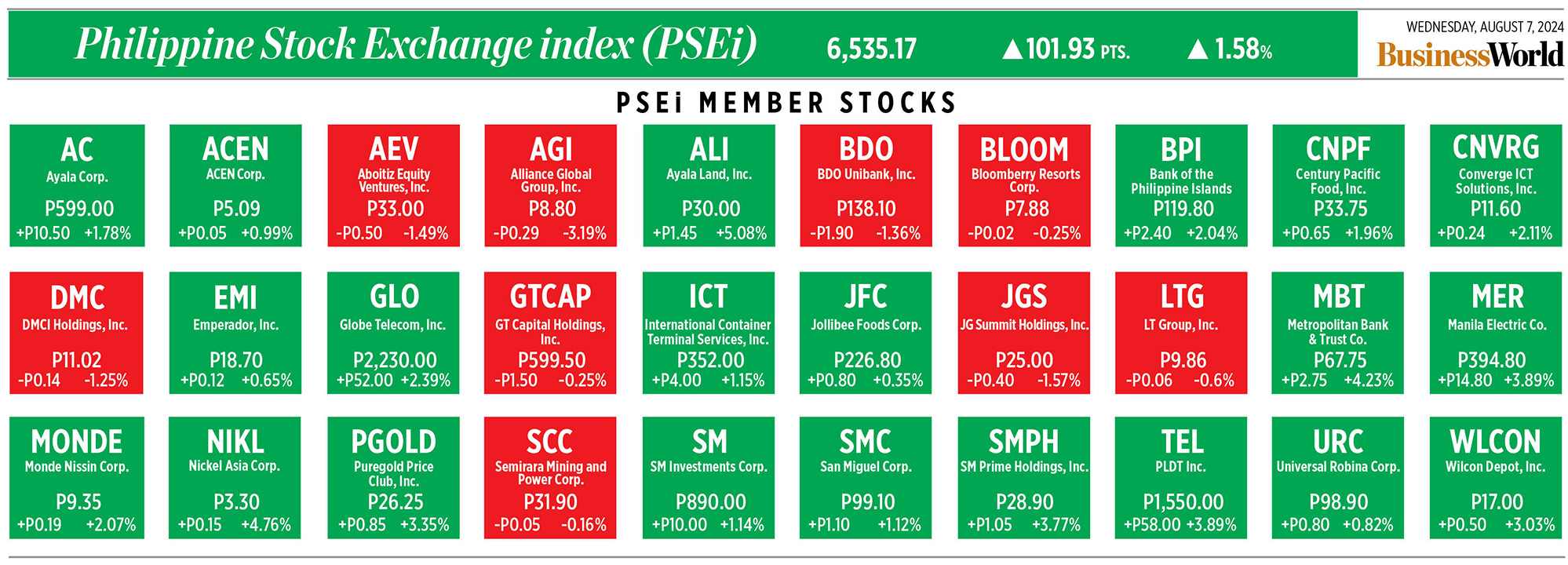
At the local bourse on Wednesday, shares in the company gained 19 centavos or 2.07% to end at P9.35 apiece. — Ashley Erika O. Jose
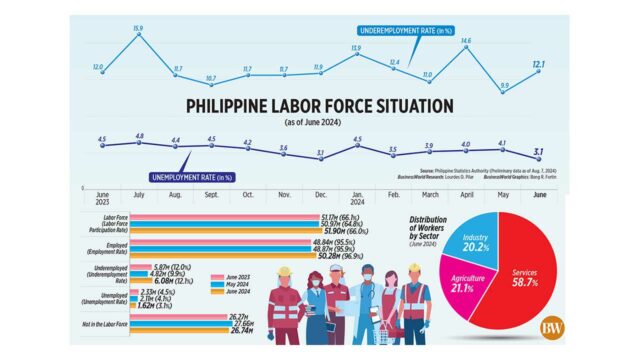
THE UNEMPLOYMENT RATE in June fell to 3.1%, the lowest in two decades, as hiring in the construction sector surged, the Philippine Statistics Authority (PSA) reported on Wednesday. Read the full story.


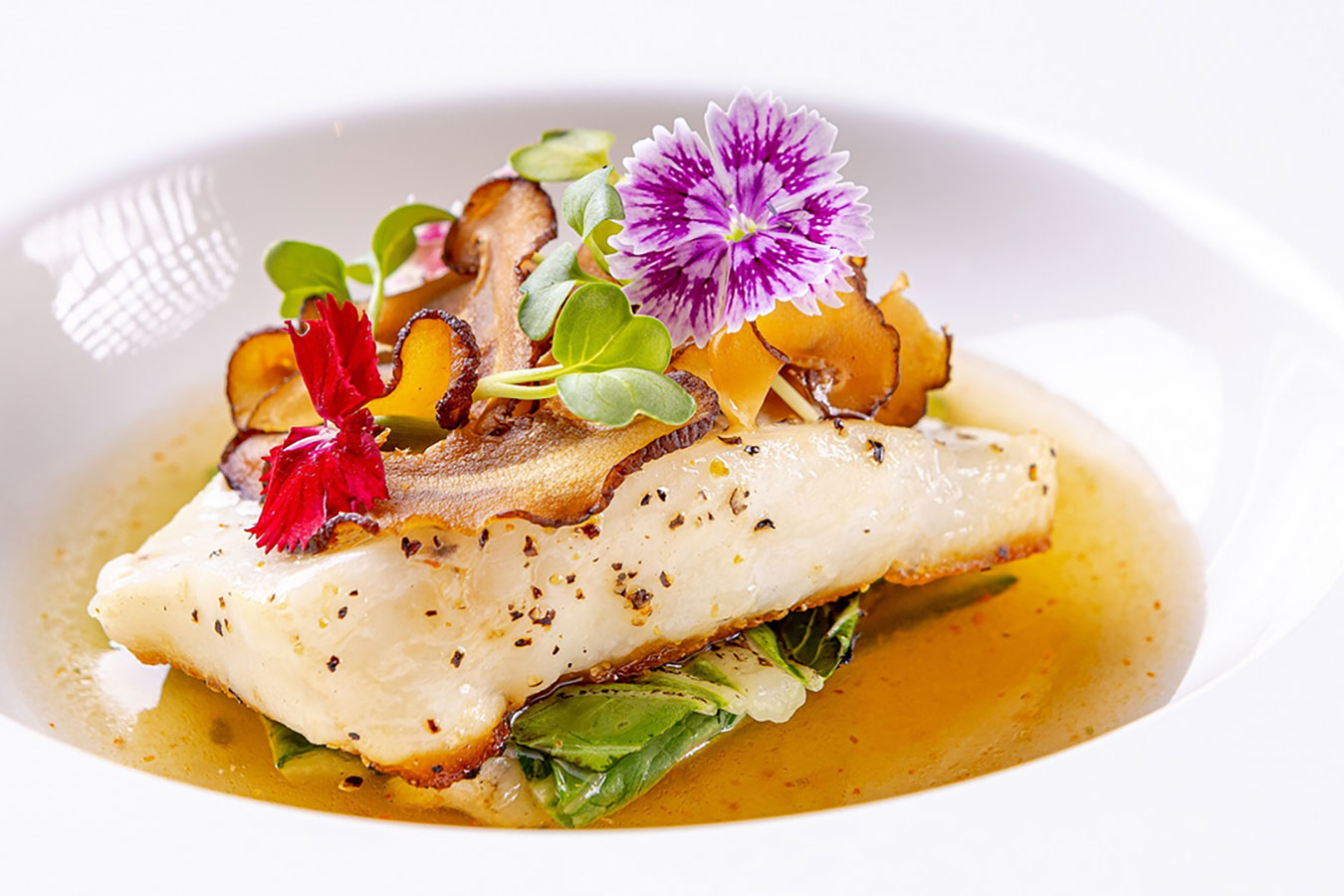


CITY of Dreams Manila’s signature restaurants highlight seasonal specialties this August, including selections from Japanese, Malaysian, and Cantonese cuisines. Nobu Manila’s Omakase tasting menu, which changes quarterly, has changed again. From now until September, a seven-course dinner menu begins with a chef’s choice of zensai (appetizer), followed by the first course of ika (squid) with capsicum jelly caviar and crispy onion. Salmon with calamansi salsa and crispy shitake mushrooms, and a seasonal selection of assorted sushi served together with Shrimp Ball Soup come after. A serving of White Fish Tataki Salad with shaved root vegetables and drizzled with garlic sesame vinegar comes before the fifth and sixth course of Pan-seared Sea Bass with charred pechay, gin-and-ginger sauce and shitake mushrooms, and Wagyu Striploin with aka (red) miso risotto, snap peas and soy-mirin reduction. The last course of Vanilla Cheesecake Mousse with mango gelee, almond dacquoise, kinako (roasted soybean) tuile, and mixed berry sorbet provides a sweet finish to the meal. From Aug. 12 to 31, A Feast of Canton reigns at Crystal Dragon at Nüwa Manila. This is a themed a la carte menu of select Cantonese specialties. The rich flavors of Malaysian cuisine take centerstage at Red Ginger, City of Dreams Manila’s Southeast Asian bistro and bar, with the Makan Makan promotion running until the end of August. Meanwhile, Jing Ting, the integrated resort’s restaurant specializing in Northern Chinese cuisine, highlights Old Peking Specials until Aug. 31. For inquiries and reservations, call 8800-8080 or e-mail CrystalDragon@cod-manila.com. For more information, visit www.cityofdreamsmanila.com.
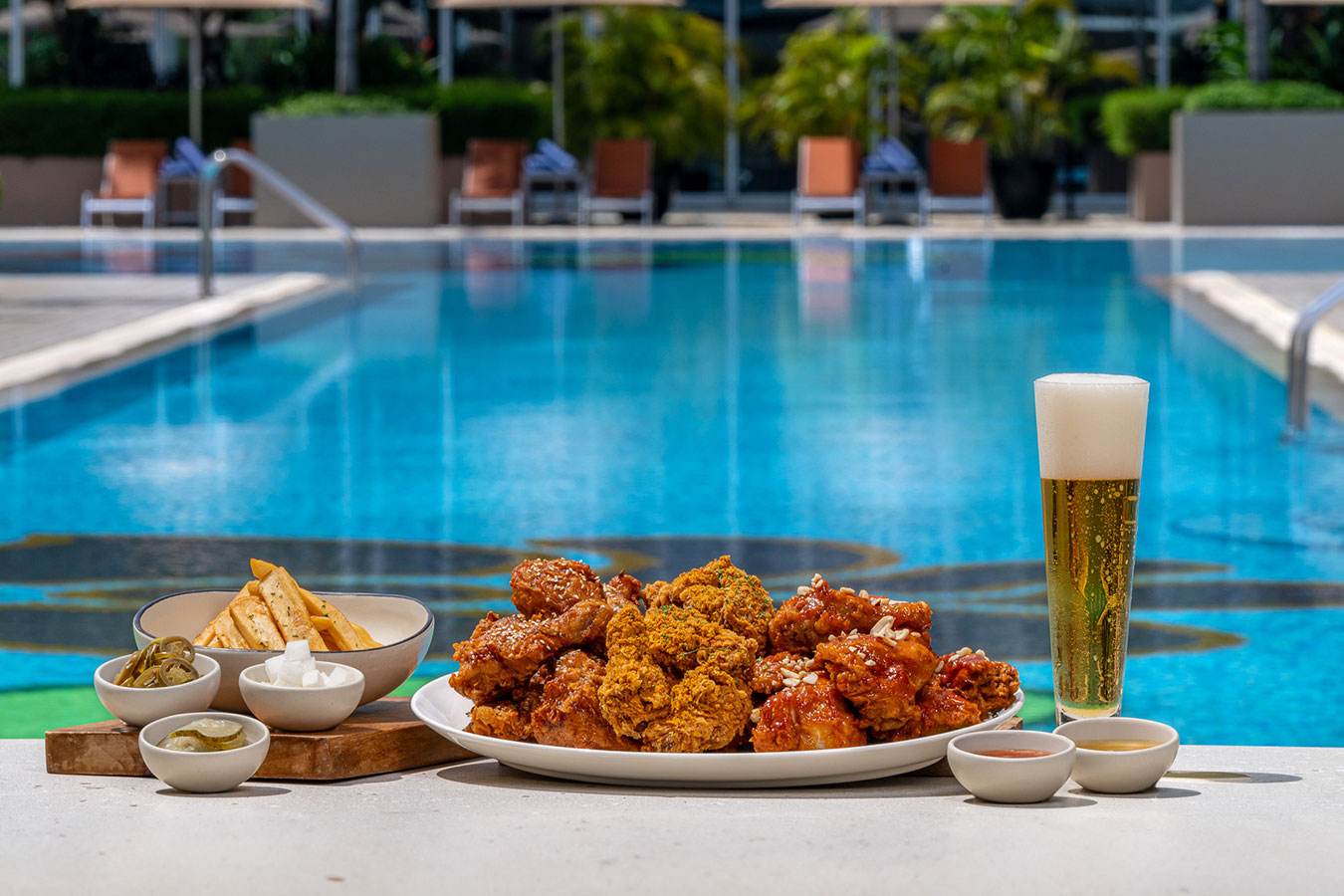
WATCH out for the ChiMac Festival happening on Sept. 7 at the Grand Ballroom of Solaire, which starts at 5 p.m. The festival includes Korean dishes and performances by DJ Kara and The Itchyworms. Savor Korean comfort food with ChiMac, a combination of “chicken” (chi) and “mac” (beer) in Korean. Start the feast with a variety of Tteokbokki flavors, kimbap, and kimchi, then Korean-style sausage or skewered fish cake soup. Visit the Korean pancake station to enjoy buchimgae with choices like kimchi, potato, seafood, zucchini, or shiitake mushroom. Then try fried Korean snacks such as fried dumplings, sausage and rice cake skewers, and sweet and sour fried chicken balls. At the Korean noodles station, choose from three types of noodles with a choice of kimchi, sweet and sour, or deep soy sauce. The Korean hot station features chicken skewers, herb marinated fresh pork belly (samgyupsal) skewers, bulgogi, and braised spicy pork ribs. No ChiMac festival is complete without South Korean fried chicken. Pair it with Korean beer and join the festivities which include a chicken and beer drinking contest, and a beer pong tournament. There will be other activities like a traditional hanbok dress experience and photoshoot. The evening will be hosted by Miss Korea Philippines 2018 and Korean Philippine TV personality, Shine Kuk. Call 8888-8888 or e-mail chimacfestival@solaireresort.com to save a seat.
THE WHISKY LIBRARY is celebrating its first anniversary with the launch of a brand-new cocktail menu, with concoctions inspired by a famous work of art. “True to the spirit of The Whisky Library, pun intended, we want the new menu to read like an actual book. It is hefty, we really had fun coming up with the drinks we think everyone can enjoy,” said Newport World Resorts Chief Marketing Officer David Jorden in a statement. “The new menu effectively replaces the previous cocktail menu, Volume 1, that was inspired by famous movies and movie stars… For this edition, we separated the menu into different chapters, each representing a different flavor profile of cocktails.” The Cocktail Menu Volume 2 lists 25 signature cocktails and four mocktails across seven chapters: Tropical & Lively, Soft Sour & Spice, Bright & Refreshing, Decadent & Indulgent, Bold & Adventurous, Shared & Experienced Together, and Flavorful & Non-Alcoholic. Visit www.newportworldresorts.com and follow @newportworldresorts on Facebook, Instagram, and TikTok for more details.
K announces the launch of the Triple Cheese collection. Each item in the Triple Cheese lineup is crafted with a mix of cream cheese, cheddar cheese, and mozzarella. These include the Triple Cheese Quesadilla (P159), the Triple Cheese Core Burrito (P199), and the Triple Cheese Crunchwrap (P199). The Triple Cheese collection is available until Sept. 30 at Taco Bell branches for dine-in and takeout, as well as apps Grabfood, Foodpanda, and Pickaroo. Check a list of operational branches at www.tacobell.com.ph/locations.
MAYA BANK, Inc. has disbursed P47 billion in loans to over a million borrowers as of June, it said on Wednesday.
“Every day, we’re driven to make banking simple, intuitive, and useful for everyone. In just over two years, we’ve shown that digital banking with Maya is the fastest and easiest way to boost the financial health of Filipinos. These new recognitions from our peers truly validate our efforts,” Maya Group President Maya Bank Co-Founder Shailesh Baidwan said in a statement.
“As of end-June 2024, Maya has provided loans to over a million borrowers, with total loan disbursements life-to-date reaching P47 billion,” the digital lender said.
The continued increase in loans was partly driven by its artificial intelligence (AI)-based credit scoring model, it said.
“Maya revolutionized unsecured lending by creating an AI-driven credit scoring model that uses payments and other alternative data, allowing it to lend profitably with speed and at scale,” the online lender said.
Of its total borrowers, 59% were first timers, it added.
Meanwhile, the digital bank’s deposit balance grew by 32% year on year to P32.8 billion as of end-June.
It said it has the biggest market share in terms of deposit balances among digital banks, with 38% as of March.
It also has the highest number of monthly active users and the highest user ratings on major app stores, Maya Bank said.
The digital lender previously said it expects to breakeven by this year and be profitable by 2025.
Maya Bank is owned by Voyager Innovations, Inc. PLDT Inc. is Voyager’s main shareholder. Hastings Holdings, Inc., a unit of PLDT Beneficial Trust Fund subsidiary MediaQuest Holdings, Inc., has a majority stake in BusinessWorld through the Philippine Star Group, which it controls. — AMCS

WHEN VIPs attend events like product launches or wedding anniversaries, they are seldom unaccompanied. They want to be inside their own social bubble. It’s not just their security team but a coterie of subordinates or friends that they bring along. Otherwise, who can they talk to? Seating assignments are ignored and it’s up to the event planner to adjust — this way please.
Like a dieter who feels he will not find the right food at a party and so carries his own tamarind bag, the VIP brings along his own seatmates. His greatest fear is being stuck in a table of uninteresting people who cannot discuss The Count of Monte Cristo and the theme of sudden wealth and cold-blooded revenge.
Worse, the likelihood of favor seekers asking him to pass the salt and in the same breath seeking employment “in one of your affiliates” is ever present. Can the request for a photo opportunity be far behind? A waiter is summoned, and the VIP must stand up and smile for the snapshot.
The VIP’s table should be filled with acquaintances, if not subordinates who know their place. Anyway, with his many commitments, the VIP can’t stay long enough for the closing speech. He may be coming from a previous event (maybe a planning session) and on his way to a fireworks display. His coterie may have come from either the previous or subsequent event and were not invited to the current one.
What are the requirements for playing the role of hanger-on in a tag team?
Attire is essential. It should conform to the required look, like “smart casual.” Good grooming is mandatory along with the appearance of someone who moves in the same circle, even in a slightly farther orbit. Certain conversation skills are necessary. One of them is listening, and the ability to lean towards the VIP as if trying to catch his witticisms, amidst the ambient noise.
Long verbal exchanges are unlikely. The soliciting of opinions in a give and take that normal conversation entails is remote. Seldom are interruptions and snoopy questions posed — Have you thought of a successor?
The size of the coterie is ideally at least three. Most tables at a big reception go from 10 to 12. Bringing too many for a table of 10 can be offensive as too many other guests are displaced, and maybe additional tables are required, especially if there are many VIPs with their own coteries.
But what if the VIP is assigned to the presidential table? What happens to his dangling earrings? The place of honor is elevated and laid out in a straight line which means that uncertain seat partners only number two, one on each side. Presumably seat mates are other VIPs too, possibly with even a higher status. There are also name cards attached with mechanical stays that are not capable of being removed by hand.
So, if the VIP is assigned a seat with a name card, what happens to his coterie? No problem — the group disperses, and everyone finds his way to free holes in different tables. Hangers-on are not picky about being thrown with strangers. Anyway, they cannot dispense favors even when asked to intercede by some importunate pest. (Do you think he may be interested in a beach property in Pundaquit?)
There is a way to eliminate uninvited guests attached to an invited VIP. Among the invitees are already peers and colleagues that the honored one may feel comfortable with. These may be former classmates who are past the favor-seeking stage, or distant relatives that are equally wealthy, even if not with the same number of zeros in their net worth. The event planner only needs to make sure they’re assigned to the right table.
But this pairing of guests needs to be abreast of the current situation. Bosom buddies of a month ago (like the unity ticket) and even couples together for a long time may have become estranged prior to the event.
In a culture that finds name-dropping socially acceptable, the hazard of table-crashing is ever present. A glowering look just bounces off the intruder posing for another photo op with the VIP. (And now, wacky please.)
Tony Samson is chairman and CEO of TOUCH xda
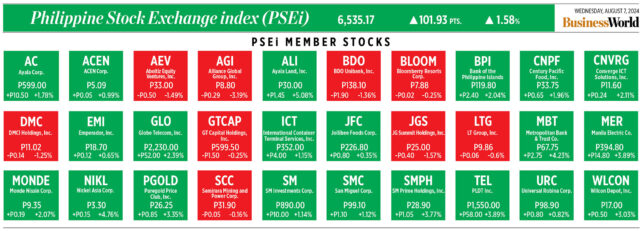
Here’s a quick glance at how PSEi stocks fared on Wednesday, August 7, 2024.

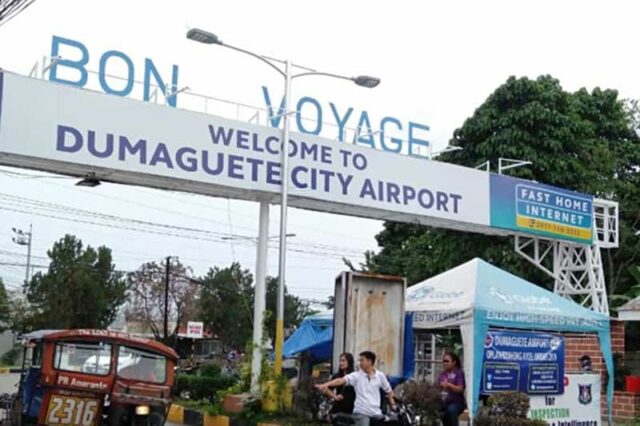
THE Department of Finance (DoF) said it signed a P13.15-billion loan agreement with the South Korean government to finance the new Dumaguete airport.
The loan was provided by the Export-Import Bank of Korea (Korea Eximbank), Finance Secretary Ralph G. Recto said at a forum on Wednesday.
In a separate statement, the DoF said the project is expected to boost tourism and trade, as well as enhance the standard of living in Negros Oriental and the surrounding area.
“With the new Dumaguete airport, we anticipate accommodating up to 2.5 million passengers per year, up from just 800,000. From serving limited domestic flights, we can now open the door to international routes,” Mr. Recto was quoted as saying during the loan agreement signing.
The project’s total cost is P17.06 billion, with P3.91 billion to be funded by the government.
It will be built on 197.55 hectares in Bacong, Negros Oriental, the DoF said.
The loan will charge interest of 0.05% for non-consulting services and 0.0% for consulting services, payable over 40 years with a grace period of 10 years.
The government is also looking to upgrade more regional airports to enhance connectivity, Mr. Recto added.
Meanwhile, the government and the Korean Eximbank also signed a $3-billion Economic Development Promotion Facility to support the Philippine infrastructure flagship program.
“This agreement serves as an additional financial bridge that will fill the gaps in realizing our ambitious Build Better More Program,” Mr. Recto said in his speech.
There are currently 185 infrastructure flagship projects in the pipeline valued at P9.14 trillion.
The $3-billion loan has an interest rate of 1.2%, payable over 25 years, with a 7-year grace period.
Projects to receive support from the new facility include the Panay-Guimaras-Negros Island bridges; the Consolacion-Liloan Bypass Road project; the Lapu-Lapu Coastal Road project; and the Pampanga Integrated Disaster Risk Reduction and Climate Change Adaptation Project Phase II.
The financing agreements were signed by Mr. Recto and Korean Eximbank Chairman and President Yoon Hee-sung on Wednesday. — Beatriz Marie D. Cruz

THE Department of Energy (DoE) said the initial findings of the pre-feasibility study on ports that will be repurposed to service the offshore wind energy industry are expected by the end of next month.
Energy Undersecretary Giovanni Carlo J. Bacordo said recently that findings on five of the 10 ports being considered will be available by that time, while the rest of the findings will be out by November.
The pre-feasibility study is being carried out with technical assistance from the Asian Development Bank (ADB) to determine which ports can service the offshore wind industry’s needs.
The ports for which the early findings are expected are Bulalacao, Oriental Mindoro; Culasi, Capiz; Tabaco, Albay; and Pulupandan and San Carlos, both in Negros Occidental.
Mr. Bacordo said NIRAS, ADB’s consultant, has conducted site visits to these ports, collecting data from local government units and port authorities.
The other ports being studied are the Energy Supply Base port of the Philippine National Oil Co. in Batangas; Bauan International Port, Inc. Batangas; Subic; the Iloilo Commercial Port Complex; and Port Irene, Cagayan.
“These ports will cater to the offshore wind front-runners in the northwest Luzon, west of Manila, north and south Mindoro areas,” Mr. Bacordo said.
He said that “the road to first kilowatt-hour in 2028 is, without a doubt, very challenging” but he added that the DoE aims to support their development by ensuring that the ports are adequately prepared and equipped to handle the specific requirements of the industry.
Mr. Bacordo has said that the funding to make ports ready for the offshore wind industry needs to be budgeted for in the 2025 General Appropriations Act (GAA).
“While the GAA 2025 is being considered as a potential funding mechanism, further evaluation of financial requirements and budgetary allocations will be necessary to solidify project timelines and expenditures,” Mr. Bacordo said.
Offshore wind farms need to be serviced from specialized ports hosting maintenance facilities and equipment.
Mr. Bacordo has said that the DoE is hoping to conduct a Green Energy Auction specific to offshore wind in the first half of 2025.
To date, the DoE has awarded 92 offshore wind energy service contracts to 38 renewable energy developers with a total potential capacity of 66.101 gigawatts (GW).
According to the Philippine Offshore Wind Roadmap, the Philippines has a potential capacity of about 63 GW from tapping offshore wind resources. — Sheldeen Joy Talavera
