Home Blog Page 2834

Congress ratifies bill on local defense equipment production

FILIPINO and American soldiers participate in war games at a recent Balikatan (shoulder to shoulder) military exercise. — PHILIPPINE STAR/WALTER BOLLOZOS

CONGRESS has ratified a bicameral conference committee report of a bill that seeks to boost the country’s defense program through investments in local defense equipment manufacturing amid growing tensions with China.

At the Senate’s plenary session on Monday, Senate President Pro-Tempore Jose “Jinggoy” P. Estrada, Jr. said the consolidated bill includes a clause that would ensure preferential treatment for local defense industry players for the state’s military purchases.

The House of Representatives separately approved the bicameral report through a voice vote.

“Our proposal aims to ensure that our weapons, vehicles and other equipment for our soldiers, police officers and law enforcement personnel are made in the Philippines by Filipinos,” Mr. Estrada told the floor in Filipino.

“By strengthening the local defense industry to meet the needs of our armed forces and national defense, we expect this initiative to create job opportunities for our citizens, drive innovation and development and reduce foreign exchange outflow,” he added.

The senator said the bill offers incentives to attract foreign defense industry investors.

The Senate approved the bill in December, while the House approved its version in January.

The measure allows the Defense department to develop a self-reliant defense posture program that will encourage manufacturers to produce weapons and defense systems in the country for local use and exports. It will also give the agency P1 billion in funding.

Local defense enterprises will be exempted from value-added tax, Customs duties on capital equipment imports and raw materials.

“With the bill, we want to give the local defense industry a fighting chance at growing into a robust industry,” Senator Juan Miguel F. Zubiri, one of the authors of the bill, told the plenary.

“We want to help local producers accelerate their growth and their ability to come out with competitively priced quality material for our own use.”

China claims more than 80% of the South China Sea based on a 1940s map, which a United Nations-backed arbitration court voided in 2016.

The Philippines has been unable to enforce the ruling and has since filed hundreds of protests over what it calls encroachment and harassment by China’s coast guard and its vast fishing fleet. — John Victor D. Ordoñez and Kenneth Christiane L. Basilio

Salary hike for PHL state workers starts this month

PHILIPPINE STAR/WALTER BOLLOZOS

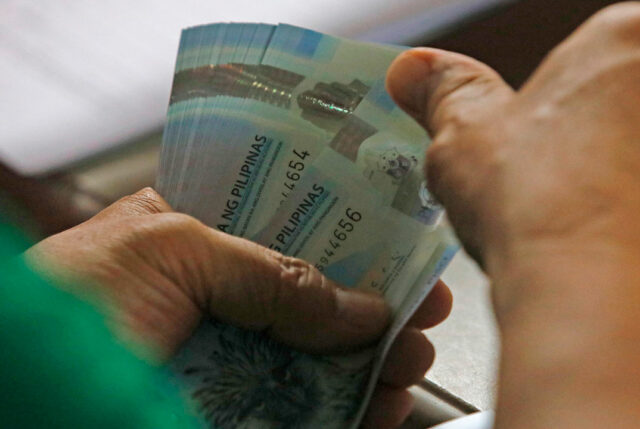
THE APPROVED salary increase for government workers will take effect this month, the Department of Budget and Management (DBM) said on Monday.

The first part of the four-tranche wage hike for state workers will be funded by the miscellaneous personnel benefit fund and unprogrammed appropriations under the 2024 national budget, the agency said.

National and local budget circulars for the implementation of the wage hike have been signed and were set to be published on Tuesday, Budget Secretary Amenah F. Pangandaman said at the presidential palace.

Guidelines had been sent to agencies so that they could enforce the salary hike, she said. “It’s up to departments and the agencies to immediately implement the adjustments,” she said in Filipino.

“This will be retroactive from January, including the midyear bonus.”

The first part of the four-tranche wage hike would cost about P36 billion. Ms. Pangandaman told lawmakers earlier in the day this will be taken from the miscellaneous personnel benefit fund and unprogrammed budgets.

At the palace, she said agencies could also use their existing personnel service budget for the wage hike.

The second package will be implemented on Jan. 1, 2025, according to Executive Order No. 64, which also entitles workers to a P7,000 medical allowance.  The last two tranches will be enforced on Jan. 1, 2026 and Jan. 1, 2027.

The DBM earlier said about P70 billion had been allocated in the P6.352-trillion budget for 2025 for the second tranche.

Under the order signed by President Ferdinand R. Marcos, Jr. this month, the increase was higher for professional (salary grade 11-24) and subprofessional (1-10) government employees than for those in managerial, executive and top-level positions.

The average rate for salary increases from grades 1-31 under the first tranche is 4.41%, bringing the salary of state workers to 84.33% of the market, the DBM said in a separate statement.

The increase is 4-5.2% for those at the subprofessional level. The minimum basic salary (grade 1) will increase by P530 to P13,530, it added.

Meanwhile, the rate for those at the professional level will range from 4.5-5.6%, it said.

For the managerial level (grades 25-28), the increase will be 4.15% to 4.4%; 2.65-3.9% for executive level (grades 29-31); and 2.35-2.4% for top Leaders (grades 32-33), the DBM said.

The salary hike does not cover military and uniformed personnel and some state offices and government-owned and -controlled corporations that have their own salary structure, the DBM said in a circular.

It also does not cover contract of service and job order employees, Ms. Pangandaman said. — K.A.T. Atienza and B.M.D. Cruz

DICT seeks ethical hackers’ help vs attacks

RAWPIXEL.COM-FREEPIK

THE DEPARTMENT of Information and Communications Technology (DICT) is seeking the help of white-hat hackers and cybersecurity experts to test e-government platforms’ vulnerabilities after a series of attacks.

“We also asked more white-hat hackers and cybersecurity experts to help us and conduct vulnerability assessment and penetration testing on our e-government platforms,” DICT Undersecretary David L. Almirol, Jr. said in a LinkedIn post on Aug. 11.

“We are not perfect, but we are doing our best and with efforts of more patriotic information technology (IT) experts, we can solidify our e-government systems.”

This came after a hacker’s group claimed that the “simple promotional static website” e.gov.ph had been hacked and defaced.

Mr. Almirol said the attackers only managed to upload files to e.gov.ph subdomain, which is used for hosting public assets such as local government unit (LGU) logos.

He said there was “no impact” because the attackers could not do anything beyond uploading a file and were not able to execute any uploaded PHP shells since the subdomain is an S3 bucket used exclusively for file storage.

“No e-LGUs or e-government systems were affected by this issue,” he said. “We have preserved and renamed the files and submitted them, along with the Docker Nginx logs to NCERT for further investigation.”.

Ronald B. Gustilo, national campaigner for Digital Pinoys, told BusinessWorld the DICT’s approach would help identify weak points of the government’s cybersecurity infrastructure so it could correct these.

But groups and people engaged by the government should be bound by law and ethical standards, he added.

Mr. Gustilo said people should be held accountable in case of any incidental or deliberate attempts to leak information that they come across.

“The government should allocate funds to create more government positions intended for cybersecurity practitioners,” he said.

“Our community of practice is supporting the call of the DICT through Undersecretary Almirol for the private sector to assist in securing the government’s e-government platforms through independent vulnerability assessment and penetration testing,” Sam V. Jacoba, founding president of the National Association of Data Protection Officers, told BusinessWorld.

He said the country could learn from other governments that have survived cybercrises such as Indonesia, and push a cyberresilience and business continuity plan for e-government systems. — Aubrey Rose A. Inosante

Gov’t action vs leptospirosis urged

MOTORISTS and commuters wade through the flooded Taft Avenue in this photo taken on July 27, 2023. — PHILIPPINE STAR/ EDD GUMBAN

THE DEPARTMENT of Health (DoH) should distribute medicines to address rising cases of leptospirosis, a congressman said on Monday.

It should also inform Filipinos about proper precautions to curb the spread of the disease, Iloilo Rep. Janette L. Garin said.

Leptospirosis is spread from animals to humans, caused by infection with the bacteria Leptospira. The most common sources of infection are contact with infected animal urine, contaminated soil or water including floods.

“The problem is there is funding for free doxycycline, but the availability on the ground is difficult,” she said in a statement in Filipino, referring to the antibiotic used to treat the infection.

“What should be done is to… send the medication immediately to the areas where it is needed; it shouldn’t be made more difficult,” she added.

The DoH recorded 67 cases of leptospirosis from July 14 to July 27, bringing the total to 1,444 this year. About 160 Filipinos have died from the disease. — Kenneth Christiane L. Basilio

Watershed structures to be probed

CONGRESSMEN on Monday filed a resolution seeking to investigate the construction of what they deem illegal structures and quarrying operations in the Upper Marikina Watershed.

These could have contributed to severe flooding from Super Typhoon Carina last month, they said.

Party-list Reps. Arlene D. Brosas, France L. Castro and Raoul Danniel A. Manuel filed House Resolution No. 1908 after a House of Representatives hearing last week found that about 500 illegal structures had been built in the protected areas of the watershed.

“The rampant deforestation and illegal activities in the Upper Marikina Watershed have reached an alarming state, leading to worse flooding, putting lives at risk,” Ms. Brosas said in a statement in Filipino.

About 31,000 Filipinos were evacuated in Marikina City alone, surpassing the number of evacuees during Typhoon Ondoy in 2009 by 2,000, according to the resolution. — Kenneth Christiane L. Basilio

Death for rape-murder pushed

A SENATOR on Monday filed a bill that seeks to impose the death penalty or life in prison on rape-murder convicts, citing the need to make laws against sexual violence harsher.

Under Senate Bill No. 2777, which Senator Robinhood “Robin” C. Padilla filed, people convicted of rape using a deadly weapon and carried out by multiple people and incidents that lead to victims becoming insane will also face life in prison or the death penalty.

“Despite the penalties under the Anti-Rape Law of 1997, this representation still finds it compelling to increase the punishment for any person who shall commit an act of rape,” the senator said in a statement.

“By doing so, we can be more certain that our laws are stronger, more gender-responsive and progressive especially in these changing times.”

Mr. Padilla said the government should ensure that men who are victims of rape and sexual violence are also protected.

More males aged 13 to 24 years experience sexual violence than females, Mr. Padilla said, citing a 2017 study by the United Nations Children’s Fund and Council for the Welfare of Children. — John Victor D. Ordoñez

Clark Depot 82% finished

THE DEPARTMENT of Transportation (DoTr) on Monday said the Clark Depot of North-South Commuter Railway (NSCR) is 82% done.

The depot sits on 33 hectares of land and will have 48 depot buildings and facilities, a stabling yard that will be crucial to the operations of the NSCR by 2027, the DoTr said in a statement. The depot is said to be a crucial part in time for the projected partial operations of NSCR by end 2027, or first quarter of 2028.

“The Clark Depot will be NSCR’s major depot, ensuring the interoperability of the whole alignment of the system from Clark in Pampanga all the way to Calamba in Laguna,” the DoTr said. — Ashley Erika O. Jose

Battle vs fake cosmetics pushed

GS1 PHILIPPINES and the Chamber of Cosmetics Industry of the Philippines are partnering to combat fake cosmetic products through the use of advanced barcode technology.

In a statement, GS1 Philippines said the barcode technology is important for the cosmetics industry amid the rampant sale of counterfeit products.

“The beauty and personal care market in the Philippines is projected to generate $6.47 billion in revenue in 2024, with an annual growth rate estimated at 1.32% until 2028,” GS1 said.

“However, the cosmetics industry faces significant challenges, notably the prevalence of counterfeit products. Recently, banned beauty items have been spotted and sold in local shops in Taguig,” it added.

“By adopting GS1 standards and leveraging barcode technology, cosmetics companies can ensure product authenticity, improve inventory management and strengthen consumer trust,” the organization said. — Justine Irish D. Tabile

Smuggled appliance probe sought

A RESOLUTION seeking to investigate the sale of smuggled appliances was filed at the House of Representatives on Monday.

The entry of smuggled appliances bought through online shopping platforms could affect the local appliance industry, leading to job losses if not curbed, Party-list Rep. Erwin T. Tulfo said in a privileged speech.

“We have witnessed a troubling trend in the rise of substandard and counterfeit products flooding our market, particularly through online platforms,” he said. “The presence of these substandard products has created an uneven playing field, where legitimate local manufacturers are forced to compete against goods… sold at prices that are impossible… to match.”

The House resolution cited gaps in enforcing online sales that lead to the entry of smuggled appliances. — Kenneth Christiane L. Basilio

Space agency touts deals

THE PHILIPPINE Space Agency has signed 12 space data mobilization deals with government agencies since July 2022, according to Malacañang.

PhilSa has also signed partnerships and collaborated with the space agencies of several countries, including Japan, the United Kingdom, France, South Korea and the United States, the presidential palace said in a statement on Monday after a meeting of the Philippine Space Council led by President Ferdinand R. Marcos, Jr.

The agency has also received four Pandora instruments for air quality measurement and distributed 59,455 satellite images and maps.

It has also launched the Space Data Dashboard, a system of geospatial data and information accessible to the public. — Kyle Aristophere T. Atienza

ODA projects lack P64B in firm PHL counterpart funds

PHILIPPINE STAR/ RUSSELL PALMA

By Beatriz Marie D. Cruz, Reporter

THE GOVERNMENT needs to source around P64 billion if it is to contribute its share of the project costs in works supported by official development assistance, the National Economic and Development Authority (NEDA) said. 

“For 2024, the unprogrammed appropriations that’s available for the ODA (official development assistance) funded projects stand at P236.49 billion,” Paul Andrew M. Tatlonghari, NEDA-Monitoring and Evaluation Staff officer-in-charge and assistant director, said at a briefing last week.

The 12 implementing agencies overseeing the 49 foreign-assisted projects, on the other hand, are requesting P300.01 billion, which means a potential funding gap of just under P64 billion.

Unprogrammed funds are those which the government has no definite sources for as yet, though it has declared its intention to spend. The government can address such shortfalls by taking on more debt, enhancing tax collections, or asking government-owned and -controlled corporations (GOCCs) to contribute more dividends.

The unprogrammed budget also includes support for persons who will be displaced by projects as well as P3 billion for right-of-way payments, NEDA said.

“We’re seeing a shortfall because there’s only limited UA (unprogrammed appropriations) than what is being requested by the agencies,” Mr. Tatlonghari said. 

“There’s an overhang there that they would have to catch up in the succeeding years,” Mr. Tatlonghari said.

According to NEDA’s latest ODA Portfolio Review, agencies would need a total of P2.03 trillion to complete 69 projects in the next few years.

Of these, the Department of Transportation would need the most funding — P1.19 trillion.

Implementing agencies would need P483.56 billion next year to support foreign-assisted projects, a funding requirement that is expected to rise to P488.47 billion in 2026 and P745.22 billion in 2027.

“While there are available loan balances from development partners, disbursement of these loan proceeds cannot proceed without corresponding appropriation in the GAA. Hence, each loan-supported project must secure adequate budgetary cover within the fiscal year to enable withdrawal of loan proceeds,” NEDA said.

ODA works typically require the government to come up with counterpart funding, to ensure that the host country has an interest in the project’s success.

Rizal Commercial Banking Corp. Chief Economist Michael L. Ricafort said GOCC surpluses are more and more likely to be harvested going forward if the government is to keep its roster of ODA-backed projects going.

“On a policy level, government can improve revenue collection, introduce new taxes or undertake domestic or foreign borrowing to fund next year’s budget priorities,” Terry L. Ridon, a public investment analyst and convenor of think tank InfraWatch PH, said via Viber.

To avoid implementation delays, agencies may request the Commission on Elections to exempt major infrastructure projects from its spending ban ahead of the midterm elections, NEDA Secretary Arsenio M. Balisacan told the briefing.

Meanwhile, the Department of Finance (DoF) is looking to develop a microsite promoting transparency in implementing ODA-backed projects.

The proposed microsite will include detailed project descriptions and progress reports, it said in a statement.

The DoF and its partner agencies have been in talks to streamline, codify and automate the negotiation and implementation procedures for ODAs.

Palay production seen flat in 2024 due to El Niño

REUTERS

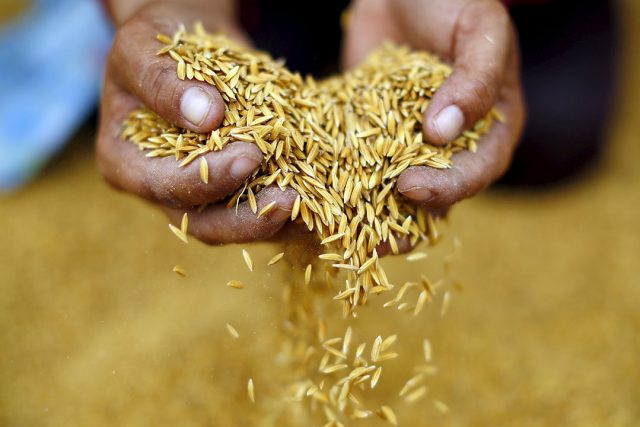
THE Department of Agriculture (DA) said production in 2024 of palay, or unmilled rice, is estimated to be little changed at 20.1 million metric tons (MMT), due largely to the dry conditions brought on by El Niño.

“Because we were hit by El Niño and then in the second half by La Niña, we are hoping to achieve parity with last year,” Agriculture Secretary Francisco P. Tiu Laurel, Jr. said at a budget hearing in the House of Representatives.

The latest estimate represents a downgrade of an earlier DA projection of 20.44 MMT.

In 2023 palay production was 20.06 MMT, equivalent to about 13 MMT of milled rice.

“Our production fell during the first half. Then during the second half we are seeing wetter conditions, huwag lang sana tayo tamaan ng bagyo (We are hoping typhoons will not inflict serious damage), We’re hoping that our production will be the nearly the same as in 2023,” Mr. Laurel added.

In the first half, palay production dropped 5.5% to 8.53 MMT, according to the Philippine Statistics Authority. This was the lowest level of first half production since the 8.39 MMT posted in 2020.

“I don’t want to over-promise… but it would depend on the gravity (of La Niña),” Mr. Laurel said on the sidelines of the briefing.

The government weather service, known as PAGASA (Philippine Atmospheric, Geophysical and Astronomical Services Administration), declared the end of El Niño in early June.

“I’m expecting one or two strong typhoons… So I have to be more conservative in our estimates,” he added.

PAGASA estimated a 70% likelihood La Niña will set in between August and October, raising the probability of tropical cyclone activity in the coming months.

The rice harvest services about 70% of domestic demand, with imports taking care of the rest.

At the hearing, Mr. Laurel said that the DA estimates rice imports for 2024 of 4 MMT.

The US Department of Agriculture projects Philippine rice imports of 4.7 MMT this year, due to the higher-than-expected volumes during the first half.

“We are trying our best to increase production, not only (via) better seed and technology, but also with the increased number of harvests,” he added.

The government lowered the tariffs on imported rice to 15% from 35%, until 2028 through Executive Order No. 62, in a bid to bring down rice prices.

The DA has said that the lowered tariff on imported rice could bring down rice prices by P6-P7 per kilogram.

“With the 15% tariff… the price of rice should be at P45 per kilo by mid-October, couple with stable world market prices, and foreign exchange rates,” Mr. Laurel said.

He added that the DA is also proposing that the National Food Authority’s buying price for palay during the wet season harvest be set at P23 per kilo dry and P20 per kilo wet. — Adrian H. Halili

ADVERTISEMENT
ADVERTISEMENT