Home Blog Page 280

Eye on the ball

AI GENERATED IMAGE PROVIDED BY THE AUTHOR

Good.

Well, for now.

Despite simmering tensions in the West Philippine Sea that have been matched since the start of the year by a social media word war soon after new Chinese ambassador, Jing Quan, took over the embassy in Manila in December, there have at least been a few signs that a potential rapprochement is in the works.

On top of the resumption in Cebu near the end of January of an undersecretary-level Philippines-China talks — described only as “candid and in-depth” (diplomatic lingo for “blunt”) — after a year-long pause were a number of subtle public signals. Recent signals include:

• Mr. Jing has been meeting with Philippine Cabinet secretaries overseeing areas of bilateral ties that can move ahead despite maritime tensions, e.g., with Interior and Local Government Secretary Juanito Victor “Jonvic” C. Remulla and Information and Communications Technology Secretary Henry R. Aguda, as well as with local government officials like mayors Ma. Josefina “Joy” Belmonte-Alimurung of Quezon City, Francisco “Isko Moreno” M. Domagoso of Manila, and Sebastian “Baste” Z. Duterte of Davao City.

• First Lady Liza A. Marcos — clearly as a proxy for President Ferdinand “Bongbong” R. Marcos, Jr. — has graced at least three high-profile events involving China’s embassy, led by Mr. Jing;

• Mr. Marcos himself has met Mr. Jing on a few public occasions, the most recent being at the ceremony marking the second phase of the Chinatown Revitalization project, but has otherwise issued conciliatory remarks, e.g., publicly thanking Mr. Jing for looming direct flights between Cebu and Fujian that begin next month (adding to direct flights between Manila and Beijing, Shanghai, and Guangzhou as well as between Cebu and Quanzhou, also in Fujian province);

•Chinese Foreign Minister Wang Yi himself — “wolf warrior” personified in the Chinese Communist Party’s politburo (who I was privileged to interview in Beijing way back in 1999 when he was just an assistant foreign minister) — sent a rare message of condolence to his Philippine counterpart, Foreign Affairs Secretary Ma. Theresa P. Lazaro, on Jan. 31 for lives lost in the sinking of passenger ferry MV Trisha Kerstin 3 off Basilan on Jan. 26;

• The Philippines in mid-January adopted a 14-day visa-free program for Chinese citizens;

Both sides have refrained from taking any negative official action against each other’s senior officials, e.g., declaring Mr. Jing persona non grata or sanctioning Philippine senators deemed having offended Chinese embassy officials;

• Both have publicly agreed on the need for dialogue to defuse the situation;

• And said they are committed (the Philippines, as 2026 chair of the Association of Southeast Asian Nations, or ASEAN) to finalizing a long-delayed code of conduct for the South China Sea within the year (though there is wide divergence on issues such as whether it should be binding, if it will dilute/erode the effects of the 2016 arbitral award at The Hague, etc.).

Significantly, the Philippine Coast Guard has lately been relatively silent on any incident of harassment in the West Philippine Sea (even as the Chinese Coast Guard and maritime militia ships were observed practicing what seemed to be blocking maneuvers in the waters of Chinese-occupied Paracel Islands closest to Vietnam, which also claims those features1).

GOOD COP-BAD COP
Clearly, efforts are under way to soothe long-strained ties.

In his Feb. 14 speech at the embassy’s Chinese New Year reception, Mr. Jing — who, like his predecessor Huang Xilian, has been meeting with Chinese-Filipino businessmen as well — said that Philippine-China relations should “stabilize as soon as possible and continue moving forward,” and that the current troubled “situation must change, and it must change quickly2.

Specifically, he is keen on pushing bilateral relations in areas outside the security and maritime spheres in order to set in motion “positive momentum to drown out the noise…” Citing the crucial role of more people-to-people engagement, he noted that “[a]s people visit each other more, misunderstandings and biases naturally fade away.”

He has noticeably refrained from issuing aggressive/antagonistic remarks against Filipino critics of Beijing’s ways, especially in the West Philippine Sea (preferring, rather, to say: “Let’s sit and talk.”)

The hatchet man’s job, it seems, belongs to Chinese Embassy Spokesperson Ji Lingpeng, who has unfailingly matched each and every criticism — even from senators — with an almost point-for-point counterargument.

The emerging SOP of this duo at the embassy resembles a good cop-bad cop, push-and-pull, carrot-and-stick routine.

TALL ORDER
Still, methinks that changing the ordinary Filipino’s mind as regards China is going to be a tall order, what with more Pinoys — nearly eight out of 10 of late — found distrusting our northern neighbor3 and continued reports on snooping by suspected agents of the Middle Kingdom4 (as well as the retaliatory arrest of Filipinos in China for alleged espionage — what ever happened to those unfortunates, I wonder?)

The US snoops on us too, pro-Beijing (both those genuinely convinced and those paid) Pinoys argue. Right, but then US ships are not harassing our boats within our own exclusive economic zone (EEZ), nor are they the ones preventing our impoverished subsistence fishermen from accessing their traditional fishing grounds.

So, it will take much more than overtures so far being made by both sides to improve bilateral relations palpably.

For good measure, maritime law expert Jay L. Batongbacal, who heads the University of the Philippines Institute of Maritime Affairs and the Law of the Sea, said that Beijing can demonstrate sincerity in talks for a mutually acceptable solution by withdrawing Chinese ships from the West Philippine Sea5 (even, I would think, without outrightly conceding its claim for now) that sometimes venture as close as 20-50 nautical miles (NM) off Luzon’s western coast, though still carefully outside Philippine territorial waters within 12 NM from the shoreline.

Or, at the very least, do not harass our fishermen nor block our efforts to tap oil and gas at Reed Bank (since the much-vaunted new find at the Malampaya field, which now covers 20-25% of Philippine energy needs but is expected to run dry some time in 2027-2029, is estimated to extend our supply from that source by just a few years6).

CLEARER HIERARCHY OF INTERESTS NEEDED…
Which brings us to the question of how exactly we are to consolidate efforts and resources now that we are working to improve relations without compromising national interest.

A patriotic diplomat bared some thoughts on a West Philippine Sea (WPS) agenda in our foreign-national security policy group chat. Some of his points were:

• There has to be a national consensus on goals and direction, and these should be translated into a national strategy that transcends political administrations. This thrust includes strengthening relevant institutions, starting with the Foreign Affairs (DFA) and Defense departments, which “must be insulated from politics.”

• Such consensus should extend to the hierarchy of national interests and priorities (e.g., “Good bilateral relations is good, but at what cost?” Is protecting our sovereign rights in our EEZ of higher or lesser value?)

• This national strategy, in turn, should be translated “into a coherent, comprehensive, principled and purposeful foreign policy.” “To protest is important, but to protest without direction and no framework as to where do we want this to go, is a waste of national protest,” the diplomat said. “We don’t protest for the sake of protesting. It must be part of a larger framework.”

I disagreed with some points, including the diplomat’s view that “there is a need to rethink the policy that the SCS (South China Sea) is not the sum total of our relations with China” since it “sends a wrong message” when “China has always been all out on the SCS.” For me, there is no contradiction between acting resolutely (though in varied ways) in defending our rights in the WPS (which is just part of the SCS) and in pushing other avenues for bilateral cooperation.

But I agree wholeheartedly with our joint defense and coast guard patrols and training “with like-minded countries.” China has proven itself the bully in the WPS, and true to form of any bully, its ships keep a cautious distance whenever ours maneuver with those of allies in those waters. Perhaps, the frequency of such maneuvers can be a bargaining chip in talks with Beijing, but giving in to exclusively bilateral talks in handling our WPS spat plays into the designs of a bully.

We also need to move faster on acquisitions for a credible defense posture. This is why the reported defunding of defense (both military and coast guard) modernization efforts, and fund realignment to dubious uses, in the past two to three years was tantamount to treason in my book. Because, then, Beijing doesn’t need to do anything to keep us weak and defenseless if we shoot ourselves in the foot that way.

There is also the need to rally more Filipinos on the WPS issue. The government needs to find ways to make this an election issue for 2028 by explaining how it impacts households, e.g., in terms of fish and other marine food for the table, and sufficient, affordable electricity now that Malampaya is nearly depleted.

… AND ONE VOICE
One good outcome from this spat is that we are honing our skills in dealing with a superpower. I wish we were on the same level as the likes of Indonesia and Vietnam in this arena, but we are clearly still learning how to balance our foreign policy the way these ASEAN powers do — and the world’s two superpowers respect them for that ability.

But besides all the points we mentioned above is the need to speak with one voice even amid a diversity of views.

Let’s get one issue out of the way at this point: yes, uniformed government personnel are just as entitled as civilians to their respective opinions. But members of the armed services — whether the military, the police, or the coast guard — have less leeway in expressing these views in public, since their roles affect national security. And, like it or not, that uniform — as well as the official position one holds (whether in uniform or in civilian attire), especially if as a spokesman — represent the authority of the government wherever one goes. And even from a practical standpoint, it is unwise for these uniformed personnel to engage in ad hominem stunts of any kind, e.g., presenting caricatures of personalities in public lectures, since that cheapens and lessens the credibility of their arguments. This holds true for active-duty personnel, especially if they are spokespersons.

Then there is a need for more cohesion on the foreign policy front.

To be sure, turfs, rivalry and infighting hound most bureaucracies worldwide, but it is best to minimize them — and, in fact, work on cohesion — especially when faced with a major external threat that is adept at capitalizing on the slightest sign of disunity.

We have witnessed signs of such a turf war at home — from criticism by some officials in some group chats that our decision to notify China of our supply missions to BRP Sierra Madre was tantamount to seeking Beijing’s permission (and, in fact, Chinese officials frame that arrangement that way to their publics), to the warning by former Supreme Court associate justice Antonio T. Carpio that “closed-door diplomacy” espoused by the DFA on WPS matters could erode wide international support gained through the military’s and coast guard’s transparency initiative in immediately baring Chinese aggression in the Philippine EEZ7.

I just hope that the “casual commentators, non-practitioners, and self-styled experts” that the DFA spokesman for maritime affairs cited in his Feb. 13 press conference did not refer to experts in think tanks and the academe. In powers like the United States and China, and even among neighbors like Indonesia, Singapore, Thailand, and Vietnam, think tanks and the academe are considered part of the foreign policy community whose views are carefully considered.

One example: the Armed Forces of the Philippines (AFP) has established a structure for regularly tapping policy inputs from the private sector in the form of the AFP Multi-Sector Governance Council, composed of members of the academe, think tanks, civil society, and business who provide recommendations on governance, transparency, policy implementation and other concerns8.

I know that the DFA does seek private sector inputs from time to time, but perhaps pressing issues such as improving bilateral ties with China warrant a more formal consultative mechanism.

1 https://tinyurl.com/23d7lk8r

2 https://tinyurl.com/2bu8x9kl

3  https://tinyurl.com/24z6z2qp

4 https://tinyurl.com/289mp9ce

5 https://tinyurl.com/236nqagf

6 https://tinyurl.com/27xsz554

  https://tinyurl.com/22w8wpvy

  https://tinyurl.com/2djkkzw9

7 https://tinyurl.com/2yphkpgr

8 https://tinyurl.com/29cv2h8k

https://tinyurl.com/2am7ameel


Wilfredo G. Reyes was editor-in-chief of BusinessWorld from 2020 through 2023.
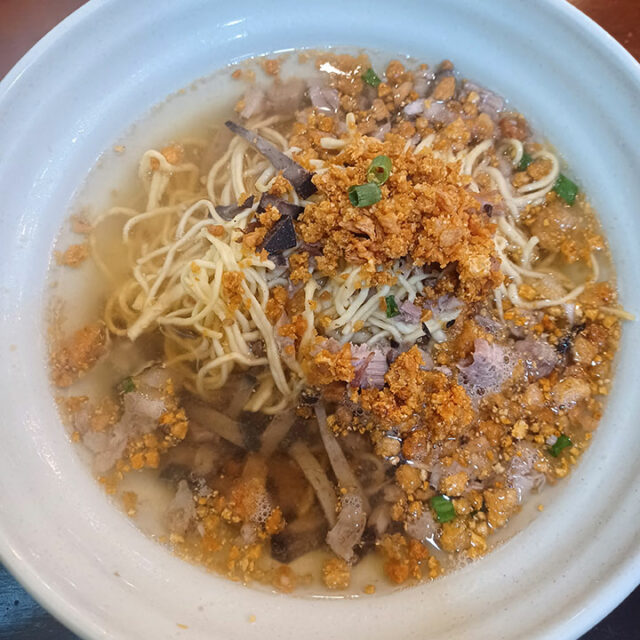
Food tripping in Iloilo

BATCHOY from Netong

By Brontë H. Lacsamana, Reporter

WHILE ILONGGOS are not the loudest cheerleaders when it comes to their cuisine (unlike, say, folks from Pampanga), once you get them started about what food to eat or places to go to, you quickly realize there’s endless love and plentiful recommendations to tick off from your checklist. It’s a culinary gem in the Western Visayas region, which most Filipinos don’t know was actually a rich source of food in our history.

Because it continues to preserve and support its culinary heritage, composed of indigenous recipes and emboldened by various native ingredients, Iloilo City was the first in the Philippines to be recognized by UNESCO (United Nations Educational, Scientific and Cultural Organization) as a Creative City of Gastronomy.

In January, a press trip around Iloilo was organized by its MICE (Meetings, Incentives, Conferences and Exhibitions) Center, coinciding with the Dinagyang Festival.

“Iloilo is where the past meets the present. That’s what the UNESCO designation celebrates. It celebrates our culinary traditions, our heritage. It’s part of our history,” said Leny Ledesma, Iloilo City executive assistant for special projects, during the media tour.

Unlike the Michelin star, which celebrates a particular chef or kitchen, the Creative City of Gastronomy title celebrates culinary heritage.

SEAFOOD, CHICKEN, PANCIT MOLO
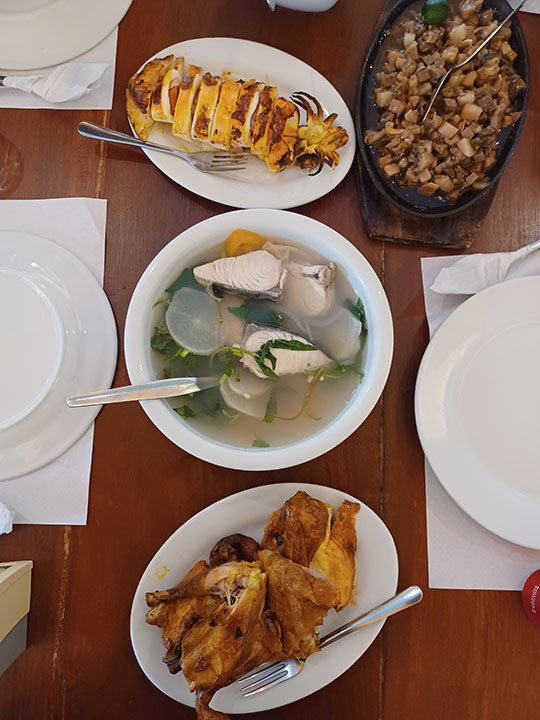
The first stop was Tatoy’s Manokan and Seafoods, known for its inasal chicken and seafood dishes, ranging from sinigang na tanigue (mackerel fish soup) to grilled squid to baked oysters.

For Manileños, diwal (angel clams) would be a novelty, with its elongated shape reminiscent of angel wings. Tatoy’s paella Valenciana is also delicious, while their kilawin offers a refreshing punch to the spread — everything proof of how Iloilo does justice to its abundance of seafood.

Kap Ising’s Pancit Molo is the next must-visit for Ilonggos returning home and visitors to the region.

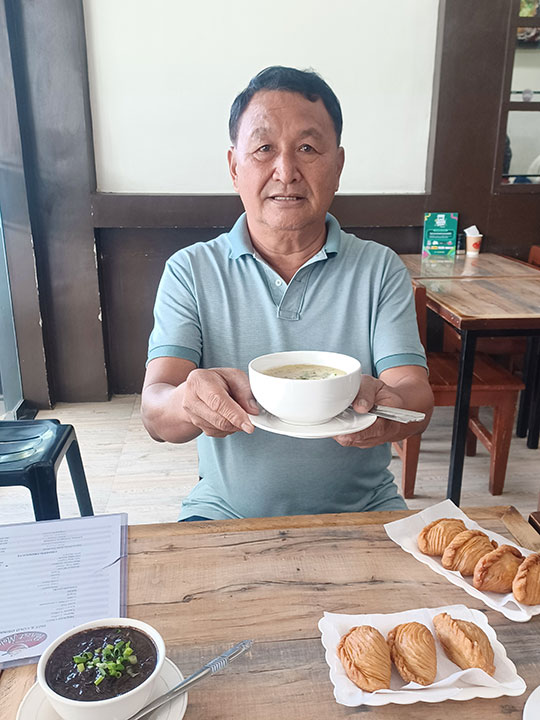
Eliezer Villanueva, better known as Kap Ising, served us himself. Originally located in the Molo district, the branch we visited was in Ayala Malls Atria, one of eight branches now, though all offer the same menu. We were given bowls of their mouth-watering pancit molo (wonton soup), dinuguan at puto (pork blood stew and rice cake), and empanadas (stuffed pastry).

Mr. Villanueva’s iteration of the restaurant came about in 2006, when he took over from his mother’s restaurant, Nida’s Original Pancit Molo, which dates to the 1980s. The dish itself comes from the Chinese community in Iloilo, largely based in the Molo district, which was absorbed into Ilonggo cuisine.

His mother used to cook, while he sold the dish at city hall and at banks.

“I’ve been a barangay captain for 30 years, kaya tawag sa’kin Kap Ising (so they call me Kap Ising),” he said.

When asked about the integrity of the recipes over time, he pointed out the use of ingredients as a major factor. The dumplings in the pancit molo are filled with ground pork, shrimp, and chicken — none of which are frozen, he specified, because the taste would be different — while the empanadas make use of potatoes and ground tenderloin.

Hindi ako bumibili ng imported. Kailangan bagong katay (I don’t buy imported [ingredients]. It has to be freshly butchered).”

Though our group easily finished our bowls, Kap Ising encouraged refills, which we noticed was normal for diners at other tables, too. The homey feel was there all throughout the meal.

COFFEE AND ICE CREAM
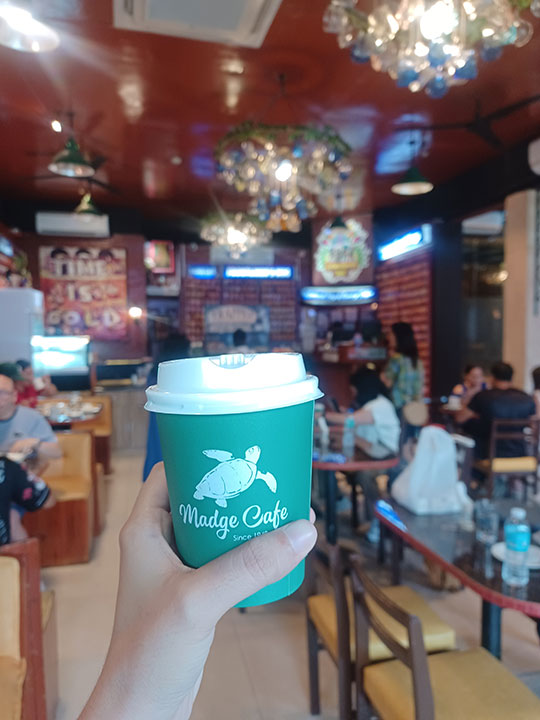
The next stop was Madge Café — again, a branch at Atria — which somehow manages to capture the charm of the original location. First set up as a stall in La Paz Market in 1940, its coffee is still prepared in the old way, manually strained using kettles and collador (cloth socks) as a filter. Mugs engraved with names of regular customers adorn the walls, an homage to how the original market stall was supported by locals.

It was established by Vicente de la Cruz, who named the café after his wife, Magdalena. Now, various second- and third-generation family members operate the different branches. A few days after having a warm and comforting cup of joe at the Atria branch, we trooped over to the original La Paz Public Market outlet for more, this one run by grandson Peter “Nonoy” de la Cruz.

“Madge is a legacy passed down in our family,” he told BusinessWorld. “The coffee really comes from Iloilo. It’s homegrown. We do the roasting with no preservatives added. Many people don’t know this, but we’re really producers of coffee.”

Another showcase of Iloilo’s homegrown ingredients is the Happy Endings Creamery and Food Lab, which is best known for its iconic spot in front of Molo Mansion. There, we fell in love with its local flavors — batwan (green sour fruit) cheesecake and baye-baye (roasted glutinous rice and coconut).

Served alongside the usual ice cream flavors like chocolate, salted caramel, and pistachio, the Iloilo ingredients highlighted give a sweet, unique spin on the flavors found in the region.

FROM PLAZAS TO THE SEASIDE
A memorable stop was Agatona 1927 Museum Café, which is housed in the Jalandoni-Montinola ancestral home overlooking Jaro Plaza. Its heirloom recipes are sumptuous, harkening to the originals yet more refined: pinitaw na manok (chicken adobo flakes), their take on dinuguan, and even biscocho (toasted bread) for snacks.

Their tsokolate-eh (hot chocolate), served with ibos (the Ilonggo version of suman or rice cake), is also a favorite, best enjoyed looking out the window at the landmarks of central Jaro, from the plaza to the cathedral.

Ms. Ledesma, representing Iloilo’s MICE Center, told BusinessWorld that the proposal they submitted to UNESCO for the City of Gastronomy designation awarded in 2023, was one “based on abundance.”

“We’re surrounded by rivers, seas, farms, and mountains in the provinces, so there’s ample food,” she explained. “It’s historical. Miguel Lopez de Legazpi, when he was in Cebu, needed to feed his crew. He searched and landed on this island, in Panay. When he landed, the first thing he said was, ‘pan ay!,’ in Spanish, ‘ay pan!’ which literally means ‘there’s bread!’ There’s food. He had found rice and vegetables.”

The exact place he landed at was Oton, 11 kilometers west of Iloilo City. Next to it is Arevalo, the city’s westernmost district, which is home to many seaside restaurants that Ilonggos frequent for fresh seafood meals with family.

We visited one such restaurant, Breakthrough, overlooking a tranquil beach and the sea that reaches out towards Guimaras (which is famed for its mangoes). It’s no wonder that the ripe mango and green mango shakes here were divine.

Not to be missed, however, is the food itself, ranging from local lechon manok to shellfish such as crayfish and scallops, as well as the iconic diwal. The grilled fish items on the menu are best paired with vegetable dishes like chopsuey.

“The abundance was clear during the pandemic. We weren’t scared because we had backyard farms. Out of 180 barangays [in Iloilo City], 80 barangays had farms to feed their constituents there, boasting the lowest or even zero malnutrition of children,” said Ms. Ledesma. “Our story isn’t just about establishments. It starts from produce, from farmers and markets.”

The UNESCO designation also helped foster pride among Ilonggos, encouraging them to share their heirloom recipes with more people. “Unless you know the specific families and get to eat in their houses, you wouldn’t get to taste all this food. Now, people are sharing it and spreading it. If we lose these traditional recipes, we lose our cultural identity,” she said.

SIOPAO, BATCHOY, FUSION
And in the middle of watching the Dinagyang festivities, Roberto’s Queen Siopao kept us full and energized. It’s an Ilonggo favorite, the siopao made of Chinese sausage, adobo flakes, and bits of boiled egg.

One of our final stops was Netong’s in La Paz, where we tried their batchoy (a noodle soup with pork offal, pork cracklings, and a variety of other parts of pork). It’s way better than the instant noodle counterpart, which was the basis of comparison for most of the media in the tour group. The savory goodness of the broth, only possible by mixing the ingredients of batchoy and eating it immediately while still hot, is to die for.

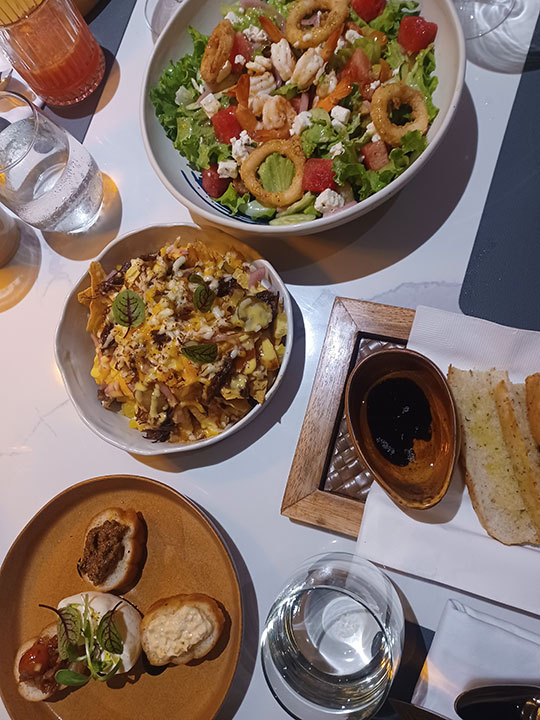
An unexpected discovery, which we found on our last night in the city, was Forum Rooftop Dining and Lounge, located in The Grid Building in the Mandurriao district. Newly opened, it offers elevated fusion cuisine including salads, pastas, and luxuriously prepared comfort food like lechon, pork knuckles, and pulled duck. It also has cocktails perfect for a classy night out observing the Iloilo skyline.

Amid the sleek yet comfortable interiors of dark stone walls, marble-topped tables, and chinaware custom-made by Lanelle Abueva, BusinessWorld spoke with Forum chef Miner Del Mundo.

“I’ve been in Iloilo for 20 years. I fell in love with the place, and it has become my second home,” he said. Hailing from Silang, Cavite, his history as a chef spans work abroad as well as for world-class hotels. Ms. Ledesma playfully calls him “ilonggated.”

When asked to describe what made Iloilo his second home, he joked, “Wala kasi traffic dito (There is no traffic here),” then added, “Restaurants here used to serve softdrinks in bottles with colorful straws. There were only two Italian restaurants back then. The dining scene has improved since, but I was challenged.”

In addition to Forum, Mr. Del Mundo also runs popular restaurants in the city like Azul and Amarillo. In a nutshell, he described Iloilo as “very pure, with a lot of raw materials and ingredients.”

Over the course of a few days, whether it’s Dinagyang season or not, any visitor would find that to be true — UNESCO designation or not.

Ayala Land Premier starts high-end Makati tower after P10.4-B sales

AYALALANDPREMIER.COM

AYALA LAND PREMIER has commenced construction of Laurean Residences, a high-end residential tower in Makati, after the project generated about P10.4 billion in sales since its launch in 2025.

“Laurean Residences was envisioned as an urban sanctuary in the heart of Makati. Today, we’re not just breaking ground — we’re opening a bold new chapter in refined urban living,” Ayala Land Premier President Mike Jugo said in a statement on Wednesday.

Laurean Residences will offer various unit types, ranging from suites to four-bedroom units, and targets professionals and multi-generational households seeking long-term homes in central Makati.

The project is the flagship residential tower within Dela Rosa Gardens, a 1.3-hectare mixed-use development along Paseo de Roxas and Dela Rosa Street.

The development is located near the Bank of the Philippine Islands (BPI) headquarters and a 2,700-square-meter park, and is close to Ayala Triangle Gardens, Greenbelt, and One Ayala.

Mr. Jugo described Laurean Residences as a model for urban living anchored on design quality and long-term location value, citing its careful planning and collaboration with design experts.

Ayala Land Premier worked with global firms HB Design, Joyce Wang Studio, and Landscape Tectonix, alongside Filipino consultants, to align international design standards with the Philippine climate, culture, and local context.

At the local bourse on Wednesday, shares in Ayala Land rose 2.2% to close at P20.95 apiece. — Alexandria Grace C. Magno

Security Bank widens nationwide footprint

PHILIPPINE STAR/DEEJAE DUMLAO

SECURITY BANK CORP. opened five new branches in January located in Luzon and Mindanao to expand its footprint nationwide.

This brought its total branch network to 383, it said in a statement on Wednesday.

In Luzon, Security Bank set up new branches in Tayug, Pangasinan; Angeles, Pampanga; and Silang, Cavite as it said it wants to tap fast-growing communities and business districts.

In Mindanao, it opened branches in Zamboanga City and Bangkal, Davao to expand its presence in key urban centers that serve regional trade and local enterprises.

“These openings reflect our commitment to being present where growth is happening,” Security Bank President and Chief Executive Officer Victor Lee Meng Teck said. “As communities expand, we want to ensure that individuals and businesses have access to reliable banking services that support their goals.”

“Our branch network remains an important part of how we serve customers. Each location is designed to work seamlessly with our digital platforms, offering both convenience and personalized service,” Security Bank Executive Vice-President and Branch Banking Group Head Leslie Y. Cham said.

The bank said it continues to invest in improving its branch services and digital capabilities.

It added that its newest branches offer various financial services, including long-term financing and wealth management solutions.

Security Bank booked a net profit of P3.2 billion in the third quarter of 2025, up 6.7% from the previous year.

This brought its nine-month income to P9.1 billion, rising by 7% year on year.

Its shares climbed by P1.95 or 2.89% to finish at P69.50 apiece on Wednesday. — A.M.C. Sy

Burning trash

STOCK PHOTO | Image by Adam Cohn from Flickr

Every time I pass a pile of garbage on our streets, what I smell is not just rot. I smell system failure. And we keep debating waste management as if we still have the luxury of choosing only elegant solutions. It is like being in a burning house and wasting time arguing over the best brand of fire extinguisher.

For years, the debate on waste-to-energy (WTE) has been paralyzed by a category error. We argue about it as if it were either an environmental or an energy issue. We want energy, but we shun incineration because burning trash releases carbon. Meantime, we build garbage mountains in landfills.

It is time to be honest about what WTE actually is for our country. It is not about generating electricity. Electricity is the byproduct. WTE is about waste reduction, a sanitation machine, a way to stop garbage from polluting and overwhelming our land, waterways, and coastlines.

Admittedly, the global conversation on incineration is changing. As the world decarbonizes, facilities that burn plastic, which is fossil-based, are becoming unpopular. Critics also warn against cities building WTE plants that must be fed trash for decades to remain profitable, quietly discouraging recycling.

These are valid concerns. But we must not confuse the “First World” dilemma of improving or optimizing an already functioning waste disposal system with the “Third World” crisis of basic sanitation. Countries that incinerate have gone through a long process to achieve circularity. We should expect to do the same.

When we invoke the Clean Air Act to block modern garbage incineration, we delude ourselves into thinking we are choosing clean over dirty air. In reality, we are just moving pollution. We shift it from a smokestack, which can be scrubbed and regulated, to a landfill, where the damage is wide and poorly policed.

We send garbage to open dumps where it decomposes and generates methane, adding to global warming. Landfills also produce leachate that seeps into our ground water. Plastic fragments and microplastics in landfills also end up in our waterways. We congratulate ourselves for rejecting incineration, for cleaning our air, while we poison our land and our water.

If we want to talk about sustainability, we need to stop treating landfills as a morally superior alternative to burning trash. They are not. A landfill is not a quiet hill of refuse. It is a living mass that can shift, fail, and bury. Look at Cebu. A trash slide at a landfill killed dozens of people in January.

Last year, a fire at a landfill in Rodriguez, Rizal sent smoke drifting into Quezon City, prompting health advisories and evacuations. There was heat, methane, and a fire that was hard to extinguish because it burned from within the pile. In 2024, a dumpsite fire in Talisay City also triggered evacuations.

These were not freak accidents. These were inevitable consequences of a disposal strategy that relied on piling up tons of garbage and praying that gravity, weather, and governance would cooperate. They seldom do. Of those three factors, only one is controllable, and even that only barely.

So when we talk about WTE, let us at least describe the real tradeoff. The choice is not burning versus clean air. The choice is managed combustion versus unmanaged decay. It is regulated emissions versus leachate. Better yet, it is smoke monitoring versus land and groundwater contamination.

I am not suggesting that we burn everything. But I am suggesting that we look at our garbage problem, recognize the tradeoffs, and decide on the best approach for solid waste management without having to choose clean air exclusively over green space and safe water.

Garbage is, ultimately, a space problem. When Metro Manila needs to dump its garbage outside its own geography, it exports the problem to someone else’s backyard. The same goes for Baguio City, Boracay, and most other places that generate tons of garbage with perhaps no more place to put them. Waste get sent elsewhere.

By pushing WTE, my primary goal is not electricity but to stop garbage from encroaching on our space, and from polluting our land and water. We produce a lot of garbage, and we must reframe WTE as volume reduction, a way to create space, with electricity as the byproduct and a means to offset operating costs.

Incineration and combustion-based systems can reduce the volume of solid waste significantly. Admittedly, incineration also generates ash that requires space, secure handling, and disposal. Still, there is a world of difference between managing just ash and managing mountains of rotting mixed waste.

To handle incineration safely also requires investment in filtration and pollution control. It requires enforcement that does not bend. It also requires us to admit that our laws were written for a different technological moment. The Clean Air Act bans incineration, but what that ban legally covers remains debatable.

Unfortunately, the ban has also become a convenient excuse for doing nothing. The Clean Air Act is 25 years old. Modern thermal treatment is not the same as backyard burning. And modern WTE is not the same as the primitive incinerators that shaped public fear two decades ago.

Proponents now point to cleaner conversion technologies and advanced gas cleaning systems. But the real challenge is for a WTE facility to prove to the public that when it operates here, that it can meet strict emission standards continuously and consistently, and not just on inspection day.

We can argue that WTE is unnecessary with “zero waste.” But in the case of the Philippines, “zero waste” is a myth. Even if we banned single-use plastics tomorrow, and even if we enforced it with draconian rigor, we would still face tons of residual waste daily nationwide.

We generate garbage every day, without fail. Diapers. Contaminated packaging. Medical waste. Sludge. Materials that no recycler wants. They will not disappear just because we invoke zero waste. Trash will exist. In the last 20 years, we tried solid waste management while we pushed away thermal treatment. What do we have to show for it?

By refusing to build high-standard thermal treatment facilities because they are not circular enough, we choose landfills by default. We choose methane by default. We choose leachate by default. And by insisting on finding a perfect disposal system, we are losing the battle against garbage. Like the way we are losing the road maintenance battle to potholes.

The problem is not just technological. It is institutional. Few LGUs have the fiscal capacity to finance a modern WTE facility. Technical expertise is scarce. Oversight can be weak. There is also little incentive, at this point, to push WTE as a lot of people make money from hauling and dumping garbage.

A thermal treatment facility can disrupt this ecosystem. It centralizes disposal. It requires a fee that reflects the cost of processing, not just the cost of dumping. It also demands stable contracts, credible regulation, and competent monitoring, plus massive capital upfront.

But while we can aggressively reduce single-use plastics, enforce Extended Producer Responsibility, and build collection and sorting systems that make recycling real, we will still need high-standard thermal treatment for residual waste as an alternative to landfills. Medical waste, for one, must be burned.

Let’s look at a 20-year transition. Within that period, we can permit and support thermal treatment for residual waste that cannot be recycled or composted in practice. Mandate the highest emission standards and require continuous emission monitoring. Emission data must be public, and real-time.

If the smokestack emits dangerous levels of pollutants, the plant shuts down automatically. No human intervention. No discretion. No explanation. No room for a bribe. The plant does not reopen until its operator, whether government or private, fixes the problem to everybody’s satisfaction.

But for this to happen, legislators should review the Clean Air Act, the Clean Water Act, and the Solid Waste Management Act. These laws are now well over 20 years old. We should audit how these laws, and their implementing rules, have actually served us in the last two decades.

In particular, we must review the incineration ban to allow a pragmatic transition. The Clean Air Act is central to this debate. We should enshrine technological neutrality: if an incineration facility can prove it meets stringent emission standards, the method should not be categorically banned.

Rejecting thermal treatment is not the same as protecting the environment. We push clean air while getting buried in trash that takes up land and pollutes water. There will always be arguments for and against waste incineration. But now is the time to decide. I believe it is time we light the fire.


Marvin Tort is a former managing editor of BusinessWorld, and a former chairman of the Philippine Press Council.

matort@yahoo.com

Cava quality made clearer: The most recent Cava DO classification

ROGER GOULART founded in 1882 — one of the Cava houses that features a wide-variety of delicious Xarello-led blends. — PHOTO COURTESY OF RIGNO SERRANO OF ICEX.

PENEDÈS, SPAIN — After attending my first Barcelona Wine Week (BWW), I was extremely grateful to be invited to stay longer for a thorough Cava re-education program, courtesy of ICEX (Instituto Español de Comercio Exterior), or the Spanish Institute of Foreign Trade.

ICEX is the agency under the Spanish Ministry of Industry, Tourism, and Trade, that works worldwide with the objective of promoting Spanish companies and products. In this case, this was a program specifically meant to promote Spanish Cava.

The Cava DO office is in Vilafranca del Penedès, just an hour drive from Sants-Montjuïc, Barcelona where BWW was held.

Cava DO is already Spain’s largest wine region export, yet there is a widespread belief that volume, especially for export, can still do better. At present, around 64% of Cava production goes to exports, compared to Italy’s Prosecco of which over 80% of its huge production is exported.

CAVA DO ON THE GLOBAL STAGE
When it comes to sparkling wines, three regional names dominate the global stage: Champagne, Prosecco, and Cava. They are the largest sparkling wine regions in the world, each with its own identity and tradition.

Italy’s Prosecco, from the two neighboring regions of Veneto and Friuli Venezia Giulia, leads in sheer volume, producing an astonishing 667 million bottles in 2025, while France’s Champagne followed with 266 million bottles, and Cava with 218 million bottles despite recent drought challenges. Yet size alone does not tell the full story. Champagne, with its historic legacy, will be expanding soon after adding 40 villages to its appellation as approved in 2008, while Cava has turned a new leaf with stricter classifications to reinforce quality and trust. In this dynamic landscape, the competition is not just about numbers, but about how each region defines excellence in sparkling wine. And the Cava DO is extremely aware of this.

Few wines embody Spain’s celebratory spirit as vividly as Cava. Crafted with the traditional method invented in Champagne, Cava is enjoyed globally — it is Spain’s number one wine export, much bigger than the products of the equally popular Rioja wine region. But in recent years, Cava DO has faced challenges to its reputation. In 2017-2018, nine prestigious bodegas broke away to form Corpinnat (it got its EU recognition in 2019), a new collective group emphasizing terroir-driven sparkling wines from Penedès, citing concerns that Cava’s standards were too broad and diluted.

The formation of Corpinnat reminds me of Germany’s VDP (Verband Deutscher Prädikatsweingüter), an association of wineries that has their own classifications different from the official German Wine Institute classification, though the VDP in Germany is not competing against non-VDP members.

This Corpinnat departure sparked questions: could Cava DO maintain its prestige and consumer trust?

The answer, now that we are in 2026, is a resounding yes. With the full implementation of the new Cava classification system introduced in 2022 (though it had been widely discussed in the Cava DO Regulatory Council several years earlier), the denomination has redefined itself with stricter, transparent, and quality-focused standards.

SHERWIN A. LAO is the first Filipino wine writer member of both the Bordeaux-based Federation Internationale des Journalists et Ecrivains du Vin et des Spiritueux (FIJEV) and the UK-based Circle of Wine Writers (CWW). For comments, inquiries, wine event coverage, wine consultancy and other wine-related concerns, e-mail the author at wineprotege@gmail.com, or check his wine training website https://thewinetrainingcamp.wordpress.com/services/. Also check out his YouTube channel, www.youtube.com/@winecrazy.

‘PREMIUMIZED’ CLASSIFICATION
The classification defined a clear two-tier quality structure: Cava de Guarda and Cava de Guarda Superior. The Guarda is the non-vintage version with minimum bottle aging of nine months, while the Guarda Superior is the premium version, is vintage-specific and has stricter guidelines that include wines having to be 100% organic, coming from vineyards that are 10 years or older, and a maximum yield per hectare of 10,000 kg.

There are three more quality tiers under Cava de Guarda Superior, depending on their bottle aging, like the ones in other Spanish wine regions.

So, the Cava classifications (and their descriptions) are:

Cava de Guarda (nine months aging) – Fresh, youthful, and fruit-driven

Cava de Guarda Superior – No Crianza level

•Reserva (aged 18 months) – Greater depth and aromatic complexity

•Gran Reserva (aged 30 months) – Intense personality, layered aromas

•Paraje Calificado (aged 36 months) – roughly translated as “qualified estate or place,” so exceptional wines from single, distinguished terroirs, with strict yield limits and manual harvests

This two-tier quality structure was designed to “premiumize” Cava, moving away from a focus on high volume to longer aging and higher quality. This hierarchy is not just aesthetics, it guarantees provenance, aging, and production integrity, reinforced by individual quality stamps at each level, and traceability from vineyard to market. By codifying these standards, Cava DO now offer clarity and assurance to consumers all around the world.

INDIGENOUS VARIETALS
While the Cava DO has allowed more varietals to be made into Cava over the years, including Champagne staples chardonnay and pinot noir, I am glad that the original Cava trio of macabeu (spelled with u not o in this region), xarello, and parellada still constitute 82% of all Cava blends. This to me is the differentiation between Cava and Champagne or other sparkling wines.

During our visit to eight amazing Cava DO houses, the consensus was that the most beloved varietal has always been xarello, and in no coincidence that xarello is also the varietal with the oldest vineyards in the Penedès region. This varietal is commended for creating wines with a good acid backbone, excellent aromatics that include green apple, white flowers, almonds and ginger, and even a nice sherry-like complex nose when the Cava has aged longer in lees.

Some of the best Cavas I enjoyed in this trip were made mostly with xarello dominating the blend.

It was also on this trip that I found out that one of the best Cavas I had in the past, Kripta, with its unique amphora-shaped bottle, joined Corpinnat just last year, and that the winery, Agustí Torelló Mata, rebranded to Celler Kripta, and is no longer a Cava DO.

A SPARKLING FUTURE AHEAD
Cava’s journey has not been without turbulence. The breakaway of Corpinnat highlighted the tension between quantity and quality, but it also pushed Cava DO to evolve and address certain concerns. Now, with its fully implemented classification system, Cava DO demonstrates that it is committed to excellence, authenticity, and consumer trust.

For wine lovers, this means that every bottle of Cava carries a promise: whether a young easy-drinking Guarda or a well-crafted Guarda Superior Paraje Calificado, it is a sparkling wine with integrity, tradition, and a renewed dedication to quality. In turning this new leaf, Cava reclaims its place not just as Spain’s most famous sparkler, but as one of the world’s most trustworthy and exciting sparkling wines.

This saying was thrown around a lot throughout Barcelona Wine Week, that “Spain produces the best quality for price ratio wines,” and this statement couldn’t have been truer in the case of Cava. Salud!


Sherwin A. Lao is the first Filipino wine writer member of both the Bordeaux-based Federation Internationale des Journalists et Ecrivains du Vin et des Spiritueux (FIJEV) and the UK-based Circle of Wine Writers (CWW). For comments, inquiries, wine event coverage, wine consultancy and other wine-related concerns, e-mail the author at wineprotege@gmail.com, or check his wine training website https://thewinetrainingcamp.wordpress.com/services/. Also check out his YouTube channel, www.youtube.com/@winecrazy.

AC Mobility launches digital wallet for EV fleets

AC MOBILITY HOLDINGS, INC.

AC MOBILITY Holdings, Inc. (ACMobility), the mobility arm of the Ayala group, has rolled out a digital wallet for electric vehicle (EV) fleets and transport groups to simplify payment systems.

The new solution, called ChargeFleet, is a sharable digital wallet that streamlines charging expenses, reduces manual tracking, and improves cost control, the company said in a statement on Wednesday.

The mobile wallet allows fleet managers to allocate and monitor charging credits across multiple drivers on a single platform. The solution also seeks to address operational gaps in adopting EVs, such as fragmented payment systems, reimbursement delays, and limited visibility over charging usage.

Once integrated, ACMobility assigns the charging credits to the client’s fleet manager, who can then distribute these to multiple drivers. Drivers can view and use their assigned credits using Evro, ACMobility’s partner application.

“Our main goal has always been to build a comprehensive EV ecosystem that serves every type of driver… With this new offering, we hope to address a critical gap for our enterprise clients — transport groups and corporate fleets who require a professional management platforms,” ACMobility Head of Mobility Infrastructure Carla Buencamino said.

Looking ahead, ChargeFleet will feature exclusive value-added perks integrated through the partner apps Evro and Power on Wheels, the company’s mobile EV charging station (EVCS).

“These upcoming features underscore ACMobility’s commitment to providing a future-proof support system for the evolving needs of their customers’ businesses,” the company said.

ACMobility’s portfolio consists of its BYD and Kia distribution businesses, Isuzu dealership operations, as well as its EV charging infrastructure and Bosch Car Service units.

The company ended its dealership with Honda Cars Philippines, Inc. last year, along with other brands such as Volkswagen and Maxus, amid its plan to focus on its EV business.

Shares of Ayala Corp. on Wednesday gained 1.7% or P9.50 to close at P569.50 apiece. — Beatriz Marie D. Cruz

Bank ‘risk transfer’ boom needs close monitoring, Basel Committee warns

EURO, Hong Kong dollar, US dollar, Japanese yen, pound and Chinese 100 yuan banknotes are seen in this picture illustration, Jan. 21, 2016. — REUTERS

LONDON — Banks are increasingly turning to bespoke deals with private investment funds to shed credit risk, but the market needs close monitoring as it spawns new vulnerabilities for the global financial system, the world’s forum for banking regulators said.

These “synthetic risk transfers” (SRTs) involve a bank selling all or part of the credit risk of a group of assets to investors such as hedge or pension funds. They allow banks to free up capital while maintaining their client relationships.

SRTs are not new, but they have proven particularly popular in the European Union (EU), with new transactions more than tripling between 2016 and 2024 after EU regulatory changes provided some synthetic securitizations preferential prudential treatment, the Basel Committee on Banking Supervision said in a report on Tuesday.

US volumes have also jumped following regulatory clarity in 2023 on how the deals are treated under bank capital requirements, added the committee, which is made up of banking regulators and central bankers from the Group of 20 economies and other countries.

Among European banks, Britain’s Barclays, Austria’s BAWAG and Greece’s Alpha are the heaviest users of SRTs relative to the size of their corporate loan books — with the average listed lender using them to cover about 12% of those loans, the report said.

WORRY OVER ‘SHADOW BANKING’ TIES
The committee said SRTs help banks boost lending that is subject to lower capital requirements but warned that heavy reliance on them left lenders exposed to the health of nonfinancial intermediaries buying the risk. If those investors falter, this could affect the flow of credit.

“A contraction in credit caused by a protracted freeze in SRT markets could exacerbate an economic downturn and increase stress in the nonfinancial sector, possibly triggering an adverse deleveraging feedback loop,” the committee wrote in the report.

Regulators globally are concerned about the growth of nonbank intermediaries involved in what is often referred to as “shadow banking,” because of a lack of transparency and the possibility of new risks that could endanger broader financial stability.

The committee’s report also highlighted risks over growing links between banks and nonbanks — because banks often finance the very investors buying the credit risk — as well as opaque individual deals and weakening underwriting standards.

While some of these risks are being monitored and addressed, the committee said closer supervision was needed as further growth of the SRT market could multiply the risks. — Reuters

On EO 108, the Office of the Executive Secretary, and sustained growth challenge

On Feb. 5, the Presidential Communications Office announced that President Ferdinand R. Marcos, Jr. had issued Executive Order (EO) 108 that abolished the Office of the Special Assistant to the President for Investment and Economic Affairs (OSAPIEA) and transferred its powers, functions, and duties to the Office of the Executive Secretary.

The OSAPIEA was created in 2023 under EO 49 and it was headed by Secretary Frederick D. Go. Mr. Go was appointed Finance Secretary last November and he has more duties and powers there.

Executive Secretary Ralph G. Recto, who was the former Finance Secretary, will now have more duties. Aside from overall monitoring and evaluation of all departments and agencies of the Executive branch, the OES will also streamline the Office of the President’s investment and economic affairs functions and promote comprehensive approaches to address current and future economic challenges.

SUSTAINING GROWTH
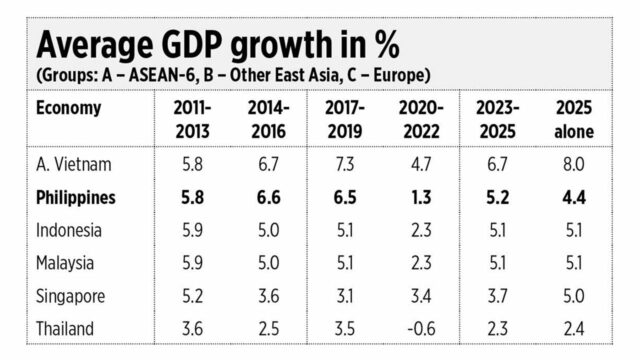
I checked the growth numbers of East Asia in contrast with those of Europe. I averaged the GDP growth rates into three-year clusters from 2011-2013, 2014-2016, etc. until the last three years. The results are contained in the accompanying table. The highlights are:

1. From 2011 to 2019, the Philippines’s trend was that of high growth along with Vietnam — we were the two fastest growing economies in the ASEAN-6 and just trailing China in the rest of East Asia.

2. Our draconian lockdown from 2020-2021 was horribly wrong. Vietnam and China, along with Taiwan, were able to grow in those years while the Philippines shrank by 9.5% in 2020, the worst in Asia, and the worst in Philippine economic history since post-WW2. Our average growth in 2020-2022 was only 1.3%.

3. We managed to grow above 5% in 2023-2024, but the infrastructure corruption scandal has dragged on 2025’s growth. Nonetheless our average of 5.2% growth in the 2023-2025 period was higher than the rest of the ASEAN-6 and other East Asian dragon economies. The detractors and pessimists are wrong in belittling our recent economic performance.

4. Degrowth is the trend in several European countries, particularly Germany and Austria, while Italy, France, and UK may fall into that trap soon.

Many European nations are focused on globalist agendas like saving the planet; saving Diversity, Equity, and Inclusion; saving Ukraine; and saving illegal immigrants. High growth, saving their jobs, businesses, and industrialization seem to have taken the back seat.

The main economic challenge for the Philippines is how to sustain an average GDP of 5-6%, if not attain 7% and not slip to 4% or lower. To help attain this, here are some Do’s and Don’ts that we should take note of.

1. There should be no more lockdowns and mandatory vaccinations regardless of how strong the globalist medical community and pharma lobby would be, should another big virus emerge.

2. We should not save the planet or save DEI, but rather save our jobs and businesses in order to save the hungry. The national agenda of promoting economic prosperity should not be subsumed under the globalist agenda of promoting ecological central planning.

3. We should follow the growth path, the economic and energy policies, of our East Asian neighbors and not that of Europe or North America. In 2025 all major East Asian nations grew above 3% except Thailand, Japan, and South Korea. This is an indicator that our region remains the most dynamic, the most prosperity-oriented in the world.

4. Finally, promoting the rule of law — that the law applies equally to unequal people and sectors, that no one is exempt and no one can grant an exemption — should be the single biggest function of governments.

In the “social contract” theory elaborated by the philosophers John Locke, Thomas Hobbes, and Jean-Jacques Rousseau, the main purpose government was invented was to secure people’s three basic rights — the right to life, the right to private property, and the right to liberty. There was no right to healthcare, right to education until university, right to monthly cash and food aid, and so on.

These new “rights” are modern inventions developed after societies progressed as a result of the protection of people’s three basic rights. These three basic rights made people very productive, very self-reliant, and not state- or welfare-dependent.

The infrastructure corruption scandal, the endless welfare-subsidy programs that lead to the endless expansion of our public debt, the ever-rising annual interest payments, and ever-rising taxes someday can be addressed if we have more rule of law.

The Office of the Executive Secretary, which is in charge of monitoring that all departments and agencies do their mandated tasks, and as head of overall investments and economic liberalization policies, has to meet high expectations from the public and from key investment actors. It has limited leeway given limited time, but it is working silently and efficiently to meet such expectations.


Bienvenido S. Oplas, Jr. is the president of Bienvenido S. Oplas, Jr. Research Consultancy Services, and Minimal Government Thinkers. He is an international fellow of the Tholos Foundation.

minimalgovernment@gmail.com

PHL cyberthreats becoming more industrialized

REUTERS

CYBERTHREATS in the Philippines have become more industrialized, with increasing digitalization among organizations and widespread mobile use by Filipinos giving fraudsters more potential vulnerabilities to exploit, Check Point Software Technologies Ltd. said.

The company’s Philippine Threat Landscape Report 2025 released last week showed that cyberthreat activity affecting organizations in the country are increasing in scale, with its mobile-first population widening the potential attack surface for cybercriminals.

“Cyberattacks in the Philippines are no longer defined by technical sophistication, but by scale, automation, and deception,” Ritchelle Santos, senior cyberthreat intelligence analyst, Check Point Exposure Management Research, said in a statement.

“In an environment where identity, trust, and mobile channels are the new battleground, the safest organizations will be those that protect their digital footprints as carefully as they protect their networks. Staying safe now means verifying everything — every message, every transaction, and every identity — every time.”

For this year, the rise of artificial intelligence (AI) will make scams faster and more believable and widespread as cybercriminals could use these technologies as force multipliers for their attacks, Check Point said.

Growing adoption of contactless payments in the country with the entry of Google Pay and increased e-wallet use is also an area of concern as threat actors could exploit device-level vulnerabilities for fraudulent transactions.

“As online platforms, mobile payments, and AI-enabled technologies become further embedded in everyday transactions, opportunistic threat actors are expected to adapt familiar social engineering and fraud techniques to these environments. Economic incentives, technological adoption, and evolving geopolitical narratives will continue to shape threat actor behavior as the landscape evolves,” it said.

“The Philippine threat landscape has shifted towards high-impact, high-visibility, low-complexity vectors, focusing on phishing, identity abuse, external misconfigurations and cloud-based exposures. These systemic changes require a fundamental shift in national defensive strategies to protect the country’s digital economy.”

Threat activity in 2025 was dominated by phishing, social engineering, and cyber-enabled fraud, with key targets being the government and public sector, financial services, critical infrastructure, and education platforms, the company said in the report.

Phishing website alerts among Check Point’s clients in the country surged by 423% to 3,824 in 2025 from 731 in 2024, the report showed. Smishing or SMS phishing was a prevalent attack point, with fraudsters using telecom-level manipulation to bypass mobile trust barriers.

“Phishing and smishing remained the most common initial access vectors, with SMS-based delivery gaining prominence through large-scale and coordinated campaigns, including those attributed to the Smishing Triad. These operations frequently served as entry points for credential harvesting, fraud, and broader abuse of digital platforms, reflecting the growing exposure associated with mobile and messaging-based communication,” it said.

The company also saw attacks via infostealer malware designed to exploit insecure portals and systems to expose sensitive information like browser credentials.

Meanwhile, recorded ransomware attacks rose to 17 in 2025 from nine the prior year, but these “remained largely opportunistic in nature, affecting a broad range of sectors rather than concentrating on specific industries.”

“The analysis shows that ransomware activity in the Philippines predominantly affected sectors with high operational and financial criticality, highlighting attackers’ preference for organizations where service disruption and data encryption can exert maximum pressure. This trend reflects the country’s increasing digitalization across critical industries, which has expanded the attack surface for financially motivated threat actors,” Check Point said.

Financial fraud and scam operations were also prevalent, supported by social media impersonation schemes, such as attackers faking banks’ AI chatbots to trick consumers.

“While these trends closely mirror broader Southeast Asia and APAC (Asia-Pacific) patterns, the Philippine threat landscape remains particularly exposed due to its mobile-first population, rapid growth of digital payments, and high engagement with social media platforms,” the company said. — Bettina V. Roc

Vikings grows up

WITH AGE comes experience, and so after 13 years of the Vikings buffet restaurants, the Vikings Group opens a new experience called Nyx.

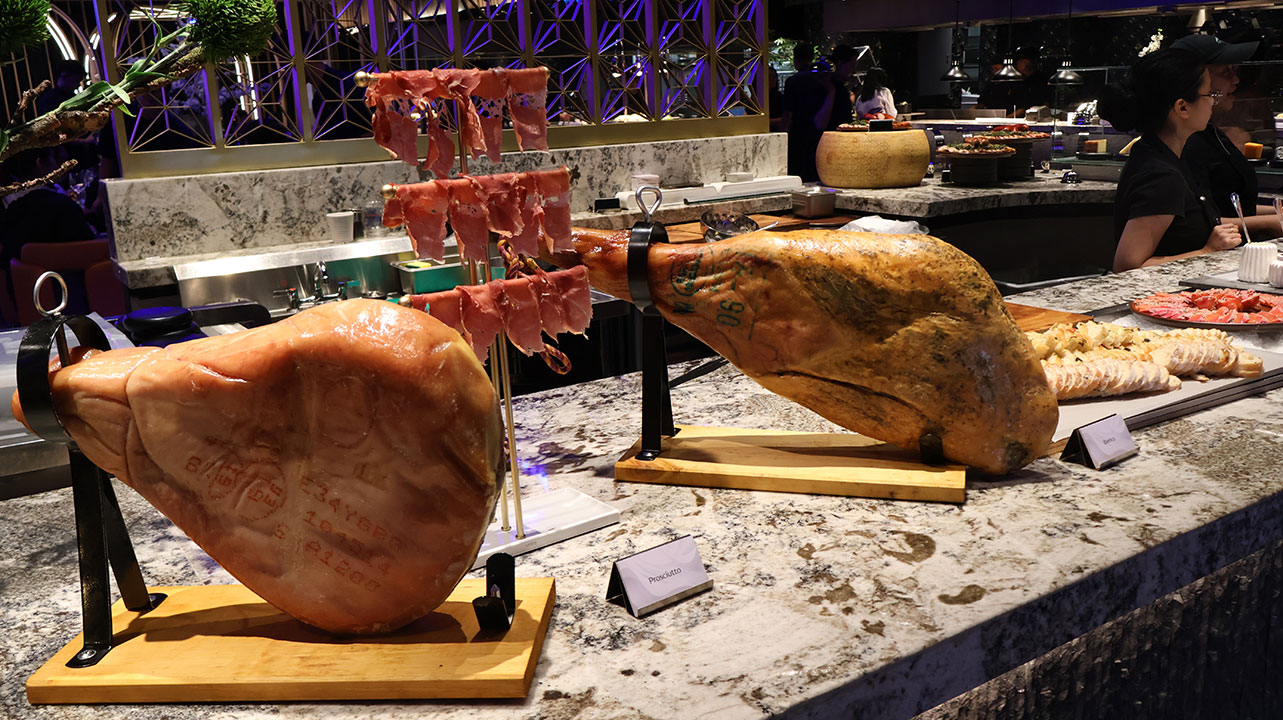
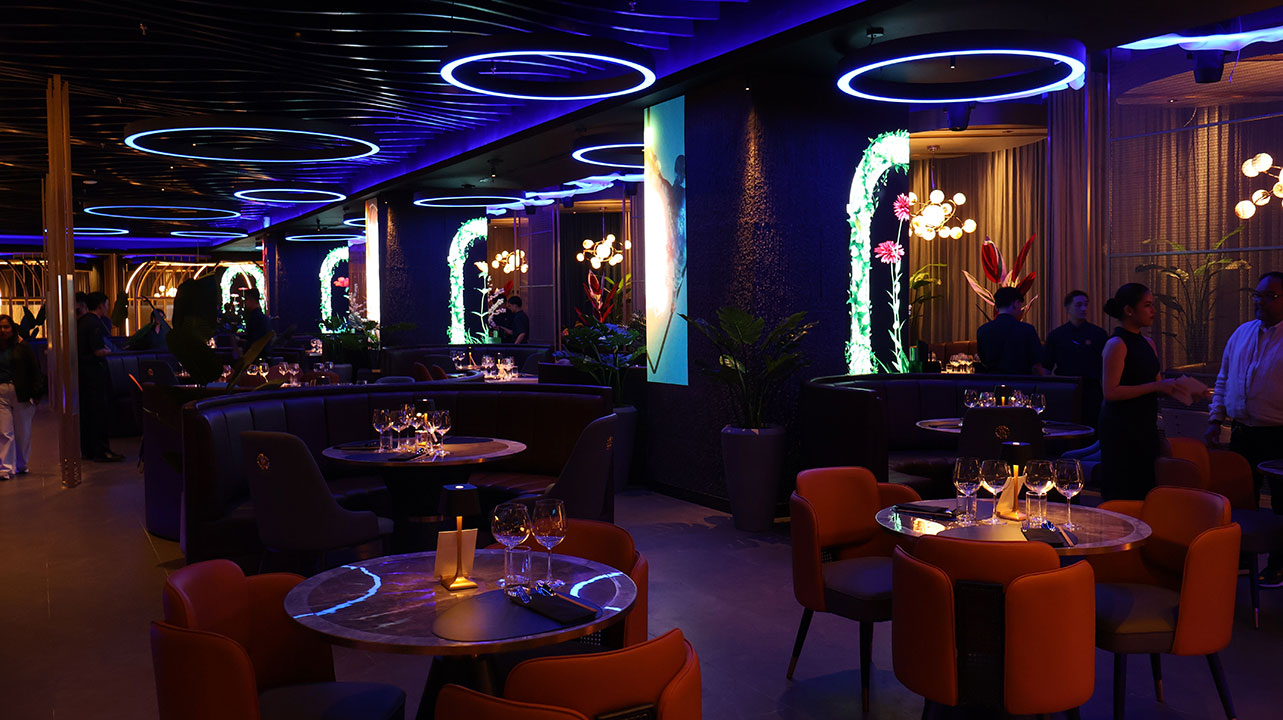
Named after the Greek goddess of the night, the One Ayala restaurant is appropriately sumptuous. On its Feb. 3 preview for its Feb. 4 opening, we saw silver chain mail hanging from the ceiling, stone floors, comfortable private rooms, mood lighting, a lounge singer, free-flowing wine, and, of course, an all-you-can-eat buffet. All of this is in a space of almost 2,000 square meters. which seats 450 people.

It’s a little bit different from other outlets of the Vikings Group (such as its other buffet concepts: Vikings, the slightly upscale Niu, and the more budget-friendly The Alley). Instead of piling on your food on plates like there’s no tomorrow, one heads to a station and points at one’s choice, which they then place in tiny plates and bites reminiscent of degustation offerings. You can either wait for them to finish plating up, or drop off your orders and wait for them at your table.

FIRST DAY JITTERS?
Therein lies the growing pains in this specific new growth: during our experience, it felt like we had to wait forever for our plates to come, and a few sprinklings of flowers and smears of sauce weren’t going to make up for it. That, and we’d finish our bite in seconds, making us wait several minutes more for our next bite.

We were offered their best: foie gras, pasta with scallops and a sprinkling of caviar, and Beef Wellington, among other treats. We clock this up to a career of good meals, but some of the other guests at our table left their offerings untouched: one complained that their free-flowing wine was not at the right temperature; another complained that his Beef Wellington had bacon instead of prosciutto (or some such complaint). Another left behind her bite of foie gras because it wasn’t seared enough. We tried our best not to voice the same complaints (saving that for the time difference between bites), but we will say that we found some of the sashimi a bit too chewy, and our lobster tasting a bit muddy. We suppose if you’re paying more than P3,000 for a meal, not to mention knowing the amount of experience of our hosts, expectations would be very high.

We did like the Italian station (spooning oxtail ravioli with the rich broth didn’t take that long), the noodle station (the duck noodles were excellent), and the carving station (our lamb and our steak were great, if a little bit thin, but we’re docking points for the horseradish sauce which lacked a kick). We give plus points for having food not normally found at buffets (who has the time to fold all that ravioli?). We offer them the grace of first-day jitters, and, well, years of experience backing up the other guests tasting their offerings.

Besides, Charles Lee — second generation of the restaurateur family and independent director of the Vikings Group — acknowledges these growing pains, and promises to make it better for the public. “We have noticed it. We just opened, so we’re sort of in a soft opening stage,” he told BusinessWorld in an interview. “We will fix it. We will add manpower if we have to; we will work on the system. We will change what we have to change. ’Di namin titipirin ’yon (we won’t skimp on that).”

The plan was to change the idea of a buffet from a place to get full into a true experience. “Buffets have been the same for many years,” he said. “What we’re trying to do here is changing the experience.

“We’re trying to make a hybrid between fine dining and buffets,” he said. “We want people to stay as long as possible here… eat as much as you want; drink as much as you can.”

In exploring this new direction, he takes off from changes they’ve seen in what diners want. “We’ve seen how they have been hungry for new things. Not just new flavors and new tastes, but newer experiences.”

THE BUFFET MODEL
When they first opened 13 years ago, they hit a winning formula with Vikings, enabling them to open the buffet restaurants across the nation. Now, they have about 20 eateries under their name, and a lot of them have unlimited dining offers. All of the restaurants are branded with the Vikings name, of course, but then they also have Taishu Yakiniku, Sam Stew, and Tong Yang (acquired from previous owners), among others. “People in the Philippines are always about value,” said Mr. Lee, who noted that unlimited deals are popular here because Filipinos will always try to maximize that value. “If the value is there, and they see they can maximize it, game.”

They’re still playing in the fine dining and a la carte game though: found in Viking’s roster is Lore, in partnership with celebrity chef Myke “Tatung” Sarthou, and Putien, a franchise from Singapore, among others. Recently, they have opened two new franchise: Ikoka Yakitori and Ramen Ibuki, both in BGC, both from Japan. The plan is to open a total of five (that makes three more) Japanese concepts, some of them with Michelin Bib Gourmand recognitions in their home country (such as Ikoka).

Mr. Lee talked about the differences between the challenges of running a buffet and a la carte dining. In a la carte dining, the volumes are lower, in terms of people and inventory. “What’s challenging is you’re limited to the menu and the cuisine that you’re given. If people don’t like it, then that’s it.

“Buffet, at the end of the day, will always be very challenging because of the sheer value of people.” That’s customers and manpower both, but another challenge he cites is always having to know what the diner wants. “How do we know that people like the food that’s being served in the entire line? You need to manage that. If you don’t manage that, you’re going to have so much wastage.” — Joseph L. Garcia

SEC standardizes OPC reporting, bond, and financial penalties

STOCK PHOTO | Image by DC Studio from Freepik

THE SECURITIES and Exchange Commission (SEC) has issued a memorandum circular that aims to ensure consistent enforcement for one-person corporations (OPCs) under the Revised Corporation Code.

While SEC had previously imposed fines for late filings under earlier circulars, Memorandum Circular (MC) No. 10, Series of 2026, standardizes and specifies penalties, deadlines, and bond obligations for all registered OPCs.

OPCs must submit a Form for Appointment of Officers (FAO) within 20 days of receiving their certificate of incorporation for initial roles such as treasurer and corporate secretary.

“Failure to comply with the initial appointment and timely submission of the FAO shall result in a one-time penalty of P10,000,” the MC read.

For subsequent officer appointments, OPCs must file the FAO within five days, with graduated fines ranging from P5,000 for the first offense to P9,000 for the fifth offense.

OPCs are required to submit financial statements within 120 days after fiscal yearend, in line with existing circulars and memorandum orders.

Starting with fiscal years after Dec. 31, 2025, audits are required only for OPCs with assets or liabilities exceeding P3 million. Companies must also disclose self-dealings and include auditor comments.

The Commission noted that substantial disclosure in the Notes to Audited Financial Statement (AFS) may waive those requirements, but all registered OPCs must still file their latest due Audited or Unaudited Financial Statements for monitoring and fine/penalty computation.

OPCs where the single stockholder acts as treasurer must post a surety, cash, or property bond equivalent to the authorized capital stock — from P1 million for stocks up to P1 million, to full capital matching above P5 million.

“For property bonds, the same must be duly annotated on the corresponding certificate of title to ensure enforceability against the property. A certified copy of the title with annotation shall be submitted to the Commission,” the MC noted.

“The OPC must secure its bond from a reputable insurance company, which must be duly registered with and conforms with the prescribed format set forth by the Insurance Commission,” it added.

The bond is due within 30 days of appointment, renewed every two years alongside a P5,000 custodian fee, with non-compliance triggering base fines of P10,000 plus monthly surcharges from P500 to P1,500 per violation.

Appointing a non-stockholder treasurer eliminates the bond requirement and allows release via a notarized affidavit confirming no harm to creditors. The Commission will determine if the filed FAO substantially complies before approving and processing the bond release request.

“In case of approval, the Commission shall direct the release of bond and transmit the released bond to the OPC through the Financial Management Department (FMD) or through the respective processing EOs. In case of disapproval, the OPC shall comply with the requirements as may be ordered by the Commission,” it added.

Existing OPCs without officer appointment filings have 30 days after the circular’s effectiveness to post required bonds or face fines. Those with bonds must confirm they are valid. OPCs previously monitored for delays but unpenalized must pay P5,000 to reset their record, treating future violations as first offenses. Pending monitoring applications under old rules are voided, requiring new filings under MC 10.

The circular amends earlier rules, such as SEC MC No. 6 of 2024 on financial penalties, and extends 2019 OPC frameworks to promote uniform enforcement amid rising OPC formations. — Alexandria Grace C. Magno

ADVERTISEMENT
ADVERTISEMENT